Search
Showing 10 of 540 results for group registration
-
Advertising opportunity for Japan’s 2025 New Zealand Study Guidebook
The KBUNSHA New Zealand Study Guidebook is a trusted publication and is the only one of its kind supported by the New Zealand Embassy in Tokyo and Education New Zealand Manapou ki te Ao (ENZ). KBUNSHA distributes 20,000 copies of the study guidebook to Japanese schools, universities and education organisations as well as education fairs and seminars.
ENZ Business Development Manager – Japan, Tomomi Kontani said advertising here is a great opportunity to leverage an increased demand for information on New Zealand’s education offering.
“We are continuing to see significant interest in New Zealand as an education destination from students and their parents, schools, and education agents here in Japan” she said.
“This is a great opportunity to showcase what makes New Zealand unique, especially in the regions. Destination marketing plays a key role in student attraction for a market like Japan with a tourism focus,” Tomomi added.
The guidebook’s last edition was distributed at the annual student fair and stakeholder focus events hosted by ENZ Japan. The events attracted around 1,000 people. The guidebook remains the main information source ENZ refers to and distributes at upcoming events in 2025.
Advertisement rates for individual providers range from approx. $2,560 NZD to $6,120 NZD for guidebook and or website listings. With the ‘Premier Plan’ and ‘Advertorial Plan’, the school logo will be listed on the new scholarship campaign page built by KBUNSHA. Individual providers can download the proposal here. Advertising copy can be provided in English.
For regional groups, download the proposal here for further details on the guidebook and pricing (approx. $2,200 NZD for a two-page colour advertisement and $3,300 NZD for a four-page colour advertisement).
Bookings must be made by 27 June 2025 directly with KBUNSHA. For more information, visit the KBUNSHA website here. The 2024 guidebook can be viewed here.
KBUNSHA contact:
Minori Takahashi (Director)
Tel: +81-3-3234-1744
Email: minori@kbunsha.com
-
Caroline plays her part in Christchurch rebuild
But she is now a qualified quantity surveyor as comfortable working on building sites as she is back in the office crunching the numbers.
Caroline says it is not a profession she would have contemplated in China, where she grew up, but Christchurch’s rebuild inspired her to pursue a career in the construction industry and she is grateful for the freedom to be able to achieve her ambitions.
“It has been very rewarding to be part of the rebuild and to see the changes in the city. Bettabuilt, the company I work for, specialises in school rebuilds. When we finish a new school, you feel like you’ve done something you should be really proud of.”
And her parents are proud too. They have backed her career choice and know that the bold decision they made to send their only child to New Zealand for education was the right one.

New Zealand a safe place to study
Caroline says they had travelled widely as a family before making the decision that she would come to Burnside High School Te Kura o Waimairi-iri in Year 11. “They wanted me to be open-minded and take on new experiences and cultures,” she says. “They decided it would be good for me to study in another country with a different culture and chose New Zealand because it was a peaceful and safe country.”
Before she arrived, Caroline was set up with a “buddy”, a student from her school in Beijing who was already studying here and helped provide insights into life in New Zealand. She also took an online course prepared for international students.
“This made me feel more confident and familiar with what I was coming to which was important, because the culture and environment is quite different from my home country.”
But there were still some big adjustments to be made when it came to schooling. “All courses in China are set by the Education Department. In New Zealand, you have freedom to choose your own courses,” she says. “At first, I was a bit overwhelmed by the options available to me because I didn’t know exactly what I should take. But it was good that I had the opportunity to try courses that I was interested in.”
She also had to get used to a self-directed approach to learning. “It allows you to study in a way which suits you best, which was positive for me. And it means when you start work you have the ability and discipline to study by yourself. I have used methods I learned in high school and university to build my knowledge in the workplace.”
With more free time in her life, Caroline had the opportunity to play sport and even take on a part-time job which she says would not have been possible in Beijing. “That job really helped me because I got to practice English and gain more confidence talking to local people.”
New career opportunities
It was all part of an international education experience which Caroline believes is about much more than study.
“When you’re an international student, you quickly acquire life skills and become much more independent.
You also learn about other cultures because you are mixing with people from many different backgrounds. It was quite an eye-opener for me, but I enjoyed it.”

Once she determined her career choice, Caroline chose Ara Institute of Canterbury as the next step on her education pathway. Starting with a Diploma in Quantity Surveying, she followed it up with a Bachelor of Construction. Job and internship opportunities were regularly shared by their programme leader, illustrating the close ties with business.
The decision to study in New Zealand has taken Caroline on a journey she couldn’t have imagined when she arrived. “In China I would not be working in construction. I would probably have been working in finance or management,” she says. “The environment here changed me and gave me career options I would not have considered at home.”
In the past few months Caroline has secured residency and bought her first house, giving her a real sense of belonging. “I enjoy my work and my life in New Zealand. I love Christchurch and I’m proud to be contributing to the rebuild of the city.”
“I feel really happy that I came here.”
-
Pakistani student leverages language skills to connect communities
Fluent in Punjabi, Urdu, and English, and passionate about community service, Usma soon became a key player working to support and connect ethnic communities in Christchurch.
So extensive have her achievements been, that she has been honoured by the university with a coveted Blues Award for community engagement, and by the Christchurch City Council with a Civic Award.
Usma arrived in New Zealand in late 2016 and gave birth to her third child shortly after arriving. “It gave me the time I needed to assess society here, and I realised the value that was placed on volunteer work.”
New Zealand values transferable skills
“My background was in teaching and ESOL (English for Speakers of Other Languages) instruction. I did teach here when I first arrived, but it was not fulfilling enough,” she says. “I needed to think what other skills I had to offer in an area of work I was passionate about. New Zealand is not a destination of degrees, it is a destination of skills, where whatever transferable skills you have to offer, are valued.”
She initially got involved in UC’s Pakistani Student Association, planning events which quickly extended beyond the student community. “I got great feedback from the wider community and different ethnic groups started coming along. People from these communities were looking for connectivity and involvement and it ended up being a multi-cultural hub.”
She admits it was not without challenges, but she was determined. “I was an international student, a woman, a mother of a special needs child, and I was working. But I managed my time. I enjoy doing volunteer work and it comes naturally.”
In her second year at Uni, she secured a role as a Diversity and Engagement Officer with the Ministry of Ethnic Communities and juggled both study and work. It was in this role that she became involved in the Government response following the Christchurch mosque attack in 2019.
Frontline worker following mosque attack
“I was one of the frontline workers dealing with victims and those left behind. Some of my colleagues were victims,” she says. “It was a difficult time. I had never had any exposure to such an event, or what the aftermath might be like. Hearing the stories, and being part of it, are totally different things.”
“I’m very proud of my work and found it very rewarding. I discovered my strengths and weaknesses and learned how much I had to offer. I could speak with many of the widows in the Muslim community in their own language, understand their needs, and advocate on their behalf. I learned how to deliver the key messages to the government agencies involved in the response and formed a link between the two groups.”
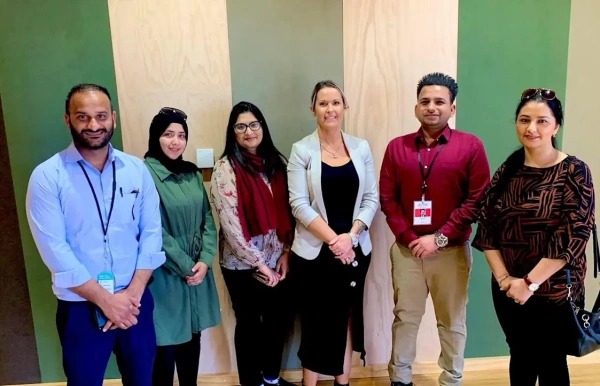
“The migrant communities have so much resilience and I believe that every disaster brings opportunity to come together, to heal, and to grow.”
Usma went on to become involved in Widows of Shuhada – an eight-part Plains FM/RNZ podcast documentary series which followed the journey of four widows following the attack.
Soon after, Covid-19 arrived in New Zealand and Usma worked on engagement with local ethnic communities, translating the Government’s messages and communicating them through a range of digital channels.
Tapping into the skills of international students
But she didn’t stop there. Usma was also influential in Christchurch’s Ethnic Communities Skills Build Programme, a project designed to smooth the pathway of migrants and international students into employment in New Zealand.
International students could join in workshops, meet career counsellors and job brokers from the Ministry of Social Development, reshape their CVs, and attend job fairs.
“I believe we need to tap into the high-level skills of post-graduate international students. We need to progress them in the right direction, utilising their skills in science, technology, and innovation.”
As for her own career, Usma could not be happier. She has secured a full-time role as a policy analyst at the Ministry of Primary Industries in Wellington and has taken a step back from her volunteer work to focus on completing her PhD this year.
She is grateful for the opportunity to study in New Zealand and to bring her family with her. Her husband is working, her children are happy, and her special needs daughter has opportunities she wouldn’t have had in Pakistan.
Usma still acts as a mentor for international students and tells them if they are to make the most of their time in New Zealand, they should “think outside the box”.
“They should think about the skills they have to offer in the community, and they will be rewarded with a transformative experience. Leaving behind the social constraints of your home country can be liberating. It’s all about following your dream.”
Usma says she’s already landed her dream job, but she plans to continue her community work once she has completed her PhD.“I believe it is my contribution to this country and I love doing it. I’m not likely to stop. I’m just settling in, finishing my PhD, and getting ready for something big. I have ambitious plans.”
-
Southern Institute of Technology cultural education exchange introduces Aotearoa to Kansas
When Covid hit, the Southern Institute of Technology (SIT) knew that it was well placed to engage with its students digitally, as it already had a well-established distance learning faculty. The next move was to look at how that capability could be used for international education.
Using distance learning for cultural education internationally
Beyond widening its offering of fees-based online courses, SIT understood the value of establishing cultural exchanges which would engage current learners and potentially generate interest from future learners, says Study Abroad and Partnership Officer Whitney Irwin. She worked in collaboration with the School of Business faculty to set up the cultural exchange between SIT students and those at Johnson County Community College (JCCC) in Kansas, USA. “Being able to create buy-in and have a motivated faculty to get partnership projects across the line is the key to success. SIT has a wonderful culture, and we have all worked together to reorientate our international strategy for the greater good of SIT and our wider community.”
Experiencing New Zealand Life from afar
Twenty-five JCCC Economics students asked to be involved out of a class of sixty, reflecting a desire to learn about far-flung New Zealand, meet global peers and to try something new. From SIT, 23 Management students and 28 Communications students took part, with both groups of students using the interactions to produce assessed work.
“Our aim was to allow US students to see New Zealand life and get a taste of who we are, what we do, and how do we do it, with the bonus that it could also lead to the opening of doors for students to visit New Zealand, and vice versa,” says tutor Selena Coburn.
Using Zoom, Snapchat, and Instagram, students interviewed each other to learn about our different cultures, looking at differences in communication, lifestyle, politics, and making economic comparisons. Minimum wage, average house prices, and everyday living costs were compared, what the US and NZ dollar bought, and who was actually better off overall.
They learned about New Zealand’s response to the Covid-19 pandemic, rural life, Māori culture, the filming of the Lord of the Rings film trilogy, our outdoors lifestyle, and our connections with Australia. They also explored more personal subjects - relationships, music preferences, religious beliefs, parental expectations, and what they did in their spare time.
“The Kansas students now have a real sense of the kind of people we are,” Ms Coburn says.
Creating opportunities with a cultural education exchange
Digital collaboration also presents an opportunity for students, both in New Zealand and offshore, who could never afford to travel or would be uncomfortable leaving their home country, to still experience the cultural exchange which international education offers,” Ms Irwin says.
“It builds confidence and familiarity with a destination such as New Zealand which may encourage the students to travel here for study later on.”
And this has proved to be the case, with six Kansas students already saying they are keen to come to New Zealand.
“All going well, the intention is to host JCCC students here at SIT in 2023.” Ms Irwin says she expects the changes in the ways education is being delivered will continue well into the post-Covid environment.
“Virtual exchanges are a fantastic collaboration of ideas, which can lead on to the development of other educational products and services.”
-
New Zealand education fair caps off busy season of engagement in Thailand
The New Zealand Education Fair 2025 at Samyan Mitrtown Hall attracted over 2,500 registrations and welcomed 1,763 visitors – a 20% increase from the previous year.
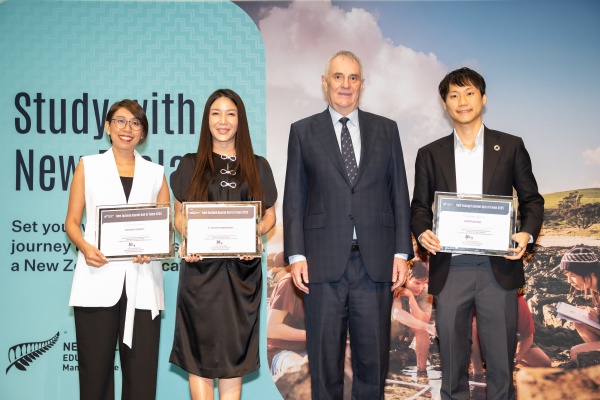
New Zealand Ambassador to Thailand HE Jonathan Kings (pictured second from left) alongside Thai alumni of New Zealand (from L to R) Dr. Arisarawan Tanasinsiri, Dr Teerawan Vanadurongwan and Jirayut Srupsrisopa.
The event gave Thai prospective students and their families a chance to meet with providers from across New Zealand’s secondary, tertiary, and English language sectors. Attendees also heard directly from New Zealand Ambassador to Thailand, Jonathan Kings, along with three accomplished Thai alumni of New Zealand institutions.
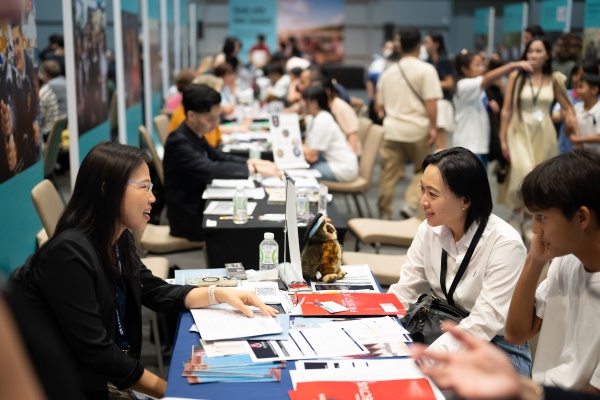
Prospective students and their parents exploring New Zealand’s education offerings.
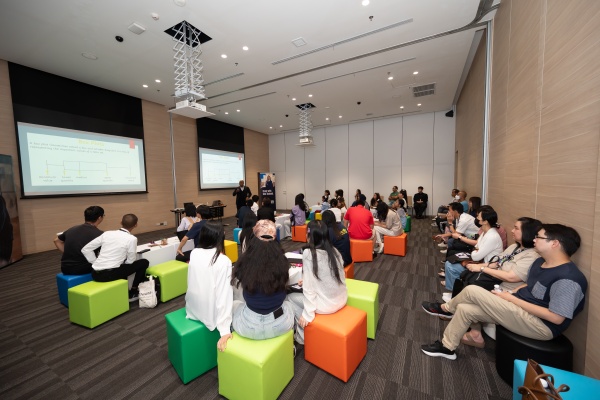
Attendees of one of the five simulated New Zealand classroom sessions.
The fair featured five simulated classrooms, offering hands-on experiences of New Zealand’s innovative, student-centred teaching style.
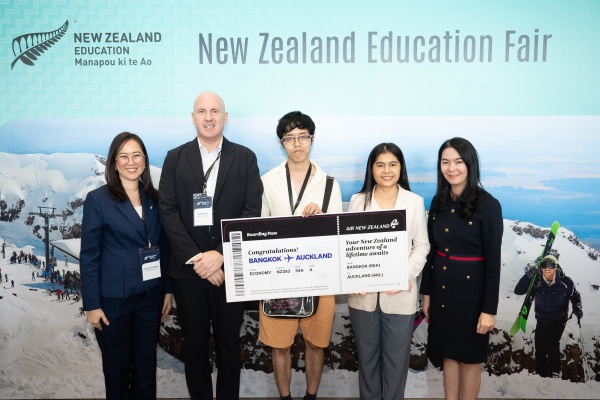
Awardee of the lucky draw air ticket campaign (pictured centre) alongside (from L to R) ENZ Market Manager Chor Pramoolpol, ENZ Regional Director Ben Burrowes, Kanchana Jangjaroen, Account Manager from Air New Zealand and ENZ Programme Manager Jaruwan Pongjaruwat.
A popular initiative at the fair was the “Apply Now, Fly Free” campaign, where 39 New Zealand institutions collectively offered an air fare scholarship to students applying at the fair. A wide range of scholarships and study opportunities were also showcased.
Further activity in Chonburi, Bangkok, Chachoengsao and Chiang Mai
To build on the momentum of the fair, ENZ organised a roadshow to more than 15 schools across Chonburi, Bangkok, Chachoengsao, and Chiang Mai, engaging directly with students, parents, and school counsellors.
The agent seminar, held alongside the fair, brought together more than 100 education agents who received a market update from ENZ and other New Zealand government agencies on New Zealand’s education policies and programmes and networked with participating New Zealand providers.
Beyond Bangkok, New Zealand institutions extended their reach through agent-led mini fairs in Chiang Mai and Chonburi on 31 August, hosted by education agencies A&T New Zealand Centre and Infogroup Education, respectively. These events helped connect Thai regional audiences with New Zealand education opportunities.
Strategic partnerships between New Zealand and Thailand were also strengthened during the fair week, with a Memorandum of Understanding signed between Assumption College and seven New Zealand secondary schools.
ENZ Programme Manager for Thailand, Jaruwan Pongjaruwat, said the energy and enthusiasm from prospective students and their parents across the events was heartening.
“This year’s fair and roadshow was a powerful demonstration of the growing interest in New Zealand education among Thai students and their families,” she said.
“We’re proud to work alongside our New Zealand provider partners and Thai agents to create meaningful pathways for students. These events are not just about recruitment — they’re about building long-term relationships and trust,” Jaruwan added.
Post-fair engagements continued in Chiang Mai, where ENZ held sessions with school counsellors and directors to explore collaboration opportunities. A dedicated agent function in early September further reinforced the important role that Thai education agents play in supporting student recruitment.
ENZ then joined a school roadshow in Udon Thani and Khon Kaen, promoting New Zealand education alongside a school cluster from Auckland and Nelson. The team visited three schools, engaging over 400 students with presentations on New Zealand’s secondary education system, and hosted a seminar in Khon Kaen for prospective students and their families.
-
Get involved in the next Korea–New Zealand Digital School Exchange Programme
Programme information
-
Number of New Zealand schools selected: Up to 10.
-
Who can apply: Schools with students in Year 7-9.
-
Number of participating students per session: 20-25 (Korean schools typically involve a full class of 20-25 students per exchange session. If a New Zealand school wishes to include more than 25 students, they can form multiple groups of around 20 students each to participate separately.)
-
Exchange period: Four, one-hour Zoom sessions held weekly from Monday 11 May 2026 to Monday 8 June 2026.
-
Exchange times: To accommodate both time zones, exchange sessions will be scheduled between 12:00-3:00pm NZT.
-
Participation fee: Free of charge.
Why join?
-
Promote your school to a South Korean audience for free
-
Showcase New Zealand’s unique education environment and culture
-
Engage your students in a hybrid STEM and cultural exchange
-
No added work to your teaching load - LEL takes care of all the admin and logistics, allowing you to simply show up with your classroom and enjoy the global learning experience
Teachers in previous rounds praised the programme for its smooth delivery and the enthusiasm it sparked in their classrooms.
Check out the story from the previous programme: New Zealand – Korea digital student exchange » Education NZ
How it works
ENZ and Seoul MOE work closely with Learn English Live (LEL), who will:
-
Coordinate all communication with New Zealand schools.
-
Match exchange times with Korean schools and New Zealand schools.
-
Provide pre-training for New Zealand teachers and students.
-
Facilitate sessions using topics tailored for digital exchanges ranging from culture & language sharing, United Nation SDG projects, STEM learning, global citizenship and much more.
In previous programmes, NZ teachers appreciated not having to prepare or run the sessions themselves—LEL takes care of everything.
Is this right for your school?
This programme is a great fit for schools that:
-
Are looking to build long-term sister-school relationships with Korean schools, especially through social studies, cultural/global studies, languages or global citizenship education.
-
See value in soft marketing opportunities, promoting their school in Korea in a meaningful, low-pressure and no cost way, and are interested in attracting potential international students over the long term.
Application timeline
-
Applications close: Friday 12 December 2025 11:59pm
-
Selection process: 15 – 16 December
-
Notification of outcome: Wednesday 17 December
-
Next steps: From April 2026, selected schools will be contacted by LEL with a detailed guide
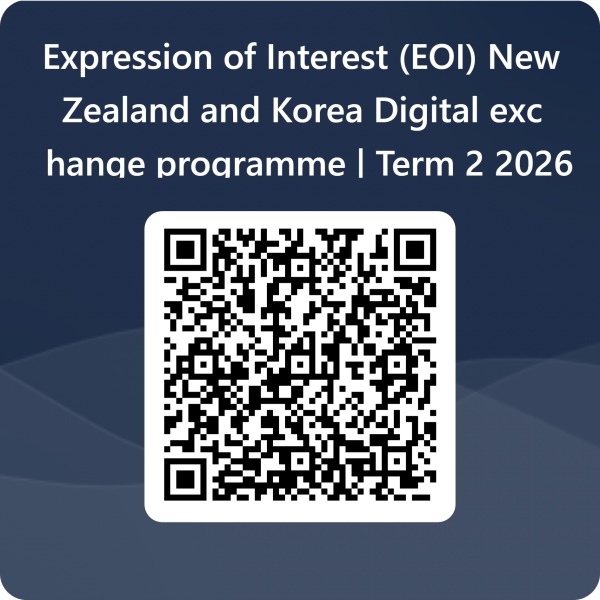
If you wish to apply for this programme, please fill out the Expression of Interest (EOI) here or scan the QRCode below.
If you have any questions, please contact ENZ (Alana Pellow ) or Learn English Live (William Clarke ).
Background
ENZ has partnered with the Seoul Metropolitan Office of Education (Seoul MOE) to run digital classroom exchanges since 2021 with ENZ education technology partner Learn English Live (LEL) . These exchanges have created meaningful connections between students, teachers, and schools in both countries. NZ students have had the opportunity to connect with their Korean peers, build global friendships, and experience cross-cultural learning—all from their own classrooms.
-
-
South Korea event series highlights growing interest in New Zealand
New Zealand Education Fair in Korea draws strong interest
The New Zealand Education Fair in Seoul brought together 40 New Zealand schools and institutions, offering students and parents the chance to explore study opportunities directly with representatives.
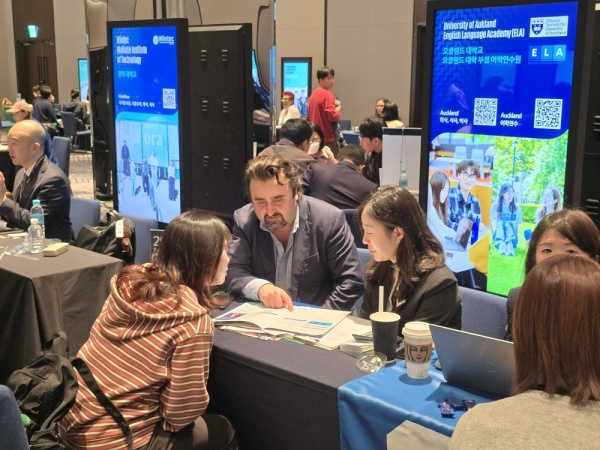
Representatives from University of Auckland English Academy showcasing study options available to prospective students and their parents at the New Zealand Education Fair.
The event attracted 2,100 pre-registrations, with 900 participants attending on the day, underscoring the strong demand for New Zealand education pathways. Families engaged in one-to-one consultations, gaining tailored advice on study options, English preparation, and scholarship opportunities.
During the fair, alumni speakers were invited to share their personal journeys and provide guidance to attendees. They spoke about effective English study strategies before departure, practical approaches to a family “one-year living in New Zealand” experience, and the pathways from New Zealand study to admission into leading universities.
Strong interest in primary education
The fair confirmed a notable shift in interest, with Korean families showing particularly strong enthusiasm for primary education opportunities in New Zealand.
Many families expressed interest in spending at least a year in New Zealand with their young children, allowing them to experience the country’s safe and nurturing education environment first-hand. This reflects a growing trend in Korea towards family-based study abroad and “one-year living overseas” experiences.
Expanding interest in New Zealand education
While in Korea, New Zealand schools took part in the Agent Seminar and one-to-one meetings attended by 51 Korean education agency representatives. There was notable participation from agencies not specialising solely in New Zealand, who are now increasingly considering it a key English-speaking study destination to promote.
The event also provided a valuable opportunity for active engagement between New Zealand education providers and agents, followed by the New Zealand Education Night Reception at the official residence of New Zealand’s Ambassador to South Korea, H.E Dawn Bennet. There, deeper exchanges were held with Korean government officials, education stakeholders, and agency representatives.
Positive feedback from schools and families
New Zealand schools noted the high level of engagement and the quality of conversations with Korean students and their families at the New Zealand Education Fair. Attendees also shared positive feedback, commenting on the value of direct consultations with New Zealand education providers.
The Korea fair followed ENZ-led events in Thailand, Japan, and Vietnam, and marked the final stop in this season’s dedicated New Zealand education fairs across Asia. Together, these events have strengthened New Zealand’s connections with families across the region and reinforced the country’s reputation as a world-class study destination.
ENZ’s Senior Market Development Manager based in Seoul, Kay Lee, said the fair was a valuable platform to not only promote a New Zealand education, but gather insights too.
“It clearly showed how market trends and the expectations of Korean students and families are evolving,” she said.
“For students, it provided a strong understanding of the benefits of New Zealand’s education system, while for schools it was an invaluable opportunity to engage directly with highly interested families,” Kay added.
-
2026 New Zealand School Scholarships launched in Viet Nam
Education New Zealand Manapou ki te Ao (ENZ) launched the New Zealand Schools Scholarships (NZSS) 2026 programme, recording the highest level of participation since the programme’s inception in 2019.
A total of 56 New Zealand secondary schools and 55 Vietnamese education agents have participated in NZSS 2026, reflecting strong education provider and market confidence in the programme.
Launched on 5 January, the programme will have applications close on 22 March 2026, with 56 scholarships available across a diverse range of state, private, single-sex and co-educational schools, offering NCEA, Cambridge or IB curricula.
To grow awareness and interest in the scholarships and New Zealand’s school study options, ENZ delivered a series of New Zealand School Scholarships information sessions in collaboration with six education agencies and one partner school in Viet Nam. This was in addition to two public webinars livestreamed on a partner media fanpage.
ENZ also strengthened agent capability through a dedicated six-part webinar series for Vietnamese agents, delivered from 3-18 December 2025. The series featured 36 speakers from New Zealand secondary schools, NZQA and SIEBA, and focused on building agent knowledge of the New Zealand school system, regional school offerings, and NZSS promotion guidelines.
The agent webinar series attracted over 160 registrations, with 60-98 agents attending each session, indicating strong engagement across the market. The sessions were designed to equip agents with practical tools to confidently advise parents and students and to support consistent, accurate promotion of NZSS.
ENZ’s Market Manager – Viet Nam, Van Banh said these activities aim to provide prospective school students and their parents clear, consistent information about the NZSS programme and application process.
“With the programme’s record school participation this year, expanded market outreach, and a strong focus on education agent capability-building, NZSS 2026 is a significant step forward to strengthen awareness of New Zealand’s secondary education offering in Viet Nam and support its long-term, sustainable growth.
“It’s fantastic to see a sustained level of commitment and contribution from education providers for this programme, it really highlights the strategic value of the NZSS as a pathway programme to study in New Zealand and underlines the sector’s continued confidence in Viet Nam’s secondary school market,” Van said.
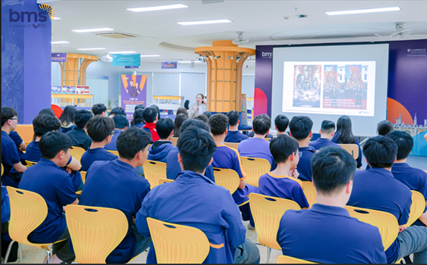
Above: Students from Ban Mai School (Ha Noi) attend a workshop about New Zealand education and opportunity with NZSS
Collectively, participating New Zealand schools have committed an estimated $441,702 NZD in scholarship investment, with each school offering a scholarship valued at 50 percent of the first-year tuition fee.
Since its first launch in 2019, NZSS has awarded nearly 80 scholarships, enabling Vietnamese students to access high-quality secondary education in New Zealand and progress to positive academic and career outcomes. Alumni achievements continue to reinforce NZSS’ reputation as one of the most established and impactful government-backed secondary school scholarship programmes in Viet Nam.
-
China transnational education policy update: What it means for New Zealand education providers
In early June, China’s Ministry of Education (China MOE) hosted its second Policy Briefing on China’s Opening-up in Education. This session followed the initial briefing held in September 2025, which was detailed in this update from Education New Zealand Manapou ki te Ao (China Insight: Transnational education update October 2025 | ENZ IntelliLab).
The briefing was led by the Director-General of the Department of International Cooperation and Exchanges. Crucially, China MOE used this senior-level platform to directly address widespread international concerns regarding policy continuity and stability.
The Director-General explicitly stated that China will not “slam on the brakes” on TNE partnerships in the coming years. Instead, Beijing views TNE as a core component of its strategy to become a world-leading education power by 2035, reassuring providers that the current open stance is built for the long term.
ENZ's Regional Director - Greater China, Dr Ron Xavier said understanding China MOE policies and how they guide and develop its international education priorities is crucial for New Zealand education providers.
“China remains New Zealand’s largest source for international students. Every year, up to 13,000 offshore Chinese students start their study with New Zealand providers as part of 81 transnational education partnerships. Understanding the essence of China's international education policies is important for New Zealand providers, as these settings continue to shape opportunities and expectations for transnational education partnerships between New Zealand and China,” Ron said.
For New Zealand providers – both those managing established programmes and those entering the market – the key takeaways sit across three main areas:
1. Regulatory predictability and market growth
Rather than a sudden tightening of controls, China MoE is shifting toward a more transparent, predictable, and streamlined regulatory environment.
· Faster approval tracks: In the first half of 2026 alone, China MoE approved 219 joint institutes and programmes – the highest level of approvals seen in over a decade. A policy change introduced in September 2025 is driving this momentum that locks in a strict decision-making timeline of 45 working days from application acceptance.
· The global and New Zealand footprint: As of 31 May 2026, China has over 1,700 approved degree-conferring joint programmes and institutes involving more than 1,100 overseas institutions. New Zealand providers are highly competitive in this stable framework, securing 15 of the 219 newly approved global partnerships.
· Codifying the rules: To cement these reforms into permanent structures, China MoE confirmed that a revision of the Regulations on Sino-Foreign Cooperation in Running Schools is actively underway, alongside the upcoming release of an official Guide to TNE Cooperation.
Regional growth pathways: As part of this stable expansion, China MoE highlighted strong, long-term demand from local governments in China’s central and western regions. Provinces with large populations and developing modern industries are actively seeking international partners, offering clear, secure opportunities for New Zealand providers looking to expand outside traditional coastal hubs.
2. Student demographics and sustained demand
To reassure providers that student demand will remain stable, China MoE linked its policy stance to clear demographic data:
· Near-term peak (now to 2035): Demand for higher education places remains intensely strong. Gaokao (College Entrance Exam) registrations rose from 12.45 million in 2025 to 12.90 million in 2026, ensuring a massive pool of prospective students for the next decade.
· Post-2035 demographic shift: While a dropping birth rate since 2017 means the college-aged population will fall sharply after 2035, the immediate focus for the next nine years is handling the current volume of students.
· “Internationalisation at home”: Rising global mobility costs and broader international uncertainties mean more Chinese families prefer high-quality, international education delivered domestically. This structural social shift ensures steady, long-term recruitment for robust TNE programmes.
3. Shifting from volume to quality control
China MoE made it clear that while the door remains wide open, it is no longer about numbers alone. Policy stability will be paired with active quality management:
· Normalised market exits: They noted that the closure of underperforming partnerships or those with low student recruitment is a normal, healthy part of managing a mature market. This ensures that high-quality, committed providers are protected from reputational risks caused by substandard programmes.
· Official partner-matching platform: To support stable, high-level pairings, China is building an official online platform to help domestic institutions find suitable international partners. The first phase will list the world’s top 1,000 ranked foreign institutions, with plans to expand access later.
What does this mean for New Zealand education providers?
To help the sector understand these regulatory shifts and the TNE landscape between New Zealand and China, ENZ’s China team is running a targeted webinar unpacking these policy updates. This session will benefit both experienced TNE managers and providers new to the market. Read more and register on the link below.
Webinar: Snapshot of transnational education between New Zealand and China
Join ENZ for a first sector-facing session on transnational education (TNE) trends, policy update, and an analysis of current TNE landscape between New Zealand and China, as well as what support Education New Zealand Manapou ki te Ao (ENZ) can offer to the sector.
Date: Friday, 31 July, 2-2.30pm New Zealand time (10-10.30 am Beijing time)
Presenters: ENZ Regional Director (Greater China), Ron Xavier, and Education Manager, Rosemary An
Why attend?
We are using this webinar as an opportunity to build broader sector awareness of TNE as an increasingly important tool for growing offshore enrolment, how well-structured TNE can contribute to expanding education access, generate revenue, build an international student pipeline and global brand awareness.
We are also keen to gather practical feedback and insights from education providers to guide how ENZ can support you in delivering in-market strategy through TNE collaboration.
Who should attend?
The webinar is primarily tertiary education sector focused.
For specific policy questions or to discuss your institution’s strategy in China, please contact the ENZ China Team at China.Enquiries@enz.govt.nz.
-
Go-to-market plans for 2026/27 priority markets launched
The plans cover our priority markets, grouped as grow, core or maintain markets. They set out where we will focus our promotional activity, which subsectors offer the strongest growth opportunities, and how we will use our resources to support New Zealand’s international education sector.
Plans are available for China, Germany, India, Indonesia, Japan, Malaysia, LATAM (Brazil, Chile and Colombia), the Philippines, South Korea, Sri Lanka, USA and Viet Nam.
Through these plans, we aim to give the sector a clearer view of our market priorities and help support a more coordinated approach to promotion offshore. They are designed to help New Zealand education providers understand market priorities, align their own planning where relevant, and identify opportunities to work with us.
The plans are available to New Zealand education providers with a MaiENZ login, alongside a range of other marketing resources.
Each plan includes a summary deck for the market. These summary decks are a useful starting point for understanding each market at a high level, including our approach and potential opportunities for sector collaboration.
The summary decks include:
- key performance indicators, including enrolment trends, visa approval rates, economic and demographic data, and future enrolment predictions
- analysis of the main opportunities and barriers in each market
- a calendar of key in-market activities – including opportunities for sector participation such as agent workshops, education fairs, and other collaboration opportunities.
Providers are strongly encouraged to familiarise themselves with the plans and use them to support their own planning.
If you have feedback or questions, please contact: sectorengagement@enz.govt.nz.
Access the go-to-market plans
- Go to the MaiENZ portal
- Sign in with your MaiENZ account
- From the MaiENZ dashboard, select 'visit IntelliLab'
- IntelliLab will open, giving you access to the available GTM plans
Note: Only New Zealand education providers can access the go-to-market plans.