Search
Showing 10 of 7292 results
- Internship Providers for PMSLA
- Map
-
Government announces International Education Going for Growth Plan
The Plan outlines an objective to double the international education sector’s economic contribution by 2034. This target has been set at $7.2 billion.
In the short term, the Plan will have Education New Zealand (ENZ) focus its promotional efforts on markets with the highest potential for growth while continuing to maintain New Zealand’s strong presence and reputation for high-quality education in other markets.
ENZ Chief Executive Amanda Malu says New Zealand reaps a broad range of economic, social and cultural benefits from having international students in our classrooms and communities.
“A New Zealand education experience transforms lives, creating lifelong connections between students and Aotearoa. International education fuels innovation, boosts our economy, creates business opportunities, and delivers essential cross-cultural skills for a more connected world. The International Education Going for Growth Plan brings to life a vision to grow New Zealand as the destination of choice for international students,” Ms Malu said.
The plan to grow the international student sector has three objectives:
1. raise awareness of New Zealand as a study destination from 40% in 2024, to 42% in 2027 and 44% by 2034.
2. grow student enrolments from 83,400 in 2024 to 105,000 in 2027 and 119,000 by 2034.
3. increase the proportion of prospective students rating NZ among their top three choices of study destination from 18% in 2024 to 20% in 2027 and 22% in 2034.
In November 2025, in-study work rights will increase from 20 to 25 hours per week for eligible student visa holders and in-study work rights will be extended to all tertiary students in approved exchange or Study Abroad programmes, including programmes one-semester long.
The Ministry of Business, Innovation and Employment (MBIE) will progress work on medium-term immigration actions under the Plan - design of a new short duration visa for some sub-degree qualifications not eligible for post-study work rights and ways to make it easier for students to apply for multi-year visas. MBIE will seek input and views from key stakeholders to inform the development of this work.
You can view the International Education Going for Growth Plan document here.
-
Following his own path – International student builds life, family, and community in New Zealand
Luke Qin has never been afraid of a challenge. Born in Sichuan, China, his childhood was a rich mix of classical Chinese literature, table tennis, badminton, basketball, football, and music.
Early intensive schooling means he can read, write, speak, think and dream in Chinese and draw on traditional Chinese virtues, but a desire to follow his own path, experience something new and explore education options overseas, led him to New Zealand as a high school student.
Selecting New Zealand was a relatively easy choice at the time – English-speaking, safe, ‘clean and green’ and affordable – it ticked all the necessary boxes. But his desire to test himself drew him to Christchurch because “fewer Chinese students there” meant he would have no choice but to fully immerse himself in the new environment.
And what an immersion it was. Luke credits his first years at Linwood High School as the perfect place to experience “an excellent introduction to the New Zealand way of life” and in his first year in New Zealand, he was playing on the wing for Linwood High School’s First XV rugby team!

“With a little help from All Black stars!” Luke tapped his rugby passion to enlist support for the Dragonboat Festival in Wellington from All Blacks Ardie Savea (left) and Dane Coles.
“I wasn’t very big and didn’t know the rules of the game when I arrived, but I had some wheels back then.” Luke explains. If it looked like trouble was coming my way, I’d just try to outrun it!” But he also knew he had to prove himself to his teammates. Once, while tackling his opposite wing, a strapping Samoan teammate joined in and sent them all to the ground. “I felt something hot dripping down my forehead but charged straight back into the ruck, only to be dragged off the field and sent to the hospital.” Three stitches later, he knew he had earned the respect of his teammates and become ‘one of the boys’.
Luke credits his school experience with developing his self-belief and preparing him for what was to come, through his university years and beyond.
After graduating with a Bachelor of Commerce from the University of Canterbury, he relocated to Wellington to join the banking industry, and completed a Master in Applied Finance from Victoria University of Wellington. He then continued on with his quest for lifelong learning and experience by achieving qualifications in Sustainable Finance, Te Reo Māori, Medical Co-Response, Citizen diplomacy and Urban Fire and Rescue, and volunteering for a number of causes.
His banking experience broadened, and several promotions later he joined Kiwibank in Auckland, leading the development of its International Strategy and Trade Finance offering, and working closely with NZ Inc partners to help New Zealand exporters and importers with risk mitigation and working capital funding.
Nowhere has his quest for a challenge been more evident than in his decision to become a volunteer firefighter 10 years ago.
“My younger self had been watching ‘Spiderman’ and saw Peter Parker leap into a burning building to save the day. At the time I thought, ‘I wonder if I could do that?’ Then I heard a call for volunteers from the NZ Fire Service on the radio while driving to work so decided to contact my local fire brigade in Seaview, Lower Hutt.”
“I thought I might be the first Asian volunteer in the station, but I was beaten to it by a Chinese lady.”
“The Fire Service is where you find the real New Zealand,” says Luke.
“Teachers, accountants, plumbers, builders, people from all walks of life - all bonded by the same commitment to serve their community. The camaraderie and environment was addictive.”
There, with the support of Fire and Emergency New Zealand, he completed the Sky Tower Stair Challenge with fellow firefighters from across the country to raise funds for Leukaemia and Blood Cancer New Zealand.
Scaling 1103 steps and 51 flights of stairs in full fire-fighting gear with a steel cylinder on his back was one of the most physical tests he has put himself through.
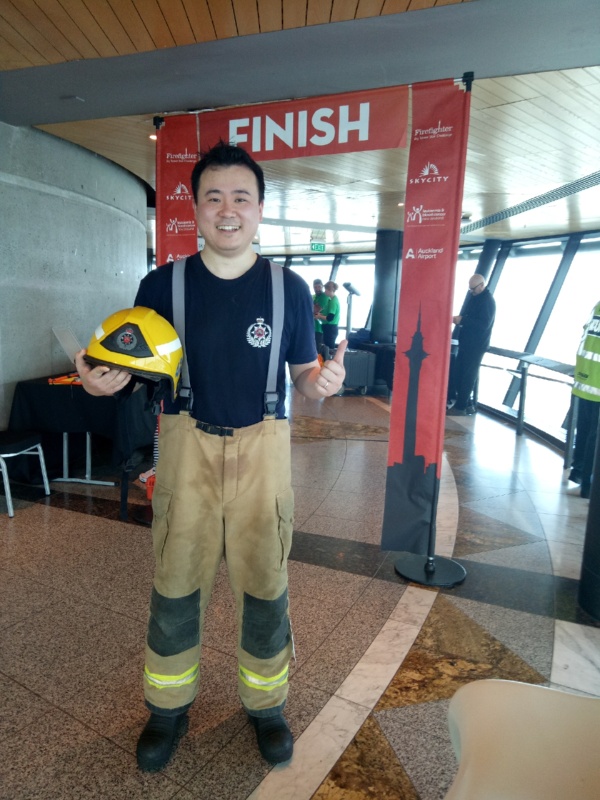
1,103 steps and 51 flights of stairs behind him, Luke was happy to complete the Sky Tower Stair Challenge - “Man of Steel” with other firefighters dressed in full gear with steel cylinders on their backs to raise funds for leukaemia and blood cancer in New Zealand.
“I have benefitted so much from all the opportunities and adventures since coming to New Zealand, especially from my volunteer roles. It’s a small way I could repay my second home for its kindness.”
“I hope I can encourage more international students and members of our diverse ethnic communities in New Zealand to become volunteers and join activities that benefit the community. There is so much we have to offer, and the reward in terms of friendships and life skills is amazing.”
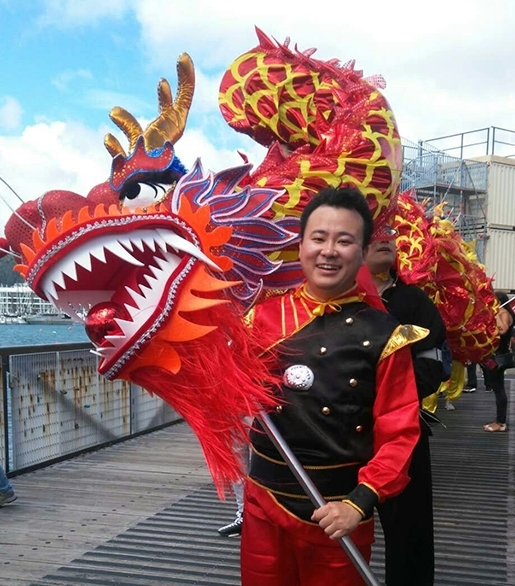
From Sichuan to Wellington waterfront, leading the Dragon Dance during Chinese New Year Parade.
Luke Qin’s journey as an international student began with a desire to immerse himself in a new environment. Grateful to his family, friends, colleagues, and mentors for the opportunities and adventures New Zealand has given him, he takes pride in being able to go home whichever way he travels between his ‘little shire’ in Sichuan and ‘Middle Earth’ New Zealand.
- IMG 20250308 WA0054
-
From the Chief Executive: Positive steps for international education
Initially focused on Asia, the Prime Minister’s scholarships started in 2013. Since then, more than 2,400 Kiwis have benefited from the experience of living in an Asian or Latin American country, developing personal connections, cultural understanding and global citizenship skills as well as gaining new perspectives in their chosen field of study. These scholarships are a great example of the two-way nature of international education – it’s about the opportunity for us as New Zealanders to learn, as well as for us to contribute.
Over the years the scholarships have evolved and this is set to continue in the future, following two recent wānanga with Māori partners. The first wānanga explored what ‘global citizenship’ means from a Māori world view. The second wānanga discussed the Prime Minister’s Scholarship programme, how to grow Māori participation in it, and how to support rangatahi through creating programme connections with iwi and the Māori economy, so the programme provides greater value for Māori. Alongside participants from a range of iwi and sector interests, representatives from the newly formed Kāhui Kaupapa also attended – Māori alumni of the Prime Minister’s Scholarships for Asia and Latin America. This work is part of ENZ’s long-term programme to build partnerships with iwi, Māori and Māori providers of education services, to transform the understanding of international education and ensure the education system delivers with, and for, Māori in the international context.
We have also made good progress with plans for inbound travel for international education this month. Universities are currently using our new portal system to nominate international students for their 1,450 places as part of the fourth cohort of 5,000 students. Working with the Ministry of Education, we are now assessing applications for places received from schools, PTEs and English language schools and will let them know their individual place allocations next week, so that they can start sending in their nominations, along with Te Pūkenga. Immigration New Zealand is due to begin processing the first formal requests for travel under this border exception by mid-April, in time for a mid-year study start.
In related news, travel from visa waiver countries such as Japan and South Korea has been brought forward two months and will now reopen from 2 May 2022. Students from these countries will be able to come to New Zealand for short courses of up to three months, which is good news for the sector, including English language schools.
While the borders were closed, online education offerings assumed a greater role. This sets us up well to continue to provide a more varied and resilient international education offering in the future. Phase two of a pilot programme to promote New Zealand-branded online education to the world starts in June and interested education providers are invited to a webinar on 31 March 2022 to find out more. This phase of the pilot will continue our partnership with FutureLearn, a well-established online platform with a significant global audience.
COVID-19 has affected our daily lives in many ways, including making virtual meetings the norm. When we held our regular peak body and regional gatherings last week, it was noticeable that a greater degree of formality tends to prevail online, and it’s much harder to get lively discussions underway. We really value and need to hear from our industry partners, and so I would welcome any suggestions for how we can make sure that these meetings enable robust discussion and exchange of ideas.
This month we welcomed Ziena Jalil to her first meeting as an ENZ Board member. Ziena was once an international student and is now an award-winning business and public sector leader, with 20 years’ experience working in New Zealand and Asia. Ziena brings enormous expertise in education, international relations and marketing, which will greatly benefit ENZ and the wider international education sector as we work to rebuild post-COVID.
This month we also published our 2020/21 Annual Report, which had been delayed by a shortage of auditors, related to COVID-19. The report is available on our website here and highlights the impacts of COVID-19 on the sector and our joint efforts to maintain an ongoing commitment to international education during this challenging period.
Okea Ururoatia! – Keep striving forward!
Grant McPherson
-
Priority international partners for ‘Team Christchurch’
Three priority areas have been identified: Guangdong Province in Southeast China; The United States West Coast – Washington (including sister city Seattle), Oregon and California; and South Korea (including sister city Songpa-gu). Australia is also identified as a key partner.
Education New Zealand Manapou ki te Ao is one of many organisations who contributed to the new strategy, alongside the city’s tertiary institutions, ChristchurchNZ, Ngāi Tahu, the Canterbury Employers’ Chamber of Commerce, Christchurch International Airport Limited, Lyttelton Port Company, The Asia New Zealand Foundation, the Ministry of Foreign Affairs and Trade, and New Zealand Trade and Enterprise.
“It’s exciting to see international education as part of such a well-integrated approach that will benefit Christchurch and the wider region,” says ENZ’s Business Development Manager, Andy Walker, who is based in Christchurch.
“Personal friendships, increased cultural understanding, community connections, language skills, positive working relationships, economic growth – international education has a huge amount to contribute to the future development of international relationships for Christchurch. The efforts of the different sectors involved are amplified when we work together, and at ENZ we are looking forward to supporting this work with our international teams.”
- Machu Picchu Peru2
- jason fox
- Massey in Colombia 2