Search
Showing 10 of 982 results for search for pheen4uuu from wiki 2025
-
Hawke's Bay pilots regional approach
This follows the development of an international education growth strategy for the region and is expected to achieve growth in the value of international students in the region – up to 25 percent by mid-2017.
ENZ Business Development Manager Mary Camp says, “The pilot is part of ENZ’s Regional Partnership Programme, and will deliver key outcomes from the strategic roadmaps developed by the international education industry in 2014. ENZ is committed to supporting the development and growth of international education in the regions of New Zealand.”
The funding is being used to create a role to implement the Hawkes Bay International Education Strategy. Stephanie Kennard has recently been appointed to that role, working alongside Vicki Berkahn who has led the project through the initial stages. Stephanie says, “The Education Hawke’s Bay initiative will provide schools and institutions alike with the ability to collaborate and create real growth. I am looking forward to working alongside the members and the fantastic institutions they represent.”
The first phase of the pilot will deliver activities including a Japanese agent tour, market research, the translation of marketing material and the set-up of a revenue monitoring framework. It will also scope the development of shared services such as management of value-added homestay packages and adventure education experiences.
Hastings District Council has taken a strong leadership role. Economic and Social Development Manager Steve Breen says, “Progressing the collaborative aspect of regional economic development is something where Hastings District Council can add value. International student attraction is a key project for our region’s economic development.”
Education Hawkes Bay anticipates the business model will be self-sustaining by the end of 2017. ENZ will share successful elements of the model in other regions.
-
Kiwi students attend Tokyo Experience School
Education New Zealand Manapou ki te Ao (ENZ) supports a range of international exchange programmes that, as well as attracting international students to New Zealand, also provide New Zealand students with the opportunity to have their own international education experiences overseas. These offer unique cross-cultural learning opportunities that develop our global citizens, serve to plant the seed for future overseas education experiences in our learners, while also promoting New Zealand’s education system on a global level.
One such programme is that organised by the Tokyo Metropolitan Board of Education (Tokyo MBoE), an Education Cooperation Partner of ENZ since 2017. The programme fosters education exchanges between New Zealand and Tokyo and each year, the Tokyo MBoE invites students to attend the Tokyo Experience School through an application process, promoted to secondary schools by ENZ. In 2023, Rangiora High School was selected by the Tokyo MBoE to send four students and one chaperone to Tokyo, joining other students from around the world for ten days in December.
Lachlan Palmer, SeungWoo Jeong, Ariana Ferguson and Oliver Burns are all studying Japanese at Rangiora High School, and were the fortunate students selected to attend on behalf of their school. The four students were accompanied by their school’s Teacher in Charge of Japanese, Jessica Bradley.
The experience proved to be a true immersion in Japanese culture and student life for the Rangiora High School Year 11-13 students with the students staying with local host families, travelling to school in rush hour, attending class and joining club activities such as chalk art, judo classes, and rugby training. The experience also gave students the opportunity to take part in several traditional experiences such as getting dressed in a kimono and attending Sado (tea ceremony).
All four students said that this Japanese exchange trip was one of the most interesting and valuable experiences they had every done and couldn’t wait to go back.
Lachlan said “The real highlight of this trip was with my host family and my time at school there. Seeing the differences and similarities between Japan and New Zealand in person allowed me to enjoy and learn about Japan in a way like no other and gave me the chance to share my own culture from New Zealand. It is safe to say I will be returning as soon as I can”.
One of Ariana’s favourite moments of the whole experience was trying on the kimono. She said "it was amazing to experience what it was like to wear, walk and feel in a Kimono and it is something I will never forget. I also loved meeting students in my class and not only learning about their likes/dislikes but sharing mine too and a New Zealand culture with them. They were so kind and welcoming, and I honestly can't wait to go back!”
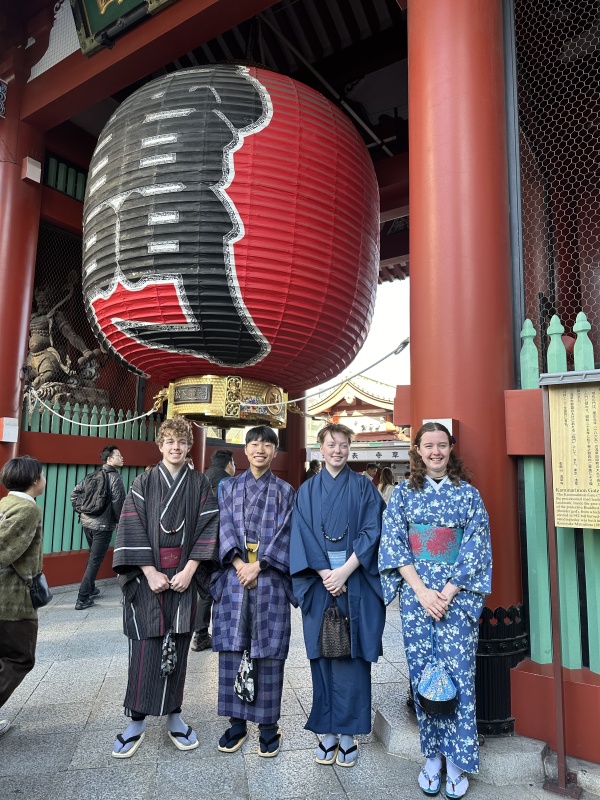
Ariana Ferguson with her travel companions; Lachlan Palmer, SeungWoo Jeong, and Oliver Burns, trying on traditional Japanese dress.
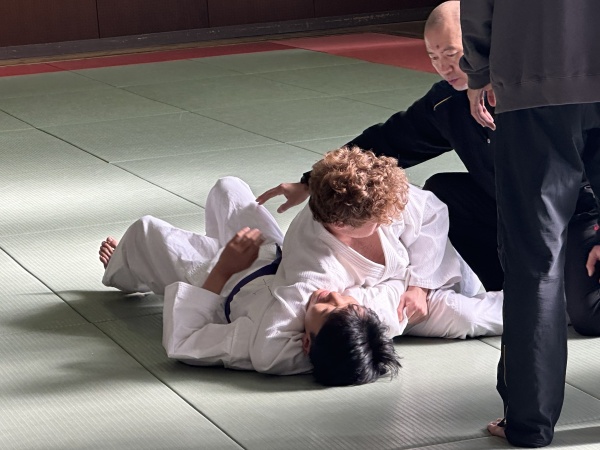
Lachlan Palmer and SeungWoo Jeong, tried Judo with their host brothers.
SeungWoo enjoyed experiencing in person the culture that he has been learning so much about at school. He said “my host brother and I went to several famous places in Japan such as Tokyo Tower, Skytree, Akihabara, Shinjuku, and Shibuya. However, I believe that the highlight of the trip was being able to experience the Japanese food my host family made for us, and the amazing experiences my host brother and I have experienced such as karaoke.’
Lastly, Oliver noted how interesting it was attending a Japanese school and some of the differences. He said “there was a lot of school spirit, much more so than my home high school, and I loved how much the student body supported each other. My favourite parts of school were the friends I made in class (and the bento lunches!).”
ENZ will continue working with Tokyo MBoE on cross cultural education opportunities. If Tokyo MBoE continue the Tokyo Experience School, ENZ will share the EOI with New Zealand schools when it is available, usually around September.
-
Haere rā: Farewell message from former Chief Executive Amanda Malu
Tēnā koutou katoa,
As I close out my time as Chief Executive of Education New Zealand Manapou ki te Ao, I leave with confidence in the future of the international education sector for New Zealand.
Over the past year the sector has continued with steady and balanced growth, contributing more than $4.52 billion annually to the economy and enjoying enduring public support for international students.
Our most recent New Zealand International Student Experience Survey also showed strong support from international students, with 87 percent of those surveyed rating their New Zealand experience positively. That’s an excellent result and something to celebrate.
Last year, the Government launched the International Education Going for Growth Plan, and I am really pleased that this work is tracking well. ENZ has been focusing its promotional efforts on markets with the highest potential for growth while continuing to maintain New Zealand’s strong presence and reputation for high-quality education in other markets. This work continues as ENZ enters its next planning cycle.
While Chief Executive, I feel extremely privileged to have joined three Prime Minister-led delegations, championing New Zealand’s unique education offering in Grow markets including China, India and Viet Nam. Another highlight was travelling to Beijing last year for the China Annual Conference and Expo for International Education (CACIE), at which New Zealand had the distinction of being the Country of Honour.
I have deeply valued being part of the ENZ team and my overall reflection is one of immense gratitude. It has been an absolute career highlight for me and an incredible experience made possible by the great people of this organisation.
I would like to end by acknowledging and thanking everyone in the sector who works so hard to grow international education and its value to New Zealand.
I know 2026 will be another exciting year and I wish you success ahead.
Hei te tau tītoki,
Amanda Malu
- 2022 Tripartite Fund Proposal Form
-
Hong Kong student wins Wellington award for unstinting community service
The Year 12 student from Wellington Girls’ College has been named a winner at the annual Wellington International Student Excellence Awards for her contribution to the city’s international student community and her tireless community service.
She was among a group of 24 high-achieving secondary and tertiary international students recognised at the event for excelling academically, in the arts, sport, community, or online.
As the only child of a teacher and a primary school assistant, Jasmine came to New Zealand in November 2019 to complete her education. Leaving behind a competitive school environment, and a tense and complex political environment, she arrived in Wellington ready to embrace the open and culturally diverse environment she found herself in.
Jasmine says that she had always wanted to get involved in community activities, but until arriving in New Zealand she lacked both the confidence and the opportunities.
“As an international student here, I have been given so many opportunities. I want to treasure all of them and get involved.”
Jasmine quickly understood the value of participation and leadership.
“Arriving in a new country where you don’t know anyone can be a lonely experience, and it’s easy to just hang out with people from your own country, but I have made great friends, both from New Zealand and around the world, and gained support through the organisations I’m involved with.”
From helping to reinvigorate the International Club at school, Jasmine went on to be a key player in the establishment of the Wellington International Students’ Association, which not only connects international students across city schools, but also seeks to build relationships between domestic and international students.
Domestic and international students learn from each other
She believes there is much that domestic students stand to learn from international students.
“They get to see a perspective from another part of the world. Coming here to study has allowed me to immerse myself in New Zealand's culture and learn far more about the country than I would if I was a tourist.
“I’m sure the same applies to New Zealand students who haven’t had the opportunity for exchanges or travel. Through encouraging domestic students to get involved in our events we have built stronger connections.”
But Jasmine hasn’t stopped there. From Mary Potter Hospice to Conservation Volunteers New Zealand to the Student Volunteer Army (SVA), she has put in the mahi. She recently earned her SVA Silver Service Award pin for clocking up more than 250 volunteer hours working to meet the UN Sustainable Development Goals.
Taking her community service to the next level, Jasmine has been selected to represent Wellington Girls’ College in the National Ambassador programme. She will join other like-minded students from around the country working to connect, support, and empower international students.
All of this while juggling studies, sport, mentoring, and music. However, she insists that she has gained more from her community service than she has given.
Volunteering builds skills and network
“Volunteering gave me the opportunity to get out there and build a strong network with experienced people. I’ve gained important inter-personal skills like customer service and communications, and I’ve also learned a lot about New Zealand culture.”
Jasmine says being an international student in New Zealand has also allowed her to appreciate some of the important issues which other communities, such as the LGBTQIA, face.
“I appreciate the inclusiveness towards gender minorities here. In Asia, people are much more reserved about their beliefs and opinions but here we can have open discussions and everyone can be passionate about sharing their thoughts. It has had a powerful influence on me.”
Global citizen skills important
The global citizen skills acquired through international education are so important for the current generation of students heading off to Uni or into the workforce, Jasmine says.
“It’s important to know people from other parts of the world, understand some of the issues they face, and appreciate their culture and beliefs. Building relationships in-person is so much more valuable than learning from the internet.”
“The diversity of ethnicity and cultures, religious and political opinions here in New Zealand has really enhanced my worldview.”
Jasmine is delighted to have been recognised for her contribution to the community, and says her parents were thrilled when her name was announced at the awards ceremony. “Not only are they proud of my own achievements, but they feel that I am representing Hong Kong well in New Zealand.”
Jasmine’s parents were among 214 friends and family of recipients who joined the livestream of the awards ceremony from around the world.
As for the future, Jasmine is looking forward to completing Year 13 and being a member of the student executive next year, striving for the SVA Gold Award for volunteering, being a National Student Ambassador, and ultimately heading to the US to study Computer Science.
-
New Zealand Global Competence Certificate programme proves a hit
What is New Zealand’s Global Competence Certificate programme?
The customised cultural exchange programme, which started as a pilot partnership last year between New Zealand’s international education agency, Education New Zealand Manapou ki te Ao and AFS Intercultural Programs, Inc. has proved so successful it is now being extended and taken up by schools and tertiary institutions around the country, connecting them with students in Asia and Latin America.
The “Kiwi way” has much to offer the world, and international education has much to offer New Zealanders at a time the world needs people with cross-cultural competencies. The New Zealand Global Competence Certificate, delivered through Massey University, develops cultural self-awareness, emotional resilience, and build bridges across cultures. It also piques the interest of students offshore in coming to New Zealand in better times.
The programme delivers animated videos, quizzes, assignments, and weekly live facilitated dialogue sessions for learners to talk with each other online in real time and learn about life from perspectives other than their own.
What have students been saying about the NZGCC programme?
“Not only have I learned to become a better communicator, empathiser, and global citizen, but also how a group of like-minded individuals can come together to form something bigger,” says Jack Hittle, of Northland’s Springbank School.
“I found the programme life-changing,” says Vaagisha Kanwar, a Year 11 student at Indus International School in Bangalore, India, who connected with the Northland students. “We learned about conflict, empathy, inequality, different communication styles, how different people adapt to new situations, and about suspending judgement. I know that I’ll use the skills we’ve learned for the rest of my life, not just when I travel abroad but also in daily life.”
"You see the way a culture greets each other or the way they dress, but then there are things like relationships, gender roles, and health,” says Whanganui Girls College student Tilda Donson.
What have educators been saying about the NZGCC programme?
Whanganui Girls College Principal Sharon Steer is delighted with the NZGCC programme, which she says will help students build their understanding of global cultures, and other critical “soft” skills which will prepare them for life as they enter the workforce.
“An important part of our curriculum is developing strong communication skills and setting our students up for success in the workplace. The NZGCC programme will add another dimension to our lessons by teaching our students how to develop meaningful relationships with one another despite language and cultural differences.”
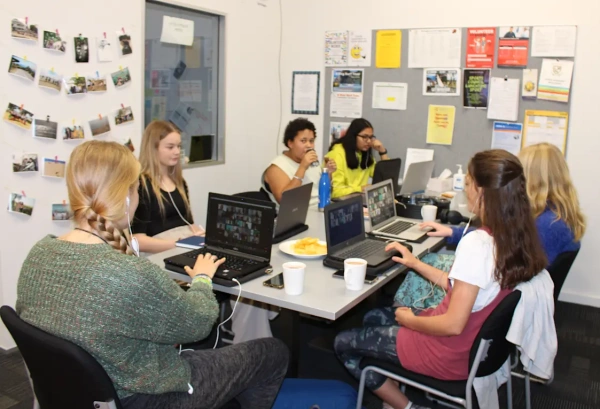
Educators say that with the borders closed, the programme now forms an important part of the reshaped international education experience.
“It is so important that our students don’t miss out on the enriching life skills that are gained when we interact and connect with people from around the globe,” says Whangarei Girls High School International Director Amelia Morrison, who has students working with peers in India.
"Global competence is mission-critical for our world," says AFS Intercultural Programs President and CEO Daniel Obst. “Educating more young people to become global citizens is crucial if we want to create a more just and peaceful world.”
The expansion of the GCC programme reflects the diversification of education in new virtual forms fit for a globally connected world, says Education New Zealand Chief Executive Grant McPherson.
“As well as helping to develop the global citizens of tomorrow, this programme demonstrates the reciprocal benefits of international education, giving our rangatahi a chance to learn with high school students from around the world, and giving their offshore peers a chance to learn ‘with’ New Zealand and our unique way of thinking.”
-
India to feature as Country of Honour at NZIEC KI TUA
The Country of Honour designation at NZIEC KI TUA celebrates New Zealand’s international education connections with partner countries and reflects one of the conference’s key values – hononga (connections).
ENZ’s Acting Chief Executive, Dr Linda Sissons, said ENZ is delighted to headline India at NZIEC KI TUA and build on the strong foundation of international education connections with partners in the country.
“Students from India are the second-largest group studying with New Zealand. We are enriched by the skills and research know-how that Indian students bring to our country. New Zealand has a number of valuable institutional and government-level partnerships that make for a strong, bilateral education relationship with India.
“We look forward to showcasing and celebrating these connections at NZIEC KI TUA 2024.”
ENZ’s Regional Director Asia (excluding China), Ben Burrowes, said having India feature as Country of Honour is a valuable opportunity for the international education sector to contribute to the conference programme with sessions that surface insights and learnings focused on India.
“New Zealand and India have such a broad education relationship, from student recruitment and student experience to partnerships on an institutional and governmental level. There’s much to surface and share by way of insights to continue forging our strong education ties.
“We look forward to collaborating with our sector colleagues to deliver a conference programme that showcases these connections and explores new partnerships moving forward.”
NZIEC KI TUA delegates can look forward to programme elements that explore and surface insights from New Zealand’s international education connections with India and also experience a few cultural delights during conference.
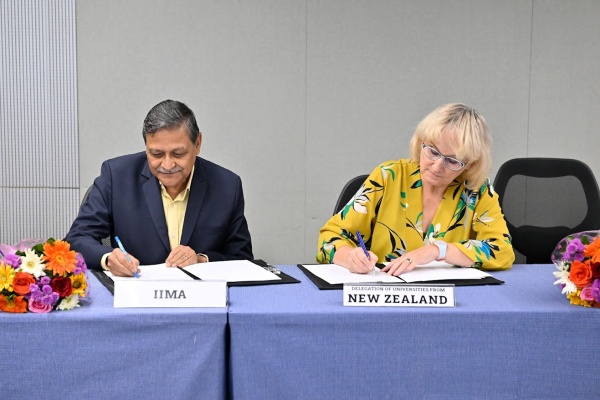
ENZ General Manager International, Lisa Futschek, and IIM Ahmedabad Director Prof Bharat Bhaskar sign an education cooperation arrangement during the NZ India Education Connect initiative in February.
Call for speaker proposals
ENZ is accepting speaker proposals for NZIEC KI TUA 2024. We welcome inspiring and engaging presenters on any topic relating to international education, especially our connections and partnerships with India.
Please submit your proposals by 30 April on this link.
Don’t miss earlybird registration pricing
Secure your earlybird registration price for NZIEC KI TUA 2024. There are two-day and one-day registration options available, alongside tickets to a gala dinner.
To find out more information about becoming an NZIEC KI TUA 2024 partner, email us nziec@enz.govt.nz
-
Education New Zealand targets $4.4 billion by 2027
Education New Zealand Manapou ki te Ao (ENZ) today announced its plan to grow the international education sector over the next three years. The strategy, which aims to build the economic contribution of international education to $4.4 billion by 2027, focuses on growing and diversifying the number of international students studying in New Zealand.
“International education has made a good start to its recovery with more than 69,000 enrolments in the first full academic year since borders reopened and universities returning to 86% of pre-pandemic numbers,” said ENZ Acting Chief Executive Dr Linda Sissons today.
“The government has a goal of doubling the value of export earnings in ten years and international education has its part to play.”
“In the first year of the strategy the focus is putting additional investment into markets we have identified with growth potential. These include India, Viet Nam, and the Philippines, and some specific sectors within markets like Japan and Thailand. We need to start now to grow awareness of New Zealand in these markets if we are to achieve our growth targets. Moving forward, we will continue to seek growth through diversifying markets while maintaining our strength in traditional markets such as China and India.”
“As a small agency with a finite budget, ENZ needs to be very smart and maximise every opportunity for New Zealand,” said Dr Sissons. “We look to use the potential of Scale, Impact, and Leverage as the measuring rods for everything we do, as we commit to the Government’s Export Double goal”.
The strategy is the result of extensive consultation with the international education sectors, partner Government agencies and comes on the back of a productive 12 months for Education New Zealand.
In the past 12 months Education New Zealand student attraction activities have delivered:
-
More than two million visits to the Study with New Zealand website
-
Added more than 69,000 prospective students to its database
-
More than 22,000 individuals have made enquiries to providers regarding study
-
Our business-to-business activities targeting education agents delivered 33 webinars to over 1,800 participants
-
18 in-country events delivered in five countries (Thailand, South Korea, Japan, Vietnam, China)
-
The New Zealand International Education Conference KI TUA 2023 to 599 delegates
-
50 new indigenous to indigenous networks and partnerships
-
Sector satisfaction with ENZ topped 77%
ENZ’s offshore team provides significant support to overseas visits by representatives of the international education sector and the New Zealand government, building and deepening relationships said Dr Sissons. In 2024 this included a visit by representatives of all New Zealand Universities to India in February, and ENZ supporting the education component of the Prime Ministerial Trade Missions to Southeast Asia and Japan.
The agency also supports education visits to New Zealand. Very recently this included the visit of Chinese Premier Li Qiang, which included China’s Education Minister Huai Jinpeng.
It was the second visit by Minister Huai to New Zealand in ten months, and highlighted the strong momentum our bilateral education relationship. In 2023 ENZ also delivered the Prime Minister’s Scholarships to Asia and Latin America (PMSA/LA) which sees New Zealanders travel internationally for learning experiences and administers the Manaaki New Zealand Scholarship programme for the Ministry of Foreign Affairs and Trade (MFAT). The Manaaki Scholarships offers scholarships to eligible citizens from developing countries to study at a New Zealand education institution or university or at a Pacific university.
In 2023 these important programmes have awarded:
-
118 individual PMSA/LA scholarships
-
20 group PMSA/LA scholarships
-
NZIEC KI TUA 2023 delivered with 599 delegates
-
861 Manaaki New Zealand Scholarships awarded
“I am very pleased and proud of the results the team at Education New Zealand Manapou ki te Ao has delivered alongside the sector. We have more to do,” said Dr Sissons.
For further information:Justin Barnett | Director of Communications, Education New Zealand Manapou ki te Ao
+64 21 875 132
About Education New Zealand Manapou ki te Ao (ENZ) https://www.enz.govt.nz/
ENZ is the government agency dedicated to helping Aotearoa New Zealand realise the social, cultural, and economic benefits of international education. Our role is to promote New Zealand as a high-quality education destination offering excellent education and student experiences and to encourage New Zealand students to study overseas.
With approximately 105 staff in 16 locations around the world, ENZ works closely with New Zealand’s diverse education sector which includes schools, English language providers, Private Training Establishments, Institutes of Technology and Polytechnics (Te Pūkenga), and universities. Internationally, we work with a range of education stakeholders, including government agencies and education providers to identify and encourage sustainable growth opportunities for New Zealand’s education sector.
-
-
BizVenture winners tackle youth mental health with "It's Okay" clothing range
The innovative business entrepreneurship scheme is a pilot initiative led by Education New Zealand, Young Enterprise Scheme (YES), and Japanese partners to give students in both countries real-life experience in developing business solutions that address one of the United Nation’s 17 Sustainable Development Goals.
Forty students collaborated in a three-day virtual exchange, where they chose a challenge tackling some of Japan’s pressing social issues, before designing and presenting a business plan in a “Dragon’s Den” style pitch to judges.
The winning New Zealand team - Hamish Robinson (Taradale High School, Napier), Benjamin Young (Tauranga Boys’ College), Daniel Blight (Waimea College, Napier), Kaiah Sherriff (Southland Girls’ High School), and Abirami Kabilan (Pakuranga College, Auckland) - chose to come up with a strategy which would directly enhance the mental wellbeing of Japanese teenagers.
The UN SDGs are some of the biggest problems facing humanity today, so working on them was a pretty full-on task” – Pakuranga College student Abirami Kabilan
It is a topic which directly impacts young people in both countries, as UNICEF ranks Japan 37th among 41 OECD countries for the state of children’s mental health, and New Zealand one lower, at 38th place.
Insights into business and culture “eye-opening”
To succeed, the students had to gain a thorough insight into Japanese culture, youth behaviour, and business practice. Ahead of their pitches, the teams joined interactive workshops with New Zealand and Japanese guest speakers, cultural mentors, and language coaches.
Abirami Kabilan describes the exposure to Japanese business and societal culture as “eye-opening”.
“The UN SDGs are some of the biggest problems facing humanity today, so working on them was a pretty full-on task.”
“One of the most interesting things about this cross-cultural experience was seeing how the Japanese students approached the same problems. Young people around the world will have such different ways of approaching these problems too. Imagine the ideas we would come up with if we all worked together.”
The winning team successfully pitched a clothing brand called 大丈夫, which translates in English to “It’s Okay”, to get the conversation about mental health out in the open among Japanese youth, and hopefully gain the support of high-reach Japanese influencers to help push their critical wellbeing message.
They decided the best way to break into the Japanese market would be with “in your face” messaging using symbols of strength, such as dragons and samurai, to promote their message.
“This is something that has not been done in Japan before and we’re ecstatic to be winners,” Hamish Robinson says.
BizVenture promotes global competency
The BizVenture programme will allow students to understand the Japanese business context and increase their global competency, says Young Enterprise Scheme lead Elizabeth Pittman.
“New Zealand youth have such a strong interest in sustainability and improving social outcomes within their communities and abroad, and this challenge allows them to explore that interest in a business context.”
International education adapts to changing needs of learners
Education New Zealand is keen to build on the success of this year’s pilot BizVenture programme as international education adapts to meet the changing needs of learners. International research shows that students are increasingly seeking programmes and content that is relevant to real world problems and which will allow them to make a real difference.
The programme also builds on New Zealand’s diplomatic relationship with Japan while travel for international students remains limited.
“Over many decades Japan and New Zealand have benefitted from an enduring partnership,” says Hamish Cooper, New Zealand Ambassador to Japan. “Education has played a really important role in fostering people-to-people ties, and supporting the development of what are now, in 2021, very close connections between our two countries.”
“Before the pandemic, more than 10,000 students from Japan studied in New Zealand every year, making an important economic contribution, but also enriching our schools and communities, and helping New Zealand students become more globally connected.”
-
From the Chief Executive: Shared ambition for the future of New Zealand international education
Kia ora koutou,
It was a pleasure to come together in Wellington this month when ENZ convened the Peak Body Forum, particularly with the Minister of Education, Hon Erica Stanford, joining us for an open and constructive discussion on the future of international education in New Zealand.
The Forum reinforced the strong momentum behind the International Education Going for Growth Plan. The Minister spoke about her ambition for the sector and her determination to unlock opportunities that will enable international education to achieve its full potential.
At the Forum, the Minister announced changes to post‑study work visa settings to support delivery of the Growth Plan. By supporting international graduates with valuable skills while maintaining high education quality, the changes make New Zealand more competitive internationally and reinforce our reputation as a destination of choice.
The Peak Body Forum continues to be a powerful example of what we can achieve together. Government agencies and peak bodies at the table, working collectively for the long-term success of New Zealand international education.
It was also a pleasure to attend ICEF ANZA in Wellington this month and connect with education agents and providers from New Zealand, Australia and around the world. I was proud to see New Zealand providers so strongly represented and to welcome our international agent partners. Te Herenga Waka Victoria University of Wellington and the Wellington City Council were magnificent hosts. Hon Erica Stanford made an inspiring address to welcome the delegates.
I want to sincerely thank sector stakeholders across the motu and around the world for the work you are doing every day to boost and grow New Zealand education’s profile internationally.
Ko te kotahitanga te kāwai i herea ai tātou.
Unity is the binding thread that connects us all.Ngā mihi nui,
Linda SissonsActing Chief Executive