Search
Showing 10 of 490 results for cardguard official website
-
The PIE News returns as media partner for NZIEC 2019
The PIE is an independent media, recruitment and events company connecting a global community of professionals working in international education.
The PIE is the only targeted media platform covering the international education sector that can boast a truly global audience of senior stakeholders working across the whole sector. We have reached over 2.7 million users so far and have 70,000 unique visitors to our website each month.
Anton and his team will cover the entire conference, providing updates on sessions through social media and the website.
-
Latest insights on international education
The Insight Story March 2022 is the latest snapshot of international education from Education New Zealand Manapou ki te Ao.
This fourth issue includes research, insights and trends on:
• our top source markets
• other English-speaking international student destinations
• student visa numbers
• international student experiences
• transitions from secondary to tertiary study in four priority Asian markets.
Do you know, for example, which countries are most interested in our Study with New Zealand website?
Or how students from Japan rate the value for money and cost of living in New Zealand, and their overall experience here?
Or which nationalities have the highest number of student visas granted in other English-speaking international education markets?
Or how positively international students rate their experience in New Zealand, and how international student experience at New Zealand universities compares with the global benchmark?
To find the answers to these questions and more, read The Insight Story and sign up for future issues, on the IntelliLab website.
-
Education New Zealand hosts first-ever NZ-China Education Week
Early Childhood Education Symposium
The inaugural New Zealand-China Early Childhood Education Symposium with China Centre for International People to People Exchange (CCIPPE), an agency under the Ministry of Education of China, was well-received by the audience of over 1,000 people.
ENZ General Manager – International, Lisa Futschek, provided opening remarks alongside distinguished officials from China who expressed support for the dialogue around ECE to continue between our two countries.
“It was very moving to hear Deputy Director General Xiaochun YANG speak te reo Māori in his closing remarks,” ENZ Director – Greater China, Miranda Herbert, said.
“The ECE Symposium highlights the special relationship between New Zealand and China and our long history of engaging in bilateral dialogue in a variety of education related fields to learn from each other.”
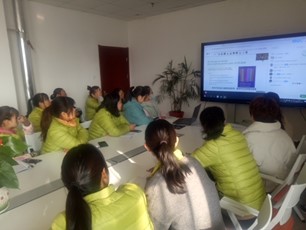
Educators tune into the ECE Symposium.
Part of the success of participation was due to CCIPE’s social media post which attracted over 8000 reads (pre-event). CCIPPE article with photos: 2020中国-新西兰学前教育研讨会在线成功举办 (qq.com)
The entire symposium was bilingual – no small feat in a virtual environment. ENZ used subtitles on pre-recorded presentations, interpretation for the live speakers and engaged a bilingual MC with experience in the ECE field.
University of Auckland Associate Dean International – Faculty of Education and Social Work, Marek Tesar, presented a session at the symposium titled “How ECE Teachers Shape Our Children: Fostering Quality ECE Teachers—Formal Education and Professional Development."
“A fantastic event, which brought together an interdisciplinary group of people to discuss the important topic of early childhood education. It has emphasised the many opportunities for ongoing collaboration between New Zealand and China and I hope that this is the first of many such symposia – hopefully in person next time!” he said.

Watch the recording
To view the recorded symposium, please log back into your ECE Symposium Attendee Login. Didn’t have a registration? Choose Attendee Registration and complete the registration on this website: https://event.dragontrail.com/NZedu/en
Once logged in, navigate to Floor Plan and click “Education Symposium 2020”
Then you will see this screen to click “Playback”
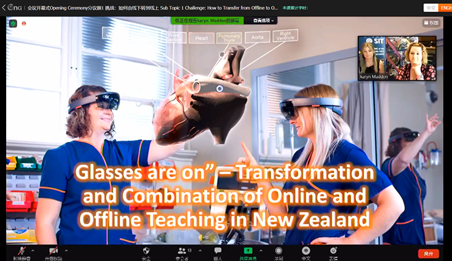
The Southern Institute of Technology (SIT) present at Sino-New Zealand Higher Vocational Education.
8th Sino-New Zealand Higher Vocational Education Conference
This year’s Sino-New Zealand Higher Vocational Education conference moved to a virtual platform this year which enabled continued dialogue between New Zealand and China.
Over three half-days, it focused on challenges and innovations in online learning and international collaboration for managers, teachers and researchers in vocational education and training.
Conference organisers, Wintec and co-organiser, Skills International worked closely with China partners Tianjin Light Industrial Vocational Technical College, Qingdao Vocational Technical College and Central Institute for Vocational Technical Education to deliver an engaging event for the live audience in Tianjin and the virtual attendees.
Agent Seminars
The Agent Seminars reached an audience of 500 attendees from across the Greater China region over two days.
Agents were welcomed by New Zealand’s Ambassador to China, H.E. Clare Fearnley, heard from Immigration New Zealand, Tourism New Zealand, and even learned how to order a green tea in te reo Māori.
With over 44 New Zealand institutions and regions exhibiting in the virtual exhibition hall, agents were able to connect through the virtual meeting rooms to have one-on-one conversations. ENZ trialled a virtual conferencing platform created for the China market that allowed our Chinese agents to join via WeChat and tailor their view to local language.
ENZ wants to thank all the exhibitors, presenters and attendees who participated in New Zealand Education Week to help make it a success and we appreciate your adaptability to a China-friendly virtual platform.
ENZ has received great feedback from both sides on the programme and future partnership opportunities – there is a strong desire to continue dialogue.
Watch the recording
Note, the Agent Seminars were over two days and the majority of presentations are in Chinese language.
To view the recorded seminars, please log back into your Agent Seminars Organization or Attendee Login.
Didn’t have a registration? Choose Attendee Registration and complete the registration on this website: https://event.dragontrail.com/NZedu/en
Once logged in, please navigate to Floor Plan and click “Agent Seminar Presentations”.
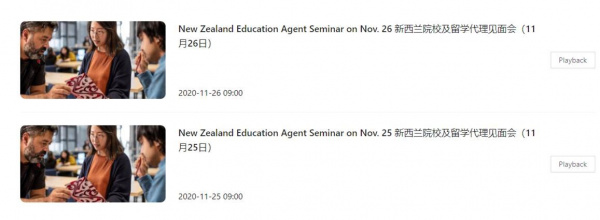
Then you will see this screen to click “Playback” for either 25 or 26 November.
-
Preferred name and inaugural CE for the IST released by Establishment Board
These conversations provide providers and their stakeholders updates on the progress being made by the Unit and an opportunity to ask questions. These latest conversations will have a focus on the name and brand including the Board’s preferred name for the new national Institute. To support the conversation, a video has been shared that captures the essence of the journey to date. It outlines a vision for the Institute, along with presenting the preferred name.
Once the Regional Kōrero have been completed, the public online consultation will open, allowing everyone to provide feedback on the preferred name being suggested.
The online consultation is open from 14 February until 8 March. Once complete, the IST Establishment Board will consider public feedback on their preferred name and finalise their recommendation to the Minister.
You can watch the video here and the online consultation will be available on the IST Establishment Unit’s website.
Stephen Town has also been named as the inaugural Chief Executive of the New Zealand Institute of Skills and Technology. Stephen is currently in his final year leading Auckland Council and will formally take up his role on 6 July 2020.
You can find out more about Stephen’s appointment on the IST Establishment Unit’s website.
-
Think New with FutureLearn
Quicklinks
About the campaign
Campaign messaging
Tips for promoting the campaign
Check out the Brand Lab to download and use campaign assets
About the campaign
Objectives
- Test an online-focused audience’s appetite for courses delivered under an NZ country brand
- Explore sector capability and willingness for generating and promoting online courses
- Test, understand and validate ENZ's role in the online education space
- Maintaining awareness of the NZ Education brand and NZ as an education destination in target markets
FutureLearn platform and courses
- New Zealand’s offerings include short courses from leading universities, English language schools, vocational PTEs, Institutes of Technology, and edtech educators including virtual reality developers and game designers.
- These not for credit courses are on average 6-8 hours long from providers across the sector.
- FutureLearn is a global online education platform jointly owned by the UK’s Open University and The SEEK Group with an existing community of approximately 15 million learners globally.
- These courses are available to learners (including teachers and educators) all over the world, including here in New Zealand.
FutureLearn is actively promoting this campaign in the following prototype markets:
- Thailand, Japan, Korea, China, India, Brazil, Indonesia, USA, Vietnam, Germany, UK, Colombia
In addition, ENZ will be promoting this opportunity to its global learner database, and through other owned channels, including website and social media.
Campaign messaging
By joining forces and sharing the same message, we can tell a stronger, more consistent story about the FutureLearn prototype, and the opportunity it represents.
The Campaign’s place in the wider strategy for international education
- ENZ is leading a programme of work that focuses on the diversification of international education products and services. It forms part of the Government’s Recovery Plan for International Education, under the “Transforming to a More Sustainable Future State” workstream.
- The New Zealand International Education Strategy, 2018 is clear in its goals for achieving a thriving and globally connected New Zealand through world-class international education.
- Goal 2 of the Strategy is Sustainable Growth - the international education sector flourishes through diversification of markets, people flows and innovative products and services.
Talking points for providers
- We are proud to be part of ENZ’s new pilot, launched with FutureLearn.
- This initiative will showcase a selection of taster courses from New Zealand providers to worldwide online learners, under the national Think New brand umbrella.
- The 12-month initiative launched 8 June and is part ENZ’s Diversifying Products and Services programme of work.
- By taking part, we are supporting the Government’s Recovery Plan for International Education.
Provider participation benefits
These messages are useful when talking about the campaign to other staff in your organisation- This initiative is an opportunity to further raise our profile to a global audience, benefiting from the exposure generated by FutureLearn and the ENZ-funded global campaign.
- We’re able to test a new recruitment and distribution channel at little cost.
- As providers, we receive notification of any further interest generated by these online courses, which could lead to further study opportunities – either online (on FutureLearn or elsewhere), or onshore when current border restrictions sufficiently ease.
- As part of the process FutureLearn worked alongside providers like us, supporting us while we created (or optimised) content for the platform.
- Standard membership fees are being waived by FutureLearn for this prototype.
- ENZ is also funding a global campaign via FutureLearn to promote the prototype.
More about FutureLearn
- FutureLearn offer courses from around 250 providers from around the world. These courses range from tasters to full online degrees.
- 15 million learners use the platform. Many (27%) users are UK-based but increasing numbers of learners across the globe are accessing FutureLearn.
Tips for promoting the campaign
By aligning our marketing activity, ENZ and providers can tell clear and consistent message about the online study courses available with FutureLearn and providers. Here are some tips to start promoting your FutureLearn courses on your channels:
Tip 1: Use the digital assets available in your promotions:
There are plenty of campaign assets designed with campaign messaging available for you to use now on The Brand Lab. Assets have been specifically created to use across websites, emails, social channels & other digital advertising.
Check out The Brand Lab to download and use images, animated tiles, email signatures, an editable ad template where you can feature your own logo and much more!
Tip 2: Share our FutureLearn & Online Learning blogs
We’ve created a blog for a learner audience to promote starting a New Zealand education online, through the FutureLearn product. Check out the blog here and share on your own social channels or website.
We also have supporting blog content written by students for learners thinking about online learning. You can also share this blog, and link to FutureLearn’s Study with New Zealand Online page
Tip 3: Follow and share FutureLearn’s posts on Study in New Zealand Facebook & Instagram channels
ENZ will be posting about New Zealand online study options on our Facebook and Instagram channels. You can easily share & repost this content on your own social channels to reach your own audience. This Facebook post is ready to share now.
-
IEGF funding broadens markets
Unsure how you can use the International Education Growth Fund (IEGF) to help innovate your offering?
We talked to Mike Walmsley, Chief Executive of Code Avengers, about how he has used the IEGF to grow his business.
ENZ: So Mike, what’s Code Avengers all about?
Mike: We have developed an online learning platform that teaches people how to build their own apps, games and websites in a way that is effective and fun as possible.
We are looking to expand into other related subject areas. Starting with a design focus – so, not only how to code software but also how to make it look nice. And, moving on to things like copy writing – making sure the content on your website or app engages learners – and tips on digital marketing that will get people actually using the product!
What has the International Education Growth Fund enabled you to do?
Our IEGF proposal was for internationalising our website. Our online courses contain a whole series of interactive exercises where people actually write code and build products as they learn. Initially, the instructions in these exercises were only available in English and those who didn’t have a reading age above 12 would struggle to follow them.
The fund enabled us to translate the course material into other languages – Russian, Portuguese, Spanish and Dutch! We’re also working on a Japanese translation. Thankfully, we’d developed the material with this in mind, so the translation process has been relatively straightforward.
Dutch is sort of the odd one out there. How that arose, was that one of our customers in the Netherlands offered to translate the content into Dutch while she was on holiday in Thailand. We jumped at the chance, and used that as a translation test case, which was really helpful.
This young woman is now working with us full time on marketing and promoting Code Avengers, including the code camps and clubs that we run. The IEGF funding has also enabled her to promote our products and engage partner organisations in other parts of Europe.
While we’re here, do you have any advice for others considering launching an EdTech business?
In any start up, passion is the key. You’ve got big competition, there are a lot of challenges and it’s not easy. In my case, I’m also doing a PhD part time and have a couple of kids, so that all adds to the challenge. For at least the first year and a half, I didn’t have anyone working with me full time, so really I think it’s the passion that keeps you going. The passion, combined with the feedback you get from customers, means you end up building a product that they like. Those two things are key.
What’s the most rewarding thing about your work?
One is definitely the feedback you get from customers. One customer emailed us saying that for their whole life – for 45 years – they thought they were really bad at maths and useless at learning anything that was quantitative.
After doing our courses, which have quite a bit of math in them, they’re feeling really good about themselves. They said, “for 45 years, I thought I was dumb and now it’s just I’ve been taught in the wrong way.”
Realising that your work can actually have real impact on someone’s life is probably the most satisfying thing.
Find out more about Code Avengers here.
-
Strong NZ presence at NAFSA 2022
 Education Minister Chris Hipkins spoke at the opening plenary event, which was co-sponsored by ENZ and the University of Colorado Denver, and attended by around 2,000 in-person guests including education professionals, government representatives, technology vendors, immigration agents, and specialist media from around the world. A further 2,000 people watched through NAFSA 2022 online.
 Alongside the NAFSA programme, Te Pūkenga launched their international education strategy,and ENZ launched the sector’s new global marketing campaign, I AM NEW.

Minister Hipkins with Dr Leon Fourie, Te Pūkenga International Chief Executive
New Zealand’s stand at the expo featured three of the stunning kākahu (garments) at the heart of the marketing campaign. We were delighted that Kiri Nathan, who was the lead designer for the kākahu, was also able to attend NAFSA and spoke at the Thursday plenary event, sponsored by ENZ.
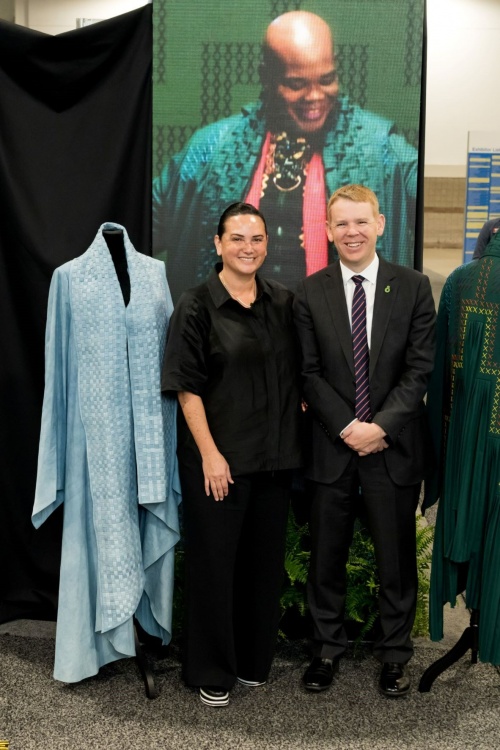
Designer Kiri Nathan with Minister Hipkins
Our marketing campaign is now well underway, with paid advertising in key partner countries supported by media releases, direct mail, social media, online video, programmatic display and other activities. It is driving a significant increase in engagement with our Study with New Zealand website, including many new users. You can view the campaign video and related images on BrandLab.
To date the campaign has reached 48 million people (this is a duplicate total across channels) and has driven 17,000 active visits to the I AM NEW campaign landing page. The Study with New Zealand website has seen 2,164 people sign up since the start of the campaign, with 754 referrals and 1,038 enquiries also registered to various institutions.
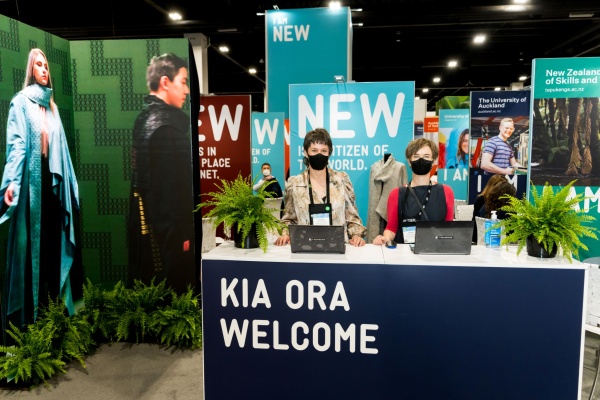
Bronwyn Shanks and Emma Wilkins from ENZ on the welcome desk
Next year will be NAFSA’s 75th year, and the conference will be held from 30 May to 2 June 2023 in Washington, DC.
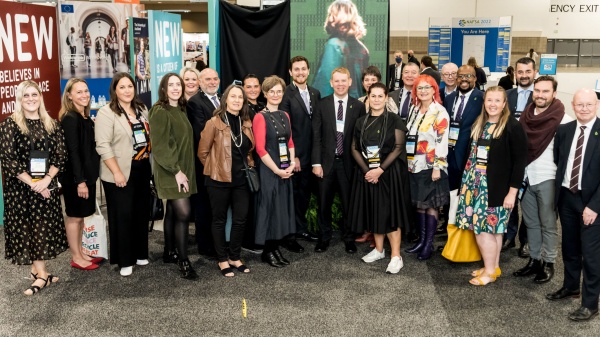
New Zealand's successful presence at NAFSA was supported by many people.
-
Pathway visa announced
This is great news for our industry and one of the priority actions identified in the international education industry strategic roadmap developed in 2014.
The pathway student visa will allow international students to undertake up to three consecutive programmes of study with selected education providers on a single visa that is valid for up to five years. A pathway programme can be offered by a single provider, or by a group of providers. For example, a student could obtain a pathway visa to study for three consecutive years at a school, or obtain a visa to undertake a year of study at an English language institution, progress to a year-long foundation programme, and follow that with a three-year degree programme.
Over 500 primary, secondary and tertiary institutions have been invited to participate in the 18 month pilot on the basis that they have a student visa application approval rate of 90 percent or higher for the 2014/15 financial year. A list of participating New Zealand education providers is available on the Immigration New Zealand (INZ) website.
The 18 month pilot period started on 7 December and will enable INZ to evaluate pilot outcomes, such as student transition rates from the first to the second programme of study and how well the arrangements between education providers are working.
Find out more about the key conditions and features of the pathway visa on the Immigration New Zealand website here.
-
INZ student visa update: July 2024
Visa processing update (as at 10 July 2024).
Since January 2024, Immigration New Zealand (INZ) has received 24,541 student visa applications from international students outside of New Zealand. INZ have completed 20,369 of these applications, with 15,242 approved.
Recent processing times for international student visa applications are published on the INZ website and are updated by month: Visa processing times for international students
Work rights available for more partners of students
In June, the Government expanded the eligibility for work visas for partners of some students studying towards a Green List occupation.
People can now apply for a Partner of Student Work Visa, with open work rights, if their partner is studying a specified level 7 or 8 bachelor’s or bachelor’s (honours) degree that will lead directly to professional registration required for a Green List role.
This relates to Green List roles where occupational registration, rather than qualification requirements, are specified, such as nurses, doctors, and teachers.
For people granted a Partner of Student Work Visa, any school-aged dependents they have will be considered domestic students for tuition fee purposes and can apply for a Dependent Child Student Visa.
End of year student visa peak – Apply early!
The processing of international student visas is a key focus for INZ, particularly as we get closer to the end of the year.
INZ receives the highest volumes of student visa applications between October and March. Applications generally take longer to be decided during this peak period, so it is important that anyone who is wanting to come to New Zealand to study next year applies early. It is recommended students apply three months before their intended travel date to give them the best chance of having their application decided in time.
There are a few things applicants can do to make sure their application is able to be processed as quickly as possible. These include:
-
Check out INZ’s student visa information sheet on the INZ website to make sure a good quality application is submitted that includes all the evidence and supporting documents we need to decide the application. INZ will not be contacting applicants to ask for more information during the peak processing period, so it is important that everything is included from the start.
-
Applicants must demonstrate that they can comfortably afford to study in New Zealand. New Zealand has a thorough funds assessment and INZ looks for genuine sources of funds that are credible and can be verified. If INZ cannot verify funds or is not satisfied that any verification would be genuine, then the application will be declined.
-
INZ is seeing decline rates for international student visas increasing for many markets due to the increase in applications that cannot meet immigration requirements, so make sure the requirements are fully understood before submitting an application.
-
-
Reconnecting New Zealanders to the world

Where does international education fit in?
Prime Minister Jacinda Ardern has announced a plan to reconnect New Zealanders to the world in 2022.
This framework is based on being able to maintain the elimination strategy, alongside a high coverage of vaccination, strong confidence in our system and a phased approach to opening the border.
Read the Prime Minister’s announcement in full | Reconnecting New Zealand to the world on Unite Against COVID-19 site
The key points of this plan are:
- To continue to speed up New Zealand’s vaccination rollout, and move to six weeks between doses so that more New Zealanders have immunity sooner.
- Phased approach to reopening border in the second half of 2021, and set up of new testing and vaccine checking systems at the border.
- Move to new, risk-based border settings that will establish low, medium and high-risk pathways into the country.
New Zealand’s ability to reconnect with the world depends on these factors being successful.
At this early stage, we can’t provide detail or any degree of certainty for students looking to apply for study in or book travel to New Zealand.
Many New Zealand institutions are now offering new ways to study. If you’re wondering which study option might be right for you, visit Study With New Zealand New Ways of Learning.
We suggest that agents, students and their families wait until policy announcements are made before booking any travel to study in New Zealand. We could expect to see more clarity on this later in the year.
FAQs
When will New Zealand open up to the world?
Work continues on developing the requirements for a phased approach to Reconnecting New Zealanders to the rest of the world in 2022. We could expect to see more clarity on this later in 2021.
Read more about the next steps to reconnecting New Zealanders to the world.
What do we know about timeframes for international students returning to New Zealand?
While we are pleased to note that a number of international students have been able to return to New Zealand under the current class exceptions, we aren’t able to provide exact timeframes for a large-scale return for international students and providers.
Managing our border doesn’t mean conditions will stay exactly as they are now, but it does mean that there are likely to be restrictions and requirements in place until at least December 2022.
Can students apply for semester 1 2022 study?
We would currently advise students not to plan for study in New Zealand for semester 1, 2022.
Please note offshore temporary visa application lodgements are currently suspended till February 2022 and this may be extended.
International student class exceptions are a key priority for the Government, but we can’t predict timing on when a further cohort might be announced, or what MIQ capacity may look like at the time.
Will the phased border approach outlined in the Reconnecting New Zealanders to the World announcements affect the temporary suspension of offshore visa application lodgements?
The Government continues work on developing the requirements for a phased approach to Reconnecting New Zealanders to the rest of the world in 2022. As such, no decisions have been made yet on how the border plan might affect offshore visa application lodgements.
What is the Government’s position generally regarding international education?
Despite the severity and complexity of the COVID-19 pandemic, and our ongoing commitment to its elimination strategy, the New Zealand Government remains committed to a thriving international education sector.
In a recent meeting with the international education sector, the Minister of Education highlighted the New Zealand Government’s support for the continued safe return of international students to New Zealand, when the time is right.
How does the border approach affect the students coming into New Zealand under the border exception classes?
It doesn’t. Existing processes for students to enter the country under existing border exception classes (the 250 PhD and postgraduate cohort and the 1000 bachelor's degree and above cohort) will remain in place.
How will New Zealand determine which countries are low, medium or high-risk?
The government is currently working through how it will determine this.
How will the phased border approach affect Managed Isolation and Quarantine (MIQ)?
Vaccinated travellers from low-risk countries will not be required to go through managed isolation facilities.
Vaccinated travellers from medium-risk countries will have modified isolation requirements, the details of which are still to be worked through.
Unvaccinated travellers and all travellers from high-risk countries will need to undergo 14 days in MIQ.
Read more on the next steps of reconnecting New Zealanders to the world
Would lockdowns in New Zealand affect the timing of the phased border approach?
The New Zealand Government is committed to the elimination strategy and the successful rollout of vaccines. New Zealand’s border approach depends on our ability to stamp out clusters of COVID-19 as they arise, so there is some possibility that further lockdowns may delay the border approach.
Will international students in New Zealand continue to receive free COVID-19 healthcare?
Yes. Vaccines are available to everyone in New Zealand (12 years and over) free of charge. This includes international students.
Read more about the COVID-19 vaccine rollout on the Ministry of Health website.
All publicly funded COVID-19 related care – including testing, treatment and vaccinations – is provided to anyone who needs it, free of charge.