Search
Showing 10 of 490 results for cardguard official website
-
Reconnecting New Zealanders to the world

Where does international education fit in?
Prime Minister Jacinda Ardern has announced a plan to reconnect New Zealanders to the world in 2022.
This framework is based on being able to maintain the elimination strategy, alongside a high coverage of vaccination, strong confidence in our system and a phased approach to opening the border.
Read the Prime Minister’s announcement in full | Reconnecting New Zealand to the world on Unite Against COVID-19 site
The key points of this plan are:
- To continue to speed up New Zealand’s vaccination rollout, and move to six weeks between doses so that more New Zealanders have immunity sooner.
- Phased approach to reopening border in the second half of 2021, and set up of new testing and vaccine checking systems at the border.
- Move to new, risk-based border settings that will establish low, medium and high-risk pathways into the country.
New Zealand’s ability to reconnect with the world depends on these factors being successful.
At this early stage, we can’t provide detail or any degree of certainty for students looking to apply for study in or book travel to New Zealand.
Many New Zealand institutions are now offering new ways to study. If you’re wondering which study option might be right for you, visit Study With New Zealand New Ways of Learning.
We suggest that agents, students and their families wait until policy announcements are made before booking any travel to study in New Zealand. We could expect to see more clarity on this later in the year.
FAQs
When will New Zealand open up to the world?
Work continues on developing the requirements for a phased approach to Reconnecting New Zealanders to the rest of the world in 2022. We could expect to see more clarity on this later in 2021.
Read more about the next steps to reconnecting New Zealanders to the world.
What do we know about timeframes for international students returning to New Zealand?
While we are pleased to note that a number of international students have been able to return to New Zealand under the current class exceptions, we aren’t able to provide exact timeframes for a large-scale return for international students and providers.
Managing our border doesn’t mean conditions will stay exactly as they are now, but it does mean that there are likely to be restrictions and requirements in place until at least December 2022.
Can students apply for semester 1 2022 study?
We would currently advise students not to plan for study in New Zealand for semester 1, 2022.
Please note offshore temporary visa application lodgements are currently suspended till February 2022 and this may be extended.
International student class exceptions are a key priority for the Government, but we can’t predict timing on when a further cohort might be announced, or what MIQ capacity may look like at the time.
Will the phased border approach outlined in the Reconnecting New Zealanders to the World announcements affect the temporary suspension of offshore visa application lodgements?
The Government continues work on developing the requirements for a phased approach to Reconnecting New Zealanders to the rest of the world in 2022. As such, no decisions have been made yet on how the border plan might affect offshore visa application lodgements.
What is the Government’s position generally regarding international education?
Despite the severity and complexity of the COVID-19 pandemic, and our ongoing commitment to its elimination strategy, the New Zealand Government remains committed to a thriving international education sector.
In a recent meeting with the international education sector, the Minister of Education highlighted the New Zealand Government’s support for the continued safe return of international students to New Zealand, when the time is right.
How does the border approach affect the students coming into New Zealand under the border exception classes?
It doesn’t. Existing processes for students to enter the country under existing border exception classes (the 250 PhD and postgraduate cohort and the 1000 bachelor's degree and above cohort) will remain in place.
How will New Zealand determine which countries are low, medium or high-risk?
The government is currently working through how it will determine this.
How will the phased border approach affect Managed Isolation and Quarantine (MIQ)?
Vaccinated travellers from low-risk countries will not be required to go through managed isolation facilities.
Vaccinated travellers from medium-risk countries will have modified isolation requirements, the details of which are still to be worked through.
Unvaccinated travellers and all travellers from high-risk countries will need to undergo 14 days in MIQ.
Read more on the next steps of reconnecting New Zealanders to the world
Would lockdowns in New Zealand affect the timing of the phased border approach?
The New Zealand Government is committed to the elimination strategy and the successful rollout of vaccines. New Zealand’s border approach depends on our ability to stamp out clusters of COVID-19 as they arise, so there is some possibility that further lockdowns may delay the border approach.
Will international students in New Zealand continue to receive free COVID-19 healthcare?
Yes. Vaccines are available to everyone in New Zealand (12 years and over) free of charge. This includes international students.
Read more about the COVID-19 vaccine rollout on the Ministry of Health website.
All publicly funded COVID-19 related care – including testing, treatment and vaccinations – is provided to anyone who needs it, free of charge.
-
Apply now for early 2025 study
It’s the busiest time of year for student visa applications at Immigration New Zealand.
If students are coming to New Zealand for early 2025 study, they need to apply for their student visa now. Otherwise, they might miss out.
Students must submit all the information needed when they apply. Our Student Visa Information Sheets on the Immigration New Zealand website have more information on what to include with a student visa application. If applications are incomplete, it will take longer or may be declined.
Apply now on the Immigration Zealand website.
-
Students flocking to Study in New Zealand website
SiNZ is now the top-ranking site in Google results for people in the UK, US, India, Thailand and Viet Nam when they search ‘studying in New Zealand’. It also ranks highly for ‘cost of living New Zealand’ and ‘universities in New Zealand’.
From December 2016 to January 2017, organic (unpaid) traffic to SiNZ increased by 24%, which means that the site is easier to find online. The SiNZ pages driving the most organic traffic include Scholarships, Study options and Work while you study.
Lucia Alarcon, ENZ’s International Digital Project Manager, said SEO (search engine optimisation) is a long-term strategy that helps make the site increasingly easy to find online.
"Having a SEO strategy helps to drive the right traffic to studyinnewzealand.govt.nz, growing value and conversion opportunities,” said Lucia.
As a result of this work, the bounce rate (the percentage of visitors who leave the site after seeing only one page) dropped from 15% to 13% between December 2016 and January this year.
Organic visits from mobile phones have increased 61% since July last year, corresponding with an impressive 70% increase in referral conversions from mobile phones. The site has also had a 44% increase in organic visits from tablet devices since last July.
These results demonstrate the importance of the site in raising awareness of the benefits of studying in New Zealand and in increasing referrals to institutions.
Other work contributing to these results includes better use of insights to create more engaging content, and tighter integration of social media channels with SEO, which ensures a more secure website that meets Google’s mobile-friendly criteria.
-
From the CE: Student visas reopen 31 July; changes to immigration settings
Firstly, there is the encouraging news that student and visitor visa processing will reopen on 31 July 2022, rather than in October as previously announced.
This is a welcome step forward and sends a strong signal that New Zealand is fully reopening to the world. Given the significant challenges faced by our international education sector over the past two years, I know this news will come as a relief for many of you.
Secondly, the government has announced changes to immigration settings arising from its immigration rebalance work. Key changes for our sector include post study work rights for international students and other student visa settings.
The recent border exception for up to 5,000 international students (cohort 4) will continue as planned, with the first students on track to begin arriving in New Zealand soon.
Post-study work rights from 11 May 2022
- International students studying bachelor’s or post-graduate courses or higher will continue to receive Post-Study Work Visas.
- Students studying non-degree courses at Level 7 and below (excluding bachelor’s degrees), will only be eligible for post-study work rights if the qualification is relevant to an occupation on the new Green List, which will replace the existing skills shortage lists. These work rights will only allow them to work in that occupation.
- The duration of work rights will reflect the duration of study undertaken in New Zealand, except for Masters and PhD students who retain the current setting of 3 years.
- International students will no longer be able to apply for a second post-study work visa.
- Students with a student visa application underway to study a qualification currently eligible for a post-study work visa and that student visa is subsequently granted; students who get a visa through the current border exception for 5,000 students; and students who already hold a student visa for a programme of study that results in a qualification that is currently eligible for a post study work visa, will be considered under the old settings if they apply for a post-study work visa within the next three years.
- There are no changes to in-study work rights for student visa holders.
Living costs and fees from 31 July 2022
- The amount of funds that students are required to demonstrate they have access to, so they can cover their living expenses while in New Zealand, will increase. For tertiary and English language students, the funds required will be $20,000 pa, and for primary and secondary school students it will be $17,000 pa. These funds are prorated for study less than a year. The current setting is $15,000pa for both. Note: This change does not affect the living costs requirements for students in cohort 4.
- Students will be required to pay tuition fees of one year or the first programme (whichever is the shorter) upfront. Note: This change does not apply to cohort 4 students.
You can see a summary of these changes including a fact sheet on international education on the Immigration NZ website here.
You can see a summary of the immigration changes on the Immigration NZ website here.
You can read the Prime Minister’s announcement here.
Grant McPherson
-
International student FAQs
The newly-launched FAQs cover study choices, applications, accommodation and finance, as well as questions on living, working and travelling in New Zealand. The content is timely, verified and sorted by categories.
Lucia Alarcon, ENZ’s International Digital Project Manager, said reviewing the FAQs involved listening closely to the international student audience and finding out what they most wanted to know.
“The updated questions were based on ENZ’s common student inquiries, and on the most searched-for questions in search engines and on the online Q&A site Quora,” she said.
“We’ve also added links from the answers to other parts of the website, encouraging students to further explore the wealth of useful content we have about studying in New Zealand.”
The FAQ content has been updated, expanded and fully optimised for internet search to ensure it ranks highly in search engine results. The How to Apply section of the website also links to the FAQs to give the page more visibility to interested students.
Lucia expects the expanded FAQs will be a valuable tool not only to support student inquiries but to drive the number of student referrals to institutions.
“It’s all part of our ongoing review of SiNZ to make it more relevant, helpful and outcome-driven,” she said.
-
Around the world in five
BRAZIL
Brazil unveils new HE internationalisation scheme
Brazil is replacing the Sciences without Borders (CSF) initiative with a new international mobility financing regime, aiming to enhance bilateral relationships with overseas partners. The new fund will be targeted towards postgraduate students and early career researchers looking to develop research abroad. While the CSF was managed at a federal level, the new scheme gives more autonomy to universities, requiring them to form an internationalisation strategy with international partners.
GLOBAL
Is fear of unqualified leads holding back your school website?
If universities optimised their websites, most could multiply the number of enquiries captured by up to 400%. Achieving this result requires just a few simple tweaks that make it easier for visitors to register their interest, such as decreasing the number of questions on a web form, segmenting by readiness (the distinction between “Keep me updated” forms and “Talk to me” forms) and using more student testimonials and videos.
UK
74% of public value international students when economic worth revealed
New research has found that people’s attitudes towards international students change when learning of their economic contribution and the jobs they generate. In a recent survey, only 12% of respondents wanted to see more international students in the country, but this doubled to 24% when they learned of the economic gains. Similarly, the 20% who wanted to see less international students in the country dropped to 13% when told of the economic value of international students.
FRANCE
French tech: A hot spot for entrepreneurs, 15 years in the making
Watch out Silicon Valley – the tech scene in France is gaining massive traction. Students from France’s world-leading business schools are now choosing tech over other job options, with one third of French students stating they would like to either found or join a start-up. The French talent pool is also impressive: Paris has over 134,000 professional developers, the second highest in Europe behind London, and 43% possess an MSc in Computer Science.
SOUTH KOREA
South Korean teens top in maths and science, but lack interest
South Korean students are excelling in science and mathematics, but the way the subjects are taught is not kindling interest in the students, a new report reveals. While South Korea placed fifth worldwide in the Program for International Student Assessment (PISA) 2015 science test, and first for maths, they ranked 26th and 28th (out of 35) in terms of interest. Professor Lee Joo-ho of the Korea Development Institute (KDI) says the disparity can be traced to the “learning by rote” method in the nation’s schools.
-
Visa advice for international graduates
Catherine Albiston, Registrar of the IAA, says that any students seeking immigration advice about their options to stay in New Zealand following their studies must use an Immigration Adviser licensed by the IAA, or an exempt person such as a New Zealand lawyer.
“If students need personalised immigration help, it is important they only seek it from people who can legally give it,” says Catherine.
“Holding an immigration adviser licence means the individual has met competency standards and must be professional.”
The IAA’s register of licensed immigration advisers can be found here.
“Visa applicants need to be honest with Immigration New Zealand and declare any help received when completing a visa application form,” says Catherine.
“If applicants are not honest, the visa application may be declined and Immigration New Zealand may refuse future visa applications.”
For more information, visit the IAA’s website or email info@iaa.govt.nz.
Further visa information is available on the Immigration New Zealand website.
-
Education New Zealand hosts first-ever NZ-China Education Week
Early Childhood Education Symposium
The inaugural New Zealand-China Early Childhood Education Symposium with China Centre for International People to People Exchange (CCIPPE), an agency under the Ministry of Education of China, was well-received by the audience of over 1,000 people.
ENZ General Manager – International, Lisa Futschek, provided opening remarks alongside distinguished officials from China who expressed support for the dialogue around ECE to continue between our two countries.
“It was very moving to hear Deputy Director General Xiaochun YANG speak te reo Māori in his closing remarks,” ENZ Director – Greater China, Miranda Herbert, said.
“The ECE Symposium highlights the special relationship between New Zealand and China and our long history of engaging in bilateral dialogue in a variety of education related fields to learn from each other.”
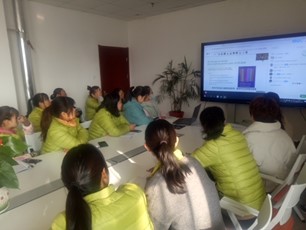
Educators tune into the ECE Symposium.
Part of the success of participation was due to CCIPE’s social media post which attracted over 8000 reads (pre-event). CCIPPE article with photos: 2020中国-新西兰学前教育研讨会在线成功举办 (qq.com)
The entire symposium was bilingual – no small feat in a virtual environment. ENZ used subtitles on pre-recorded presentations, interpretation for the live speakers and engaged a bilingual MC with experience in the ECE field.
University of Auckland Associate Dean International – Faculty of Education and Social Work, Marek Tesar, presented a session at the symposium titled “How ECE Teachers Shape Our Children: Fostering Quality ECE Teachers—Formal Education and Professional Development."
“A fantastic event, which brought together an interdisciplinary group of people to discuss the important topic of early childhood education. It has emphasised the many opportunities for ongoing collaboration between New Zealand and China and I hope that this is the first of many such symposia – hopefully in person next time!” he said.

Watch the recording
To view the recorded symposium, please log back into your ECE Symposium Attendee Login. Didn’t have a registration? Choose Attendee Registration and complete the registration on this website: https://event.dragontrail.com/NZedu/en
Once logged in, navigate to Floor Plan and click “Education Symposium 2020”
Then you will see this screen to click “Playback”
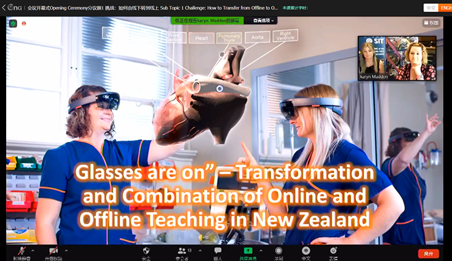
The Southern Institute of Technology (SIT) present at Sino-New Zealand Higher Vocational Education.
8th Sino-New Zealand Higher Vocational Education Conference
This year’s Sino-New Zealand Higher Vocational Education conference moved to a virtual platform this year which enabled continued dialogue between New Zealand and China.
Over three half-days, it focused on challenges and innovations in online learning and international collaboration for managers, teachers and researchers in vocational education and training.
Conference organisers, Wintec and co-organiser, Skills International worked closely with China partners Tianjin Light Industrial Vocational Technical College, Qingdao Vocational Technical College and Central Institute for Vocational Technical Education to deliver an engaging event for the live audience in Tianjin and the virtual attendees.
Agent Seminars
The Agent Seminars reached an audience of 500 attendees from across the Greater China region over two days.
Agents were welcomed by New Zealand’s Ambassador to China, H.E. Clare Fearnley, heard from Immigration New Zealand, Tourism New Zealand, and even learned how to order a green tea in te reo Māori.
With over 44 New Zealand institutions and regions exhibiting in the virtual exhibition hall, agents were able to connect through the virtual meeting rooms to have one-on-one conversations. ENZ trialled a virtual conferencing platform created for the China market that allowed our Chinese agents to join via WeChat and tailor their view to local language.
ENZ wants to thank all the exhibitors, presenters and attendees who participated in New Zealand Education Week to help make it a success and we appreciate your adaptability to a China-friendly virtual platform.
ENZ has received great feedback from both sides on the programme and future partnership opportunities – there is a strong desire to continue dialogue.
Watch the recording
Note, the Agent Seminars were over two days and the majority of presentations are in Chinese language.
To view the recorded seminars, please log back into your Agent Seminars Organization or Attendee Login.
Didn’t have a registration? Choose Attendee Registration and complete the registration on this website: https://event.dragontrail.com/NZedu/en
Once logged in, please navigate to Floor Plan and click “Agent Seminar Presentations”.
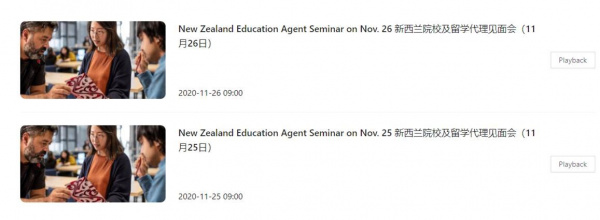
Then you will see this screen to click “Playback” for either 25 or 26 November.
-
Generation Study Abroad and Travel Award winners announced
ENZ has awarded five students US$2000 travel stipends: Cooper Frantz Geddes, Raquel Goutierez, Emma Hardy, William Pahutski and Phoebe Stark.
A further nine students received US$500 from New Zealand universities towards their study costs.
An example of a ‘Kiwi ambassador’ - US student Jake Voss shares his New Zealand adventures on the SiNZ Instagram.
To apply, students had to submit an essay explaining why they wanted to study in New Zealand and serve as ‘Kiwi ambassadors’ on social media.
ENZ’s Director of Education, North America, Amy Rutherford said this support is part of ENZ’s commitment to helping US students experience New Zealand universities.
"These programmes open up new opportunities for US students seeking to study in New Zealand.”
Launched in 2014 by the Institute of International Education, GSA is an initiative to double the number of American students who study abroad by the end of the decade.
ENZ has provided more than 24 scholarships to US students since the programme’s inception, selecting recipients on the basis of academic excellence, leadership skills and ambassadorial qualities.
In addition to the GSA Awards, ENZ and the US Department of State recently announced a new $100,000 partnership in support of the Benjamin A. Gilman International Scholarship Program, which enables students of limited financial means to study or intern abroad.
To read about the winners’ Kiwi adventures, visit their blogs:
Cooper Frantz Geddes http://coopertakeschristchurch.blogspot.com/ Raquel Goutierez http://raquelalexis.weebly.com Emma Hardy https://emkathardy.wordpress.com/ William Pahutski http://billsnewzealandadventure.weebly.com/ Phoebe Stark https://therockytopkiwi.wordpress.com/ Maya Calderwood https://studynz17.wordpress.com/2017/04/27/why-new-zealand/ Sadie Dix https://mynewzealandchronicles.wordpress.com/ Eliza Fallick https://efallicknz2017.wordpress.com Carli Fawcett http://newzealandadventures.webs.com/ Michael McGaw https://michaeltakesonnewzealand.wordpress.com/ Daniel Patel http://danpinnz.blogspot.com/2017/04/im-off-to-new-zealand.html Ellie Peoples https://passportpagesweb.wordpress.com/ Kelsey Woody https://kelseywoody22.wixsite.com/website/blog Josie Davis https://medium.com/@davis.josie01 -
Preferred name and inaugural CE for the IST released by Establishment Board
These conversations provide providers and their stakeholders updates on the progress being made by the Unit and an opportunity to ask questions. These latest conversations will have a focus on the name and brand including the Board’s preferred name for the new national Institute. To support the conversation, a video has been shared that captures the essence of the journey to date. It outlines a vision for the Institute, along with presenting the preferred name.
Once the Regional Kōrero have been completed, the public online consultation will open, allowing everyone to provide feedback on the preferred name being suggested.
The online consultation is open from 14 February until 8 March. Once complete, the IST Establishment Board will consider public feedback on their preferred name and finalise their recommendation to the Minister.
You can watch the video here and the online consultation will be available on the IST Establishment Unit’s website.
Stephen Town has also been named as the inaugural Chief Executive of the New Zealand Institute of Skills and Technology. Stephen is currently in his final year leading Auckland Council and will formally take up his role on 6 July 2020.
You can find out more about Stephen’s appointment on the IST Establishment Unit’s website.