Search
Showing 10 of 982 results for search for pheen4uuu from wiki 2025
-
Ask New Anything: ENZ's next global campaign

Launching in mid-October, ENZ’s global digital campaign 'Ask New Anything' is our most technically sophisticated campaign yet.
The 'Ask New Anything' campaign aims to challenge commonly held perceptions of New Zealand and increase awareness of the country as a high-quality study destination. It does this in a new and innovative way – by inviting audiences in 14 international markets to question what they know about New Zealand.
'Ask New Anything' will be the first time the refreshed 'Think New' brand has been widely used in digital channels. To read more about ‘I AM NEW’, see the E-News story ‘A brand NEW day’.
The campaign brings together ENZ’s digital insights, the refreshed brand and the Study in New Zealand chatbot Tohu, to give prospective students the answers they need to make an informed study decision.
The creative concept
Drawing on Google search data, China-specific insights and data from Tohu, we’ve pulled together a list of the most commonly searched questions about studying in New Zealand.
We put these questions to real international students, a New Zealand student, a teacher, a parent and an employer and recorded their responses in 100 unscripted videos.
As well as being used on YouTube, Facebook and other digital media, the videos will be available on demand in Tohu the chatbot (who can be found on the studyinnewzealand.govt.nz website, the NauMai NZ website and Facebook Messenger).
If asked a question it cannot answer, Tohu will direct prospective students to a new Facebook group or Instagram Live event, where they can ask current international students their questions in real time, delivering on the promise that you can 'Ask New Anything'.
In China, the campaign will use the most relevant questions for the market within WeChat and other local platforms.
ENZ Director Platforms and Campaigns, Euan Howden, says: “Harnessing our award-winning data and marketing platform, we're bringing the refreshed 'Think New' brand to life with a level of technical sophistication that we couldn't have dreamed of a year ago. I'm looking forward to seeing how audiences engage with this campaign, and how this affects their perceptions of New Zealand as their preferred study destination.”
Introducing the new brand
The campaign will be the first global digital showcase of the refreshed 'Think New' brand which positions our international education brand for success and defines quality by the ways we help students make their mark on the world. Additionally, the campaign captures New Zealand’s values of societal openness, transparency and manaakitanga.
ENZ Director Brand and Design, Kaylee Butters, says: “This is the most interactive campaign we’ve run to date. The involvement of our Kiwi Ambassadors and the direct connections enabled by the Facebook group and Instagram Live events really underpins the authenticity of the brand and puts our students right at the heart of the creative concept.”
More information
To find out more about the campaign, and how you can leverage this activity in your own marketing, please click here. This webpage will be updated regularly throughout the campaign as new information and resources become available.
-
Around the world in five
CANADA
Another step toward a new international education strategy
The Canadian government has announced funding for a new international education strategy that will place emphasis on increasing the outbound mobility of Canadian students.
INDIA
Making ‘Study in India’ a success
A lack of infrastructure, funding constraints and a non-existent support system for international students are a few issues restricting 'Brand India' from making India an attractive study destination.
GLOBAL
Humanism is at the heart of international education
Refugee and at-risk migrant students are engaging in international education in different ways than traditional study abroad populations due to the mobility forced on them.
CHINA
Increase in students researching study options 2+ years in advance
Students in China are increasingly commencing preparations to study abroad as early as two years in advance, basing their decision on factors such as expanding international knowledge.
JAPAN
Education on AI proposed for university and technical college students
A panel of experts has called for all university and technical college students in Japan to be given beginner-level education on artificial intelligence with the aim to boost AI research and development.
-
Engaging with Italian students and agents
Italy is New Zealand’s third-largest source of school students in Europe, the sixth-largest European market across all sectors, and our 25th largest market globally. The number of international students coming to New Zealand from Italy has grown steadily in recent years to 617 in 2017.
In October, the ENZ team attended bustling student fairs in Rome and Milan, targeting students looking for study abroad opportunities at tertiary level.
ENZ’s Market Development Manager Europe, Olga Elli, said it was a great opportunity to talk to students one-on-one – particularly at tertiary level, there is much interest in postgraduate study programmes.
“Italian students are really attracted to the idea of New Zealand but their knowledge of our education offering is still fairly low,” said Olga.
“Talking to hundreds of students and making presentations at each fair provided an opportunity to promote New Zealand education. There is also a growing focus on vocational training and pathways to employment – which fits well with our current ‘future-proof’ messaging.”
Over half of Italian students coming to New Zealand choose to study in Auckland, but education agents who attended an ENZ workshop in Milan were keen to hear more about opportunities in other areas of New Zealand.
“Italian agents are very engaged and several of the workshop attendees had recently been on a familiarisation visit to New Zealand, visiting Northland, Tauranga, Wellington and Christchurch.
“We are working with regional development agencies to run a series of webinars for agents in Europe to boost their knowledge, so they have the tools to advise their clients about what New Zealand can offer international students.”
New Zealand’s profile as an education destination for Italian high school students was boosted this year by ENZ’s Follow the Kiwi scholarship campaign which ran in France, Germany and Italy. Italy led the way in generating digital engagement, with the highest number of visits to the scholarship application page, and a strong showing in completed applications and requests for further information.
Building on this engagement, Olga paid a surprise visit to the school of Italian Follow the Kiwi scholar Gaia Leidi, from Busto Arsizio, near Milan, who will use the NZ$15,000 award to study at Kerikeri High School from January to September next year.
“Our visit to Gaia’s school generated lots of media attention. She’s a huge rugby fan and was blown away to be invited to the All Blacks vs. Italy game in Rome later this month!
“ENZ intends to build on the success of this year’s campaign and will run it again next year – watch this space!”
If you would like to get in touch with an ENZ Recognised Education Agent in Italy, please take a look here.

L-R: Olga Elli engaging with students at the student fair in Milan; and meeting Gaia during a surprise visit to Gaia's school.
-
From the Chief Executive: Growth and global partnerships in international education
Kia ora koutou,
It’s great to be home following an impactful, whirlwind visit to Beijing for the China Annual Conference and Expo for International Education (CACIE).
I am pleased with the collective outcomes we have achieved from this visit. For one, New Zealand education institutions formalised 32 new partnerships with their Chinese counterparts that present real opportunity for knowledge exchange and pathways for students to experience the best of both countries.
ENZ signed a letter of intent with the China Center for International People-to-People Exchange to grow our education cooperation, particularly through institutional relationships across higher education and schools.
As Country of Honour at CACIE 2025 New Zealand had unparalleled opportunity to demonstrate why we are a high-quality education destination, backed by a strong student experience and a reputation for safety, inclusivity and innovation.
Last week ENZ’s extended leadership team, including our offshore Regional Directors, came together in Wellington. As part of our programme we visited four education providers across the region – Wellington College, Victoria University of Wellington, Whitireia and WelTec Petone and Le Cordon Bleu Wellington – before meeting with the Schools International Education Business Association (SIEBA) to understand the work they do with schools nationwide. These were insightful engagements that enriched our understanding, and we appreciated the warm welcome extended.
In other news, I am pleased to share with you that Tony Gray has been appointed permanent Chair of the Board of Education New Zealand. Tony has been a strong advocate for us while Acting Chair and a genuine pleasure to work with, so it is fantastic to have him confirmed in the role to 31 October 2027.
Lastly, I wanted to finish by acknowledging the sad passing of two public sector colleagues, Paul Irwin and Neil Miller, during the month of October.
Paul Irwin was a valued colleague at ENZ, having been a member of the Senior Leadership Team and part of our whānau for seven years. Although I didn’t work with Paul at ENZ, I knew him from his advertising industry days when we worked together on the ‘It’s Not OK’ campaign for action on family violence. His passing is a tremendous loss and he will be remembered for his strategic smarts, calm nature, and his leadership of New Zealand’s education brand over the years.
As Chief Advisor - Policy and International at the New Zealand Qualifications Authority, Neil Miller was a regular presence at International Peak Body meetings over the last four years. Neil would bring his deep-thinking skills and humour to these meetings, and always took a genuine approach to listening and helping solve issues that matter to us all.
Our thoughts are with their families and friends.
Moe mai rā, Paul and Neil.
Kua whetūrangitia kōrua
Return, take your place amongst the stars along with your ancestors that adorn the sky.
Ngā mihi nui,
Amanda Malu
Chief Executive
-
Around the world in five
China
A new visa scheme announced by China this month to woo international STEM talent to the country could encourage more short-term exchanges, visiting fellowships, and cooperative research projects, according to experts.
Global
ICEF Monitor explored how proposed changes to post-study work policies in the US and UK could reshape international student mobility.
United States of America
A National Foundation for American Policy report warns that many US colleges could shut down without international students and immigrants.
Australia
Australia’s international education sector has endured 18 months of turmoil. Sudden policy shifts, political rhetoric blaming both students and agents, and a looming cap on international student numbers have shaken confidence in what was once a beacon for global learners.
Pakistan
Pakistan's large youth population is fuelling a surge in student mobility, with the UK, US and Germany seeing the largest growth, a new report has revealed.
-
New brand identity of the Manaaki New Zealand Scholarship Programme launching next week
Education providers and suppliers who are part of the programme will be able to start using the new brand’s design assets from The ENZ BrandLab from 23 October.
The Manaaki New Zealand Scholarship website will also prominently showcase the refreshed brand from next week.

The new Manaaki logo consists of three parts. The tohu is on the left, the Manaaki wordmark is placed in the middle, with the Aotearoa New Zealand fernmark on the right-hand side.
New Zealand Ministry of Foreign Affairs and Trade - Manatū Aorere (MFAT) Scholarships Unit Manager, Alexandra Grace, said it was important for the new brand identity to reflect the transformational nature of Manaaki scholarships to build people’s skills and support them to contribute positively to their communities and countries.
“The new brand is an exciting step forward to unify the Manaaki New Zealand Scholarship Programme’s visual identity to appeal to prospective scholars who are most aligned with our Programme’s values,” Alexandra said.

He parirau is one of the key patterns of the new brand. It is inspired by the takarangi (spiral) and parirau (feathers).
The brand identity development and working group involved kaimahi Māori from MFAT, Education New Zealand Manapou ki te Ao and Indigenous Design Innovation Aotearoa (IDIA) who gifted a specially crafted whakatauākī* for the Manaaki New Zealand Scholarship Programme.
The whakatauākī ‘He Parirau Toro Ao’ translates to ‘stretch your wings to the world’.
ENZ’s Senior Advisor, Rautaki Māori, Craig Rofe, said the whakatauākī is a profound taonga and gift to the Manaaki New Zealand Scholarship Programme.
“It beautifully anchors the programme in āhua Māori (Māori ways of being).”
“We are also pleased with how the whole process of creating the new brand has been steeped in āhua Māori. The way everyone involved in the project used whakawhanaungatanga – the specific act of getting to know one another before we started our work – and wānanga, coming together to meet, discuss and deliberate, every step of the way, made all the difference,” Craig said.


Digital banners showing the application of the brand and whakatauākī.
The new brand was developed following research and interviews with 29 scholars and alumni, and a survey covering 627 people.
The research surfaced three compelling principles for the Manaaki New Zealand Scholarship Programme – manaakitanga, empowering people, communities and countries, and fostering enduring connections.
ENZ’s Manaaki Scholarships Manager, Nancy Linton, said the concept of manaakitanga is integral to the Manaaki New Zealand Scholarships Programme – not only by name, but also in the way that scholars are supported during their entire journey, from application and study to their return home.
“The manaaki we show our visitors by embracing them like part of our ‘whānau’ or family is visible in the way our educational providers extend that support to Manaaki scholars and alumni, who really value it as part of their study experience.
“I am pleased with the way we have incorporated this core element of the Programme, among others, into the new brand identity,” Nancy said.
A brand transition period is in place through 28 February 2025, to allow providers enough time to switch to new brand assets.
Visit The ENZ BrandLab to access new design assets for the Manaaki New Zealand Scholarship Programme after 24 October.
* Whakatauākī are proverbs where the person who said it first is known, as opposed to whakataukī, which are proverbs whose origin cannot be traced to a person.
-
International student enrolments continue upward surge
“Enrolments are steadily rising to pre-pandemic levels, with 2024 enrolments (83,425) now at 72 percent of 2019 totals (115,705).
“New Zealand reaps a broad range of economic, social and cultural benefits from having international students in our midst. International education boosts our economy, creates business opportunities, fuels innovation, and delivers essential cross-cultural skills for a more connected world.
“This sustained growth highlights the international education sector’s progress towards achieving the Government’s Going for Growth Plan goal of doubling the export revenue from international education by 2034.
“Universities and government-funded private training establishments (PTEs) are close to matching 2019 enrolment numbers. We are seeing enrolments grow across universities, schools, Te Pūkenga/NZIST, government-funded PTEs, and English language schools subsectors. In 2024, the strongest year-on-year growth was seen at government-funded PTEs (+59%) along with primary (+53%) and intermediate (+32%) schools.
“Universities saw 33,485 total enrolments, schools had 18,350 enrolments, while Te Pūkenga/NZIST and government-funded PTEs each had 10,270 and 10,185 enrolments, respectively.
“More international students are now enrolled for master’s study programmes in New Zealand. Between 2023 and 2024, there has been a 68% increase in master’s enrolments, with 14,695 international students in 2024, up from 8,740 in 2023. This is an 85% increase compared to 2019 when we had 7,945 enrolments for master’s study.
“The overall rise in enrolments at the national level is underscored by a diversity of regions leading strong growth from 2023, including Waikato (+50%), Hawke’s Bay (+44%), West Coast (+185%) and Gisborne (+156%). The Waikato region is notable in that it has seen significant growth across multiple subsectors: universities, Te Pūkenga/NZIST, government-funded PTEs and schools.
“China and India remain the top two source markets for international student enrolments with 34% and 14% enrolments respectively, followed by Japan (9%), South Korea (4%), Thailand (3%), United States of America (3%), Germany (3%), the Philippines (3%) and Sri Lanka (3%),” Malu says.
More information on enrolment numbers can be found here.

Note: All numbers are current as at 1 April 2025. Full numbers have been rounded to the nearest five. One individual may enrol more than once.
Government-funded PTEs are PTEs that receive government student funding for learners who are defined as domestic students under the Education and Training Act 2020 (note that PhD and exchange students are defined as domestic students under the Act).
For further information:
Sai Raje | Senior Communications Advisor, Education New Zealand
+64 21 479 649
About Education New Zealand Manapou ki te Ao (ENZ)
Education New Zealand Manapou ki te Ao (ENZ) is the government agency dedicated to helping New Zealand realise the social, cultural, and economic benefits of international education. Our role is to promote New Zealand as a high-quality education destination offering excellent education and student experiences.
With approximately 82 staff in 14 locations around the world, ENZ works closely with New Zealand’s diverse education sector which includes schools, English language providers, Wānanga, private training establishments, New Zealand Institute of Technology/Te Pūkenga, and universities. Internationally, we work with a range of education stakeholders, including government agencies and education providers to identify and encourage sustainable growth opportunities for New Zealand’s education sector.
-
Around the world in five
Canada
A new report by Statistics Canada has revealed international graduates typically earn less than their Canadian peers and are more likely to work in sales and services industries.
Australia
A new study into the perceptions of immigrants and immigration policy preferences led by The Australian National University (ANU) has found that Australians want less migration but also hold “large and often contradictory misperceptions”. At the same time, support for international students remains steady.
Africa
ICEF Monitor has analysed mobility patterns in East Africa, noting the growing emphasis on arrangements and frameworks that are beneficial for both sending and receiving countries.
United Kingdom
A UK public opinion poll has shown support for international students and for maintaining or increasing current numbers, with most voters not viewing students as migrants.
India
India’s University Grants Commission has introduced several higher education reforms over the last four years in keeping with the National Education Policy 2020.
-
Incheon Metropolitan Office of Education deepens links in New Zealand
The delegation from Incheon Metropolitan Office of Education East Asia Global Education Institute (Incheon MOE) travelled to Ngatea, Wellington, Canterbury and Otago – visiting providers from the schools, university and vocational education sectors.
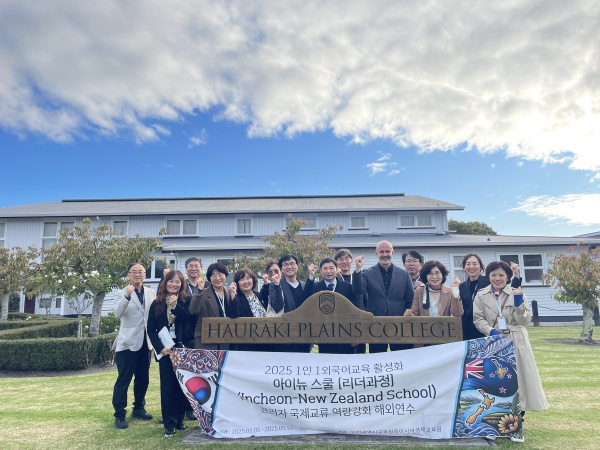
The visit began with a visit to Ngatea to connect with Hauraki Plains College and Ngatea Primary School.
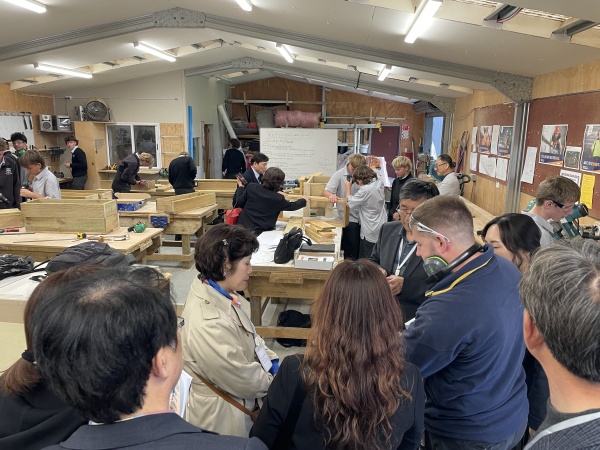
Observing the Agriculture Academy and trades-based courses at Hauraki Plains College.
A key aspect of the delegation’s time in Ngatea was the signing of a Memorandum of Understanding (MoU) between Hauraki Plains College and four schools from Incheon: Sunin High School, Shinsong High School, Geomdan High School and Youngwha International Tourism High School.
The intent of the MoU is to strengthen educational ties between the schools, which includes a reciprocal exchange program.
The first of these exchanges will see 28 students from across the four Incheon schools visit Hauraki Plains College in October 2025, 28 students from Hauraki Plains College will then travel to Incheon in April 2026.
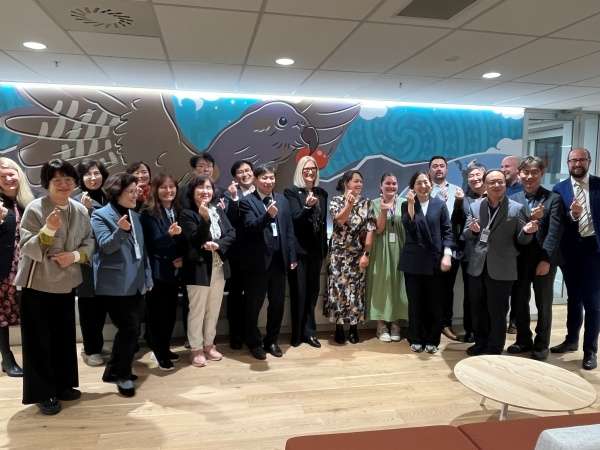
The delegation was formally welcomed to the Wellington with a Mihi Whakatau hosted by ENZ Chief Executive Amanda Malu, local staff and the Ministry of Education (MOE).
In Wellington, the delegation received a detailed briefing from the Ministry of Education and visited Scots College to observe the school in action.
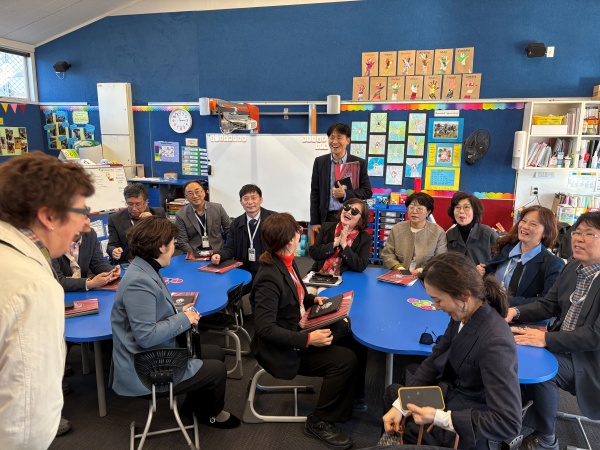
Scots College Junior School Principal, Rachael Huggins, showing the Incheon delegation around a primary-level classroom.
Down to Christchurch, the Incheon delegation visited Lincoln University to fine-tune the details of an MoU signed in January this year. The partnership arrangement will support five Incheon students to study at Lincoln University each year.
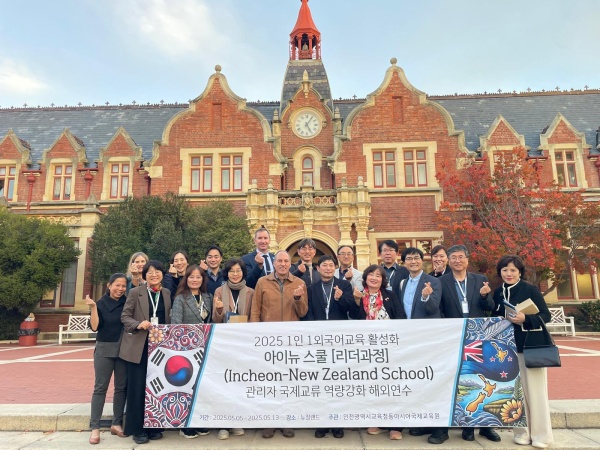
Incheon delegate members with Lincoln University staff from the Faculty of Agriculture and Life Sciences, Faculty of Agribusiness and Commerce, Academic Preparation and Pathways and International Operations.

Waitākiri Primary School Principal Mr. Andrew Barker introduces a Year 6 long-term international student from Korea to the delegates. She shared how much she has enjoyed her time at Waitākiri Primary School and expressed her sadness that her year at the school is coming to an end.
The group visited Shirley Boy’s High School and Avonside Girls High School in Christchurch, with a side-visit organised with Waitākiri Primary School.
Further South, a visit was arranged with Otago Polytechnic in Cromwell to understand the pathways to vocational education in New Zealand.
Director of Incheon Metropolitan Office of Education East Asia Global Education Institute, Jooyong Kim, said visiting New Zealand schools was a truly meaningful and deepened delegates understanding of the education system.
“We hope this visit will help strengthen the relationship between schools in New Zealand and Incheon”.
“We look forward to future collaborative projects with New Zealand institutions,” he added.
Several of the schools visited have expressed interest in deepening these new relationships, with planning underway to keep up the momentum and connect again at ENZ-led fairs and agent seminars in Korea later this year.
-
Diverse New Zealand experience on show at the symposium on offshore delivery
Dr Rob Griffiths, Programme Director of Occupational and Aviation Medicine at the University of Otago summed up the mood of over 70 participants from across the university, Institutes of Technology and Polytechnics (ITP), Private Training Establishments (PTE) and educational services sector that attended a symposium on offshore delivery organised by Education New Zealand (ENZ) in partnership with Victoria University of Wellington on Thursday 9 June. Senior education professionals shared their experiences - both the good and bad – in delivering education services offshore. Sessions covered quality assurance, sustainable models, collaboration and the power of partnerships, critical success factors and explored a variety of markets from Singapore to Russia, the Middle East to Association of Southeast Asian Nations (ASEAN).
The future of digital and online learning technologies to transform and disrupt higher education was discussed with examples ranging from early childhood training, software development, and aviation medicine to training in wildlife rescue after an oil spill. ENZ’s General Manager Business Development Clive Jones said that the day “created a network bringing together a diverse group at different stages of development who were keen to stay together”.
One of the keynote speakers on international trends was Boston-based Richard Garrett from The Observatory on Borderless Higher Education, an education think tank with a focus on transnational education (TNE). Garrett was positive about the huge global opportunity and the TNE potential for New Zealand. In particular, the opportunity to learn from the main TNE providing countries - UK and Australia – and take a strategic approach in partnership with destination countries. His view that offshore delivery was like a permanent start up resonated strongly with participants.
“With around 3,500 offshore international student enrolments there is quite a way to go to achieve the target of 10,000 by 2025 set by the Government’s Leadership Statement for International Education. But the diversity of providers, markets and projects showcased at the symposium confirmed that New Zealand has the products, range of capability and interest in moving forward together. ENZ has been challenged to keep the conversation we started in Wellington going” said Adele Bryant, Business Development Manager at ENZ.
For more information contact Adele Bryant.