Search
Showing 10 of 982 results for search for pheen4uuu from wiki 2025
-
New Zealand Global Competence Certificate programme proves a hit
What is New Zealand’s Global Competence Certificate programme?
The customised cultural exchange programme, which started as a pilot partnership last year between New Zealand’s international education agency, Education New Zealand Manapou ki te Ao and AFS Intercultural Programs, Inc. has proved so successful it is now being extended and taken up by schools and tertiary institutions around the country, connecting them with students in Asia and Latin America.
The “Kiwi way” has much to offer the world, and international education has much to offer New Zealanders at a time the world needs people with cross-cultural competencies. The New Zealand Global Competence Certificate, delivered through Massey University, develops cultural self-awareness, emotional resilience, and build bridges across cultures. It also piques the interest of students offshore in coming to New Zealand in better times.
The programme delivers animated videos, quizzes, assignments, and weekly live facilitated dialogue sessions for learners to talk with each other online in real time and learn about life from perspectives other than their own.
What have students been saying about the NZGCC programme?
“Not only have I learned to become a better communicator, empathiser, and global citizen, but also how a group of like-minded individuals can come together to form something bigger,” says Jack Hittle, of Northland’s Springbank School.
“I found the programme life-changing,” says Vaagisha Kanwar, a Year 11 student at Indus International School in Bangalore, India, who connected with the Northland students. “We learned about conflict, empathy, inequality, different communication styles, how different people adapt to new situations, and about suspending judgement. I know that I’ll use the skills we’ve learned for the rest of my life, not just when I travel abroad but also in daily life.”
"You see the way a culture greets each other or the way they dress, but then there are things like relationships, gender roles, and health,” says Whanganui Girls College student Tilda Donson.
What have educators been saying about the NZGCC programme?
Whanganui Girls College Principal Sharon Steer is delighted with the NZGCC programme, which she says will help students build their understanding of global cultures, and other critical “soft” skills which will prepare them for life as they enter the workforce.
“An important part of our curriculum is developing strong communication skills and setting our students up for success in the workplace. The NZGCC programme will add another dimension to our lessons by teaching our students how to develop meaningful relationships with one another despite language and cultural differences.”
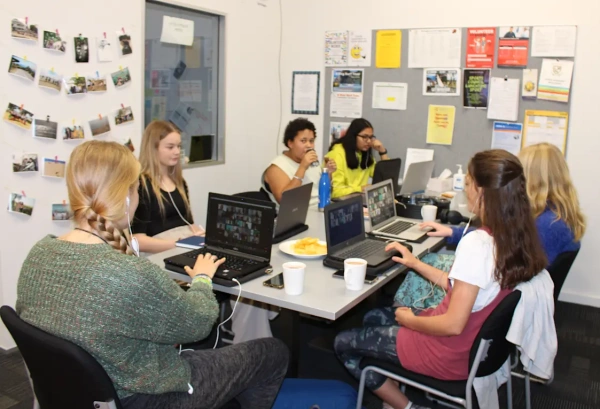
Educators say that with the borders closed, the programme now forms an important part of the reshaped international education experience.
“It is so important that our students don’t miss out on the enriching life skills that are gained when we interact and connect with people from around the globe,” says Whangarei Girls High School International Director Amelia Morrison, who has students working with peers in India.
"Global competence is mission-critical for our world," says AFS Intercultural Programs President and CEO Daniel Obst. “Educating more young people to become global citizens is crucial if we want to create a more just and peaceful world.”
The expansion of the GCC programme reflects the diversification of education in new virtual forms fit for a globally connected world, says Education New Zealand Chief Executive Grant McPherson.
“As well as helping to develop the global citizens of tomorrow, this programme demonstrates the reciprocal benefits of international education, giving our rangatahi a chance to learn with high school students from around the world, and giving their offshore peers a chance to learn ‘with’ New Zealand and our unique way of thinking.”
-
Government delegation from South Korea visits New Zealand to reconnect with several of our education providers
New Zealand and South Korea have strong education links and one unique partnership is the education cooperation under the Korea-New Zealand Free Trade Agreement (KNZFTA) which has historically included education programmes for Korean school and tertiary students.
The visiting delegation included representatives from the Korea Ministry of Food, Agriculture and Rural Affairs (MAFRA), the Korea Ministry of Oceans and Fisheries (MOF), the Korea Agency of Education, Promotion and Information Service in Food, Agriculture, Forestry and Fisheries (EPIS) and Korea Fisheries Resources Agency (FIRA), the implementing agency for the MOF-funded project.
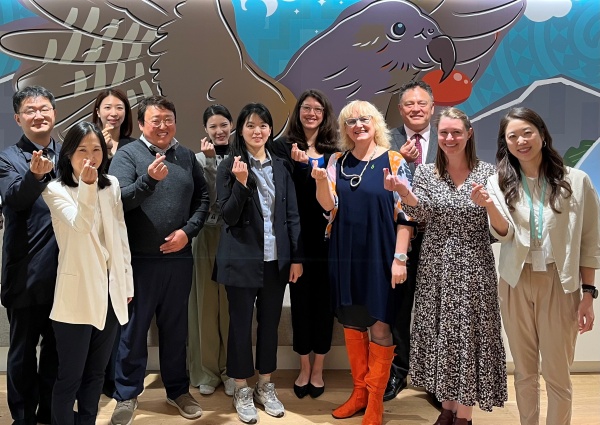
The delegation was welcomed to the ENZ Wellington office with a mihi whakatau on their first day. ENZ, Ministry of Education (MoE) and Ministry of Foreign Affairs and Trade (MFAT) colleagues joined together for waiata and kai with our Korean guests.
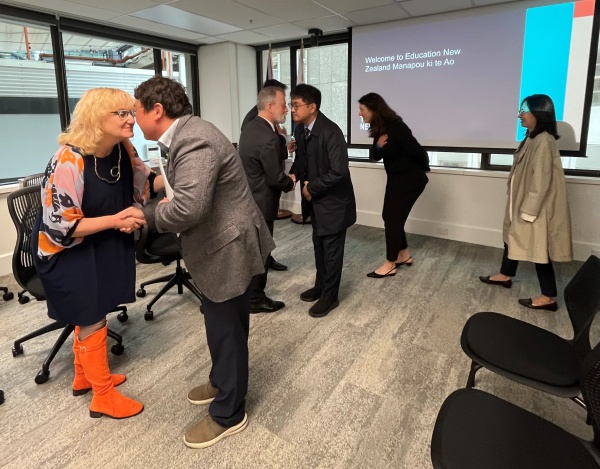
Following a welcome and mihi whakatau in Wellington, the group travelled on to Nelson where they visited Te Pūkenga Nelson Marlborough Institute of Technology (NMIT) and Nayland College. The visit to Nayland College was an opportunity for the Korean representatives to gain a better understanding of the pastoral care for school students and the unique offerings such as outdoor education and horticulture programmes.
Kay Lee, ENZ Senior Market Development Manager – Korea, said it was important for the Korean delegation to experience firsthand the welcoming and safe environment of New Zealand schools to regain confidence in the Schools Visits Programme.
“After the COVID-19 pandemic, the Korean Government was concerned about sending students, especially younger students, overseas to study particularly on scholarship programmes because parents wanted assurance their children will be well looked after. In the debrief with the Korean representatives, it was clear they gained confidence from speaking to the New Zealand institution representatives around the procedures and systems in place to support students.”
“We hope that this renewed confidence will mean that we start seeing Korean government scholarship school students studying in New Zealand again in the near future”.
High on the agenda during the delegation’s visit were the School Visits and Tertiary Training Programmes, both of which were affected significantly during the pandemic.
From 2016 –2019, the School Visits Programme provided 150 high school scholarships per year for South Korean students from rural areas to attend New Zealand schools for eight weeks. The Korean Government planned to continue the Schools Visits Programme with its own funding in 2020, however, the programme was cancelled due to travel restrictions during the pandemic.
An alternative programme was run by MAFRA and MOF from December 2022 which involved short-term English Language Training for school students in Korea with three New Zealand teachers travelling to Korea to teach English (Read about their experience here).The Korean organisers have decided to run the English language programme in Korea again with six New Zealand teachers traveling to Korea to teach English in January 2024.
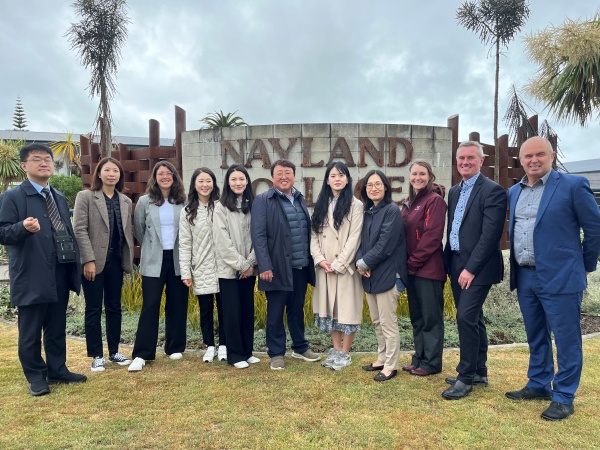
Nayland College demonstrated manaakitanga by welcoming the group to rainy Nelson but provided an Asia Kiwi lunch complete with meat pies and sushi!
Like the Schools Visits Programme, the pandemic interrupted tertiary programmes and the revised programme ran in January 2023 with short term group programmes. The site visits in November to Te Pūkenga NMIT and Lincoln University provided an opportunity to discuss the institutions’ proposals to host Korean tertiary students in January 2024.
Also discussed was the importance of reciprocity and it was noted that Korea is a popular destination for New Zealanders under the Prime Minister’s Scholarship for Asia (PMSA) scheme. Since 2016, the scheme has awarded scholarships to 196 individuals or groups for study, intern or research programmes in Korea. Lincoln University, in particular, has been successful in facilitating group PMSA programmes focused on agriculture to Korea.
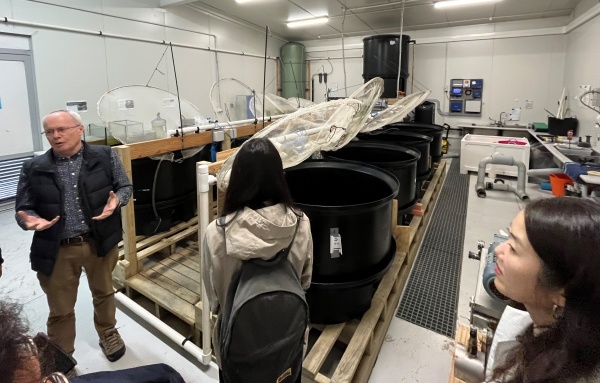
Dr Mark Burdass, Aquaculture Programme Coordinator and Tutor, introduces the hands on learning in the aquaculture programme at Te Pūkenga NMIT.
At the conclusion of their visit, the Korean delegation expressed their gratitude to the institution hosts for making their time in New Zealand memorable and valuable through fruitful discussions. The delegation emphasised the importance of conducting these meetings in person and visiting the campuses to meet with institution staff and academics. The ENZ Manapou ki te Ao team is pleased to continue close cooperation with our Korean education partners to facilitate connections with New Zealand education providers for the education programmes.
If you are interested in finding out more about the education initiatives originally outlined in the KNZFTA, you can read about this in a 2016 E-News article here - New opportunities for New Zealand and Korea.
-
ENZ strengthens role in Indonesia

Desiree Lee
Desiree Lee has been appointed as ENZ Market Manager responsible for Indonesia, in addition to Malaysia and the Philippines.
Naluri Bella Watti has been appointed to the position of ENZ Programme Manager, Indonesia, and will begin with ENZ in the Jakarta office from Monday 17 June. Naluri will be responsible for developing and delivering ENZ’s in-market activities, having formerly worked in a marketing strategy role for British Council Indonesia.

Naluri Bella Watti
ENZ’s Regional Manager East Asia, Ben Burrowes, said these appointments align with ENZ’s strategic direction to bolster in-market representation for ENZ’s priority markets, with at least two representatives now covering the South East Asian markets.
“Indonesia remains an important market for ENZ with a wide range of business opportunities across the country. We’re very pleased to now have additional senior resourcing and with a busy activity calendar ahead, we look forward to working alongside our institution partners to deliver the right results.”
The annual ENZ Fair is the next large event on ENZ’s Indonesia activity calendar and will be held in Jakarta on Sunday 28 July. An agent seminar will also be held the following day on Monday 29 July.
For more information and to register for the events, click here. Please note that the second round of institution registration closes on Monday 13 May.
For any Indonesia enquiries ahead of Naluri’s start date, please contact desiree.lee@enz.govt.nz or ben.burrowes@enz.govt.nz.
-
New Zealand's growing presence in US study abroad
The Forum on Education Abroad
Held in Seattle, Washington, this year’s conference was an opportunity for New Zealand providers to meet with existing and potential partners in the US, and to participate in professional development sessions on standards in study abroad. The University of Auckland exhibited, and the University of Otago co-presented a session. Representatives from Nelson Marlborough Institute of Technology, University of Canterbury and Victoria University of Wellington also attended as did ENZ’s US Director of Education, Amy Rutherford, and ENZ’s US Field Director, Alanna Dick.
 The conference capped off at a luncheon plenary where Shanna Law, a former study abroad student, gave a talk about her year at the University of Otago. Shanna won the ‘Award for Academic Achievement Abroad’ for her research project on geology in Central Otago, which she presented to 1,000 conference attendees.
The Forum on Education Abroad is accepting nominations for next year’s Award for Academic Achievement Abroad. The deadline is 30 August 2017. The next conference will be in March 2018 in Boston, Massachusetts.
The Institute of International Education Best Practices conference
Alanna Dick also represented ENZ at the Institute of International Education (IIE) Best Practices Conference, in Florida, in March. The event showcased the 2017 winners of the IIE Heiskell awards, which acknowledge international partnerships, internationalising campuses and study abroad.
Monash University and Macquarie University were the only non-US award recipients to present their programmes. Awardees were given 15-minute speaking slots at the event, while their institutions were recognised through IIE press releases, a cash prize and an awards ceremony.
As the awards are a great way to showcase the innovative practices on campuses, Alanna hopes to see New Zealand institutions involved in future.
“New Zealand institutions have several innovative initiatives that could fit the Heiskell award categories, including the unique ways they run international partnerships with US institutions to meet the needs of students.
“The awards are self-nominated, and it’s never too early to be thinking about next year’s award selection,” Alanna said.
IIE Heiskell Award applications are due in October 2017. Winners are notified in December, giving ample time to prepare for the conference in March.
Get involved with the IIE
IIE aims to double the number of US students studying abroad by 2020. New Zealand institutions can partner with the IIE by becoming a participating university in the Platform for Education in Emergencies Response programme or hosting a professor or researcher from the Scholarship Rescue Fund.
For more information, contact Alanna: alanna.dick@enz.govt.nz.
-
Announcing the recipients of the Welcome to New Zealand Scholarships
The initiative was warmly received across Germany, Italy, and France, where it was promoted with the goal of encouraging students to experience the world-class education and unforgettable lifestyle that New Zealand has to offer.
As part of the campaign, we offered four scholarships, each valued at 5,000 EUR to go toward tuition fees at New Zealand secondary schools or tertiary institutions. These scholarships were designed to support talented and passionate students on their journey to study abroad.
A key highlight of the campaign was our collaboration with Air New Zealand, who will generously sponsor return flights for the scholarship recipients. Their support played a pivotal role in making the dream of studying in New Zealand even more accessible for the winners.
The scholarship attracted over 200 applications – with a majority coming from Germany, followed by Italy and France.
During the campaign period, there were 19,965 total views on the Welcome to New Zealand Scholarship page on the Study with New Zealand website.
The campaign generated 172 lead enquiries to New Zealand providers (118 enquiries from Germany, 47 enquiries from France and 7 from Italy). These enquiries are sent straight on to the education providers so they can directly engage with the prospective student on their study interests.
Meet the recipients

Germany
The scholarship winner from Germany is 16-year-old Manuel Fink, from Unterhaching (near Munich).
Manuel will be heading to Te Puke High School, where he’ll immerse himself in both the academic and cultural experience of studying in New Zealand.
A passionate advocate for New Zealand and its education system already, Manuel has his sights set on becoming a pilot — ideally flying for Air New Zealand one day!
Our tertiary scholarship recipient from Germany is currently finalising their enrolment, and we look forward to announcing their name once the process is complete.

Italy
Our Italian scholarship recipient is 16-year-old Lea Sagliaschi from Milan. Lea will be attending Selwyn College and is full of excitement for what she describes as a “once-in-a-lifetime adventure” in Aotearoa New Zealand.
Unfortunately, no recipient could be selected from France this year due to a lack of eligible applications — however, the ENZ Europe team remains committed to engaging with prospective students in the French market and looks forward to stronger participation in future campaigns.
ENZ Associate Director of Engagement Europe, Olga Elli, said the campaign raised great awareness of New Zealand’s education system in European priority markets and opened the door to new experiences and opportunities for winners.
“We look forward to building on this momentum and continuing to share the unique value of a New Zealand education with European students and partners,” she said.
- Generation Study Abroad New Zealand Institutes of Technology and Polytechnics Excellence Awards NZITPEA application form
-
Around the world in five
BRAZIL
Brazil unveils new HE internationalisation scheme
Brazil is replacing the Sciences without Borders (CSF) initiative with a new international mobility financing regime, aiming to enhance bilateral relationships with overseas partners. The new fund will be targeted towards postgraduate students and early career researchers looking to develop research abroad. While the CSF was managed at a federal level, the new scheme gives more autonomy to universities, requiring them to form an internationalisation strategy with international partners.
GLOBAL
Is fear of unqualified leads holding back your school website?
If universities optimised their websites, most could multiply the number of enquiries captured by up to 400%. Achieving this result requires just a few simple tweaks that make it easier for visitors to register their interest, such as decreasing the number of questions on a web form, segmenting by readiness (the distinction between “Keep me updated” forms and “Talk to me” forms) and using more student testimonials and videos.
UK
74% of public value international students when economic worth revealed
New research has found that people’s attitudes towards international students change when learning of their economic contribution and the jobs they generate. In a recent survey, only 12% of respondents wanted to see more international students in the country, but this doubled to 24% when they learned of the economic gains. Similarly, the 20% who wanted to see less international students in the country dropped to 13% when told of the economic value of international students.
FRANCE
French tech: A hot spot for entrepreneurs, 15 years in the making
Watch out Silicon Valley – the tech scene in France is gaining massive traction. Students from France’s world-leading business schools are now choosing tech over other job options, with one third of French students stating they would like to either found or join a start-up. The French talent pool is also impressive: Paris has over 134,000 professional developers, the second highest in Europe behind London, and 43% possess an MSc in Computer Science.
SOUTH KOREA
South Korean teens top in maths and science, but lack interest
South Korean students are excelling in science and mathematics, but the way the subjects are taught is not kindling interest in the students, a new report reveals. While South Korea placed fifth worldwide in the Program for International Student Assessment (PISA) 2015 science test, and first for maths, they ranked 26th and 28th (out of 35) in terms of interest. Professor Lee Joo-ho of the Korea Development Institute (KDI) says the disparity can be traced to the “learning by rote” method in the nation’s schools.
-
Teaching the teachers
The School Influencers Workshop series focuses on new ideas in Early Childhood Education, English Language teaching and educational management and leadership. Originally planned to be delivered in-person, this is the first time the course will be held online.
Members of the UC College of Education, Health and Human Development will deliver the online courses to more than 100 education practitioners and administrators alongside in-market organisations Teach for Indonesia and Teach for the Philippines.
UC Associate Dean (International), Dr Stuart Wise, said “The College of Education, Health and Development at the University of Canterbury is delighted to support this initiative sponsored by Education New Zealand. We are very keen to support our colleagues at Teach for Indonesia and Teach for Philippines are looking forward to the opportunity to engage with course participants and share some of our expertise with them.”
The professional development of teachers has been a key part of ENZ’s South East Asia engagement strategy since 2016.
“The School Influencers Workshop series gives teachers and administrators a taste of New Zealand’s top-quality education by offering an insight into our hands-on teaching methodologies and contact with top academics,” ENZ Market Manager Indonesia, Malaysia and Philippines, Desiree Lee, said.
“Teachers, counsellors and school leaders remain a key group of influencers in a student’s study journey. They are an important group which ENZ will continue to engage as the international education sector recovers from COVID-19.”
Read the UC story on the Schools Influencers Workshop series
-
Meet the Team: Lisa Futschek
Hi Lisa. Could you please outline your own role and the role of the International team?
ENZ’s International Team delivers on the strategies our organisation sets to best position New Zealand as an education partner in our key offshore markets. It’s a two-way flow with our skilled offshore teams not only delivering a vast array of in-market initiatives, but also providing crucial market intel contributing to the setting of our core strategies and objectives.
We ask a lot of our teams. Not only do they bring crucial language skills and a deep understanding of the cultural context, but they are also marketers, event organisers, Government-to-Government experts, relationship managers, skilled communicators and more. They need to be as comfortable talking with a Minister as they are with a student seeking an education in New Zealand.
My role is to set the direction, to coach, mentor, energise, and to ensure that the output of our team plays its part in realising the overall vision of our organisation.
How is the COVID-19 pandemic impacting your team’s work?
The impacts of COVID-19 on the International Team’s work have been wide-ranging.
The first order of things related to the closed borders and the need to cancel, postpone or re-imagine the large number of in-market events that had been planned.
At the same time, there was a square focus for both ENZ’s off- and onshore teams to support the experience of those international students who remained in New Zealand or had been unable to get here. This included everything from their access to online learning, accommodation needs, physical and emotional wellbeing, support through hardship, visa queries and connection to repatriation flights.
Throughout all of this, the offshore teams have been heavily engaged in communicating with a full range of stakeholders – students, parents, agents, industry partners, NZ Inc partners and governements – to keep them abreast of developments and to assist in responding to their wide-ranging information needs.
Can you tell me a bit about your own professional background?
I’ve always been interested in international relations. I spent 18 years as a career diplomat with the Ministry of Foreign Affairs and Trade (MFAT), living and working in Chile, Germany and New York City.
Through those 18 years at MFAT, I gained an understanding of New Zealand’s place in the world. There is no doubt that we punch above our weight. Positioning our nation globally through diplomacy is highly rewarding but it is also a long game.
What I have found particularly satisfying since joining Education New Zealand in 2013 is the short gap between effort and result. We get to see very quickly the impact of our work on thousands upon thousands of people whose lives have been transformed by a New Zealand education. I’m proud to be able to play a part in that.
People might think that diplomacy is something which happens exclusively at embassies and at a Government level. But in fact, education diplomacy is part of our organisaton’s DNA. And through our alumni we have created an enormous international network of ambassadors for both a New Zealand education as well as everything else our country has to offer.
What do you do in your spare time? Can you tell us about the choir you sing in?
Yes! I’ve been in a local choir called the Doubtful Sounds since 2014. It’s wonderful. It’s complete “me time”. It’s away from work, it’s away from the family, it’s an escape from the normal preoccupations of life. I find it completely joyful.
I love making music with other people. We’re not too serious; it’s not an auditioned choir and reading music is not a pre-requisite. I love the fact there’s a whole range of people involved. Our choir master Bryan Crump (of RNZ fame) is a brilliant musician and arranger of music, and is very active in getting us in public. We sing at weddings, flash mobs in the street, the Fringe Festival, slots on RNZ. We sang last year in the Wright’s Hill gun implacement and at this year’s Newtown Fair.
-
Around the world in five
GLOBAL
University applicants turn away from US and UK
Canada has overtaken the UK as a preferred study destination for international university applicants, according to the 2018 QS Applicant Survey. The survey provides further evidence that international students are increasingly rejecting the UK in favour of other English-speaking destinations.
SOUTH EAST ASIA
South East and East Asia’s growing popularity with international students
South East Asia’s lower study and living costs, coupled with its offering of an ‘exciting study abroad experience not too far from home’, is attracting international students from the wider Asia-Pacific region.
UK
Take students out of migration stats, say policymakers and stakeholders
A forum about the UK’s future immigration policy included lengthy discussion about the inclusion of international students in the net migration target, with many arguing it creates the perception that the UK is unwelcoming to students.
BRAZIL
Brazil to get 'Singapore-style' education thanks to teacher training deal
More than 50,000 students in Brazil will soon be provided with a more Singaporean-style education, thanks to a memorandum of understanding with Singapore’s National Institute of Education to improve the education system in Brazil.
MALTA
Increasing international English language enrolments
More than 87,000 international students attended English language schools in Malta in 2017, seeking “a high quality of English teaching accompanied with the sun and the safety of the island.”