Search
Showing 10 of 982 results for search for pheen4uuu from wiki 2025
-
India to feature as Country of Honour at NZIEC KI TUA
The Country of Honour designation at NZIEC KI TUA celebrates New Zealand’s international education connections with partner countries and reflects one of the conference’s key values – hononga (connections).
ENZ’s Acting Chief Executive, Dr Linda Sissons, said ENZ is delighted to headline India at NZIEC KI TUA and build on the strong foundation of international education connections with partners in the country.
“Students from India are the second-largest group studying with New Zealand. We are enriched by the skills and research know-how that Indian students bring to our country. New Zealand has a number of valuable institutional and government-level partnerships that make for a strong, bilateral education relationship with India.
“We look forward to showcasing and celebrating these connections at NZIEC KI TUA 2024.”
ENZ’s Regional Director Asia (excluding China), Ben Burrowes, said having India feature as Country of Honour is a valuable opportunity for the international education sector to contribute to the conference programme with sessions that surface insights and learnings focused on India.
“New Zealand and India have such a broad education relationship, from student recruitment and student experience to partnerships on an institutional and governmental level. There’s much to surface and share by way of insights to continue forging our strong education ties.
“We look forward to collaborating with our sector colleagues to deliver a conference programme that showcases these connections and explores new partnerships moving forward.”
NZIEC KI TUA delegates can look forward to programme elements that explore and surface insights from New Zealand’s international education connections with India and also experience a few cultural delights during conference.
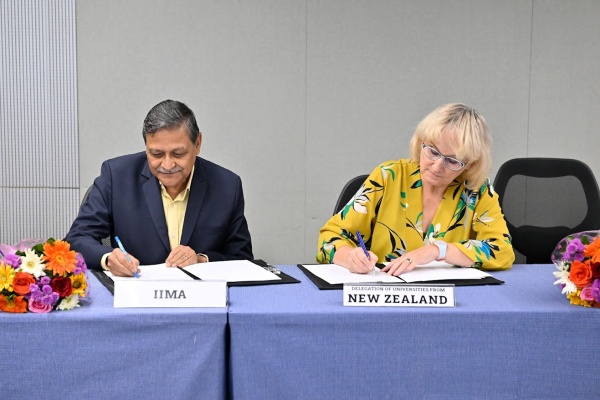
ENZ General Manager International, Lisa Futschek, and IIM Ahmedabad Director Prof Bharat Bhaskar sign an education cooperation arrangement during the NZ India Education Connect initiative in February.
Call for speaker proposals
ENZ is accepting speaker proposals for NZIEC KI TUA 2024. We welcome inspiring and engaging presenters on any topic relating to international education, especially our connections and partnerships with India.
Please submit your proposals by 30 April on this link.
Don’t miss earlybird registration pricing
Secure your earlybird registration price for NZIEC KI TUA 2024. There are two-day and one-day registration options available, alongside tickets to a gala dinner.
To find out more information about becoming an NZIEC KI TUA 2024 partner, email us nziec@enz.govt.nz
-
Around the world in five
BRAZIL
Brazil unveils new HE internationalisation scheme
Brazil is replacing the Sciences without Borders (CSF) initiative with a new international mobility financing regime, aiming to enhance bilateral relationships with overseas partners. The new fund will be targeted towards postgraduate students and early career researchers looking to develop research abroad. While the CSF was managed at a federal level, the new scheme gives more autonomy to universities, requiring them to form an internationalisation strategy with international partners.
GLOBAL
Is fear of unqualified leads holding back your school website?
If universities optimised their websites, most could multiply the number of enquiries captured by up to 400%. Achieving this result requires just a few simple tweaks that make it easier for visitors to register their interest, such as decreasing the number of questions on a web form, segmenting by readiness (the distinction between “Keep me updated” forms and “Talk to me” forms) and using more student testimonials and videos.
UK
74% of public value international students when economic worth revealed
New research has found that people’s attitudes towards international students change when learning of their economic contribution and the jobs they generate. In a recent survey, only 12% of respondents wanted to see more international students in the country, but this doubled to 24% when they learned of the economic gains. Similarly, the 20% who wanted to see less international students in the country dropped to 13% when told of the economic value of international students.
FRANCE
French tech: A hot spot for entrepreneurs, 15 years in the making
Watch out Silicon Valley – the tech scene in France is gaining massive traction. Students from France’s world-leading business schools are now choosing tech over other job options, with one third of French students stating they would like to either found or join a start-up. The French talent pool is also impressive: Paris has over 134,000 professional developers, the second highest in Europe behind London, and 43% possess an MSc in Computer Science.
SOUTH KOREA
South Korean teens top in maths and science, but lack interest
South Korean students are excelling in science and mathematics, but the way the subjects are taught is not kindling interest in the students, a new report reveals. While South Korea placed fifth worldwide in the Program for International Student Assessment (PISA) 2015 science test, and first for maths, they ranked 26th and 28th (out of 35) in terms of interest. Professor Lee Joo-ho of the Korea Development Institute (KDI) says the disparity can be traced to the “learning by rote” method in the nation’s schools.
-
ENZ highlights international students' contributions to New Zealand in comments to immigration settings inquiry
International students coming to New Zealand support the achievement of the Government's broader goals and objectives while contributing to an important export industry. This is one of the key messages from Education New Zealand's submission to the Productivity Commission's inquiry into immigration settings.
In the submission, ENZ says that international students should not be characterised as coming to New Zealand to seek employment, invest or run a business. Rather, international students are motivated by different drivers in deciding whether to come to New Zealand, and are different to other temporary migrants included in the scope of the inquiry.
International students bring foreign exchange to New Zealand to fund their studies and living costs, which contributes to New Zealand's economic development. The submission also discusses the broad benefits international students deliver for New Zealand, including regional development, research output, and strengthened bilateral relationships with other countries.
You can read ENZ's submission to the inquiry here (links to the Productivity Commission's website).
-
Auckland hosts Voice of The Oceans round the world expedition
Just over two years after leaving Brazil on the sailboat KAT to sail around the world, the Voice of The Oceans (VOO) initiative arrived in Auckland, New Zealand, at the beginning of November.
One of the initiative's leaders, David Schurmann, is an alumni from New Zealand – he studied Cinema at Auckland University of Technology (AUT) and at the South Seas Film & Television School in the 1990s. And since then, he was inspired by the ecological awareness of Kiwis. Throughout his career as a filmmaker, in addition to fiction films, David produced documentaries about the importance of preserving the environment.

Eloisa and David Schurmann at Viaduct Harbour in front of the Voice of the Oceans sailboat KAT. Photo credit @annupam @withjane
VOO’s mission is to examine and record the environmental state of the oceans including plastic pollution so that this data can raise awareness and inform education, science, and innovation that improves the health of our oceans. It has the global support of the United Nations Environment Programme.
The VOO arrived in Auckland to mark the end of the first stage of their journey, after traveling for two years and visiting more than 100 destinations, recording the levels of plastic pollution they see as they go.
The arrival in Auckland featured the event “Brazil and New Zealand: Sustainability & Innovation” – guest panelists discussed how their businesses are innovating in the sustainable space. The event was organised by the Latin America New Zealand Business Council (LANZBC), the leading organisation focused on promoting business growth opportunities and collaborations in Latin America. Support for the event was provided by Education New Zealand Manapou ki te AO (ENZ), the Latin America Center of Asia Pacific Excellence (CAPES), and Viaduct Harbor Holdings (VHH).

Host and panellists at the at the Brazil and New Zealand: Sustainability & Innovation event included from left to right Guiliana Silveira, LANZBC CEO, Heloisa Schurmann, VOO, David Schurmann, VOO, Colum Rice, Mint Innovation, Phil Matheson, BioFab, Rachel Williams, Viva Expeditions Ltd , and Dhanya Herath, Climate Club. Photo credit @annupam @withjane

David and the VOO crew. Photo credit @annupam @withjane
Giuliana Silveira, CEO Latin America New Zealand Business Council (LANZBC) said that it was a privilege to work with Voice of the Oceans and these amazing NZ businesses to showcase what each of them is doing to innovate in the sustainability sector.
“We have to join forces to fight the climate crisis. We hope events, such as this, help to raise awareness and create a dialogue within the business and education communities to share our kaitiakitanga responsibilities," said Guiliana.

Following the panel discussion, attendees had the opportunity to mingle with the VOO crew and panelists. Photo credit @annupam @withjane

Wendy Kerr, ENZ’s General Manager Sector Engagement, and Ed Tuari, ENZ’s Manukura – Chief Advisor Maori, with David Schurmann, VOO during the event which was supported by ENZ along with the Latin America Center of Asia Pacific Excellence and Viaduct Harbor Holdings. The Latin America New Zealand Business Council organised and hosted the event.
Part of the arrival programme, also included over 70 children from Stanley Bay Primary School joining an environmental afternoon with talks by the Voice of The Oceans crew about the importance of taking care of the marine environment.
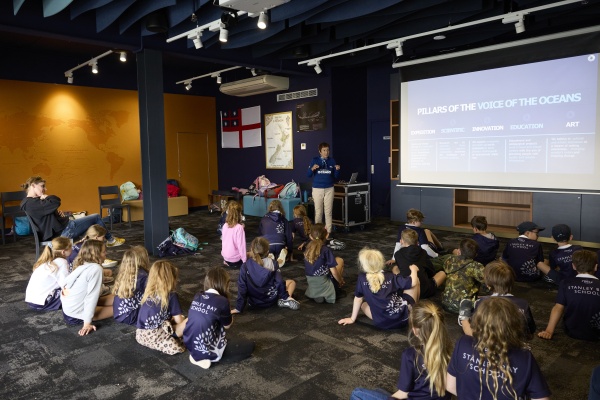
Eloisa Schurmann talks to the Stanley Bay School children about the importance of taking care of the ocean. Photo credit @annupam @withjane

As part of the sustainability tour, the children from Stanley Bay School were taken to the Viaduct Harbour Marina to view the sailboat Kat. Photo credit @annupam @withjane
“It's always a special moment to be back in New Zealand! We have a very close relationship with this country, which has been an important stop on all our major expeditions. My youngest sister Kat was born here, and I decided to stay in New Zealand during my families first expedition around the world, to study film making and start my career as a director”, said David Schurmann at the events in Auckland.
The VOO crew will spend the next few months in New Zealand to raise awareness about the state of Earth’s oceans before setting sail again to continue their trip around the world.
More information on VOO and their expedition can be found here - Voice of the Ocean - we turn people's attention to the ocean.
-
Crowdsource your NZIEC 2017 experience
Alongside the usual presentations, workshops and panel discussions, we’re introducing crowdsource cafés.
Crowdsource cafés are designed to harness the collective intelligence of the group. Rather than listening to ‘a sage on the stage’, these interactive sessions will see you working with others to brainstorm and problem solve.
“Crowdsource cafés are a neat way to explore the breadth and depth of experience and insights from professionals across our industry,” says Sam Mackay, ENZ Strategic Projects Manager.
“You’ll connect with other delegates, share challenges, learn what others are doing, and come away with new ideas and inspiration you can implement.”
There’s a crowdsource café for school delegates to share international marketing tips, and another for all delegates to explore emerging trends and developments.
“To make the most of these sessions, come prepared to share your insights, tips and best practice with fellow participants,” says Sam.
"We’ll also be announcing three new session formats in the lead-up to August. Stay tuned!"
-
BizVenture winners tackle youth mental health with "It's Okay" clothing range
The innovative business entrepreneurship scheme is a pilot initiative led by Education New Zealand, Young Enterprise Scheme (YES), and Japanese partners to give students in both countries real-life experience in developing business solutions that address one of the United Nation’s 17 Sustainable Development Goals.
Forty students collaborated in a three-day virtual exchange, where they chose a challenge tackling some of Japan’s pressing social issues, before designing and presenting a business plan in a “Dragon’s Den” style pitch to judges.
The winning New Zealand team - Hamish Robinson (Taradale High School, Napier), Benjamin Young (Tauranga Boys’ College), Daniel Blight (Waimea College, Napier), Kaiah Sherriff (Southland Girls’ High School), and Abirami Kabilan (Pakuranga College, Auckland) - chose to come up with a strategy which would directly enhance the mental wellbeing of Japanese teenagers.
The UN SDGs are some of the biggest problems facing humanity today, so working on them was a pretty full-on task” – Pakuranga College student Abirami Kabilan
It is a topic which directly impacts young people in both countries, as UNICEF ranks Japan 37th among 41 OECD countries for the state of children’s mental health, and New Zealand one lower, at 38th place.
Insights into business and culture “eye-opening”
To succeed, the students had to gain a thorough insight into Japanese culture, youth behaviour, and business practice. Ahead of their pitches, the teams joined interactive workshops with New Zealand and Japanese guest speakers, cultural mentors, and language coaches.
Abirami Kabilan describes the exposure to Japanese business and societal culture as “eye-opening”.
“The UN SDGs are some of the biggest problems facing humanity today, so working on them was a pretty full-on task.”
“One of the most interesting things about this cross-cultural experience was seeing how the Japanese students approached the same problems. Young people around the world will have such different ways of approaching these problems too. Imagine the ideas we would come up with if we all worked together.”
The winning team successfully pitched a clothing brand called 大丈夫, which translates in English to “It’s Okay”, to get the conversation about mental health out in the open among Japanese youth, and hopefully gain the support of high-reach Japanese influencers to help push their critical wellbeing message.
They decided the best way to break into the Japanese market would be with “in your face” messaging using symbols of strength, such as dragons and samurai, to promote their message.
“This is something that has not been done in Japan before and we’re ecstatic to be winners,” Hamish Robinson says.
BizVenture promotes global competency
The BizVenture programme will allow students to understand the Japanese business context and increase their global competency, says Young Enterprise Scheme lead Elizabeth Pittman.
“New Zealand youth have such a strong interest in sustainability and improving social outcomes within their communities and abroad, and this challenge allows them to explore that interest in a business context.”
International education adapts to changing needs of learners
Education New Zealand is keen to build on the success of this year’s pilot BizVenture programme as international education adapts to meet the changing needs of learners. International research shows that students are increasingly seeking programmes and content that is relevant to real world problems and which will allow them to make a real difference.
The programme also builds on New Zealand’s diplomatic relationship with Japan while travel for international students remains limited.
“Over many decades Japan and New Zealand have benefitted from an enduring partnership,” says Hamish Cooper, New Zealand Ambassador to Japan. “Education has played a really important role in fostering people-to-people ties, and supporting the development of what are now, in 2021, very close connections between our two countries.”
“Before the pandemic, more than 10,000 students from Japan studied in New Zealand every year, making an important economic contribution, but also enriching our schools and communities, and helping New Zealand students become more globally connected.”
-
GP practice for international students
Caring Clinic is focused on meeting the needs of international students and migrants from Asia, providing services in Cantonese and Mandarin as well as English, and offers innovative services including Skype consultations after hours and e-prescriptions.
The new clinic has been welcomed by the Auckland Agency Group (AAG), a cross-agency collaboration of central and local government agencies formed to lead communication with international student groups, ethnic communities and providers in Auckland.
Hayley Shields, ENZ’s Director of Student Experience and Chair of AAG, said the new clinic reflects the shift to make support services more attuned to students’ cultural needs.
“More than 60 per cent of international student enrolments are in Auckland, and it’s important for students to be able to access culturally appropriate healthcare services.
“This is one of the key objectives in the New Zealand International Student Wellbeing Strategy.”
Dr Jessie Liu and Dr Ruoh Sim, the two principal doctors at Caring Clinic, came to New Zealand as teenagers and both studied medicine at Otago University.
-
New Zealand well represented at the 2024 World Digital Education Conference
The 2024 World Digital Education Conference, attended by representatives from over 70 countries and regions as well as international organisations, aims to work with governments, the education sector, and stakeholders to jointly implement the outcomes of the United Nations Transforming Education Summit, promote education recovery post-pandemic, equitable quality education through digital education transformation, and advance the realisation of the Sustainable Development Goals (SDGs).
Chinese Education Minister Huai Jinpeng provided the keynote speech at the opening ceremony. He noted the impact of technology on education and the need to prioritise education reform to keep pace with changes and harness the benefits of digital education. Minister Huai concluded by saying they look forward to the new impetus into promoting international cooperation in digital education through this conference.
New Zealand was represented by Minister of Education, Hon Erica Stanford (through a pre-recorded session); H.E. Grahame Morton, New Zealand Ambassador to People’s Republic of China; Ardi Barnard, New Zealand Consul-General to Shanghai; Dr Grant Klinkum, Chief Executive New Zealand Qualifications Authority and Education New Zealand’s China-based representatives. The strong presence at the conference contributes to New Zealand’s reputation as an education partner with an innovative approach to digital learning. New Zealand Education Minister Hon Erica Stanford gave a video address and shared New Zealand’s efforts to harness digitalisation to improve our education system and support lifelong learning.
“As an education minister with a relentless focus on the progress and achievement of all students, I see that digital tools and the well-designed use of data have enormous potential to help us drive progress and achievement,” said Minister Stanford.

Hon Erica Stanford, New Zealand’s Minister of Education delivered a pre-recorded session, sharing New Zealand’s efforts to harness digitalisation and data in education.
In his address at the Opening Ceremony, Ambassador Morton highlighted the important role of education in the New Zealand-China relationship and gave insights into New Zealand’s innovative EdTech sector.
“Digital education is at the centre of New Zealand’s EdTech sector and its developments. Three-quarters of New Zealand EdTech companies are actively looking to take their offerings to the world,” said Ambassador Morton.
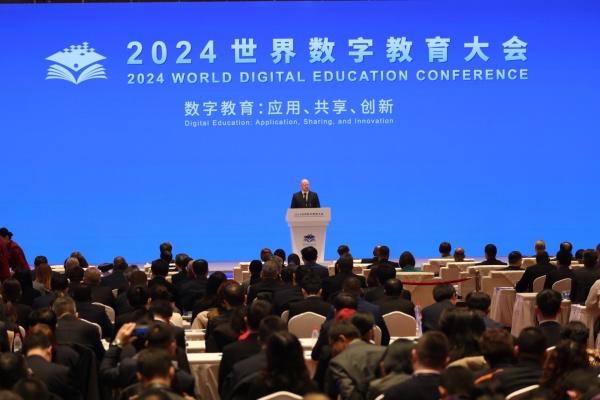
Ambassador Morton addresses the audience during the Opening Ceremony of the conference.
During the Parallel Session on Governance and Digital Transformation, Dr Klinkum shared New Zealand’s experience in quality assurance, qualification recognition and assessment delivery in the digital era.
“We would like to continue working with our international colleagues to ensure that we provide credible education for learners and that life-long learning and global mobility is supported by digital education and reflects the needs of increasingly digital societies,” said Dr Klinkum.
During the conference, organisers held the inaugural launch ceremony of the World Digital Education Alliance (WDEA). Universities New Zealand, on behalf of the University sector, joined the Alliance. The first batch of members is by invitation and as of 30 January 2024, 104 agencies from 41 countries joined the alliance ranging from schools to Technical and Vocational Education and Training (TVET) institutions, training centres, colleges and universities as well as research institutions and enterprises. The initiative aims to fulfil the UN SDG 4, build a mechanism for international cooperation and exchange in digital education, form synergy to promote global educational development, and create a new environment for smart education.
-
Indigenous Peoples Talk Series 2023: final event
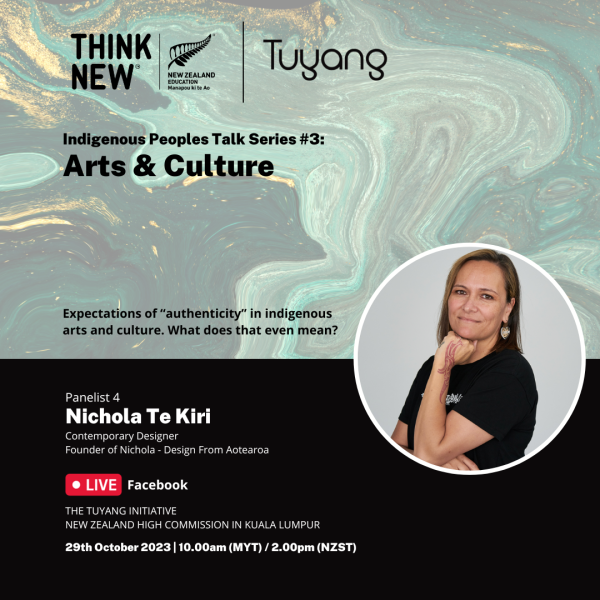
The third and final event of the Indigenous Peoples Talk Series will be held online on 29 October 2023, at 10am in Kuala Lumpur, Malaysia (2pm NZDT).
This event, jointly organised by The Tuyang Initiative, a Malaysian Social Enterprise, and Education New Zealand Manapou ki te Ao, is focused on Arts and Culture, specifically the expectations of authenticity in indigenous arts and culture and what this means. Taking part in the discussion are several brilliant indigenous academics, artists, and cultural practitioners from Malaysia and Aotearoa New Zealand, including Nichola Te Kiri, contemporary designer and founder of Nichola – Design from Aotearoa.
Information on the Tuyang Initiative was shared in a previous E-News here. You can register for this free event via this form: https://forms.gle/5f3SW5iCteZTHyC98
-
Around the world in five
CHINA
A model for teaching innovation in higher education worldwide?
China is stepping up its drive to lure overseas talent to become an innovation economy. An example of this is Shanghai-based DeTao Masters Academy (DTMA), which recruits 500 experts (‘Masters’) from universities and industry around the globe to regularly visit China and share their knowledge and skills with Chinese students and professionals.
SINGAPORE
Children must be ready for jobs ‘that do not yet exist’
Many children will end up working in jobs that do not yet exist, said Minister-in-charge of Singapore's Smart Nation initiative Vivian Balakrishnan. “We need to go beyond just the formal school curriculum”, he said, adding that the ABCs needed in school must be advanced: A for aesthetics (technology), B for building (applying) technology, and C for communication, to bridge the gap between user and technologist.
JAPAN
Junior high students rip elementary English as ‘useless’
In a new survey, 82.6 percent of sixth-grade students believe an English education is useful, but that figure plunged to 53.9 percent after they entered junior high. Researcher Yumiko Fukumoto said the loss of interest is lack of confidence in ability: “In junior high schools, children don’t spend much time on speaking or writing and the program is mostly based on translating and memorizing.”
INDIA
Why it is important for India’s education system to embrace disruption
Business, economy, politics and society are part of the same ecosystem. Educators therefore, have a duty to offer knowledge for enhancing skillsets and expertise that will help students face up to the challenges of the coming years. In this context, the higher education segment has a crucial role to play, but lack of qualified faculty, discipline, experiential learning and industry relevance is hindering students.
UNITED KINGDOM
Scrap fees for international students and use foreign aid budget to bring them to UK
The number of EU students applying to UK universities has fallen by 7 per cent since the Brexit vote. A professor of Economics at the University of Buckingham said the higher tuition fees is “extortionate” and should be scrapped altogether to encourage applicants. Instead, he said the Government should take money from the Department for International Development to recruit candidates and enable student mobility. Any leftover funding should be available to promote research collaborations anywhere in the world, he added.