Search
Showing 10 of 982 results for search for pheen4uuu from wiki 2025
-
Keynote speakers inspire at NZIEC
That was the theme of the 27th New Zealand International Education Conference, held in Wellington on 9-10 August.
Three keynote speakers gave inspirational addresses to packed audiences at Te Papa.
Making a global impact
Yoseph Ayele, chief executive of the Edmund Hillary Foundation, kickstarted the conference by exploring how to make a global impact from New Zealand.

He gave four practical tips for bringing global citizenship into international education:
1. Create experiences, rather than content.
2. Learn to learn. Create an environment where everyone in your organisation is able to see themselves from other people’s perspectives.
3. Teach your values. Rather than focusing on practical skills, teach students key values such as manaakitanga or innovation.
4. Invest in diversity. Think about attracting students who may not be able to afford to study here, but who would greatly benefit from a New Zealand education and would want to give back.
Understanding online behaviour
Dr Shanton Chang, from the University of Melbourne, shared his knowledge of the online behaviour of students moving between countries.

His insights included:
- Providing the right information at the right time to students is crucial.
- Digital literacy is patchy and often limited to Google searches – even for ‘digital natives’. Don’t assume students will find the information you put online.
- The layout and visual cues of websites often vary between cultures. Even downloading lecture notes can be a struggle for international students. If you want them to use your website, show them how.
- Most of us have 7-10 websites we visit frequently. International students may continue to visit their favourite sites from home more than any other sites, particularly if they’re feeling isolated.
“Put it online and they will come? That is nonsense,” says Dr Chung. “We need to unpack that myth and engage properly.”
Developing partnerships
Anna Curzon, chief partner officer at cloud accounting software company Xero, gave advice on developing partnerships to become more globally successful.

She challenged the audience to ask themselves five important questions:
- What is your purpose?
- What are you awesome at?
- What are the experiences in your value chain that will achieve your purpose?
- Do you need to build, buy or partner?
- If you need to partner, do you have the right people and culture to grow the relationship?
In his address to the conference, Education Minister Hon Chris Hipkins described global citizens as people who can “study, work and live across cultural and national boundaries”.
For those of us educating the next generation of global citizens, the three areas covered by the key speakers are important elements to consider as we continue to connect New Zealand to the world.
-
Miriama Kamo to headline NZIEC 2018
Miriama will preside over the 27th New Zealand International Education Conference and Expo to be held at Te Papa in Wellington on Thursday 9 and Friday 10 August.
“The NZIEC conference is always a calendar highlight,” says Miriama.
“It’s a conference that provides learning and networking opportunities – and a lot of fun. I’m so looking forward to seeing everyone again this year.
“I really enjoy NZIEC conferences. With over 600 delegates, you’d think it could feel impersonal but somehow this crowd pulls off the personal with aplomb.
“Always inspiring, always educative, always fun.”
If you didn’t attend conference last year, you’ll likely recognise Miriama from her role presenting TVNZ 1’s flagship current affairs programme Sunday. She also co-presents current affairs programme Marae, is a regular 1NEWS newsreader and is the host on TVNZ 1’s new lifestyle programme, Kiwi Living.
As a reporter for Sunday, Miriama won the prestigious Best Current Affairs Reporter gong at the Qantas Media Awards in 2005 for her investigation into alleged abuses at Porirua Hospital in the 1960s and 70s. She has also spent six years fronting TVNZ 2’s current affairs show 20/20.
Miriama emceed the 2016 and 2017 conferences in Auckland, and we’re delighted to be able to welcome her to the ‘World’s Coolest Little Capital’ later this year as we explore the theme of Inspiring Global Citizens.
Programme update
With just over a hundred sleeps to go, we’re working hard behind the scenes to deliver a fantastic NZIEC for the industry.
After being inundated with breakout presentation submissions, we’re in the final stages of confirming the conference programme and will be in touch with submitters over the coming weeks to advise them of the outcome of their submissions.
With breakout streams focused on global citizenship, student experience and wellbeing, digital innovation, markets and products, sharing our stories and contribution to New Zealand, the programme will highlight the diversity and expertise of New Zealand’s vibrant international education industry.
We’re also planning some changes to the conference format – stay tuned to e-news for updates on all our conference announcements.
Registration to open late May
Registration for NZIEC 2018 will open in late May. We expect this year’s event to sell out, so be sure to be in quick to confirm your place at the international education event of the year.
Find out more about NZIEC at www.nziec.co.nz
-
Emergency benefit for temporary visa holders
Emergency Benefit, which was available for eligible temporary visa holders until 28 February 2021 from Work and Income at the Ministry of Social Development, has been extended to 31 August 2021.
It’s a weekly payment to help with basic living costs while the person arranges to return home as soon as they can.
You can direct in-need students to this Work and Income link to find out if they will qualify and how to apply.
Who is eligible
Foreign nationals may be able to get the Emergency Benefit if they:
- have a current temporary New Zealand visa that is not sponsored, for example a visitor visa, student visa or work visa
- are in financial hardship with no other means of support (other than money to buy a flight home)
- either:
- are arranging to return home as soon as they can, or
- can't get home because of COVID-19 travel restrictions but will do so as soon as flights are available
- are taking all reasonable steps to find other means of support, including looking for work; consular assistance; savings or support from family, friends and organisations in NZ or overseas
- have a valid passport
- have a New Zealand bank account
- have an Inland Revenue (IRD) number.
-
Register for ISANA NZ Conference
The conference will be held at Harbourside Function Centre, Wellington from 5-6 September 2019.The theme is ‘Professionalisation of the International Education Sector in New Zealand: Promoting an integrated NZ Inc. approach to student wellbeing.’
Keynote speakers include
- Bariz Shah (New Zealand) – President of the University of Canterbury Muslim Students Association, Bariz became a spokesperson for the Muslim student community following the tragedy of March 15.
- Marcela Lapertosa (Australia) – former Director of Education and Intercultural learning at AFS, Marcela will share insights she gained leading the development of intercultural competence programmes for students, families and staff around the world.
- Lian-Hong Brebner (New Zealand) – Diversity Manager at Auckland University of Technology, Lian-Hong will outline strategies for promoting cultural intelligence within institutions and the wider international education sector.
- Dr Paula Durance (Australia) – Consultant to international education providers, Paula is a respected international education professional. She will be exploring strategies for developing professionalism in international education.
There will also be a range of breakout sessions and workshops from practitioners, policy advisors and educators, including updates on work and study opportunities, tailored mental health practice, strategies for enabling social connections and overcoming communication obstacles and accommodation insights in relation to Code compliance.
Get the early bird rate until 19 July – click here to register.
Education New Zealand and the Ministry of Education International Unit are sponsors.
-
Brazil to headline NZIEC as Country of Honour
ENZ has joined with the Brazilian Embassy in Wellington to bring to life the partnership, which celebrates the growing education connections between New Zealand and Brazil.
Lisa Futschek, ENZ Regional Director Americas and Europe, said ENZ is excited to showcase Brazil this year.
“As the largest student recruitment market in Latin America and with momentum growing, Brazil is an important diversification market for New Zealand’s international education industry.
“Moreover, conference participants will revel in tasters of Brazil’s vibrant music and cuisine culture!”
Paulo Camargo, Ambassador of Brazil in New Zealand, is delighted to see Brazil featured as the Country of Honour at NZIEC 2018.
“Every year, thousands of Brazilians come to New Zealand to study across a variety of sectors. I also see a growing interest of New Zealand students going to Brazilian universities. In the process, this exchange builds one of the best foundations for the strong relationship between two countries: the human ties of friendship and understanding.
“Brazil and New Zealand share many values and have great potential to enhance educational cooperation. I look forward to working with Education New Zealand to turn 2018 into a landmark for our two-way partnership."

Be sure to soak up some of the sights and sounds of Brazil at NZIEC 2018
Last year, almost 3,600 Brazilian students studied in New Zealand. Engagement with Brazilian institutions is also increasing due in part to the Prime Minister’s Scholarships for Latin America and the funding offered to help internationalise Brazil’s postgraduate departments.
In March this year, five New Zealand universities participated in the Brazil/New Zealand Academic Cooperation Forum designed to enhance collaboration and research linkages at postgraduate level.
The Country of Honour designation at NZIEC celebrates and showcases New Zealand’s international education connections with partner countries.
NZIEC delegates can look forward to engaging with the team from the Brazilian Embassy at its booth in the Expo Hall – and experience a few delights during conference.
NZIEC 70% sold out!
With fewer than a third of places left at NZIEC 2018, make sure you book your ticket soon. Register today at www.nziec.co.nz

-
ENZ responds to international education commentary on NBR
ENZ Acting Chief Executive Dr Linda Sissons rebuts an economics commentary published on National Business Review (NBR) on Monday 25 March 2024. The rebuttal is published here on NBR and is reproduced below.
 In response to your piece “International education: wrong horse to back for export growth?” my answer to the question is a hard “no”. Here’s why.
 Students are returning to New Zealand. In the first eight months of 2023 international student enrolments topped 59,000 with all sectors experiencing growth except wānanga. Accepting that it is from a low base, comparing 2023 to 2022, Universities have bounced back strongly reporting a 15% increase from 24,040 to 27,535.
It is true that we have not yet returned to 2019 numbers. In my opinion, this is not a bad thing. During the pandemic years the sector lost people and capability. The recent moves of some of our competitors tell you what a sudden return to those numbers of students brings.
I want to address your correspondent’s concerns about the lack of a plan and competition within amongst universities. There is a plan. The New Zealand International Education Strategy, revised in 2022 in discussion with the sector and across Government, sets out the plan to develop a high-value, resilient and innovative education sector for both international and domestic students.
I can also assure you that the sector is working together to achieve its goals, that all eight universities participated in a recent ENZ-led delegation to India, is just one example of the co-operation.
International education is more than universities. In the first eight months of 2023 English Language Schools saw the greatest percentage increase in international enrolments, increasing by 347% from 1,565 to 7,001. Schools reported a 114% increase from 5,925 to 12,662. NZIST Te Pūkenga, a 32% increase from 4,955 to 6,560 and Private Training Establishments (funded and unfunded), a 13% increase from 5,000 to 5,671.
Immigration New Zealand tell us that international student visa applications for all forms of study have increased by about 20 per cent in the peak application period. Between 1 October 2023 and 8 March 2024, they received over 31,800 applications for an international student visa.
Today we have a base of international students in the country and the pipeline for the coming academic year has strong growth.
Our own research shows that the experience international students have while studying in New Zealand is a good one. In our Student Experience survey of 4,755 international students from more than 70 nationalities, 84 percent rated their overall experience positively, while another 83 percent said they would recommend New Zealand as a study destination.
When these students return to their home, and 75% of international students return home after three years, they will be our word-of-mouth advocates – an advocacy we didn’t have during the COVID years.
New Zealanders also appreciate the benefits of international students. In an ENZ survey of 1,100 New Zealanders conducted in December last year, 75 percent of respondents believe that international students benefit New Zealand. The Ipsos Fast Facts survey, which drew responses from all regions of the country, saw 80 percent of respondents highlighting economic benefits, particularly in local communities, as a key reason for their positive view.
The results of the 2023 survey highlighted the continuing growth in support for international students and their positive impact on New Zealand since 2016 when only 57 percent believed international students helped the New Zealand economy and economic growth.
We have students in New Zealand; a strong pipeline; students having a positive experience and advocating for New Zealand; and New Zealanders appreciating the benefits having of them in our communities.
International education is highly competitive. Your correspondent rightly recognises that there are new competitors emerging and Singapore is a good example. We’ve also seen countries like South Korea, a core market for New Zealand, become competitors.
This is not new. We have, and will always have, to compete to attract international students to New Zealand – that they are returning tells me our reputation is good and we remain an attractive option.
Globally the number of international students has grown significantly over the past two decades from around two million in 1998 to over 6.4 million in 2020, according to UNESCO data. New Zealand only needs a very small proportion of what is effectively a supply-driven market to return to pre-pandemic levels of economic contribution and value.
While I am confident that international education is not the “wrong horse”, achieving double the export earnings is going to require a lot of hard work and there is much to do. My point is, that in less than two years since the borders reopened in August 2022, the recovery has well and truly commenced, the progress made to date is significant, and as a sector we can be rightly proud of what we have achieved together.
Linda Sissons
Acting Chief Executive, Education New Zealand
-
Virtual events around the world
Viet Nam: Career fair at Nguyen Sieu School (NSS)
Representatives from eight New Zealand providers attended a career fair at Hanoi’s Nguyen Sieu School (NSS) last month.
With no cases of community-transmitted COVID-19 for the past six weeks, Viet Nam has started to return to normal life. Schools have reopened just ahead of the end of the academic year.
Usually, the NSS Career Fair only allows in-person representatives from foreign institutions. However, thanks to ENZ’s strong relationship with the school, our institutions were represented by proxy – either an education agent or alumnus. A representative from the institution was also permitted to join via video link.
As a result, New Zealand’s presence was well ahead of our competitors like Canada (with two institutions), the UK (also two), or Australia (three).
ENZ Viet Nam Market Manager Van Banh says this is a great example of how key in-market relationships will be critical as international education looks to conduct usual activity online.
“This year’s NSS Career Fair was an exciting example of how we can incorporate digital technology into our in-person events,” she says.
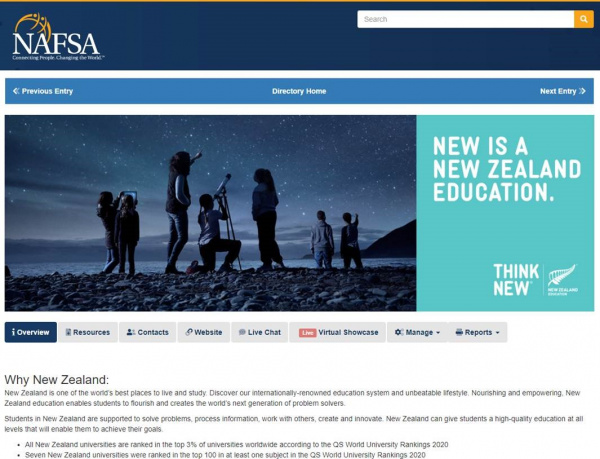
North America: NAFSA eShowcase
For the first time ever, the world’s biggest B2B international education conference was held entirely online.
More than 9,000 international educators from over 100 countries were expected to attend the conference in St. Louis, Missouri over 25-29 May before COVID-19 forced organisers to take it to the digital world. In the end, over 2,000 attended the eShowcase.
Participants were able to visit ENZ’s virtual booth and engage either through chat or live video conversations at designated times.
New Zealand universities and ITPs had dedicated times to host a ‘Virtual Showcase’, which is a mechanism by which NAFSA exhibitors presented, met or collaborated with attendees via a dedicated Zoom session.
“The process of moving the largest in-person B2B international education conference in the world online has been a big learning curve, not only for ENZ and the individual booths and attendees, but for NAFSA themselves,” ENZ Director of Engagement – North America, DuBois Jennings, says.
“With no live, conference-wide chatroom or method to see a list of conference participants it felt isolating at time on the booth, which is very different from the normal, in-person NAFSA conference. However, it has been a valuable learning experience as the international education industry looks for new ways to connect virtually.”
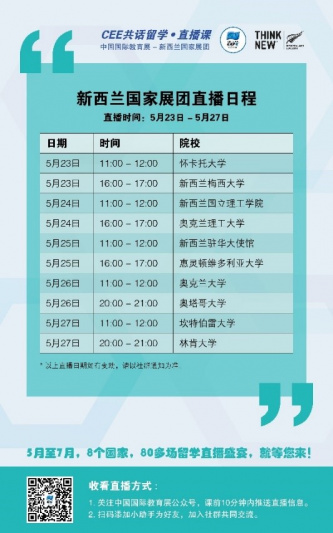
The official NZ CEE schedule.
China: China Education Expo (CEE)
In late May, representatives from ENZ, all eight of New Zealand’s universities and the NZIST were offered a unique opportunity to engage directly with students from China and their parents.
The annual China Education Expo (CEE) is one of the biggest events in the Chinese international education calendar. But ENZ Market Development Manager, Jane Liu, says this year’s engagement through the virtual platform is greater than they would usually expect.
“Although ENZ has worked with the CEE for years, this is the first time we’ve been collaborated with them online. We can see this being useful to New Zealand institutions even after COVID-19.”
Each university provided a one-hour presentation sharing their programmes and how they can work with interested students once COVID-19 precautions have been lifted. The NZIST representative also gave a detailed introduction to the reforms the ITP sector has recently gone through.
The webinars have garnered a combined total of 1000 views, and have been recorded and hosted on WeChat so that students and parents can watch them at their leisure.
-
Exploring indigenous exchange programmes and internships
The students, from University of Auckland and AUT, are part of the British Columbia & New Zealand Indigenous Student Mobility Project,a two-year programme that aims to provide reciprocal, short-term learning abroad and professional development and networking opportunities for indigenous students. The students will be joined by five First Nations students from Victoria University (UVic) in Canada, who are also part of the programme.
Next year the Kiwi students will travel to Vancouver and be hosted by UVic for the 2020 GIC. UVic is a leader in the Canadian Co-Op model, where an internship is a required component of the university degree.
“Increasing access to international learning opportunities for all students, and in particular our Māori and Pasifika students, is an important goal for the University of Auckland,” says Brett Berquist, University of Auckland’s Director International.
“Community and family are key to this strategy, and the chance to share and learn from First Nations students and academics at UVic is a great opportunity for our students.”
The Student Mobility Project aims to engage indigenous students in immersive experiences that help them to establish and maintain relationships with other indigenous students and communities, industry, academics, and higher education professionals. It intends to provide a forum for indigenous students to present their perspectives and experiences, facilitating an exchange of ideas and networks.
At the GIC, the students will share their perspectives and experiences on how international experiences benefit indigenous communities, how to best connect indigenous communities internationally, and how work placements and co-operative education have influenced their lives and careers.
Karima Ramji, UVic’s Manager of International Programmes will also discuss critical success factors in developing indigenous international work-integrated learning exchange programmes.
The GIC will feature further perspectives on global internships via a panel of University of Auckland Māori and Pasifika awardees of the Prime Minister’s Scholarships funded internships in Asia and Latin America.
The 2019 Global Internship Conference will take place on 2-5 July, hosted by the University of Auckland. To register or to find out more, click here.
-
INZ replacing physical visa labels with eVisas
INZ’s Assistant General Manager Peter Elms says while eVisas are currently issued to all visa applicants who use online channels, this is now extended to include paper-based applications.
“INZ has been issuing eVisas since 2016, and nearly half of all visas currently issued are label-less. This means education providers should expect to see more eVisas,” says Peter.
“Successful applicants will receive an approval letter with the visa details via email which they should print and keep with their passport. Other than the letter, education providers and employers can verify visa details via INZ’s VisaView online system.
“On the rare occasion that an applicant does not have an email address, arrangements can be made to post the decision letter.”
Peter adds that while there is no need to have a physical visa label in a passport, INZ recognises that some individuals may prefer to have one. A label can be obtained by request by filling in an application form and a fee of $110.
INZ advises that students using Provider Direct (an on-campus system run between the education provider and INZ) will continue to receive labels. INZ will review this over the next year.
For more information on eVisas, click here.
-
PIF Recipient: Virtual Medical Coaching
In the United States alone, approximately 800 women die each year during pregnancy and within 42 days after delivery. More than 60% of those deaths are believed to be preventable. In developing countries, the rate of pregnancy-related deaths is up to 300 times higher.
An important part of the solution is education. Globally, midwives are in high demand, with the UK’s NHS increasing their places for student midwives by 3000, starting this year. Australia is also planning to increase numbers, while in New Zealand, a funding boost will increase the number of Māori and Pacific students training in midwifery.
While the demand for midwifery training is growing, education offerings haven’t kept up. Childbirth is deeply personal, and feedback from mothers – validated by hospital staff – is that they do not wish to have extra staff or students in the room for training. With no effective opportunities for face-to-face learning, there is a global need for a realistic and scalable childbirth simulation.
That’s where Virtual Medical Coaching’s vision comes in, supported as a recipient of the International Education Product Innovation Fund. Virtual reality (VR) software will provide a safe and controlled environment for students to see and assist in childbirth simulations, both with and without complications and in a range of different scenarios. As the student improves, the simulations they encounter increase in difficulty. A machine-learning algorithm enables fast and accurate feedback to both the learner and any tutors.
The simulation will be interactive and responsive, meaning that any action taken by a student creates a life-like consequence and reaction. The outcome is that learners are taught to effectively make decisions and problem solve.
Existing options for midwifery training include a physical mannequin simulator, but this can be prohibitively expensive, out of reach of many training providers, and doesn’t offer students maximum learning hours. In addition, existing options don’t include the ability to witness mechanisms like rotations/restitutions or the ability to have back and forth conversations. By contrast, the VR simulation will be available to students wherever they are, and whenever they need to practice. The nature of the VR experience means that modern learning styles, such as asynchronous and remote learning, are well catered for.
With support from the International Education Product Innovation Fund, Virtual Medical Coaching’s childbirth simulation is on track to become fully released by the end of 2024. A beta-version is already used by some educators globally. The Product Innovation Fund is a New Zealand Government-funded initiative to reimagine what a New Zealand education can look like and mean for global learners.
Managed by Education New Zealand Manapou ki te Ao (ENZ), New Zealand’s government agency for international education, the fund is supporting a range of pilot projects from existing and emerging New Zealand education providers. Together, the projects rethink how an education experience from New Zealand can be delivered, and create impact, for global learners.
For Virtual Medical Coaching, it’s about finding a better solution to a serious issue. Like many other innovative Kiwi education technology companies, Virtual Medical Coaching is designing technology that will create positive impact around the world. It’s already successfully developed an x-ray simulation for healthcare professionals which has won multiple national and international awards. Now, with the support of ENZ through the International Education Product Innovation Fund, Virtual Medical Coaching is set to respond to a clear need for better midwifery training options and develop another cutting-edge learning product for both New Zealand and offshore markets.
More information: