Search
Showing 10 of 982 results for search for pheen4uuu from wiki 2025
-
ENZ survey to understand the supply of student accommodation is underway
The availability of accommodation for international students is often cited by our education partners as a potential barrier to the growth of the international education sector here in New Zealand. To date, evidence of this as a barrier has been anecdotal from individual providers and regions, with no specific data to offer a clear picture on the actual situation and extent of it.
Education New Zealand Manapou ki te Ao (ENZ) is therefore conducting a survey of international education providers with the aim to understand more about any potential or actual shortages, where and what accommodation type, and why that be, at a regional, sub-sector and national level. While the survey aims to better understand capacity issues and whether it is a barrier for growth in any part of New Zealand, we importantly want to build an evidence base to then enable tracking over time if a need is identified. Survey results will be shared with peak bodies and regions at an aggregated level to inform cross sector regional conversations and planning to address any issues found.
The survey link has already been sent out to the peak bodies who are forwarding this on to their members. If you are an international education provider here in New Zealand with experience in international student accommodation and have not yet received an email with the survey link, please email SectorEngagementTeam@enz.govt.nz. The survey will be open from now until 1 March 2024.
This is an inaugural survey and if you think a key question or aspect has been missed and should be included in future surveys, please use the free text box to capture this.
-
New Zealand Schools Scholarships 2024 launches in Viet Nam
This scholarship, launched by Education New Zealand Manapou ki te Ao (ENZ) and New Zealand schools, provides a 50% subsidy towards selected Vietnamese middle and high school students currently in grades 8 – 10 in Viet Nam. Applications opened on 22nd January 2024 and close at 11:59pm Indochina Time on 17th March 2024.
Interest in studying with New Zealand remains high amongst students and parents in Viet Nam, with recent fairs held in both Ho Chi Minh City and Hanoi receiving between 400-500 attendees respectively.
Viet Nam continues to be a priority market for New Zealand schools. Pre-COVID, the sector saw 80 percent growth in students from Viet Nam between 2017 and 2019. Currently, Vietnamese high school students account for 15% of the entire Vietnamese student base here in New Zealand.

This initiative aims to simultaneously increase interest and enrolments from high quality Vietnamese students into New Zealand schools, whilst also providing support to the students and families themselves by reducing the financial barrier to study overseas.
ENZ’s Business Development Manager Mary Camp said the New Zealand School Scholarships initiative has attracted quality students with high grade point average and good English language ability to study in New Zealand.
“We are impressed with the calibre of students we have welcomed through this programme. Many of them have had academic success and gone on to study at high-quality universities in NZ.”
“Schools are excited to welcome students from Viet Nam and eager for them to experience our quality education in a safe and nurturing environment.
Mary added that the support of the Schools in International Education Business Association (SIEBA) has been valuable.
“SIEBA supports this programme by undertaking reference checks of interested education agents, thus reducing the burden on schools and helping them connect with new agents. Activating new agents in Viet Nam helps the entire sector”.

ENZ’s Regional Director – Asia, Ben Burrowes said he was pleased to see the New Zealand Schools Scholarships initiative continue in 2024.
“ENZ is absolutely committed to its education relationship with Viet Nam and we’re excited to welcome more scholarship winners this year, enriching our schools, classrooms and communities here in New Zealand.
"As the scholarship continues to run each year, it allows new scholarship winners to meet previous scholarship winners and form a community of their own,” said Ben.
"Since its initial launch in 2018, the New Zealand School Scholarships initiative in Viet Nam has grown to become a prestigious, top of mind scholarship for local students," he added.
The New Zealand School Scholarship initiative is just one of the initiatives that Education New Zealand Manapou ki te Ao delivers as part of its investments into the Vietnamese – New Zealand relationship. Other initiatives include student fairs, co-funding agent events and engagements, media and PR initiatives as well as supporting institutional partnerships.
Celebrating past recipients of the New Zealand School Scholarship
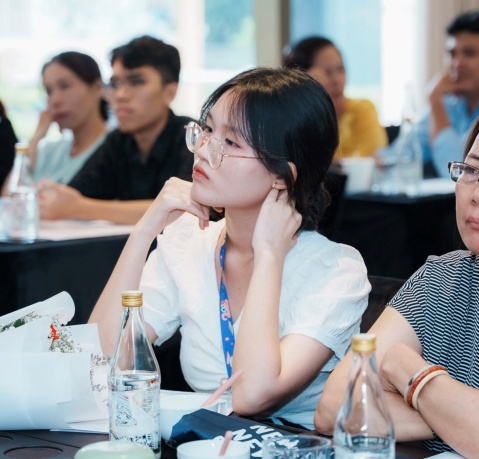
Dinh Minh Thao
2023 New Zealand School Scholarship recipientWith a strong desire to venture beyond her comfort zone, Dinh Minh Thao courageously applied for and successfully attained the NZSS 2023, starting her educational journey at Newlands College (Wellington, New Zealand) in July 2023.
In just six months, she immersed herself in studies, actively participated in various extracurricular activities, and experienced numerous "first in life" experiences including contributing to cultural events and participating in the festival of the Indian community. Notably, she challenged herself by becoming the class representative for the "Year 10 Speech Competition," typically reserved for upper grades, winning the coveted "Public Speaking" trophy.
Expressing her gratitude, Minh Thao stated, "Thanks to the NZSS, I have set foot in New Zealand, embarking on a journey towards independence and confidence, thus evolving into a new version of myself. I am eagerly anticipating the exploration of new opportunities that Kiwiland will unfold in 2024."
- Dinh

Xuan Khang
2019 New Zealand School Scholarship recipientXuan Khang came to Pakuranga College in July 2019 and graduated at the end of 2022. He remained in New Zealand throughout the pandemic, and achieved an outstanding academic record. He passed NCEA Levels 1 to 3 endorsed with Merit or Excellence, gaining Excellence in both Level 3 Calculus and Chemistry. He was involved in the Academic Council, Environmental Council, the Service Council, the Cultural Council and Peer Support. Xuan Khang won Top Academic International Student at senior prize-giving in 2022 and is studying Engineering at the University of Auckland in 2023.
"I came to New Zealand to broaden my horizons and become more independent. I have really enjoyed the practical aspects of working in labs and putting theory into practice. By using English daily, I feel my English has improved to a high standard. I have enjoyed being able to discuss my work with my teachers, who have been friendly and helpful. I feel I have really benefitted from the opportunities provided by living in New Zealand and studying at Pakuranga College."
- Xuan
-
Indonesian events see strong interest from agents, students, NZ alumni, and scholarship applicants
In late January, Education New Zealand Manapou ki te Ao (ENZ) and all eight New Zealand universities joined forces to promote New Zealand's education offerings in Surabaya and Jakarta, Indonesia. The collaboration between ENZ and the universities aimed to strengthen ties with Indonesian education agencies, school counsellors, and alumni, fostering future partnerships and enhancing the visibility of New Zealand as a preferred destination for international education.
ENZ and the New Zealand universities organised a series of promotional activities in Surabaya on 24 January that saw participation from 11 agencies and school counsellors representing six schools. The promotional activities continued in Jakarta the next day, where representatives from 22 education agencies and 18 schools further demonstrated enthusiasm and interest in a New Zealand education. ENZ’s Regional Director for Asia (excluding China), Ben Burrowes and Market Manager (Indonesia and Malaysia), Naluri Bella, also had engagements with key agencies, such as Fortrust Education and SUN Education, across the two days.
Ben Burrowes said that the two events served to reconnect the universities with Indonesian agents and schools and proved an excellent opportunity for the institutions to showcase the diverse range of academic programmes available in New Zealand.
“The two events provided a platform for open discussion, idea exchanges and the exploration of potential partnerships that were focused not just on recruitment but also on building sustainable collaborations that would benefit both New Zealand institutions and Indonesian students seeking quality education abroad,” said Ben.
“A great example of such potential partnerships is how one school has already followed up saying they’d like to invite the universities back for a ‘New Zealand day’ event,
“These discussions come at an opportune time as ENZ continues to firm up its Indonesia strategy for the next financial year,” added Ben.
Following the university events, on 27 January, ENZ co-hosted a New Zealand Alumni Day with New Zealand Inc agencies. The event included information sessions on New Zealand scholarships, ranging from the New Zealand Manaaki scholarships and the Indonesian government scholarships such as LPDP (Indonesia’s Institute of Education Fund Management) and Indonesian International Student Mobility Awards (ISMA), attracting around 100 potential leads. This initiative aimed to guide and inspire prospective students in their pursuit of educational opportunities in New Zealand.
ENZ and NZ Inc also witnessed the launch of the New Zealand - Indonesia Alumni Association during the Alumni Day. The Association serves as a networking platform for connecting New Zealand alumni in Indonesia, fostering a supportive community and providing ongoing resources for professional and personal development. The event concluded with a networking dinner, providing a relaxed and informal setting for alumni to connect with each other and with representatives from New Zealand universities.
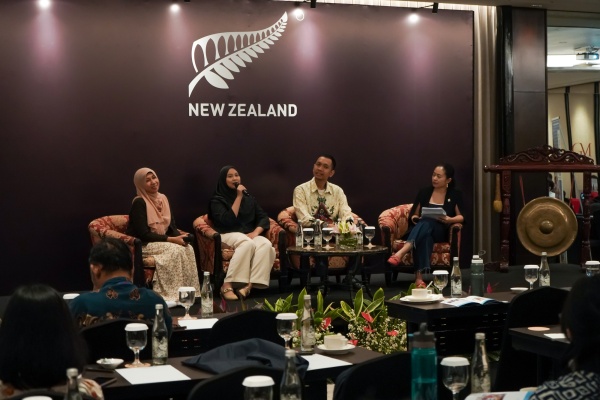
ENZ’s Naluri Bella moderating the alumni sharing session featuring alumni from different scholarship schemes at the New Zealand Alumni Day on 27 January 2024. From left to right: Nur Khaririyatun – Lincoln University, Master of Management of Agribusiness (Ministry of Agriculture scholarship), Alifia Sabila Putri – University of Canterbury (IISMA Scholarship), Moses Gregory Ginting – University of Auckland, Master of Energy (LPDP Scholarship).
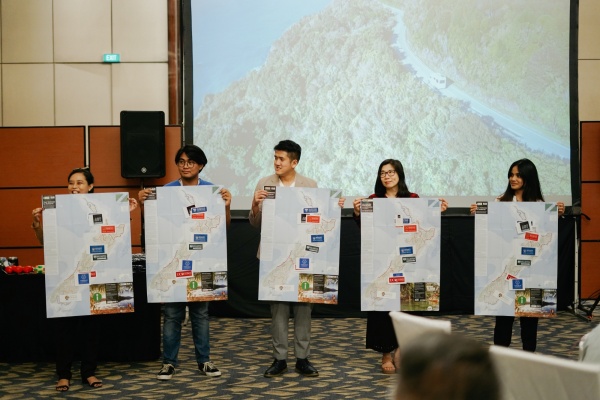
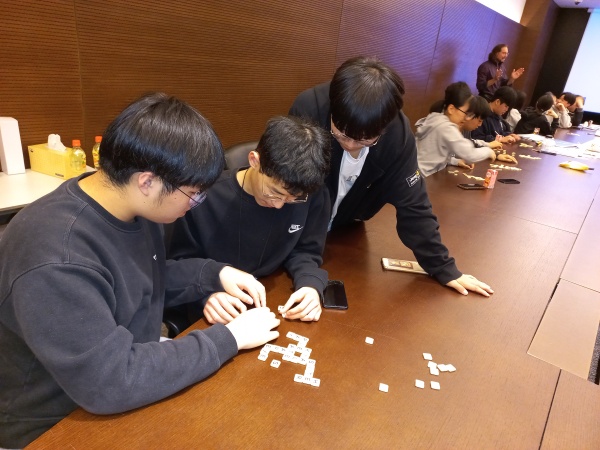
Agents in Jakarta engaged in interactive games to deepen their understanding of the beautiful and diverse landscapes and culture of Aotearoa New Zealand.

ENZ’s Ben Burrowes speaking at the New Zealand Alumni Day, highlighting the benefits of Study in New Zealand in front of the potential students.
-
Reflections from English Teachers in South Korea
In January 2024, six New Zealand teachers were selected to spend part of their summer season teaching English in South Korea as part of the New Zealand Korea FTA Partnership English Language Training Programme.
This programme is supported by Education New Zealand Manapou ki te Ao (ENZ) who assists with the teacher recruitment process. This was one of the key KNZFTA programmes recently discussed during the South Korea Government delegation visit to New Zealand late last year.

The group of six New Zealand teachers selected to teach English in South Korea in January. From left, Jane Bassett, Food Technology Teacher from Havelock North Intermediate School, Sharon Powell, English Teacher from Long Bay College in Auckland, Kara Shortland, Acting Team Leader (Bilingual) from Whangārei Intermediate School Te Tai Tokerau. Glenn Cheyne, Head of Learning Area Social Sciences from Nayland College in Nelson, Gordon Sim, Social Science teacher from Hillcrest High School in Hamilton, and Dan Greer, Social Studies/Drama teacher from Logan Park High School in Dunedin.
Kay Lee, ENZ Senior Market Development Manager – Korea, said that it was an absolute pleasure to see New Zealand teachers continue to travel to South Korea to teach English during their summer break.
“There are so many positive outcomes from the running of this cross-cultural programme for both the Korean students and the New Zealand teachers participating.
"On one hand, the students get the opportunity to hone their English language skills while experiencing the New Zealand teaching style, learning more about New Zealand, including its culture and education system. Meanwhile, while teaching English and serving as ambassadors of a New Zealand education, the teachers can immerse themselves in Korean life for a few weeks, seeing new sights, trying new food and making new friends.

Gordon, Jane, and Dan, sampling Korean cuisine at the end of the teaching day.
"Our Korean government partner for educational programmes, EPIS, has acknowledged ENZ for its significant contribution to the programme’s success through effective teacher recruitment. These positive outcomes are testament to the strength of our NZ-Korea Government-to-Government partnership,” added Kay.
Upon their return to New Zealand, two of the teachers who are trained in teaching English as a Second Language (ESL), shared their experiences with ENZ. Read on to hear about the reflections from their two weeks abroad....
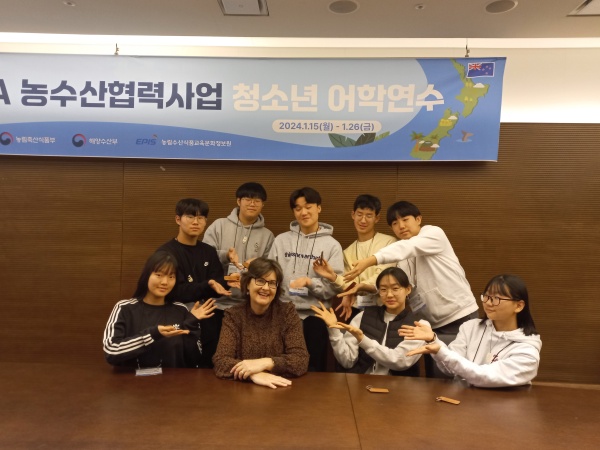
Jane Bassett (지안 (Jian) from Havelock North Intermediate School with her students.
Jane Bassett is a Food Technology teacher at Havelock North Intermediate School and said that the experience of exchanging cultures whilst teaching in an overseas classroom environment was an absolute privilege.
“Our students were aged 14 – 17 years old and came from all over South Korea with family backgrounds in the Agricultural and Fisheries industries. Each student had been awarded a scholarship from the Korean government to attend the two-week intensive English programme organised by the Hyundai Research Institute.
"The Institute went above and beyond in their efforts to ensure an incredible experience for both the students and our group of teachers.
“The teaching programme included a wide range of modules and as well as English grammar, we covered lessons on New Zealand culture, history, tourism, agriculture, sports, famous New Zealanders, and school life. My class was also exposed to the New Zealand Technology curriculum and was tasked with developing a new snack product. As part of the project, I introduced them to several New Zealand snacks and Kiwi classics such as WeetBix, Marmite and Watties Baked Beans, to varying degrees of enjoyment!”
Students were encouraged to speak in English throughout the day via fun-games, readings, conversations and plays so that the teachers could fine-tune their English to help them become more fluent with more natural English phrasing.
"We also explained aspects of Māori culture and the significance of pepeha (way of introduction). The students, who were from agricultural and fisheries backgrounds, were quickly able to identify their own awa (river) and maunga (mountain), showing their own personal connection to their land.”
Jane said that a personal highlight was being able to spend her birthday in Seoul learning about Korean cuisine through a cooking class on kimchi making and tea ceremony in a traditional house. She admitted that this was an appropriate birthday experience for a New Zealand Food Technology teacher!
She summed up the experience by saying that the group of teachers gained a greater understanding of cultural diversity and appreciation of the challenges learning English poses for new learners, learnings which they will take home with them.
“We really hope that our students will remember their experience as fondly as we will and that they will look to study and visit New Zealand in the future.”
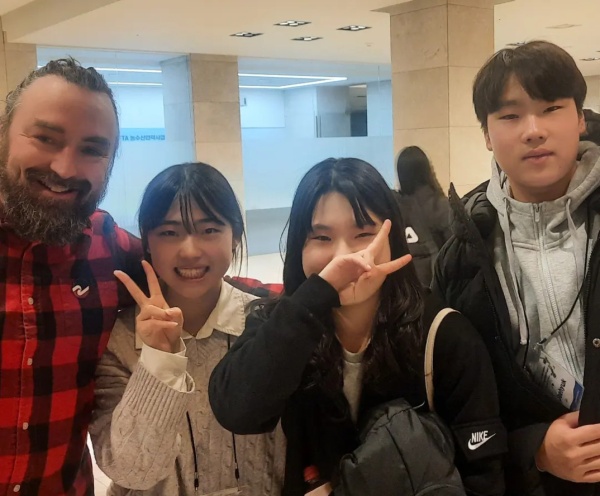
Drama and Social Studies teacher, Dan Greer, of Logan Park High School with three of his students.
Dan Greer, is a drama and social studies secondary school teacher from Logan Park School in Dunedin. He joined Jane as one of the six teachers selected to travel to South Korea, his second experience as an English language teacher in South Korea, having taught in Ulsan 12 years ago.
“I had such an amazing time participating in the Hyundai Research Institute’s programme. It was great to have other quality teachers on this experience with me and we were able to work together, mixing up the style of teaching and activities. I had the more beginner level class, and as a drama teacher we added games to my traditional English teaching. The students really enjoyed it, and it gave them more confidence to give things a go”.
Dan reflected on the fact that there was one practice of teaching English in Korea that he had often thought was a little unfair, that being the naming of Korean students with English names.
“As an English teacher in Korea, you are often asked to name Korean students with English names. Sometimes this is because they want them, sometimes it is because they ’have’ to, and for many it is because westerners find Korean names hard to pronounce. I have named nine children in my life, one being my daughter and the other eight have been my Korean students”.
Dan used this practice as a topic of discussion in class one day and shared his opinion that it had not always felt right to him as he felt that if Korean students were taking the time to learn the English language, that teachers should make an effort in return.
He then asked his students whether English teachers should have Korean names. This prompted them to ask many questions about Dan including who he is when he is not “Dan the teacher”, his whakapapa, and the meaning of his name in English.
Dan said “You can imagine my surprise when my students were all waiting for me when I arrived the next day. One wonderful student then stood up and using perfect English gifted me a Korean name. I was no longer just “Dan the Teacher,” but also now 도혁 (Dohyuk), which meant I was ‘leading them to a bright path’.
“This was such a humbling experience that I will cherish forever. For me, this is what makes teaching and life so special,” added 도혁 (Dan).
If the Korean organisers decide to run the NZ-Korea FTA Partnership English Language Training Programme in the future, ENZ will continue to share the applications with NZ school teachers through the Asia NZ Foundation and Schools International Education Business Association (SIEBA).
-
Kiwi students attend Tokyo Experience School
Education New Zealand Manapou ki te Ao (ENZ) supports a range of international exchange programmes that, as well as attracting international students to New Zealand, also provide New Zealand students with the opportunity to have their own international education experiences overseas. These offer unique cross-cultural learning opportunities that develop our global citizens, serve to plant the seed for future overseas education experiences in our learners, while also promoting New Zealand’s education system on a global level.
One such programme is that organised by the Tokyo Metropolitan Board of Education (Tokyo MBoE), an Education Cooperation Partner of ENZ since 2017. The programme fosters education exchanges between New Zealand and Tokyo and each year, the Tokyo MBoE invites students to attend the Tokyo Experience School through an application process, promoted to secondary schools by ENZ. In 2023, Rangiora High School was selected by the Tokyo MBoE to send four students and one chaperone to Tokyo, joining other students from around the world for ten days in December.
Lachlan Palmer, SeungWoo Jeong, Ariana Ferguson and Oliver Burns are all studying Japanese at Rangiora High School, and were the fortunate students selected to attend on behalf of their school. The four students were accompanied by their school’s Teacher in Charge of Japanese, Jessica Bradley.
The experience proved to be a true immersion in Japanese culture and student life for the Rangiora High School Year 11-13 students with the students staying with local host families, travelling to school in rush hour, attending class and joining club activities such as chalk art, judo classes, and rugby training. The experience also gave students the opportunity to take part in several traditional experiences such as getting dressed in a kimono and attending Sado (tea ceremony).
All four students said that this Japanese exchange trip was one of the most interesting and valuable experiences they had every done and couldn’t wait to go back.
Lachlan said “The real highlight of this trip was with my host family and my time at school there. Seeing the differences and similarities between Japan and New Zealand in person allowed me to enjoy and learn about Japan in a way like no other and gave me the chance to share my own culture from New Zealand. It is safe to say I will be returning as soon as I can”.
One of Ariana’s favourite moments of the whole experience was trying on the kimono. She said "it was amazing to experience what it was like to wear, walk and feel in a Kimono and it is something I will never forget. I also loved meeting students in my class and not only learning about their likes/dislikes but sharing mine too and a New Zealand culture with them. They were so kind and welcoming, and I honestly can't wait to go back!”
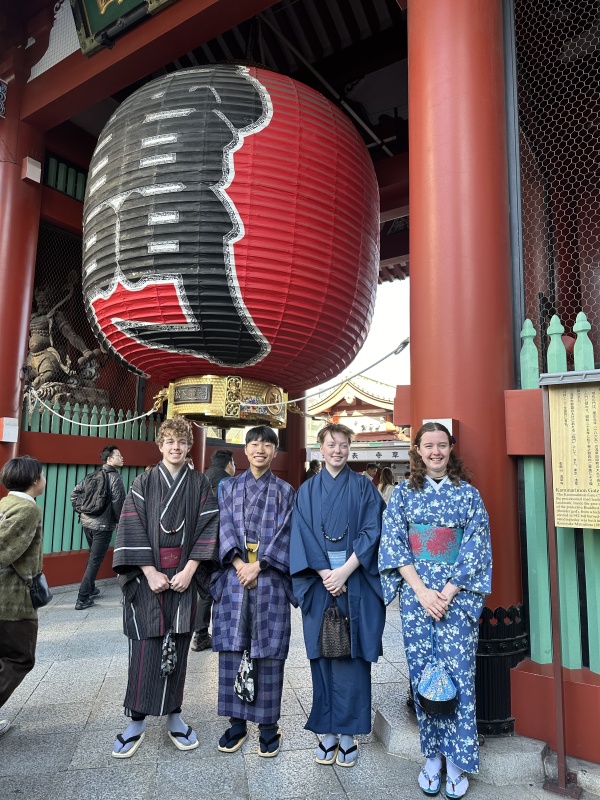
Ariana Ferguson with her travel companions; Lachlan Palmer, SeungWoo Jeong, and Oliver Burns, trying on traditional Japanese dress.

Lachlan Palmer and SeungWoo Jeong, tried Judo with their host brothers.
SeungWoo enjoyed experiencing in person the culture that he has been learning so much about at school. He said “my host brother and I went to several famous places in Japan such as Tokyo Tower, Skytree, Akihabara, Shinjuku, and Shibuya. However, I believe that the highlight of the trip was being able to experience the Japanese food my host family made for us, and the amazing experiences my host brother and I have experienced such as karaoke.’
Lastly, Oliver noted how interesting it was attending a Japanese school and some of the differences. He said “there was a lot of school spirit, much more so than my home high school, and I loved how much the student body supported each other. My favourite parts of school were the friends I made in class (and the bento lunches!).”
ENZ will continue working with Tokyo MBoE on cross cultural education opportunities. If Tokyo MBoE continue the Tokyo Experience School, ENZ will share the EOI with New Zealand schools when it is available, usually around September.
-
New Zealand well represented at the 2024 World Digital Education Conference
The 2024 World Digital Education Conference, attended by representatives from over 70 countries and regions as well as international organisations, aims to work with governments, the education sector, and stakeholders to jointly implement the outcomes of the United Nations Transforming Education Summit, promote education recovery post-pandemic, equitable quality education through digital education transformation, and advance the realisation of the Sustainable Development Goals (SDGs).
Chinese Education Minister Huai Jinpeng provided the keynote speech at the opening ceremony. He noted the impact of technology on education and the need to prioritise education reform to keep pace with changes and harness the benefits of digital education. Minister Huai concluded by saying they look forward to the new impetus into promoting international cooperation in digital education through this conference.
New Zealand was represented by Minister of Education, Hon Erica Stanford (through a pre-recorded session); H.E. Grahame Morton, New Zealand Ambassador to People’s Republic of China; Ardi Barnard, New Zealand Consul-General to Shanghai; Dr Grant Klinkum, Chief Executive New Zealand Qualifications Authority and Education New Zealand’s China-based representatives. The strong presence at the conference contributes to New Zealand’s reputation as an education partner with an innovative approach to digital learning. New Zealand Education Minister Hon Erica Stanford gave a video address and shared New Zealand’s efforts to harness digitalisation to improve our education system and support lifelong learning.
“As an education minister with a relentless focus on the progress and achievement of all students, I see that digital tools and the well-designed use of data have enormous potential to help us drive progress and achievement,” said Minister Stanford.

Hon Erica Stanford, New Zealand’s Minister of Education delivered a pre-recorded session, sharing New Zealand’s efforts to harness digitalisation and data in education.
In his address at the Opening Ceremony, Ambassador Morton highlighted the important role of education in the New Zealand-China relationship and gave insights into New Zealand’s innovative EdTech sector.
“Digital education is at the centre of New Zealand’s EdTech sector and its developments. Three-quarters of New Zealand EdTech companies are actively looking to take their offerings to the world,” said Ambassador Morton.
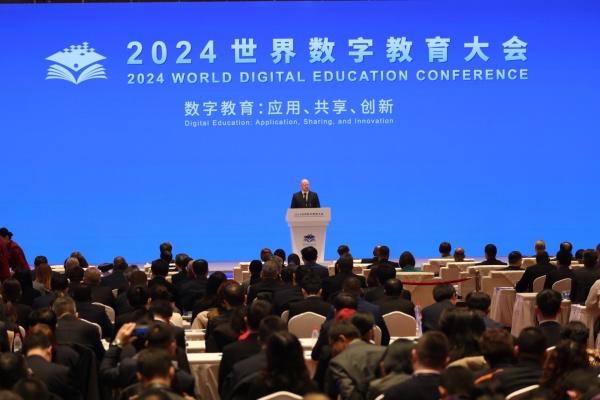
Ambassador Morton addresses the audience during the Opening Ceremony of the conference.
During the Parallel Session on Governance and Digital Transformation, Dr Klinkum shared New Zealand’s experience in quality assurance, qualification recognition and assessment delivery in the digital era.
“We would like to continue working with our international colleagues to ensure that we provide credible education for learners and that life-long learning and global mobility is supported by digital education and reflects the needs of increasingly digital societies,” said Dr Klinkum.
During the conference, organisers held the inaugural launch ceremony of the World Digital Education Alliance (WDEA). Universities New Zealand, on behalf of the University sector, joined the Alliance. The first batch of members is by invitation and as of 30 January 2024, 104 agencies from 41 countries joined the alliance ranging from schools to Technical and Vocational Education and Training (TVET) institutions, training centres, colleges and universities as well as research institutions and enterprises. The initiative aims to fulfil the UN SDG 4, build a mechanism for international cooperation and exchange in digital education, form synergy to promote global educational development, and create a new environment for smart education.
-
New Zealand Traveller Declaration toolkit
The New Zealand Traveller Declaration (NZTD) is an online system that travellers can use to answer questions on travel, customs, immigration, and biosecurity information before they arrive in New Zealand. The earliest travellers can submit a declaration is 24 hours before starting their trip to New Zealand. Once they have submitted a declaration, they will receive an email telling them what they need to know when they enter New Zealand. Travellers need to complete a declaration for any dependents they are travelling with, including children and infants.
The New Zealand Customs Service has prepared a toolkit for promoting the NZTD to networks, customers, communities and in workplaces. In this toolkit, are factsheets posters, videos, flyers, forms, social media tiles and copy available in various languages including Hindi, Japanese, Korean, Punjabi, Simplified and Traditional Chinese, Spanish, Vietnamese, Portuguese, French and German.
For more information on the traveller declaration process, please visit this page here - About | New Zealand Traveller Declaration.
*Paper forms will continue to be available for travellers who cannot complete the form online and will be accepted as a paper-based version of the digital NZTD at the air border.
-
Around the world in five
Asia
A shift towards non-recruitment based engagement with Indian schools could be key to better managing student expectations, stakeholders have suggested. Those who have done it well – particularly schools in the US – have created engagement through faculty, immersion trips, experiential learning opportunities, curriculum engagement and alumni, The PIE learned.
North America
British Columbia is Canada's westernmost province, and a leading destination for international students within Canada. On 1 March, the BC Ministry of Post-Secondary Education and Future Skills released details of how the international student cap will be applied within the province's education system.
Europe
A new paper from a group of experts, including three former universities ministers, challenges suggestions that the United Kingdom has too many international students and warns that the government is using out-of-date data to predict the number of overseas students expected to come to the UK for their higher education.
Africa
International educators need to prepare for ‘The Africa Decade’, where enrolment growth rates of African students globally are expected to hit their fastest rates over the next 10 years. Modelling suggested African students will account for one in eight international students by 2050, but visa rejections are seriously hampering efforts to enrol students from across the continent.
Oceania
International students are more open to switching destinations following recent government policy changes in three of the top destinations – Australia, Canada and the UK, with the UK most affected and the USA looking set to benefit, according to a student survey conducted by global higher education-focused agency group IDP Education.
-
From the Acting Chief Executive: Building global connections
Tēnā koutou katoa
Earlier this week the Prime Minister of the Socialist Republic of Viet Nam, His Excellency Phạm Minh Chính, made an official visit to New Zealand accompanied by a large delegation. Joining him was their Minister of Education and Training, Nguyen Kim Son. The visit was a timely opportunity to highlight our education cooperation with Viet Nam and to identify areas in which we can grow.
Viet Nam is a multi-sectored market for New Zealand’s international education sector and the fifth largest source country for international students.
I was delighted to witness first-hand the signing of an Education Engagement Arrangement (EEA) between New Zealand and Viet Nam, signed by our Minister for Tertiary Education and Skills, Hon Penny Simmonds, and Viet Nam’s Minister of Education and Training. This arrangement demonstrates to prospective students and their families that New Zealand is a partner of choice for the Vietnamese Government in the field of education, which aligns with the New Zealand Government’s priority to build a more resilient and sustainable sector. You can read more about the EEA and the signing event in this issue of E-News here.
Keeping with the theme of building global connections, last week I was pleased to meet with Ambassador Eduardo Saboia, the Secretary for Asia and Pacific at Brazil’s Ministry of Foreign Affairs (Itamaraty). Brazil is our largest partner in Latin America and prior to the COVID-19 pandemic, New Zealand welcomed over 3,000 Brazilian students. We know that Brazilian students are valued additions to New Zealand classrooms, and that Brazil has been a popular destination for the Prime Minister’s Scholarships for Latin America.
Last week we also received formal confirmation that Hon Penny Simmonds, Minister for Tertiary Education and Skills, will be the Minister responsible for international education and Education New Zealand Manapou ki te Ao.
Minister Simmonds is the Member of Parliament for Invercargill, elected in 2020. Prior to her election, Penny was Chief Executive of the Southern Institute of Technology (SIT) from 1997 to 2020.
The coalition Government has made clear its objective to double the value of exports in 10 years and we now await the Minister’s Letter of Expectations which will set out her detailed expectations for our work.
In closing, positive news to share is that international students are returning to New Zealand. The total number of international student visa holders, in and outside New Zealand is now 45,753 – that is a 171 percent increase since our borders reopened in August 2022 (16,853). The total number of visa holders in March 2024 is 68 percent of those in March 2020 (67,331), when the borders closed. It is heartwarming to see the beaming and excited faces of the new intake of international students joining their schools, universities, Polytech's, English language institutes, and other private training establishments in the gallery of student welcomes that has been compiled here.
After the challenges of recent years, it is a reason to celebrate.
Ngā mihi,
Linda Sissons
Acting Chief Executive
-
PIF Recipient: Blue Tomorrow
A new online offering from AUT Ventures is set to immerse learners worldwide in one of the greatest challenges – and opportunities – of our times: the blue economy. More importantly, it aims to give learners the confidence to take their next steps towards a rewarding career and an education pathway that builds a more sustainable future for humanity and the ocean.
The blue economy describes marine activities that generate economic value and contribute positively to ecological, cultural and social well-being. ‘Blue Tomorrow’ is an innovative learning experience that will guide learners through the blue economy’s mission, careers and pathways.
Blue Tomorrow is a pilot project developed jointly by AUT Ventures and Education New Zealand Manapou ki te Ao (ENZ), New Zealand’s government agency for international education. Through its International Education Product Innovation Fund, ENZ is supporting a range of pilot projects that reimagine how a New Zealand education can engage and inspire international learners and create impact through new delivery modes, approaches, and partnerships.
Blue Tomorrow was one of the first projects to be supported by the Product Innovation Fund and is a natural fit as innovation is both its cause and career lens. The approach positions New Zealand as a leader and champion for sustainable oceans, inspiring learners into a diverse range of career opportunities and the education pathways to get them there.
So why Blue Tomorrow? Globally, the blue economy is set to double in size by 2030. It is a natural fit with New Zealand’s identity as an island nation and a member of the South Pacific region, whose countries and peoples are intrinsically connected to the ocean. With 96% of its territories underwater, New Zealand has one of the world’s longest coastlines and largest exclusive economic zones, making it a hotspot for marine biodiversity. Aotearoa has the wisdom, obligation, and opportunity to lead the world toward the ocean we want.
To deliver this programme, AUT Ventures is partnering with Moananui, a collaboration of leading private companies, public sector entities, and research institutions, with the goal of transforming Aotearoa New Zealand into a world-leading ecosystem for developing and commercialising blue economy products, services, technology, research, and capability. For Moananui, Blue Tomorrow aligns with its mission to accelerate innovation and investment in Aotearoa’s blue economy to generate unparalleled economic, social, cultural, and ecological value.

AUT Ventures is partnering with Moananui, a collaboration of leading private companies, public sector entities, and research institutions.
Modern learners are searching for a career in service of a cause, but the pathways to enter them are often unclear. Mission-led organisations require talent and leadership with a shared purpose to fill the domestic and global needs of the growing blue economy. Blue Tomorrow flips the traditional model around - purpose first, career second, and helps take care of the pathway puzzle. The online learning experience shows how the blue economy can lead to a financially rewarding career that contributes to shared global challenges and builds a more sustainable global economy.
In today’s climate, there is no shortage of challenges, from over-fishing and biodiversity loss to ocean warming and acidification. The importance of sustainable oceans, and the pressing need for action, are reflected in the UN Ocean Decade and Sustainable Development (SDG) Goal #14 – life below water. But developing the blue economy also presents immense opportunity, including the potential to address other SDGs, including zero hunger (SDG #2), decent work and economic growth (SDG #8), responsible consumption and production (SDG #12), and climate action (SDG #13).
The partnership with Moananui brings together commercial, public, and community partners from New Zealand’s blue economy who have global credibility and unique stories of innovations that are good for the planet to share with learners worldwide. Blue Tomorrow has the potential to become a widely known model for linking the blue economy’s growing demand for talent with respected education offerings from New Zealand providers, building awareness, and enabling action for a more sustainable future for the ocean.
Across four weeks of online learning, Blue Tomorrow will empower learners to find their own place in the blue economy. Unlike some traditional programmes designed to prepare learners for a specific career, sector or discipline, Blue Tomorrow aims to inspire learners around a cause – in this case, the blue economy. Local industry guests accompany learners on the journey that starts with an overview of ocean literacy and the blue economy. They then explore the blue economy sectors and take a deep dive into one (aquaculture in the pilot), where they investigate careers and pathways, including a taste of local learning (Te Pūkenga, NMIT’s sustainable aquaculture programmes in the pilot). The experience wraps up with learners reflecting on their inner development and planning for their next steps in the blue economy.
The blue economy is one of the biggest opportunities on the planet. Blue Tomorrow puts learners at the centre of this new frontier.