Search
Showing 9 of 9 results for esol
-
PTE English for Speakers of Other Language (ESOL) Provision Fund
The $1.5 million fund is designed to help English language schools impacted by the border closure to international students.
The funding was announced in July by Minister of Education Chris Hipkins as part of the Government’s $51.6 million Recovery Plan for International Education.
The PTE ESOL Fund is part of the first workstream, which seeks to stabilise the sector while borders remain closed. Read more about the Recovery Plan.
The funding aims to help increase demand for English language training, to be met by English Language Schools. It will also help with upskilling and improving the employability of New Zealanders with English language needs, including migrant partners and dependents of New Zealanders.
The fund is being implemented by the Tertiary Education Commission (TEC).
Eligibility
To be eligible for the PTE ESOL Provision Fund, your organisation must hold a Category 1 External Evaluation and Review (EER) rating from NZQA as at 1 July 2020.
Teaching enabled by this fund may only be provided to Category A and B learners. All learners must be in New Zealand.
Read more details on eligbility
How to apply
Applications for the PTE ESOL Provision Fund are open now and will close at 5pm on Friday, 28 August.
To apply, you need to complete the form on the TEC website and send it through to the TEC Customer Group via email: customerservice@tec.govt.nz
Other considerations
For the full list of terms and conditions, including successful applicants’ reporting and monitoring requirements, refer to the TEC website.
-
Recovery plan for the international education sector

The Minister of Education has announced a long-term recovery plan for the international education sector.
It includes a $51.6 million investment from the COVID-19 recovery and response fund to help reset New Zealand’s international education sector.
The Plan consists of three concurrent workstreams that focus on stabilising the international education sector, strengthening the system, and accelerating the transformation of the sector as signalled in the 2018 International Education Strategy.
It includes:
- $20 million in support for state and state-integrated schools to continue to employ the specialist international workforce to provide teaching and pastoral care to international students in New Zealand this year.
- $10 million targeted and immediate funding to private training providers of strategic importance (including English language schools) to preserve the foundations of the sector. MOE is developing eligibility criteria which will be implemented by TEC; providers can apply to TEC from mid-August.
- $1.5 million for English Language Schools to deliver English language training to migrants to help them to succeed in our schools and communities.
- $6.6 million to continue pastoral care and other activities normally funded by the Export Education Levy.
- $500k for NZQA to ensure the quality of New Zealand education being delivered offshore, and continue strengthening ongoing quality assurance processes.
ENZ will administer:
- $3 million for marketing and brand protection activities to keep New Zealand’s education brand visible in key markets and to ensure we capitalise on the strong international reputation New Zealand has gained through its handling of the COVID-19 crisis.
- $10 million to develop new future-focused products and services to drive growth in our system onshore and offshore, to ensure a more resilient sector. This will include:
- An offshore pathways initiative to enable learners to begin their New Zealand education journey from their home country and to study programmes that pathway directly into bachelors and masters degrees in New Zealand, providing greater flexibility for learners and resilience to shocks.
- A New Zealand digital platform to provide a single strong New Zealand brand and presence to enable New Zealand providers to deliver their education products and study programmes to more people offshore, and to meet changing learner needs.
Education New Zealand will also support and drive the Recovery Plan through its annual activity. This will include brand positioning, maintaining engagement with students, partners and agents offshore, student retention and transitions, building the international reputation of New Zealand education, and working with the sector and regions on innovation and new modes of delivery.
The Ministry of Education has developed criteria for the allocation of funding for Private Training Establishments (PTEs) and English language schools, to be implemented by the Tertiary Education Commission (TEC).
Fund for PTEs in financial difficulty due to COVID-19
The Private Training Establishment (PTE) Targeted Assistance Fund (TAF) closed on 11 September 2020.
PTE ESOL Provision Fund
The PTE ESOL Provision Fund closed on 28 August 2020.
Further information
- Download the Recovery Plan outline here
- Read the Minister of Education's release
- Cabinet Paper - A Strategic Recovery Plan for the International Education Sector
-
IEGF success key to Chile market
Vital English’s success in Chile started in mid-2012 when ENZ staff introduced Vital English to STEP, an institute associated with the University of Santo Tomas that regularly tenders for Chilean Government bids in English for Speakers of Other Languages (ESOL).
Through this introduction, Vital English was able to identify an opportunity for developing an ESOL product based on an existing Vital English course that would be suitable for upskilling Chilean primary and secondary school teachers.
Just a few months later, Vital English and STEP were involved in a Chilean Government pilot involving 380 teachers. The pilot saw teachers improve their Test of English for International Communication scores by one or more levels on the Common European Framework of Reference for Languages in three months.
Given that success, the Chilean Government sought to extend the pilot to a 12 month course in 2013 involving 4000 teachers.
Vital English was under pressure to rapidly develop new content to meet the needs of this bid and attend a number of meetings with Chilean Government officials. While both STEP and Vital English could recognise the scope of the opportunity, neither party had sufficient resources available to meet these requirements within the required timeframe.
“Fortunately, the IEGF was announced”, says Adrian. “Winning an IEGF has provided enough of a financial boost to allow Vital English to develop the required content and get to market quickly to maximise the opportunity.
“The result of being able to respond quickly to the requirements of the Chilean Government has, without question, strengthened our position there and accelerated our ability to grow the market. It has led to Vital English being invited to participate in a further bid for providing ESL to 1000 secondary school students.
“Vital English is now participating in three different Chilean Government bids worth hundreds of thousands of dollars. More importantly, the lessons learned from the partnerships formed, have opened the door to a new business model that Vital English is well positioned to maximise.”
For more information on the IEGF, click here.
About Vital English
Vital English is a supplier of digital support products for international students throughout the student engagement lifecycle; from helping institutions build awareness in the market to communicating with alumni digitally. Central to the Vital Suite of products is a catalogue of online and blended English courses. Vital English supply these products globally working with institutions in New Zealand, Canada, Australia, South East Asia and the Americas.
Vital English is happy to share more feedback from lessons learned in Chile. Please contact Adrian Sallis for more information. adrian.sallis@vitalenglish.com
-
Around the world in five - September 2022
International
Ardern welcomes students back to New Zealand
Amended NZ education strategy released
Finding value in technology for education
New Zealand university plans biggest ever job cuts
Gender gap ‘impossible to overcome’ without ‘intervention’
NZ: Victoria partners on TESOL in Vietnam
Linguistic racism can take a high toll on international students
New Zealand
Watch: PM Jacinda Ardern on Covid-19 Rules, Construction Industry and International Students
Tauranga education showcase returns to South Korea
Education NZ’s plan to woo Asian students
ESOL outdated: English for speakers of other languages guilty of othering
Return of international students marks new era for sector
International students: How changes in Asia could affect how young Kiwis learn
Australia
Western Australia government launches Agent Incentive Scheme, extends student bursaries
China
China will again welcome international students
Colombia
NZ Embassy welcomes Colombia agents
India
University of Auckland announces scholarships worth NZ$1.5 million for Indian students
Rural Indians join rush to study abroad as prospects dim at home
Indonesia
9 Indonesian women complete Girls in Tech scholarship programme
Italy
Japan
Government sets goal of 100,000 students going abroad by 2027
Malaysia
Many Malaysians returned as experts after New Zealand education, says High Commissioner
New Zealand’s University of Waikato keen to collaborate with Malaysian universities
South Korea
New Zealand, Korea well placed in digital ecosystem to work together: ambassador
Winners of Student Reporter Contest recognized at ceremony
Thailand
Rose Garden Rangsit School joins hands with ENZ to organize coding camp
Vietnam
Quang Tri teacher receives full scholarship from New Zealand Education Agency
University of Auckland supports students from South-East Asia
-
More analysis of latest international student enrolment data

The 2012 Export Education Levy data contained mixed news across sectors, and from some of our key international markets. While the number of international student enrolments is down overall, importantly the value of the industry, as measured by international fees earned, has increased by 2 percent and this is a significant result.
Education New Zealand is committed to working with each sector of New Zealand’s international education industry to support institution’s needs and priorities to enable industry-led growth. We have a strong programme of work underway in 2013 to achieve this.Schools

For all schools, international student numbers declined 0.3% to 15,643 students in 2012 compared with 2011
-
Primary and intermediate enrolments were down 3.3%
-
Secondary, composite and special enrolments fell 0.3%.
-
But value has remained more or less static over the past five years
-
South Korea and China make up half the international education market for this sector
South Korea was down 15% for schools in 2012. Why?
-
South Korean Government moves to provide more English language tuition in Korea
-
Foreign providers setting up in Korea
-
Christchurch earthquake
-
Economic factors in markets
-
High NZ dollar.
China shows strong growth
-
In 2012 there was a 20% increase in Chinese school international student numbers
-
Chinese first-time visa applications are up, particularly for contributing, composite and special schools.
Japan is emerging as a growth market
-
Japanese school international student numbers rose 23% in 2012
-
ENZ regards Japan as a market worth further exploration, particularly for school partnerships.
Universities

Universities earned $308.9 million in international fees in 2012, an increase of 5.5%
-
There are fewer international students, but they are higher value.
International university student numbers fell 5.2% - a decline of 980 students
-
Indian international students accounted for more than 40 percent of the decline.
-
There was a small increase in numbers of Chinese international students (universities’ biggest and most valuable market). This suggests that New Zealand’s most important international education market is performing well
-
Japanese international student numbers almost doubled
-
Saudi numbers are falling due to a halt in new intakes for Saudi scholarship students in 2012
-
Universities have seen overall international student numbers fall since 2004 despite ongoing growth in the global market for international students
-
Capacity exists and there is scope for recovering market share in the university sector.
Figures for individual universities are not yet available but we believe about a quarter of this decline can be attributed to a fall in enrolments at Canterbury and Lincoln Universities due to earthquakes
Universities have strong commitment to internationalisation, partnering with institutions in a variety of markets.
Institutes of Technology and Polytechnics (ITPs)
In 2012 ITP fee income was up 4.9% from 2011 - overall revenue for the sector has increased almost 50% since 2007
International student numbers rose 7.1%; EFTS were up a corresponding 3.4%. ITPs was the only sector to see a rise in numbers and EFTS
India and China make a combined 57.6% of all ITP international enrolments:
-
Numbers are up or holding for all major markets
-
There were small declines in South Korea and Saudi Arabia
-
Saudi numbers are falling due to a halt in new intakes for Saudi scholarship students in 2012
-
China remains relatively strong
-
ITPs are encountering strong competition in India from traditional competitors Canada and Australia
-
ITPs want to diversify their exposure to India and China with new market development in the Middle East, Sri Lanka, Nepal, Indonesia and the Philippines.
Private Training Establishments (PTEs)

PTEs (non-SDR)
Enrolments at non-SDR PTEs (mostly English language schools) fell 13% in 2012
-
English language schools down 17%.
-
Tuition fees were down 9 % to $105.1 million
-
The decline in English language schools likely to be linked to the rising value of the NZ dollar. International language travelers are known to be price sensitive; also an area of intense international competition.
This fall, which has been happening for two years, is of concern because ESOL students often move on to further academic study
Why down:
-
Affordability – the high NZ dollar
-
Greater provision of English language tuition in South Korea
-
Saudi Arabia – fewer new Saudi scholarships
-
New immigration policy – changes to work rights for L5 and 6 diplomas introduced in April 2012
-
Competition from other our key global competitors.
PTEs (SDR)
-
Enrolments at SDR PTEs (mainly vocational education training institutions) were down 6% in 2012
-
Tuition fees were up 6.4% to $99 million
-
Internationally, demand is growing for high quality vocational training
-
Some of our competitors (eg. Australia) have tightened up student immigration criteria for vocational training.
-
-
Kiwi robots breakthrough in China schools
At the 2013 world robotics championship New Zealand high schools won three of the five high school divisions and went on to win the World Championships.
Students from Glenfield College and teachers from Glenfield College, Westlake Girls High School and Massey University, led by Chris Hamling, National Manager of Kiwibots were invited by Tianjin Association for Science and Technology (TAST) to attend last month’s Tianjin Science Week.
They visited five schools in the northern Chinese city. As well as showing off their robots, the teachers also did a number of presentations about New Zealand’s education system on the theme of “How we make winning students”.
Chris says “We wanted to build up from a simple description of how robotics are used in the classroom and then go on to illustrate how New Zealand's education system emphasizes practical work.
“Our ESOL support is important in allowing international students to find their feet quickly and that our universities are an important part of our education pipeline.”
The Kiwi party was followed from school-to-school by CCTV, China’s largest television channel.
Earlier this year TAST approached Chris wanting New Zealand schools to take part because China, like New Zealand, wants to to accelerate scientific progress and develop new technology, popularize scientific knowledge and create an environment for innovation. Chris says discussions between TAST and the Kiwibots led them to conclude that “it is primarily because of our education system that we are so successful”.
Education New Zealand Senior Education Manager in Beijing, Stijn Te Strake, says “stimulating creativity through education is a recurring theme in dialogue with China and other Asian countries looking towards technological innovation to advance rapidly developing economies.
“Kiwibots is a great demonstration of New Zealand’s strengths in these areas, in a fun and engaging manner that all can relate to.
“During the visit we saw New Zealand and Chinese students interacting and learning from each other, with their passion for science and technology as the basis of common understanding.”
Education New Zealand (ENZ) supported the Kiwibots visit to Tianjin. Last December ENZ also supported the Asia-Pacific Robotics Championship held in Auckland to leverage and promote New Zealand as a study destination, particularly for middle and high school students with an interest in technology.
More than 500 students in nearly 150 teams competed in this championship, with 70 percent coming from offshore, mostly China (77 teams) but also Hong Kong and Singapore.
-
Japanese agriculture students visit Southland
The students, known as Chikujyo (“ari-girls” in Japanese)came from agricultural high schools across Japan to spend 12 days in Southland at Southland Girls' High School, which offered ESOL classes and technical training in farming. Alongside this, the students visited Fonterra Edendale, Blue River Dairy, Southern Dairy Hub research farm and other dairy farms with women in leadership roles. The Southern Institute of Technology also assisted with some activities.
Misa Kitaoka, ENZ’s Senior Market Development Manager – Japan said the programme generated significant media coverage in Japan and is a great example of industry and institutions collaborating to deliver a programme that highlights New Zealand’s unique education offerings and expertise.
“Students were impressed by the efficiency and productivity of agriculture practices in New Zealand, and the support for women in farming. They left feeling that farming in New Zealand allows a good work life balance,” said Misa.
“I am so inspired by the girls who are using what they learned in New Zealand to promote a new image of working in agriculture that’s more accessible for new entrants, especially females.”
The programme was developed by the Ministry of Agriculture, Forestry and Fisheries’ New Entrant’s and Women’s Division, in consultation with the New Zealand Ministry of Foreign Affairs and Trade, Ministry of Primary Industries and ENZ. It was administered by the Japan Agricultural Exchange Council and was funded by the Japan Racing Association.
-
Pakistani student leverages language skills to connect communities
Fluent in Punjabi, Urdu, and English, and passionate about community service, Usma soon became a key player working to support and connect ethnic communities in Christchurch.
So extensive have her achievements been, that she has been honoured by the university with a coveted Blues Award for community engagement, and by the Christchurch City Council with a Civic Award.
Usma arrived in New Zealand in late 2016 and gave birth to her third child shortly after arriving. “It gave me the time I needed to assess society here, and I realised the value that was placed on volunteer work.”
New Zealand values transferable skills
“My background was in teaching and ESOL (English for Speakers of Other Languages) instruction. I did teach here when I first arrived, but it was not fulfilling enough,” she says. “I needed to think what other skills I had to offer in an area of work I was passionate about. New Zealand is not a destination of degrees, it is a destination of skills, where whatever transferable skills you have to offer, are valued.”
She initially got involved in UC’s Pakistani Student Association, planning events which quickly extended beyond the student community. “I got great feedback from the wider community and different ethnic groups started coming along. People from these communities were looking for connectivity and involvement and it ended up being a multi-cultural hub.”
She admits it was not without challenges, but she was determined. “I was an international student, a woman, a mother of a special needs child, and I was working. But I managed my time. I enjoy doing volunteer work and it comes naturally.”
In her second year at Uni, she secured a role as a Diversity and Engagement Officer with the Ministry of Ethnic Communities and juggled both study and work. It was in this role that she became involved in the Government response following the Christchurch mosque attack in 2019.
Frontline worker following mosque attack
“I was one of the frontline workers dealing with victims and those left behind. Some of my colleagues were victims,” she says. “It was a difficult time. I had never had any exposure to such an event, or what the aftermath might be like. Hearing the stories, and being part of it, are totally different things.”
“I’m very proud of my work and found it very rewarding. I discovered my strengths and weaknesses and learned how much I had to offer. I could speak with many of the widows in the Muslim community in their own language, understand their needs, and advocate on their behalf. I learned how to deliver the key messages to the government agencies involved in the response and formed a link between the two groups.”
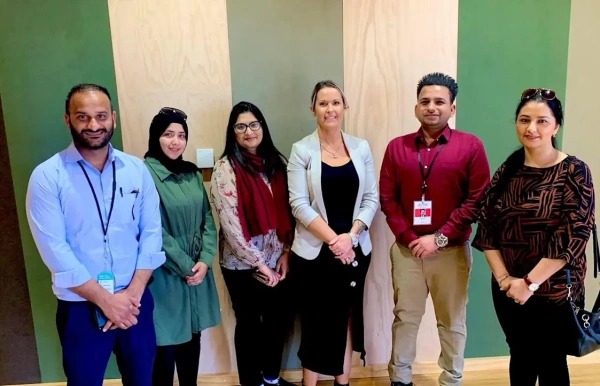
“The migrant communities have so much resilience and I believe that every disaster brings opportunity to come together, to heal, and to grow.”
Usma went on to become involved in Widows of Shuhada – an eight-part Plains FM/RNZ podcast documentary series which followed the journey of four widows following the attack.
Soon after, Covid-19 arrived in New Zealand and Usma worked on engagement with local ethnic communities, translating the Government’s messages and communicating them through a range of digital channels.
Tapping into the skills of international students
But she didn’t stop there. Usma was also influential in Christchurch’s Ethnic Communities Skills Build Programme, a project designed to smooth the pathway of migrants and international students into employment in New Zealand.
International students could join in workshops, meet career counsellors and job brokers from the Ministry of Social Development, reshape their CVs, and attend job fairs.
“I believe we need to tap into the high-level skills of post-graduate international students. We need to progress them in the right direction, utilising their skills in science, technology, and innovation.”
As for her own career, Usma could not be happier. She has secured a full-time role as a policy analyst at the Ministry of Primary Industries in Wellington and has taken a step back from her volunteer work to focus on completing her PhD this year.
She is grateful for the opportunity to study in New Zealand and to bring her family with her. Her husband is working, her children are happy, and her special needs daughter has opportunities she wouldn’t have had in Pakistan.
Usma still acts as a mentor for international students and tells them if they are to make the most of their time in New Zealand, they should “think outside the box”.
“They should think about the skills they have to offer in the community, and they will be rewarded with a transformative experience. Leaving behind the social constraints of your home country can be liberating. It’s all about following your dream.”
Usma says she’s already landed her dream job, but she plans to continue her community work once she has completed her PhD.“I believe it is my contribution to this country and I love doing it. I’m not likely to stop. I’m just settling in, finishing my PhD, and getting ready for something big. I have ambitious plans.”
-
Language and culture exchange strengthens ties with South Korea
The students, from 64 schools across South Korea, were welcomed by Waiuku College and St Peter’s School in Cambridge, where they connected with local students, explored school facilities, and experienced Kiwi culture first-hand. From powhiri to classroom visits, the exchange sparked meaningful cross-cultural connections.
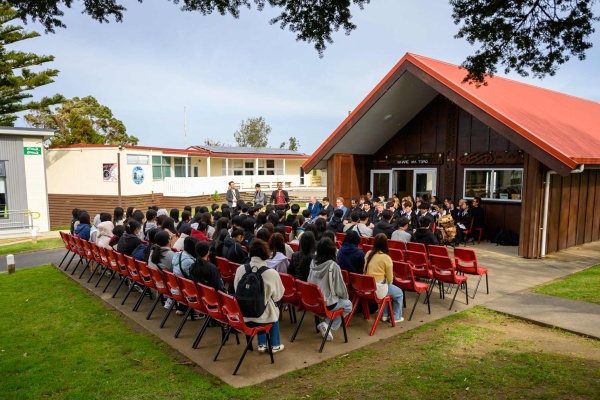
Powhiri at Waiuku College.
Waiuku College Director of Community and Global Relations, Antionette Walters, said the students were amazing, and willing to make the most of their experience.
“They were so happy to give anything a go – they even loved trying a New Zealand mince pie!” she said.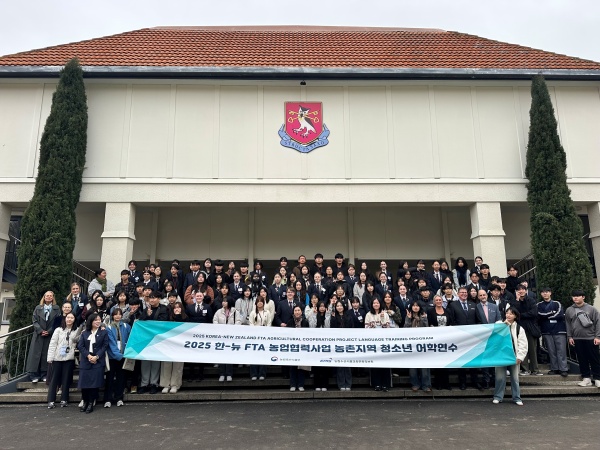
At St Peter’s, students toured the Equestrian Centre and Golf Academy, with Head of School Jason Speedy welcoming the group and sharing insights into the school’s campus and learning environment.
The visit followed a two-week English training programme in rural South Korea, where six experienced New Zealand teachers taught students aged Year 8–11. Selected from over 35 applicants, the teachers represented schools from Hamilton, Hawke’s Bay, Auckland, Cambridge, Wellington, and Tauranga.
ENZ representatives joined the programme’s opening event in Yangpyeong on 25 July, meeting the teachers and witnessing the enthusiasm of Korean students engaging with New Zealand’s distinctive teaching style.
Bernadette Moffat, ESOL Teacher at Silverdale Normal School and Huntly Primary School, said: “It was a privilege to represent New Zealand and see how eager the students were to learn.”
Bernadette was one of six New Zealand teachers who travelled to Korea to teach English and attended the closing ceremony where students were recognised for excellence in English.
Looking ahead, EPIS is exploring the possibility of expanding the current short visit into a four-week study experience in New Zealand from 2026, offering even deeper immersion for future scholarship recipients.