Search
Showing 10 of 1236 results for Value-priced treatments https://simplemedrx.top
-
India insights snapshot
Country dashboard – India
In the year ended December 2024 New Zealand exported $398.02 million of education related travel to India and imported $3.9 million, representing a trade balance of $394.12 million and a total trade value of $401.92 million.
Broad field and level of study for Indian students in New Zealand - 2023
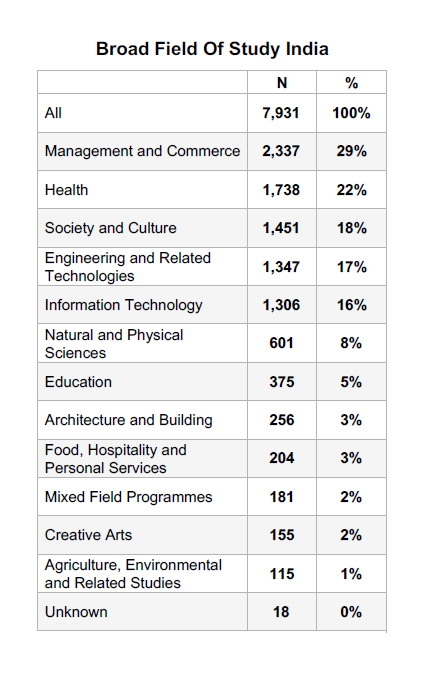
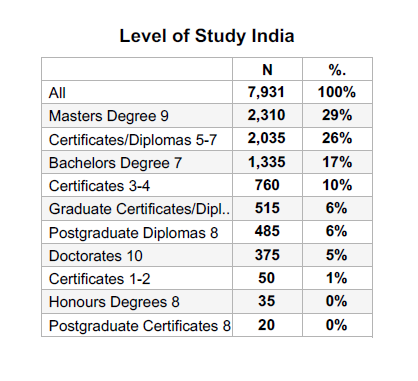
Browse the full country dashboards for India and other markets on this link.
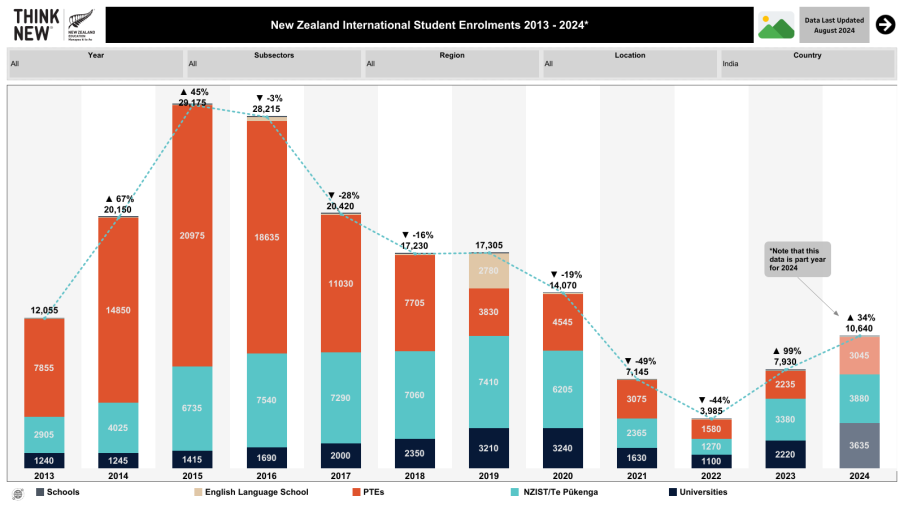
International student enrolments from India
Between January and August 2024, overall international student enrolments from India grew 34% to 10,640 from 7,930 enrolments in the full year period for 2023. Enrolments for universities grew around 64%, private training establishment enrolments grew 36% and Te Pūkenga enrolments from India grew 15% over the same period.
86% of Indian students in New Zealand rate overall experience positively
Indian students are thriving in New Zealand. The New Zealand International Student Experience Survey 2024 reveals that 86% of Indian students rated their overall experience in New Zealand positively.
From high-quality education and a warm, welcoming environment to strong community connections, these insights reflect New Zealand’s continued commitment to delivering a world-class, student-centred experience. -
Around the world in five
THAILAND
Thailand's skills problem is slowing down its high-tech push
Thailand’s Education Minister is trying to close his country’s skills gap, promoting innovation and advanced industries to help lift the economy. However, with Thailand’s working age population expected to shrink 11 percent by 2040, the need for skilled workers is rapidly increasing.
GLOBAL
Growing openness to online programmes among parents
A global survey of parents with school or college-aged children finds 41 percent would consider study abroad for their child, including 65 percent in the UAE, 60 percent in Indonesia, 55 percent in India, and 54 percent in China. Sixty percent of parents also said they would consider a university programme that is delivered online.
CHINA
How China's youth population dip may spell trouble
Data in the latest 'Patterns and Trends' analysis from Universities UK shows that the Chinese youth population is projected to shrink by a quarter from 2015 to 2025. As China has become the dominant source of international students, this projection is bad news for Western universities that rely on fees paid by Chinese international students.
GLOBAL
Survey shows long-term impacts of language travel
According to a survey of 2,000 former language learners, 90 percent of respondents said face-to-face interaction with other people was the most valuable language learning experience, such as interacting with their host family, fellow students and teachers. Overwhelmingly, most survey respondents had travelled to study English (62 percent).
MALAYSIA
Malaysia faces low female participation in STEM sectors
In 2015, women made up less than half of the graduates in Malaysia in engineering and technology. Dr Halimaton Hamdan from the Academy of Sciences Malaysia (ASM) said “while there are no specific programmes to promote STEM among girls, to spur interest in science and mathematics, ASM has started inquiry-based science education, as well as getting students involved in industry placements and training.
-
ISANA NZ – COVID-19 Update
Catch-up cafés
ISANA NZ is offering members and friends the chance to catch up and discuss the issues they are facing.
We have a weekly Zoom networking opportunity on Wednesday mornings from 11am. Join special guests each week including officials from ENZ, MoE, NZQA and INZ. MoE is providing responses to concerns and questions raised by the weekly events.
Register here for this week’s Catch-up Café, or through our Events tab on the website for upcoming Cafes. Please go to our Good Ideas and Responses page to learn more and access previous Café notes and responses.
Each week, the general Q&A starts at 11am, and special guests are introduced at 11:30am. Email contact@isana.nz to forward any questions ahead of a session.
Looking Ahead webinar series
ISANA NZ is pleased to announce our International education: Looking ahead webinar series.
This series includes professional standards and self-care, enabling international student integration and work readiness, responding to racism and supporting online learning. Keep an eye out in ISANA NZ mailouts, our website and social media platforms for details of our up-coming webinars.
Feel Good Friday
ISANA NZ would like to acknowledge members who are going above and beyond the call of duty.
Every fortnight on a Friday we would like to acknowledge these wonderful people through our social media channels and give them a chance to go in a draw for a $100 gift voucher to be drawn later in the year. Please send an 100-word explanation as to why you would like to nominate your colleague and also the logo of your institute (optional) to contact@isana.nz
-
Does it matter if New Zealand wasn’t a student’s #1 choice? Join the Insights and Student Experience teams and find out!
In this session, Director of Insights, Marie Clark, Insights Analyst, Dr Tom Vardy, and Student Experience Manager, Ross Crosson, will give an overview of the key findings of the survey and will also exclusively preview our deep dive into the questions on decision making and country choice. Answering the question: Does it matter if New Zealand wasn’t an international student’s first choice?
In the 2024 International Student Experience Survey, students lifted their positive rating of their experience to 86 percent, two percent higher than the previous year. In addition, the number of students who rated their experience as “excellent” lifted eight percent to 41 percent. ENZ’s media release which includes links to the report and data sets can be found on our website - Rise in international students rating New Zealand experience positively.
As many education providers are looking to take advantage of new opportunities, this webinar is an important first chance to identify what additional support for international students may be required for the 2025 academic year.
Click this link to join the session: Student Experience Webinar | Tuesday 24 September 11am to 12pm.
-
Study with New Zealand online launched for adult professional learners
The Study with New Zealand Online platform – an outcome of the Strategic Recovery Plan for International Education 2020 – is a New Zealand owned and branded platform that offers global learners a new way to engage with a New Zealand education.
Study with New Zealand Online has up to 60 courses available from 20 + education providers.
ENZ’s General Manager – Sector Engagement, Wendy Kerr, said the pilot learning platform aims to tap into the adult professional learner market.
“Our research shows that there is a significant career-oriented, adult learner market that is looking for ways to advance within their current career. Study with New Zealand Online aims to tap into that market and test if there is value in what New Zealand can offer uniquely.
“Good examples of courses unique to New Zealand are a short course on sustainability in the wine industry delivered by NMIT | Te Pūkenga. If you are in the wine industry, you clearly know New Zealand wines and our expertise in sustainability. The same goes for an ECE course offered by Te Rito Maioho ECNZ, which showcases New Zealand’s bicultural approach in this field.”
Kerr says, “We know how hard the pandemic was on international education. We know this project is about exploring new and different ways to deliver, and new and different audiences for, the New Zealand education experience. The goal is to diversify and build resilience.”
Findings from the Study with New Zealand Online pilot will help inform insights and recommendations on how New Zealand’s education sector could transform to a more sustainable future state through the diversification of our international education offerings.
Visit Study with New Zealand Online on https://online.studywithnewzealand.govt.nz/
-
Around the world in five
GLOBAL
Institutional websites remain a key element of online recruiting
As many as 9 in 10 prospective students don’t have a particular school in mind when they begin their search process, making institution websites an essential source of information for prospective students. Social media plays an important part too, particularly for gathering recommendations for institutions or schools and as a window into student life.
GLOBAL
Teacher demand international schools’ biggest challenge
Parents’ desire to equip their children with English language skills and prepare them for university overseas have contributed to a worldwide boom. The number of international students worldwide is forecasted to reach 6.3 million by 2021. Schools will therefore face the challenge of finding enough skilled teachers to deliver a high quality education to all of these students – some 150,000 qualified teachers are expected to be needed by 2021.
USA/MEXICO
Building bridges not walls will bring greater innovation
Over 60 university leaders from the Americas, Europe, Asia, Middle East and Africa met earlier this month along the USA-Mexico border to discuss the challenges and opportunities pertaining to innovation in higher education. They discussed innovation through effective partnerships – internationally, and between business connections and between disciplines.
AUSTRALIA
The growth of the higher education sector as an industry: what can we learn from Australia?
Australia is an attractive destination for students, but the country doesn’t rest on its laurels. Australia’s universities and schools take a proactive approach to recruitment. Many Australian institutions have implemented student diversification policies and have begun direct recruitment to specific demographics or regions.
UK
Mobility = Employability
In 2015, 64% of employers said that graduates with international experience are more employable – up from 33% in 2006. Globally, mobility is on the rise yet the UK fares poorly. In 2013/14, just over 10,000 of all higher education students in UK were outwardly mobile, compared to 50,000 each from Germany and Spain. The dominant barriers to mobility include lack of confidence with language skills (36%) and perceived difficulties adapting to a different culture (19%). So what are we doing to respond to these barriers?
-
NZIEC 2018: Register for AFS pre-conference workshops
The partnership will see AFS deliver breakout sessions throughout conference as well as two pre-conference workshops exploring the conference theme of Inspiring Global Citizens.
AFS is a leading global organisation promoting international study, with education and volunteer programmes across 98 countries empowering people of all ages and backgrounds with intercultural knowledge, skills and understanding.
Grant McPherson, ENZ Chief Executive, said the partnership reflects New Zealand’s vibrant international education ecosystem.
“AFS has a well-established track record of fostering global citizens so we’re delighted to have AFS contribute its expertise to our conference discussions relating to global citizenship,” said Grant.
“NZIEC delegates may be particularly interested in exploring practical ways in which they can implement global competence within their institutions at AFS’ two in-depth pre-conference workshops.”
AFS New Zealand National Director, Doris Cuthell, is excited about showcasing the organisation’s expertise at NZIEC.
“AFS is honored to be a programme partner at such an event as the NZIEC.
“We invite NZIEC delegates to join our pre-conference workshops and conference sessions for an opportunity to explore the area of global competence, which is a crucial component for any quality international education programme.”
In addition to its breakout and pre-conference sessions, delegates can connect with AFS at their stand in the Expo Hall.
Register now for AFS pre-conference workshops
AFS is offering two interactive pre-conference workshops on Wednesday 8 August. Numbers are limited. Secure your place through the links below.
Pre-conference workshop 1: Global competence in international education: What is it? Why does it matter? How can I foster it?
This workshop explores the concept of global competence, why it is of growing importance and why your organisation should be engaging with it.
You will have a chance to participate in experiential activities that enhance intercultural skills. We will discuss strategies for implementing these activities in different settings and identify ways to turn brief experiences into long-lasting learning for your audience.
Find out more and register here
Pre-conference workshop 2: High-tech solutions for global competence programmes
Research shows that merely coming into contact with cultural differences doesn’t develop global competence in students. However, students do develop these skills when taught within a developmental, experiential and holistic framework.
This workshop offers three frameworks that can provide a foundation for your curriculum to build global competence in both inbound and outbound students.
Find out more and register here
Conference dates
The 27th New Zealand International Education Conference and Expo will be held at Te Papa Tongarewa in Wellington on 9-10 August. Pre-conference workshops will be held on 8 August.
Registration for pre-conference workshops is now open. Registration for conference will open in late May. Find out more at www.nziec.co.nz
-
Around the world in five
CHINA
HSBC launches international education payment service
HSBC has launched a mobile payment system on mobile app and WeChat for Chinese international students. The service offers tuition payment with currency conversion and transfer to major global universities.
SOUTH EAST ASIA
ASEAN higher education more open to international engagement
Higher education systems in the ASEAN region, particularly Malaysia, Viet Nam, The Philippines, Indonesia and Thailand, are becoming more open for international engagement, according to a new British Council report.
US
The continuing expansion of online learning in the US
Distance education enrolments continue to increase in the US, with total enrolments of 6.36 million, which equate to nearly 31.6% of all higher education enrolments in the country.
CANADA
Ontario’s new international strategy for post-secondary education
The Canadian region has released a new strategy, Educating Global Citizens, in a bid to create study abroad opportunities for students, enrich the learning environment at Ontario’s public colleges, and build a stronger workforce by attracting more students to the region.
GLOBAL
Google invests in app to prep students for TOEFL
Google has announced its investment in an app that helps students prepare for standardised English language tests such as TOEFL. This is part of the company's investment in start-ups offering developing technologies that will broaden features offered by Google’s virtual assistant.
-
Update from Immigration New Zealand
Visa processing update
- From 01 January to 31 March 2025, student visas have been processed in 12 days (two and a half weeks) on average, compared to 24 days (five weeks) for the same period in 2024.
- Currently, international student visas are being decided in 10 days (two weeks) on average.
- The tertiary sector’s mid-year intake is almost upon us, and students need to apply for their visas now.
- Latest visa processing times can be found on the INZ website: Student visa wait times | Immigration New Zealand.
Reminders from Immigration New Zealand
The conditions of a student visa state that the visa holder must attend the programme of study at all times, at the place of study endorsed on the visa (unless there are genuine reasons for absences), and that they must make satisfactory progress in the programme of study.
Immigration New Zealand (INZ) receive a number of applications from students in New Zealand, who have poor attendance and/or progress, without any explanation of why.
If students do have poor attendance or progress, it is recommended that an explanation for this is provided up front with the application to avoid the need for INZ to request further information. This will prevent any delays in processing.
- All terminations of enrolment (ToE) must be submitted to INZ. This can be done through the INZ website: https://www.immigration.govt.nz/assist-migrants-and-students/assist-students/student-enrolment-termination
If you are refunding an international student’s fees, then the ToE form should be filled out, regardless of whether or not the student’s visa has been sighted by the provider.
- From 01 January to 31 March 2025, student visas have been processed in 12 days (two and a half weeks) on average, compared to 24 days (five weeks) for the same period in 2024.
-
Vietnamese TikTok contest draws millions of views for New Zealand
The contest is part of a collaboration between Education New Zealand and the University of Economics in Ho Chi Minh City to promote New Zealand education.
A total of 54 entrants posted their take on New Zealand to the hashtag #studywithnz on the popular TikTok app, which allows people to create and share short videos.
Beating off the competition to take first prize was Phan Khanh Ngan. Her video drew inspiration from the format of the popular Vietnamese TV quiz show The Road to Mount Olympia.
“I didn’t think the classical vlog would be attractive enough to catch the attention of people and make them remember the brand,” said Ngan.
“So, I chose one of the most beloved TV shows in Vietnam, which is known to allow its audiences to learn new knowledge.”
Coming in second, and with the most likes and comments, was hot TikToker Ngo Hai Long, who has 1.3 million followers. His video attracted nearly 43,000 likes.
The TikTok contest was the finale of a programme by ENZ and the International School of Business at the University of Economics that included 11 webinars for students and 10 New Zealand university masterclasses.
ENZ’s Vietnam Market Manager, Van Banh, said the popularity of the competition showed the growing awareness in Vietnam of the benefits of studying with New Zealand.
“Given international travel restrictions in most parts of the world, we are thrilled to see that Vietnamese students are still able to discover New Zealand in a special way.
“These creative 60-second TikTok videos show their affection towards New Zealand’s people, land, culture and education system,” she said.