Search
Showing 10 of 1931 results for how to register international groups
-
From the CE: A uniquely Kiwi education
Tēnā koutou katoa –
I’m extremely proud to have introduced ENZ’s Māori name this year: Manapou ki te Ao. It truly sums up our work and values: Manapou means supporting and sustaining life, enabling growth and progression, while ki te Ao means to the world. That’s our role in a nutshell – enabling all students to gain the skills and knowledge to grow and contribute to the world.
And that’s been our focus this year. Together with the sector and other government agencies, we’re working towards the goals of the International Education Strategy – to ensure students who come to New Zealand have a high-quality, uniquely Kiwi education, and that they feel welcome and flourish.
Here’s a roundup of some of our latest work to help achieve this:
We’ve been developing tools to support students while they’re studying here. Our new student-focused website NauMai NZ embodies manaakitanga. It offers practical and trusted information for students new to New Zealand, on everything from bank accounts to water safety to mental health. And it decodes the mysteries of Kiwi slang! To date more than 20,000 students have visited the site.
We’ve been promoting a New Zealand education through our new brand message, I Am New, which encourages students to think independently and to ask questions. Ask New Anything, our new marketing campaign, reinforces that. It’s where prospective students can ask real students real questions about what it’s like to study here, and receive an authentic, unscripted answer. Take a look at the videos on YouTube. New Zealand’s education providers and ENZ Recognised Agents are very welcome to use these resources in their own marketing.
Our new joint work programme with Immigration New Zealand is helping to increase numbers of decision-ready applications from students coming into the immigration system. This will help improve processing times, reduce pressure on the system and attract genuine students.
In addition, we’re working with stakeholders from across government, the sector and providers to ensure international education is fully considered in the vocational education reforms. We’re also working with the New Zealand Institute of Skills and Technology (NZIST) to develop a strong global marketing platform to promote New Zealand as a destination for quality vocational education. In the interim we’re working closely with ITPs to support the message to students and agents that it’s “business as usual” for international students.
Finally, we often talk about the benefits of international education in terms of economic, social and cultural benefits for New Zealand and New Zealanders. But for me, international education is much more than that – it’s personal.
That’s because I’ve been an international student and because, together with my family, we have been privileged to host several college-aged international students from Japan and to become their New Zealand family. Likewise, many of my colleagues here at ENZ have been international students or hosted students or had family members studying abroad. So, we understand first-hand manaakitanga, the richness that cultural diversity brings, and the strong and enduring bonds that are formed.
At the end of the day, international education is about nourishing and enriching the young manuhiri in our care as they live and study among us, far from home.
So in closing, I wish you and your extended families the compliments of the season and a happy New Year. I’m looking forward to working with you next year to provide a uniquely New Zealand education and experience to those choosing to study here, and to ensure more young New Zealanders take up the opportunities to study abroad.
-
Around the world in five
Chile
Māori and Mapuche concert at UAHC
China
Build a strong security line during study abroad-China Overseas Chinese Network
India
University Of Auckland: University Earns Double Top Ranking for Sustainability
University of Waikato Announces Scholarships Worth NZ$ 500K for Indian Students
Indonesia
New Zealand Education Minister shares tips when facing the pressures of studying abroad
Third Year, KIWI Challenge 2022 Entrepreneurial Competition is back
South Korea
Right time to elevate New Zealand-Korea educational partnership: minister
Thailand
New Zealand Education Guidance with Scholarships Free Registration 5 Nov 2022
United States
Outbound US study abroad down 91%
Viet Nam
PM Ardern meets Prime Minister of Viet Nam for Prime Ministers’ Summit
More learning opportunities for students with New Zealand Schools
Vietnam, New Zealand Agreed to Expand Cooperation
Nearly 1,000 students participated in the New Zealand Education Fair 2022
ENZ: Connection through education
How has New Zealand's advanced education changed young people?
Things I wish I knew before studying in New Zealand
International
Agents: demand set to ‘exceed’ pre-pandemic level
Immigrants and international students boost exports
It is a wonderful time to be international students
Australian visa grants to Indian subcontinent students plummet
Survey shows growth in climate-related university courses
New Zealand
International student opens up on loneliness of studying in NZ
-
Around the world in five
UK
Scotland and Wales to pilot phone outreach for international graduates
A new graduate outcomes pilot will contact international alumni by telephone from December 2026 as the sector seeks stronger evidence of graduate outcomes beyond the UK.
Global
A social-listening analysis based on over 2,000 student posts and conversations finds that the traditional linear enrolment funnel concept is not suitable for international student recruitment and support today.
Global
What is happening to student mobility flows between the Global South and Global North?
In 2026, students in a number of important student source countries for Western schools and universities are increasingly likely to see their study visa applications rejected.
India
Currency crash and visa crackdowns force Indian students to rethink studying abroad
A weakening currency, bleak job prospects in the US and Europe, stricter visa requirements and immigration crackdowns have forced many Indian students to reconsider whether it is worth taking on hefty debts to move abroad.
Australia
When submission means suspicion: unpacking the AI anxiety affecting international students
For international students in Australia, navigating language, culture, and the immense pressure of overseas study has always been challenging. But the findings of the 2026 Australian Student Wellbeing Report (n=1,234 with 16% international) highlight a new and insidious weight being added to the balancing act: AI anxiety.
-
Indigenous women leaders see international education as key to the future
They were speaking at a new webinar in the Kōrerorero: Conversations that Matter series – organised by Education New Zealand’s North America and Latin America teams in partnership with The Chronicle of Higher Education.
The webinar attracted almost 800 academics, international education professionals, government officials and businesspeople, with 275 joining live and the rest registered to view it later. The event drew on the Chronicle’s large subscription base to reach an audience of high-ranking academics in the Americas and attracted an all-star panel of indigenous women leaders in education and business.
Dr Alina Namuncura Rodenkirchen of Chile’s Universidad Católica de Temuco explained the challenges faced by Mapuche women, whose accessibility issues are amplified by rural living and lead to exclusion.
“Education is the key to face all these obstacles. International education can show opportunities, can give us a bigger picture, can empower us,” she said.
“At the same time, we can look back. When we are far away, we can cherish our people and feel what is missing, feel where we want to go back, to support and to collaborate.”
Indigenous entrepreneur and consultant Rachel Petero shared her experiences as a Māori wāhine connecting with the Mapuche.
“Think of entrepreneurship (as a way) to own your own self-determination, your sovereignty. We need to decolonise entrepreneurship and how we do that is (by) connecting,” she said.
“International education is even more important now than ever before because it gives us hope. … It takes us out of this global pandemic mindset that we are stuck in and gives us hope to develop ourselves and move forward.”
Carrie L. Billy, President and CEO of the American Indian Higher Education Consortium, said indigenous people had a special perspective on international education.
“The cultural and societal responsibilities of women are the centre of our collective ability to maintain balance and harmony and wellbeing within the community. When that's out of balance, everything else follows,” she said.
Associate Professor Ella Henry, Senior Lecturer in International Business, Strategy and Entrepreneurship at Auckland University of Technology, said international education could help to turn the tide for disadvantaged communities.
“International education is very important, particularly for addressing some of the discrimination and disadvantage that indigenous communities and indigenous women face. Indigenous education is an important vehicle. What is also strengthened by that process is our indigenous identity,” she said.
Dr Henry, of Ngātikahu ki Whangaroa, Ngāti Kuri and Te Rārawa, addressed non-indigenous educators interested in supporting indigenous international education, asking them to “learn to walk with us, alongside us, as allies.”
Watch the full webinar episode – Kōrerorero: International Education and Developing Indigenous Women’s Leadership.
The Chronicle of Higher Education – Education New Zealand’s webinar partner for the event – has an audience of 10 million higher education employees and 1,600 organisational subscribers to its web content and publications.
-
Countdown to conference
It’s being held at the Viaduct Events Centre in Auckland on Thursday and Friday, 18-19 August.
We expect to release the programme and open registrations in the coming weeks.
In the meantime, here are some key updates on New Zealand’s international education event of the year:
Help us celebrate 25th anniversary
2016 marks the 25th year of the New Zealand International Education Conference being held. We’d love you to help us celebrate 25 years of international education networking, sharing and capability development. If you’ve been around in the industry for “a while”, we’d love to hear from you.
We want to showcase how our industry has grown and changed over the past 25 years. So if you have some interesting memories, stories, records or recollections, please drop us a line. It would be great to feature your memories as part of our 25th celebrations.
BPO Intelligence comes to the party again

A big thanks to our Platinum Sponsor, BPO Intelligence, who are sponsoring NZIEC for the third consecutive year. We’re grateful for their support of NZIEC – as well as the support they provide to international education providers across the country.BPO Intelligence offers a wide range of services for international education providers. Check out what they offer at www.bpointelligence.com and be sure to check out their booth at conference.
Official media partner

We’re excited to announce that we’ve partnered with The PIE (Professionals in International Education) as our official media partner for NZIEC 2016. The PIE team will be exhibiting at and reporting from the conference. If you haven’t already, you can sign up for The PIE News here.
Gold and silver sponsors
We’re pleased to announce that Hotcourses and QS World University Rankings will be joining us at NZIEC 2016 as Gold Sponsors.
Southern Cross Travel Insurance will feature at NZIEC as a Silver Sponsor.
Find out more about our sponsors at the conference website and be sure to check out their booths at the conference exhibition hall.
Exhibitors
We have an array of exhibitors confirmed for NZIEC 2016:
-
ASB Bank
-
BPO Intelligence
-
Education New Zealand
-
Hotcourses
-
ICEF
-
MBIE Immigration New Zealand
-
New Zealand Police
-
New Zealand Qualifications Authority
-
PTE Academic
-
QS World University Rankings
-
Schools International Education Business Association (SIEBA)
-
The PIE.
Stay tuned
We’ll be releasing the programme and opening registrations for NZIEC in the coming weeks at www.nziec.co.nz. You can also stay tuned via E-News and LinkedIn.
-
-
Navitas and University of Canterbury strengthen ties
The University of Canterbury (UC) and global education provider Navitas have strengthened their partnership, reflected in a new UC International College (UCIC) logo.
Navitas and UC have worked together since 2013, creating UCIC to provide pathway courses for international students. To date, more than 600 international students have enrolled in the programme.
 The new UCIC logo features the University of Canterbury crest, andwas unveiled at a celebratory launch on 31 January. The logo is just one of many changes UCIC has made recently, which includes the appointment of Stewart Brougham as the new College Director and Principal.
Dr John Wood, CEO of Navitas’ University Partnerships Australasia division, said the changes signal a shift for both institutions.
“The service we offer international students, alongside the strengths Mr Brougham will bring as College Director, are a new chapter for Navitas and UC. We continue to explore further opportunities to enhance and extend programmes offered through UCIC,” he said.
Other changes include Qualifying for UC (QUC), a new postgraduate qualifying programme UCIC will deliver from October 2017. It is anticipated to draw international students seeking postgraduate study, but who first want to improve their language, research and project-based skills. UCIC has also changed its teaching practice to better transition students from international backgrounds into the Western university system, ensuring they are better prepared for tertiary study and life in New Zealand.
Dr Rod Carr, UC Vice Chancellor said their institution is interested in any initiatives that can help international students achieve success in tertiary education.
“UC is among New Zealand’s most international universities due to the ratio of international staff we have on campus. UC is a welcoming and supportive environment, no matter where in the world you come from,” said Dr Carr.

L-R: Stewart Brougham (UCIC College Director and Principal), Dr Rod Carr and Dr John Wood.
-
International students cap off education experience with Mural
Three students have rounded off their international education experience in Aotearoa New Zealand by teaming up with respected artists and local iwi to create a large street-side mural which celebrates the culture and diversity of Tāmaki Makaurau, their host city.
In the first collaboration of its kind, international students Nikita Sharma from Unitec, and Celia Lee, and Jenny Zhong from Auckland University’s Elam School of Fine Arts, were chosen to design and paint one panel of a three-panelled mural after Study Auckland invited art students from tertiary institutions across the city to join the project.
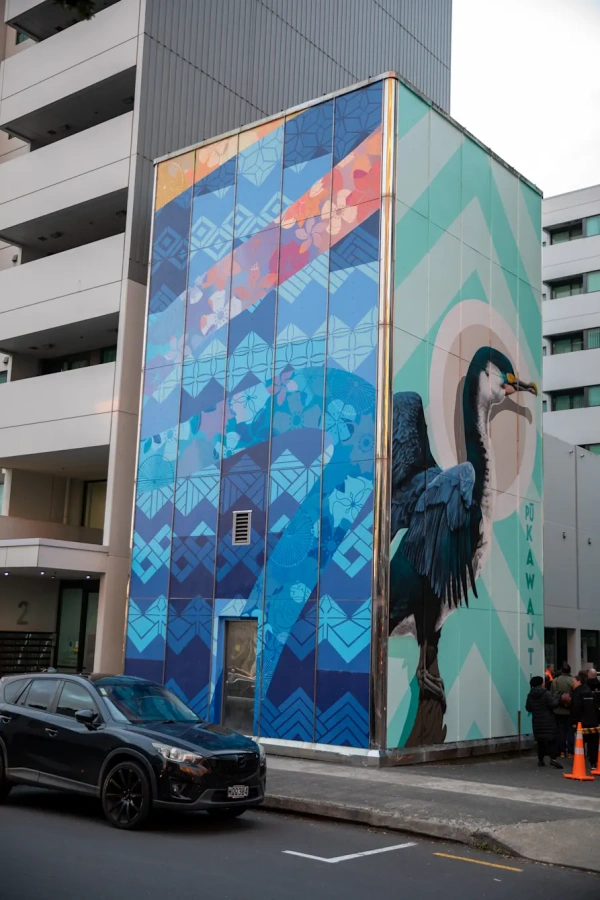
Nikita, who came from India to study in New Zealand, enjoyed working on the project along with Chinese-born New Zealander Jenny and Taiwanese international student Celia. “Our panel depicts diversity, inclusion and culture,” she says. “The project has given us the chance to give something back to the city and to the people who have welcomed us. We hope people feel a sense of connection to the artwork.”
International students were given the opportunity to connect with local iwi
The aim of the Study Auckland panel was to give international students the opportunity to connect with local iwi and work with respected local artists, including Hana Maihi of Ngāti Whātua Ōrākei, to explore what it means to make public art in New Zealand.
To help with the design process, the students joined Hana in a three-day wānanga at Ōrākei Marae to immerse themselves in Māori history, and learn about the significance of the mural’s location in Te Tōangaroa, on Ngāti Whātua Ōrākei owned land.
Study Auckland business development manager Beth Leyland, who led the project, is thrilled with the outcome and says the students are too.
“Auckland Unlimited’s Head of International Education Henry Matthews says the project truly reflects the principle of hospitality amongst the diverse cultures that make up our collective world right here in Tāmaki Makaurau.”
The students’ panel was funded through a $20,000 grant from the Ministry of Education’s International Student Wellbeing Fund. The other two panels were designed and painted by Hana and Te Whetū Collective member Poi Ngawati to bring awareness to the rich Māori heritage and taiao (environment) on which the city was founded.
Collectively, the three panels depict the importance of welcoming different cultures and diversity in Tāmaki Makaurau.
The vibrant 12-metre-high mural, incorporates elements of biodiversity which were once part of the landscape of the area. The students’ panel includes the poutama, a well-known step-like pattern seen in tukutuku panels adorning the walls of wharenui.
In 2019, 115,713 students from 180 countries enrolled to study in Aotearoa New Zealand, and became part of our communities. This injected $4.9b into our economy and supported more than 48,000 jobs. Just over 63,000 of those students were based in Tāmaki Maukaurau. The city currently hosts just under 13,000 international students.
-
Around the world in five
Asia
South Korea outlines plans to host 300,000 international students - StudyTravel Network
The South Korean Government announced the Study Korean 300k Project in August, which aims to have 300,000 international students at South Korean universities by 2027 as part of its goals to secure more high-skilled workers and boost global competitiveness. A fast-track scheme to permanent residency in South Korea for international students with advanced degrees in key fields will also be established.
North America
The international education sector in Canada has expressed concerns about potential reforms, with the Housing Minister suggesting that a cap on international students should be considered while the Immigration Minister has referred to concerns about integrity in the system. This comes amid an emerging housing crisis that has been described as complex and multifaceted, and with Canada projecting to host 900,000 study permit holders by the end of 2023.
South America
Chile launches higher ed mental health plan
The University of Chile, in collaboration with multiple government entities including Chile’s Ministry of Education and Ministry of Public health, have launched a comprehensive plan to help domestic and international students take care of their mental health. The plan aims to address an “alarming rise” of students impacted by mental health problems in the return to in-person education after the COVID-19 pandemic.
Europe
German chancellor appeals to international graduates
The German Government’s Skilled Immigration Act will create new opportunities to enter Germany, with Chancellor Olaf Scholz saying that international graduates of Germany’s higher education system will help to successfully develop the country’s economy. Scholz said it was inspiring to see how many students from around the world come to Germany and wish to work there afterwards.
Africa
2022 US visas 'broke records' in India, Ghana and Nigeria
The US state department reported that it is issuing more student visas to applicants from African countries than anytime in the past six years, with more visas for students from Nigeria and Ghana being issued last year than any year in the past two decades. This comes after an estimated 92,051 African students were denied US visas between 2018-2022.
-
From the CE: 12 months on from the borders reopening
Kia ora tātou,
Twelve months ago, New Zealand’s borders reopened to international students. From a standing start the international education sector has, alongside Education New Zealand Manapou ki te Ao (ENZ) and our New Zealand Inc partners in government, worked enormously hard.
The first challenge was to get New Zealand back “on the map” as a high-quality international education destination. One of our ENZ teams tells me that we were involved in a minimum of 27 events including NAFSA, ANZA, EAIE, agent and student fairs over the last 12 months. There have been at least 11 senior ministerial and sector delegations covering China, India, Viet Nam, Japan, South Korea, US, Canada, Chile, Brazil, and Thailand. This is only the tip of the iceberg of all the effort expended by New Zealand providers, with our partner agents, providers and Government agencies – offshore and onshore.
And as students started to apply for their visas and arrive in New Zealand, we cannot underestimate the amount of effort that has been required to get the infrastructure that supports the sector up and running. Reviewing applications, delivering offers of place, processing visas, finding accommodation, pastoral care; the list goes on. Lots of unseen and unheralded effort that goes on behind the scenes to ensure international students receive a high-quality experience.
Yet this is just one part of what we do. Onshore and offshore, the sector has also supported the Prime Minister’s and Manaaki Scholarships, and worked closely with ENZ to explore opportunities to innovate and make the sector more resilient.
It isn’t easy and while we all know that there is more to do on all fronts, it is worth taking a moment to acknowledge just what has been achieved together.
Turning our attention to the next 12 months, in June the ENZ Board approved our business plan for this financial year (1 July 2023 to 30 June 2024). The plan has four clear priorities:
- Grow inbound student mobility for Aotearoa New Zealand
- Support sector capability development
- Build global connections
- Encourage and support innovation in the sector
Within these priorities, close to 75% of our discretionary budget is focused on the first one. This is completely aligned with Focus Area 1 of the New Zealand International Education Strategy, which is to help providers of international education to build back onshore offerings. We know there is more to do and over the next 12 months the priority is to build on the good start we have made and cement the recovery and rebuilding of the sector.
That’s not to say we aren’t investing in the other areas; we are. We will continue to build global connections. These connections go hand-in-hand with our first priority and in some countries, they are essential to achieving it.
We will also build on the lessons of the past 12 months around innovation. In the first week of August, we organised a series of events facilitated by Professor Martin Bean, a recognised leader in discussions around the future of education. His brief was to provoke and encourage discussion on what the future could look like and what it might take to get there. You can read more about his visit in our E-News story here.
And when it comes to building sector capability this week’s NEW ZEALAND INTERNATIONAL EDUCATION CONFERENCE KI TUA is an immediate opportunity to listen, learn, discuss, contribute, and network with specialists and colleagues. It will be great to be able to meet in person for the first time in close to three years and to celebrate the 30th time that we have joined together as a sector. I look forward to meeting and talking with many of you over the next few days.
Mauri tū, mauri ora, an active soul is a healthy soul.
Ngā mihi
Grant
-
Introducing David Downs, incoming Chief Executive
He most recently served as Chief Executive of New Zealand Story, a collaborative agency bringing together several internationally focused government organisations (including Education New Zealand Manapou ki te Ao (ENZ)) to curate New Zealand's brand and reputation to benefit the country's international growth aspirations. In this role, he led work to strengthen New Zealand’s global reputation and brand, supporting the country’s international growth ambitions.
He previously spent around a decade at New Zealand Trade and Enterprise (NZTE) in general manager roles, building extensive experience in international business. Earlier in his career at Microsoft, he led the South East Asia Emerging Markets portfolio within one of the company’s divisions and spent significant time working across the region. He has also worked in Europe.
David began his career as a software developer and remains closely connected to the technology sector, with a strong interest in artificial intelligence. He has spent several years building his expertise in AI and recently taught a course on the subject at The Icehouse.
Alongside his executive career, David has significant governance experience. He was until recently Chair of The Icehouse board, is Deputy Chair of Young Enterprise, and chairs the advisory group for the Kupe Leadership Scholarship at the University of Auckland.
You’ve just stepped into the CE role – what excites you most about leading ENZ at this moment?
A few things. Firstly, we’ve got a high-performing team here, and there’s been some great progress to build on. It’s also a fascinating time in the global environment – tricky, obviously, with global disruption and geopolitical tensions – but that leaves New Zealand in a relatively strong position as a trusted, safe destination for students. The export opportunity of international education is a significant one for New Zealand. And personally, I just love learning about the sector, and the strategic opportunity of bringing so many highly talented people into New Zealand – thinking about our future workforce, enabled through education.
What drew you to this role and to international education?
I’ve had a bit to do with the education sector over the last few years. While I was a very poor student myself – straight Cs in my undergraduate years! – I really appreciated the opportunity to have an education in New Zealand and overseas. For the last seven or eight years I’ve chaired the Kupe Leadership Scholarship at the University of Auckland, and I see the impact that education has. I’ve also been on the board of Young Enterprise, a programme that teaches business and entrepreneurship in high schools across New Zealand.
International education takes that to another level again – bringing talented people from around the world to New Zealand, while also building New Zealand’s reputation as a destination. It really builds on my previous role at New Zealand Story.
People describe you as a storyteller – how does that shape your leadership style?
Storytelling has always been my nature. As a stand-up comedian, actor and writer all through my twenties, telling stories as a way of getting information across, bringing people along and enthusing them towards a greater vision is just a natural way of how I like to work.
I believe good leaders inspire through stories – they’re far more memorable than data and facts alone. Stories motivate people, and they’ve been the way we’ve transmitted information for millennia. The power of storytelling is something I regularly reflect on and have taught workshops about, so I guess it’s simply part of what I do.
What’s something people might be surprised to learn about you?
It might surprise some people that I used to be a stand-up comedian as a job. That led me to setting up a comedy club and working in TV, which led me into business, which eventually led me into the government world. A strange career path! I doubt many other stand-up comedians are now government chief executives – although, surprisingly, President Zelensky of Ukraine used to be a comedian too, so I guess I’ve got big shoes to fill.

From your experience with New Zealand Story, NZTE and Microsoft, what have you learned about New Zealand’s place in the world – and how we tell that story?
My roles at New Zealand Story, NZTE and Microsoft – where I worked across South East Asia – taught me about New Zealand’s unique ability to be an aspirational destination, and an aspiration in general for people who see our country as not only good IN the world, but good FOR the world.
We really do stand out as an exemplar of a values-based country. Our Māori culture, te ao Māori, is such a critical part of our global image and such an opportunity to show who we are to the rest of the world. Our spirit of manaakitanga, kaitiakitanga and pono are great examples of New Zealand having a unique way to care for people and place.
Then we have this extra innovation streak. As the youngest country in the world – in terms of when we were populated by humans – we have an innovation and go-it-alone spirit. We refer to it as pōtikitanga: the concept of being the youngest child and wanting to carve our own path.
What’s your vision for ENZ over the next few years?
Firstly, to achieve our international growth targets. It’s critical for us as an organisation to contribute to the New Zealand economy. We also know the work we do brings in export revenue – highly valuable for a small exporting economy – and allows us a deep connection with others and the chance to build relationships.
I think ENZ is in a great position to take the great work that’s been done in the past and accelerate it – thinking deeply about building a future New Zealand through the links we make with education.
What are the biggest opportunities and challenges for New Zealand in international education, and how could we respond?
Virtually every sub-sector has an opportunity to keep growing and bringing in talent. There are definitely headwinds, and we’ve got to be mindful of those – making sure we remove friction and ensure the right quality candidates come into the country. I’m confident, with our relationships across NZ Inc, that we’re doing a good job of having high-quality education products and a pathway for our visitors.
How do you see ENZ working with education providers, agents and partners?
I’m still learning how ENZ works with education providers, agents and partners, but I’m really interested in getting more involved personally. I know our team has strong relationships across multiple parts of the sector – with individual entities and with the sector peak bodies – and I’m looking forward to meeting as many people in the sector as I can.
What would you like the sector to know about how you want to work together?
In a word: collaboration. We can’t be successful alone as a government organisation. We’re essentially a broker – what we do is facilitate introductions, leads and opportunities for international students to understand more about New Zealand. The real work comes when those students are introduced to educational institutions, so we need to collaborate and form tight relationships.
Outside of work, what do you like to do?
I have three boys, all in their twenties, and live with my wife, Katherine. I really enjoy getting into New Zealand’s outdoors. I also have a personal history with battling cancer – there’s a documentary about that journey called ‘A Mild Touch of Cancer’ – and I spend quite a bit of my time outside work in the cancer advocacy and fundraising space. I sit on several boards for health-related charities, championing bringing innovative cancer therapies to New Zealand. If people want to learn more about me, they can check out my TED talks.