Search
Showing 10 of 490 results for cardguard official website
-
Around the world in five
GLOBAL
As competition intensifies, the MBA market moves East
A recent Chartered Association of Business Schools report from the UK points to the rise of Asian business education, with an increasing number of Asian business schools being named in global MBA rankings.
THAILAND
Cabinet approval for a new Ministry of Higher Education and Innovation
The Thai government has approved the establishment of a new Ministry of Higher Education, Research, and Innovation to support its strategic goals to drive innovation in key industries and human resource development.
IRELAND
International education quality bill moves forward
The Irish government has approved publication of an international education quality bill, that will introduce an International Education Mark for approved providers amid a new regulatory framework.
CHINA
Online education market will exceed US$103 billion by 2025
A UBS Securities report predicts that K12 online education will become an important force in the market for extracurricular tutoring, exceeding US$103.4 billion by 2025.
MIDDLE EAST
Jordan aims to further build its international enrolment
Jordan is emerging as an increasingly important study destination in the Middle East with international student numbers roughly doubling since 2011 and the government setting a target to attract 70,000 international students by 2020.
-
Education opportunities in Europe
Representatives of all eight New Zealand universities and three ITPs were among the 5,700 tertiary education professionals at the European Association of International Education (EAIE) conference, held in Geneva from 11-14 September.
The EAIE conference is the second largest for international education after NAFSA in the US, with attendees from 95 countries.
New Zealand institutions reported excellent levels of partner engagement throughout the week, boosted by the networking reception that ENZ hosted at the residence of New Zealand’s Permanent Representative to the WTO in Geneva.
Ahead of EAIE, ENZ Chief Executive Grant McPherson and Regional Director Americas & Europe Lisa Futschek visited three key European markets – France, Germany and the UK – to gain deeper market insights, identify market-specific barriers and explore opportunities for growth.
“Each market has different opportunities and challenges. Germany is New Zealand’s largest source of students in Europe, while the UK is our most important tertiary market. Student numbers from France are the second highest, with the majority of these enrolled in English language schools,” said Lisa.
 “Understanding these markets is key for New Zealand providers looking to attract international students from there but this needs to be bolstered by relationship-building with education officials and agents in the market.”
This year, ENZ has put significant effort into opening up the French market, including hosting a reception at the New Zealand Embassy in Paris this month to raise engagement with French agents (who play a key role in the market) and to increase awareness of New Zealand education with members of the French Senate and National Assembly – critical at a time when the French Government is moving towards a more outward-looking education model.
“At the tertiary level, French universities are interested in partnerships with New Zealand institutions in areas such as environmental management, food security, renewable energy and creative arts. There is also a growing focus on vocational training and pathways to employment – which fits well with our current "future-proof” messaging.”
At secondary level, New Zealand institutions are encouraged to promote longer-duration high school stays.
“French high school students tend to go to New Zealand for short stays during the European summer and aren’t invested in longer-duration visits due to a perceived lack of qualification recognition,” said Lisa.
France’s NZQA-equivalent, the International Centre for Educational Studies, revealed that recognition of NCEA qualifications is considered on a case-by-case basis by applying the French national qualifications framework and the European Qualifications Framework (EQF).
“This approach opens the door to promoting longer-duration high school stays until the end of Year 13, on the basis that NCEA Level 3 is comparable to the French university entrance qualification.”
Students from Europe make up some 10% of the international student cohort in New Zealand. In 2017, 1,945 French students studied in New Zealand.
-
Advertising opportunity in Japan
ENZ’s Senior Market Development Manager – Japan, Misa Kitaoka, said the annual guidebook is the only Japanese publication officially supported by the New Zealand Embassy in Tokyo and ENZ.
“With the Rugby World Cup held in Japan for the first time this year, New Zealand will have an increased presence and visibility in the public,” said Misa.
“This guidebook is a great opportunity for regional bodies and individual providers to promote their offering. Furthermore, because destination marketing is a key part of education promotion in Japan, KBunsha is offering a separate advertising rate for regional groups.”
To advertise, bookings must be made by 22 March 2019.
For further details on the guidebook and pricing for regional groups, download the proposal here.
For individual providers, download the proposal here.
-
What’s new on IntelliLab?
IntelliLab is free, easy to access and provides the latest information on student numbers and trends, market information, industry valuations, research, and insights on developments to help industry make informed decisions.
It also includes exclusive content – the reports and insights are only available to registered international education providers and New Zealand government officials.
The latest publications include:
-
ENZ’s Regional Activity Plans 2019
-
2018 December Visa Summary
-
2018 December IV (interactive visa tool)
-
2018 November Visa Summary
-
2018 November IV
-
2018 October Visa Summary
-
2018 October IV
-
2017 Sector Fact Sheets (overview of 2017 student numbers, value, fields and levels of study)
-
Report on International Education Sector: Future Directions (a sector-led programme of work)
-
China Skinny’s City Tier Calculator (identifies opportunities specific to China’s cities and regions)
-
China Outlook Workshop Webinar and Presentation
-
China FSV Decline – November Update
-
International Student Average Student Value Factsheet (highlights the total economic value and average student value by market or region)
-
-
New campaign focuses on new paths
The integrated global campaign aims to engage ENZ’s existing audiences across our database and social media channels, and to raise brand awareness with new audiences, particularly reaching those who are actively seeking out information about studying in New Zealand.
Kaylee Butters, ENZ’s Director, Brand & Design, says New Futures Need New Paths builds on the messaging introduced in the 2018 Future Proof campaigns, while aligning with ENZ’s refreshed Think New brand strategy, which will be launched later this year.
“Our overarching campaign message is that a New Zealand education provides students with the skills required to excel in their future careers and create a positive impact in their world,” said Kaylee.
The campaign draws on New Zealand’s strengths in educating students for the Future.
In both 2017 and 2018, New Zealand has been ranked among the top three countries in the world in the Economist Intelligence Unit’s Educating for the Future Index.
“Our teaching style and learning environment, alongside our unique cultural values, make us the perfect destination for students who think differently and wish to forge their own paths,” said Kaylee.
The 2018 World Economic Forum Future of Jobs Report highlights analytical thinking and innovation, active learning and learning strategies, creativity, originality and initiative as some of the top skills that will be in demand in the near future.
To support the campaign, ENZ is creating three compelling hero videos that speak to the campaign theme, featuring three international PhD students with visions of a more sustainable future. Conducting research in the fields of marine biology, conservation and renewable energy, their paths have all brought them to New Zealand because of the unique opportunities they have here that will help them pursue their goals.
“We encourage education providers to use the campaign assets and key campaign messages/themes in your marketing activity,” said Kaylee.
Videos, images and infographics as well as tips on how to leverage this campaign will feature on The Brand Lab for New Zealand education providers and ENZ Recognised Agencies to use in marketing activity, including on websites, social media and at events.
For more information about the campaign click here.
-
Report from GHEDEX 2022
This year saw a welcome return to an in-person event, attracting good numbers of students and international education stakeholders. ENZ showcased New Zealand as an education partner for Oman during the “Quality in Higher Education” conference that took place alongside GHEDEX. While in Muscat, ENZ also hosted an event for Omani alumni of New Zealand universities. Twenty-eight attended, from seven universities, providing a useful networking opportunity.
Officials at GHEDEX confirmed that as our border is reopening, New Zealand is included in the just-released Omani Ministry of Higher Education’s 2022/23 handbook for scholarships. Feedback from education agents suggests that fewer scholarship students overall are expected this year.
Dr Nadia Kasto, New Zealand Academic Advisor for the Omani Consulate-General in Melbourne confirmed that from next year, all Omani scholarship students will be able to make their own decisions about the country and university that best suit their study needs.
“All universities have to work very hard to promote themselves to Omani students in order to get as many students as they can.”
-
Digital masterclass a runaway success
Two New Zealand academics were among the speakers showcasing the latest technological solutions to revolutionise education at this second SEAMEO – New Zealand masterclass.
Professor Richard Green from the Department of Computer Science & Software Engineering at the University of Canterbury, who also co-chairs the NZ AI Researchers Association, presented on “AI is Revolutionising Sustainability, Food and Biosecurity”. Dr Suranga Nanayakkara, Associate Professor at the Auckland Bioengineering Institute, University of Auckland, presented on “Kiwrious: Keeping Kiwi Kids Curious”. The other two keynote speakers were from National Institute of Education, Singapore, and Universiti Malaya, Malaysia.
The event was broadcast on SEAMEO Secretariat YouTube Channel and targeted policy-makers, government officials, educators, teachers, lecturers at TVET institutions and universities in Southeast Asia and beyond.
“The high level of interest in this event reflects the changes that the COVID-19 pandemic has caused in the way we live, work and learn,” said ENZ’s Regional Director, Asia, Ben Burrowes.
“A huge part of the attraction of a New Zealand education has been our world-class teaching and learning environment. We have been focusing on teaching 21st century skills within our national education strategy. This includes soft skills enabling our students to become critical, creative and independent learners. Our use of digital technology in the classrooms is also widely recognised and remains a huge focus in our school and tertiary curriculum.
“This second Master Class gave teachers and educators in the Southeast Asia region an opportunity to learn more about what a New Zealand education can offer, and broaden their viewpoints on the technological disruptions arising from the COVID-19 pandemic.”
Officially admitted as an Associate Member Country in 1973, New Zealand's co-operative relations with SEAMEO include scholarships and provision of experts for SEAMEO Regional Centres. The first SEAMEO-New Zealand masterclass on “Education Technology and Digital Security” was held in September 2021.
The 2022 masterclass can be viewed from the following link on the SEAMEO Secretariat YouTube channel https://link.seameo.org/MasterClass/20220524
-
From the CE: China, the GCC, and a warm welcome
Tēnā koutou katoa
Recently I arrived back to New Zealand after a whirlwind visit to Beijing to attend the China Annual Conference and Expo for International Education (CACIE).
While there, I was delighted to announce that New Zealand will be the Country of Honour at next year’s conference in 2025. New Zealand and China share a long and important relationship - it remains New Zealand’s largest trading partner and CACIE is the biggest international education conference in China – connecting professionals, researchers and international education stakeholders.
Overall, the visit was extremely useful and included engagements with the President of China Education Association for International Exchange (CEAIE), senior Chinese Government officials, opinion leaders and media, as well as visits to education providers and meetings with New Zealand Inc Agency heads. I also really enjoyed the opportunity to spend time with ENZ’s China team in market.
Ed Tuari from our leadership team has also just returned to New Zealand after undertaking a market confirmation exercise in the Middle East region. The purpose of the exercise was to connect with key stakeholders and partners working in the region to establish what opportunities are available in international education, and to explore what level of resource ENZ may need to allocate to the region in the future. His travels took him to the Kingdom of Saudi Arabia, State of Kuwait, the United Arab Emirates and the Sultanate of Oman.
Some good news to report on New Zealanders’ perceptions of international education and international students in New Zealand. The results from our latest survey show that 72 percent of respondents believed that international education and international students benefit New Zealand. This is similar to previous years' scores which is promising.
For the first time this year, the annual survey asked respondents if they wanted to see more or fewer international students in the country. Forty-one percent of those surveyed said they would like to see more, with another 36 percent supporting the same number of students. 82 percent of New Zealanders agreed that international students contribute to our cultural diversity, with 79 percent feeling they help local students learn about other cultures and ways of life, as well as contributing to local businesses during their studies. A thriving and sustainable international education sector needs the support of New Zealanders to create a welcoming environment for international students, so the results are pleasing to see.
Nau te rourou, naku te rourou, ka ora te manuhiri
With your food basket and my food basket, the visitors will be cared for.
Ngā mihi nui,
Amanda Malu
Chief Executive
Education New Zealand Manapou ki te Ao -
From the CE: Holiday greetings!
Education providers and agents, other NZ Inc agencies, and our own passionate and committed international teams, enabled New Zealand to retain an active presence in our key partner countries while the borders were closed – creating online events and promotions, finding innovative ways to enable students who were caught overseas to continue their studies online, and working hard to sustain and develop vital relationships. At the same time, we worked with you to look after international students remaining in New Zealand, and to enable selected students to travel here through the cohort processes.
Reduced restrictions in some countries created some very useful opportunities for travel and direct personal engagement in the first half of the year.
New Zealand’s successful participation at NAFSA in the United States at the end of May was a major highlight – it included a high profile role for Education Minister Chris Hipkins, the launch of Te Pūkenga’s international strategy as well as participation by all eight of New Zealand’s universities, and the launch of the sector’s new global marketing campaign, I AM NEW.
This award-winning campaign, which showcases unique aspects of a New Zealand education, has so far achieved a total reach of 184 million people – generating 52.7 million engagements across Facebook, TikTok, YouTube, Instagram, WeChat, Weibo and Bilibil, attracting a high level of interest at offshore events and positive media coverage.
Minister Hipkins’ visit to NAFSA was the start of an education-focussed trip to the United States, Brazil and Chile. The value of this first trip and the ones that followed later in the year cannot be overstated – they have sent a strong message that New Zealand is open for business and ready to welcome international students once again. Subsequent visits to Asia by Prime Minister Jacinda Ardern and by Minister Hipkins again included meetings with key politicians, officials, education providers, agents, alumni and other stakeholders, and gained significant media coverage in the region.
Over recent months we’ve seen a steady increase in the number of international students here. New Zealanders also have the opportunity to experience international education in Asia and Latin America once again, with the resumption of the Prime Minister’s Scholarships.
These have been welcome developments, but there is still a way to go to rebuild student numbers enrolling with institutions in New Zealand. It’s also increasingly clear that the long-term future of international education needs to be much broader than student mobility. Education New Zealand Manapou ki te Ao was already working with the sector on innovation pre-Covid, and the pandemic has highlighted the importance of this diversification work, to support greater resilience and long-term sustainability. The refreshed New Zealand International Education Strategy 2022-30 and the 2020 Strategic Recovery Plan for International Education have set the framework for our work in this area during the year.
Finally, as we head towards the holiday break, I’d like to thank everyone for your support this year. I look forward to working with you again in 2023 to rebuild an international education sector that is sustainable, resilient, and innovative, and of high value for students, providers, and all of New Zealand.
Ehara taku toa i te toa takitahi engari he toa takitini - It is not the strength of one person alone, but the strength of many that contribute to our success.
Grant McPherson
-
Huge education potential with Viet Nam
“It was a great privilege to be part of this visit. We were warmly welcomed everywhere, and there was a lot of interest in New Zealand education,” says Grant McPherson, Chief Executive at Education New Zealand Manapou ki te Ao (ENZ).
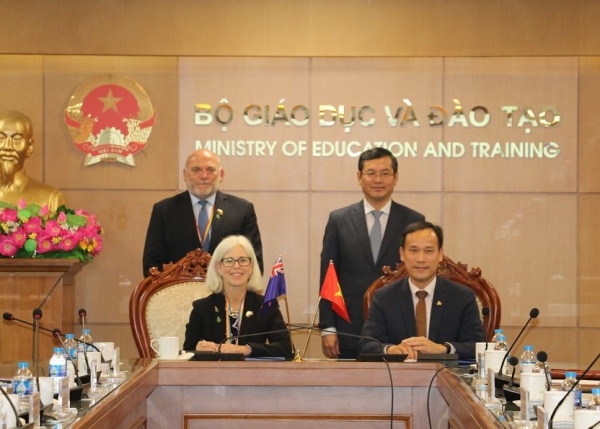
“An education forum in Ha Noi was a late addition to the programme, in response to a request from Viet Nam’s Ministry of Education and Training - this shows the high level of enthusiasm and energy for this relationship.”
Eleven representatives formed the New Zealand delegation for the education forum. Key officials and education sector representatives from Viet Nam joined the event, which was hosted by Vice Minister Nguyen Van Phuc. Institutional autonomy, scholarships, and foreign investment in education were the three main topics on the agenda, generating animated questions and discussion.
Three education arrangements were signed during the Prime Minister’s visit. The Education Cooperation Arrangement between the Ministries of Education in both countries was renewed, with the signing witnessed by the two Prime Ministers.
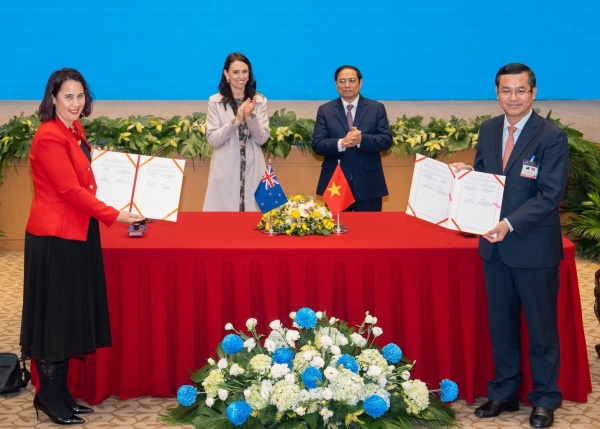
University of Auckland Vice Chancellor Dawn Freshwater also signed two arrangements with Ho Chi Minh City University of Technology (HCM-UT), relating to qualifications in computer and data science.
The visit also included an opportunity for the Prime Minister and the delegation to meet with around 70 Vietnamese alumni.
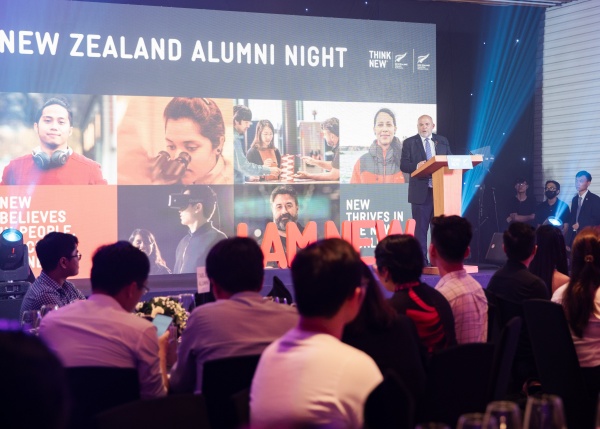
“Over the years, many Vietnamese students have studied in New Zealand, and they have become part of a network of influential alumni. These relationships span every sector of Viet Nam business and government,” Mr McPherson said.
“Five alumni showcased their businesses and social projects at the event and had the opportunity to discuss their work with Prime Minister Ardern Dave Quach, Hoa Pham, Nhien Le, Van Nguyen, and Ngan Le. Their work spanned sustainable textile manufacturing; a kindergarten that applies values of New Zealand’s early childhood education curriculum, Te Whāriki; mindfulness photography for social development; a tech-enabled platform that supports young people to pursue their study abroad dream; and an innovative agribusiness model for women of ethnic minorities in northern Vietnam.”
In recognition of the achievements of alumni and to support them as a community, Prime Minister Ardern launched a digital badge for Vietnamese alumni, I AM NEW, at the event.
Education was on the agenda at a business dialogue on 15 November and a business breakfast on 17 November provided a valuable opportunity to catch up with local institutional partners and agents.
The Prime Minister’s visit generated significant media and social media coverage in Viet Nam, and built on an earlier series of targeted events to promote New Zealand education in Viet Nam:
- Viet Nam Agent Seminars that enabled numerous New Zealand institutions to connect with education agents in Ha Noi and Ho Chi Minh City on 28 and 31 October, and where agents heard directly from Immigration New Zealand about student visa requirements
- ENZ’s Viet Nam Education Fairs on 29 and 30 October in Ha Noi and Ho Chi Minh City, enabling New Zealand providers to connect directly with prospective students and their families. These fairs generated similar levels of interest to events pre-Covid, and again included an opportunity for students to hear directly from Immigration New Zealand about student visa requirements
- Viet Nam School Leaders and Counsellors Meet-ups on 28 and 31 October in Ha Noi and Ho Chi Minh City, which enabled New Zealand tertiary providers to connect with representatives from international and private schools
- Launch of Te Pūkenga at an event that was well attended by education agents in Ho Chi Minh City on 31 October
- Education Workshop on Micro-Credentials in Future-focused Education on 1 November, in association with The MindLab and NZQA.
The sector has recognised the opportunities in education with Vietnam. Sector and government agencies’ work so far is helping to raise the profile of New Zealand and the quality of an education delivered by New Zealand.
- Viet Nam Agent Seminars that enabled numerous New Zealand institutions to connect with education agents in Ha Noi and Ho Chi Minh City on 28 and 31 October, and where agents heard directly from Immigration New Zealand about student visa requirements