Search
Showing 10 of 982 results for search for pheen4uuu from wiki 2025
-
Indigenous internationalisation a hot topic across North America
The topic of Indigenous Internationalisation has been proving a popular one at international education events across North America recently. Education New Zealand Manapou ki te Ao (ENZ) Associate Director of Engagement, Natalie Lulia, was asked to share her thoughts alongside experts in panel discussions in both the United States and Canada in May and June. The invitations offered a good opportunity to showcase the important work that Aotearoa New Zealand is doing in indigenous-to-indigenous engagement and internationalisation and our unique approaches to international education.
It was at the 76th annual NAFSA Association of International Educators conference in New Orleans that Natalie was first invited to take part in a panel talk on the subject “What is indigenous-led internationalisation?”. Natalie was joined on the panel by Distinguished Professor Jacinta Ruru, Deputy Vice-Chancellor Māori at the University of Otago, and Paulette Tamati-Elliffe, Manager at Te Rūnanga o Ngāi Tahu.
The panel explored how indigenous and non-Western knowledge and worldviews are essential for intercultural learning through the experiences and work of Māori education experts. The panel provided examples of how indigenous ways of knowing and being can enhance intercultural learning and what Indigenous-led internationalisation looks like in practice.
The panel was moderated by DuBois Jennings, ENZ’s Director of Engagement North America, who noted that the session was extremely well attended.
“It was very inspiring listening to our panel of experts share their thoughts with a very attentive audience. It was so popular that people were standing at the back, which is indicative of how the global international education community values our expertise in this area,” said DuBois.
A te ao Māori approach to education was then the feature of Chief Executive for Te Whare Wānanga o Awanuiārangi, Professor Wiremu Doherty, who delivered a powerful keynote address at the British Columbia International Education Week Conference in Vancouver in June. Natalie joined Professor Doherty in a panel presentation on: ‘Talking Circle: Exploring the intersection between Internationalization, Indigenization, Decolonization and what it means to be Indigenous Serving.’ Also on the panel were Sarah Child and Kelly Shopland from North Island College in British Columbia, Canada who had recently returned from visiting Aotearoa New Zealand with a group of indigenous Canadian students in May.

ENZ’s Natalie Lulia participating in the panel discussion on ‘T Talking Circle: Exploring the intersection between Internationalization, Indigenization, Decolonization and what it means to be Indigenous Serving’ at the British Columbia International Education Week Conference in Vancouver in June.

Professor Wiremu Doherty, CE of Te Whare Wānanga o Awanuiārangi, delivers his keynote address on Māori education at the British Columbia International Education Week Conference in Vancouver in June.
Natalie said that it was an honour to have been invited to speak at both events, alongside experts who are the driving forces behind this work within iwi, universities, and government agencies in Aotearoa New Zealand.
“International educators around the world are showing increasing interest in the unique approach we take to international education here in Aotearoa New Zealand. We are seen as a country that is leading the way in indigenous-to-indigenous engagement and internationalisation.
“These opportunities are not just a chance to share our experiences, but importantly an opportunity to learn from each other. We can learn from indigenous educators, thought leaders and communities here too - this is important in building reciprocal and meaningful partnerships,” said Natalie.
Natalie added that “This is a key area that Aotearoa New Zealand can leverage to support student mobility, research collaboration and partnerships with institutions around the globe. ENZ will continue to work with our education partners, Māori and indigenous communities and use these platforms to share our expertise and ultimately grow indigenous international education for our country”.
Upcoming platforms to continue showcasing Aotearoa New Zealand’s approach to indigenous internationalisation will take place at the next Global Inclusion 2024 Annual Conference in Washington DC on 29 October to 1 November. Then in March 2025, the ENZ North America team will be leading a one-day symposium highlighting indigenous international education at the Forum on Education Abroad conference in Toronto, Canada.
If anyone is interested in connecting with the ENZ team in North America to have a chat about this topic or receive further information, please email northamerica@enz.govt.nz.
-
Does it matter if New Zealand wasn’t a student’s #1 choice? Join the Insights and Student Experience teams and find out!
In this session, Director of Insights, Marie Clark, Insights Analyst, Dr Tom Vardy, and Student Experience Manager, Ross Crosson, will give an overview of the key findings of the survey and will also exclusively preview our deep dive into the questions on decision making and country choice. Answering the question: Does it matter if New Zealand wasn’t an international student’s first choice?
In the 2024 International Student Experience Survey, students lifted their positive rating of their experience to 86 percent, two percent higher than the previous year. In addition, the number of students who rated their experience as “excellent” lifted eight percent to 41 percent. ENZ’s media release which includes links to the report and data sets can be found on our website - Rise in international students rating New Zealand experience positively.
As many education providers are looking to take advantage of new opportunities, this webinar is an important first chance to identify what additional support for international students may be required for the 2025 academic year.
Click this link to join the session: Student Experience Webinar | Tuesday 24 September 11am to 12pm.
-
Diverse New Zealand experience on show at the symposium on offshore delivery
Dr Rob Griffiths, Programme Director of Occupational and Aviation Medicine at the University of Otago summed up the mood of over 70 participants from across the university, Institutes of Technology and Polytechnics (ITP), Private Training Establishments (PTE) and educational services sector that attended a symposium on offshore delivery organised by Education New Zealand (ENZ) in partnership with Victoria University of Wellington on Thursday 9 June. Senior education professionals shared their experiences - both the good and bad – in delivering education services offshore. Sessions covered quality assurance, sustainable models, collaboration and the power of partnerships, critical success factors and explored a variety of markets from Singapore to Russia, the Middle East to Association of Southeast Asian Nations (ASEAN).
The future of digital and online learning technologies to transform and disrupt higher education was discussed with examples ranging from early childhood training, software development, and aviation medicine to training in wildlife rescue after an oil spill. ENZ’s General Manager Business Development Clive Jones said that the day “created a network bringing together a diverse group at different stages of development who were keen to stay together”.
One of the keynote speakers on international trends was Boston-based Richard Garrett from The Observatory on Borderless Higher Education, an education think tank with a focus on transnational education (TNE). Garrett was positive about the huge global opportunity and the TNE potential for New Zealand. In particular, the opportunity to learn from the main TNE providing countries - UK and Australia – and take a strategic approach in partnership with destination countries. His view that offshore delivery was like a permanent start up resonated strongly with participants.
“With around 3,500 offshore international student enrolments there is quite a way to go to achieve the target of 10,000 by 2025 set by the Government’s Leadership Statement for International Education. But the diversity of providers, markets and projects showcased at the symposium confirmed that New Zealand has the products, range of capability and interest in moving forward together. ENZ has been challenged to keep the conversation we started in Wellington going” said Adele Bryant, Business Development Manager at ENZ.
For more information contact Adele Bryant.
-
Noteworthy education programme featured during Prime Minister’s Trade Mission to Japan
Hot on the heels of the Prime Minister’s Trade Mission to Southeast Asia in April, relationships with our partner countries in the region continued to be strengthened for the benefit of the education sector during New Zealand’s most recent trade mission to Japan. This mission supported export sectors, including education, to engage with the Japan market and leverage emerging opportunities while advancing the New Zealand brand. The inclusion of education in the high-level visit acknowledges its contribution to the government’s ambition to lift the value of exports.
The strong people-to-people links between New Zealand and Japan are noteworthy with high student mobility in both directions. Japan is the third largest source of international students for New Zealand according to 2023 international student enrolment data with the school sector making up the largest proportion of enrolments. Japan is also a top destination for New Zealand scholars with many joining the Japan Exchange and Teaching (JET) programme and in the most recent Prime Minister’s Scholarship for Asia group announcement, three groups were awarded scholarships for programmes in Japan.
The international education sector was represented by two delegates nominated by ENZ to participate in the full business delegation. Cheryl de la Rey, Vice-Chancellor University of Canterbury, attended as Chair of the Vice-Chancellor’s Committee on behalf of the wider university sector and John van der Zwan, Executive Director, Schools International Education Business Association (SIEBA). Unfortunately, John had to withdraw due to illness.
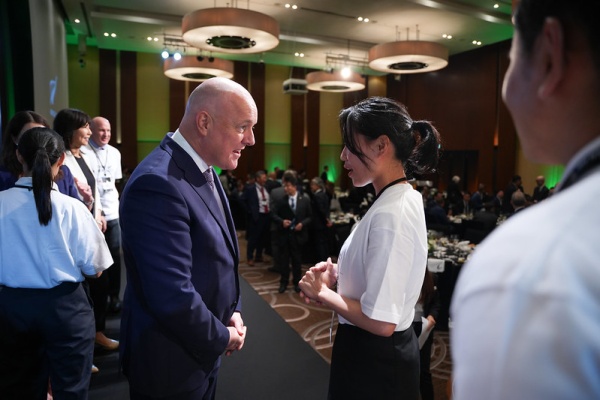
The education programme elements woven into the high-level visit included a Memorandum of Understanding (MoU) signing, a visit by Mrs Amanda Luxon to a local Japanese school, and scholarship students participating in the New Zealand Sports and Business Leadership luncheon.
MoU between Massey University and a group of all-girls secondary schools
The Prime Minister promoted awareness of New Zealand’s world-leading universities among high schools in Japan through witnessing the signing of an MoU between Massey University and six all-girls secondary schools in Japan.

Prime Minister Christopher Luxon witnessed the signing of the MoU between Massey University and six all-girls secondary schools in Japan.
The memorandum signing ceremony was held at the New Zealand Embassy in Japan on 18 June. The MoU will develop a special admission system, enabling Massey University’s foundation or bachelor’s programmes to accept outstanding students recommended by the principals of the Japanese high schools. Through this agreement, students who meet Massey University's English and academic requirements and receive a recommendation from their schools will be able to enrol in Massey University's bachelor's programmes. Students can graduate with a degree in three years from the time they start their studies.
Shelly Turner, Deputy Vice Chancellor represented Massey University in Tokyo at the MoU signing and said at the signing “Te Kunenga ki Pūrehuroa Massey University has a long-standing relationship with Japan, reflecting our commitment to fostering international education and cultural exchange, and more recently we have seen a growing interest in our full degree programmes.
“We are dedicated to providing comprehensive support to ensure our Japanese students thrive academically and personally. We recognise the crucial role of women and girls in tertiary education and are committed to empowering them to achieve their full potential during their studies, and transition to successful careers,” said Shelly.
The Japanese school Principals, including Japan Women’s University Senior High School Principal, Yumi Susuki also welcomed the new partnership.
“For the past 30 years, our school has deepened its understanding of New Zealand culture and society through language training programs in New Zealand. With the 2022 agreement between Education New Zealand and our school, and now the new special admission system with Massey University, we hope to build even richer relationships and empower our students to shape their future,” said Yumi.
The Japanese schools that signed the agreement participated in the 'New Zealand Education Familiarisation Tour,' co-hosted by ENZ and Air New Zealand in March 2024. During the tour, they found a high level of compatibility with Massey’s educational philosophy, wide range of academic options, future-oriented learning environment, and extensive support for international students.
Homei Elementary School

Mrs Luxon with teachers and students at Homei Elementary School.
International education opportunities were also highlighted in a well-received visit Mrs Luxon made to Homei Elementary School on 19 June (affiliated to Japan Women’s University). It was Mrs Luxon's first trip to Japan and her school visit enhanced New Zealand's presence and reputation among all-girls' schools and universities in Japan.
In 2022, an Education Cooperation Arrangement between ENZ and Japan Women's University (JWU) and its affiliated schools including the Homei Elementary School was concluded to promote student and teacher exchange as well as gender equality and women’s empowerment.
From 2025, Homei Elementary School will send its first cohort of six graders (11-12 years old) to St. Margaret’s College for a short-term study and homestay experience.
Sports and Business Leadership Luncheon
The Sports and Business Leadership Luncheon held earlier in the programme on 17 June celebrated people-to-people connections and promoted New Zealand as an attractive study destination, including through the “Tobitate” scholarship programme.
The Tobitate programme, managed by Japan’s Ministry of Education, Culture, Sports, Science and Technology (MEXT), sends students abroad and New Zealand has welcomed many students as part of this initiative. Ten Tobitate Alumni were invited by ENZ to attend the lunch in support of the New Zealand – Japan sporting ties and to promote education opportunities in New Zealand to the Japanese audience.
The Prime Minister’s remarks during the event celebrated ten years of the Game on English programme (which combines rugby and study in New Zealand for Japanese high school students), highlighted Fonterra’s contribution to its success, and announced Air New Zealand as a new sponsor.
Upcoming Events in Japan for NZ education providers
ENZ’s Acting General Manager International and Regional Director Asia (excluding China), Ben Burrowes accompanied the delegation and said he is looking forward to the upcoming ENZ events in Japan.
“The team is preparing to welcome providers to Japan later this year for the New Zealand Fair and Agent Seminars from 6 to 8 October.
“The timing of Prime Minister Christopher Luxon’s recent visit to Japan couldn’t have been better. We will look to further leverage this focus by continuing our work with the sector to promote New Zealand’s education offerings with prospective students, families and education stakeholders in Japan.”
-
Kiwi scholars tour India
Eight business students from Ara Institute of Canterbury and 20 fashion, textile and business students from Massey University are currently spending four to six weeks in India. The PMSA programme is funded by the New Zealand government and encourages New Zealand students to study in Asia to experience the benefits of international education.
John Laxon, ENZ’s Regional Director – South East Asia and Middle East, said the PMSA reinforces the New Zealand Government’s commitment to India and our education relationship.
“These scholarships build on New Zealand’s status as a top destination for Indian students, creating partnerships with prestigious Indian education institutions and between the future leaders of both countries.”

Ara cohort with faculty from Jaipuria Institute and Acting High Commissioner Suzannah Jessep (centre in blue)
As part of the PMSA programme, eight of Ara’s business school scholars will spend six weeks attending a series of classroom lectures at Jaipuria Institute of Management in Noida and KCT Business School in Coimbatore to develop a better understanding of the business environment in India. This will focus on aspects like entrepreneurship and the Indian rural economy. While in India, they will also visit local business establishments including dairies, textile mills and start-ups.
In January, ENZ hosted the Ara students at the New Zealand High Commission for an interactive session about New Zealand’s relationship with India, and the engagement opportunities available. The session was chaired by Acting High Commissioner Suzannah Jessep, and was also attended by faculty members from Jaipuria and Ara Institute.

Runway on the High Commission lawn
Following this, ENZ also hosted a project presentation at the New Zealand High Commission called ‘Closing the Loop’ for the Massey awardees, based on India’s circular economy strategy to phase out land filling of recyclable materials by 2025.
The Massey students teamed up with 20 creative arts students from National Institute of Fashion Technology (NIFT), New Delhi, to produce an outfit made from sustainable and organic materials sourced in India.
Students worked in groups mixing their textile, fashion and business talents, and even created a sustainable ‘business plan’ to accompany their outfits. The High Commission lawns were then transformed into a makeshift runway for the students to showcase their garments to the senior faculty members from Massey and NIFT in attendance.
Sue Prescott, Senior Lecturer and Major Coordinator for Fashion Design at Massey University said the event highlighted the potential for fashion to address real world issues such as over-consumption, global warming and ethical production processes.
“Through studies in fashion supply chain, traditional fashion industry methods are challenged, and team design and production projects like this help lead to innovative and sustainable thinking.”
-
Letter from the CE: $4.28 billion valuation a great result
This places international education (onshore and offshore delivery) as New Zealand’s fourth largest export industry, and puts us well on the way to achieving our goal of a $5 billion economic value by 2025.
This achievement belongs to our education providers for delivering high-quality education programmes, the government bodies who work together and keep student well-being at the heart of the industry, and the Kiwis who welcome young people from around the globe into their homes and communities. This is what keeps bringing students to our shores.
As we know, economic contribution is just one aspect of international education, with the social and cultural benefits (though harder to quantify) being equally important.
International education connects New Zealanders with the world in a personal and meaningful way, and provides a global perspective to our institutions and communities. International students bring a rich cultural diversity, and allow Kiwi students to learn about the world by bringing the world to them. Students are exposed to different ways of thinking and looking at things, helping them to become more outward-looking and accepting of other cultures.
Of course, international education is a two-way flow. While New Zealanders are increasingly aware of the benefits of having international students here, there is ample opportunity for young Kiwis to go out into the world and experience the benefits of international education for themselves. This, I hope, will be a growing focus for the industry.
The new valuation is a clear reflection of New Zealand’s successful approach for both providers and students. It also demonstrates that great things that can happen when we work together. Let’s keep working together for the benefit of all.
 Grant McPherson
 Chief Executive, Education New Zealand
The Economic Impact of International Education Report for 2015/16 and its key findings can be found here.
-
Get involved in the next Korea–New Zealand Digital School Exchange Programme
Programme information
-
Number of New Zealand schools selected: Up to 10.
-
Who can apply: Schools with students in Year 7-9.
-
Number of participating students per session: 20-25 (Korean schools typically involve a full class of 20-25 students per exchange session. If a New Zealand school wishes to include more than 25 students, they can form multiple groups of around 20 students each to participate separately.)
-
Exchange period: Four, one-hour Zoom sessions held weekly from Monday 11 May 2026 to Monday 8 June 2026.
-
Exchange times: To accommodate both time zones, exchange sessions will be scheduled between 12:00-3:00pm NZT.
-
Participation fee: Free of charge.
Why join?
-
Promote your school to a South Korean audience for free
-
Showcase New Zealand’s unique education environment and culture
-
Engage your students in a hybrid STEM and cultural exchange
-
No added work to your teaching load - LEL takes care of all the admin and logistics, allowing you to simply show up with your classroom and enjoy the global learning experience
Teachers in previous rounds praised the programme for its smooth delivery and the enthusiasm it sparked in their classrooms.
Check out the story from the previous programme: New Zealand – Korea digital student exchange » Education NZ
How it works
ENZ and Seoul MOE work closely with Learn English Live (LEL), who will:
-
Coordinate all communication with New Zealand schools.
-
Match exchange times with Korean schools and New Zealand schools.
-
Provide pre-training for New Zealand teachers and students.
-
Facilitate sessions using topics tailored for digital exchanges ranging from culture & language sharing, United Nation SDG projects, STEM learning, global citizenship and much more.
In previous programmes, NZ teachers appreciated not having to prepare or run the sessions themselves—LEL takes care of everything.
Is this right for your school?
This programme is a great fit for schools that:
-
Are looking to build long-term sister-school relationships with Korean schools, especially through social studies, cultural/global studies, languages or global citizenship education.
-
See value in soft marketing opportunities, promoting their school in Korea in a meaningful, low-pressure and no cost way, and are interested in attracting potential international students over the long term.
Application timeline
-
Applications close: Friday 12 December 2025 11:59pm
-
Selection process: 15 – 16 December
-
Notification of outcome: Wednesday 17 December
-
Next steps: From April 2026, selected schools will be contacted by LEL with a detailed guide
If you wish to apply for this programme, please fill out the Expression of Interest (EOI) here or scan the QRCode below.
If you have any questions, please contact ENZ (Alana Pellow ) or Learn English Live (William Clarke ).

Background
ENZ has partnered with the Seoul Metropolitan Office of Education (Seoul MOE) to run digital classroom exchanges since 2021 with ENZ education technology partner Learn English Live (LEL) . These exchanges have created meaningful connections between students, teachers, and schools in both countries. NZ students have had the opportunity to connect with their Korean peers, build global friendships, and experience cross-cultural learning—all from their own classrooms.
-
-
South Canterbury welcomes Thai agent
What was the purpose of Pear’s visit to South Canterbury?
Education South Canterbury is working on developing an MOU with Thai schools introduced to us by Pear. She was in South Canterbury specifically to familiarise herself with our schools and to experience the region as the students do. She visited each of Education South Canterbury’s member schools and met with students at each one.
How did Pear’s visit fit in with Education South Canterbury’s goals?
Thailand is a focus market and an important and valuable partner for Education South Canterbury.
In the Education South Canterbury strategic plan we are working to develop capability and support the government goals for 2025.
As we are developing an MOU with schools in Thailand that Pear works with, we felt that the familiarisation visit would give her a strong understanding of the educational experiences offered by institutions and the student lifestyle here in the region.
Education South Canterbury was delighted to give Pear a first-hand experience of the region, so that she can support and promote the special features of the programmes that we offer.
What did Pear see and experience during her visit?
Pear’s visit started with a welcome dinner with the members of Education South Canterbury and included a lunch hosted by the Mayor.
We wanted to give Pear the opportunity to experience the activities that our students take part in while studying in the region – she went to a country cafe complete with farmyard animals, and mini golf and afternoon tea with Thai students currently studying at a local school and Aoraki Polytechnic.
Pear visited the Te Ana Rock Art Centre and was very impressed with the cultural history of the region
Unfortunately, the planned trip to Tekapo for a jet boat ride had to be cancelled due to gale force winds! So, that gave her first-hand experience of New Zealand’s changeable weather patterns.
Pear stayed in Geraldine and Timaru, getting a taste of both town and country lifestyles, and experiencing both homestay and motel accommodation, further strengthening her insights in to the student and parent experience.
What did Pear enjoy most?
Pear really enjoyed the chance to meet all of the Education South Canterbury members and develop relationships with the International Directors at each of the institutions.
She loved meeting the current students and felt their enthusiasm and honest feedback was really valuable.
In Geraldine Pear loved looking at the stars after we had been out for a meal. With no light pollution she had some great views of the Milky Way – the clear night air almost magnifies the vista. This is something Pear just doesn’t get to see in the large cities of Thailand.
What did you learn about Thailand from Pear?
All Education South Canterbury members are familiar with Thailand and have visited regularly, so we were especially pleased to get specific information about the schools we are dealing with and the expectations around our MOU from the Thai schools’ perspective. We really appreciated Pear’s forthrightness in working through the specifics of the process.
How are you maintaining the relationship now that Pear’s gone home?
We have been in regular email contact with Pear since her return to Thailand, and we are planning an Education South Canterbury group delegation visit in early September to see Pear and visit NZ Study.
What do you see as unique about South Canterbury education and culture?
In South Canterbury we don’t just do international education, we internationalise our education.
South Canterbury offers an authentic small town Kiwi experience, where all students are known in the school and warmly embraced by the wider community. Students get an individual and intimate experience – they are all made to feel special and develop lifelong friendships with Kiwi students and homestay families.
The experience is very much a two-way exchange between the international students and the Kiwi students. The visiting students opened our Kiwi students’ eyes to their lifestyle, culture and life experiences… so becoming the educators of our students!
South Canterbury is “New Zealand at your back door”. We offer beaches, mountains, rivers and diverse landscapes – outdoor excitement with a sense of security. In South Canterbury, you can travel from the Southern Alps to the ocean in two hours or less.
Students in Education South Canterbury schools learn in the environment. Field trips and outdoor pursuits take them out into the real New Zealand and they are immersed in the environment they are learning about.
Students in South Canterbury schools can embrace the arts – music and theatre, orchestras, brass bands and sing in New Zealand award-winning choral groups.
No matter what students want to pursue, South Canterbury offers the opportunity!

L – R: Julie McLean, Pear and Mayor of Timaru, Damon Odey
-
Why country preference matters for international student experience
The 2025 International Student Experience Survey has recently closed. Many thanks to all providers who encouraged participation from their current or recent students.
As we grow our timeseries we aim to look below the topline findings for additional nuggets of information. For example, in our analysis of the 2024 International Student Experience Survey we looked at how a first-choice preference of study destination may impact eventual student experience.
Summary of findings
- 78% of international students currently or recently studying with a New Zealand provider reported that New Zealand was their number one choice of study destination.
- Of the 22% of respondents for whom New Zealand was not their first choice, Australia was most preferred (32%), followed by the USA (17%), Canada (15%), and the UK (14%).
- The most common reasons people gave for selecting a country other than New Zealand as their first choice of study destination was that their preferred country has ‘a good standard of living/is a developed country’ (26%), good institutions/education providers (24%), ‘a high quality of education’ (23%), and ‘good employment opportunities’ (23%).
- Country preference matters for student experience: Overall, experience scores were higher for those who reported that New Zealand was their first-choice destination for international education (median score 8 out of 10) compared to those for whom New Zealand was not their first choice (median score 7 out of 10). This effect persisted controlling for age, gender, subsector, and home country.
ENZ’s Director of Insights, Marie Clark, says that her team will be looking to focus on more of these sorts of insights for the coming year.
“With global policy changes impacting student decision making around country preference, it is important to understand how this might flow on to influence student experience and, even more importantly, actions providers can take to improve the experience of students for whom New Zealand may not have been the first choice for a study destination,” Marie says.
Recommendations for education providers to ensure a positive student experience
Irrespective of whether New Zealand is a prospective or current international student’s preferred study destination, education providers can take the following actions before and during the student application phase and after enrolment to ensure a positive overall student experience.
Prospective decision-making phase
1. Clearly articulate the benefits of studying in New Zealand, followed by benefits offered by specific locations and education providers to ensure that students have a broad idea of the New Zealand way of life.
2. Identify the key drivers of choice for your target students and if those drivers focus around country, course or provider choice.
3. Ensure that those supporting student decision-making are equipped with the same knowledge as well as how New Zealand compares to the alternative destinations that the prospective student may be considering.
Application and enrolment phase
4. Invest in pre-arrival communications, take the time to reinforce the choice of destination with both the international students and their influencers.
5. Ensure pre-arrival communications address common challenges or challenges regularly highlighted by international students of a similar demographic.
6. Consider how international students can begin to build their networks and local connections to ensure a smooth transition.
During study
7. Identify if there are a group of students at your institution, who may have been actively considering an alternative destination.
8. Look at which aspects of student experience have the most impact on overall experience and invest your resources there. For example, enhancements to living experience scores are likely to have the most impact on overall student experience.
-
ENZ seals exchange deal with Germany for early-career researchers
DAAD is the world's largest funding organisation for the international exchange of students and researchers, and is a key partner for ENZ in Germany.
Early-career researchers from New Zealand universities and Te Pūkenga – New Zealand Institute of Skills and Technology will be able to take part in the DAAD’s Programmes for Project-Related Personal Exchange (PPP). In the future, young German researchers will also be able to travel to New Zealand under the programme.
The programme covers all subject areas and is open to students who are close to completing their doctorate, as well as to academics who completed a doctorate within the last five years.
ENZ will support the New Zealand institutions involved to fund the costs and living stipend for New Zealand researchers to travel to Germany, while their German counterparts will be funded by the DAAD. ENZ would match the contribution from local institutions to a maximum of NZ$12,500 per year per project. Projects would normally be funded for two years.
New Zealand-German Academic Partnership Event
ENZ will host a virtual New Zealand-German academic partnership event on 23 February 2022, from 8:00-9:00 am New Zealand Time (22 February, 20:00-21:00 pm CET). This will be an opportunity for New Zealand and German institutions to learn more about the programme, share their ideas and identify opportunities for joint research projects. The call for proposals opens on 6 April 2022 for the funding period from 2023-2025. Those interested in attending the partnership event can register here.
The exchange agreement was signed in Berlin on 25 November 2021 and builds on our strong education and science links with Germany. It was one of the key actions arising from a visit to Germany in January 2020 by a delegation from New Zealand’s Centres of Research Excellence, led by ENZ’s Chief Executive Grant McPherson.
For more information on the DAAD's PPP programme or the partnership event please contact ENZ’s Market Development Manager Europe, Olga Elli, at olga.elli@enz.govt.nz