Search
Showing 10 of 982 results for search for pheen4uuu from wiki 2025
-
Exploring indigenous exchange programmes and internships
The students, from University of Auckland and AUT, are part of the British Columbia & New Zealand Indigenous Student Mobility Project,a two-year programme that aims to provide reciprocal, short-term learning abroad and professional development and networking opportunities for indigenous students. The students will be joined by five First Nations students from Victoria University (UVic) in Canada, who are also part of the programme.
Next year the Kiwi students will travel to Vancouver and be hosted by UVic for the 2020 GIC. UVic is a leader in the Canadian Co-Op model, where an internship is a required component of the university degree.
“Increasing access to international learning opportunities for all students, and in particular our Māori and Pasifika students, is an important goal for the University of Auckland,” says Brett Berquist, University of Auckland’s Director International.
“Community and family are key to this strategy, and the chance to share and learn from First Nations students and academics at UVic is a great opportunity for our students.”
The Student Mobility Project aims to engage indigenous students in immersive experiences that help them to establish and maintain relationships with other indigenous students and communities, industry, academics, and higher education professionals. It intends to provide a forum for indigenous students to present their perspectives and experiences, facilitating an exchange of ideas and networks.
At the GIC, the students will share their perspectives and experiences on how international experiences benefit indigenous communities, how to best connect indigenous communities internationally, and how work placements and co-operative education have influenced their lives and careers.
Karima Ramji, UVic’s Manager of International Programmes will also discuss critical success factors in developing indigenous international work-integrated learning exchange programmes.
The GIC will feature further perspectives on global internships via a panel of University of Auckland Māori and Pasifika awardees of the Prime Minister’s Scholarships funded internships in Asia and Latin America.
The 2019 Global Internship Conference will take place on 2-5 July, hosted by the University of Auckland. To register or to find out more, click here.
-
Huge response to Indonesia promotion
Prime Minister John Key and Education New Zealand Chief Executive, Grant McPherson, recently visited Indonesia. One of the highlights of the trip was a Jawa Pos event in Surabaya involving 2,500 students and 500 teachers to promote a competition to win a trip to New Zealand.
Jawa Pos is the largest newspaper group in Indonesia with over 500,000 copies circulated daily. Zetizen is Jawa Pos’ new news portal targeted at young people aged between 12-23 years old.Jawa Pos wanted to generate a buzz around the launch of their new platform. After consulting with NZ Inc. in Indonesia it was decided that a competition to win a trip to New Zealand would be the perfect hook to grab young people’s attention.
The tagline of the competition is: be a good Zetizen and go to New Zealand. Young people are being tasked with taking a positive action in their community and writing a short essay about why they should be chosen to come to New Zealand.
Jawa Pos has been profiling New Zealand and New Zealand educational institutions since the competition launched in May. The newspaper group will fly 34 young Indonesians to New Zealand in November for the trip of a lifetime – all captured and documented by a group of journalists who will be accompanying them.
Education New Zealand, New Zealand Trade and Enterprise and the Ministry of Foreign Affairs and Trade are putting together a fantastic programme. The group will visit schools and tertiary institutions in Auckland, Rotorua and Wellington. They will also get the chance to sample the wonderful tourist activities and fantastic food New Zealand has to offer.This competition is giving New Zealand fantastic profile and reaching a very targeted age group. These young people may very well go on to study in New Zealand.
-
Pakistani student leverages language skills to connect communities
Fluent in Punjabi, Urdu, and English, and passionate about community service, Usma soon became a key player working to support and connect ethnic communities in Christchurch.
So extensive have her achievements been, that she has been honoured by the university with a coveted Blues Award for community engagement, and by the Christchurch City Council with a Civic Award.
Usma arrived in New Zealand in late 2016 and gave birth to her third child shortly after arriving. “It gave me the time I needed to assess society here, and I realised the value that was placed on volunteer work.”
New Zealand values transferable skills
“My background was in teaching and ESOL (English for Speakers of Other Languages) instruction. I did teach here when I first arrived, but it was not fulfilling enough,” she says. “I needed to think what other skills I had to offer in an area of work I was passionate about. New Zealand is not a destination of degrees, it is a destination of skills, where whatever transferable skills you have to offer, are valued.”
She initially got involved in UC’s Pakistani Student Association, planning events which quickly extended beyond the student community. “I got great feedback from the wider community and different ethnic groups started coming along. People from these communities were looking for connectivity and involvement and it ended up being a multi-cultural hub.”
She admits it was not without challenges, but she was determined. “I was an international student, a woman, a mother of a special needs child, and I was working. But I managed my time. I enjoy doing volunteer work and it comes naturally.”
In her second year at Uni, she secured a role as a Diversity and Engagement Officer with the Ministry of Ethnic Communities and juggled both study and work. It was in this role that she became involved in the Government response following the Christchurch mosque attack in 2019.
Frontline worker following mosque attack
“I was one of the frontline workers dealing with victims and those left behind. Some of my colleagues were victims,” she says. “It was a difficult time. I had never had any exposure to such an event, or what the aftermath might be like. Hearing the stories, and being part of it, are totally different things.”
“I’m very proud of my work and found it very rewarding. I discovered my strengths and weaknesses and learned how much I had to offer. I could speak with many of the widows in the Muslim community in their own language, understand their needs, and advocate on their behalf. I learned how to deliver the key messages to the government agencies involved in the response and formed a link between the two groups.”
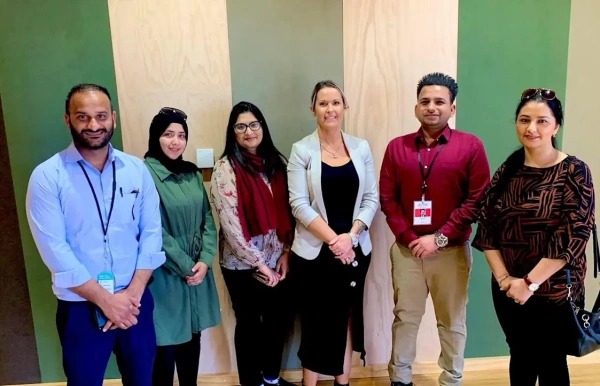
“The migrant communities have so much resilience and I believe that every disaster brings opportunity to come together, to heal, and to grow.”
Usma went on to become involved in Widows of Shuhada – an eight-part Plains FM/RNZ podcast documentary series which followed the journey of four widows following the attack.
Soon after, Covid-19 arrived in New Zealand and Usma worked on engagement with local ethnic communities, translating the Government’s messages and communicating them through a range of digital channels.
Tapping into the skills of international students
But she didn’t stop there. Usma was also influential in Christchurch’s Ethnic Communities Skills Build Programme, a project designed to smooth the pathway of migrants and international students into employment in New Zealand.
International students could join in workshops, meet career counsellors and job brokers from the Ministry of Social Development, reshape their CVs, and attend job fairs.
“I believe we need to tap into the high-level skills of post-graduate international students. We need to progress them in the right direction, utilising their skills in science, technology, and innovation.”
As for her own career, Usma could not be happier. She has secured a full-time role as a policy analyst at the Ministry of Primary Industries in Wellington and has taken a step back from her volunteer work to focus on completing her PhD this year.
She is grateful for the opportunity to study in New Zealand and to bring her family with her. Her husband is working, her children are happy, and her special needs daughter has opportunities she wouldn’t have had in Pakistan.
Usma still acts as a mentor for international students and tells them if they are to make the most of their time in New Zealand, they should “think outside the box”.
“They should think about the skills they have to offer in the community, and they will be rewarded with a transformative experience. Leaving behind the social constraints of your home country can be liberating. It’s all about following your dream.”
Usma says she’s already landed her dream job, but she plans to continue her community work once she has completed her PhD.“I believe it is my contribution to this country and I love doing it. I’m not likely to stop. I’m just settling in, finishing my PhD, and getting ready for something big. I have ambitious plans.”
-
New Zealand experience grows global indigenous network
A special bond forged through a Study Abroad programme, involving Vermont’s Champlain College and Auckland University of Technology (AUT), was marked by the gifting of a unique pare whakairo (carved doorway mantel) to the US College in September.
Called Te Hononga (The Convergence), the pare whakairo was created by kaiwhakairo (Māori carver) Pahi O’Carroll over four weeks in residence on the Champlain campus.
The pare is unlike any other. It is carved from a wood native to the area – black walnut – and evokes values, beliefs and traditions common to both Māori and the indigenous people of Vermont, the Abenaki.
The relationship between Champlain and AUT dates back five years, when New Zealand Honorary Consul and trustee of Champlain College, Dr George Burrill, first established a study abroad exchange programme between the two institutions. To date, over 100 students have participated.
One of the highlights of American students’ time at AUT is the Noho Marae programme.
“Every year students tell us how the Noho Marae programme has profoundly impacted them,” ENZ General Manager – International, Lisa Futschek, says. “It turns them into lifelong advocates for New Zealand, its education system and Māori culture.”
Run by AUT Senior Lecturer in Māori and Indigenous Development, Jason King, the mini-course includes basic Te Reo Māori, Māori mythology, waiata (songs) and cultural customs. It includes with a noho marae (weekend-long marae experience).
King describes the course as “the base of a tree, from which branches and leaves grow”.
“The course puts indigenous goggles on students,” he says. “It opens them up to areas of discussion with their own indigenous people.
“My ultimate aim is to connect us not only globally, but indigenously.”
Thanks to their connection to Māori via AUT and the Noho Marae programme, Champlain College made a formal connection to their own indigenous people, the Abenaki tribe. A representative from the Abenaki was present at the unveiling of Te Hononga.
Many US students choose to keep in touch after they return home through the student-led Whānau Councils. These were first established in 2010 after students from Europe were so moved by their AUT marae experience that they set up their own group to maintain their connection to New Zealand and each other. There are now three Whānau Councils across Europe and the US actively supported by AUT.
For the European council’s 10-year anniversary, members of group are planning to return to New Zealand – this time with their partners and children.
“We tell them during the Noho Marae, after studying in New Zealand you are whānau for life,” King says.
-
Events season wraps up in the Philippines
Ben Burrowes, ENZ’s Regional Communications & Strategic Relations Manager for South East Asia, said the events were a fantastic way to sign off on a successful year in the Philippines.
“The market has not been without its challenges in 2017 but we’ve made some great progress in shifting perceptions away from a migration focus on New Zealand to promoting our world-class offering for high-value students,” said Ben.
“Much of that has been achieved through building networks with local and international schools. Our latest series of school roadshows, in which we were joined by a number of New Zealand providers, built some strong partnerships particularly as we look to recruit the new K-12 Filipino graduates into our tertiary system.”
ENZ also co-funded three successful agent-led fairs with Golden Summit Immigration Consultancy (Cebu), IDP (Manila) and Fortrust Education Services (Manila) with more than 25 providers attending. The feedback from all providers was very positive and the events were well attended – particularly the Fortrust fair, which attracted more than 2,200 visitors.

ENZ’s Ben Burrowes with Andrea Preston (Queenstown Resort College) and Catherine Ang (Weltec & Whitireia) at Far Eastern University in Manila.
Close to 100 local guidance counsellors and career advisors attended a training session hosted by Unitec, which included a soft-sell presentation on New Zealand’s world-class education offering.
“This growing network of local counsellors and career advisors is proving valuable, as they have a strong influence on prospective students,” said Ben.
“We’ll continue to work with them closely as we focus on recruiting a greater number of Filipino students into our undergraduate programmes.”
ENZ also generated some great media coverage, a highlight being an NZ Inc. media roundtable in Cebu which included David Strachan (the New Zealand Ambassador to the Philippines), Hernando Banal (New Zealand Trade Commissioner), Steven Dixon (Tourism New Zealand’s Regional Director), Catherine Albiston (Immigration Advisors Authority) and ENZ’s own John Laxon, Regional Director – South, South East Asia & the Middle East.

NZ Inc. media roundtable in Cebu
-
Brazil to headline NZIEC as Country of Honour
ENZ has joined with the Brazilian Embassy in Wellington to bring to life the partnership, which celebrates the growing education connections between New Zealand and Brazil.
Lisa Futschek, ENZ Regional Director Americas and Europe, said ENZ is excited to showcase Brazil this year.
“As the largest student recruitment market in Latin America and with momentum growing, Brazil is an important diversification market for New Zealand’s international education industry.
“Moreover, conference participants will revel in tasters of Brazil’s vibrant music and cuisine culture!”
Paulo Camargo, Ambassador of Brazil in New Zealand, is delighted to see Brazil featured as the Country of Honour at NZIEC 2018.
“Every year, thousands of Brazilians come to New Zealand to study across a variety of sectors. I also see a growing interest of New Zealand students going to Brazilian universities. In the process, this exchange builds one of the best foundations for the strong relationship between two countries: the human ties of friendship and understanding.
“Brazil and New Zealand share many values and have great potential to enhance educational cooperation. I look forward to working with Education New Zealand to turn 2018 into a landmark for our two-way partnership."

Be sure to soak up some of the sights and sounds of Brazil at NZIEC 2018
Last year, almost 3,600 Brazilian students studied in New Zealand. Engagement with Brazilian institutions is also increasing due in part to the Prime Minister’s Scholarships for Latin America and the funding offered to help internationalise Brazil’s postgraduate departments.
In March this year, five New Zealand universities participated in the Brazil/New Zealand Academic Cooperation Forum designed to enhance collaboration and research linkages at postgraduate level.
The Country of Honour designation at NZIEC celebrates and showcases New Zealand’s international education connections with partner countries.
NZIEC delegates can look forward to engaging with the team from the Brazilian Embassy at its booth in the Expo Hall – and experience a few delights during conference.
NZIEC 70% sold out!
With fewer than a third of places left at NZIEC 2018, make sure you book your ticket soon. Register today at www.nziec.co.nz

-
NZIEC 2016: Celebrating 25 years of coming together
With a record 650 delegates marking the occasion, including 90 speakers, six plenary and keynote sessions, and 44 breakout sessions, there was a lot going on.
Dr Adam Fraser kicked things off with an inspiring keynote address on The Third Space. It’s an ideal technique to better manage your time in the fast moving international education industry. If you didn’t manage to purchase one of Dr Adam Fraser’s books before they sold out, you can do so here.
In her Q&A with conference MC Miriama Kamo, Professor Stephanie Fahey, Lead Partner for Oceania at Ernst & Young, provided a range of insights on the future of the international education industry
Our conference dinner hit a high point as we celebrated 25 years of networking and collaboration. Cultural icon Elena wowed delegates with her personal story, which spoke to the importance of developing international connections firmly grounded in one’s culture.

On Day two, Jim Moser, Chief Executive of Clemenger BBDO New Zealand, provided insights into the future of marketing. Dopamine and oxytocin have never been mentioned more at a NZIEC than after his entertaining and insightful address!
Friday rounded off with David Bell from ASB Bank outlining how their organisation has used technology to continue innovating to stay one step ahead – including the development of the new Clever Kash cashless money box.
Feedback for the conference has been positive, with 94 per cent of attendees rating the conference good to excellent. Furthermore, some 83 per cent of delegates agreed or strongly agreed that NZIEC added value to their organisation.

You can also read some great coverage of the conference from PIE News here.
Conference presentations are available for download here.
Towards NZIEC 2017
NZIEC 2017 will be held on Tuesday 22 and Wednesday 23 August 2017 at the Sky City Convention Centre in Auckland. We’re already getting to work on designing the experience for NZIEC 2017, so please contact Sam Mackay if you have any suggestions. We’ll also be releasing a global Call for Papers in the coming months, so keep an eye out to secure your presenting slot at NZIEC 2017.
We look forward to seeing you back in the City of Sails next year.
-
Making New Zealand’s roads safer for students
The Visiting Drivers Project is aiming to do just that. The project is a collaboration between the New Zealand Transport Agency (NZTA) and its road safety partners, including the Automobile Association (AA), and rental vehicle operators and tourism operators across the country.
The focus for the project is the Otago, Southland and West Coast regions where visiting drivers make up a large proportion of traffic. On roads in these regions, safety improvements such as centre-line rumble strips, “keep left” arrows, “no-passing” markings and new signage have been installed. Road safety information has also been made more accessible and user-friendly, with resources available in different languages and formats, including interactive videos and apps.
Over summer, during the regions’ peak visitor season, an education campaign will be run to help visiting drivers understand and prepare for driving in New Zealand.
Jim Harland, NZTA’s Regional Director, Southern, says the strength of the project has been in the shared objective of ‘host responsibility’ and a partnership approach that ensures visitors are helped at every stage of their journey.
While the project is largely aimed at tourists, it will benefit all newcomers to New Zealand, including international students.
“We want all visitors who are driving on our roads, including students, to make good decisions based on correct information about travel times, speeds and conditions,” he said.
“It’s our responsibility as New Zealanders to help our visitors have a safe and enjoyable time.”
The Visiting Drivers Project initiatives also include the following, many of which are available in different languages.
- AA’s online Visiting Driver Training Programme, which includes video footage of New Zealand driving scenarios.
- Apps with road safety messaging such as CamperMate.
- Air New Zealand’s 'Driving in New Zealand' in-flight app (available on long-haul flights) and videos on all international flights about driving in New Zealand.
- A 'Driving in New Zealand' leaflet available from rental vehicle and other tourism operators, and can be downloaded here.
- Providing road safety information to successful applicants for student visas.
- Guidelines for accommodation providers to provide practical driving advice to their guests.
- A Rental Vehicle Operators’ Code of Practice.
-
Universities New Zealand to strengthen ties with India
Stronger ties between New Zealand and India at the university level are a key outcome of the Prime Minister John Key’s visit to India currently underway.
Universities New Zealand (UNZ) has made two announcements: development of an engagement strategy to strengthen relationships with India and attract more university students to New Zealand; and a Strategic Education Partnership Agreement with the Maharashtra State Government.

Professor Harlene Hayne, Chair of Universities New Zealand and Vice-Chancellor of the University of Otago
Professor Harlene Hayne, Chair of Universities New Zealand and Vice-Chancellor of the University of Otago, says, “Currently, students from India make up five per cent of the 26,000 international students who are studying at a New Zealand university.
“We recognise there is significant potential to attract and welcome increasing numbers of university-level students from India.”
The strategy builds on an increasing university market presence in India, with student visas for first-time university students from India up 18 per cent through to August 2016. Professor Hayne says the UNZ India Strategy, which will be formally launched in early 2017, will see New Zealand’s universities working collectively to promote study in New Zealand, and to further develop and strengthen partnerships between institutions in India and New Zealand.
UNZ and ENZ are co-sponsoring the strategy. ENZ Chief Executive, Grant McPherson, says, “We are delighted to partner with our universities in India, and applaud their leadership in investing in the long-term future of this hugely important market.”
The Strategic Education Partnership Agreement with Maharashtra State Government provides a framework to explore academic opportunities between the two countries, added Professor Haynes.
Maharashtra State Government in Western India is the second most populous state in India with over 112 million inhabitants. Its capital, Mumbai, has a population of approximately 18 million. Maharashtra has 24 universities with a turnout of 160,000 graduates every year, while New Zealand has eight universities and 43,000 graduates each year.
“This strategic agreement offers us an avenue to build institutional engagement between our universities, through faculty relationships and exchanges, research and innovation collaboration, and information sharing.”

Shri Sitaram Janardan Kunte, Principal Secretary, Higher Education of the Maharashtra (left) and Professor Neil Quigley, Vice-Chancellor of the University of Waikato (right), who signed the agreement on behalf of Universities New Zealand.
-
Asia comes to Marsden School
With funding from the Asia New Zealand Foundation, Marsden Head of Humanities, Fiona Crawford, organised a full day of activities for students, with the aim to increase their cultural awareness and educate them on a region with increasing ties to New Zealand.
"We want our students to thrive and contribute towards putting New Zealand on the map, so it is our responsibility to equip them for their future relationships with Asia," Crawford said.

Marsden students dressed up for Experience Asia Day.
The day included a range of activities and sessions that represented 11 Asian countries, starting off with a Tai Chi session in the gym, and ending with an inter-house KPop (Korean Pop) dance competition. In between, students broke into groups to take part in Judo, Kung Fu and Bollywood dance classes, sushi, dumpling and curry making, language learning and haiku writing, as well as origami, henna painting, sari dressing, lantern making, calligraphy, kite making – and much more.
“The students really enjoyed themselves, but also gained valuable insights into the many Asian cultures on show. Many commented on how fun it was, and hope to do it again next year,” Crawford said.
Amanda Cundy, a former Marsden student who went on the school’s first exchange to China back in 2010, stopped by Asia Day to share her experience with students. She spoke about the impact that Chinese studies had on her life, and the importance of understanding other cultures in an increasingly globalised world.

Marsden students tried their hand at sushi making, Diwali art and calligraphy.