Search
Showing 10 of 982 results for search for pheen4uuu from wiki 2025
-
Virtual events around the world
Viet Nam: Career fair at Nguyen Sieu School (NSS)
Representatives from eight New Zealand providers attended a career fair at Hanoi’s Nguyen Sieu School (NSS) last month.
With no cases of community-transmitted COVID-19 for the past six weeks, Viet Nam has started to return to normal life. Schools have reopened just ahead of the end of the academic year.
Usually, the NSS Career Fair only allows in-person representatives from foreign institutions. However, thanks to ENZ’s strong relationship with the school, our institutions were represented by proxy – either an education agent or alumnus. A representative from the institution was also permitted to join via video link.
As a result, New Zealand’s presence was well ahead of our competitors like Canada (with two institutions), the UK (also two), or Australia (three).
ENZ Viet Nam Market Manager Van Banh says this is a great example of how key in-market relationships will be critical as international education looks to conduct usual activity online.
“This year’s NSS Career Fair was an exciting example of how we can incorporate digital technology into our in-person events,” she says.
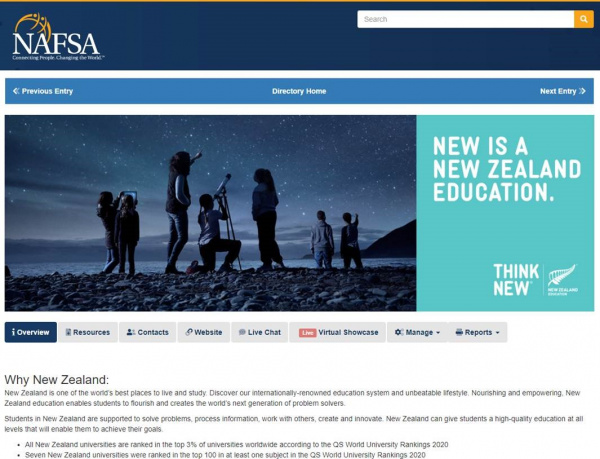
North America: NAFSA eShowcase
For the first time ever, the world’s biggest B2B international education conference was held entirely online.
More than 9,000 international educators from over 100 countries were expected to attend the conference in St. Louis, Missouri over 25-29 May before COVID-19 forced organisers to take it to the digital world. In the end, over 2,000 attended the eShowcase.
Participants were able to visit ENZ’s virtual booth and engage either through chat or live video conversations at designated times.
New Zealand universities and ITPs had dedicated times to host a ‘Virtual Showcase’, which is a mechanism by which NAFSA exhibitors presented, met or collaborated with attendees via a dedicated Zoom session.
“The process of moving the largest in-person B2B international education conference in the world online has been a big learning curve, not only for ENZ and the individual booths and attendees, but for NAFSA themselves,” ENZ Director of Engagement – North America, DuBois Jennings, says.
“With no live, conference-wide chatroom or method to see a list of conference participants it felt isolating at time on the booth, which is very different from the normal, in-person NAFSA conference. However, it has been a valuable learning experience as the international education industry looks for new ways to connect virtually.”
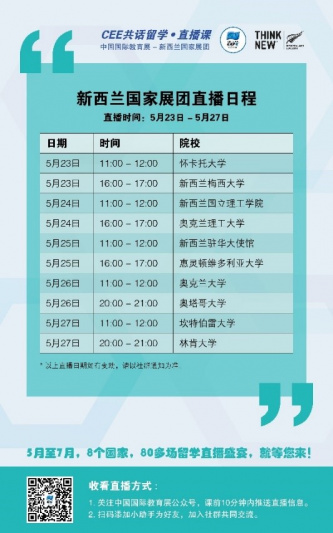
The official NZ CEE schedule.
China: China Education Expo (CEE)
In late May, representatives from ENZ, all eight of New Zealand’s universities and the NZIST were offered a unique opportunity to engage directly with students from China and their parents.
The annual China Education Expo (CEE) is one of the biggest events in the Chinese international education calendar. But ENZ Market Development Manager, Jane Liu, says this year’s engagement through the virtual platform is greater than they would usually expect.
“Although ENZ has worked with the CEE for years, this is the first time we’ve been collaborated with them online. We can see this being useful to New Zealand institutions even after COVID-19.”
Each university provided a one-hour presentation sharing their programmes and how they can work with interested students once COVID-19 precautions have been lifted. The NZIST representative also gave a detailed introduction to the reforms the ITP sector has recently gone through.
The webinars have garnered a combined total of 1000 views, and have been recorded and hosted on WeChat so that students and parents can watch them at their leisure.
-
Emergency benefit for temporary visa holders
Emergency Benefit, which was available for eligible temporary visa holders until 28 February 2021 from Work and Income at the Ministry of Social Development, has been extended to 31 August 2021.
It’s a weekly payment to help with basic living costs while the person arranges to return home as soon as they can.
You can direct in-need students to this Work and Income link to find out if they will qualify and how to apply.
Who is eligible
Foreign nationals may be able to get the Emergency Benefit if they:
- have a current temporary New Zealand visa that is not sponsored, for example a visitor visa, student visa or work visa
- are in financial hardship with no other means of support (other than money to buy a flight home)
- either:
- are arranging to return home as soon as they can, or
- can't get home because of COVID-19 travel restrictions but will do so as soon as flights are available
- are taking all reasonable steps to find other means of support, including looking for work; consular assistance; savings or support from family, friends and organisations in NZ or overseas
- have a valid passport
- have a New Zealand bank account
- have an Inland Revenue (IRD) number.
-
Meet the team: John Goulter
Could you please outline your own role and the role of the Stakeholders and Communications team?
The Stakeholders and Communications team looks after the part of ENZ’s work that intersects with key external groups – such as other government departments, Ministers, Parliament and, through our various channels, the people of New Zealand.
We try to get all those influences lined up in support of international education. Right now, thanks to COVID-19, there is more external focus on international education than there has been for years. We try to ensure it’s well-informed.
How has COVID-19 impacted your team’s work, and what work do you have ahead of you with the recovery?
Sometimes it seems like we have done nothing else since COVID-19 appeared on the horizon way back in January.
It has brought to the surface some long-running issues about international education. It’s an opportunity for us to show leadership in outlining the future role of the sector, and developing interesting new approaches.

John with ENZ Field Director - North America Lewis Gibson in Washington DC.
Can you tell me a bit about your professional background?
I was a journalist for a long time, mainly reporting politics from the Press Gallery in Parliament.
I loved that at the time but I moved into public affairs roles because after a while in journalism I wanted to be influencing the way things happen, rather than just writing about them.
Journalism is now changing totally, like many sectors are. Some new models are emerging, but it’s a struggle in a country the size of New Zealand.
What do you enjoy doing in your free time?
I like running and travelling and live music. So I’m not having a great year. Most running events have been cancelled or postponed, and so have all the concerts I had booked for.
I listen to some podcasts, mainly about running and politics in the United States. It is hard for us to fathom the depth of the COVID-19 crisis they are going through.
I actually liked a lot about our lockdown. It was good being a little family unit at home. I loved running on nearly empty roads. I took up Zoom yoga classes with my daughter in Christchurch. I wonder about what the new reality is going to look like for us all.
-
Introducing Team AMEE
The Americas, Middle East and Europe team (AMEE) will be led by Regional Director Amy Rutherford.
Bronwyn Shanks has now taken on the role of Special Adviser – Special Projects, Europe and the Middle East. Suzan Mozher remains in her role as Market Manager/Deputy Education Attaché, based at the New Zealand Embassy in Riyadh, Saudi Arabia.
The re-allocation of the Middle East was for pragmatic reasons – primarily, to even out the workload between our two international teams. There is also only a one-hour time difference between Suzan in Riyadh and Vienna, where Bronwyn is based.
“I’m looking forward to working with our partners in the Middle East,” Amy says. “Please contact either me, Bronwyn or Suzan if you’d like to discuss any development ideas or issues to do with the region.”
-
New Zealand and Viet Nam commit to strategic education partnership
A refreshed Strategic Engagement Plan on Education was signed this week between Education New Zealand (ENZ) and Viet Nam’s Ministry of Education and Training.
The signing – ahead of a virtual leaders’ meeting between Prime Minister Jacinda Ardern and Viet Nam Prime Minister Nguyễn Xuân Phúc – marks the elevation of the two countries’ relationship to a ‘strategic partnership’ and heralds a deeper level of education cooperation.
The renewed Strategic Engagement Plan 2020-2023 will feature initiatives across education sectors in New Zealand and Viet Nam, including joint programmes in the tertiary sector, innovative education models in blended and online delivery, continued collaboration to improve institution-to-institution partnerships for English language training, and alumni engagement.
Among the refreshed plan’s proposed initiatives are innovative education models in blended and online delivery, which will be particularly relevant to how New Zealand and Viet Nam build on their education relationship in a post COVID-19 environment.
New Zealand will continue its commitment to support Viet Nam’s efforts in achieving its 21st century education objectives to produce well-trained, work-ready graduates with the skills necessary to compete in a rapidly changing global market.
ENZ Chief Executive, Grant McPherson, said the Strategic Engagement Plan’s renewal provides an important opportunity to leverage and build on the longstanding education partnership between New Zealand and Viet Nam.
“We value the vibrancy and richness that Vietnamese students bring to New Zealand campuses and communities, and we’ve been thrilled to see the growing number of students from Viet Nam choosing to study in New Zealand in recent years.
“While COVID-19 has presented us with challenges, we are looking forward to welcoming Vietnamese students into New Zealand when it is safe for to do so, including through initiatives such as the New Zealand Schools Scholarships and the New Zealand Scholarships programme for postgraduate students.”
The New Zealand Ambassador to Viet Nam, Wendy Matthews, said it was fitting to see the re-commitment to the Strategic Engagement Plan in 2020, which marks the 45th anniversary of diplomatic relations between New Zealand and Viet Nam.
“The New Zealand-Viet Nam relationship has gone from strength to strength in recent years and education has been an integral part of this growth. I am delighted to see New Zealand institutions embarking on new ventures with education partners in Viet Nam – together they are developing innovative and student centric approaches. As we celebrate 45 years of diplomatic relations in 2020, I’m confident today’s signing will serve as an effective platform to further advance education cooperation between Viet Nam and New Zealand and deliver successful education outcomes for our students.”
-
PTE English for Speakers of Other Language (ESOL) Provision Fund
The $1.5 million fund is designed to help English language schools impacted by the border closure to international students.
The funding was announced in July by Minister of Education Chris Hipkins as part of the Government’s $51.6 million Recovery Plan for International Education.
The PTE ESOL Fund is part of the first workstream, which seeks to stabilise the sector while borders remain closed. Read more about the Recovery Plan.
The funding aims to help increase demand for English language training, to be met by English Language Schools. It will also help with upskilling and improving the employability of New Zealanders with English language needs, including migrant partners and dependents of New Zealanders.
The fund is being implemented by the Tertiary Education Commission (TEC).
Eligibility
To be eligible for the PTE ESOL Provision Fund, your organisation must hold a Category 1 External Evaluation and Review (EER) rating from NZQA as at 1 July 2020.
Teaching enabled by this fund may only be provided to Category A and B learners. All learners must be in New Zealand.
Read more details on eligbility
How to apply
Applications for the PTE ESOL Provision Fund are open now and will close at 5pm on Friday, 28 August.
To apply, you need to complete the form on the TEC website and send it through to the TEC Customer Group via email: customerservice@tec.govt.nz
Other considerations
For the full list of terms and conditions, including successful applicants’ reporting and monitoring requirements, refer to the TEC website.
-
Supporting your international students
Through our NauMai NZ resource, ENZ is continuing to provide up-to-date information and advice especially for international students. We encourage and welcome all international students in New Zealand to join NauMai NZ.
COVID-19 testing
COVID-19 related care – including diagnosis, testing and treatment – is provided free of charge to anyone who requires it, including international students. This is irrespective of citizenship, visa status, nationality, NHI number or level of medical insurance coverage. See more information on free COVID-19 testing.
Some countries require travellers to confirm a negative COVID-19 test before they leave New Zealand. If your student is in this situation and requires a test prior to departure, they can organise this through Healthline or their GP, but they will need to pay for it. See questions and answers on pre-departure COVID-19 testing.
covid19.govt.nz has help and advice in several different languages, including simplified Chinese, Hindi and Korean.
Financial support
This is a really difficult time for a lot of people financially, including some international students.
The Assistance to Foreign Nationals Impacted by COVID-19 Programme opened on 1 July 2020. Any foreign national in New Zealand – including international students – may apply for this support if they are experiencing temporary hardship due to the effects of COVID-19.
If they are eligible, students will receive support to help them meet basic needs like rent, electricity, food and clothing. Each applicant’s circumstances will be considered at an individual level to ensure support reaches those who need it most. Eligibility is established through a series of checks on visa and employment status, savings, outstanding debts and alternative sources of income or in-kind support.
If you know of a student who is in need of temporary hardship support, please encourage them to apply at this link: https://foreignnationals.services.govt.nz/
There may be opportunities for people, including international students, who are in extreme hardship to return home through the Foreign Nationals Programme. If you know of a student who wants to return home but can’t afford the flights, then please encourage them to apply to the Programme for this additional assistance.
If they require assistance with translation support or have questions about criteria and eligibility, they can call 0800 RED CROSS and ask to speak with the Visitor Care Manaaki Manuhiri team.
Visas
Ongoing border closures and travel disruption around the world are making it challenging (and in some cases impossible) for students to return home. If you have international students whose visa is due to expire in the next few months and they are unable to leave New Zealand on the date originally planned, then please make sure they have applied for a new visa.
If they do not apply for a new visa before their current visa expires, they will become unlawful and this will affect any future travel plans. Students also have the option of applying for the COVID-19 short-term visitor visa.
Embassy and consular assistance
If you have an international student in hardship and their situation is not likely to improve in the medium to long term, then they are advised to consider all their options, including returning home.
Students should contact their home country embassy in New Zealand for up-to-date information and advice on travel information or special requirements when returning home, such as medical certificates or quarantine arrangements. Read more information on embassies and consulates.
Thank you for your ongoing support of international students in New Zealand and for sharing this information with them.
-
Registrations open: NZ Vocational Education and Training Research Forum
The NZ Vocational Education and Training Research Forum (NZVETRF) is a multi-sector opportunity for discussing ‘what works’ in vocational education. In 2020, the forum will be delivered fully online, including international keynotes, and a curated programme of breakout sessions, along with interest based ‘hangouts’ and expert sessions.
The new partnership with Skills International extends the reach of the forum to an international network, to learn from and contribute to global developments in VET to support the COVID-19 recovery efforts.
CEO of The Skills Organisation, Garry Fissenden, says vocational education and training will be a critical component of the response to the employment, economic, and social shocks caused by COVID-19 around the world. He says:
“With New Zealand’s vocational education sector embarking on a major reform, now more than ever is a time to come together to share evidence and capability of how vocational education and training can support skills and productivity, and wider wellbeing.”
For more details, head to the NZVETRF website.
-
Summer plans: what students need to know
Under current border settings, tertiary-level international students will need to make careful and informed decisions about their plans for the summer period.
Any international student who chooses to return home (or otherwise leave New Zealand) over the summer break needs to be aware that they are not eligible to re-enter the country to continue study in early 2021 under current border settings. Students facing hardship will need to reconsider whether they should continue to stay in New Zealand or are better to return home.
International students currently in New Zealand who intend to continue to study in 2021 have the following options at the end of this academic year:
- Remain here over the break and continue their New Zealand study next year
- Find additional summer school study programmes
- Return home and continue their New Zealand study online next year, if their institution supports this option
- Return home and cease their New Zealand study.
Study providers are asked to ensure they are familiar with their ongoing Code obligations over the summer period, and to assist students to understand their options.
Education New Zealand wants to complement and spread the word about the excellent work the sector and regional economic development agencies are all currently undertaking.
We are also mindful that remaining in New Zealand will bring challenges for students and so supporting student connection and wellbeing is also a focus over this time.
At ENZ we are:
- Creating new NauMai NZ pages, specifically aimed towards keeping students in New Zealand over the summer.
- The aim of these pages is to provide a central repository of activities and opportunities, addressing key themes of study, recreation, skill development, and connection with other students.
- They will signpost out to activity happening at a regional and national level, as well as highlighting ENZ-led online initiatives.
- These pages will be live at the end of September
- Hosting a Summer in NZ online virtual fair for international students in NZ on 31 October, where regions and contributing organisations will have a chance to showcase summer activities that they are developing and delivering. Students will be able to register via NauMai NZ at the beginning of October.
- Activating a variety of communications channels to direct students to NauMai NZ and the Summer in NZ fair to maximise awareness of summer opportunities and to gently encourage consideration of further study to those whose programmes may be finishing.
- Facilitating online events and opportunities to support student wellbeing and connection over the summer period.
We look forward to showcasing the fantastic experiences for students here in New Zealand over summer 2020/2021, building their capability, and supporting their wellbeing and connection to Aotearoa New Zealand. Further information will be available in the coming weeks.
-
From the CE: Rebuilding and reshaping our sector
The Recovery Plan for International Education, released in late July, is a plan to support the rebuild, recovery and reset of the international education sector with an eye on the future. It’s made up of three concurrent workstreams to stabilise, strengthen and transform international education.
Since its release, Education New Zealand, with other government agencies, has been carrying out a short, focused engagement on the plan with our peak bodies and providers.
So far, we’ve met with representatives from groups, including schools, some PTEs, parts of the university sector, ITPs and English language sectors, as well as the New Zealand International Students’ Association and EdTech NZ. And further meetings are scheduled.
We have heard from you on a variety of topics. Naturally, the most common concern is around student re-entry. Other topics focused on encouraging cross-sector collaboration and hearing student voices as we rebuild our sector. We also know that each part of the sector has its own unique challenges and needs.
These conversations are only the beginning of our engagement with you. There will be many more opportunities to discuss and collaborate as part of the strengthening and transforming workstreams of the Plan, and on the Government’s vision for international education.
Next, the Ministry of Education and ENZ will co-host deep-dive workshops with sub-sectors on both the Recovery Plan and issues particular to them.
You can read more on the overall Recovery Plan on ENZ’s website: Recovery Plan for International Education. This page will continue to be updated as our work develops.
Here at ENZ, we have realigned our activities and resources to implement the Recovery Plan. We have launched our new business plan for 2020/2021, called Building a New Future.
There are major areas for us to focus on, including the retention of as many students already in New Zealand as possible, early re-entry of students, renewing and reshaping future options (such as different modes of delivery and student decision-making), and creating deeper understanding of the benefits of international education, both in New Zealand and globally.
I’d like to reinforce that throughout this change, the goals of New Zealand’s International Education Strategy – an excellent education and student experience, sustainable growth, and global citizens – remain our beacon on the hill.
Finally, I’d like to thank you for meeting with us over what continues to be an incredibly difficult time. We value your honest feedback and look forward to continuing to work with you to rebuild and reshape international education,
Ehara taku toa I te toa takitahi, engari he toa takitini
My strength is not that of a single warrior but that of many.
Ngā mihi,
Grant McPherson
Chief Executive Education New Zealand Manapou ki te Ao