Search
Showing 10 of 538 results for group registration
-
New student forum for NauMai NZ WeChat mini programme
Education New Zealand’s NauMai NZ platform is designed to inform, support and empower international students.
A WeChat mini programme – an app designed for the WeChat ecosystem popular with Chinese students – has extended NauMai NZ’s reach, attracting over 12,000 users in its first year.
The NauMai NZ WeChat mini programme helps students make the most of their New Zealand experience, with advice on everything from finding a part-time job and knowing their rental rights to looking after their wellbeing and understanding Kiwi English. There are also stories from students about their lives – for instance, people sharing ideas on what to do during their summer in New Zealand.
“We know that Chinese students prefer to connect with each other in their language, on the WeChat channel they trust,” says Faymie Li, Senior Advisor for Student Experience at ENZ.
“We’re delighted to see how much they enjoy this digital platform and how quickly it’s growing. It’s great to be able to connect Chinese students to each other and to people who’re willing to help them out.”
The WeChat mini programme has now run six livestreams hosted by experts, alumni and current international students on topics including employability, how to grow your network, and mental health and wellbeing. Students tuning in to watch can use the chat feature to ask questions.
The livestreams have attracted a total of nearly 3,000 live views with over 18,000 engagements during the live events and, so far, more than 1,000 views afterwards.
The WeChat mini programme has now added a new forum so that Chinese students and alumni can better share their life and study experiences and support one another. The text-based, moderated forum allows students to have their questions answered by their peers.
A group of international students have signed on as ambassadors for the WeChat forum, including alumni from the Prime Minister’s Scholarship for Asia programme. One of the forum ambassadors, Mengdi Zhang, says she’s looking forward to connecting with newer students.
“I am excited to be a student ambassador so that any students with unresolved questions can reach out. I can see my own past in the students’ questions, and I hope to help them through to a better experience in New Zealand,” she said.
If you would like to know more about the NauMai NZ WeChat mini programme, contact faymie.li@enz.govt.nz. You can share it with others using the WeChat QR code.
-
Survey shows that New Zealand is among top destinations for Brazilians who study abroad
Belta’s annual survey, sponsored by Education New Zealand Manapou ki te Ao (ENZ), was conducted between December 2022 and April 2023 with 763 students and 317 international education agents from all regions of Brazil surveyed to assess their perceptions of international education. The survey results were shared at a recent event in Sao Paolo with dozens of agents and media attending, in person and virtually, to hear about the survey’s latest findings.
ENZ’s Market Development Manager in Brazil, Bruna de Natale, delivered a short speech ahead of the results release. She said it was positive to see so much interest in the release of the survey results, especially when the results revealed that New Zealand continues to rank strongly as an international education destination amongst Brazilian students.
“In this most recent survey, New Zealand moved to seventh position on the list of top education destinations sought by Brazilians who studied abroad, compared to before the Covid-19 pandemic when it was in eighth place. The main reason driving country choice for the students surveyed is the quality of life – New Zealand ranks very well for the quality of life, education, and the protection of civil rights.
“The quality of teaching is another reason given by those surveyed when choosing New Zealand and 60% of participants rated the quality of our English schools and language programmes as good or excellent. It is fantastic to see that New Zealand continues to attract attention as a quality international education destination and it is certainly on the radar as a desired destination for future exchange students,” said Bruna.
Of the international education agents who were surveyed, 52.9% reported that the demand for students interested in New Zealand has remained stable since the borders reopened, while 20.6% recorded growth in interest. This group projects that the numbers of Brazilian students travelling to New Zealand will return to pre-pandemic levels in 2023 and 2024, with the highest flows expected for the first (35.3%) and second quarters of 2024 (32.4%), with demand increasing gradually from the first quarter of 2023.
For a copy of the full survey in English, please email belta@belta.org.br.

Bruna delivering an introductory speech at an event which released the results from Belta’s survey on international education.
-
Around the world in five
CANADA
Canadian language programmes register modest growth in 2016
The number of students enrolled in Canadian language programmes increased by 1 percent in 2016 even as student weeks fell by 5 percent, according to a Languages Canada survey. The survey report noted that language students looking to work during study were more likely to choose Australia or New Zealand, where work and study is facilitated, as compared to Canada, where off-campus work during language study is prohibited.
UK
UK’s net migration position under pressure
Calls for a rethink on net migration targets and the inclusion of international students within that target were mounting on all sides of the UK political spectrum on August 24. As the latest news that 97 percent of international students leave after their studies filtered through, MPs and business leaders stepped up calls for Theresa May to protect the UK’s international education industry and rethink the inclusion of international students in net migration figures.
GLOBAL
Hotcourses embeds TNE into course searches
Study search platform Hotcourses has expanded its offering to include a transnational education course search. Over 3,000 programmes from 432 education providers are offered in the new expansion, allowing students to search for courses in their own country, or overseas, with a degree awarded from a foreign university.
US
US reduces visa operations in Russia
The United States has suspended all visa operations in Russia for one week and from September will only provide visa services from the US Embassy in Moscow and not at other consulates, a move likely to cause disruption for Russian agents and students. The move follows the Russian government's recent order to cut the American diplomatic mission staff by 755 people.
HONG KONG
Hong Kong’s ESF raises fees as government funding phased out
Year 2 pupils are the latest year group to face an additional fee payment of US$2,200 this year at English Schools Foundation (ESF), one of Hong Kong’s largest providers of English-medium education, as a result of the removal of a large government grant. ESF, which operates 22 schools across Hong Kong, teaching 17,600 students, is in its second consecutive year of phasing out the grant money it received from the government, which totalled US$36.5 million annually.
-
Mayoral events provide vibrant welcomes to students in their regions
Last month we shared some of the wonderful images that New Zealand schools, universities, PTEs, Te Pūkenga and English Language Schools shared with ENZ as they welcomed their new students for 2024. This month we are sharing details and images from the Mayoral welcomes that some of our regions have held for their visiting international students.
Thank you for adding to our diversity and vibrancy!
More than 40 international students were greeted by Whanganui District Council Mayor, Andrew Tripe, at a special Mayoral welcome to the community on Monday 8 April.
Speaking to the students from countries including Brazil, South Korea, Japan, Germany, China, India Indonesia, Thailand, and Viet Nam, the Mayor thanked them for choosing Whanganui and adding to the “diversity and vibrancy of our community”.
The students attending had enrolled in both secondary schools and tertiary institutions in the district such as Whanganui High School, UCOL Whanganui and the New Zealand International Commercial Pilot Academy.
Formal greeting over, the Mayor was rushed by students seeking a special ‘selfie moment’ to share with families and social media.
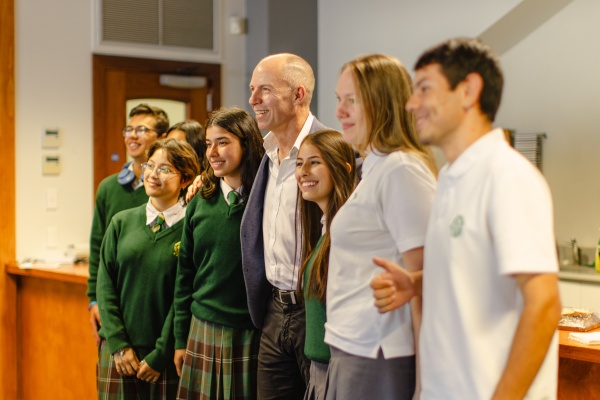
A group of Brazilian international students attending Whanganui High School take up the opportunity of a photo with the Whanganui District Council Mayor, Andrew Tripe.
Similar levels of excitement were seen in Hamilton where the Mayor of Hamilton, Paula Southgate and local performance groups welcomed approximately 250 new international students to the Waikato region. The welcome event was held at the Pā, University of Waikato and is the first welcome since the Covid-19 pandemic put these events on hold.
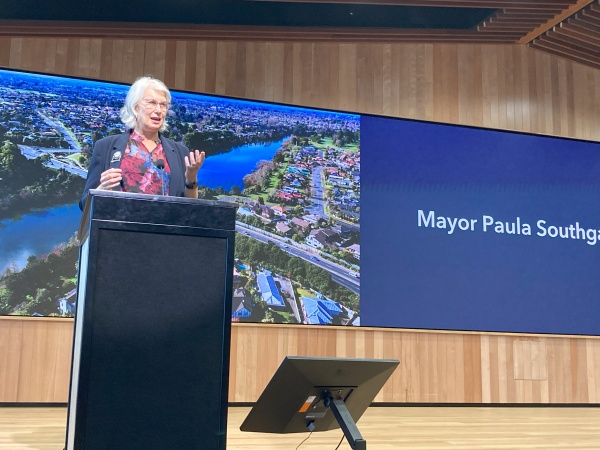
Mayor Paula Southgate providing the official welcome to the Waikato’s approximately 250 international students.
Faymie Li, Education New Zealand Manapou ki te Ao’s Senior Advisor Student Experience said, “I was deeply honoured to witness this significant event and see how we demonstrate manaakitanga to our international students.
“The diverse cultures we embrace in Aotearoa is truly something to cherish and celebrate. It was wonderful to see so many school students attending the ceremony, offering them a unique student experience they don't typically encounter.”
Jiabao Zhao (Boa), a former international student who completed a Bachelor of Management Studies with First Class Honours at the University of Waikato, shared a message of encouragement with the students. Boa’s advice for new students was: to study hard but also “talk to and meet students from outside your country. It’s easy to remain in your comfort zone but that is not the point of studying abroad. Network and build your presence”.
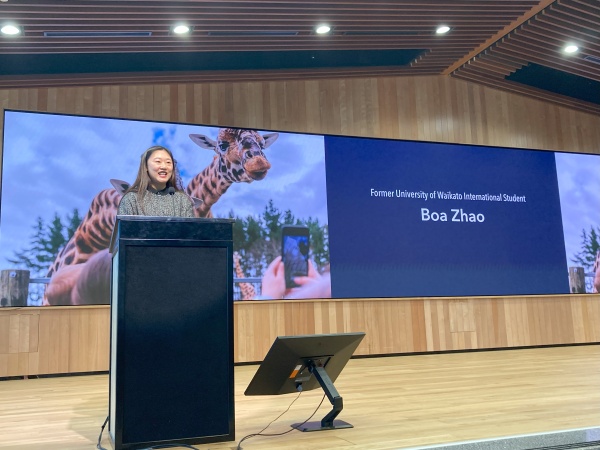
Former University of Waikato International Student sharing a message of encouragement to the new international students.
She also reminded students to take care of both their physical and mental health. There will be challenges but also great opportunities, and her own study and career journey is testament to that. She now works as an International Sales Operation Executive at Prolife Foods Ltd in Hamilton.
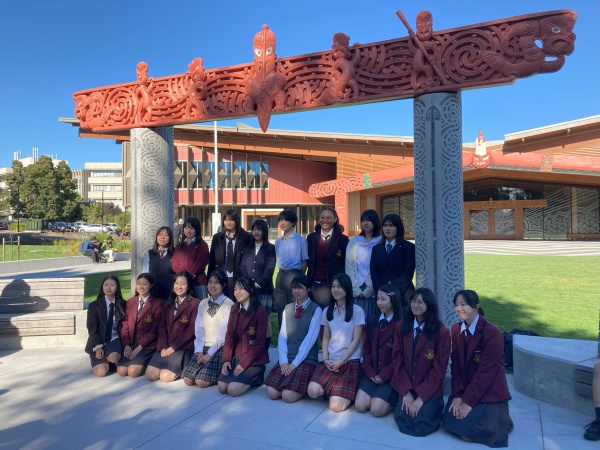
A handful of the 250 students who travelled to the Pā at the University of Waikato, for the international student welcome.
Also in March, nearly 100 international students received a fine welcome centered on the theme of connection, by Timaru District Mayor, Nigel Bowen. The Timaru District will be home to students from Japan, China, Germany, Thailand, South Korean, Hong Kong, Macau, Fiji, Philippines, Brazil and Poland, and more over the course of this year. You can read about this welcome in the Stuff article here - Nearly 100 international students welcomed to Timaru | Stuff.
-
From Whangaparaoa to Colombia
As a recipient of the Prime Minister’s Scholarship for Latin America (PMSLA), Eve Bain, 23, is undertaking a two-semester exchange in Colombia to complete her Bachelor of Arts degree.
After finishing her LLB (Hons) at Victoria University of Wellington, Eve headed to Medellín, Colombia in January to study Political Science at Universidad EAFIT.
“I really wanted to immerse myself in a completely different culture and become fluent in Spanish,” she said.
“EAFIT is an extremely modern and impressive university and a lovely place to study. It’s been fascinating to study political science during the peace process in Colombia, and to talk to Colombians about their perspectives on the process too.”
Eve says some of the biggest differences in education between the two countries are the structure of classes at the university.
“Here there are no lectures. It’s more like college, with classes of 25 to 30 students. There are a lot of group projects and small quizzes, whereas at university in New Zealand you have two or three big independent assignments.”
Eve recently obtained the EAFIT Language Centre’s ‘scholarship to share culture and language,’ which will enable her to take Spanish-language classes while teaching English to children each week, using New Zealand culture and history as a platform.
“People often don’t know a lot about New Zealand but they know Lord of the Rings was filmed there and that our country is beautiful.
“I plan to bake Anzac cookies with them, and teach them some Kiwi slang, rugby and kapa haka!”
Eve describes the Colombian culture as vibrant and rich, and says the people are some of the friendliest she has met.
“It’s also been great to connect with Kiwis here through the scholarship – I even had dinner with New Zealand’s Ambassador to Chile and New Zealand’s Trade Commissioner for South America last month.”

Eve in San Agustin, where she “had the trip of a lifetime” doing a 6-day horse trek through the rain forest (despite no previous horse riding experience).
Eve is about to start her second semester of study before returning to New Zealand in December. She said so far she’s had nothing but positive experiences.
“I am really proud of my progress so far – I have improved my Spanish so much now that I am fairly fluent, and I have learned a lot about the history and culture of Colombia, and the region more generally.”
“I am also gaining skills that will be valuable for New Zealand in the future, particularly for my future goals of diplomacy and international dispute settlement.”
“My experience here would not have been possible without the PMSLA.”
-
English New Zealand 2017 Conference success
Held in Auckland, “The Future Face of ELT in New Zealand” featured presentations on all aspects of best practice in the ELT environment: the academic and teaching context, assessment, marketing, management and pastoral care.
Sahinde Pala, ENZ’s Business Development Manager, said the event had something insightful for everyone across the sector.
“The programme was well designed to cater to the various English language professionals who attended, and the line-up of presenters was impressive,” said Sahinde.
“It was particularly motivational to hear ACG’s Marnie Watson endorse collaborative marketing to ensure the profile of New Zealand’s quality reputation is raised even further.”
Also joining the conference was an English New Zealand famil group of study abroad agency representatives from Spain, Italy and France.
Kim Renner, English New Zealand’s Executive Director said as well as visiting member schools around New Zealand, the representatives appreciated the chance to network and give a market presentation to conference delegates.
“Visiting New Zealand in person to see what we offer is invaluable to them,” said Kim.
“They provided insights around the use of social media and not underestimating the important role study abroad agencies play in assisting students with their study abroad choices and planning.”
The conference was organised by English New Zealand, with the support of ENZ, Cambridge Assessment English and the Auckland Institute of Studies.
Before the conference, English New Zealand hosted the QALEN Symposium, a forum for representatives of ELT global quality assurance bodies, some of whom stayed on to participate in the conference.
-
US students arrive in New Zealand
Amy Rutherford, ENZ’s Director of Education, North America, said studying in New Zealand will be a life-changing experience for these students, and will hopefully create more Kiwi ambassadors in the US.
“We’re working hard in the US to raise the profile of New Zealand as a high-quality education destination, and authentic stories from students who have studied in New Zealand are a great way to do that,” said Amy.
“We also want to see a more diverse group of US students having overseas experiences, and these scholarships are an excellent first step.”
Taylor Weckstein, one of the recipients of the GSA Awards, is studying at the University of Otago. She chose New Zealand as a way to follow in her grandfather’s tracks – literally. After learning about the great hikes he did in New Zealand many years ago, she wanted to share the experience.
US student Josh Golden, the recipient of the Go Overseas New Zealand scholarship, has also begun his semester at the University of Canterbury. As a marine science major with biology and environmental science minors, he wants to explore the geography and wildlife of New Zealand.
“I am simultaneously excited and nervous. I expect to be mesmerized by New Zealand’s natural beauty and culture. I can’t wait to live as a Kiwi this semester!”
Gilman Scholar Angel Geller has also arrived in New Zealand. Her scholarship came from a partnership between ENZ and the US Department of State, which is aimed at diversifying the kinds of students studying internationally.
Angel will explore Māori culture and tribal politics at the University of Waikato and compare them with her experience growing up with UmonHon, her indigenous tribe in Nebraska.
“I did extensive research to find a host site with indigenous-relevant classes on topics from history to language. The University of Waikato has this, as well as resources on how to connect with community members, and a significant Māori student population who I will have as my peers,” said Angel.
You can follow the study adventures of our Kiwi Ambassadors on the Study in New Zealand Instagram, YouTube and Blog.
For more information on scholarships for US students please contact ENZ’s US team, Amy Rutherford or Alanna Dick.
New assets on the Brand Lab
Want to share scholarship information with your US partners? Visit the Brand Lab and search under "USA" and "Study Abroad" keywords to find two scholarship flyers and education and lifestyle PDFs designed for US students and advisors.
Share your student stories
Do you have interesting student stories or scholarship winners on your campus? ENZ is always looking for student profiles to share through our social and marketing platforms. Please contact Lucy Johnston, ENZ Senior Communications Advisor.
-
Japanese students join Kiwi flight school
The students came from Kinjo Gakuin University in Nagoya, Japan and studied a short course specially designed for them. In addition to New Zealand School of Tourism’s flight attending course, they also had a session from Cut Above Academy about hair and makeup training, as immaculate grooming is an essential part of the job.
Shizuko Ozaki, a teacher from Kinjo Gakuin University, said the girls loved their time at the airport campus, and were impressed with the school’s facilities – including offering training onboard a real plane.
“They enjoyed the hands-on learning and the practical aspect of the training on the 737 aircraft. The trainer was fantastic with our students, she made the learning easy for them to understand and follow. They also enjoyed interacting with the other classes and they felt very comfortable and welcomed on campus.”
New Zealand School of Tourism frequently creates bespoke programmes for international groups.
New Zealand student Armani Young said having international groups at the college was a bonus for everyone involved. She said it gave the trainers the opportunity to learn about other cultures, and the international students the chance to experience life in New Zealand.
“Our class also loved interacting with the Japanese group. They were quiet and shy at first, but soon became comfortable and had fun interacting with us. It was great to share our culture with them.”
-
ENZ signs education arrangement with Atsugi city
The arrangement was signed between ENZ, the Atsugi City Council and the Atsugi City Board of Education at the New Zealand Embassy in Tokyo on 5 April.
The signing was preceded by a two-day visit to Wellington by an Atsugi City Board of Education delegation in late March. They met ENZ Chief Executive Grant McPherson, Deputy Mayor of Wellington Jill Day and visited secondary schools.

ENZ Chief Executive Grant McPherson with Atsugi City Board of Education Superintendent Takaharu Soda in Wellington
Already there are tangible results from the signing. Atsugi city is making plans to send a group of junior high school students on a 10-day study visit in August to Wainuiomata High School, Wellington.
Misa Kitaoka, ENZ’s Senior Market Development Manager – Japan, said Atsugi city is keen to provide more opportunities for Atsugi’s school students as well as English teachers for teacher training in New Zealand.
Atsugi city will also act as a host town for New Zealand under the Japanese government’s initiative to promote exchanges between Japanese cities and the countries participating in the 2020 Olympics and Paralympics.
The education cooperation arrangement is the first of its kind between a Japanese host town and guest country.
Adele Bryant, ENZ’s Regional Director for China and North Asia, said the arrangement will strengthen the education relationship.
“Atsugi city has begun organising a range of activities to foster a strong relationship between the city and New Zealand in sport, culture and education.
“The arrangement has highlighted the range of education exchange initiatives that we could further promote as part of Japan’s ongoing internationalisation agenda leading up to and after the 2020 Olympics,” Adele said.
-
ENZ’s new partnership with the Manaaki New Zealand Scholarships Programme
The Manaaki scholarships represent the government’s single largest investment in international scholarships and have been awarded for more than 70 years.
The scholarships are a key pillar of Aotearoa New Zealand’s International Development Co-operation, offering more than 1,100 scholarships annually to students from 112 eligible countries to study in Aotearoa New Zealand, in the Pacific, or online.
“This partnership plays to the strengths of both MFAT and ENZ,” says Andrew Needs, MFAT Deputy Secretary – Pacific and Development Group.
“It will help us ensure that not only are we demonstrating manaaki to our scholars, but also offering scholarships that address the skills and knowledge requirements of each of our partner countries.”

ENZ will participate in joint governance of the programme and provide data and insights to inform investment decisions, as well as operational management, drawing on its expertise in supporting a world-class scholar experience. The partnership offers opportunities to develop closer connections between scholarship partners and tertiary education providers and encourage innovation in product development.
ENZ already manages the Prime Minister’s Scholarships for Asia and Latin America as well as scholarships on behalf of the Ministries of Business, Innovation and Employment, and Primary Industries.
“This is an excellent example of ‘NZ Inc.’ cooperation in action,” said Grant McPherson, ENZ’s Chief Executive.
Two recent Manaaki Scholars are Aminat Razaq from Nigeria, who has completed her New Zealand studies on sustainable energy – you can read about her experiences here; and Jason Nath from Fiji who completed a Postgraduate Clinical Doctoral Degree in Paediatric Dentistry in New Zealand – you can read about his experiences here.