
Search
Showing 10 of 538 results for group registration
-
Export Education Levy projects from 2016/17
The annual report covers the period from 1 July 2016 to 30 June 2017, and can be found on the Education Counts and ENZ website.
The levy is paid by education providers who enrol fee-paying international students in New Zealand.
“In 2003, the Government introduced the Export Education Levy to fund a wide range of development and risk management initiatives for the export education sector. This includes funding the Code of Practice which oversees the wellbeing of our international students while they are studying in New Zealand, as well as marketing, development, quality assurance and research for the sector,” says Belinda Himiona, Group Manager International Education, Ministry of Education.
Activities funded by the levy in 2016/17 include:
- Implementing the International Student Wellbeing Strategy
- supporting promotional activities in ENZ’s priority markets
- expanding the scope and regions in ENZ’s Regional Partnership Programme
Support for promotional activities in ENZ’s priority markets included digital marketing via the Study in New Zealand website, social media campaigns, fairs and events held overseas. It also supported in-bound agent visits and international media familiarisation visits to New Zealand.
Funding also went into expanding the scope of growth activities, and number of regions participating in ENZ’s Regional Partnership Programme, which works with international education providers, local government, regional economic development agencies and communities to encourage regional growth in international education.
Funding was also allocated to administering and monitoring the Code of Practice for the Pastoral Care of International Students. To support the implementation of the new Code of Practice, guidelines and other resources were developed and published on the New Zealand Qualifications Authority’s website. A letter of expectations was sent to all signatories advising them of the new Code of Practice and highlighting their responsibilities
-
US students arrive in New Zealand
Amy Rutherford, ENZ’s Director of Education, North America, said studying in New Zealand will be a life-changing experience for these students, and will hopefully create more Kiwi ambassadors in the US.
“We’re working hard in the US to raise the profile of New Zealand as a high-quality education destination, and authentic stories from students who have studied in New Zealand are a great way to do that,” said Amy.
“We also want to see a more diverse group of US students having overseas experiences, and these scholarships are an excellent first step.”
Taylor Weckstein, one of the recipients of the GSA Awards, is studying at the University of Otago. She chose New Zealand as a way to follow in her grandfather’s tracks – literally. After learning about the great hikes he did in New Zealand many years ago, she wanted to share the experience.
US student Josh Golden, the recipient of the Go Overseas New Zealand scholarship, has also begun his semester at the University of Canterbury. As a marine science major with biology and environmental science minors, he wants to explore the geography and wildlife of New Zealand.
“I am simultaneously excited and nervous. I expect to be mesmerized by New Zealand’s natural beauty and culture. I can’t wait to live as a Kiwi this semester!”
Gilman Scholar Angel Geller has also arrived in New Zealand. Her scholarship came from a partnership between ENZ and the US Department of State, which is aimed at diversifying the kinds of students studying internationally.
Angel will explore Māori culture and tribal politics at the University of Waikato and compare them with her experience growing up with UmonHon, her indigenous tribe in Nebraska.
“I did extensive research to find a host site with indigenous-relevant classes on topics from history to language. The University of Waikato has this, as well as resources on how to connect with community members, and a significant Māori student population who I will have as my peers,” said Angel.
You can follow the study adventures of our Kiwi Ambassadors on the Study in New Zealand Instagram, YouTube and Blog.
For more information on scholarships for US students please contact ENZ’s US team, Amy Rutherford or Alanna Dick.
New assets on the Brand Lab
Want to share scholarship information with your US partners? Visit the Brand Lab and search under "USA" and "Study Abroad" keywords to find two scholarship flyers and education and lifestyle PDFs designed for US students and advisors.
Share your student stories
Do you have interesting student stories or scholarship winners on your campus? ENZ is always looking for student profiles to share through our social and marketing platforms. Please contact Lucy Johnston, ENZ Senior Communications Advisor.
-
11 million engagements across channels
Patrick Holden, ENZ’s Digital Media Project Manager, said this makes it ENZ's single largest marketing campaign yet.
“We are really pleased with how ENZ’s ‘Future Proof’ campaign has been tracking since its launch on 19 March,” he said.
New Zealand was ranked the #1 country in the world for educating students for the future, according to a report by The Economist Intelligence Unit (EIU) released late last year.
On 19 March, ENZ launched an eight-week global campaign to promote the ranking and encourage international students to sign-up to ENZ’s database marketing programme.
The first ‘dream’ phase of the campaign focused on awareness.
“We reached over 30 million people and have had 11,757,000 engagements across our digital and social ecosystem.
“This is the largest qualified audience ENZ has ever achieved in a single campaign.”
The second phase of the campaign started on 1 April and is focussed on converting the audience into enquiries to institutions. Ten days in, 11,600 referrals have been made.
The ‘Future proof’ campaign integrates ENZ’s social communities and digital channels via ENZ’s student attraction engine and is the first campaign integrated with the database marketing platform.
The third ‘decide’ phase will introduce the My StudyNZ member centre tool for which we received excellent feedback from the pilot prospective student group.
-
Japanese students join Kiwi flight school
The students came from Kinjo Gakuin University in Nagoya, Japan and studied a short course specially designed for them. In addition to New Zealand School of Tourism’s flight attending course, they also had a session from Cut Above Academy about hair and makeup training, as immaculate grooming is an essential part of the job.
Shizuko Ozaki, a teacher from Kinjo Gakuin University, said the girls loved their time at the airport campus, and were impressed with the school’s facilities – including offering training onboard a real plane.
“They enjoyed the hands-on learning and the practical aspect of the training on the 737 aircraft. The trainer was fantastic with our students, she made the learning easy for them to understand and follow. They also enjoyed interacting with the other classes and they felt very comfortable and welcomed on campus.”
New Zealand School of Tourism frequently creates bespoke programmes for international groups.
New Zealand student Armani Young said having international groups at the college was a bonus for everyone involved. She said it gave the trainers the opportunity to learn about other cultures, and the international students the chance to experience life in New Zealand.
“Our class also loved interacting with the Japanese group. They were quiet and shy at first, but soon became comfortable and had fun interacting with us. It was great to share our culture with them.”
-
ENZ signs education arrangement with Atsugi city
The arrangement was signed between ENZ, the Atsugi City Council and the Atsugi City Board of Education at the New Zealand Embassy in Tokyo on 5 April.
The signing was preceded by a two-day visit to Wellington by an Atsugi City Board of Education delegation in late March. They met ENZ Chief Executive Grant McPherson, Deputy Mayor of Wellington Jill Day and visited secondary schools.

ENZ Chief Executive Grant McPherson with Atsugi City Board of Education Superintendent Takaharu Soda in Wellington
Already there are tangible results from the signing. Atsugi city is making plans to send a group of junior high school students on a 10-day study visit in August to Wainuiomata High School, Wellington.
Misa Kitaoka, ENZ’s Senior Market Development Manager – Japan, said Atsugi city is keen to provide more opportunities for Atsugi’s school students as well as English teachers for teacher training in New Zealand.
Atsugi city will also act as a host town for New Zealand under the Japanese government’s initiative to promote exchanges between Japanese cities and the countries participating in the 2020 Olympics and Paralympics.
The education cooperation arrangement is the first of its kind between a Japanese host town and guest country.
Adele Bryant, ENZ’s Regional Director for China and North Asia, said the arrangement will strengthen the education relationship.
“Atsugi city has begun organising a range of activities to foster a strong relationship between the city and New Zealand in sport, culture and education.
“The arrangement has highlighted the range of education exchange initiatives that we could further promote as part of Japan’s ongoing internationalisation agenda leading up to and after the 2020 Olympics,” Adele said.
-
Winners of KIWI Challenge announced
This year was the first where university students were able to enter a new category alongside the schools' challenge.
The winning teams from Petra Christian University and USG Education headed off strong competition from eight other finalists, drawing praise from the judges for their solutions to support youth-led Small and Medium Enterprises (SMEs).
Finalists presented to a panel of judges from University of Otago – Ōtākou Whakaihu Waka and Education New Zealand Manapou ki te Ao (ENZ), who were cohosting the initiative.
Both winning teams received a voucher valued at 10,000,000 Indonesian Rupiah (approximately 1,000NZD) as well as virtual internships from the University of Otago – Ōtākou Whakaihu Waka commencing in semester one, 2025.
Tech-led solutions
A team from Petra Christian University developed an app ‘Partify’ which connects emerging small businesses and keen part-time workers. Businesses post part-time jobs, and workers swipe to find flexible gigs nearby, with AI matching candidates based on skills, location, and availability.

Partify university winner – ENZ market manager Naluri Bella and University of Otago Regional Market Manager Sarah Ewing present the award for First Place in the University category to team members from Petra Christian University for their app ‘Partify’.
In the high school category, a team from USG Education took the top prize with ‘LAW4MSME’, a platform allowing small businesses to access legal information and advice.
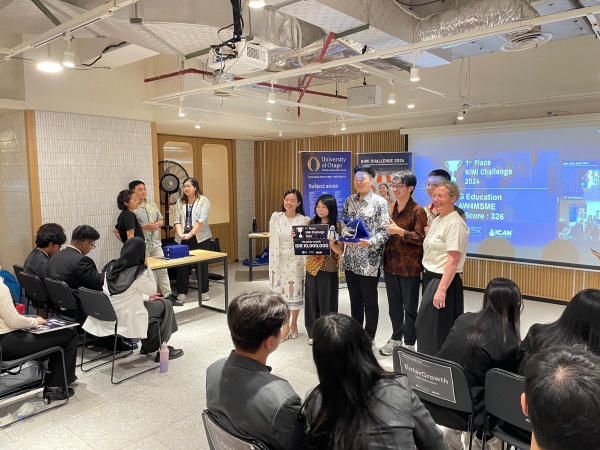
LAW4MSME High school winner - ENZ market manager Naluri Bella and University of Otago Regional Market Manager Sarah Ewing present the award for First Place in the University category to team members from USG Education for their platform “LAW4MSME’.
Explaining the group’s business idea, team leader for LAW4MSME, David Francis said the students found that Indonesian youth-led SMEs lack knowledge of the laws and regulations needed to run their businesses.
“To address this, we developed an AI bot that educates SME owners on these regulations, helping them navigate legal requirements more effectively,” David said.
The KIWI Challenge competition aims to inspire youth across Indonesia to engage in entrepreneurial activities and help resolve societal issues. Over the five years the competition has run, 1000 Indonesian youth have participated. This year, Education New Zealand Manapou ki te Ao (ENZ) partnered with University of Otago to co-host the initiative.
This year’s competition included 49 teams with a total of 221 student participants.
Mentorship key
Mentorship is a key element of the competition. The finalists attended a workshop run by Associate Professor Dr Conor O’Kane, Head of the Bachelor of Entrepreneurship programme at Otago Business School. This assisted entrants to develop their ideas and refine business plans.
ENZ Acting General Manager International Ben Burrowes said he’s delighted to see the continued development of the KIWI Challenge.
“Inviting university students for the first time has given us the opportunity to include a whole new cohort of talented young entrepreneurs, and we have been very impressed with the quality and creativity of their submissions,” Ben said.
“The competition has also benefitted from the enthusiasm and expertise of our colleagues at the University of Otago, and we are grateful for their willingness to partner with us for the KIWI challenge’s fifth year.”
Dr O’Kane said it was inspiring to witness the quality of entrepreneurial thinking among Indonesian students.
“These students have very bright futures. The concepts and programmes the finalists presented were remarkable and captured the impressive ability of the teams to identify tangible business problems and visualise and communicate a solution to these challenges,” Dr O’Kane said.
-
International students get behind Super Saturday vaccine drive
A group of students showed their concern and social responsibility by telling their stories to The New Zealand Herald ahead of the Super Saturday vaccination drive on 16 October 2021.
Education New Zealand Chief Executive Grant McPherson said it was great to see international students getting involved in the vaccination effort.
“New Zealand reaching its 90% vaccination target will aid in our recovery and bring us one step closer to welcoming more international students to Aotearoa,” he says.
“These are people who bring an array of benefits to community wellbeing, our global relationships, a productive workforce, a strong education system and enabling trade and diplomacy.”
-
Japanese teachers tour Kiwi schools
The 10 teacher participants were carefully selected from New Zealand education seminars in 2018. It was oversubscribed, showing strong interest among Japanese teachers wanting to learn about what makes New Zealand education special.
In partnership with SIEBA and regional education bodies, the group visited four schools and enjoyed tourism activities in Hamilton, Cambridge, Rotorua, Taupo, Tauranga and Auckland including Te Puia, Huka Falls and the Waitomo Caves to show what each city offers students outside of the classroom.
Misa Kitaoka, ENZ’s Senior Market Development Manager for Japan, said the teachers were very interested to learn about Kiwi’s different approaches to teaching.
“A teacher from Tauranga Boys’ College showed us how Google Classroom was used in his class which was a great learning experience for the Japanese teachers as they transition from lecture style to more student-led learning,” said Misa.
“NCEA offering subjects like food technology, creative arts and performing arts was also seen as a real strength of New Zealand’s secondary school education, as it supports creativity as well as students’ wellbeing.
“The teachers were particularly impressed by the strong Māori influence in New Zealand schools.”
An English language teacher from Hiroshima Jogakuin Junior and Senior High School noted, “During this tour, I was so impressed with Māori culture and their spirituality. I would very much like my students to enjoy the lovely experience that I had there, to learn what well-being is, and to find a path they can follow.”
With Japan hosting the 2019 Rugby World Cup and 2020 Olympics and Paralympics, the Japanese government will be implementing education policies to promote English education, resulting in a strong interest from schools and universities across Japan to study abroad to learn English.
“Since 2015, school teacher famils have resulted in an increase of 735 students,” said Misa.
“These famils wouldn’t have been possible without our partnership with Air New Zealand. We are very interested in replicating it in the future for the tertiary sector.”
-
Growing offshore interest in NZ through onshore ‘Famils’
‘Famil’, short for ‘Familiarisation’, are visits organised to literally familiarise invited groups of people with a product, or in our case, New Zealand as an international education destination. The intended purpose is that those who attend famils will become valuable advocates for a New Zealand education and therefore drive preference for New Zealand in market.
During Covid-19 these visits were stopped due to border closures. Now that borders have been fully open for some time and our international education sector is recovering, this summer provided the perfect opportunity to show off New Zealand, including our regions and unique culture, and the wide range of educational and experiential offerings to representatives from various international markets.
The summer of showcasing New Zealand started in November with two media famil groups from India and Viet Nam. This was followed by three groups of education agents from Brazil, Germany and South Korea visiting in March and most recently, a famil co-hosted by ENZ and Air NZ bringing Japanese school teachers to regions in the North Island. ENZ subsidises these programmes with other costs covered by participants, regional economic development agencies, and education providers.
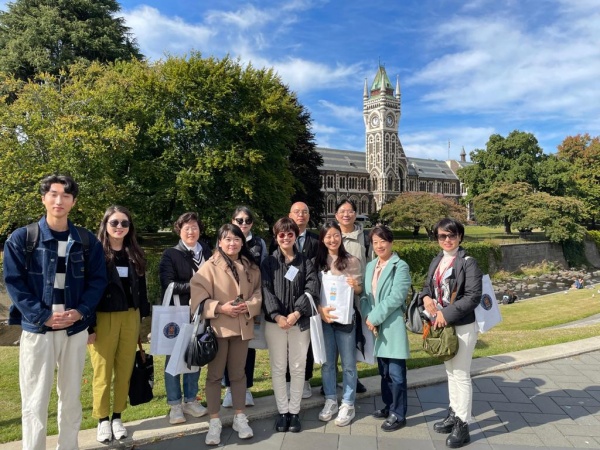
The University of Otago provided a campus tour with a Korean student and didn't miss the opportunity for a classic picture with its famous Clock Tower.
ENZ’s General Manager International, Lisa Futschek said that careful planning goes into facilitating these visits to ensure the famil groups are exposed to a range of subsectors that are relevant to the visiting country while also leveraging the visits to benefit as many providers as possible.
“While we’d love to showcase every New Zealand provider, this is obviously not possible. Much consideration is given to the source market and to the subsectors that we know are popular with that country.
“This ensures we are targeted in our approach and our visitors go back to their countries equipped with the most relevant information that helps build that pipeline of future students," said Lisa.
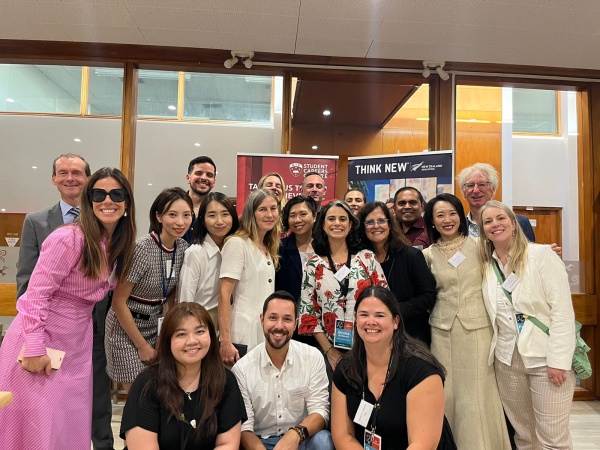
The Brazilian agents attended a networking event hosted by AIS for Auckland-based English Language providers.
“We also look for opportunities in which we can make introductions to several providers in one go. For example, a networking function was held at Auckland Institute of Studies (AIS) with Auckland-based English Language Schools invited to meet the agents from Brazil, cultivating many new connections while strengthening existing ones,” added Lisa.
As well as showcasing the various subsectors, promoting the destination is also hugely important and famil itineraries also include time spent seeing what the regions have to offer international students. This is often organised with the help of the regional economic development agencies.
A perfect example of cross sector collaboration was seen in Ōtautahi Christchurch where Christchurch Educated, an international education organisation based in the region, hosted a networking dinner with the regional economic development agency, ChristchurchNZ. They hosted the Brazilian and German agent famil groups and education providers from various sectors in the Canterbury region.

The German agents are pictured here at the Christchurch Educated networking event with a group of Christchurch based education providers (mainly high schools). The event was hosted at Ara’s Visions on campus restaurant with the Brazilian agents in attendance too.
Stefi Porter, International Education Partnership Manager for Christchurch Educated said that bringing everyone together to mutually share the benefits of studying in Ōtautahi Christchurch was a wonderful thing.
“There is certainly strength in numbers and a perfect example of where collaboration between providers and regional economic development agencies can really deliver greater bang.
“Instead of competing against one another, we are sharing resources, time and energy to show the best of our region and the breadth of study options we can offer international students.”
A key outcome of the various famil groups visiting New Zealand is that they become advocates for New Zealand as a place to study, ensuring a steady pipeline of students for years to come. In the post-famil survey, all attendees reported they were either much more likely (87.5%) or somewhat more likely (12.5%) to recommend New Zealand as a place to study for prospective students.
Other positive outcomes, include the positive media articles and social media posts produced by visiting journalists and individuals to their networks in their home countries. This positive coverage not only showcases the quality of New Zealand's education system but also shares the New Zealand education experience with prospective students in their home countries through stories featuring students and alumni.
The India media famil has achieved five in-depth stories to date in Education Times, India's largest newspaper supplement (circulation 500,000). The stories showcase the research prowess at New Zealand universities, including in biotechnology, managing climate change related disruptions, and feature the New Zealand education experiences of a range of students from India.
In Viet Nam 10 articles and four social media posts have been published so far, reaching an audience of 557,000, with more coverage expected in the coming months. Of note is HHT, the top teen magazine in Viet Nam has created a column “letters to New Zealand”, which shares weekly articles about New Zealand written about alumni.
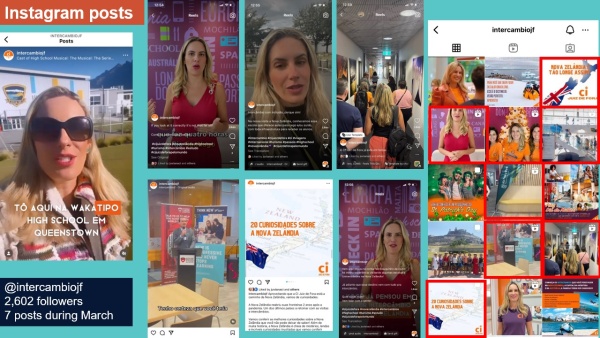
An example of some of the coverage these visits receive. Featured is a compilation of posts that Brazilian agent, Juliana Viana Silveira, owner of CI Intercambio in Juiz de Fora, made on Instagram to her followers during March while in New Zealand. The role of agents in Brazil in international student recruitment is becoming increasingly more important as reported by StudyTravelNetwork here -https://studytravel.network/magazine/news/0/30492
ENZ would like to extend a huge thanks to the education providers and regional representatives for hosting our international visitors and leaving them with a strong sense of New Zealand’s education offerings. The way in which ENZ is able to work collectively with providers and the regional economic development agencies to collaboratively plan the famil is ideal to ensure a good mix of experiences and a balance of activities. This approach helps regions feature strongly in any future famil plans and also helps develop the regional international education ecosystem.
We look forward to hearing about more connections with education representatives at the ICEF ANZA conference in Christchurch.
Check out our image gallery of the famils which shares further details of each of the groups including who attended, where they went and who they met with.
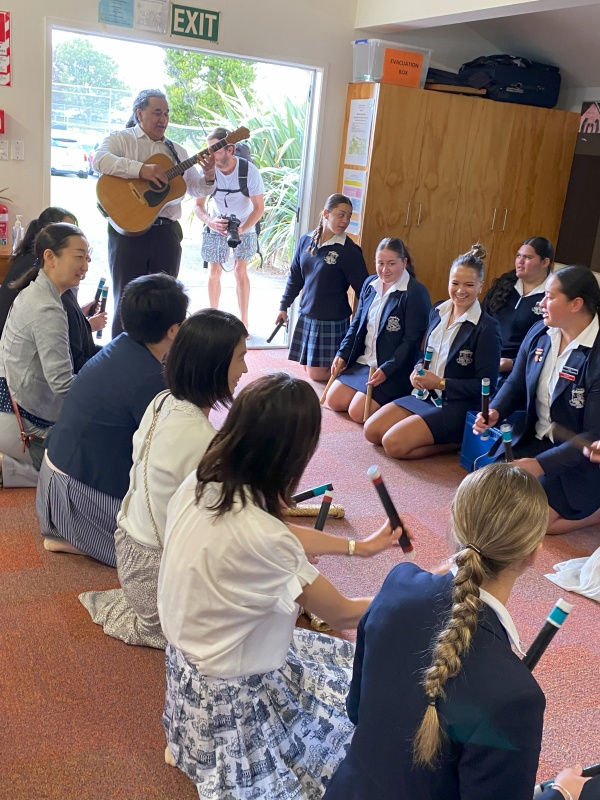
The Japanese All Girls School Teachers participated in a kapa haka class at New Plymouth Girls High School in New Plymouth. Here they are pictured playing the Tītī tōrea Māori Stick game, a traditional New Zealand game which has been played for generations.
-
High level of interest in vocational education forum
Organised by Skills Consulting Group and Education New Zealand Manapou ki te Ao (ENZ), together with Te Pūkenga, the forum provided an opportunity to share knowledge and insights on best practice in technical and vocational education and training, in an accessible format.
A key theme was the importance of close relationships with industry, particularly in terms of apprenticeships. For some participants, a longstanding perception that higher education is more important than vocational education remains a challenge. Student panel participants also talked about the confidence and support that their parents provided when they were making decisions about whether to enter vocational education programmes, and having no regrets about the career paths followed.
Topics covered included solving skills shortages, apprenticeships, youth employment, lifelong learning, digital transformation, sustainability, and promoting diversity. Senior government officials, major companies, international organisations, sector leaders and students from around the world spoke at the forum, which was opened with a speech from Education Minister Chris Hipkins.
Text-based chat and discussion tools in the virtual environment were multilingual, providing instant translation to enable communication and networking across 28 different languages.
The China – New Zealand Higher Vocational Education Summit was also part of the APAC TVET Forum and featured a dedicated virtual room for Chinese presenters and audience members. The Summit provided a platform to:
- discuss New Zealand’s recent experience of vocational education reform
- further develop cooperation in vocational education between New Zealand and China, building on the existing joint programmes between Te Pūkenga subsidiaries and vocational institutions in China.
Keynote speakers from China included Chen Dali, Deputy Director, General Department of International Cooperation and Exchanges from the China Ministry of Education, and presenters from industry including Wang Jinsheng from Qingdao Technical College.
ENZ Business Development Manager Richard Kyle says APAC TVET is the only forum of its type in the region.
“It was particularly encouraging to see double the number of registrations this year, building on the success of the first forum in 2021. There’s clearly a high level of interest in this event, and it’s a great opportunity to showcase New Zealand’s strengths in vocational and technical education.”
Positive comments were received from many attendees.
“Brilliant tech. Excellent management…and good content.”
“Amazing numbers... Very informative sessions and I’ve got people more interested in our upcoming activities.”
“It was well organised from the invitation to the closure of the forum – well done job!”
