Search
Showing 10 of 540 results for group registration
-
Around the world in five
United Kingdom
British Council examines future of English language learning
English will remain the world’s most widely spoken language over the next decade driven by employment and higher education trends, and teachers will continue to be at the heart of learning despite the rise of AI and automation, according to a new publication by the British Council.
United States
New forecast warns that US is falling behind in the global race for talent
A new HolonIQ analysis focused on the US and its competitive position relative to other leading study abroad destinations finds that within the total global international education market, the US is losing share of foreign students to Australia, Canada, and the UK.
Canada
Dalhousie University - New study abroad course takes 14 Indigenous students to Aotearoa-New Zealand
A group of Indigenous students from Dalhousie have embarked on a two-week study tour of New Zealand that will transport them deep into the country's rich Māori history and culture.
India
Dishonest players in India are 'damaging' industry reputation
Education counsellors across India say duplicitous players in the international education market are having a seriously negative impact on the sector, with one senior counsellor describing the situation as “supremely unethical”.
Netherlands
Netherlands outlines plans to control international student flows
The Dutch education minister has written to universities to outline plans for controlling international student numbers, including a central management system, tools for ministerial intervention, strengthening of the Dutch language and targeted instruments on programmes to control flows.
-
Massey links up with Dutch social scientists
Researchers from the Sociology of Development and Change group at Wageningen University in the Netherlands were hosted by Massey University’s School of People, Environment and Planning earlier this year.
Together, they created and signed The Mordor Accord (referencing the Lord of the Rings film scenery where it was signed) and developed a collaborative workplan addressing issues to do with the environment, food, political economy and development studies.
Massey Professor Glenn Banks, Head of the School of People, Environment and Planning, says the school jumped at the opportunity to work with Wageningen.
“Massey and Wageningen have been working together for a number of years but it is only recently that we started a discussion between social scientists at the two institutions,” he said.“The main objective of the collaboration is to kick-start joint teaching, research and grant development, and to help strengthen and broaden the relations between the two universities.
“We are also looking to gain from their strength in Latin America and Africa, where they do a lot of work. [In turn], they get a lot from us in the Pacific and Asia where they are looking to expand their research and are seeking networks and joint opportunities."In future, the partnership will translate into work programmes with joint publications, research grant development and applications, and staff and student visits and exchanges.
Some of these are already underway – a Massey University Sociology PhD student Stella Pennell is leaving in mid-year for a three-month visit to Wageningen as part of her study.
-
Strong interest in NZ from Filipino students at the Te Pūkenga Agent Workshop and NZ Study Workshop 2023
55 education agents representing 27 agencies from across the Philippines attended the one-day workshop on 27 October. The workshop provided a valuable opportunity for the four Te Pūkenga representatives, including Bipul Das, Kerry Clarke, Prashanth Nallur Puttaswamy and Richard Cao, to share their most recent updates and developments, including information on Te Pūkenga’s vocational education offerings.
ENZ’s Market Manager – Philippines & Thailand, Chortip Pramoolpol, supplied an update on ENZ’s activities and showcased the array of tools and resources available to empower education agents in promoting New Zealand as a study destination. Joining the workshop remotely were key figures from Immigration New Zealand. Celia Coombes, Manager of International Education, Dolores Hyde, Senior Advisor for International Education, and Philippa Lee, Immigration Officer, Visa Operations, delivered a comprehensive briefing on student visa applications and post-study work rights. If any education agents would like a copy of the slides delivered by ENZ, they are available on IntelliLab here - ENZ Philippines.

Bipul Das from Te Pūkenga’s International Team said that it was incredibly valuable to be able to meet face to face with education agents and prospective students in the Philippines.
“It was wonderful to see the education agencies are excited to promote New Zealand as the preferred study destination for vocational education and we are grateful for the support from ENZ, our Education Agents and INZ on the work being done in the Philippines market. We will continue to focus on growing our international student population from the Philippines, " said Bipul.
Following on from the workshop, ENZ and Te Pūkenga welcomed over 170 visitors to the NZ Study Expo 2023. The event provided a unique platform for attendees to explore the breadth of opportunities in New Zealand including specific courses, scholarships, and post-study opportunities and discuss these personally with the NZ representatives on-hand.
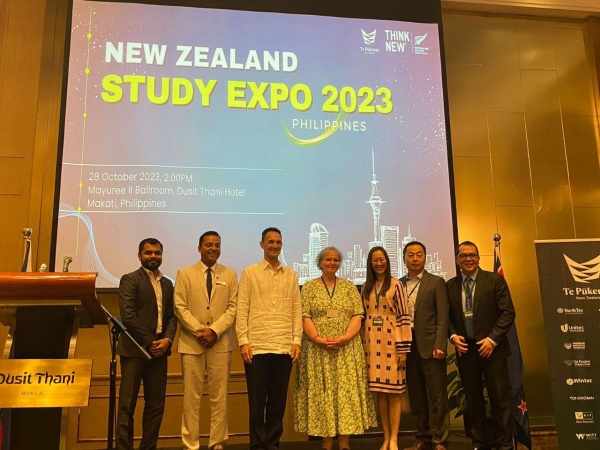
From left to right: Prashanth Nallur Puttaswamy, Bipul Das, His Excellency Peter Kell, New Zealand Ambassador to the Phillippines, Kerry Clarke, Chortip Pramoolpol, Richard Cao and Joel Miranda Angon.
New Zealand Ambassador His Excellency Peter Kell presided the event and shared his remarks, encouraging Filipinos and their families, to choose New Zealand as a destination to continue their education journey.
Ambassador Kell told the audience “This event is more than just a fair; it is a bridge that connects aspirations with opportunities. It is a platform for our Filipino students to explore and embrace new horizons, to acquire skills and knowledge that will empower you to become leaders in your chosen fields.
“New Zealand’s education system is often highly regarded and ranked in the world for preparing students for the future. Our education providers often have strong connections to industry and the business community. This facilitates internships, work placements, and real-world experiences for students, preparing them for the workforce,’ he added.
ENZ Market Manager – Philippines & Thailand, Chortip Pramoolpol, was excited to have had the opportunity to speak face to face with interested students and their families following the pandemic.
“There is certainly a lot to be said for being able to explain in-person to prospective students and their families, why they must consider New Zealand as a destination for future study and we were so pleased to see such genuine interest.
These events generated dozens of leads which has helped drive a significant increase in in visits and enquiries from Filipino students to the Study with New Zealand website,” added Chortip.
If any education providers or agents would like any additional information on marketing to students in the Philippines, please contact Chortip Pramoolpol – chortip.pramoolpol@enz.govt.nz
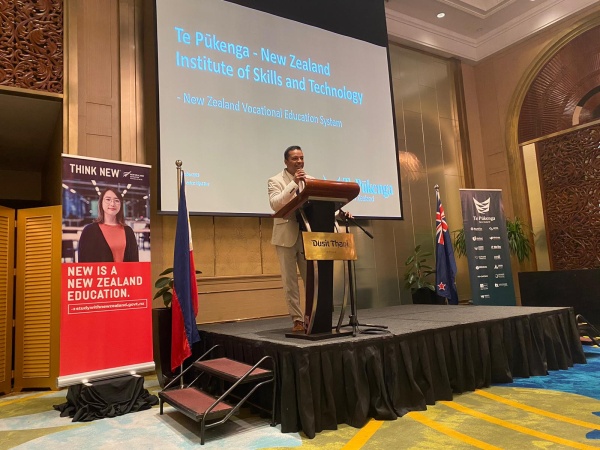
Bipul Das from Te Pukenga International Team presented on their programme offerings.
-
Brazilian students look to New Zealand tertiary studies
Organised by Brazil agent FPP Edu-Media, ENZ attended the high school tour to introduce Brazilian students to the tertiary possibilities in New Zealand, particularly undergraduate qualifications.
The last BELTA SEAL Survey from March 2018 shows that 30% of the Brazilians who studied overseas in 2017 were in the 18 to 21 age group, and that their main motivation for international education is to stand out professionally.
Daniela Ronchetti, Director of Operations at FPP Edu-Media, says while short-term programmes have typically been the most popular overseas study for Brazilian students, there's a growing interest in undertaking full degrees overseas.
“Many of these students, fluent in English and with experience of overseas study via summer courses at a young age, are comfortable enrolling in international universities.
“With interest in the US and UK declining, Brazilian students are looking closer at New Zealand, Australia and Canada when considering a full degree abroad.”
Ana Azevedo, ENZ’s Senior Market Development Manager for Brazil, visited eight international secondary schools, from small boutique schools with 15 students per class to large education groups with thousands of students, which are all investing in pathways to international tertiary education.

ENZ’s Ana Azevedo with Marilda Bardal, International Relations Coordinator at International School Alphaville.
“These schools typically offer bilingual education, IB (International Baccalaureate) or the American diploma and academic counselling, so that by the time students complete high school, they are prepared for an international experience,” said Ana.
Also in attendance were government education organisations and universities from the US, Canada, Australia, France, Germany, the Netherlands and the UK – but Ana said New Zealand had an edge.
“It was a great experience to stand among our competitors at the opening of each event and present New Zealand as the country that best prepares students for the future – not an easy ranking to beat!”
“There is still work to be done on raising awareness of all that New Zealand has to offer to Brazilian students, particularly in tertiary education. It is a significant investment for a family so we need to be clear about the return of this investment.
“Showing students the variety of programmes they can find in New Zealand, the cultural diversity and welcoming environment – very few countries offer this combination. It is a full package!”
-
Students around the globe join New Zealand summit
Kicking off this week with seminars on the space economy and mechanisms for social change, and the human cost of climate change, the online global workshop connects a diverse group of potential international students to help them connect, collaborate and shape their future.
ENZ’s Deanna Anderson, Business Development Manager says the project offers ENZ a great opportunity to learn more about the motivations of learners from new markets while offering the students involved a unique digital engagement with New Zealand.
“It’s a two-way learning experience that explores the futures of our next generation of learners while offering them a window into New Zealand’s unique way of problem solving.
“The aim is to create an inspiring initiative that engages hundreds of students and allows us to use their insights to better understand the future of our next generation of learners.
“Each student has the ability to offer insight that could help shape a more personalised, meaningful, relevant and uniquely New Zealand education experience.”
The summit involves 12 expert speakers who are presenting six online seminars on topics ranging from sustainable design to social entrepreneurship to climate change.
“After the seminar series, the students will be involved in a co-creation weekend where they will work as part of 65 online challenge groups to discuss solutions to some of the planet’s most pressing issues such as energy production, waste as a resource and the future of human survival.”
Deanna says this pilot research project will provide invaluable insights for New Zealand’s international education sector that will inform the direction of future industry innovation.
For more information or to join the webinars, visit https://www.emergingfutures.co.nz/
-
International education drives NZ$4.5 billion economic boost as sector grows with strong public support
New Zealand’s international education sector continues its steady and balanced growth, contributing more than NZ$4.52 billion annually to the economy and enjoying enduring public support for international students.
According to latest Stats NZ data, education-related travel exports climbed to $4.52 billion for the year ended September 2025, up from $3.6 billion in the year ended December 2024. International education now ranks among New Zealand’s top 10 exports and now contributes 13.6% of the country’s total services exports.
From January to August 2025, 83,535 international students enrolled with New Zealand education providers, a 14% increase compared to the same period in 2024, and already surpassing last year’s full-year total.
Education New Zealand Manapou ki te Ao (ENZ) Chief Executive Amanda Malu said the figures confirm New Zealand’s position as a trusted and attractive destination for international learners.
“New Zealand is moving higher up the ladder of top choices of study destinations as students look for quality education in a safe, welcoming and stimulating environment. Our steady growth shows the sector is resilient and competitive as we move at pace to deliver on the International Education Going for Growth Plan,” Malu said.
“We are not chasing numbers at any cost, we are focused on sustainable, balanced growth that benefits our regions, strengthens our economy, and adds value to our communities.”
Quality Tertiary Institutions (QTI) Chair and New Zealand Skills and Education Group Founder, Brijesh Sethi, said he was very pleased to see international student enrolments increase for private training establishments (PTEs) in New Zealand.
“This growth is not only an academic success story but also an economic one.
“International students contribute substantially to local communities and the national economy, reinforcing the international education sector’s role as a cornerstone of New Zealand’s global engagement strategy.
“While there are some concerns regarding the PTE application numbers for 2025, enrolment increases are encouraging,” Sethi said.
Public support remains strong
Alongside growth in international student enrolments, ENZ’s latest 2025 Public Perceptions of International Education Survey shows 77% of New Zealanders want to see the same or more international students in the country up slightly on last year’s 75%.
By comparison, only just over 50% of Australians polled in 2025 support maintaining or increasing international student numbers, and at less than 50% of those in the UK polled in 2023 were in favour of students coming to research or study at UK universities.
Commenting on the survey, Malu said the survey shows international education is a key economic growth driver that also brings diverse perspectives through visiting students.
“It’s absolutely fantastic to see New Zealanders continue to back international students so strongly year after year,” Malu said.
Deputy Vice-Chancellor, University of Waikato, Alister Jones, said they were excited about the increasing number of international students at the university.
“This represents the significant work undertaken by our International and Engagement Office, both onshore and offshore.
“Our international students bring diversity to our Hamilton and Tauranga campuses, as well as having a positive impact on the wider communities and businesses.
“For the students who choose to make New Zealand their home upon completing their studies, it is a really good outcome for New Zealand society as a whole,” Jones said.
Beyond the economic benefits, New Zealanders also continue to appreciate the broad range of cultural and social benefits that international students bring to the country.
81% agree international students contribute to local communities, and 79% say they provide invaluable global connections and research links.
“International education is not just an economic driver, it’s a bridge to the world.
“New Zealanders clearly value the cultural and social benefits international students bring, and that support is vital as we look to the future,” Malu said.
Looking ahead
ENZ’s International Education Going for Growth Plan aims to double the sector’s export value to NZ$7.2 billion by 2034, while maintaining public support for international education.
“International education is a key contributor to the Government’s Going for Growth Plan to grow the New Zealand economy. This growth reflects the sector’s resilience and its critical role in our economic future.”
“Our focus is on sustainable, balanced growth, diversifying markets, strengthening vocational pathways, and ensuring students have a positive experience.
“We want New Zealand to remain among the top choices globally, not just for education quality but for the values we stand for,” Malu said.
Read more:
International student enrolments 2013-2025
2025 New Zealanders’ Perceptions of International Education Survey | ENZ IntelliLab
For further information:
Sai Raje | Senior Communications Advisor, Education New Zealand Manapou ki te Ao
sai.raje@enz.govt.nz | +64 21 479 649
About Education New Zealand Manapou ki te AoEducation New Zealand Manapou ki te Ao (ENZ) is the government agency dedicated to helping New Zealand realise the social, cultural, and economic benefits of international education. Our role is to promote New Zealand as a high-quality education destination offering excellent education and student experiences.
With approximately 85 staff in 13 locations around the world, ENZ works closely with New Zealand’s diverse education sector which includes schools, English language providers, Private Training Establishments, Institutes of Technology and Polytechnics (New Zealand Institute of Skills and Technology Te Pūkenga), and universities.
Internationally, we work with a range of education stakeholders, including government agencies and education providers to identify and encourage sustainable growth opportunities for New Zealand’s education sector.
-
Around the world in five
THAILAND
Reassessing the Thai education system
Thailand’s PISA scores have plunged. Among the challenges are the many celebrations and holidays that take children out of the classroom and the huge quantity of paperwork that reduces teachers’ ability to focus on students’ learning.
INDIA
IT superpower India has the world’s least tech-savvy classrooms
India’s classrooms are by and large outdated. Most Indian classrooms lag in incorporating smartphones, tablets, or even the simple whiteboard – over two-thirds of Indian classrooms surveyed use blackboards and chalk.
CHINA, UK
Over 500 teachers from China, UK exchange math teaching methods
Over the past four years, more than 500 teachers from China and the United Kingdom have participated in an exchange program enabling both sides to learn from each other's math teaching methods.
AUSTRALIA
Rainbow Hub launches LGBTQI video campaign
Brisbane’s Rainbow Hub initiative has launched a new video campaign to promote the city as a welcoming destination for LGBTQI+ international students and promote their services.
GREECE
Significant increase in U.S. students studying in Greece
There has been a significant increase in the number of American university students visiting Greece for study abroad programs in the 2016/17 academic year – a 21.1 percent increase from the previous academic year.
-
PTE English for Speakers of Other Language (ESOL) Provision Fund
The $1.5 million fund is designed to help English language schools impacted by the border closure to international students.
The funding was announced in July by Minister of Education Chris Hipkins as part of the Government’s $51.6 million Recovery Plan for International Education.
The PTE ESOL Fund is part of the first workstream, which seeks to stabilise the sector while borders remain closed. Read more about the Recovery Plan.
The funding aims to help increase demand for English language training, to be met by English Language Schools. It will also help with upskilling and improving the employability of New Zealanders with English language needs, including migrant partners and dependents of New Zealanders.
The fund is being implemented by the Tertiary Education Commission (TEC).
Eligibility
To be eligible for the PTE ESOL Provision Fund, your organisation must hold a Category 1 External Evaluation and Review (EER) rating from NZQA as at 1 July 2020.
Teaching enabled by this fund may only be provided to Category A and B learners. All learners must be in New Zealand.
Read more details on eligbility
How to apply
Applications for the PTE ESOL Provision Fund are open now and will close at 5pm on Friday, 28 August.
To apply, you need to complete the form on the TEC website and send it through to the TEC Customer Group via email: customerservice@tec.govt.nz
Other considerations
For the full list of terms and conditions, including successful applicants’ reporting and monitoring requirements, refer to the TEC website.
-
Record audience for ECE symposium streamed live from China
Thousands watched the third annual New Zealand – China Early Childhood Education Symposium, as it was livestreamed from Guilin in southern China on 23 September 2022. A further 200 attendees were present at the event in Guilin, and New Zealand presenters and attendees joined via webinar.
Sponsored by Education New Zealand Manapou ki te Ao (ENZ), the New Zealand Embassy in China, and the China Centre for International People to People Exchange, and co-organised by Guangxi Normal University, the 2022 Symposium’s theme was: Together for a Shared Future: Sustainable Development in Early Childhood Education and Care.
Thought-provoking and inspirational presentations covered a wide range of topics, including education systems, language development and practical examples of play-based learning. You can view the 2022 ECE Symposium programme, including details of the presenters, here.
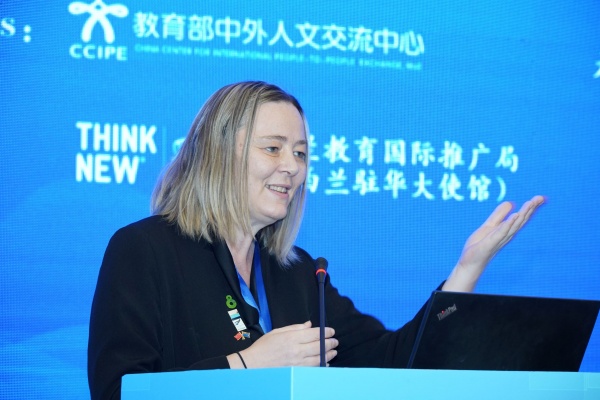
Miranda Herbert at a media engagement with Chinese news channels
Miranda Herbert, ENZ’s Regional Director for Greater China was invited to an interview with Guilin TV to explain our collaboration with China’s Ministry of Education, to support dialogue around best practice in the early childhood education field. The event was also covered by other key news outlets in China, including Guangming Daily, a national Chinese-language daily newspaper published in the People's Republic of China.
“New Zealand is recognised as one of the first partners with China for early childhood education, as a result of the symposium,” Ms Herbert said.
“Now in its third year, the symposium has grown from strength to strength each year, and is highly valued by the Ministry of Education in China.”
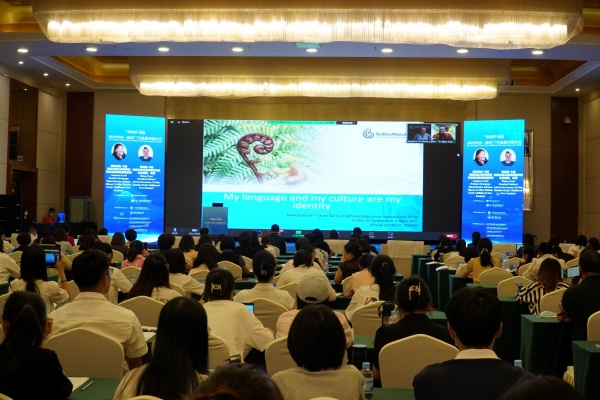
Representatives from Te Rito Maioha presented a talk on the theme 'My language and my culture are my identity'.
Arapera Card, Senior Advisor Māori at Te Rito Maioha, said meeting the organisers both from Beijing and Aotearoa set a sense of whanaungatanga and manaakitanga ahead of the symposium.
“As an organisation Te Rito Maioha found this experience to be overall well executed and amazed at the number of participants across China. That was lovely to see, and should the opportunity come around again, we will be sure to increase the numbers of participants attending from Aotearoa. The line-up of presenters from both countries absolutely showed that the early childhood sector is in good hands,” Ms Card said.
New Zealand and China have been collaborating on early childhood education since 2020 and this is now an item under the mechanism of the Joint Working Group on Education and Training, last held in February 2021.
Want to know more about ENZ initiatives in China? Contact China@enz.govt.nz
-
From the CE: The outlook for the future
Many of you are wondering – and fielding a lot of questions – about the outlook for the future as COVID-19 continues to disrupt the world.
It’s very important to acknowledge that COVID-19 is an unprecedented event in our lifetime. While there have been crises, disasters, wars and terrorist attacks, none have had the scale, impact or complexity of this global pandemic. There is little certainty as the world navigates its way through this and looks to the development of effective vaccines to counter its impact.
As New Zealand’s Director-General of Health advises, COVID-19 is a very tricky virus and we have to be very vigilant. The Government is continuing to take a balanced approach to ensure the health, safety and wellbeing of everyone in New Zealand and to carefully manage demand on the country’s quarantine facilities. We aren’t out of the woods yet and can’t be complacent.
Like many other countries, New Zealand’s border restrictions remain in place. The Government is granting entry to small, targeted cohorts by exception only, and only these visas are being processed. Students are not able to apply for a student visa from outside New Zealand, unless a border exception applies. This decision will be reviewed in February 2021.
Last month we saw the Government recognise the vital role international education will play in the recovery and rebuild of New Zealand and the need to continue the fight against the pandemic. The Minister of Education announced that the Government would allow a small cohort of up to 250 postgraduate (mostly PhD) students into New Zealand. These are students whose study has been interrupted by COVID-19 and who have a practical research component to their study that requires them to be here. Providers are currently selecting these students and they are expected to enter New Zealand earlier next year.
We acknowledge that this exception applies to a fraction of the number of students we normally welcome to the country. Some students and providers may be disappointed not to have been a part of this first border exception group.
The Government says it will review further possible border exceptions to enable more cohorts to enter the country, as and when the time is right, and to then build up numbers when it’s safe for all to do so. But no further decisions around cohorts have been made at this stage.
So, given this information, we won’t see normal numbers of students entering the country in time for term one or semester one next year. I suggest that tertiary students consider starting or continuing their New Zealand study online, until there is more certainty on border exceptions. Students and their families are advised to keep in close contact with their agent or study provider.
But throughout this uncertainty, I can assure you that New Zealand highly values international students and looks forward to their return. Until then, the team at Education New Zealand will continue to tell you as much as we can about the situation here, as soon as we can.
Ehara taku toa I te toa takitahi, engari he toa takitini.
My strength is not that of a single warrior but that of many.
Ngā mihi,
Grant McPherson