Search
Showing 10 of 2262 results for read 2024 FRM Exam Part I - Quantitative Analysis online free
-
From the CE: International education in the spotlight
Kia ora koutou,
I’ve recently returned to New Zealand following a productive visit to Viet Nam with the Prime Minister’s Trade Mission. It was highly encouraging to see international education front and centre of so many conversations. Beyond attracting Vietnamese students to New Zealand, the education relationship between our countries is evolving into deeper collaborations involving education institutions, businesses, and governments.
The visit also showcased outstanding examples of educational partnerships across the spectrum of New Zealand’s international education sector, from universities and private training establishments to EdTech companies, highlighting the breadth of collaboration opportunities.
Overall, the Mission was a valuable opportunity to raise awareness of New Zealand as a top-tier education destination offering a safe and welcoming environment.
International education was also a component of Deputy Prime Minister and Minister of Foreign Affairs, Rt Hon Winston Peters’ official visit to China. As part of his programme, the Minister had a warm meeting with Chinese alumni of New Zealand universities. From the report back, it was clear that the New Zealand study experience had left the alumni with a lasting, positive impression.
Coming up in May, ENZ will be going into the field for the 2025 International Student Experience Survey. This survey covers a range of topics relevant to the sector, including student decision-making, arrival and orientation, the education experience, living experience, people and connections, and perceptions of value for money.
Last year’s survey had 86 percent of international students reporting a positive overall experience of their time in New Zealand, and 41 percent of students giving an ‘excellent’ rating, the highest percentage yet! In case you missed deep diving into specific aspects of the student experience, you can browse through them here.
I’ve started packing my bags again, as this weekend I will be joining the Prime Minister’s Trade Mission to India. I’ll be staying on for a further week in Delhi for APAIE 2025. I look forward to updating you in my next column.
Ngā mihi nui,
Amanda Malu
Chief Executive
Education New Zealand Manapou ki te Ao
-
From the CE: Boosting global connections in education
Kia ora koutou,
In March, I spent an incredible couple of weeks in New Delhi and Mumbai as part of the Prime Minister’s Trade Mission to India, and for the 2025 Asia-Pacific Association for International Education (APAIE) conference.
During the trade mission, I was pleased to witness, together with Prime Ministers Christopher Luxon and Narendra Modi, the signing of a refreshed bilateral Education Cooperation Arrangement (ECA) between New Zealand and India. Education is a key feature in the New Zealand-India bilateral relationship, with India the second largest source market of international students for New Zealand.
The trade mission also served as a valuable opportunity to grow our connections with the Indian Institute of Technology New Delhi (IIT Delhi) through the New Zealand Centre, which is at the heart of our education partnerships in India.
IIT Delhi is backed by all eight New Zealand universities and is a hub for joint research and advancing India’s Digital India vision in AI, data science and advanced engineering. Prime Minister Luxon spoke at the education event which saw the announcement of several education initiatives, including a scholarship package and virtual internship programme, aimed at deepening bilateral collaboration.
There is no doubt that New Zealand has made a splash in India, and we look forward to continuing the momentum.
Last week, the Government announced its Quarter 2 Action Plan for New Zealand with 38 actions focused on economic growth. Boosting international education and export education earnings is a key action under the plan. ENZ is currently leading cross-agency work to develop an International Education Growth Plan for the Prime Minister and Ministers, and will be undertaking a series of sector engagements in the coming weeks.
It is an exciting time, and I look forward to sharing more about this work in my next column.
Ngā mihi nui,
Amanda Malu
Chief Executive
-
Immigration New Zealand update
India delegation
Alison McDonald, Head of Immigration, joined ENZ Chief Executive Amanda Malu as part of the Prime Minister’s official delegation to India. Celia Coombes, Director Visa at Immigration New Zealand, responsible for the student visa product, joined Amanda and Ben Burrowes in India afterwards where they supported the New Zealand delegation at the Asia Pacific Association for International Education (APAIE) and met with the New Zealand Education Representatives in India (NZERI), a group of Indian education agents.
“Immigration New Zealand found the trip very valuable and insightful,” says Celia.
“Now we are working on how we can continue to support the growth of the education sector, particularly in India which is such an important market for New Zealand, and what needs to be done to support more applications being approved.”
New local points of contact in India and China
Immigration New Zealand has new Engagement Advisors appointed in New Delhi and Beijing. They will be a local point of contact and working to improve communication within both the education and tourism industry.
Visa processing
INZ is in a strong position for processing student visas, following initiatives put in place to make our processing more efficient. At the end of March 2025, international student visas were being decided in 10 days (two weeks) on average.
On average Te Pūkenga (New Zealand Institute of Skills and Technology) applications are being processed within 2.5 weeks, 2 weeks for University applications, 3 weeks for Private Training Establishment applications and 1.5 weeks for school applications.
INZ have already decided more than 20,500 student visa applications so far this year, and approved around 18,000 student visa applications (from 1 Jan – 31 March 2025).
To help with faster visa processing, it is key that all the information and documents needed to decide the application is provided. All the details can be found on our information sheet for students on the INZ website: Student visa information | Immigration New Zealand.
-
New Zealand tertiary institutions make strong connections in Indonesia
A series of education promotion engagements in Indonesia kicked off with a co-funded activity alongside local education agency ICAN Education that ran from 13 to 18 February.
The schedule was packed with student outreach, school visits and a New Zealand Application Day in both Jakarta and Surabaya.
All eight New Zealand universities, the Southern Institute of Technology, UC International College, Waikato College, UP Education and Le Cordon Bleu were involved in the roadshow.
Jakarta
The team began with visits to two international schools in the Greater Jakarta Area — BINUS School Serpong and Gandhi Memorial Intercontinental School. These sessions gave students a chance to learn about New Zealand’s tertiary education system.
On 15 February, the New Zealand Application Day in Jakarta drew a crowd of around 435 students and parents. The event created a space for prospective students to speak with universities about undergraduate study options, application processes and life in New Zealand.
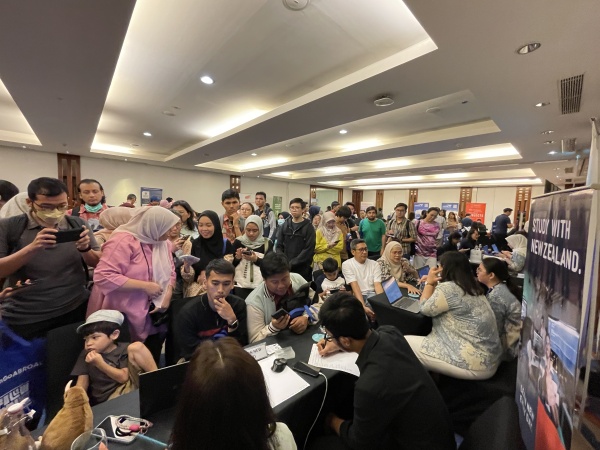
Crowds gathered around university booths, eager to learn more and take their first steps towards studying abroad.
Surabaya
In Surabaya, the New Zealand Application Day took place on 16 February, the event attracted 183 attendees.
The next day, institutions visited students at Cita Hati West and Cita Hati East schools. Engagement focused on introducing year 10 to 12 students to the New Zealand education system, helping them visualise study pathways and what student life in New Zealand looks like.
Connecting with education agents across Indonesia
Alongside student-focused activities, ENZ organised a series of agent networking events across Jakarta, Yogyakarta and Denpasar. These sessions formed part of the Study with New Zealand roadshow, which ran from 21 to 28 February and created space for deeper engagement between New Zealand providers and Indonesian education agents.
Each event aimed to strengthen relationships, share updates, highlight New Zealand’s unique offerings, and help raise visibility for New Zealand education among prospective students.
A range of education providers participated in the networking event, including University of Auckland, Auckland University of Technology, Lincoln University, Massey University, University of Otago, University of Waikato, Victoria University of Wellington, and UP Education.
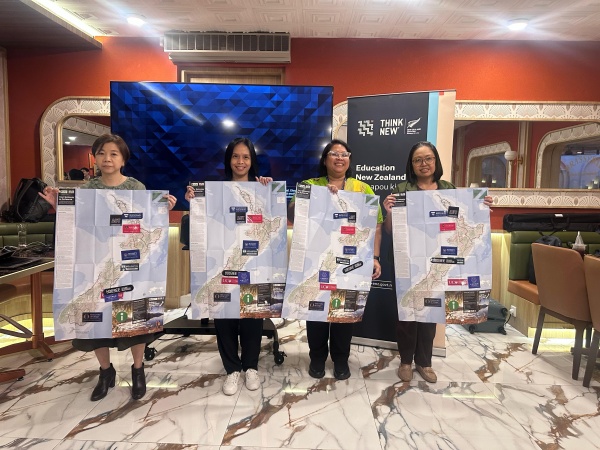
Education agents play a matching game with New Zealand tertiary providers and the regions where they are based at a networking dinner in Jakarta.
ENZ Market Manager for Indonesia, Naluri Bella, presented the latest market promotional resources available to agents, followed by interactive quiz games hosted by New Zealand providers. These sessions were attended by around 30 agencies and gave agents the tools and confidence to market New Zealand as a study destination.
Naluri said that there is an appetite in the region for high-quality international education experiences.
“New Zealand is increasingly seen as a destination that offers both academic excellence and a welcoming, supportive environment,” she said.
“Our institutions were able to showcase not only their study options, but the unique values and lifestyle that set New Zealand apart,” Naluri added.
-
Positive outcomes for education from PM’s trade mission to India
Prime Minister Rt Hon Christopher Luxon led a high-level visit to India from 16–20 March, accompanied by one of the largest New Zealand delegations to date. The delegation included representatives from the business, community, media, and government sectors, along with a cultural delegation, Te Kapa Haka o Te Whānau-a-Apanui.
Education New Zealand Manapou ki te Ao (ENZ) Chief Executive Amanda Malu joined the trade mission as part of the education component of the delegation – alongside University of Auckland Vice Chancellor, Dawn Freshwater; Vice Chancellor, University of Waikato, Neil Quigley; Te Pūkenga/NZIST Chief Executive, Gus Gilmore and Whitecliffe College Executive Chairman, Feroz Ali.
The mission saw a number of key education initiatives announced that aim to strengthen New Zealand’s education ties with India, including the signing of the refreshed bilateral Education Cooperation Arrangement (ECA).
These initiatives mark a significant step forward in deepening New Zealand’s collaboration with India around joint research, student exchanges, academic innovation and fostering long-term institutional partnerships.
The original ECA was signed in 2010 with the objective of strengthening bilateral cooperation between New Zealand and India and fostering collaboration and the exchange of information on individual education systems.
The ECA refresh builds on this foundation and aims to foster further cooperation in education specifically through information exchange, collaboration between institutions, and sharing best practices in curriculum development, digital transformation, and sustainability.
A key education engagement during the mission was the ‘Shared Visions and Connected Futures’ event on 18 March, co-hosted by ENZ and New Zealand Centre partner IIT Delhi. Key education and government stakeholders were brought together to celebrate education, innovation, and the strong ties between New Zealand and India.
Six new memoranda of understanding (MOU) were signed on the day, with an additional four signed across other events and cities. The New Zealand Excellence Awards (NZEA) scholarships were officially launched by Prime Minister Luxon and ENZ Chief Executive Amanda Malu - this is a joint initiative between ENZ and all eight New Zealand universities offering a total of 29 scholarships valued at NZ $260,000.
An exclusive virtual internship programme was also launched – this initiative will provide opportunities for 30 IITD students to intern virtually with New Zealand organisations. The event also witnessed the announcement of the inaugural New Zealand Centre Innovation Fellowship which aims to enhance collaboration between New Zealand and India in innovation and entrepreneurship by providing a two-week immersive experience in India's innovation ecosystem.
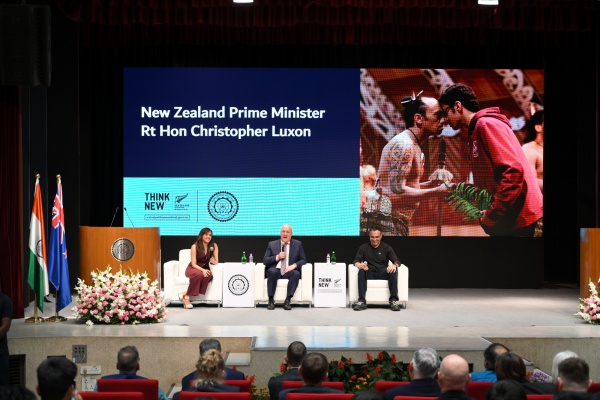
The Prime Minister in a Fireside Chat with New Zealand alumni, Shirley Setia, University of Auckland alumni and Ashwani Batla, University of Waikato alumni.
To round off a packed programme, the Prime Minister hosted a "Fireside Chat” with celebrity alumni from University of Auckland and the University of Waikato, where they showcased their experiences studying and living in New Zealand.
ENZ Chief Executive Amanda Malu said the event was a testament to the strength of New Zealand’s educational relationship with India.
“India and New Zealand share a longstanding education relationship. Our collaborations bring enduring benefits to both nations. We look forward to continuing to work together to innovate, grow our skills and co-create education solutions for our future,” she said.
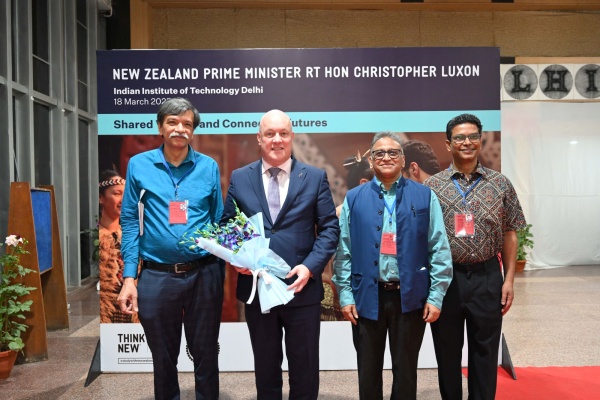
From L to R: Director of IIT Delhi, Professor Rangan Banerjee; the Prime Minister; Dean of Research and Development, Professor Naresh Bhatnagar; and Dean of International Programmes Professor James Gomes.
-
Announcing the recipients of the Welcome to New Zealand Scholarships
The initiative was warmly received across Germany, Italy, and France, where it was promoted with the goal of encouraging students to experience the world-class education and unforgettable lifestyle that New Zealand has to offer.
As part of the campaign, we offered four scholarships, each valued at 5,000 EUR to go toward tuition fees at New Zealand secondary schools or tertiary institutions. These scholarships were designed to support talented and passionate students on their journey to study abroad.
A key highlight of the campaign was our collaboration with Air New Zealand, who will generously sponsor return flights for the scholarship recipients. Their support played a pivotal role in making the dream of studying in New Zealand even more accessible for the winners.
The scholarship attracted over 200 applications – with a majority coming from Germany, followed by Italy and France.
During the campaign period, there were 19,965 total views on the Welcome to New Zealand Scholarship page on the Study with New Zealand website.
The campaign generated 172 lead enquiries to New Zealand providers (118 enquiries from Germany, 47 enquiries from France and 7 from Italy). These enquiries are sent straight on to the education providers so they can directly engage with the prospective student on their study interests.
Meet the recipients

Germany
The scholarship winner from Germany is 16-year-old Manuel Fink, from Unterhaching (near Munich).
Manuel will be heading to Te Puke High School, where he’ll immerse himself in both the academic and cultural experience of studying in New Zealand.
A passionate advocate for New Zealand and its education system already, Manuel has his sights set on becoming a pilot — ideally flying for Air New Zealand one day!
Our tertiary scholarship recipient from Germany is currently finalising their enrolment, and we look forward to announcing their name once the process is complete.

Italy
Our Italian scholarship recipient is 16-year-old Lea Sagliaschi from Milan. Lea will be attending Selwyn College and is full of excitement for what she describes as a “once-in-a-lifetime adventure” in Aotearoa New Zealand.
Unfortunately, no recipient could be selected from France this year due to a lack of eligible applications — however, the ENZ Europe team remains committed to engaging with prospective students in the French market and looks forward to stronger participation in future campaigns.
ENZ Associate Director of Engagement Europe, Olga Elli, said the campaign raised great awareness of New Zealand’s education system in European priority markets and opened the door to new experiences and opportunities for winners.
“We look forward to building on this momentum and continuing to share the unique value of a New Zealand education with European students and partners,” she said.
-
Employers embrace influence of international students
These employers know that, along with their skills, the international graduates bring rich cultural context, a fresh perspective, an innovative mindset, and a solid work ethic to the office each day.
Assurity Consulting, a New Zealand-owned digital delivery services consultancy, has been hiring international students for their graduate programme almost since the company’s inception 17 years ago. Last year it won the International Student Workplace category at the Wellington International Student Excellence Awards.
“From very early on we took an approach of inclusive selection,” says Aron Chantelau, General Manager, People and Capability. “We wanted to find people whose values aligned with ours instead of simply trying to select based on people’s background and whether or not they went to Uni.”
Assurity has also partnered with Wellington NZ’s Employer Connect programme, established to provide insights into the business environment and networking opportunities for graduating international students; and the Work Ready programme, offering support on CV writing, cover letters, and what to expect from the hiring process.
“For the students, it is an opportunity to build their own network in a place where that might not otherwise be easy. For our staff, they get to connect with new people outside the industry and learn about the challenges the international students face, which gives them greater perspective.”
Aron says the students who attend both programmes are engaged, good at taking feedback, and highly motivated to start their careers.
Learning from each other
For Assurity, employing international graduates is about much more than filling jobs in the tech sector. “Our international graduates bring diversity of thought to our teams, which benefits our clients,” Aron says. “They also bring innovation, introducing new ideas and fresh perspectives which has led us over the years to try new things. And, culturally, it makes for an enjoyable workplace because there’s lots to learn from each other.”
He acknowledges there can be challenges, especially for students with English as a second or third language but says it’s all about providing the right structure and level of support. “We have a People Lead in all our teams. That role can be about supporting career progression, but it can also involve pastoral care - understanding what challenges that person is facing and helping to mitigate them.”
In Southland, Blue River Dairy is another company which recognises the value which international student graduates bring to their business. Since 2018, Blue River has hired more than 30 international students from the Southland Institute of Technology (SIT) and other institutions.
“The culture within an organisation is so important. Hiring only for skills is short-sighted,” says People and Capability Manager Abbigail Surridge. “With many of the international students that we have hired, we’ve been able to harness their life experience, dynamic exposure, and untapped potential as they have grown in their roles.”
“Diversity adds value to our organisation, by introducing different ways of thinking and problem-solving. When we collaborate, those differences help to create success.”

Jacky Shen arrived at SIT from Beijing in 2017 to study for his graduate diploma in Information Technology (IT). He already had a Master’s degree in Communication and Information Systems but wanted to better understand the New Zealand tech environment. He is now a software engineer at Blue River, leading a team of three.
Not only does the company benefit from Jacky’s technical skills, but also his language skills. “We have a number of Chinese suppliers, so I can speak to them easily and provide quick solutions for them,” he says. “Many companies want applicants to have local experience, but Blue Dairy allowed me to gain that experience on the job. It’s been a great opportunity.”
Economic and cultural influence
He believes that international students bring real value to the workplace. “We come with good technical skills, but we also contribute to the economy and to the cultural diversity of the country. It’s a win-win.”
Aron Chantelau says the international students who work in New Zealand have a bright future, whether here or overseas.
“They make a huge difference to our economy, both in terms of digital outcomes for New Zealand but also improving the quality of life here through the work they do,” he says. “Some of them will move overseas but if they’ve had a good experience here, they will become ambassadors for New Zealand.
“It’s great to be part of their journeys.”
-
Graduate’s Kiwi know-how helps reduce water use in UAE desert
Rather than travelling to New Zealand and undertaking theoretical research with limited relevance back home, Wafa was able to carry out hands-on work addressing critical water management issues in her arid home country, while being supervised by New Zealand-based experts.
It was a personalised and practical kind of international education experience which Wafa is grateful for. “It allowed me to continue working, while at the same time learning and finding solutions to the water management issues facing the UAE.”
The education partnership grew out of a New Zealand G2G (Government to Government) relationship with the UAE which dates back to 2014. “The aim is to build the capacity of local people and find solutions to real problems through scholarships for study,” she says.
Already qualified with a Bachelor’s degree in ecology and environmental science and Master’s degree in water and environmental engineering, Wafa was working as an environmental scientist for Environment Agency - Abu Dhabi (EAD) when asked to be involved in the programme.
The region needs to find ways to manage the growing demand for groundwater in a hyper-arid, saline environment. Abu Dhabi, the capital of the UAE, has about 19 million planted trees in desert “forests”, a precious legacy of founding father Sheikh Zayed Al Nayhan. They provide a range of ecological benefits but are heavily dependent on groundwater irrigation.
With EAD given a government mandate in 2016 to protect groundwater reserves, water meters were introduced and areas of wastage identified. Wafa’s research was required to determine the exact water needs of the plants through the implementation of New Zealand technology, and experimentation with the use of treated sewage effluent, or “grey water”.
Distance learning partnership with Massey University
She worked with a team at New Zealand’s Plant & Food Research and her project was supervised by Principal Scientist Brent Clothier. The programme was managed by Lesley Kennedy of Wellington-based consultancy firm OnlyFromNZ.
“I travelled to New Zealand once or twice a year to meet Massey University requirements such as attending exams, presentations, or conferences. Likewise, Brent would come to the UAE with his team and help oversee the research.”
“It’s fit-for-purpose academic knowledge with real practical utility,” Dr Clothier says.
Wafa used Plant & Food Research’s heat pulse technology, which has been employed successfully in New Zealand and other parts of the world, but never in a region where temperatures can reach close to 50degC in summer. Once up and running, the technology provided readings every 30 minutes which allowed Wafa to calculate precisely the amount of water being absorbed by the plant.
“The data provided new and exciting information for us. We found that many of the trees had already adapted to the summer heat and did not take up as much water as we were providing through irrigation,” she says.
“By the end of the study we determined that we could save 35 - 70 percent of the water we have been supplying through irrigation.”
The technology was extended to other crops, and farmers are now provided with crop calculator software which provides guidance on the specific water needs of a tree, according to the month of the year, location, and soil type. “It’s a very important tool for growers in the UAE.”
“It’s good for countries to work together and find solutions to our challenges.”
Enduring relationship with New Zealand
Wafa is proud of the fact that her research is helping to solve a critical environmental issue in her country and knows that the collaboration with Massey through the NZ G2G partnership has been an integral part of her success. It has also paved the way for two other Emirati students to follow in her footsteps.
“I met other international students from the Middle East while at Massey and they were envious of me. They said I was very lucky because I was doing something for my country.”
She believes international education plays a key role in the exchange of information with other countries. “It’s good for countries to work together and find solutions to our challenges. If we are talking about the environment, we are all living in one world so it’s important that we work together to solve issues.”
But this academic partnership has not just produced practical results. It’s also seen a special bond develop between the New Zealand scientists and their Emirati students.
“I have built a long-lasting relationship with New Zealand,” Wafa says. “I know that I can always call my contacts in New Zealand to discuss an issue and they will be there for me.
“The relationship is much bigger than the life of the project and this is very important for me as a scientist and a researcher.”

-
Prime Minister unveils 2025 Tripartite Fund recipients at Fudan University
During his remarks at Fudan University, Prime Minister Christopher Luxon announced the 2025 New Zealand–China Tripartite Partnership Fund recipients, as well as plans for a second high-level Education Forum to be held during China Annual Conference and Expo for International Education (CACIE) 2025.
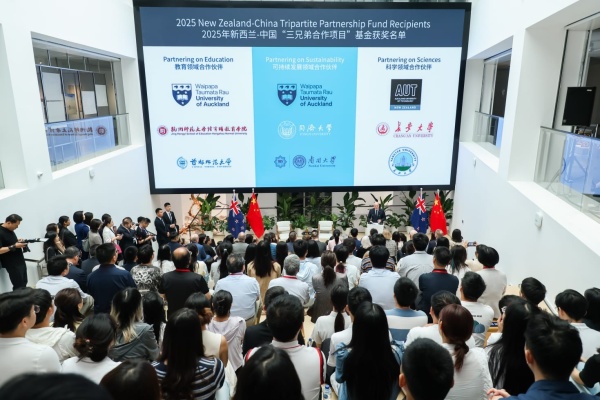
2025 marks 20 years of the New Zealand – China Tripartite Partnership Programme. Photo credit: New Zealand Trade & Enterprise.
ENZ congratulates the following researchers whose projects exemplify the high-quality research collaboration between our two countries:
-
Dr Fiona Ell (University of Auckland): Working with Hangzhou Normal University and Capital Normal University to enhance mathematics and science teacher education through comparative studies and exchanges.
-
Dr Sihong Wu (University of Auckland): Partnering with Tongji and Nankai Universities on sustainable production and carbon neutrality in manufacturing joint ventures.
-
Dr Yiming Ma (Auckland University of Technology): Collaborating with Chang’an and Yangtze Universities to explore mechanisms behind silent earthquakes.
Dr Fiona Ell said she is looking forward to working with her Chinese research partners to enhance mathematics and science teacher preparation, an important focus for education systems in both New Zealand and China.
“Our study brings together teacher educators from two Chinese universities, and teacher educators at the University of Auckland to exchange ideas and techniques for mathematics and science teacher preparation. The Tripartite grant allows us to visit each other, see teacher education practices in each country and compare policy directions in teacher education,” she said.
This will enhance the understanding and skills of all participants and help us find ways to improve mathematics and science teacher education in both countries,” Dr Ell added.
The Tripartite Fund, managed by ENZ in collaboration with several government agencies, supports strategic research partnerships between one New Zealand and two Chinese universities. The programme celebrates its 20th anniversary in 2025.
Learn more about the Tripartite Partnership Fund here.

Professor Nic Smith, Vice-Chancellor Te Herenga Waka – Victoria University of Wellington exchanges a Memorandum of Understanding with Fudan University President, Li JIN. Photo credit: New Zealand Trade & Enterprise.
Another key part of the event was Victoria University of Wellington renewed an agreement with Fudan University to revitalise the relationship, achieve resumption of student flows, and pursue research cooperation in the areas of public health, bio-tech and climate science.
-
-
Driving student interest in Indonesia through strategic co-funded initiatives
ENZ and SUN Education delivered a jam-packed programme of student recruitment events in Surabaya and Jakarta in late May to drive student interest and connect New Zealand providers with potential partners for academic collaboration.
Surabaya
The activity began with an introductory meeting between Universitas Airlangga’s International Office and visiting New Zealand providers to explore opportunities for academic collaboration between our two countries.
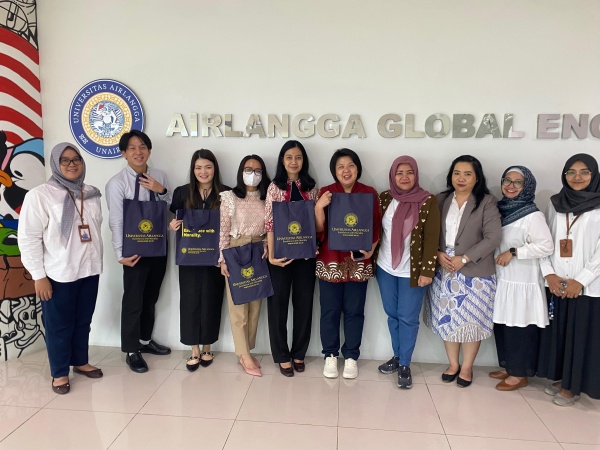
The meeting was attended by representatives from the University of Auckland, Auckland University of Technology, the New Zealand Honorary Consulate in Surabaya and SUN Education.
Discussions centred on potential areas of partnership, including articulation pathways, staff exchanges, guest lectures, and joint research initiatives.
The following day, providers met with prospective students at the Study in New Zealand Exhibition in Surabaya.
The exhibition featured the University of Auckland, Auckland University of Technology, University of Waikato, UP Education, University of Otago, Le Cordon Bleu, the Southern Institute of Technology and Lincoln University.
The event attracted around 200 students and their parents.
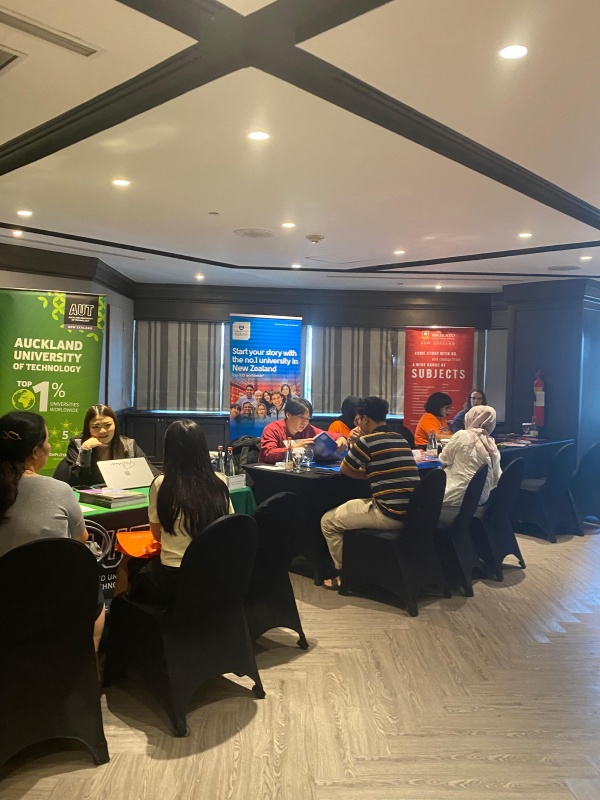
Study in New Zealand exhibition attendees learning about tertiary education options in New Zealand.
Jakarta
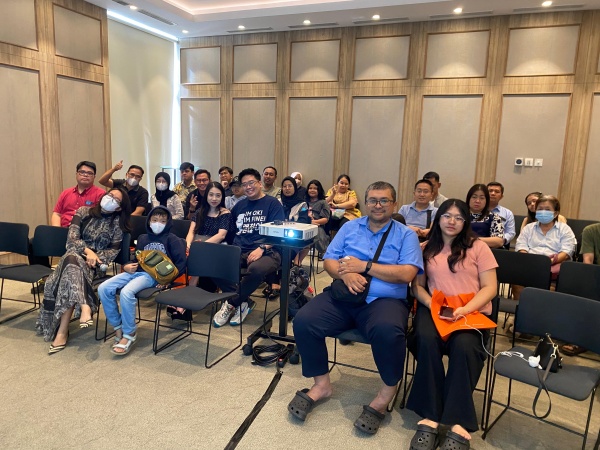
Over to Jakarta, ENZ organised an exhibition featuring a strong line-up of New Zealand institutions, comprised of all eight of New Zealand’s universities alongside the Southern Institute of Technology, Le Cordon Bleu, University of Canterbury International College and UP Education.
The fair attracted approximately 250 students and parents, all eager to explore the diverse study options and world-class education opportunities that New Zealand has to offer.
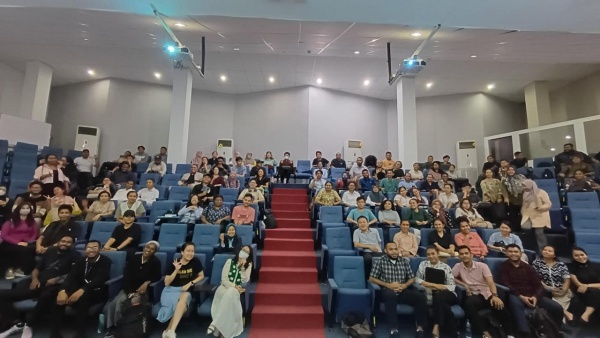
To close off a busy student recruitment period, a mini exhibition was hosted at Universitas Indonesia, the top-ranked university in Indonesia.
The exhibition was specifically for LPDP Affirmative Scholars and students interested in postgraduate-level study.
As part of the event, ENZ Market Manager, Naluri Bella, delivered a ‘Study in New Zealand’ session, which attracted around 100 enthusiastic attendees.
The session provided insights into New Zealand’s high-quality education system and scholarship opportunities, helping to raise awareness and inspire future postgraduate study pathways.
ENZ’s Regional Director (Asia) Ben Burrowes said the activities were designed enhance agents’ and students' awareness of New Zealand’s world-class education offering.
“These collaborations help position New Zealand as a competitive and credible choice for Indonesian students,” he added.