Search
Showing 10 of 2262 results for read 2024 FRM Exam Part I - Quantitative Analysis online free
-
Student visa processing update
INZ’s Head of Operations in Mumbai, Marcelle Foley said it is typical at this time of year for INZ to receive a high volume of applications, especially offshore. Marcelle says that applications that are submitted online, with all the required documentation will be prioritised.
“To ensure ample time for processing, students should apply at least eight weeks prior to the date of their intended travel to New Zealand. This allows INZ to appropriately assess the student’s application and to make any necessary verification steps to finalise the visa in time for the date of travel to New Zealand,” says Marcelle.
To enable the smooth processing of their application, students are encouraged to:
- Apply using the Immigration ONLINE submission platform. This is INZ’s preferred submission channel and the most efficient.
- Provide all the required documentation when submitting an application. Often, delays in processing occur when Immigration Officers do not have enough information at hand to make a decision on an application.
- Contact INZ only when required. There is no need to check in with INZ on the processing of an application unless the situation is urgent. As soon as an application is finalised or INZ needs further information, they will make contact with you.
If you have any questions regarding the visa process or wish to apply online please visit www.immigration.govt.nz
-
Update from Immigration New Zealand
Student Visa Update: Apply early with our new online forms
Planning to study in New Zealand in 2026?
Immigration New Zealand’s peak visa processing period runs from October to March, so it’s important to apply early to avoid delays - ideally at least three months before you travel.
On 18 August, applications for the following student visa types transitioned to Immigration New Zealand’s enhanced Immigration Online system:
- English Language
- Exchange Student
- Fee Paying Student
- Pathway Student
- NZ Government Scholarship Student
- Foreign Government Supported Student
Applications submitted on the old form on or before 17 August will still be processed. Applicants can continue to upload documents and respond to requests until a decision is made. Draft applications on the old system must be submitted on or before 17 September, after that all applications must be submitted through enhanced Immigration Online. Paper applications will no longer be accepted from 18 September.
We’ve redesigned the application process to make applying faster, easier, and more transparent. Applicants will get real-time updates, email notifications, and clearer guidance throughout the process. The form itself is dynamic, only showing sections and asking questions relevant to their situation. It also includes guidance and prompts to support you through the process.
For help with the online form, visit our Applying Online help page, or contact Immigration New Zealand.
-
New Zealand Passenger Arrival Cards to be phased out
Customs New Zealand | Te Mana Ārai o Aotearoa has announced that Passenger Arrival Cards will be phased out, to be replaced by New Zealand Traveller Declaration | Whakapuakanga Tangata Haere ki Aotearoa cards by early 2024. There will be a transition period between 1 December 2023 and 31 March 2024, during which both Passenger Arrival Cards and New Zealand Traveller Declaration (NZTD) cards will be accepted. However, after 31 March 2024, only NZTD cards will be in circulation. These will be available through the NZTD mobile app or website. Paper forms will continue to be available for travellers who cannot complete the form online and will be accepted as a paper-based version of the digital NZTD at the air border. Passengers travelling by sea are not currently required to complete a digital declaration.
For more information on the traveller declaration process, please visit this page here - About | New Zealand Traveller Declaration.
-
Think New in translation
The Brand Lab online marketing toolkit run by Education New Zealand (ENZ) for industry users now includes over 200 individual pieces of marketing material in these languages: Chinese, Thai, German, Spanish, Portuguese, Japanese, Korean and Vietnamese.
That means there are translated versions of 11 posters, 3 brochures, various advertisement templates and the ‘New Zealand education story’ videos (subtitled).
ENZ International Marketing Director Rachel Winkel says the translations truly internationalise the Think New brand, introduced in 2013.
“The brand and its supporting materials were designed to better promote New Zealand education internationally. The idea behind developing these resources is to build awareness of New Zealand education internationally – who we are and what we offer as a country – which paves the way for you to introduce your school, university, business or institution and its distinctive strengths in more detail.”
Rachel Winkel says the translation project was “quite a big” undertaking that is expected to markedly strengthen the value of the free marketing toolkit to industry users.
“The Brand Lab is already proving really useful to education organisations. We have over 1,100 registered users now, and that is steadily rising every month, along with the number of downloads of materials from the site.
“It is great to see lots of the ‘Think New’ material in use at fairs and in other recent marketing initiatives by industry – it means we are building a shared foundation of awareness of New Zealand as a ‘go to’ education destination.”
Having translated material available was the obvious next step for The Brand Lab, she says.
“It’s all about making it easy for education institutions and agents to reach out to audiences in their own languages.”
Phase two of the translation project is underway, involving the creation of digital assets for different markets, in the form of web banners in a range of popular sizes.
The Brand Lab use is free for organisations involved in New Zealand international education.
You can access the translated marketing collateral, as well as the existing English versions and hundreds of photos, on The Brand Lab.
-
A Brazil market update
This trend is mirrored here in New Zealand which has experienced growth from Brazil in all sectors over the last three years.
In the following market update, ENZ’s Senior Market Development Manager, Ana Azevedo, and International Market Manager, Julian Ashby, talk about recent initiatives that shine a positive light on the Brazilian market.
Internationalising postgraduate departments

The opening of the Academic Cooperation Seminar. Seated from left: Professor Jose Alexander Araujo, CAPES, Professor Hernan Chaimovich, FAPESP, ENZ’s Ana Azevedo and Caroline Bilkey, New Zealand Ambassador. At the lecturn is emcee Mr Pedro Marchi, former director of LAE in Brazil.
Following the recent hugely successful Latin American roadshow, ENZ hosted an Academic Cooperation Seminar – New Zealand & Brazil last month in Sao Paulo to promote collaboration between New Zealand and Brazilian universities.
Five of the eight New Zealand universities attended, sending nine senior academics to the event. From the Brazilian side, 17 universities were represented by 38 academics and international staff.
Ana said the aim of the forum was to capitalise on the recent announcement by the Brazilian Federal Agency for Support and Evaluation of Graduate Education (their acronym is CAPES – which it should be noted is not the same as New Zealand’s CAPEs), which has established a programme to help internationalise Brazilian universities. The Program for Internationalisation of Brazilian Postgraduate Programs (BPP) is a successor to the earlier undergraduate programme known as ‘Science without Borders’.

Professor Caroline Daley of University of Auckland
CAPES is investing USD$350 million over the next four years to internationalise the universities’ postgraduate departments. Up to 40 Brazilian universities will be selected by CAPES to participate and proposals involving international partners are due in May.
For the next four years, this initiative will be the focus of the Brazilian universities.

From left: Professor Roberta Campos, Federal University of Rio de Janeiro (UFRJ - COPPEAD) and Professor Suzane Strehlau, School of Advertising and Marketing, ESPM.
The New Zealand Ambassador to Brazil, Caroline Bilkey, attended the forum as did representatives of FAPESP, the São Paulo Research Foundation.
“Successful proposals could greatly enhance New Zealand’s engagement with the region,” said Ana.
Ana acknowledged the support of the Ministry of Foreign Affairs and Trade in contributing funding and logistical support to ensure the New Zealand academics could travel to Brazilian universities after the event to solidify partnerships.
Future Proof campaign shows high digital demand
Interest from Brazilian students in New Zealand can be further seen through the results of the Future Proof campaign that is running on multiple ENZ channels.
Brazil currently has the second most active users globally from the campaign with more than 10,000 views to the Study in New Zealand website and 1,000 referrals to New Zealand institutions’ websites.
“This demonstrates that whilst the Brazilian audience is generally very happy to view content, they are also engaging with the message to a higher extent than normal,” said Julian.
“The more we learn about Brazilian students from campaigns like this the more we can actively target those most receptive to our messages,” he said.
Activating media in Brazil

At the start of April, ENZ hosted two senior (rival) journalists from two of Brazil’s most influential media outlets, Exame and Folha de Sao Paulo, on a one-week trip through New Zealand.
The journalists sought to answer two key questions:
1. How had New Zealand become the #1 ranked country in the world for preparing students for the future?
2. How had New Zealand made international education such an important industry?
Julian noted the trip therefore provided an opportunity to highlight key messages to the Brazilian market.
“The journalists visited and interviewed teachers, principals, students (both New Zealand and Brazilian), officials and lecturers across the state education system and the results have been very pleasing,” he said
Some of the key observations about New Zealand’s education system from Fabio Takahashi of Folha de Sao Paulo were:
Ask three before me
Children are encouraged to ask their peers for help before approaching the teacher, the net effect of which frees teachers up for dedicated one-on-one time with students and demonstrates to students that teachers aren’t the only holders of knowledge.Learning & teaching same word in Maori (Ako)
A common refrain from schools is that students aren’t there to be taught but to learn, and that teachers foster this from day one. Fabio latched onto the Maori word that symbolises this – Ako.Schools as staging grounds for tertiary study
High schools provide a high level of autonomy to students in picking their own career path and mirrors tertiary study (choose courses, get credit). This is unheard of in Brazil.Freedom vs pets
One of the most powerful interviews conducted was with a year 13 Brazilian student, who started off stating that NZ teachers were authoritarian and cold compared to the more ‘huggy’ first-name-basis Brazilian teachers. However, as the student talked, he began to reflect on how much independence and responsibility he had in New Zealand bringing him to the realisation that his life in Brazil was like that of a pet…his parents fed him, housed him, ran him around, made all his choices for him, while in New Zealand he was free to go where he liked if he could figure out how to get there and how to pay for it. You could see the pride he took in this epiphany that he was actually free and capable of making life choices.Toddlers with tools
As you’ll see from the photo in the published article above, the other thing that impressed Fabio was the 4-year-olds armed with real saws and hammers!The answer then for how we do it was revealed through every level of the education system. Children are encouraged to be active learners and this is achieved through a national curriculum that allows flexibility for each community to adapt aspects of education to their own surroundings.
Fabio produced a full-page article in the largest national newspaper in Brazil that fully articulates why New Zealand is the #1 country in the world for preparing students for the future.
Articles published to date include: “A paradise for learning”, “How teens build successful New Zealand businesses”, “These two MBAs in NZ have 100% employability”, “Brazilian lecturer and PhD student create start-ups in NZ”.
The reach of Exame’s online readership is in the 20 million range whilst the print edition of Folha De Sao Paulo enjoys 300,000 subscribers.
For comments or questions on this report, please contact Ana ana.azevedo@enz.govt.nz (Brasila-based) or Julian julian.ashby@enz.govt.nz (Wellington-based).
-
Marketing toolkits
On this page are links to a number of toolkits that you may find helpful as you look to market your education institution to international students.
Also, included are some toolkits to help you raise the profile and benefits of international education here in New Zealand.
Digital Boost
This is a free self-directed online learning platform, packed with short videos, live events and expert advice to help you grow your business and thrive in today's digital world. https://digitalboost.business.govt.nz/s/?language=en_NZ
NZ Story Toolkit
On this website, you will find free resources including images, footage, brand videos, infographics, presentations, research and how-to-guides to promote New Zealand offshore. New Zealand Story | New Zealand Story Group (nzstory.govt.nz)
Social Licence Toolkit
Check out ENZ's communications toolkit that helps you tell stories about the benefits of international education to New Zealanders. The significant impacts of COVID-19 mean international education needs increased public support to rebuild and recover, so it can help our country to do the same. By using unified messaging and telling shared stories, we can create a new international education story that captures the hearts and minds of the New Zealand public. Communicating the benefits of international education - toolkit | ENZ IntelliLab
Brand Lab
The ENZ Brand Lab is a rich source of images, videos and other marketing tools to help our industry partners promote New Zealand education. Home | Education NZ Brand Lab | The ENZ Brand Lab
-
Former international student represents Aotearoa in Ecuador
With his career as an agronomist under way, Juan Pablo came to New Zealand on an MFAT-administered scholarship in 1988, wanting to build on his agricultural qualifications. After taking English courses at Victoria University Wellington Te Herenga Waka, he completed a two-year Diploma in Rural Studies at Massey University Te Kunengaki Pūrehuroa.
His time in New Zealand had such a profound impact on his life that he returned home determined to establish lasting bonds between the two countries. And there is no doubt that his appointment reflects just how much he has achieved.
Juan Pablo says he had dreamed of coming to New Zealand long before he got here. He had read ‘Grass to Milk’, Campbell McMeekan’s 1960s account of New Zealand’s dairying management practices which was well-known among dairy farmers in Ecuador. “I read the book and decided this is the place I want to go.”
Learning from the best
Very few students travelled to New Zealand from Ecuador at that time, most went to the United States for further education, he says. “Many people asked me why I was going to New Zealand, and people still ask me about it today. I tell them I went because I wanted to learn from the best.”
Juan Pablo says he was inspired by his lecturers, especially the late Professor Colin Holmes, a respected researcher, mentor, and advocate of the dairy industry.
“I came from an education system where the teacher held all the knowledge, where it was always black or white. In New Zealand it was totally different because learning was inquiry-based. Critical thinking was the method of developing knowledge.”
He says his experience was transformative on both a personal and professional level.
“The things I saw and learned, the New Zealand way of doing things, and the care and respect people had for each other had a powerful effect on me.”
Over the decades since Juan Pablo’s education experience in Aotearoa, he has built a highly-regarded career in Ecuador, founding and leading primary industry companies, accepting numerous board appointments, representing Ecuador in international free trade agreement negotiations, and being recognised with multiple honours for his contribution to the livestock and dairy sector.
Enduring ties to New Zealand
But he never forgot his ties to New Zealand, working tirelessly to strengthen the bilateral relationship and boost both business and education opportunities. He initially established a company to import agricultural products from New Zealand. When he later secured the role of General Manager of the Cattlemen’s Association, he passed on all his business contacts, and the organisation has been importing electric fencing components and seeds from New Zealand companies ever since.
“In 1988, we brought some cattle in from New Zealand for a breeding programme. Now many farms in Ecuador, including the ones I oversee, have cattle from New Zealand stock. And in the 1990s I helped to establish an education programme with Massey, which saw lecturers come to Ecuador to take short courses in dairy management.”
“When it comes to dairy farming, almost everything I know I learned in New Zealand - pasture management, milk production systems, electric fencing, animal welfare – and farmers have applied these practices successfully in Ecuador,” Juan Pablo says.
“New Zealand is top of mind for every farmer here. When you talk about New Zealand here, everybody knows about its reputation in agriculture. Going to New Zealand is on the wishlist for many people.”
Honoured to represent Aotearoa
Juan Pablo says he was deeply honoured to be asked to be New Zealand’s Honorary Consul in Ecuador, a role which is all about connections and creating opportunities which benefit both countries.
“I am very proud, and I’m happy because I now have the chance to advocate for Aotearoa,” he says. “The better the relationship with New Zealand, the better it is for Ecuador too. We must focus on what we have in common and make the most of it.”
He firmly believes international education is at the heart of relationship-building and collaboration between countries, even more than tourism and business. “You learn the values of a nation through education. Time spent studying in New Zealand will make you a better person.”
“International students will become New Zealand’s ambassadors to the world.”
-
New Zealand education on the world stage at NAFSA 2024
More than 8,500 international education professionals descended on New Orleans to take part in the 76th annual NAFSA Association of International Educators (NAFSA) conference from 28 to 31 May. Due to its scale, the conference is an important strategic platform for New Zealand in raising brand awareness for our international education offerings.
This year, the New Zealand Pavilion featured imagery from ENZ’s new brand campaign Learn New Every Day. The pavilion provided an eye-catching focal point to showcase the New Zealand education brand, our education products and services and proved a friendly meeting point for the hundreds of meetings and engagements held over the course of the week.
With an audience of thousands of international education professionals in one place, the University of Otago harnessed the opportunity to launch its new brand. Jason Cushen, Director – International from Otago said that NAFSA was the perfect place to launch amongst our global partners and friends, the university’s new tohu (symbol) and Te Reo Māori name, Ōtākou Whakaihu Waka, a metaphor meaning A Place of Many Firsts.

ENZ’s NAFSA team at the celebration of the international launch of the University of Otago’s new brand and Te Reo Māori name – Ōtākou Whakaihu Waka. From left to right: Natalie Lulia, Associate Director of Engagement North America, DuBois Jennings, Director of Engagement North America, Amy Rutherford, Regional Director for Americas, Middle East and Europe, Ben Burrowes (Regional Director for Asia, excluding China and Acting General Manager International), and Janine Huxford, Manager, Global Events and Education Agents.
To open New Zealand’s participation at the event, ENZ and all eight universities co-hosted a networking event ‘The New Zealand Experience’. Welcome remarks were shared by Amy Rutherford, ENZ’s Regional Director for Americas, Middle East, and Europe and Counsellor (Education) with Distinguished Professor Jacinta Ruru, Deputy Vice-Chancellor Māori at the University of Otago, as MC for the evening.
Amy said that the networking event was an opportunity to celebrate reciprocal partnerships, which form the cornerstone of the New Zealand International Education Strategy.
“Key partners and stakeholders from around the globe were invited to connect with our New Zealand education representatives at the networking function. It also gave us the opportunity to showcase and celebrate New Zealand’s international education with old friends and new and set the tone for a busy and positive week of more networking, meetings, and valuable engagements.
“This entire week is incredibly important for amplifying our visibility and credibility as a small but high-value education host country on the world stage. Having a presence here means we can meet face-to-face and build sustainable relationships with a wide range of players in our sector on a scale that, due to our location in the world, we do not get to do every day,” added Amy.

ENZ’s Regional Director AMEE, Amy Rutherford, with Carlos Enrique Vecino Arenas - Director for International Affairs, Universidad Industrial de Santander and Giovanni Anzola, Director International Relations, Universidad Externado during a meeting with Colombia Challenge your Knowledge at the New Zealand Pavilion. Amy is holding poi which were given as gifts to partners.
ENZ also took part in a panel talk called ‘What is indigenous-led internationalisation’? The panel explored how indigenous and non-Western knowledge and worldviews are essential for intercultural learning through the experiences and work of Māori education experts. The panel provided examples of how indigenous ways of knowing and being can enhance intercultural learning and what Indigenous-led internationalisation looks like in practice.
Moderated by DuBois Jennings, ENZ’s Director of Engagement North America, the panel of experts included Distinguished Professor Jacinta Ruru, Deputy Vice-Chancellor Māori at the University of Otago, Paulette Tamati-Elliffe, Manager at Te Rūnanga o Ngāi Tahu, and Natalie Lulia, ENZ’s Associate Director of Engagement. The session was very well attended with the NAFSA Board Chair LaNitra Berger commenting that the session was incredibly informative and well done.

ENZ’s Associate Director of Engagement, Natalie Lulia participating in a panel talk called ‘What is indigenous-led internationalisation?’ at NAFSA 2024.
Natalie said that it was a wonderful opportunity to be invited to showcase the important work that Aotearoa New Zealand is doing within our indigenous internationalisation ecosystem and our unique approaches to international education.
“It is not often you get to hear the perspectives of expert voices from iwi, university, and government agencies who are the driving forces behind this work, let alone on an international platform such as NAFSA.
“We are seen as a world leader in this area, which is why the session proved so popular and people were having to sit on the floor! I am looking forward to continuing this discussion next week at the British Columbia International Education Week Conference in Vancouver where I have been invited to speak on this topic, alongside the CE for Te Whare Wānanga o Awanuiārangi, Professor Wiremu Doherty,” added Natalie
Following the success of New Zealand’s participation at NAFSA 2024 it will be ENZ’s turn to host our friends from NAFSA in a few weeks. We will be welcoming Dr Fanta Aw, CEO and Executive Director of NAFSA, and LaNitra Berger, NAFSA President and Chair of Board of Directors, to New Zealand when they will attend the NZIEC KI TUA conference from 6 to 8 August in Te Whanganui-a-Tara Wellington.
-
From the CE: Board announces new ENZ CE
Tēnā koutou katoa
Our Board yesterday announced the appointment of Amanda Malu (Ngāi Tahu) as our new Chief Executive. Amanda is currently Deputy Chief Executive Service Delivery at ACC, and formerly Chief Executive at Whānau Āwhina Plunket, leading that organisation through extensive change over six years in the role. She previously held senior marketing and communication roles including at the Tertiary Education Commission, and earlier in her career worked in marketing and international student recruitment in the polytechnic sector. Amanda will take up the role in September. Until then, I will continue as Acting Chief Executive.
This is excellent news. I am sure you will all join me in giving Amanda a very warm welcome to Education New Zealand Manapou ki te Ao and our international education community.

Amanda Malu has been appointed ENZ's new Chief Executive by ENZ's Board.
To the visit of Premier Li. Last Friday I had the privilege of attending three events held as part of Premier Li’s visit to New Zealand. Significantly, Premier Li was accompanied by Minister of Education Huai Jinpeng who led a delegation of Chinese university senior leaders and senior education officials. This is Minister Huai’s second visit to New Zealand within 12 months following his engaging contribution to NZIEC Ki Tua 2023. This is a very special recognition of the close education ties between New Zealand and China.
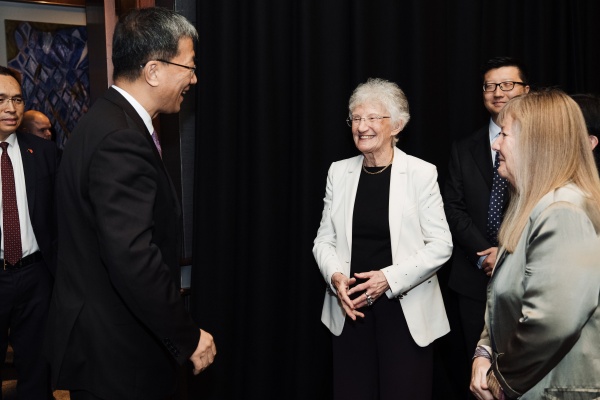
ENZ's Acting Chief Executive Dr Linda Sissons greets Minister Huai with Minister Penny Simmonds and ENZ Regional Director & Counsellor, Greater China (Education), Michael Zhang, prior to the Education Forum (held at the Pullman Hotel, Auckland)
Our Minister for Tertiary Education and Skills, Penny Simmonds and Minister Huai co-chaired a “Looking into the Future: High Level Education Forum”. The Forum was attended by 11 University Presidents from some of the most prestigious universities in China, and all eight of our university Vice-Chancellors. The Forum discussed themes spanning student and academic mobility, research partnerships, innovation and productivity and digital education. A compelling discussion topped off with the signing of twenty institution-level MOUs.
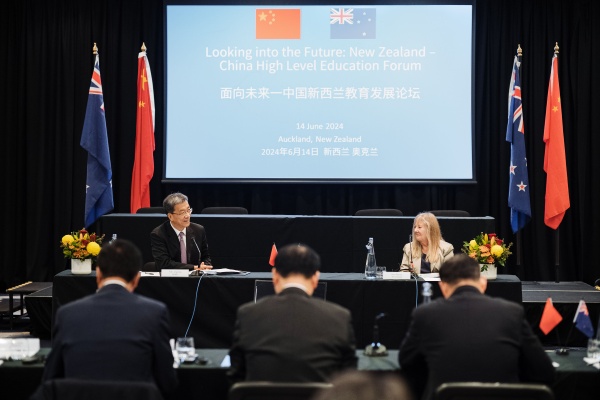
Minister Huai and Minister Simmonds open 'Looking into the Future: New Zealand - China High Level Education Forum
And towards the end of the Forum, Premier Li, our Prime Minister, the Rt Hon Christopher Luxon, as well as the Minister of Education, Erica Stanford, joined the closing ceremony and took an active part in proceedings. This included the Prime Minister presenting the latest Prime Minister’s Scholarships to a group from Canterbury University heading to China and announcing the 2024 recipients of the New Zealand-China Tripartite Research Partnership Fund. Premier Li also announced allocations of scholarships for New Zealand Chinese Language teachers, summer camp places for New Zealand students and donations of Chinese language textbooks.
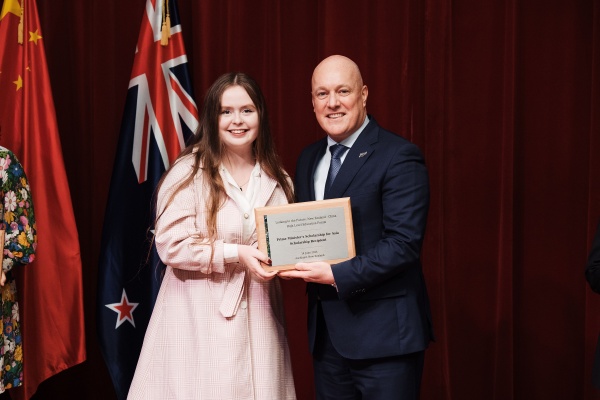
Prime Minister Rt Hon Christopher Luxon with Maia Hosking of the University of Auckland who will begin her programme in China under the Prime Minister's Scholarship for Asia.
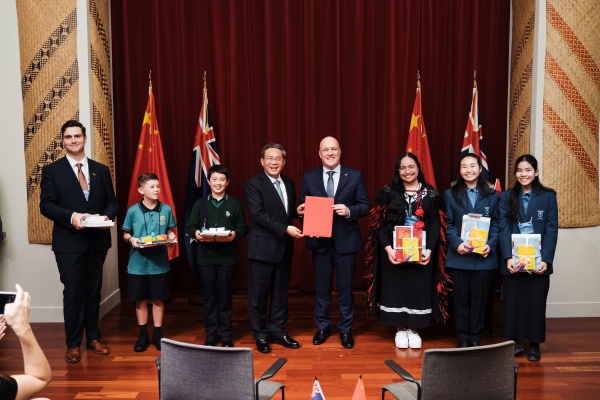
Premier Li (centre left) presents list of announcements to Prime Minister Rt Hon Christopher Luxon (centre right) on stage with six New Zealand students who received Chinese Language books
To close the day, we accompanied our Minister, our Chinese and New Zealand university colleagues, and NZ Inc representatives to the Gala dinner where Prime Minister Luxon called out education among the other vital ties between China and New Zealand.
These special events proved a unique opportunity to showcase our high-quality education offering to China while demonstrating our commitment to enhancing student mobility and future education and research collaboration. It was fantastic. We can all be very proud of education’s contribution to this important relationship.
Ngā mihi nui,
Dr Linda Sissons
Acting Chief Executive
Education New Zealand Manapou ki te Ao
-
Updated UIP system gives better user experience
The UIP system is an automated data collection system that will collect individual learner and provider data from UIPs. These providers are private training establishments that enrol international students and do not receive government funding.
Additional improvements were made to make the system more user-friendly. This work was completed on 1 May 2018 in time for submission of trimester 1 data this year. The updated UIP system is easier to use and features a new online portal - an additional option for providers to submit data.
The UIP system is a cross-agency project by the Ministry of Education, New Zealand Qualifications Authority and Education New Zealand and will help provide a more comprehensive picture of international student enrolments for this sector. Over time, this information will also help improve market analysis and inform decisions to support the international education industry.
Tour groups or group study tour operators will submit aggregate data through the Tour Group portal, which is also now live.
More information about the UIP system including the data requirements, the options to submit data and the Tour Group portal can be found at the STEO website.
For any questions, please contact UIP.DataCollection@education.govt.nz.