Search
Showing 10 of 2262 results for read 2024 FRM Exam Part I - Quantitative Analysis online free
-
ENZ moves to Study with New Zealand website
The official government site for advice on how to study with New Zealand has been completely rebuilt and rebranded, in line with ENZ’s new global brand campaign to attract more international students to a New Zealand education.
The Study with New Zealand website showcases the full range of choices available to international students, from studying in New Zealand to new, flexible options for online and offshore courses, and pathways from these courses to further onshore study or blended learning programmes. It replaces the Study in New Zealand site.
Students can search for a course, a school, an education agent or a scholarship in a more intuitive and comprehensive way. ENZ will add new functions to the site in early 2022, including more enhancements to the Finder tool.
The new website is a key part of ENZ’s strategy for the evolution of the New Zealand education brand, in line with the Strategic Recovery Plan for International Education, which aims to diversify our education offerings and rebuild a more resilient sector.
Inviting students to study with New Zealand is more than just a subtle shift in language.
The website asks students to take a new look at a New Zealand education. It features ENZ’s new brand messages, photographs and videos showing students learning online. All brand and campaign materials are available for use by international education providers and agents on the ENZ Brand Lab.
We welcome your comments and suggestions on the new site. Get in touch with Study with New Zealand digital project manager Brooke Dyer at feedback@studywithnewzealand.govt.nz
-
Diversification of International Education sees six innovative projects receive funding
Education New Zealand Manapou ki te Ao (ENZ) has today announced the recipients of the International Education Product Innovation Fund.
Just over $1.6 million in funding has been awarded to six organisations, with support ranging from $200,000 to $300,000 for individual projects over the next 12 months.
The projects that received funding span a wide range of activity. They include a global course for rugby coaches developed in partnership with The Crusaders, an online indigenous eCommerce programme, English language learning based on original, high quality drama content, global enterprise coaching and peer group learning, an evolution of an NZ financial literacy platform for global audiences, and virtual reality online medical training focused on childbirth simulation.
Initial response to the Product Innovation Fund saw more than 150 organisations express interest. ENZ designed a rigorous process for submitting and assessing applications, working alongside Creative HQ – a specialist innovation agency. The process involved a clear set of criteria that were communicated to all applicants. A shortlist was prepared, and a final assessment was completed by an independent expert panel comprising external innovation and education experts and senior ENZ staff.
Commenting on the recipients, ENZ Chief Executive Grant McPherson said the innovation and scope of the applications had been eye-opening.
“The quality of the entrants was a clear indication of New Zealand ingenuity, market knowledge and cutting-edge innovation,” said Mr McPherson.
“The sheer variety of fields and technology being utilised shows how advanced the thinking and capability of New Zealand education providers has become. The potential of each of these projects can now be fully explored, and I am confident the lessons learned can be shared for the benefit of our whole education sector, inspiring others to follow their lead.”
The Product Innovation Fund was launched by ENZ in April to encourage providers to design and develop new education products and services for international learners. It is part of the broader refreshed international education strategy and is intended to fund programmes that deliver new, meaningful, and unique learning experiences from New Zealand with education products and services that set New Zealand apart from other countries.
Providers will create new products and services aimed at transforming the way international learning is developed, promoted, and delivered. Funding and support from ENZ will help providers fast-track the exploration and development of new ideas, conduct market research, build prototypes, and advance their global market strategy. Lessons learnt from the programme will assist in developing future education products and services for the benefit of the entire international education sector.
Details of the successful applicants and their projects can be seen here.
Recipient
Funding Amount
Banqer
$300,000
BOMA New Zealand
$300,000
Chasing Time English
$250,000
Te Kaihau Education
$200,000
Te Whare Hukahuka
$255,000
Virtual Medical Coaching
$300,000
ENDS
-
Rebuilding New Zealand education’s visibility in China
Last month, Lillian spent three weeks in New Zealand in what was her first visit to the country as part of her role at Education New Zealand Manapou ki te Ao.
The two-pronged purpose of her trip was to provide refreshed marketing insights to education providers in New Zealand and hear from providers on their expectations and the challenges they face when marketing their offering in China.
Here are Lillian’s takeaways from her visits and interactions in New Zealand –
Need for storytelling that better highlights New Zealand education’s points of difference
- Engaging with education providers and visiting campuses highlighted to me several points of difference for New Zealand education, particularly how it is innovative, how it develops work-ready graduates, as well as how international students are welcomed and valued in New Zealand. Seeing these points of difference in real time made me realise how underrated the New Zealand education story is overseas, and the need to tell that story better. We need to focus on telling a New Zealand education story that is authentic and has concrete examples. A more visual storytelling format would be ideal to deliver the story.
- Tip: Demonstrate the teaching and student engagement practices your institution delivers using visuals (images or videos).
- Example: Take photos/videos in the lab, with robotics machines, with the 3D printer, the hands-on experience and student engagement (student hub), self-learning and learning from their peers.
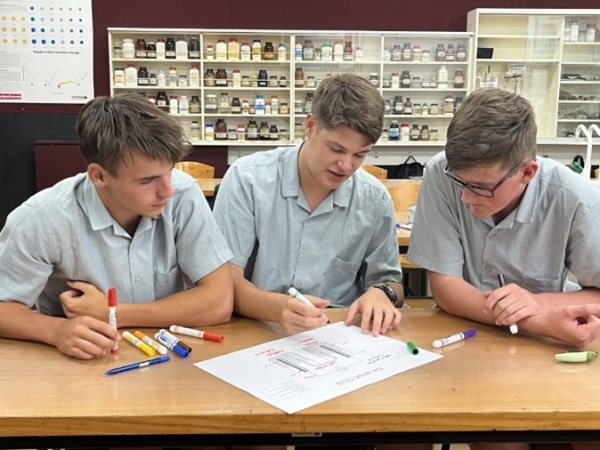
Visit to Middleton Grange Intermediate School to understand the differences between New Zealand and Chinese classrooms
Demonstrate outcomes of education programmes via successful alumni stories to promote offering
- Chinese parents and students are very outcome driven. Institution or programme rankings remain the key consideration, but other indicators and outcomes are becoming increasingly important, including employability, international recognition, and a life-changing experience.
Demonstrating the outcome of an education programme by leveraging successful student or alumni stories and testimonials can be a critical in activating ‘word-of-mouth’ promotion that influences the decision-making of prospective students and parents.
- Tip: Highlight successes or outcomes for students through stories. Degree + good experience = happy alumni story. Parents and students want to know if a qualification from a New Zealand institution will be recognised in China, the world or if it could be a pathway to further study.
- Example: A Chinese student studied a business degree with a New Zealand tertiary provider and then landed a job at a Fortune 500 company or became an industry leader. Or if a Chinese student studied virtual art in a New Zealand PTE, got a job in Weta Digital, which has worked on recent Chinese blockbuster films. We have seen Chinese media are very interested in interviewing and profiling such students in their publications.
Consider digital content in local language for marketing impact
- Research indicates that more Chinese students do their own research online and make their own decisions when choosing an overseas study destination and institution. So having a digital presence on China’s digital platforms is critical. Digital content in local languages also goes a long way in building brand awareness. If resources allow, exploring multiple channels and interacting with your audience in local languages will help you to gain a major advantage in optimising brand awareness and driving results in student recruitment.
- Tip: Host Chinese language and China specific channels such as an official WeChat account. We understand it isn’t easy to set one up. If you are unable to set up a WeChat account for any reason or don’t have Chinese-speaking staff, having a Chinese language website is the next best option. Having crucial information online in Chinese helps promote the institution as trustworthy. Parents and students will use the Chinese language website to confirm information, even if they rely heavily on agents or school counsellors.
- Example: ENZ has been working to optimise our digital presence in China, including with our Chinese language website: studywithnewzealand.cn. We recently revamped the storefront of SWNZ.cn to bolster its localisation, ensuring that from a Chinese user point of view, we can keep them interested and engaged in considering a New Zealand education provider. To ensure our digital presence continues to be fit for purpose, we undertake regular work to update and troubleshoot our platform and content.
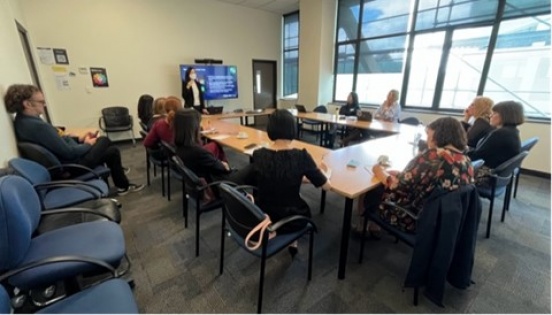
ENZ’s Lillian Zhang presents China Marketing Insights and Strategies session to members of Study Dunedin on 24 February
With China fully re-opening to the world in January, the tempo of in-person events in the country is at pace already.
ENZ’s Greater China team is looking forward to supporting New Zealand providers visiting the country for agent seminars in Guangzhou and Beijing in May and other events later in the year.
If you have any enquiries related to marketing in China, please contact: china@enz.govt.nz
- Engaging with education providers and visiting campuses highlighted to me several points of difference for New Zealand education, particularly how it is innovative, how it develops work-ready graduates, as well as how international students are welcomed and valued in New Zealand. Seeing these points of difference in real time made me realise how underrated the New Zealand education story is overseas, and the need to tell that story better. We need to focus on telling a New Zealand education story that is authentic and has concrete examples. A more visual storytelling format would be ideal to deliver the story.
-
Summer holiday fun for Vietnamese students at the 2023 New Zealand Future Skills Camp
At this year’s camp, in addition to NZ EdTech Code Avengers which specialises in digital skills training, Education New Zealand Manapou ki te Ao (ENZ) also worked with another NZ Ed Tech company Chasing Time English, a digital platform that enhances English language learning through exclusive short films. Three local partners were involved to help promote and deliver training sessions for the students.
20 teams were shortlisted for the camps which ran from Saturday 24 June to Sunday 2 July 2023. The teams could participate in a variety of online and in-person group work and interactive activities, learning coding skills together with English skills for an intercultural environment. After the camps, the teams were required to work on a coding project themed “Making a creative and impressive 'Our Future Profile' Webpage introducing your team 15-20 years from now”.
The top eight teams with the most impressive webpages were then invited to present their products, in English, to a panel of judges on Sunday 16 July. The other teams from the 20 who were shortlisted were also invited to the Awards Ceremony held on Friday 7 July to receive certificates and announcement of the final results either in person or virtually.
His Excellency Mr. Scott James, New Zealand Consul General in Ho Chi Minh City, attended the Awards Ceremony. In his remarks, he said “All of the students here are already winners because you have not only surpassed many contestants to come this far, but you have also taken the courage to step out of your comfort zone and embark on this adventure to learn new skills.”
Assoc. Prof. Minh Nguyen, Head of Department Computer Science and Software Engineering at Auckland University of Technology, was one of the judges who evaluated the teams’ webpages and then the short-listed presentations. He commented: “It was an absolute pleasure to be a part of such an inspiring event. The creativity and innovation displayed by the teams was truly impressive.”
Ms. Karen Kemsley, Production Manager at Chasing Time English who taught students at online sessions, said: “I had a wonderful time with the NZ Future Skills Camp students. Everyone participated enthusiastically which made the classes both fun and engaging. They took every opportunity they could to share creative opinions and ideas while demonstrating excellent English language skills. They were an absolute delight!”
The 1st prize winning team, together with two 2nd prize winning teams went on to represent Viet Nam at the New Zealand – Asia Code Camp Day on 5 August with other students from Indonesia, Malaysia, South Korea and Thailand.
NZFSC not only provided an exciting and meaningful summer event for the participating students, but also left both students and their parents with a very positive impression of Aotearoa New Zealand as an innovative, welcoming and beautiful destination for their potential international education plans.
-
Meet the Team: Lisa Futschek
Hi Lisa. Could you please outline your own role and the role of the International team?
ENZ’s International Team delivers on the strategies our organisation sets to best position New Zealand as an education partner in our key offshore markets. It’s a two-way flow with our skilled offshore teams not only delivering a vast array of in-market initiatives, but also providing crucial market intel contributing to the setting of our core strategies and objectives.
We ask a lot of our teams. Not only do they bring crucial language skills and a deep understanding of the cultural context, but they are also marketers, event organisers, Government-to-Government experts, relationship managers, skilled communicators and more. They need to be as comfortable talking with a Minister as they are with a student seeking an education in New Zealand.
My role is to set the direction, to coach, mentor, energise, and to ensure that the output of our team plays its part in realising the overall vision of our organisation.
How is the COVID-19 pandemic impacting your team’s work?
The impacts of COVID-19 on the International Team’s work have been wide-ranging.
The first order of things related to the closed borders and the need to cancel, postpone or re-imagine the large number of in-market events that had been planned.
At the same time, there was a square focus for both ENZ’s off- and onshore teams to support the experience of those international students who remained in New Zealand or had been unable to get here. This included everything from their access to online learning, accommodation needs, physical and emotional wellbeing, support through hardship, visa queries and connection to repatriation flights.
Throughout all of this, the offshore teams have been heavily engaged in communicating with a full range of stakeholders – students, parents, agents, industry partners, NZ Inc partners and governements – to keep them abreast of developments and to assist in responding to their wide-ranging information needs.
Can you tell me a bit about your own professional background?
I’ve always been interested in international relations. I spent 18 years as a career diplomat with the Ministry of Foreign Affairs and Trade (MFAT), living and working in Chile, Germany and New York City.
Through those 18 years at MFAT, I gained an understanding of New Zealand’s place in the world. There is no doubt that we punch above our weight. Positioning our nation globally through diplomacy is highly rewarding but it is also a long game.
What I have found particularly satisfying since joining Education New Zealand in 2013 is the short gap between effort and result. We get to see very quickly the impact of our work on thousands upon thousands of people whose lives have been transformed by a New Zealand education. I’m proud to be able to play a part in that.
People might think that diplomacy is something which happens exclusively at embassies and at a Government level. But in fact, education diplomacy is part of our organisaton’s DNA. And through our alumni we have created an enormous international network of ambassadors for both a New Zealand education as well as everything else our country has to offer.
What do you do in your spare time? Can you tell us about the choir you sing in?
Yes! I’ve been in a local choir called the Doubtful Sounds since 2014. It’s wonderful. It’s complete “me time”. It’s away from work, it’s away from the family, it’s an escape from the normal preoccupations of life. I find it completely joyful.
I love making music with other people. We’re not too serious; it’s not an auditioned choir and reading music is not a pre-requisite. I love the fact there’s a whole range of people involved. Our choir master Bryan Crump (of RNZ fame) is a brilliant musician and arranger of music, and is very active in getting us in public. We sing at weddings, flash mobs in the street, the Fringe Festival, slots on RNZ. We sang last year in the Wright’s Hill gun implacement and at this year’s Newtown Fair.
-
International Student Hardship Fund
Thank you for all the applications we have received.
The Fund has now been allocated and we are no longer able to accept applications.
The Government has established a $1M hardship fund for international students to address urgent, temporary needs, for example temporary inability to access cash or because of reduced part-time employment.
Criteria
We welcome applications from education providers and organisations to apply for grants of up to $20,000 (GST not to be included) to enable you to provide eligible international students with direct financial relief or other support, including food parcels and support towards living costs.
Organisations can apply for grants up to $20,000.
Applications can be made from 21 May until funding has been allocated.
Which organisations are eligible to apply to ENZ for grants?
- Education providers who are signatories to the Code of Practice
- Community groups
- Peak bodies, or
- Other organisations who currently work with international students and have the mechanisms and experience to support international students with hardship requests.
Individual students and education agents may not apply to ENZ to access the fund.
What grants are available?
- Eligible organisations may apply for grants of up to $20,000 (GST not to be included) per request to the fund.
- Grants are one-off; however, the same organisation may make additional requests after using their initial funding (subject to the availability of funding).
What can grants be used for?
The grants may be used to:
- scale up existing student hardship initiatives
- support eligible students through:
- Direct cash grants
- The purchase of resources on behalf of international students, such as food parcels, where this is appropriate.
- The maximum amount that can be applied for is up to $1,000 per international student your organisation is supporting.
- Funds may not be used for:
- Salaries or staff administration costs
- Funding for flights home
- Tuition fees
- Granting individual students support of more than $1,000 in cash or kind.
Which students are eligible for support?
- Grants can only be used to provide support to eligible students.
- An eligible student is:
- A current fee-paying international student, or enrolled as a fee-paying international student as at 23 March
- Currently in New Zealand
- In genuine, temporary hardship[1]
- Not eligible for other government financial support.
- International PhD students paying domestic fees are eligible for the government’s domestic student hardship fund and should be encouraged to seek help from that scheme in the first instance.
Table: Summary of eligible and ineligible students
Eligible students
Ineligible students
- A current fee-paying international student, or enrolled as an international student as at 23 March.
- In genuine, temporary hardship.
- International PhD students paying domestic fees.
- International students who are not currently enrolled or who were not enrolled as an international student as at 23 March.
- International students who are eligible for other government support.
How do organisations apply?
- To apply for grant funding, organisations must complete and submit an online application form to ENZ.
- Organisations will need to provide the following information:
- Their strategy and approach to identifying students in need, including outreach efforts and ensuring eligibility criteria are met
- Estimated number of international students and basic demographics (e.g. age range, sector, nationalities, region)
- Total amount requested, what it will be used for, and how it has been calculated
- The organisation’s resources to ensure appropriate distribution
- Agreement to meet reporting requirements (including publication) and to repay any underspend within 12 weeks of having been granted the funds
- Invoice and bank details for payment.
- Process – Applications are now closed.
- Assessment of applications will be completed within five working days. Approval will be notified by email, as will confirmation of distribution of funds.
- Any queries about the International Student Hardship Fund can be sent to response@enz.govt.nz or raised with Sahinde Pala, Director of Student Experience & Global Citizens at Education New Zealand.
Reporting requirements:
- Organisations will need to report to ENZ on:
- The number of students assisted, and basic demographics (e.g. age range, sector, nationalities, region of New Zealand)
- The type of assistance provided
- How much was provided.
- To demonstrate programme outcomes, and as part of its commitment to ensuring value for money from expenditure, ENZ will publish reports from participating organisations in whole or part.
Closing date
Applications can be made from 21 May, until funding has been allocated.
Further information
Frequently asked questions are available here.
Any queries or concerns about the International Student Hardship Fund can be sent to response@enz.govt.nz or raised with Sahinde Pala, Director of Student Experience & Global Citizens at Education New Zealand.
Thank you for your assistance in helping to support international students currently studying here during these unprecedented times.
[1] Organisations will have the discretion to determine what constitutes significant, temporary hardship in accordance with their existing policies and practices.
-
Celebrating the 28 Pasifika graduates of the He Manawa Tītī Programme
He Manawa Tītī was a 13-week bespoke training course for emerging Pacific leaders delivered between February and May 2023 under the Manaaki New Zealand Scholarship Programme (MNZSP). The name He Manawa Tītī stems from a Māori Whakataukī (proverb) meaning ‘stout of heart’ and the course formed part of the Ministry of Foreign Affairs and Trade (MFAT) contribution to the suite of reparations for Pacific peoples announced in 2021 by the New Zealand Government. The press release announcing these scholarships is available here).
Emerging leaders (aged 25 – 35) from public, private, and voluntary sectors took part in the course combining academic and experiential training. Scholars participated in several weeks of online learning from their home countries and spent nine weeks of the programme based in Te Whanganui-a-Tara Wellington. He Manawa Tītī included modules on good governance and public sector leadership, trade policy in the context of the Pacific, and explored Pasifika values as key tenets of modern leadership.
Education New Zealand Manapou ki te Ao (ENZ) was involved in this kaupapa (programme of work) through its partnership with MFAT on the operational management of the MNZSP.
“It was fantastic to be able to celebrate these 28 inspiring young leaders as they completed this programme in Wellington last month. In true Pacific style, there was plenty of laughter, fun and colour, and it was a fitting celebration for all that these graduates have already achieved throughout their education and early careers,” said ENZ’s General Manager International, Lisa Futschek.
“The programme was designed by MFAT in collaboration with key Pasifika stakeholders and community members, highlighting Pasifika ways of learning and recognising the knowledge that is already held by Pasifika peoples. This collaboration also ensured opportunities for the scholars to build networks with Pasifika communities here in Aotearoa New Zealand, which connects them to our country now that they have returned home,” Lisa added.
The Manaaki New Zealand Scholarship Programme is part of the International Development Cooperation support that MFAT provides for developing partner countries across the globe. Manaaki alumni are well-known to be integral contributors to the development of their home countries.
“These Pacific emerging leaders are enthusiastic about returning home and putting into practice the leadership skills they have gained in Aotearoa,” said MFAT Lead Adviser, Alexandra Grace.
“While they have successfully completed this bespoke cohort course, real success will be demonstrated over coming years through what they achieve for their communities and countries. Scholars told me they won’t miss the weather (!) but will take with them enduring memories of the manaakitanga they experienced in our country.”
-
Smart waste management idea sees students take out top spot in KIWI Challenge Indonesia finals
The theme was “Reforming Indonesia’s mobility and smart cities using AI technology”. This year’s initiative hosted 59 teams from across 37 schools for a total of 269 student participants, the highest ever at the KIWI Challenge.
The groups were required to submit video entries to a judging panel made up of AUT academics and ENZ representatives, who reviewed the submissions and selected finalists. Participants received mentoring from a New Zealand university academic through the process and took part in workshops to refine their business plans. They were given a taste of New Zealand’s learning environment along the way and built an understanding of our tertiary education offering for future planning.
The participating academic was Dr Taghreed Hikmet from AUT, a Senior Lecturer in International Business, Strategy, and Entrepreneurship who has expertise in smart cities and is passionate about mentoring and inspiring young future leaders.
The finals were held on Saturday 25th November, where six shortlisted teams from across Indonesia presented their ideas to a panel of judges made up of Dr Hikmet (AUT), Ben Burrowes (ENZ’s Regional Director, Asia), and Indonesia Embassy staff (representing Ministry of Foreign Affairs and Trade), Hira Trisnoputri.
UniSadhuGuna International College took first place with their ‘Greenlight’ business idea, a smart waste management enterprise which aims to create a sustainable waste management system that actively involves households, businesses, and the government. UniSadhuGuna International College received a voucher worth 10,000,000 Indonesian Rupiah for winning the competition.
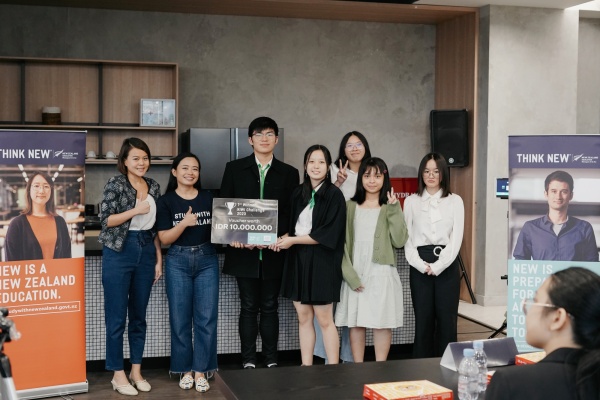
Winners! The team from UniSadhuGuna international College took out first place with their ‘Greenlight’ business idea.
Dr Hikmet reflected on the KIWI Challenge warmly. “It has been truly rewarding, observing the outstanding progress and growth in the finalists' projects, presentations, and overall confidence.
"It was a privilege to engage with high school students across Indonesia, contributing to the vibrant entrepreneurial spirit fostered by the competition. Excitement brews within me for the potential of future collaborations and initiatives,” Dr Hikmet concluded.
Following the finals, Ben Burrowes and Dr Taghreed Hikmet participated in an Instagram Live session with KOMPAS TV, the leading media network in Indonesia. This Instagram Live generated a total of 3.4k views and the highest number of people watching online was 348. You can watch the Instagram Live here: Part 1 and Part 2.
-
Bound for Asia
In September Lauren will move to Shanghai to begin her exchange at East China Normal University, one of the oldest and most prestigious universities in China to study the Global Curriculum programme as part of Victoria University's Study Abroad and student exchange programme.
“I expect my Chinese language skills to improve as well as my knowledge of Chinese consumers through living amongst them. Longer term I view this as an amazing opportunity to form networks with new friends, future colleagues and business partners.
“The university is also close to Fonterra’s headquarters in China. I will be interning there one day per week. This will give me a chance to link what I am learning in the classroom with actual business cases. The tangible benefits of learning the language are already becoming clear. I recently wrote my first email in Chinese,” says Lauren.
Increasing Kiwi students’ cultural awareness and understanding of our Asia-Pacific neighbours will strengthen their global connectedness and deepen New Zealand’s links in the Asia-Pacific region.
Through their Asian study experience students will gain confidence in operating in an international context and obtain knowledge and skills that will help them in their future careers.
Not only will some students make lifelong connections through these study experiences, all of them will be great ambassadors for the quality and strength of New Zealand’s education system.
With one of New Zealand’s greatest challenges being to overcome the lack of awareness of our education offerings, having some of our best and brightest participate in study in Asian markets is another way of raising our profile.
More about the Prime Minister’s Scholarships for Asia, including full list of recipients, can be found here.
Read Minister Joyce’s press release announcing the awardees here.
-
NZ education making headlines across Asia
Key coverage since then has included feature articles in target publications in China, India, Malaysia, Indonesia, Viet Nam, Thailand and the Philippines.
"Carving a name for themselves in the land of Kiwis”, “Open spaces, open hearts invite ASEAN minds to think new” and “Engineering options in New Zealand” – these are just a few recent headlines about New Zealand education featuring in media across Asia.
From March to June, 21 media from seven target markets visited 20 different education providers throughout the country on Education New Zealand’s visiting media programme.Key coverage since then has included feature articles in target publications in China, India, Malaysia, Indonesia, Viet Nam, Thailand and the Philippines.“ENZ invites overseas media to visit New Zealand to report on our world-class education experience – filming, writing, blogging and tweeting about their experiences,” says John Goulter, General Manager, Government and Partners.“ENZ developed programmes that saw the journalists visit a wide range of education providers from across all sectors and get a real taste of New Zealand’s education strengths most relevant to their audiences.”“The impressions these visiting journalists form, and the coverage they give New Zealand as a result, relies on the rich experiences they have and the engaging students they meet. Thank you to those involved earlier this year for the effort and time you invested in delivering a great experience.”
Highlights include:
- A two-page feature on the front of the ‘Learning’ section of the Philippine Daily Inquirer. “Open spaces, open hearts encourage ASEAN students to ‘think new’” reached over 2.7 milion readers through the stories
- of two students studying IT and cooking. The article compared New Zealand’s work-relevant programmes, choice of subjects, strengths in niche areas such as Computer Science with those offered in the Philippines, and praised New Zealand’s diversity and equality.
- A story on New Zealand’s rising prominence as a high-quality, value-for-money destination for international students, published in the Bangkok Post as part of an ASEAN 40 visit to celebrate four decades of diplomatic relations between New Zealand and ASEAN nations. The newspaper has a daily circulation of 75,000. You can read the story here.
- Multiple-page features in Malaysian newspapers the New Straits Times (average daily readership 240,000), Sin Chew Daily (500,000 readers) ande Berita Harian (983,000 readers). Articles highlighted New Zealand’s strengths in a variety of subject areas, the student experience in NZ, and qualifications that equip students with work-ready skills.
- Full-page features in India pointing out the advantages of studying media design and hospitality and adventure tourism in New Zealand (New Indian Express, circulation 335,616).
- One-page profiles on each New Zealand university in the Indonesian youth magazine High End Teen, which reaches a targeted youth audience aged 13 to 18. Each profile highlighted the university’s distinctive strengths and included a student profile.