Search
Showing 10 of 2262 results for read 2024 FRM Exam Part I - Quantitative Analysis online free
-
Consultations
Open
There are no open consultations at this time.
Closed
New Zealand Qualifications Authority (NZQA) Rules
The New Zealand Qualifications Authority (NZQA) is reviewing the NZQA Rules to reflect amendments to the Education and Training Act 2020 which came into effect on 1 August 2022, and to ensure the rules remain up-to-date and fit for purpose.
Consultation closed on 21 October 2022. Go to https://www.nzqa.govt.nz/providers-partners/rules-consultation/
New Zealand International Education Strategy 2022-2030
The Minister of Education is refreshing the New Zealand International Education Strategy. The Ministry of Education has developed a draft Strategy and was seeking your views on the proposed changes.
Consultation closed on 28 June 2022. Go to https://consultation.education.govt.nz/te-puna-kaupapahere-policy/new-zealand-international-education-strategy-2022/
Enrolling international fee-paying students under Year 9
The Ministry of Education was seeking your views on the future of enrolling international fee-paying students under Year 9 (primary and intermediate level).
Submissions closed on 11 March 2022. Go to consultation.education.govt.nz/international-education/intlenrolunderyear9
Immigration policy settings
The New Zealand Government has asked the Productivity Commission to undertake an inquiry into what immigration policy settings would best facilitate New Zealand’s long-term economic growth and promote the wellbeing of New Zealanders.
Submissions closed on 24 December 2021. Go to www.productivity.govt.nz/inquiries/immigration-settings
ENZ made its own submission to the inquiry, which you can read here (links to Productivity Commission website).
Draft policy statement: high value for international education
The Ministry of Education was seeking your views to help it define what ‘high-value’ means for international education.
Submissions closed on 24 September 2021. Go to consultation.education.govt.nz/international-education/highvalue/
-
ENZ highlights international students' contributions to New Zealand in comments to immigration settings inquiry
International students coming to New Zealand support the achievement of the Government's broader goals and objectives while contributing to an important export industry. This is one of the key messages from Education New Zealand's submission to the Productivity Commission's inquiry into immigration settings.
In the submission, ENZ says that international students should not be characterised as coming to New Zealand to seek employment, invest or run a business. Rather, international students are motivated by different drivers in deciding whether to come to New Zealand, and are different to other temporary migrants included in the scope of the inquiry.
International students bring foreign exchange to New Zealand to fund their studies and living costs, which contributes to New Zealand's economic development. The submission also discusses the broad benefits international students deliver for New Zealand, including regional development, research output, and strengthened bilateral relationships with other countries.
You can read ENZ's submission to the inquiry here (links to the Productivity Commission's website).
-
Fourth cohort of 5,000 international students as a border exception
The students will be able to enter New Zealand from mid-2022 as a border exception, through a centrally managed process.
Student places will be allocated across the sector, based on the proportion of international students who were attending each type of education provider pre-COVID in 2019:
- University 1,450
- Te Pūkenga 700
- School (year 9 and above) 1,000
- PTE (including pilot training) 850
- English Language School 1,000
ENZ and the Ministry of Education are currently consulting with the peak bodies for universities, Te Pūkenga, PTEs, ELS and schools, on a draft implementation framework. The framework will include information on the allocation of places to providers, criteria for nomination of students to these places and all related processes. If you are an education provider who is not aligned to a peak body, you can request a copy of the draft framework by emailing c4@enz.govt.nz.
The implementation framework is expected to be finalised by 14 March 2022, and more information will then be made available for prospective students and the wider education sector.
Education providers will be responsible for determining eligible students to fill their allocation of places, and submitting information on these students to education agencies. Education agencies will confirm with providers that the students meet the criteria, and nominate these students to Immigration New Zealand.
As with previous border exceptions, students who are interested should talk to their prospective education providers and indicate their interest.
Expected timings are as follows:
- Mid-March 2022 – decisions begin to be communicated about the allocation of places to individual education providers
- Mid-late March 2022 – education providers begin nominating students
- 13 April 2022 – the border exception visa application process opens for cohort 4 students
- From mid-2022 – students are in New Zealand ready to begin their study.
We appreciate that the timings are tight, and everyone involved will need to work closely together so we can make the most of this opportunity.
Students will need to meet the same living cost requirements as the previous cohort, namely funds of $15,000pa for school students and $20,000pa for other students.
Students will also need to comply with the vaccination and other health requirements that apply at their time of travel. Read more about travel to New Zealand on the Unite against COVID-19 website: Travel to New Zealand
-
Latest insights on international education
The Insight Story March 2022 is the latest snapshot of international education from Education New Zealand Manapou ki te Ao.
This fourth issue includes research, insights and trends on:
• our top source markets
• other English-speaking international student destinations
• student visa numbers
• international student experiences
• transitions from secondary to tertiary study in four priority Asian markets.
Do you know, for example, which countries are most interested in our Study with New Zealand website?
Or how students from Japan rate the value for money and cost of living in New Zealand, and their overall experience here?
Or which nationalities have the highest number of student visas granted in other English-speaking international education markets?
Or how positively international students rate their experience in New Zealand, and how international student experience at New Zealand universities compares with the global benchmark?
To find the answers to these questions and more, read The Insight Story and sign up for future issues, on the IntelliLab website.
-
From the CE: Student visas reopen 31 July; changes to immigration settings
Firstly, there is the encouraging news that student and visitor visa processing will reopen on 31 July 2022, rather than in October as previously announced.
This is a welcome step forward and sends a strong signal that New Zealand is fully reopening to the world. Given the significant challenges faced by our international education sector over the past two years, I know this news will come as a relief for many of you.
Secondly, the government has announced changes to immigration settings arising from its immigration rebalance work. Key changes for our sector include post study work rights for international students and other student visa settings.
The recent border exception for up to 5,000 international students (cohort 4) will continue as planned, with the first students on track to begin arriving in New Zealand soon.
Post-study work rights from 11 May 2022
- International students studying bachelor’s or post-graduate courses or higher will continue to receive Post-Study Work Visas.
- Students studying non-degree courses at Level 7 and below (excluding bachelor’s degrees), will only be eligible for post-study work rights if the qualification is relevant to an occupation on the new Green List, which will replace the existing skills shortage lists. These work rights will only allow them to work in that occupation.
- The duration of work rights will reflect the duration of study undertaken in New Zealand, except for Masters and PhD students who retain the current setting of 3 years.
- International students will no longer be able to apply for a second post-study work visa.
- Students with a student visa application underway to study a qualification currently eligible for a post-study work visa and that student visa is subsequently granted; students who get a visa through the current border exception for 5,000 students; and students who already hold a student visa for a programme of study that results in a qualification that is currently eligible for a post study work visa, will be considered under the old settings if they apply for a post-study work visa within the next three years.
- There are no changes to in-study work rights for student visa holders.
Living costs and fees from 31 July 2022
- The amount of funds that students are required to demonstrate they have access to, so they can cover their living expenses while in New Zealand, will increase. For tertiary and English language students, the funds required will be $20,000 pa, and for primary and secondary school students it will be $17,000 pa. These funds are prorated for study less than a year. The current setting is $15,000pa for both. Note: This change does not affect the living costs requirements for students in cohort 4.
- Students will be required to pay tuition fees of one year or the first programme (whichever is the shorter) upfront. Note: This change does not apply to cohort 4 students.
You can see a summary of these changes including a fact sheet on international education on the Immigration NZ website here.
You can see a summary of the immigration changes on the Immigration NZ website here.
You can read the Prime Minister’s announcement here.
Grant McPherson
-
Palmerston North’s education connections with Viet Nam
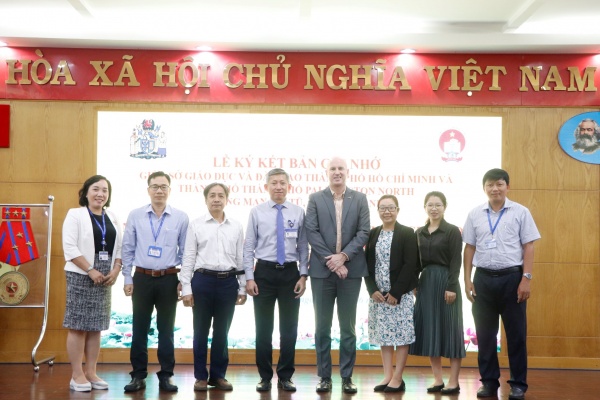
The MoA signing is the latest development in the education relationship between Palmerston North and Ho Chi Minh City – an earlier agreement signed in 2014 had expired in 2019. Unlike the 2014 agreement, which only included a few education providers in Palmerston North, the renewed MoA captures a much broader range of institutions, from schools to tertiary providers.
Education New Zealand Manapou ki te Ao had helped to sustain this relationship in 2020, through the NZ Global Competence Certificate initiative. The Central Economic Development Agency and the Palmerston North City Council (PNCC) teamed up with ENZ to offer scholarships for 50 secondary school students in Manawatū and Ho Chi Minh City to increase their global competency – read more here.
The new MoA was signed by Palmerston North Mayor Grant Smith on behalf of PNCC and Deputy Director from Ho Chi Minh City’s Department of Education and Training, Duong Tri Dung. It was witnessed by Vietnamese Ambassador Nguyen Van Trung, New Zealand Ambassador Tredene Dobson, and representatives of ENZ.
“Education arrangements like this help to further strengthen these ties. Building on sustained and increasing interest from New Zealand education providers to engage with institutional counterparts in Ho Chi Minh City, this will open a new chapter for collaboration and success for the respective cities,” Ms Dobson said.
-
First research projects funded through NZ Centre at IIT Delhi
Ten projects will each receive seed funding of USD10,000 for one year, half funded by IIT Delhi and half by the New Zealand university involved.
The New Zealand Centre at IIT Delhi was established in February 2020 as a focal point for joint academic activity between New Zealand's eight universities and IIT Delhi.
The purpose of the Centre is to promote relationships of understanding and co-operation across diverse fields of academic and other sector engagement between New Zealand and India. One of the Centre’s key objectives is to promote joint research projects among IIT Delhi and New Zealand universities in thematic areas of research important for both countries.
Below is the list of funded projects:
- Design of an electron cyclotron resonance based magnetically steered plasma thruster – IIT Delhi and University of Auckland
- Utilisation of Ammonia in a Spark-Ignition engine – IIT Delhi and Victoria University of Wellington
- Study on beam-to-column connections of cold formed steel portal frames for low-cost sustainable construction – IIT Delhi and University of Auckland
- Andreev reflection in twisted bilayer graphene junctions: effect of magnetic field – IIT Delhi and Victoria University of Wellington
- Deciphering the genome wide DNA methylation and transcriptomic signature of hypoxia in meningioma – IIT Delhi and University of Otago
- Discovering novel long non-coding RNA associated with epigenetic signatures colorectal cancer and dissecting their role in tumour heterogeneity – IIT Delhi and University of Otago
- Adaptive Drone swarms for precision agriculture and wildlife conservation – IIT Delhi and Auckland University of Technology
- Understanding exit choice behaviour in metro stations using virtual reality – IIT Delhi and Massey University
- Digital twin base health management of wind turbine power train – IIT Delhi and Victoria University of Wellington
- Building Code checker model on BIM structural plans using AI approach – IIT Delhi and Victoria University of Wellington.
You can read more about the New Zealand Centre at IIT Delhi here.
-
ENZ hosts its first famil since 2019
Eleven public universities were represented in the Malaysian delegation of senior executives from the Multimedia Technology Enhancement Operations Sdn Bhd (METEOR). METEOR is a consortium of universities that aims to provide advanced solutions through technology. This was an exploratory visit, to enable delegates to discuss a range of opportunities and possible partnerships with New Zealand universities and Te Pūkenga.
The visit was exciting on many fronts as our institutions demonstrated their expertise and explored mutually beneficial relationships, regions showcased their attractions, and the famil delegates from Malaysia experienced many aspects of New Zealand.
The eight-day visit included Wellington, Canterbury and the Waikato. While the start of the week coincided with a cold southerly storm, this was mitigated by warm hospitality and the promise of sun later in the week.
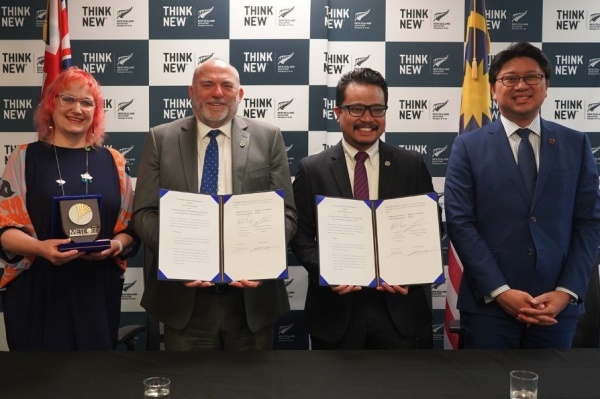
L to r: Lisa Futschek, GM International at ENZ; ENZ’s Chief Executive Grant McPherson; Mr Muhammad Afiq Bin Redzuan, Group Chief Executive Officer at METEOR; and YB Senator Tuan Jaziri Alkaf Abdillah Suffian, after signing an Education Cooperation Agreement.
The delegation was fortunate to meet with Minister of Education Chris Hipkins during their visit. While in Wellington they also signed an Education Cooperation Agreement with ENZ that provides a framework for our relationship going forward. They also met up with Malaysian students at various institutions and heard about their personal experiences here.
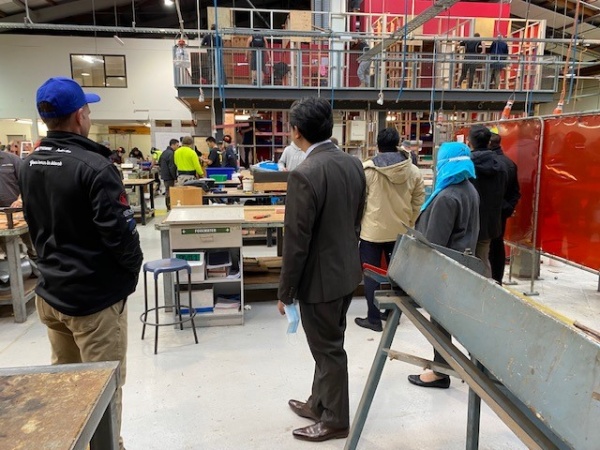
The delegation saw trades in action at WELTEC’s trades campus where they observed building apprentices on a block course.
Famils are important for ENZ as well as for New Zealand institutions, as they establish relationships and strengthen people-to-people links. They are also a key way to showcase some of the best education New Zealand has to offer across different regions.
ENZ looks forward to hosting more famils in the coming months, in partnership with institutions and regions throughout New Zealand.
You can read more about the METEOR famil on the Ara website here.

A Kiwi welcome was on offer at a private bach in Duvauchelle near Akaroa.
-
Te Wiki o te reo Māori - Māori Language Week 2022
The Ikubunkan Institute of Education in Tokyo facilitates a one-year study abroad programme for students to attend high schools in New Zealand, Australia and Canada. Pre-COVID, Ikubunkan sent 100 students annually to NZ for three terms at 100 public schools.
Because students have learned kapa haka/waiata at different schools they have developed their own Ikubunkan’s style of kapa haka when practising as one school.
Ikubunkan students performed haka for the former Māori Development Minister Te Ururoa Flavell, who visited the school in 2016. They also performed haka for the Prime Minister at the NZ Embassy Tokyo, when she visited Japan during the RWC in 2019.
You can read more from the full Daily Mail story here.
-
International recognition for New Zealand educational robot KaiBot before official launch
The AI-enabled robot, KaiBot, which has won the award two months before its official launch date, is designed to support 5 to 15-year-old children to develop coding skills.
The Smart Toys competition is coordinated by the Dubai Future Foundation in collaboration with the World Economic Forum to highlight the best-emerging AI toys in education. The competition attracts innovators, entrepreneurs, toy developers, and start-ups from 20 countries globally.
Education New Zealand Manapou ki te Ao (ENZ) has been offering wraparound support to Kai’s Education over the last year, including supporting them to participate at EduTech Australia in August, profiling them with a spotlight feature with EdTechNZ, and offering support and insights as they venture into the UAE region.
ENZ’s Business Development Manager Alana Pellow, who has been working with Kai’s Education, said this was a fantastic outcome for New Zealand’s edtech community.
“KaiBot is a great example of how innovative and fun technology can positively impact education outcomes for young learners. It’s wonderful to see the Kai’s Education team achieve international recognition for the transformative impact their edtech has on learners.”
Read more about EdTech company Kai’s Education and KaiBot on this link.