Search
Showing 10 of 2262 results for read 2024 FRM Exam Part I - Quantitative Analysis online free
-
Around the world in five
CANADA
Country briefing: Canada confirms travel exemption and emergency assistance for eligible international students
In a normal academic year, this week would have marked the end of classes for the winter semester at many Canadian universities and colleges, followed by a transition to final exams and the packing up of campus for the summer break. Needless to say, this year has been anything but normal so far.
AUSTRALIA
Int’l Student Support Network launched
The Australian Homestay Network has launched an Australia wide program called the International Student Support Network to provide short-term, heavily discounted homestay to eligible international students impacted by the global crisis.
GLOBAL
Measuring COVID-19’s impact on higher education
A new report from Moody’s Investors Services highlights the financial impacts of the pandemic on higher education institutions around the world.
UNITED KINGDOM
A day in the life of an online student
To further her business career, Charlotte Synnestvedt had to make a choice. She could either stay in her home country of Norway where her business education would be subsidised or she could apply for a leading business school overseas.
GLOBAL
Vouchers over refunds could save study travel sector from collapse
The study travel sector is at risk of imploding unless language students are obliged to accept vouchers instead of being given refunds for cancellations of their overseas study experience, industry professionals have told The PIE News.
-
Global demand for online courses from New Zealand, pilot shows
ENZ has tested the market for New Zealand’s online courses using FutureLearn – a London-based platform with a global learner base of 17 million people.
A total of 22 short courses from 13 New Zealand providers attracted nearly 63,000 enrolments from more than 48,000 individual learners in more than 200 countries between June and October 2021. The pilot project will run through to March 2022.
ENZ’s General Manager of Partnerships and Marketing, Paul Irwin, says the pilot project demonstrates the potential of online study platforms to reach new global audiences and draw learners into more online or onshore study with New Zealand.
“This pilot shows there is an appetite for online courses from New Zealand, as well as our ability to attract learners in full-time employment – a segment with a big potential for growth.
“It also highlights the willingness of many in the New Zealand education sector to build their online presence,” he says.
The pilot project featured digital courses from New Zealand universities, Te Pūkenga – New Zealand Institute of Skills and Technology, private training establishments and education technology companies – all promoted under the umbrella of a New Zealand-branded collection of courses.
They covered a wide range of subjects from technology and accounting to languages and culinary skills. English language courses were the most popular, but there was strong interest in 3D animation and courses with a sustainability theme.
“As well as running the digital learning project, ENZ was able to add value by steering the strategy to encourage learners to engage with New Zealand’s unique education brand,” Mr Irwin says.
“Partnering with an existing online education platform like FutureLearn is a smart way to test global demand from online learners, to complement our traditional mobility audience. We were able to use what we had, bypass the development phase and get to market fast with an established customer base, making it easier to test what did and didn’t work.
“The next steps are to continue evolving our offering on FutureLearn and better understand the pros and cons of partnering with existing online learning brands versus the potential benefits of a New Zealand-only branded platform that uses existing, proven technology.
“But we need to do more work first to develop a viable commercial model for providers. There is also room to improve the ability of providers to convert digital leads into viable pathways for further study,” he says.
ENZ will be adding more courses and providers to the FutureLearn platform between now and March 2022 and is planning the approach for the next three months, as well as options beyond March with FutureLearn.
If you are interested in being part of the pilot, contact the pilot project manager Tim Brown at tim.brown@enz.govt.nz
Find out more about the Online Learning Rented Platform Pilot by downloading the report and viewing the full pilot data. Check out Education New Zealand’s Products and Services Diversification Programme Timeline.
-
Around the world in five
New Zealand
NZ public positive on overseas student benefits and return
The report was commissioned by Education New Zealand to gauge public opinion in the context of the Covid-19 pandemic, and was conducted by research company TRA, based on a survey of 560 people as well as qualitative co-creation sessions.
United States
US begins processing student visas for Chinese students
Visa processing for Chinese students would resume this month, with plans to handle 2,000 applications a day by mid-May.
Canada
International grad stream reaches 40,000 limit in one day
Canada’s new pathway to residency for international graduates has reached its 40,000 application limit, just over one day after going live.
Global
Survey confirms that vaccination rollouts are influencing student choice
New QS global research indicates that the introduction of COVID vaccines is strengthening prospective international students’ resolve to study abroad, and that many students now want to begin their studies sooner than they had planned because of vaccine availability.
Latin America
If you are from a university, join the virtual THE Latin America Universities Summit 2021 free of charge to examine how the higher education sector across the region can develop strategies to build capacity, adapt to digitisation, increase strategic impact and improve public appreciation of universities’ role in progressing society as we look towards a new era post-pandemic.
Hosted in partnership with the University of São Paulo, this online summit will bring together leaders from across the region and their institutional partners around the world to set the agenda for the future of higher education in Latin America.
-
Around the world in five
GLOBAL
Beyond Covid-19: What’s Next for International Higher Ed
International education has been hit particularly hard by the pandemic. As many international students pursue their studies online this semester, study abroad and foreign exchange programs have been cancelled. In a world with little travel, closed borders, and surging infections, many are asking: what is next for international higher ed?
CANADA
Canada to open borders to international students from Oct 20
International students will be able to enter Canada from October 20 if the institution they are studying at has a Covid-19 readiness plan approved by their local provincial or territorial government, Immigration, Refugees and Citizenship Canada has announced.
GLOBAL
Fourth annual PIEoneer Award winners revealed in online ceremony
The fourth annual PIEoneers Awards was held on October 2, with the latest celebration of the international education sector held on a virtual stage for the first time due to the ongoing Covid-19 pandemic. ENZ was a sponsor of the event and was awarded Highly Commended in the Student Support category.
AUSTRALIA
Killing the golden goose: How Australia's international students are being driven away
Just 4,062 student visa applications were received in June, compared to 34,015 last year. Current international students are telling others not to come to Australia.
CHINA
China’s Ministry of Education: Utilise the advantages of cooperation in running schools to solve the problems of studying abroad
To tackle these challenges, the Chinese Government responded quickly to pressing issues raised by its students.
Amongst all the interventions put forward, the expanded enrolment of Sino-foreign cooperation in running schools (hereafter referred to as joint programme or JP) attracted the greatest attention from the public.
According to the Q&A Session, Chinese students who are unable to travel overseas to pursue their study can either enrol in online learning organised by their foreign institutions (the recognition of their foreign qualification will not be affected), or the students who are enrolled with foreign universities will now have the chance to study JP at Chinese institutions.
The increased enrolment in JPs will not be included in the national unified enrolment plan, and will not take up the original enrolment quota of the higher education establishments. After completing their studies, students who meet the academic requirements will only be awarded a degree certificate from the foreign university.
If the student still would like to pursue their study overseas as soon as border restrictions are lifted, they should choose online learning by their foreign university, as indicated by China MoE.
About 90 JPs and joint institutes, including EIT, are on the list for expanded enrolment. The Master in Applied Finance programme offered by AUT and Zhejiang University of Economics and Finance is currently the only NZ programme that is on the list.
-
India to feature as Country of Honour at NZIEC KI TUA
The Country of Honour designation at NZIEC KI TUA celebrates New Zealand’s international education connections with partner countries and reflects one of the conference’s key values – hononga (connections).
ENZ’s Acting Chief Executive, Dr Linda Sissons, said ENZ is delighted to headline India at NZIEC KI TUA and build on the strong foundation of international education connections with partners in the country.
“Students from India are the second-largest group studying with New Zealand. We are enriched by the skills and research know-how that Indian students bring to our country. New Zealand has a number of valuable institutional and government-level partnerships that make for a strong, bilateral education relationship with India.
“We look forward to showcasing and celebrating these connections at NZIEC KI TUA 2024.”
ENZ’s Regional Director Asia (excluding China), Ben Burrowes, said having India feature as Country of Honour is a valuable opportunity for the international education sector to contribute to the conference programme with sessions that surface insights and learnings focused on India.
“New Zealand and India have such a broad education relationship, from student recruitment and student experience to partnerships on an institutional and governmental level. There’s much to surface and share by way of insights to continue forging our strong education ties.
“We look forward to collaborating with our sector colleagues to deliver a conference programme that showcases these connections and explores new partnerships moving forward.”
NZIEC KI TUA delegates can look forward to programme elements that explore and surface insights from New Zealand’s international education connections with India and also experience a few cultural delights during conference.

ENZ General Manager International, Lisa Futschek, and IIM Ahmedabad Director Prof Bharat Bhaskar sign an education cooperation arrangement during the NZ India Education Connect initiative in February.
Call for speaker proposals
ENZ is accepting speaker proposals for NZIEC KI TUA 2024. We welcome inspiring and engaging presenters on any topic relating to international education, especially our connections and partnerships with India.
Please submit your proposals by 30 April on this link.
Don’t miss earlybird registration pricing
Secure your earlybird registration price for NZIEC KI TUA 2024. There are two-day and one-day registration options available, alongside tickets to a gala dinner.
To find out more information about becoming an NZIEC KI TUA 2024 partner, email us nziec@enz.govt.nz
-
Insight into China Education Developments
Produced by our China team, the latest report provides a roundup of China’s education developments during the first half of 2014 and follows their January report which was picked up and reported around the world.
Sam Mackay, Senior Education Manager in Beijing, says the Insight Report is the China team’s way of keeping industry up-to-date with changes in the region.
“There’s so much information flying around about Chinese education developments that it can be hard to keep current. We developed the China Insight Report so you can stay abreast of the key trends in this top priority market for New Zealand.”
“We’ve also tried to deliver it in an engaging manner. You can contemplate our ‘questions to ponder’, try your luck at some of this year’s Gaokao questions, and even enjoy a (somewhat related) dance clip.”
Download the China Insight report here. We welcome feedback to china@enz.govt.nz.
Quick summary:
-
The number of Chinese students heading overseas rose in 2013, but at a slower rate than previous years.
-
Chinese international student enrolments in New Zealand rebounded, exceeding the 25,000 mark for the first time since 2007. Strong growth occurred in the school and university sectors.
-
Postgraduate student numbers within China are falling due to the introduction of tuition fees. Interest in ‘professionally oriented’ postgraduate programmes, however, is rising.
-
A record number of graduates are finding employment prospects tough. The expected monthly salary has fallen 2000 yuan over the past three years.
-
China’s vocational education system is being transformed. Changes to the exam system, institution entry processes and a boost in the number of higher vocational institutions are all in the works.
-
Global acceptance of Gaokao has increased as the exams get reformed. A technical stream to the exams will be introduced, and students will be able to sit their English exams periodically throughout the year.
-
Chinese parents are increasingly asking providers to illustrate the return on investment.
-
-
Bold gaokao reforms announced
The changes will see the removal of streaming – a policy which has been in place since 1957 – allowing students greater flexibility in subject choices to count toward their final score. Higher education admission processes are also slated to change.
Common subjects remain
Under the current gaokao system, students must study Chinese language, maths and a foreign language (usually, but not exclusively, English). Students will continue to study these common subjects.
While the three common subjects will be tested at a ‘unified date’, many provinces will allow students to take two separate exams for English and submit their best result.
Streaming abolished
The reforms will remove the policy of streaming students into the arts stream or the science stream in their second year of senior high school. Instead, students will study a mix of arts and science subjects.
More subjects introduced
As well as the three common subjects, the reforms will see students study 11 others. The 11 subject areas will likely vary between provinces.
While students must study all 11 subjects, only three results from six identified subjects – history, geography, politics, chemistry, biology and physics – will count toward their overall gaokao score. The three results may be a student’s best results and/or be from subject areas which align well with their future study plans.
The 11 subjects will be assessed based on a ranking system, with students awarded a ‘pass’ or ‘fail’ grade. How the rankings will be converted into scores for the overall gaokao score is an area that will be clarified through implementation plans.
These changes will likely see students prioritise particular subjects based on their future study plans.
Change in admission processes
The admission processes of China’s higher education institutions will also change. The reforms encourage institutions to adopt a multidimensional enrolment system; to look beyond a singular focus on gaokao results to include ‘academic performance’ and ‘overall qualities’ in their assessments.
With the removal of streaming, it is likely that Chinese higher education institutions will provide students with greater clarity as to the subject requirements they must meet to apply for specific fields of study – for example, a higher score in politics may be more important for students seeking to study law than biology.
Another change relates to the ‘extra points’ policy. This policy saw students with strengths in sports or artistic pursuits awarded bonus points for the gaokao and thus a better chance of entering top universities. This policy will be removed from 2015.
Implementation
The China Ministry of Education has designated Shanghai municipality and Zhejiang province as pilot areas for the reforms. Implementation will begin later this year for first year students at senior high schools.
Both Shanghai and Zhejiang are expected to publish implementation plans in the coming months which will outline in greater detail how the reforms will be implemented.
The reforms will be rolled out nationwide from 2017 and are expected to be fully implemented by 2020.
Rationale for the change
The reforms follow the significant debate across China about the education system’s ‘fitness for purpose’ in an era where innovation is essential for the next phase of China’s economic development.
The reforms seek to address common criticisms of the gaokao. As Vice Minister of Education Du Yubo said, “to put it simply, we are trying to solve the problem of yi kao ding zhong shen (one exam determines one's entire life)”.
Greater international recognition likely
The reforms will likely stimulate an increase in the number of tertiary institutions around the world accepting gaokao for admission into degree programmes. A growing number of institutions already accept gaokao results, including seven of Australia’s Group of Eight universities.
Education New Zealand has been working with Universities New Zealand on the acceptance of gaokao results for direct entry. We are interested in hearing from all New Zealand providers which do currently or are considering direct entry on the basis of gaokao. Email us at china@enz.govt.nz.
-
Make the most of international student success stories
Richard Kyle, ENZ’s Industry Development Manager, said these stories are valuable assets for schools and should not be overlooked for marketing campaigns.
“Proof points are truly valuable assets for schools, and personalised ones such as student success stories are gold when working with agents and families who are considering study destinations,” he said.
“These success stories promote your school as well as the quality of New Zealand’s education in general, including the qualifications on offer such as NCEA.”
Here are just a few examples of international students succeeding in New Zealand:
Craighead Diocesan School, Timaru: Thirada (Yaya) Channawichote from Thailand is a talented artist and graphic designer and was awarded a New Zealand Scholarship in Design and Visual Communication. She received endorsements all through her NCEA studies, and was recently awarded scholarships to study Painting in the US at MICA University.
Pukekohe Christian School: Ren Monn Lee from Malaysia achieved a Top Achievement Award at the recent International Cambridge Awards Ceremony. Ren Monn received the top mark of any student in New Zealand in the June AS Geography exam, having completed the year-long course in just six months.
Marlborough Girls’ College: Minji Kim from South Korea gained Excellence at NCEA Level 2 and has been selected as the International Prefect for the school for 2017. Minji is now focussed on gaining excellence again in Year 13.
James Hargest College: Kawinwit Kittpalawattanapol was awarded a Scholarship in English and Tadsapon Wiwitawan was awarded a Scholarship in Photography (both students hail from Thailand).
Cambridge High School: International student Charles Zha was awarded in Mathematics with Calculus and received the highest number of NCEA Level 2 excellence credits in Year 12 at the school.
Congratulations to all students for their achievements, and we look forward to hearing many more success stories in 2017.
-
Felix Loh: kūwaha a symbol of enduring ties to New Zealand
Now chief executive of the stunning and expansive botanical attraction that is Singapore’s Gardens by the Bay, Felix is delighted that it was selected as the site for a Māori kūwaha, or carved doorway, which feels personally symbolic to him.
Recently unveiled by Prime Minister Jacinda Ardern, the kūwaha celebrates the long-standing friendship between Aotearoa New Zealand and Singapore. “New Zealand has a special place in my heart, and I am honoured to host this precious Māori artefact. I hope the kūwaha will be a symbol of our friendship for many years to come.”
New Zealand now feels like a second home to Felix, but he shocked his parents and perplexed the scholarship selection committee back in 1988 when he told them he wanted to study horticulture at Massey University.
“I knew that Massey was well-known as an agricultural centre of excellence, and that horticulture was a very popular course,” he says. “But they were puzzled and asked me why I wanted to be a farmer in an urban city state like Singapore.
“My Dad did not speak to me for a few years, because Asians all want their kids to be lawyers, engineers, and doctors, and I chose to be a plant doctor instead. But I never regretted that decision.”
Felix says he felt welcome from the moment he arrived in New Zealand and enjoyed his four years as an international student so much he would have stayed on if he could. But the terms of his scholarship meant he needed to return to Singapore.

The Māori kūwaha recently unveiled at Gardens by the Bay.
No such thing as a stupid question
A less formal approach to education, with an emphasis on inquiry and collaborative learning, proved an initial challenge for Felix but ended up being one of the reasons he rates his New Zealand education experience so highly.
“At my first class we were told that we were expected to ask questions. This was the first time that I heard the phrase ‘there’s no such thing as a stupid question’,” he says. “That shook me, because in Singapore in those days nobody answered a question in class unless they were sure they had the right answer. For the first time, someone was willing to explore an alternative point of view.”
He turned up to English classes thinking it would simply be language tuition but discovered it was all about writing for your audience, with essays to be critiqued by classmates. “I initially questioned why fellow students would judge my work, but I quickly understood the value in taking on board a diversity of views to refine an idea or get a better product.”
And group project work certainly provided a life lesson for Felix, who had been conditioned to individual success based on exam results. “Not only did we have to work in groups, but we couldn’t choose our project partners,” he says.
“I’ll never forget the lecturer telling us that when we get to the workplace, we cannot choose our boss or even our colleagues, so we need to be able to work with different people. I learned that New Zealanders place people at the centre of what they do, and that we need to learn to appreciate the input of others.”
“I learned that New Zealanders place people at the centre of what they do”
Felix says his New Zealand education set him up for life-long learning which has helped to drive his career success. “You’ve got to learn and unlearn throughout your whole lifetime. It’s not so much about the content, but about being curious and knowing where to go for the answers.”
Friendships lead to enduring ties
It is through the people he met that he has forged an enduring relationship with New Zealand. Fellow churchgoers and schoolmates became life-long friends and “a moral and emotional support base” over the years. He has returned to New Zealand many times and stays in touch with former lecturers and teaching staff, some of whom are now plant suppliers for him in his role at Gardens by the Bay.
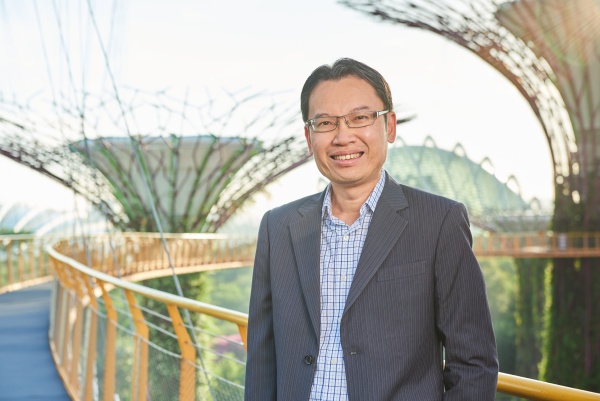
Felix at Gardens by the Bay.
“When I took on this job, one of my first trips was to go back to New Zealand to source new plants for our temperate Flower Dome. I visited a number of nurseries, just knocking on their doors, and I was made to feel so welcome. It just felt like I was at home.”
The world is a very different place from what it was in the 1990s, but Felix says the value of international education remains as important as ever.
“International education helps us to understand other perspectives better and demystify misconceptions we have about each other.
“In today’s uncertain world it is always good to have friends in other places. You discover that we have more things in common than set us apart.”
-
Around the world in five
Australia
Risk ratings could 'damage' long term health of Australian education sector
The latest release of immigration risk ratings for international education providers in Australia has raised questions about the best approach to ensure the sustainability of the sector.
Brazil
The Brazilian outbound market is continuing to grow after a post-Covid boom with increases across several products and new destinations emerging, while the role of the agent has become even more important.
Canada
Canadian Immigration Minister Marc Miller has announced an official national cap allocation of study permit applications for this year.
United Kingdom
But what do international students think of these proposed policy changes, and to what extent is it really having an impact on their interest in studying in the UK?
Global
Is the drive for internationalisation grinding to a global halt? Entry to major HE providers is getting tougher just as pressure rises within universities to attract ever greater numbers of international students.