Search
Showing 10 of 2262 results for read 2024 FRM Exam Part I - Quantitative Analysis online free
-
Māori and First Nations people connect during University of Toronto visit
18 indigenous students and two indigenous staff from the University of Toronto’s ‘First Nations House’ were invited to Aotearoa New Zealand for a week-long visit at Tirorangi Marae at the base of Mount Ruapehu in July.
The purpose of the visit was to enhance cross-cultural understanding between Māori and First Nations and Métis peoples and is significant as empowering iwi and hapū in the international education space is an important Te Tiriti obligation for ENZ, as an Aotearoa New Zealand government agency.
The visit took place during the time of ‘Puanga’ which is when the single star rises higher in the sky than the Matariki star cluster and is recognised by iwi and hapū that can’t see the Matariki cluster from their location.
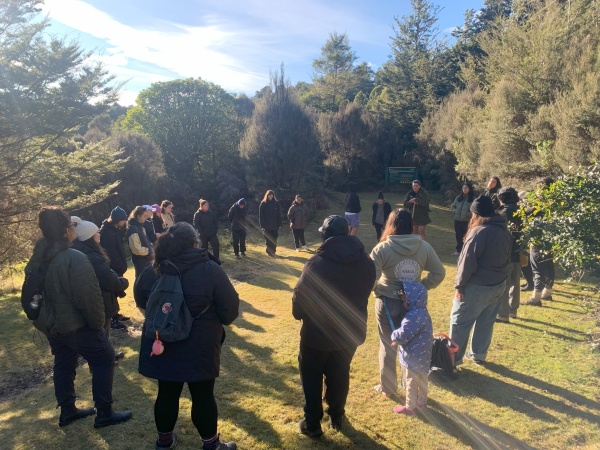
Māori and First Nations and Métis people have ’sharing circles’ as a common way to teach and learn.
The group participated in a wide range of activities in the area while staying at the marae. They were then welcomed to Te Whanganui-a-Tara by the ENZ Wellington office, visiting Te Tiriti o Waitangi at Archives New Zealand Te Rua Mahara o te Kāwanatanga and and Te Herenga Waka — Victoria University of Wellington, before finishing their trip in Whakatū (Nelson) with some adventure tourism activities.
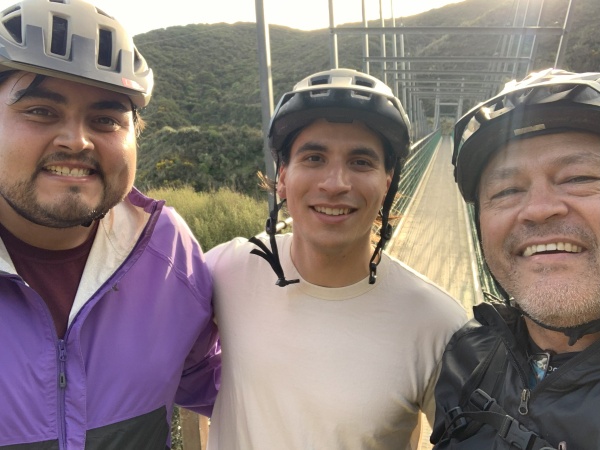
Indigenous students Kieren and Bailey from the University of Toronto sampling Wellington’s outdoors with ENZ's Craig Rofe.
The First Nations and Métis members of the group experienced what living on a marae was like and were also immersed in how a tribe engages with the environment, and how iwi businesses, local council and government agencies such as the Department of Conservation (DOC) operate in the field with iwi partnership.
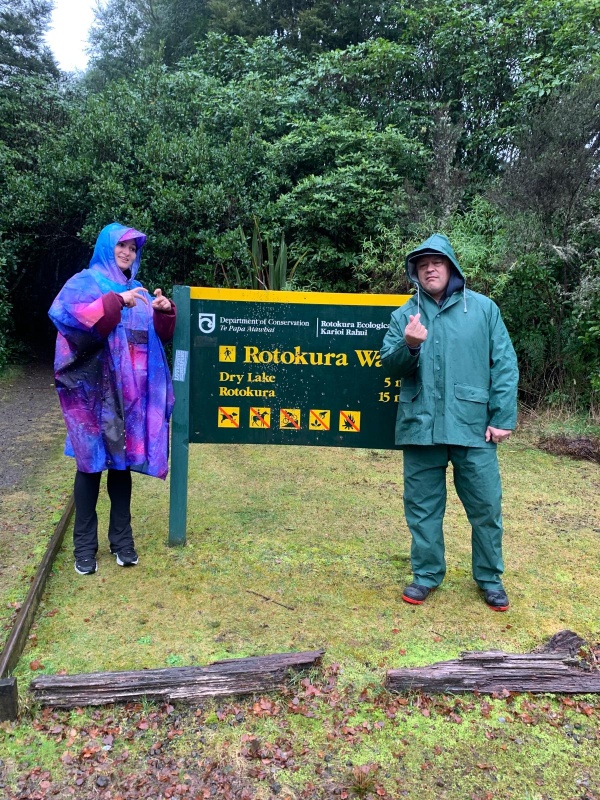
Iwi people sharing lake Rotokura’s healing power, a wāhi tapu (sacred place) for the local tribe.
Dr Craig Rofe, ENZ’s Kaitohutohu Matua Māori – Senior Advisor Māori, said that during the visit, Māori and First Nations and Métis people were able to compare the similarities and differences of their contexts to grow understand of their respective challenges and successes.
“The First Nations people’s struggles to overcome racism and prejudice resonated with tangata whenua, in particular the intentional elimination of language and the current mechanisms of revitalisation.
“Many stories shared with together showed the everyday trauma that resides in each of us and how, as indigenous people, we try to navigate these obstacles to make a better world for the next generation”, said Dr Rofe.
The trip motivated the students to connect more with their languages and culture upon their return.
Kenzie, from the Mohawk tribe said “when we meet again, I’ll be able to talk to you in my language, I’m declaring it!”.
Katherine from the Eskasoni First Nation tribe said “My experience connecting with the Ngāti Rangi revealed the transformative power of global Indigenous connections. Participating in ceremonies such as Hautapu and visiting Mount Ruapehu was particularly moving. Listening to their stories of ancestral ties to the land and taking part in traditional ceremonies that emphasized community and connection to the environment deepened my own personal understanding. This experience inspired me to initiate conversations with elders in my own community about our traditional land management practices.”
This experience also highlights the important offerings that Māori, and indeed indigenous knowledge, has to offer to international education. In particular, and not exclusively, the deep connection that indigenous peoples have with the environment and therefore natural obligation of care.

First Nation student, Alexis, discovers the origins, medicinal, spiritual and mechanical properties of harakeke (flax).
Sustainable practices and programmes can benefit from indigenous inclusion and perspectives, especially with the large-scale impacts of global warming and general pollution in many countries. The co-governance structure that Ngāti Rangi iwi and DOC work with as part of post Te Tiriti Settlement was used as an example of decolonised solutions within our New Zealand context.
There have been discussions between ENZ, Ngāti Rangi iwi, and the University of Toronto about an ongoing relationship and considering what a reciprocal engagement might look like moving forward.
Nāku te ika i hī, nāku anō i whakatau
Ki te haere, whāia i te Pare-i-te-taitonga, tērā taku ika.
This is a Ngāti Rangi iwi reference to the Ruapehu mountain being the ‘pillar post’ of the ‘Fish’ (North Island).
-
International student speakers lay the wero at NZIEC KI TUA
Sean Teow, Aria Ngārimu, Ibuki Nishida, and Albert Lu, each shared stories and insights with NZIEC KI TUA attendees that offered a reminder to those working in international education about why they do what they do.
The students’ speeches laid a worthy wero for the international education sector to continue the good work and keep international students at the centre of our work long after they arrive in New Zealand.
In this context, a wero is a traditional Māori challenge, performed by Māori warriors at a pōwhiri to test the intentions of visitors – by wielding weapons and laying down the challenge, with a token, such as a small branch for visitors to pick up and show they come in peace. Wero can also be used to convey a 'challenge' in other settings besides the traditional usage.
President of the New Zealand International Students' Association (NZISA), Sean Teow (Malaysia), spoke candidly about the full range of his student experience – offering insights on how he came to choose New Zealand to what the international education sector could focus on to better the student experience further.

Sean Teow speaks at NZIEC KI TUA.
Sean spoke about the need to focus on the “level of heart” that New Zealand exudes when interacting with prospective students alongside “bread and butter” attributes such as the high quality of education, lifestyle and beautiful natural environment.
“Be proud of the quality of New Zealand education, but also you as people, there is a level of heart that exudes itself when talking to students. That intention can be felt by a prospective student who may be afraid and anxious to embark on that path, a simple feeling that these people know how to take care of me, and they mean well.
“Don’t forget that the next time you recruit or interact with students for that could make the very difference with students remembering New Zealand and enjoying their time here. Embrace and embody manaakitanga,” Sean urged delegates.
Prime Minister’s Scholarship recipient Aria Ngārimu (Ngāti Porou, Ngāti Kahungunu ki Wairoa, Rongomaiwāhine, Te Whānau-ā-Apanui), a domestic student at Te Herenga Waka - Victoria University of Wellington visited India as part of her scholarship experience.

Aria Ngārimu at the Taj Mahal in Agra, India during her scholarship experience. Photo credit: Aria Ngārimu.
In her address, Aria aptly used an Indian folk tale of five blind men attempting to describe an elephant that they had encountered for the first time to highlight how individual perspectives can be wildly different yet equally accurate. Her speech was a powerful reminder of the need to be open to points of view different from our own.
International representative of the University of Otago Students' Association, Ibuki Nishida (Japan), offered a challenge to the sector to remember that every international student has a story and the importance of staying connected to their experience and story while they were in the country.

Ibuki Nishida laid a wero for the sector to remember that every student has a story.
“Don’t forget about those of us that are already here. I challenge you to not set a “finish line”, but instead learn from, and be a part of, each student’s ongoing story while we are here, that we can take to our loved ones to inspire them back home.
“Do not underestimate the power of word-of-mouth. When looking at growth, it might be one of the most important. And the way you tap into that, is to make sure students have a great experience while they’re here too. And remember that each international student is a story waiting to be told. So help us make it one for the books,” Ibuki said.

Albert Lu spoke about the differences in school life in his native Taiwan and New Zealand and what he likes about studying in Wellington.
Albert Lu (Taiwan), a Year 11 student at Wellington High School, noted the differences in life in Taiwan and New Zealand as he spoke about his experience in New Zealand.
Albert spoke about the NCEA curriculum providing an opportunity to students to enjoy a good balanced lifestyle, how confidence was the key to settling into life in New Zealand and importantly, ‘another way to improve language faster is to hang out with friends whose first language is not my first language’. Albert does this through joining student groups, attending church and generally being proactive about life here in New Zealand.
“Everyone is friendly, I love it,” Albert said.
*Wero: In this context, a wero is a traditional Māori challenge, performed by Māori warriors at a pōwhiri to test the intentions of visitors – by wielding weapons and laying down the challenge, with a token, such as a small branch for visitors to pick up and show they come in peace. Wero can also be used to convey a 'challenge' in other settings besides the traditional usage.
-
From the CE: Ki te Ao - To the World
Tēnā koutou katoa
This will be my last column as Acting Chief Executive, as later this month I will be handing over to Amanda Malu, ENZ’s incoming Chief Executive.
It has been a privilege to lead ENZ since November 2023. Over the past eleven months I have had the pleasure of connecting with the sector and New Zealand Inc colleagues to advance New Zealand’s international education offerings to the world. I have also deeply valued being part of the ENZ team – I have been awed by the commitment everyone has to international education.
It has been inspiring to be part of New Zealand Inc’s commitment to double the value of our exports in the next decade. We are working alongside our major export agencies, and collectively working to find solutions.
The Government has also signalled increased focus on Southeast Asia as a key market for New Zealand. Recently I was pleased to join our Minister, Hon Penny Simmonds, when she held bilateral meetings with senior delegations from the Philippines and Viet Nam.
Some of the highlights during my time at the helm have included interacting with scholars at the first ever Manaaki New Zealand Scholarship Conference in May, attending the New Zealand – China Education Forum with China’s Minister of Education His Excellency Dr Huai Jinpeng in June, and receiving the President of India, Honorable Smt. Droupadi Murmu, at our New Zealand International Education Conference (NZIEC) KI TUA in August. It has been wonderful to witness first-hand the transformative power of international education.
I would like to acknowledge and thank everyone in the sector who work so hard to grow international education and its value to New Zealand. As I return to the Board, I am very much looking forward to seeing the sector continue to flourish.
Kei ōu ringaringa te ao.
The world is yours.
Dr Linda Sissons
Acting Chief Executive
Education New Zealand Manapou ki te Ao -
Winners of KIWI Challenge announced
This year was the first where university students were able to enter a new category alongside the schools' challenge.
The winning teams from Petra Christian University and USG Education headed off strong competition from eight other finalists, drawing praise from the judges for their solutions to support youth-led Small and Medium Enterprises (SMEs).
Finalists presented to a panel of judges from University of Otago – Ōtākou Whakaihu Waka and Education New Zealand Manapou ki te Ao (ENZ), who were cohosting the initiative.
Both winning teams received a voucher valued at 10,000,000 Indonesian Rupiah (approximately 1,000NZD) as well as virtual internships from the University of Otago – Ōtākou Whakaihu Waka commencing in semester one, 2025.
Tech-led solutions
A team from Petra Christian University developed an app ‘Partify’ which connects emerging small businesses and keen part-time workers. Businesses post part-time jobs, and workers swipe to find flexible gigs nearby, with AI matching candidates based on skills, location, and availability.

Partify university winner – ENZ market manager Naluri Bella and University of Otago Regional Market Manager Sarah Ewing present the award for First Place in the University category to team members from Petra Christian University for their app ‘Partify’.
In the high school category, a team from USG Education took the top prize with ‘LAW4MSME’, a platform allowing small businesses to access legal information and advice.
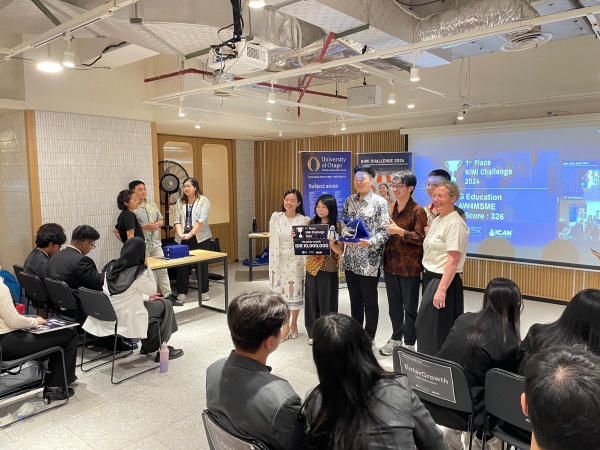
LAW4MSME High school winner - ENZ market manager Naluri Bella and University of Otago Regional Market Manager Sarah Ewing present the award for First Place in the University category to team members from USG Education for their platform “LAW4MSME’.
Explaining the group’s business idea, team leader for LAW4MSME, David Francis said the students found that Indonesian youth-led SMEs lack knowledge of the laws and regulations needed to run their businesses.
“To address this, we developed an AI bot that educates SME owners on these regulations, helping them navigate legal requirements more effectively,” David said.
The KIWI Challenge competition aims to inspire youth across Indonesia to engage in entrepreneurial activities and help resolve societal issues. Over the five years the competition has run, 1000 Indonesian youth have participated. This year, Education New Zealand Manapou ki te Ao (ENZ) partnered with University of Otago to co-host the initiative.
This year’s competition included 49 teams with a total of 221 student participants.
Mentorship key
Mentorship is a key element of the competition. The finalists attended a workshop run by Associate Professor Dr Conor O’Kane, Head of the Bachelor of Entrepreneurship programme at Otago Business School. This assisted entrants to develop their ideas and refine business plans.
ENZ Acting General Manager International Ben Burrowes said he’s delighted to see the continued development of the KIWI Challenge.
“Inviting university students for the first time has given us the opportunity to include a whole new cohort of talented young entrepreneurs, and we have been very impressed with the quality and creativity of their submissions,” Ben said.
“The competition has also benefitted from the enthusiasm and expertise of our colleagues at the University of Otago, and we are grateful for their willingness to partner with us for the KIWI challenge’s fifth year.”
Dr O’Kane said it was inspiring to witness the quality of entrepreneurial thinking among Indonesian students.
“These students have very bright futures. The concepts and programmes the finalists presented were remarkable and captured the impressive ability of the teams to identify tangible business problems and visualise and communicate a solution to these challenges,” Dr O’Kane said.
-
Growing visibility of New Zealand education in Latin America
From 12 -21 March, Education New Zealand Manapou ki te Ao (ENZ) held its first in-market, in-person roadshow in Latin America since before the Covid-19 pandemic. A total of 18 New Zealand education providers took part in the activities held in Colombia (Bogotá), Brazil (São Paulo), and Chile (Santiago), which brought together 143 representatives from 97 education agencies.
Representatives from institutions across New Zealand’s education sector (universities, English language schools, PTEs, and secondary schools) had the opportunity to network with agents and recruit students directly, strengthening connections with strategic partners and raising the profile of New Zealand in Colombia, Brazil, and Chile.
ENZ’s Director of Engagement for Latin America, Javiera Visedo, and Brazil Market Development Manager, Bruna de Natale, led the activities in all three countries. They provided full support to the New Zealand delegation, offering strategic information to maximise the professionals' time with Latin American partners, as well as sharing insights about the New Zealand institutions with local agents.
Through institutional presentations, one-on-one meetings with agents from the three countries, and collaborative discussion panels, where all shared best practices and ideas for continuing partnerships and New Zealand institutions were able to advance their business relationships with local partners.
This was also the perfect opportunity to launch the Spanish and Portuguese versions of ENZ’s Learn New Everyday marketing campaign, that was well received by agents as it provided them new assets and videos to use in local languages.
During the South America Roadshow, some New Zealand institutions also took part in parallel events in Bogotá and Santiago, organised by ENZ in collaboration with local partners. This included a student fair and a dedicated session with private and International Baccalaureate schools, reflecting the growing interest from students and families in pursuing undergraduate studies in New Zealand.

ENZ's Director of Engagement Latin America Javiera Visedo (pictured fourth from left, bottom row) and Coordinator Simone Cocco (to Javiera's right) with roadshow participants at one of the events in Bogota.
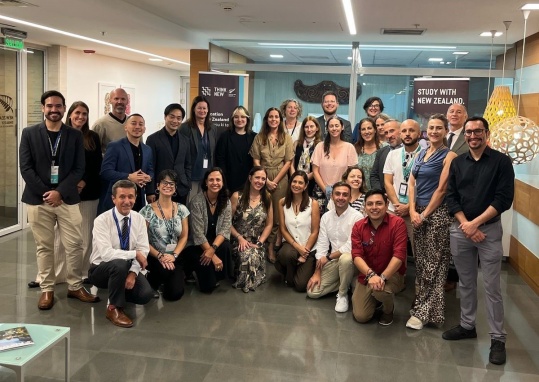
ENZ's Market Development Manager Bruna de Natale (pictured second from right, bottom row), Director of Engagement Latin America Javiera Visedo (pictured fifth from left, bottom row) and Coordinator Simone Cocco (pictured second from right, bottom row) with roadshow participants at one of the events in Santiago.
Director of Engagement Latin America, Javiera Visedo, said engagement between New Zealand institutions and the Latin America market advanced significantly during the roadshow.
“There is no substitute for the connections and momentum we build when we meet face-to-face, and the trusted relationships we build,” she said.
“Engagements like these are key to ensuring the sustainable growth of students from Chile, Colombia, and Brazil to New Zealand,” Javiera added.
Feedback from education sector participants was positive. Director of Mount Maunganui Language Centre, Geoff Butler, said he wouldn’t hesitate to get involved in these events again.
“Post-pandemic, we were keen to have official events to reconnect with these markets - the events didn’t disappoint,” he said.
“There were excellent opportunities throughout each event day to engage with agents not only at our desks, but informally too,” Geoff added.
If you’re a New Zealand education provider and are interested in learning more about the Latin America market, reach out to the team via email: latinamerica@enz.govt.nz.
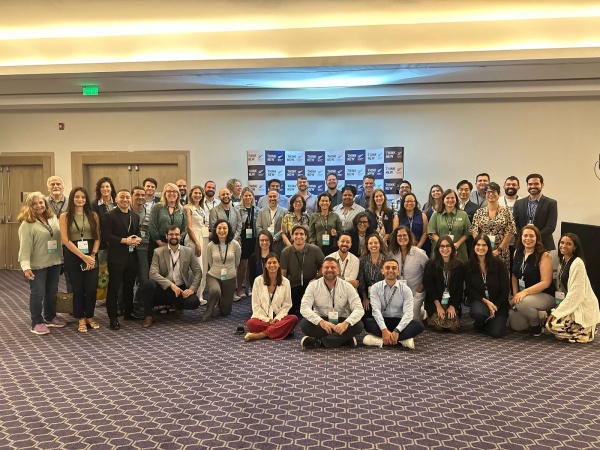
Attendees of the São Paulo ENZ agent event.
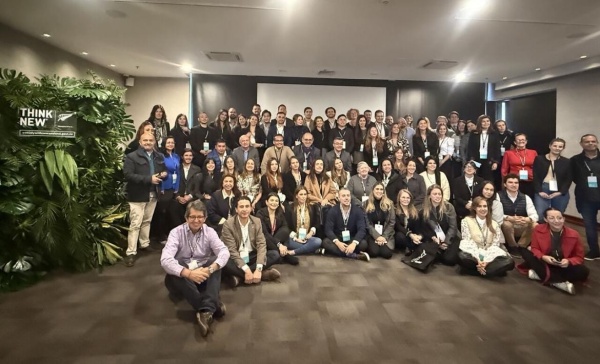
Attendees of the Bogotá ENZ agent event.
-
Charan overcomes obstacles to finally return to New Zealand study
Having to dig deep to overcome the disruption to his education caused by the Covid-19 pandemic, he recently returned to Lincoln University to pick up where he left off. He is part of the second cohort of 1000 international students able to come back to New Zealand to complete their studies after being caught offshore when border restrictions began in March 2020.
As Covid spread, the Indian student was recalled to New Zealand only six weeks into his semester exchange at Wageningen University in the Netherlands, but our border closed while he stood in line at Amsterdam’s Schipol Airport.
“It was pretty tense,” he says. “The flight I had initially booked was cancelled, so I had to book the next earliest flight which was at 7am the next day. I reached the airport around 2am but while waiting for my boarding pass, I received a call from New Zealand asking me not to board the flight as the borders were closing that night.”
Charan could not even get back to India, as the airports he would need to transit in were closed. At the time, he was in the third year of his Bachelor of Agricultural Science degree, with one year left to complete.
He says the staff at both universities were super-helpful and after many flurried emails and calls, it was agreed he could return to his studies at Wageningen. With no sign of the border opening in June he was granted permission to stay until the end of the year, and he managed to secure an extension to his Erasmus scholarship which funded his living costs.
“I decided I was going to treat what was happening as an adventure”
Covid disruption a stressful time
But the disruption came at a price. The high-achieving student failed his first test after the stressful experience at the airport. “It took me some time to accept what had happened. I just couldn’t focus on study.” But his second attempt was successful, and he never looked back.
“I decided I was going to treat what was happening as an adventure, and to make the most of my time in the Netherlands.”
By the end of 2020, Charan was still unable to return to New Zealand and he made the decision go home to India. “The first four months were pretty chaotic, but I was really blessed I could be with my family.”
He didn’t know how long he would be in India but was committed to getting back to Lincoln to complete his degree. “I didn’t want to study remotely. I decided it was better to have time off and then return to do my Honours year.”
In the end, it took another year and multiple attempts at securing a place in MIQ before he could return to New Zealand. “When they brought in the lottery system, I had to wake up at 3am each week to log in and try and secure a place. I’m still trying to look at the experience positively and I know that I have stories to share in the years to come!”
Charan arrived back in Christchurch in January and is excited to be underway with his Honours year. He is working with Professor Clive Kaiser at Lincoln University’s new Centre of Excellence for Potato Research and Extension.
Potato research of value internationally
He is researching the development of a rapid test for the identification of Candidatus Liberibacter in potato leaves and tubers. The bacterium causes Zebra chip, a disorder of potatoes which creates distinctive stripes in the flesh and poses a threat to commercial potato growers. Rapid identification of affected plants in the field will help reduce cost and wastage for the $1 billion potato industry in New Zealand.
“I was keen to be involved in this research because I like solving problems and this is a real-world problem with big implications here and overseas,” Charan says. “Potatoes are grown all around the world and almost every culture uses them as a staple part of their diet. So, this research will be of value internationally.”
Charan is eyeing a future in vertical farming, an intensive form of horticulture where crops are grown in trays indoors under controlled conditions and he hopes to one day run his own business.
He says studying at Lincoln has been “an amazing experience” where he has made friends with New Zealand students and other international students. “I learned a lot about different cultures from them.”
Charan describes the challenges that Covid has thrown at him as “daunting” but says that overcoming them has made him more resilient. He is grateful to be back on track with his international education in New Zealand, a place which “keeps you grounded and allows you to focus on your study”.
-
International students cap off education experience with Mural
Three students have rounded off their international education experience in Aotearoa New Zealand by teaming up with respected artists and local iwi to create a large street-side mural which celebrates the culture and diversity of Tāmaki Makaurau, their host city.
In the first collaboration of its kind, international students Nikita Sharma from Unitec, and Celia Lee, and Jenny Zhong from Auckland University’s Elam School of Fine Arts, were chosen to design and paint one panel of a three-panelled mural after Study Auckland invited art students from tertiary institutions across the city to join the project.
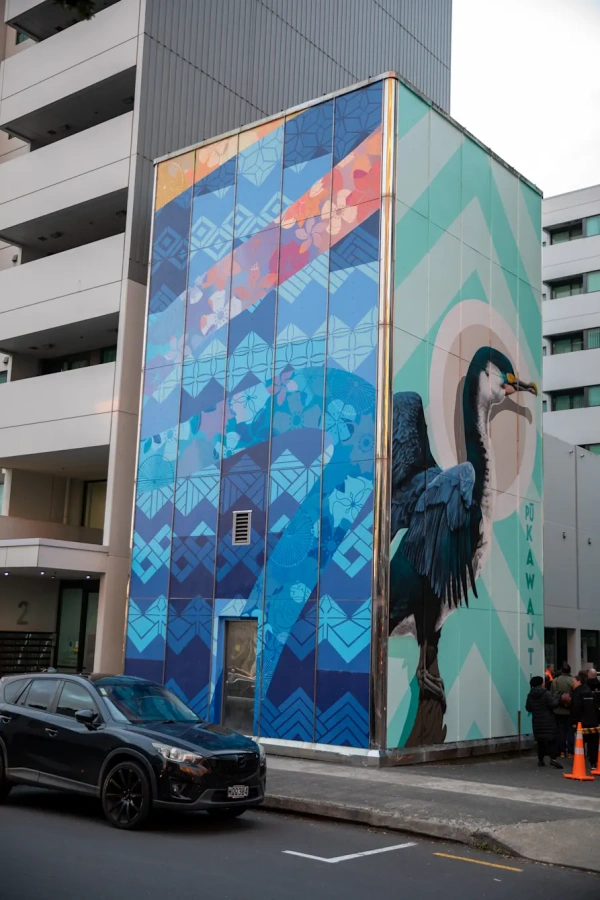
Nikita, who came from India to study in New Zealand, enjoyed working on the project along with Chinese-born New Zealander Jenny and Taiwanese international student Celia. “Our panel depicts diversity, inclusion and culture,” she says. “The project has given us the chance to give something back to the city and to the people who have welcomed us. We hope people feel a sense of connection to the artwork.”
International students were given the opportunity to connect with local iwi
The aim of the Study Auckland panel was to give international students the opportunity to connect with local iwi and work with respected local artists, including Hana Maihi of Ngāti Whātua Ōrākei, to explore what it means to make public art in New Zealand.
To help with the design process, the students joined Hana in a three-day wānanga at Ōrākei Marae to immerse themselves in Māori history, and learn about the significance of the mural’s location in Te Tōangaroa, on Ngāti Whātua Ōrākei owned land.
Study Auckland business development manager Beth Leyland, who led the project, is thrilled with the outcome and says the students are too.
“Auckland Unlimited’s Head of International Education Henry Matthews says the project truly reflects the principle of hospitality amongst the diverse cultures that make up our collective world right here in Tāmaki Makaurau.”
The students’ panel was funded through a $20,000 grant from the Ministry of Education’s International Student Wellbeing Fund. The other two panels were designed and painted by Hana and Te Whetū Collective member Poi Ngawati to bring awareness to the rich Māori heritage and taiao (environment) on which the city was founded.
Collectively, the three panels depict the importance of welcoming different cultures and diversity in Tāmaki Makaurau.
The vibrant 12-metre-high mural, incorporates elements of biodiversity which were once part of the landscape of the area. The students’ panel includes the poutama, a well-known step-like pattern seen in tukutuku panels adorning the walls of wharenui.
In 2019, 115,713 students from 180 countries enrolled to study in Aotearoa New Zealand, and became part of our communities. This injected $4.9b into our economy and supported more than 48,000 jobs. Just over 63,000 of those students were based in Tāmaki Maukaurau. The city currently hosts just under 13,000 international students.
-
Pakistani student leverages language skills to connect communities
Fluent in Punjabi, Urdu, and English, and passionate about community service, Usma soon became a key player working to support and connect ethnic communities in Christchurch.
So extensive have her achievements been, that she has been honoured by the university with a coveted Blues Award for community engagement, and by the Christchurch City Council with a Civic Award.
Usma arrived in New Zealand in late 2016 and gave birth to her third child shortly after arriving. “It gave me the time I needed to assess society here, and I realised the value that was placed on volunteer work.”
New Zealand values transferable skills
“My background was in teaching and ESOL (English for Speakers of Other Languages) instruction. I did teach here when I first arrived, but it was not fulfilling enough,” she says. “I needed to think what other skills I had to offer in an area of work I was passionate about. New Zealand is not a destination of degrees, it is a destination of skills, where whatever transferable skills you have to offer, are valued.”
She initially got involved in UC’s Pakistani Student Association, planning events which quickly extended beyond the student community. “I got great feedback from the wider community and different ethnic groups started coming along. People from these communities were looking for connectivity and involvement and it ended up being a multi-cultural hub.”
She admits it was not without challenges, but she was determined. “I was an international student, a woman, a mother of a special needs child, and I was working. But I managed my time. I enjoy doing volunteer work and it comes naturally.”
In her second year at Uni, she secured a role as a Diversity and Engagement Officer with the Ministry of Ethnic Communities and juggled both study and work. It was in this role that she became involved in the Government response following the Christchurch mosque attack in 2019.
Frontline worker following mosque attack
“I was one of the frontline workers dealing with victims and those left behind. Some of my colleagues were victims,” she says. “It was a difficult time. I had never had any exposure to such an event, or what the aftermath might be like. Hearing the stories, and being part of it, are totally different things.”
“I’m very proud of my work and found it very rewarding. I discovered my strengths and weaknesses and learned how much I had to offer. I could speak with many of the widows in the Muslim community in their own language, understand their needs, and advocate on their behalf. I learned how to deliver the key messages to the government agencies involved in the response and formed a link between the two groups.”
“The migrant communities have so much resilience and I believe that every disaster brings opportunity to come together, to heal, and to grow.”
Usma went on to become involved in Widows of Shuhada – an eight-part Plains FM/RNZ podcast documentary series which followed the journey of four widows following the attack.
Soon after, Covid-19 arrived in New Zealand and Usma worked on engagement with local ethnic communities, translating the Government’s messages and communicating them through a range of digital channels.
Tapping into the skills of international students
But she didn’t stop there. Usma was also influential in Christchurch’s Ethnic Communities Skills Build Programme, a project designed to smooth the pathway of migrants and international students into employment in New Zealand.
International students could join in workshops, meet career counsellors and job brokers from the Ministry of Social Development, reshape their CVs, and attend job fairs.
“I believe we need to tap into the high-level skills of post-graduate international students. We need to progress them in the right direction, utilising their skills in science, technology, and innovation.”
As for her own career, Usma could not be happier. She has secured a full-time role as a policy analyst at the Ministry of Primary Industries in Wellington and has taken a step back from her volunteer work to focus on completing her PhD this year.
She is grateful for the opportunity to study in New Zealand and to bring her family with her. Her husband is working, her children are happy, and her special needs daughter has opportunities she wouldn’t have had in Pakistan.
Usma still acts as a mentor for international students and tells them if they are to make the most of their time in New Zealand, they should “think outside the box”.
“They should think about the skills they have to offer in the community, and they will be rewarded with a transformative experience. Leaving behind the social constraints of your home country can be liberating. It’s all about following your dream.”
Usma says she’s already landed her dream job, but she plans to continue her community work once she has completed her PhD.“I believe it is my contribution to this country and I love doing it. I’m not likely to stop. I’m just settling in, finishing my PhD, and getting ready for something big. I have ambitious plans.”
-
Prime Minister's Scholarship shakes up geology student's plans
Soltice Morrison was only 15 when that earthquake happened, but she is part of a new generation of students and researchers wanting to equip themselves with the latest knowledge and technology to better understand New Zealand’s vulnerability to quakes. The best way to achieve this is through international collaboration with other countries which face the same risks.
Having already completed a BSc in Geology and Oceanography from Otago University, Rotorua-born Soltice secured a Prime Minister’s Scholarship for Asia during her Honours year in 2018, which allowed her to enrol in a post-graduate short course in geology at Hokkaido University in Japan and stay on to complete most of her Honours research.
Prime Minister’s Scholarship allowed joint research
Under the guidance of her supervisor, Dr Virginia Toy, she was involved in a project which studied the characteristics and behaviours of New Zealand’s Alpine Fault and Japan’s Median Tectonic Line to better understand what causes earthquakes in both countries.
"We’re both very seismically active countries but Japan is much more advanced in its use of technology. We were able to bring some of that knowledge back to New Zealand."
Soltice says that without the funding she received through the Prime Minister’s Scholarship (PMS), she would not have been able to study abroad.
The scholarship programme to Asia was established in 2013 and extended to Latin America in 2016. To date, 2400 students have been given financial support to study abroad. While currently on hold due to Covid travel restrictions, the programme is poised to restart once borders reopen.
Importance of New Zealanders studying abroad
Funded by the government and administered by Education New Zealand, the programme recognizes the importance of giving New Zealanders the opportunity to have an international education experience in countries where we have key trade and business relationships.
There are few restrictions on study options, with the programme having broad goals to enhance understanding of other cultures and business practices; establish new friendships and networks; and upskill the New Zealand workforce through overseas experience.
“It’s very important to connect with students and colleagues internationally in order to get ahead,” says Soltice. “We can get caught up thinking that the New Zealand way is the only way. Studying overseas helps you broaden your horizons, your knowledge, your understanding of different cultures, and the way things can be done.”
In geophysics, Soltice says international collaboration is essential.
“We’re able to learn a lot from Japan and the advances they have made in technology and monitoring.”
The time Soltice spent in Japan ended up taking her career in a new direction. “While I was there, I was able to understand the effects of seismic activity on buildings and how we can strengthen our cities to ensure they’re resilient, so I’ve ended up in the engineering space working for Aurecon.”
But her work also has an environmental focus and she is currently part of the multi-disciplinary team working on the Lakes 380 project, which seeks to combine best scientific thinking with mātauranga Māori (traditional wisdom and knowledge) to better understand the social, cultural, and environmental history of Aotearoa’s lakes. “It’s rewarding work and I love it.”
Reawakening of cultural identity
Soltice says her time in Japan prompted a reawakening of her own cultural identity. “I had always tried to blend in at home, but the questions I was asked about my background while I was away made me realise I was proud of my Māori ethnicity and also taught me the value of indigenous knowledge.”
Building on this confidence, she has set up a Māori strategy group with colleagues at Aurecon “looking at ways we can weave cultural understanding with scientific knowledge into the work we do.”
Soltice says she made life-long friends during her time in Japan and built a valuable network of contacts. “I work closely with the geophysicists here at Aurecon and sometimes when we have questions, I will reach out to my contacts offshore.”
Three years on, she remains a passionate advocate for Prime Minister’s Scholarship programme. “The overall experience – the research, the culture, the living situation, I would 100 percent say it was one of the best times of my life.”
Students value flexibility, networks, and personal growth
The positivity of Soltice’s experience was echoed by other scholarship recipients in a recent survey conducted by Education New Zealand. Close to 300 students participated, with 98 percent saying they would recommend PMS to others. Benefits they identified included the unique flexibility of the programme, the networks they built, the opportunity for personal and professional growth, and the chance to better understand New Zealand’s place in the world.
As for life after the programme, 57 percent said they would become involved in global causes, 50 percent would become involved in political or policy issues, and 44 percent would become involved in their local community or iwi.
-
From the Chief Executive: Growth and global partnerships in international education
Kia ora koutou,
It’s great to be home following an impactful, whirlwind visit to Beijing for the China Annual Conference and Expo for International Education (CACIE).
I am pleased with the collective outcomes we have achieved from this visit. For one, New Zealand education institutions formalised 32 new partnerships with their Chinese counterparts that present real opportunity for knowledge exchange and pathways for students to experience the best of both countries.
ENZ signed a letter of intent with the China Center for International People-to-People Exchange to grow our education cooperation, particularly through institutional relationships across higher education and schools.
As Country of Honour at CACIE 2025 New Zealand had unparalleled opportunity to demonstrate why we are a high-quality education destination, backed by a strong student experience and a reputation for safety, inclusivity and innovation.
Last week ENZ’s extended leadership team, including our offshore Regional Directors, came together in Wellington. As part of our programme we visited four education providers across the region – Wellington College, Victoria University of Wellington, Whitireia and WelTec Petone and Le Cordon Bleu Wellington – before meeting with the Schools International Education Business Association (SIEBA) to understand the work they do with schools nationwide. These were insightful engagements that enriched our understanding, and we appreciated the warm welcome extended.
In other news, I am pleased to share with you that Tony Gray has been appointed permanent Chair of the Board of Education New Zealand. Tony has been a strong advocate for us while Acting Chair and a genuine pleasure to work with, so it is fantastic to have him confirmed in the role to 31 October 2027.
Lastly, I wanted to finish by acknowledging the sad passing of two public sector colleagues, Paul Irwin and Neil Miller, during the month of October.
Paul Irwin was a valued colleague at ENZ, having been a member of the Senior Leadership Team and part of our whānau for seven years. Although I didn’t work with Paul at ENZ, I knew him from his advertising industry days when we worked together on the ‘It’s Not OK’ campaign for action on family violence. His passing is a tremendous loss and he will be remembered for his strategic smarts, calm nature, and his leadership of New Zealand’s education brand over the years.
As Chief Advisor - Policy and International at the New Zealand Qualifications Authority, Neil Miller was a regular presence at International Peak Body meetings over the last four years. Neil would bring his deep-thinking skills and humour to these meetings, and always took a genuine approach to listening and helping solve issues that matter to us all.
Our thoughts are with their families and friends.
Moe mai rā, Paul and Neil.
Kua whetūrangitia kōrua
Return, take your place amongst the stars along with your ancestors that adorn the sky.
Ngā mihi nui,
Amanda Malu
Chief Executive