Search
Showing 10 of 982 results for search for pheen4uuu from wiki 2025
-
Strengthening education links in US
The trip included speaking at the world’s largest annual international education conference (NAFSA), as well as interviews with international education media including Chronicle of Higher Education, PIE News, and Times Higher Education. Chris Hipkins also met with US government officials and education professionals from various organisations and institutions.
The trip began with an open forum discussion with New Zealand education representatives. Chris Hipkins responded to questions relating to the challenges New Zealand faces as it reopens and rebuilds its international education sector. He then met with Jared Polis, Governor of Colorado. Their discussion touched on commonalities between New Zealand and the State of Colorado and compared approaches to education reform and improving education outcomes for students, particularly those from marginalised backgrounds. They also discussed the importance of research collaboration, particularly as it relates to STEM subjects and the global climate crisis. The meeting ended with agreement that deeper relationships between institutions in Colorado and New Zealand would be beneficial.
Speaking at the opening plenary at NAFSA, Chris Hipkins emphasised that New Zealand is once again ready to welcome international students. NAFSA leadership invited the Minister to a private reception after the plenary where they shared their enthusiasm for New Zealand reconnecting with the world. During his day at the Denver Convention Center, the Minister also took a tour of the conference exhibit hall, chatting with both New Zealand and international educators.
“It was wonderful for the Minister to get this chance to engage with our education providers and get a broader look at the international education field,” says Lisa Futschek, ENZ’s General Manager International. “It was great for him to see how well-regarded New Zealand’s education system is in the global international education ecosystem.”

Guests enjoying the New Zealand reception at NAFSA
Chris Hipkins then met with Deputy Assistant Secretaries of the US State Department’s Bureau of Education and Cultural Affairs (ECA) and the Bureau of East Asian and Pacific Affairs. He reaffirmed New Zealand’s strong partnership with the US and the international education sector’s commitment to diversity, equity, and inclusion through our continued partnership with ECA around the Fulbright and Gilman scholarships, which enable students of limited financial means to study abroad.
“The Minister received a very warm welcome from our colleagues at the State Department who were excited to hear our borders are opening,” says Education Counsellor to the US and ENZ’s Regional Director to the Americas, Middle East and Europe, Amy Rutherford. “It’s great to have such a strong relationship with a government’s education agency committed to the same values that we are.”
A variety of organisations involved with the delivery of international education in the US also met with Chris Hipkins for a roundtable discussion. This covered the unique opportunities for New Zealand in the international education sector and what sets us apart from other countries and their education systems.
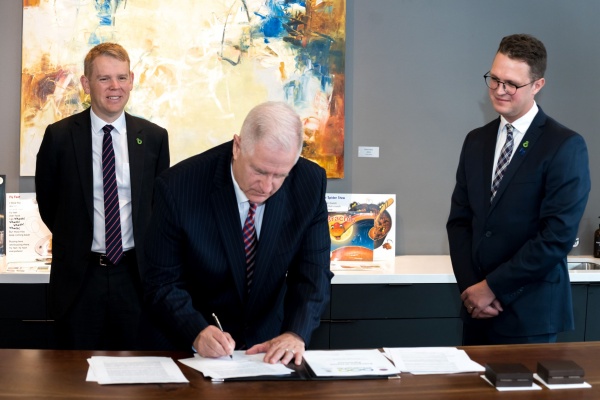
(l to r) Education Minister Chris Hipkins, Kahle Charles, Assistant Superintendent of Assessment, Curriculum and Instruction, St Vrain Valley School District and Scott Cardwell, Co-founder and CEO, ImmerseMe. Mr Charles is signing the agreement between St Vrain and ImmerseMe.
On the final day of his visit, Chris Hipkins headed to Xero’s Denver headquarters to participate in a roundtable discussion with several principals and school superintendents in surrounding Denver school districts, as well as the New Zealand edtech company ImmerseMe and representatives from JillE Literacy. The conversation touched on the changing face of early childhood and school education due to COVID. Panellists were interested in the approaches and policies being implemented in New Zealand and all were agreed that we would benefit from working together and learning from each other to improve education outcomes. At the end of the roundtable, the Minister witnessed the signing of a seven-year partnership agreement between ImmerseMe and St. Vrain Valley School District, and the gifting of GlobalEd’s JillE Literacy books to roundtable participants.
The Minister’s involvement, along with the launch of the I AM NEW global marketing campaign, certainly helped lift New Zealand’s profile at NAFSA. There was a lot of interest inNew Zealand’s announcement of reconnecting with the world, and the eight universities and Te Pūkenga were kept busy meeting with partners each day of the conference.
The trip strengthened our connections with the international education community, including with US study abroad professionals recruiting students to study in New Zealand. As study abroad applications begin to open for January 2023 study, thanks to the Minister’s visit to NAFSA, the international education community will be well aware that New Zealand is ready to host students and can provide a unique and high-quality education experience.
-
ENZ discontinues recognised agency programme
The decision followed a global review that included input from NZ education providers, education agents globally and NZ government agencies. It also considered practice across other jurisdictions and the global education agent landscape in a post-pandemic environment. The decision becomes effective immediately. The review was foreshadowed in the refresh of the New Zealand International Education Strategy in 2022.
“There are many positive aspects of our engagement with agents,” said General Manager of Sector Services, Sahinde Pala.
“Our global staff network and trusted relationships with agents are important factors in assisting students who wish to further their studies in New Zealand. ENZ’s AgentLab platform has also been a rich resource and information hub for education agents, particularly during the pandemic. We will continue to offer these services going forward.”
“But there were also issues. Our review showed that many successful agents did not see the value in joining the programme. The programme was also not accessible to emerging education consultants and organisations, and it did not meet the needs of New Zealand education providers.”
“After careful consideration of the feedback from many agencies and New Zealand education providers, it became clear that the existing programme was not fit for the emerging environment and the decision was taken to discontinue.”
“Looking forward, we want to ensure a more even-handed and efficient approach and feel the best way of achieving this is to open up the power of our international network, along with our information and training capability to all agents, regardless of their size, expertise or capability.”
While the ENZRA programme will cease, the new AgentLab platform will be launched in August and will include a wide range of updates relevant to education agents, including a calendar of events, details of upcoming webinars, resources, and latest news and updates from across the New Zealand education landscape.
Education agents will be able to access the same level of information and resources via the AgentLab platform. The discontinuation of the ENZRA programme will not affect this.
Any agent seeking more information or support should email: agent.help@enz.govt.nz
For further information:
Sai Raje | Senior Advisor Communications, Education New Zealand
+64 21 479 649
Notes to Editors:
About Education New Zealand (ENZ) https://www.enz.govt.nz/
Education New Zealand Manapou ki te Ao (ENZ) is the government agency responsible for taking New Zealand’s education experiences to the world. ENZ promotes a New Zealand education as one that teaches students to be critical thinkers, problem solvers and lifelong learners, which will help them succeed in their future careers and create a positive impact on the world.
With approximately 100 staff in 18 locations around the world, ENZ works closely with New Zealand’s diverse education sector including schools, English language providers, Private Training Establishments, Te Pūkenga (Institutes of Technology and Polytechnics), universities; and internationally with NZ Inc agencies, Government agencies and education providers to encourage sustainable growth and identify opportunities.
-
Massey student’s robotic gut capsule could be a game-changer
Millions of people globally die every year from gut-related illnesses, and many more live a life of suffering, yet diagnostic tools remain quite rudimentary.
Arriving from Pakistan as an international student in 2018, armed with a BSc and MSc in Electrical Engineering, Rehan was excited to join the Microbiotics Lab at Massey University. There he accelerated early work on a micro capsule which could be swallowed and was able to collect samples of the microbiome in specific parts of the gut.
Unlike the poop in a jar method, the capsule’s targeted sampling provides a much more detailed analysis, allowing for earlier diagnosis of killer diseases such as cancer and diabetes and easier treatment of inflammatory conditions like Crohn’s and coeliac diseases.
Early treatment of gut disease can save lives
Treating disease early reduces complications and saves lives. And with the capsule expected to be quite affordable to produce, developing countries could share in the benefits it would bring.
“It is a huge step forward. There are so many advantages and applications,” Rehan says. “The gut is still a bit of a mystery, but the micro-organisms that live there can tell us a lot about our health.”
While an endoscopy camera capsule can take images, it has limitations, and clinicians are excited by the prospect of having such a sophisticated but easy-to-use device to help with diagnosis, Rehan says.
Research project shows commercial promise
What started as a research-oriented project is showing commercial promise. And not just from doctors. Rehan has also had interest from the veterinary sector, and nutritionists keen to better understand nutritional absorption.
The next step is to hone the final details of the capsule design and apply for patents. Once he has ethical approval, he can begin testing in animals. He expects that to be within months.
Rehan is proud of what he has achieved since arriving in New Zealand with his young family three years ago. He says he could have gone to the UK or US, but chose New Zealand based on recommendations by friends already studying here, who described the research environment for international students as open and collaborative. He was also excited by the work being undertaken in microbiotics by his supervisor Ebu Avci and was keen to be involved.
Collaborative environment makes for impactful outcomes
“I’ve valued the network of like-minded people I’ve developed and know that I’ll have a supportive community to call on when I’m no longer in New Zealand,” he says. “The easy collaboration with other universities and organisations such as Callaghan Innovation and MacDiarmid Institute also makes the research and outcomes more impactful.”
Such is the life-saving potential of Rehan’s gut capsule, that he was selected to represent New Zealand last month at the International Falling Walls Lab competition in Berlin, Germany. The competition provides a platform for early-career innovators to present, in a three-minute pitch to a jury of experts from academia and business, how they might fix pressing global challenges. Rehan had to compete remotely and wasn’t the ultimate winner but says he it was a great opportunity to network and learn from other research developments going on around the world.
Rehan plans to spend next year writing his thesis before returning to Pakistan. Funded by his government to study internationally, he is conscious of the need to return home to share his skills and knowledge but has not ruled out returning to New Zealand to undertake further research in the future.
-
Sustainable growth for schools
Industry experts shared their vision of sustainable school growth at NZIEC.
Why should students choose your school?
Dr Stephen Holmes, founder and Principal of The 5Rs Partnership, says the international school landscape is compelling for students.
He believes New Zealand schools will benefit from having clear, distinctive positioning.
“Find a cogent and compelling reason for your audiences to choose your school over others,” he says.
Stephen’s top tips include:
- Find your school’s intrinsic strengths rather than trying to be everything to everybody. “Don’t give me 50 reasons to choose you – give me three reasons to choose you.”
- Communicate substance – teaching, pedagogy, curriculum and staff.
- Back up your claims with evidence of the impact you have on students.
- Make sure staff are engaged with your messaging, so the rhetoric is backed up by the delivery.
- Focus on reputation and co-brands (affiliations, partnerships; who goes to your school).
- Word of mouth has more impact than traditional marketing. Parents, staff and former students are all important advocates.
How to promote internationalism
For John van der Zwan, Executive Director of SIEBA, internationalisation is a powerful driver for student recruitment and an essential element of future-focused education.
He says the aim of internationalisation is to help students become culturally competent and globally ready.
John believes internationalisation requires a commitment across all areas of the school, and should be embedded within teaching and learning.
The role of international staff in internationalisation, he says, is to:
- Support or coordinate cultural PLD (professional learning and development).
- Promote and lead cross-cultural activities.
- Write a paper for the board and school leaders.
- Be an advocate and make conversations happen.
-
Around the world in five
UNITED KINGDOM
UK government announces fast track visa plan for top researchers
New visa regulations designed to attract the world’s top scientific researchers will be announced later this year.
GLOBAL
Why more international students are attending Australian schools
The number of international students at Australia’s international schools is up 11 percent from 2016.
GLOBAL
Better than rankings: three more meaningful metrics for choosing a university
While university rankings play an influential role for any prospective student choosing a university, there are many other factors that contribute to a meaningful tertiary experience.
GLOBAL
The link between employment outcomes and recruiting
Employability is now a top priority among international students when planning for study abroad.
UNITED STATES
Eliminating achievement gaps in tertiary education
Taking a systems approach driven by data, Georgia State University (GSU) managed to eliminate achievement gaps based on ethnicity and income.
-
Insights from China
Session One: It’s all about the relationship: that’s the main message to emerge from a panel discussion between education providers that have partnered with institutions in China.
Professor Alister Jones is Senior Deputy Vice-Chancellor of the University of Waikato, which has a joint institute to fully deliver its degrees at Zhejiang University City College in Hangzhou.
“It can take 15 to 25 years to create those relationships so it’s important to maintain your China team,” says Alister.
Steve Burt, Director of International Education at Kāpiti College, says his school began developing its ties with schools in China by working with a Chinese education bureau eight years ago.
For the Eastern Institute of Technology (EIT), developing relationships with organisations in China’s provinces help it diversify and build on its strengths in viticulture and wine.
Fred Koenders, EIT’s Executive Dean for Commerce and Technology, says China is looking to increase its capabilities in vocational education.
Tips for forming partnerships
The panel’s tips for partnering with institutions in China include:
- Do your research.
- Be prepared to invest time and money into developing the relationship.
- There is no substitute for face-to-face communication.
- It’s critical to have a fluent Chinese speaker on your team.
- Your Chinese partners may become friends for life.
Session Two: Digital marketing in China
China has a unique and challenging digital landscape. So how can New Zealand’s education sector use digital marketing to effectively promote themselves in China?
Euan Howden, ENZ’s Director of Marketing Platforms and Campaigns, and Jordi Du, New Zealand General Manager of digital agency UMS, shared their insights into China’s social media landscape at NZIEC.
Is WeChat enough?
Jordi advises education providers adopt an omni-channel approach to digital marketing in China, rather than relying on WeChat.
He says it’s important to look beyond WeChat because:
- There are barriers to registering a WeChat official account.
- It can be expensive to invest in content, media and campaigns.
- It’s difficult to measure conversion.
- WeChat isn’t the right channel to target Generation Z (born from the mid-1990s to early 2000s) or possibly Generation Y (born from 1980 to 1994).
ENZ’s approach
Western websites and social media platforms have issues with accessibility, performance and loading speed in China, so ENZ has created bespoke digital technology to share the New Zealand education story with Chinese students.
We have multiple touchpoints with our Chinese audience, including an official WeChat account, a China-hosted version of our Study in New Zealand website, email, online media and a WeChat mini program to encourage students to use our My StudyNZ tool to connect with New Zealand education providers.
Creating a content strategy
When it comes to content strategy, Euan says some things are the same in China as they would be anywhere else.
“People want relevant content, in the right place, that resonates with them and makes them want to learn more.”
He advises using your own sources, such as current students, alumni, parents and agents, to create and share content across channels and tools.
Euan also suggests:
- Choosing the right platform by understanding where your target audience is.
- Developing carefully targeted content in the best possible format.
- Aligning with ENZ’s campaigns for better brand recall.
- Exploring and making use of key opinion leaders (KOLs) in China.
-
Pakistani student leverages language skills to connect communities
Fluent in Punjabi, Urdu, and English, and passionate about community service, Usma soon became a key player working to support and connect ethnic communities in Christchurch.
So extensive have her achievements been, that she has been honoured by the university with a coveted Blues Award for community engagement, and by the Christchurch City Council with a Civic Award.
Usma arrived in New Zealand in late 2016 and gave birth to her third child shortly after arriving. “It gave me the time I needed to assess society here, and I realised the value that was placed on volunteer work.”
New Zealand values transferable skills
“My background was in teaching and ESOL (English for Speakers of Other Languages) instruction. I did teach here when I first arrived, but it was not fulfilling enough,” she says. “I needed to think what other skills I had to offer in an area of work I was passionate about. New Zealand is not a destination of degrees, it is a destination of skills, where whatever transferable skills you have to offer, are valued.”
She initially got involved in UC’s Pakistani Student Association, planning events which quickly extended beyond the student community. “I got great feedback from the wider community and different ethnic groups started coming along. People from these communities were looking for connectivity and involvement and it ended up being a multi-cultural hub.”
She admits it was not without challenges, but she was determined. “I was an international student, a woman, a mother of a special needs child, and I was working. But I managed my time. I enjoy doing volunteer work and it comes naturally.”
In her second year at Uni, she secured a role as a Diversity and Engagement Officer with the Ministry of Ethnic Communities and juggled both study and work. It was in this role that she became involved in the Government response following the Christchurch mosque attack in 2019.
Frontline worker following mosque attack
“I was one of the frontline workers dealing with victims and those left behind. Some of my colleagues were victims,” she says. “It was a difficult time. I had never had any exposure to such an event, or what the aftermath might be like. Hearing the stories, and being part of it, are totally different things.”
“I’m very proud of my work and found it very rewarding. I discovered my strengths and weaknesses and learned how much I had to offer. I could speak with many of the widows in the Muslim community in their own language, understand their needs, and advocate on their behalf. I learned how to deliver the key messages to the government agencies involved in the response and formed a link between the two groups.”
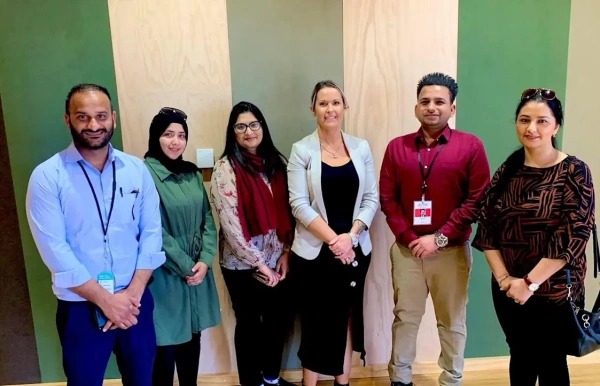
“The migrant communities have so much resilience and I believe that every disaster brings opportunity to come together, to heal, and to grow.”
Usma went on to become involved in Widows of Shuhada – an eight-part Plains FM/RNZ podcast documentary series which followed the journey of four widows following the attack.
Soon after, Covid-19 arrived in New Zealand and Usma worked on engagement with local ethnic communities, translating the Government’s messages and communicating them through a range of digital channels.
Tapping into the skills of international students
But she didn’t stop there. Usma was also influential in Christchurch’s Ethnic Communities Skills Build Programme, a project designed to smooth the pathway of migrants and international students into employment in New Zealand.
International students could join in workshops, meet career counsellors and job brokers from the Ministry of Social Development, reshape their CVs, and attend job fairs.
“I believe we need to tap into the high-level skills of post-graduate international students. We need to progress them in the right direction, utilising their skills in science, technology, and innovation.”
As for her own career, Usma could not be happier. She has secured a full-time role as a policy analyst at the Ministry of Primary Industries in Wellington and has taken a step back from her volunteer work to focus on completing her PhD this year.
She is grateful for the opportunity to study in New Zealand and to bring her family with her. Her husband is working, her children are happy, and her special needs daughter has opportunities she wouldn’t have had in Pakistan.
Usma still acts as a mentor for international students and tells them if they are to make the most of their time in New Zealand, they should “think outside the box”.
“They should think about the skills they have to offer in the community, and they will be rewarded with a transformative experience. Leaving behind the social constraints of your home country can be liberating. It’s all about following your dream.”
Usma says she’s already landed her dream job, but she plans to continue her community work once she has completed her PhD.“I believe it is my contribution to this country and I love doing it. I’m not likely to stop. I’m just settling in, finishing my PhD, and getting ready for something big. I have ambitious plans.”
-
Indigenous Peoples Talk Series 2023: final event
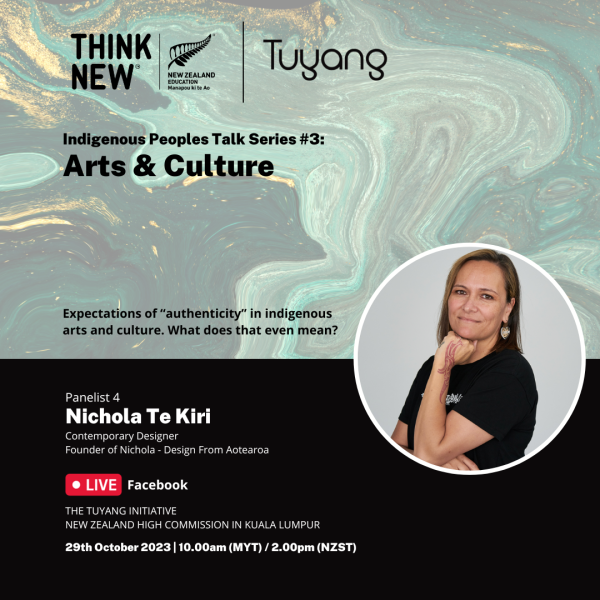
The third and final event of the Indigenous Peoples Talk Series will be held online on 29 October 2023, at 10am in Kuala Lumpur, Malaysia (2pm NZDT).
This event, jointly organised by The Tuyang Initiative, a Malaysian Social Enterprise, and Education New Zealand Manapou ki te Ao, is focused on Arts and Culture, specifically the expectations of authenticity in indigenous arts and culture and what this means. Taking part in the discussion are several brilliant indigenous academics, artists, and cultural practitioners from Malaysia and Aotearoa New Zealand, including Nichola Te Kiri, contemporary designer and founder of Nichola – Design from Aotearoa.
Information on the Tuyang Initiative was shared in a previous E-News here. You can register for this free event via this form: https://forms.gle/5f3SW5iCteZTHyC98
-
A brand NEW day

A brand NEW day is here – the launch of New Zealand Education’s new brand platform, ‘I AM NEW’.
‘I AM NEW’ is a philosophy shared between those who promote a New Zealand education, and those who choose to study here. We invite potential students to 'Think New' and experience this unique approach to education, so they can say ‘I AM NEW’, too.
You’ll find everything you need to help share the New Zealand education brand story ‘I AM NEW’ and build your own story on the NEW Brand Lab. Access and download a wide range of NEW marketing resources from images to videos, templates and more.
We look forward to seeing you on the Brand Lab.
-
Around the World in Five
INDIA
New Zealand sees 63 percent rise in first-time visas for Indian students
An industry-oriented curriculum and a focus on a supportive educational experience has triggered an increase in Indian students choosing to study in New Zealand.
NEW ZEALAND
Scholars to study traditional health system in India
A multi-disciplinary team of senior Rongoā Māori scholars, practitioners and members of the community will undertake a six-week indigenous health and entrepreneurship programme in India, supported by the Prime Minister’s Scholarships for Asia.
GLOBAL
The world’s changing language landscape
It’s never been more difficult - or more exciting - to choose which foreign language to study, as such a wide range are now important.
GLOBAL
International students want universities to be greener
Nearly all prospective international students looking to study in the United States, United Kingdom, Australia or Canada believe universities are not doing enough to be environmentally sustainable, according to new research.
ASIA
Asia outperforms continental Europe in top 500 universities for boosting student careers
In contrast to the QS World University Rankings, Asia’s top universities were shown to outperform continental Europe’s leading institutions.