Search
Showing 10 of 538 results for group registration
-
ENZ’s new partnership with the Manaaki New Zealand Scholarships Programme
The Manaaki scholarships represent the government’s single largest investment in international scholarships and have been awarded for more than 70 years.
The scholarships are a key pillar of Aotearoa New Zealand’s International Development Co-operation, offering more than 1,100 scholarships annually to students from 112 eligible countries to study in Aotearoa New Zealand, in the Pacific, or online.
“This partnership plays to the strengths of both MFAT and ENZ,” says Andrew Needs, MFAT Deputy Secretary – Pacific and Development Group.
“It will help us ensure that not only are we demonstrating manaaki to our scholars, but also offering scholarships that address the skills and knowledge requirements of each of our partner countries.”
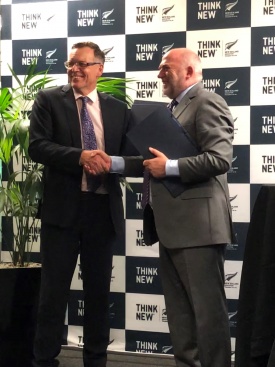
ENZ will participate in joint governance of the programme and provide data and insights to inform investment decisions, as well as operational management, drawing on its expertise in supporting a world-class scholar experience. The partnership offers opportunities to develop closer connections between scholarship partners and tertiary education providers and encourage innovation in product development.
ENZ already manages the Prime Minister’s Scholarships for Asia and Latin America as well as scholarships on behalf of the Ministries of Business, Innovation and Employment, and Primary Industries.
“This is an excellent example of ‘NZ Inc.’ cooperation in action,” said Grant McPherson, ENZ’s Chief Executive.
Two recent Manaaki Scholars are Aminat Razaq from Nigeria, who has completed her New Zealand studies on sustainable energy – you can read about her experiences here; and Jason Nath from Fiji who completed a Postgraduate Clinical Doctoral Degree in Paediatric Dentistry in New Zealand – you can read about his experiences here.
-
Digital skills and global citizenship at #NZAsiaTech Code Camp
A team of six students from Te Kura Māori o Porirua, a predominantly te reo Māori medium school in Porirua, interacted with school students in Japan, South Korea, Thailand, Viet Nam, Philippines, Malaysia, and Indonesia.
The overall theme was tourism, seen through the lens of the United Nations Sustainable Development Goals (SDG) - a theme that is highly relevant for the Asia-Pacific region. Students were given the task of profiling their home country’s SDG initiatives, with a focus on sustainable tourism.
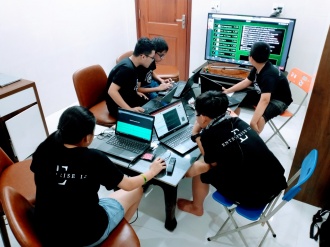
Team Enterprise 12 from Viet Nam work on building website project during #NZAsiaTech Code Camp
The North Asia Centre of Asia-Pacific Excellence partnered with educational coding programme Code Avengers and Education New Zealand Manapou ki te Ao to deliver the event.
“With New Zealand’s borders having been closed for more than two years, it’s crucial that the next generation of students still have opportunities to build cultural competencies and make connections across the globe,” says Education New Zealand’s Regional Director for Asia, Ben Burrowes.
“The #NZAsiaTech Code Camp was an opportunity for Kiwi students to re-establish connections with students in other countries, while gaining critical digital skills to prepare them for the future.
“It also also gave a taste of New Zealand’s education offering to prospective international students from the Asia region, who might consider enrolling in high school or tertiary study in New Zealand in the future.”
Code Camps can help to generate subsequent visits by interested students to New Zealand. For example, the Code Camp held at Waseda Jitsugyo School in 2021 and at Waseda University Junior and Senior High School in 2022 has led to Waseda’s group students’ programme sending around 50 students from three schools to New Zealand for three weeks in March 2023. Code Camp served as a great opportunity for students and teachers from Waseda University affiliated schools to experience our world-class digital education first-hand.
Honam Jeon, the Education Manager at Gangwon International Education Institute said the programme helped increase awareness of New Zealand:
“South Korea is very interested in international engagement and exchange programmes for school students. The #NZAsiaTech Code Camp was a perfect example we want to continue to join. Thanks so much again to ENZ for organising the well-structured programme.”
The online programme included team building exercises, English learning, HTML coding lessons, and the creation of a website by student teams, to demonstrate their understanding of the importance of sustainable tourism.
“As our students look to enter an increasingly globalised word, developing cultural connections and transferable skills is so important,” says Te Kura Māori o Porirua school principal, Whāea Evelyn Wharehinga.
“The Code Camp has been an exciting growth experience for our students, who have extended their digital literacy skills while having the chance to connect with students of different ethnicities and cultures across the Asia-Pacific region.”
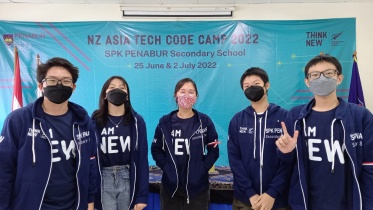
Team Indonesia was the winning team after presenting their newly developed website on Sustainable Tourism to a virtual panel of judges.
The students presented their sustainable tourism-themed websites to a panel of expert judges at the awards ceremony on 2 July 2022, with students from Indonesia winning the top prize.
Steve Budd of Code Avengers, a global edtech company based in New Zealand, said it was a great programme to participate in.
“It was a privilege to gift all participants a one-year free subscription to the Code Avengers site as part of our mission to build lasting digital capabilities for educators and young people, and bridge the digital divide,” says Budd.
-
New Zealand education in focus during Prime Minister’s trip to China
Education elements featured strongly in the Prime Minister’s Trade Delegation to China helping raise the visibility of New Zealand as an education destination for Chinese students.
To launch the trip, the delegation joined the Prime Minister at a Showcasing New Zealand event held at the New Zealand Embassy in Beijing to promote New Zealand as a travel and study destination. ENZ invited key media, influencers, and Chinese and New Zealand students to interact with the Prime Minister. This sparked significant local news coverage, amongst leading Chinese state media, setting the tone for the visit and highlighting the significance of international student exchanges between New Zealand and China. New Chinese media outlets also were seen covering New Zealand education as a topic for the first time.
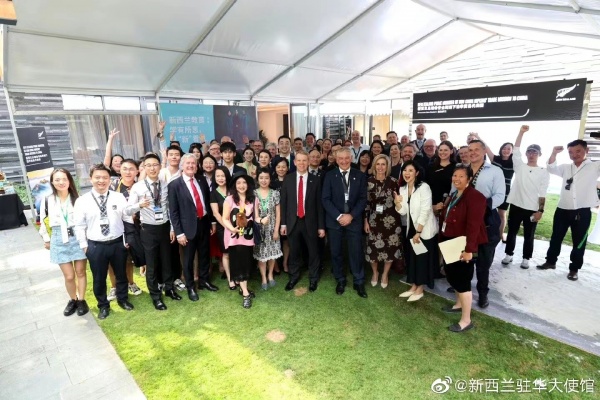
Group photo at Showcasing New Zealand event! (It was a kiwi bbq)
The Prime Minister also gave an address at Peking University to students, media, and the New Zealand delegation. To read the full speech, please visit the Beehive website.
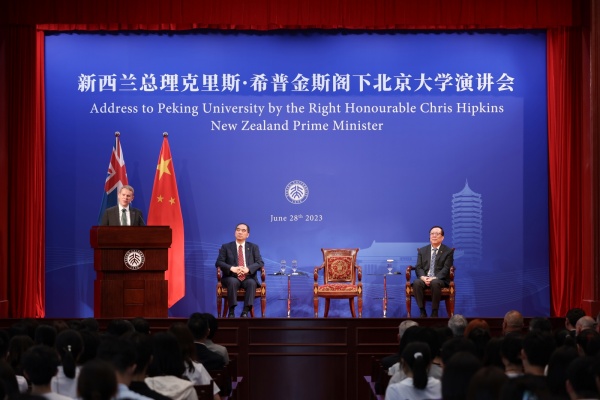
Peking University is host to the New Zealand Centre. Established in 2007 as a collaborative project between Peking University and the University of Auckland, the New Zealand Centre at Peking University has grown to represent all eight of New Zealand’s universities and enable high-level engagement across a range of departments and faculties. During the visit to the University on 28 June, the Prime Minister, with Hao Ping, Chair of Peking University Council and Gong Qihuang, President of Peking University, the Ambassadors of New Zealand and China, and representatives of the New Zealand Centre launched the Rewi Alley Professorship.
There were also other several significant developments in our bilateral education links with China that were achieved while there. These included:
- Signing of the Arrangement on Mutual Recognition of Academic Qualifications in Higher Education between the Ministries of Education witnessed by Prime Minister Rt Hon Chris Hipkins and Premier Li.
- Signing of a Strategic Partnership between Education New Zealand and Air New Zealand to support international education mobility and joint promotion in China. To read more, please visit the article on ENZ Collaboration with NZ Inc Agencies in China.
- The education delegation meeting with the Vice-Minister of Education Chen Jie (responsible for international cooperation) and China Ministry of Education officials. The meeting underscored the importance of a strong government-to-government relationship and provided a chance to showcase the education sectors present within the New Zealand delegation and discuss areas of existing and potential cooperation.
- A Sustainability Roundtable with a focus on education involving the education sector delegation and Chinese education partners.
It was a busy, challenging, insightful and ultimately very rewarding week. The education delegates also shared their own feedback. John van der Zwan, Executive Director Schools International Education Business Association reflected that the mission to China was hugely valuable and a chance to get high level insights into working with Chinese officials and agents following the pandemic.
“The mission was also a special opportunity to engage with the Prime Minister and other government officials on the role and importance of international education for our school sector,” he said.
Executive Director of English New Zealand, Kim Renner, noticed the shift in how New Zealand is profiled in China compared to many years ago and echoed the response from other delegates that the visit was valuable for the representatives of the education sectors.
“China is a development market for most of our members, so it was a great opportunity for English language to be part of this important delegation, particularly the meetings with the Vice Minister of Education and JJL Overseas Education Agency.”
“While seeing the country is a key part of study travel, we know that inbound students also want an immersive experience focused on people, cultural exchange and making connections. This was certainly showcased during the visit and was received very positively by all those we engaged with”, added.
ENZ would like to offer its sincere thanks and congratulation to everyone who was involved in the preparation and planning for the visit and gives special recognition to the education sector representatives on the Prime Minister Trade Delegation.
- Signing of the Arrangement on Mutual Recognition of Academic Qualifications in Higher Education between the Ministries of Education witnessed by Prime Minister Rt Hon Chris Hipkins and Premier Li.
-
From the CE: Putting NZ back on the map in 2022-23
With relatively low numbers of international students currently in New Zealand, the primary focus for Education New Zealand Manapou ki te Ao (ENZ) over the 2022-23 year will be on rebuilding the sector. The rebuild will have an emphasis on quality and long-term sustainability. We will be working closely with our key sector partners here and around the world to put New Zealand back on the map.
This focus is reflected in the draft refresh of the New Zealand International Education Strategy 2022-30, in our recently published Statement of Intent 2022-26 and Statement of Performance Expectations 2022-23, and in our internal business planning for the year ahead.
The high impact global marketing campaign, I AM NEW, launched at NAFSA in late May, provides a strong starting point for the rebuild. As well as raising New Zealand’s profile by attracting significant international media coverage, the campaign has so far reached over 115 million users. This is a unified, overarching promotion on behalf of New Zealand’s international education providers – an essential approach for us to be heard in this extremely competitive sector. We have focussed the promotion on ten partner countries: Brazil, China, Colombia, Germany, India, Japan, South Korea, Thailand, United States, and Viet Nam. The current phase of the campaign includes highlighting individual student stories.
Travel to partner countries to support the work of locally based ENZ staff and our NZ Inc agency partners is also an important part of promoting New Zealand’s education. Prime Minister Jacinda Ardern’s visit to Singapore and Japan in April, and Education Minister Chris Hipkins’ travel to the United States, Brazil and Chile in May-June have delivered the clear message that New Zealand is open for business, raised awareness of our quality education offering, and progressed our relationships in these countries. You can read more detailed reports about the trip to North and South America in this month’s E-News, and we’re currently planning our forward schedule of travel to other key partner countries.
After discussions with education providers, we have finalised the programme of in-market events where New Zealand will be represented through until the end of 2022, and this is now available on our website here.
The reopening of New Zealand’s borders has also enabled the Prime Minister’s Scholarships for Asia and Latin America to restart this year, so New Zealanders have the opportunity to learn from international experiences and develop their global citizenship competencies and networks. Decisions were recently announced on the first round of group applications, while applications for individual scholarships are open until 31 August 2022.
This month we also formalised a new partnership between the Ministry of Foreign Affairs and Trade and ENZ that will see ENZ take over operational management of the Manaaki New Zealand Scholarship Programme from November 2022. This is an excellent example of ‘NZ Inc.’ cooperation that plays to each agency’s strengths. You can read more about the partnership in this issue of E-News.
He ora te whakapiri, he mate te whakatāriri – Unity is strength
Grant McPherson
-
Manaaki Scholarships operations transferred to ENZ
Operational responsibility for the Manaaki New Zealand Scholarships programme was formally transferred to Education New Zealand Manapou ki te Ao (ENZ) on 1 November 2022, the result of almost two years of sustained effort from both sides.
The team transferring from the Ministry of Foreign Affairs and Trade (MFAT), along with other new staff working on the scholarships programme, were welcomed to ENZ with a mihi whakatau by a group that included ENZ Board Chair Steve Maharey and Chief Executive Grant McPherson.
Manaaki Scholarships represent the government’s single largest investment in international scholarships and have been awarded for more than 70 years. ENZ is taking over operational management from MFAT, which will remain responsible for setting the strategic direction, alumni relationships and funding the programme.

On the symbolic handing over of MFAT's ‘living taonga’ to ENZ, Divisional Manager Joanna Kempkers noted, “if our Policy Team are the head, giving strategic direction, and the Alumni Team is the arms, reaching out to embrace scholars on completion, then the Operations Team is the beating heart of the Manaaki Scholarships Programme. We are confident that ENZ will take good care of our team, of the Manaaki Scholarships Programme, and deliver enhanced ‘mana through manaaki’ to our individual scholars.”
ENZ and MFAT have worked together on an improvement programme that will get underway early in 2023. This will include a technology upgrade as well as operational policy shifts to strengthen student experience.
“This partnership is one of those rare events where logic and virtue combine to provide a stronger and better outcome,” said ENZ Chief Executive Grant McPherson. “It is not just a good idea for our two agencies, but it’s a great idea for NZ Inc and will bring broader benefits beyond our immediate goals.”
“We know our own in-country teams already work closely with MFAT on matters concerning the Manaaki Scholars,” says GM Sector Services Sahinde Pala.
“This is an exciting opportunity for us to become more closely involved in the scholarships programme and the work on continuous improvements. Our aim is to ensure scholars have an excellent experience and become lifelong ambassadors for Aotearoa New Zealand.”
Manaaki Scholarships are a key pillar of Aotearoa New Zealand’s International Development Co-operation, offering more than 1,100 scholarships annually to students from 112 eligible countries to study in Aotearoa New Zealand, in the Pacific, or online.
For information on opening dates to apply for Manaaki Scholarships, go to: Application opening and closing dates for your country | MANAAKI | Education New Zealand (nzscholarships.govt.nz)
Programmes of study can be found here: Types of Manaaki Scholarships | MANAAKI | Education New Zealand (nzscholarships.govt.nz)
Eligible countries can be found here: 1.Check eligible countries | MANAAKI | Education New Zealand (nzscholarships.govt.nz)
To contact ENZ’s Manaaki Scholarship team, please email manaaki@enz.govt.nz
-
ENZ hosts its first famil since 2019
Eleven public universities were represented in the Malaysian delegation of senior executives from the Multimedia Technology Enhancement Operations Sdn Bhd (METEOR). METEOR is a consortium of universities that aims to provide advanced solutions through technology. This was an exploratory visit, to enable delegates to discuss a range of opportunities and possible partnerships with New Zealand universities and Te Pūkenga.
The visit was exciting on many fronts as our institutions demonstrated their expertise and explored mutually beneficial relationships, regions showcased their attractions, and the famil delegates from Malaysia experienced many aspects of New Zealand.
The eight-day visit included Wellington, Canterbury and the Waikato. While the start of the week coincided with a cold southerly storm, this was mitigated by warm hospitality and the promise of sun later in the week.
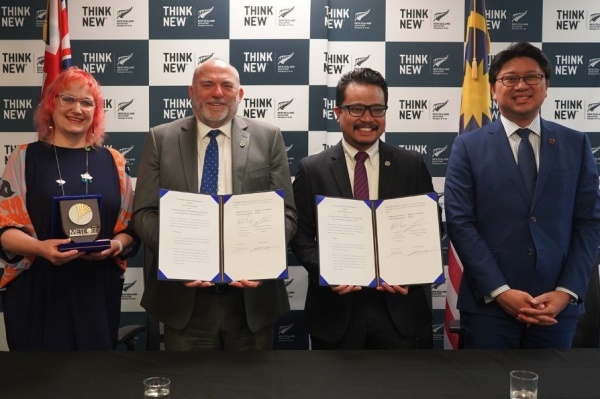
L to r: Lisa Futschek, GM International at ENZ; ENZ’s Chief Executive Grant McPherson; Mr Muhammad Afiq Bin Redzuan, Group Chief Executive Officer at METEOR; and YB Senator Tuan Jaziri Alkaf Abdillah Suffian, after signing an Education Cooperation Agreement.
The delegation was fortunate to meet with Minister of Education Chris Hipkins during their visit. While in Wellington they also signed an Education Cooperation Agreement with ENZ that provides a framework for our relationship going forward. They also met up with Malaysian students at various institutions and heard about their personal experiences here.
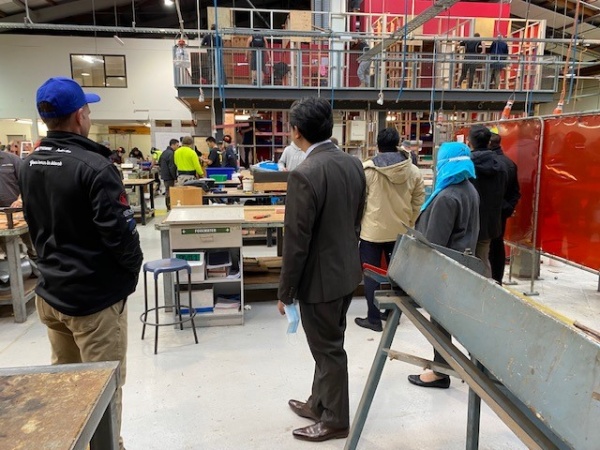
The delegation saw trades in action at WELTEC’s trades campus where they observed building apprentices on a block course.
Famils are important for ENZ as well as for New Zealand institutions, as they establish relationships and strengthen people-to-people links. They are also a key way to showcase some of the best education New Zealand has to offer across different regions.
ENZ looks forward to hosting more famils in the coming months, in partnership with institutions and regions throughout New Zealand.
You can read more about the METEOR famil on the Ara website here.

A Kiwi welcome was on offer at a private bach in Duvauchelle near Akaroa.
-
From the CE: 2023 is off to a flying start
Following the appointment of Chris Hipkins to Prime Minister, last week we welcomed our new Minister of Education, Jan Tinetti. Minister Tinetti knows education well. She has over 20 years as a primary school principal, in four schools across Southland and Tauranga. She also holds a Diploma in Teaching (Primary), a Bachelor of Education and Master’s in Education with First Class Honours, from the University of Canterbury.
Both appointments are good news for international education. We have both a Prime Minister with rich knowledge and appreciation for the many benefits that international education brings working alongside a Minister of Education who has significant education experience.
The first month of the year saw significant announcements in China, an important partner country. The first was the change to the Zero-COVID policy, followed shortly after with the decision by the Chinese qualification recognition agency to revert to pre-COVID settings for online qualifications. Chinese students were already returning to study in New Zealand and these announcements will encourage this further.
In response to these changes in China our team collaborated with Tourism New Zealand to drive awareness of New Zealand as a short-term study destination. Late last year we put the New Zealand education brand back on the map in Colombia with an important event in Bogota. I am also excited to see the relaunch of the New Zealand Schools Scholarships – our flagship initiative for Viet Nam.
The first month of the year also saw our first iwi-led Prime Minister’s Scholarship for Asia recipients (Te Piriru Marae, Ngāti Maniapoto) travelling to Hokkaido for six weeks, forging connections with the indigenous Ainu people of Japan. There will be more on this in next month’s ENews.
While I’m on the subject of the Prime Minister’s Scholarships the most recent round of applications saw a significant and very pleasing increase in Māori participation to 22 percent up from five percent from 2016 to 2019. We are eager to continue this increase and will be partnering with iwi to raise it further in the March group application round.
After the challenges of the past couple of years, a flying start was exactly what we needed and I am very pleased that is what we have.
Waiho i te toipoto, kaua i te toiroa
Let us keep close together, not wide apart.
Ngā mihi nui,
Grant McPherson
-
Reconnecting with stakeholders in Japan
Across the two days, 68 representatives from education and travel agencies, schools, universities and ENZ’s education partners in Japan networked with 19 New Zealand education providers, regional representatives and edtech company, Chasing Time English, and heard updates from ENZ. Networking opportunities included one-on-one meetings, and a reception at iki, a newly opened New Zealand-themed roastery and eatery in Tokyo. Key Japanese partners including ENZRA agents, Ministry of Education, Culture, Sports, Science and Technology, and ENZ’s Education Cooperation Partners: Tokyo Metropolitan Board of Education, Japan Women’s University and Waseda University attended the event.
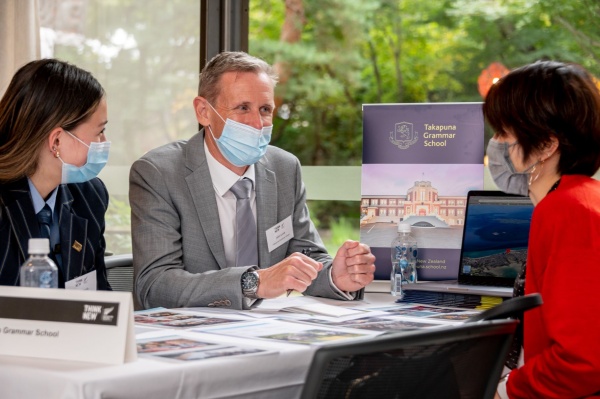
In terms of market trends, Misa Kitaoka, ENZ’s Director of Education in Japan, noted the increasing demand for “one term school study” in New Zealand, which can be attributed to changes made in admission requirements by the Japanese universities.
“With the Japanese government’s internationalisation efforts, more and more universities in Japan are now adopting a holistic assessment of applicants, based on their high school grades, English language skills, extracurricular activities, and essays, in addition to the traditional written exams,” Ms Kitaoka says.
“Students who study abroad have a competitive advantage in these assessments – their English and communication skills improve, and they gain a wide range of life experiences overseas. With this new trend, we are expecting to see more secondary schools sending their students for one term or longer to New Zealand, to help them prepare for admission to university.”
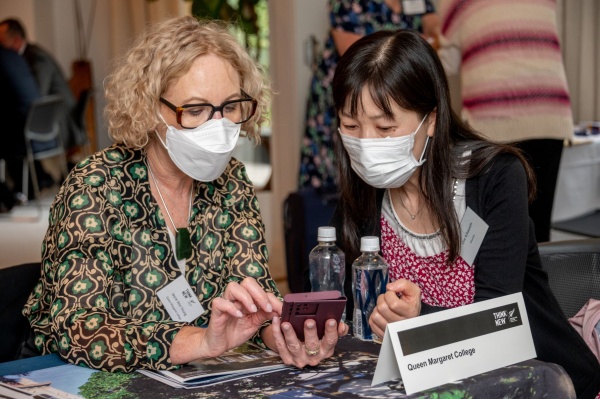
Japanese agents and educators are also interested in New Zealand’s full Bachelor’s degree programmes, given the increasing number of bilingual Japanese/English students in Japan. With more International Baccalaureate (IB) schools (the Japanese government’s current target is 200 IB schools) and the improvement of English language education in Japan, more students in Japan are prepared to apply directly to New Zealand tertiary institutions after finishing high school.
“We are excited to work with ENZ to start an annual, outbound group study programme for our affiliated schools,” Ryohei Matsuoka from the International Office at Waseda University said. “We are planning to send more than 70 Waseda high school students to Manawatu and Hawke’s Bay in March 2023. With Waseda’s increasing interest in New Zealand’s tertiary education, the programme will incorporate visits to tertiary institutions in addition to study at secondary schools.”
ENZ and Air New Zealand are co-hosting and co-funding a “famil” for the executive members of Waseda University and its affiliated schools in late November, visiting schools and tertiary institutions in the two regions mentioned above.
Due to Japan’s border restrictions which were in place until October, and the ongoing Covid-19 restrictions, ENZ did not undertake a student-facing event this year, and is planning to restart student fairs in 2023.
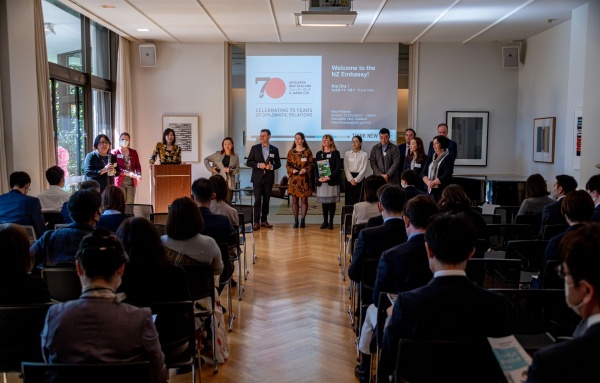
Social media coverage of the stakeholder events was well received and generated a high level of engagement.
-
Growing offshore interest in NZ through onshore ‘Famils’
‘Famil’, short for ‘Familiarisation’, are visits organised to literally familiarise invited groups of people with a product, or in our case, New Zealand as an international education destination. The intended purpose is that those who attend famils will become valuable advocates for a New Zealand education and therefore drive preference for New Zealand in market.
During Covid-19 these visits were stopped due to border closures. Now that borders have been fully open for some time and our international education sector is recovering, this summer provided the perfect opportunity to show off New Zealand, including our regions and unique culture, and the wide range of educational and experiential offerings to representatives from various international markets.
The summer of showcasing New Zealand started in November with two media famil groups from India and Viet Nam. This was followed by three groups of education agents from Brazil, Germany and South Korea visiting in March and most recently, a famil co-hosted by ENZ and Air NZ bringing Japanese school teachers to regions in the North Island. ENZ subsidises these programmes with other costs covered by participants, regional economic development agencies, and education providers.
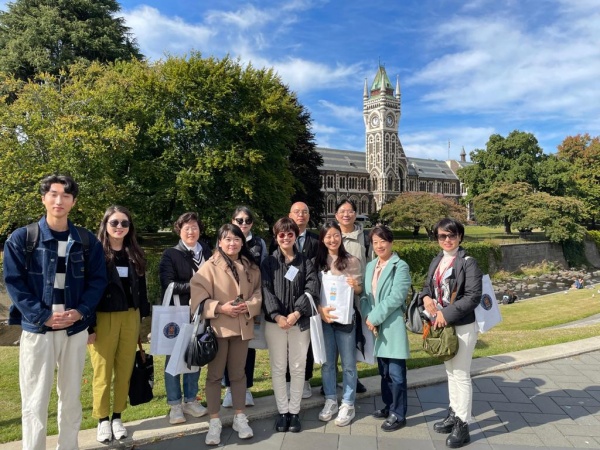
The University of Otago provided a campus tour with a Korean student and didn't miss the opportunity for a classic picture with its famous Clock Tower.
ENZ’s General Manager International, Lisa Futschek said that careful planning goes into facilitating these visits to ensure the famil groups are exposed to a range of subsectors that are relevant to the visiting country while also leveraging the visits to benefit as many providers as possible.
“While we’d love to showcase every New Zealand provider, this is obviously not possible. Much consideration is given to the source market and to the subsectors that we know are popular with that country.
“This ensures we are targeted in our approach and our visitors go back to their countries equipped with the most relevant information that helps build that pipeline of future students," said Lisa.
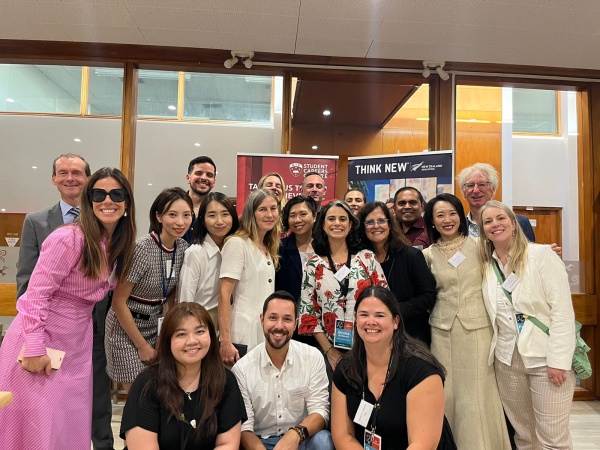
The Brazilian agents attended a networking event hosted by AIS for Auckland-based English Language providers.
“We also look for opportunities in which we can make introductions to several providers in one go. For example, a networking function was held at Auckland Institute of Studies (AIS) with Auckland-based English Language Schools invited to meet the agents from Brazil, cultivating many new connections while strengthening existing ones,” added Lisa.
As well as showcasing the various subsectors, promoting the destination is also hugely important and famil itineraries also include time spent seeing what the regions have to offer international students. This is often organised with the help of the regional economic development agencies.
A perfect example of cross sector collaboration was seen in Ōtautahi Christchurch where Christchurch Educated, an international education organisation based in the region, hosted a networking dinner with the regional economic development agency, ChristchurchNZ. They hosted the Brazilian and German agent famil groups and education providers from various sectors in the Canterbury region.

The German agents are pictured here at the Christchurch Educated networking event with a group of Christchurch based education providers (mainly high schools). The event was hosted at Ara’s Visions on campus restaurant with the Brazilian agents in attendance too.
Stefi Porter, International Education Partnership Manager for Christchurch Educated said that bringing everyone together to mutually share the benefits of studying in Ōtautahi Christchurch was a wonderful thing.
“There is certainly strength in numbers and a perfect example of where collaboration between providers and regional economic development agencies can really deliver greater bang.
“Instead of competing against one another, we are sharing resources, time and energy to show the best of our region and the breadth of study options we can offer international students.”
A key outcome of the various famil groups visiting New Zealand is that they become advocates for New Zealand as a place to study, ensuring a steady pipeline of students for years to come. In the post-famil survey, all attendees reported they were either much more likely (87.5%) or somewhat more likely (12.5%) to recommend New Zealand as a place to study for prospective students.
Other positive outcomes, include the positive media articles and social media posts produced by visiting journalists and individuals to their networks in their home countries. This positive coverage not only showcases the quality of New Zealand's education system but also shares the New Zealand education experience with prospective students in their home countries through stories featuring students and alumni.
The India media famil has achieved five in-depth stories to date in Education Times, India's largest newspaper supplement (circulation 500,000). The stories showcase the research prowess at New Zealand universities, including in biotechnology, managing climate change related disruptions, and feature the New Zealand education experiences of a range of students from India.
In Viet Nam 10 articles and four social media posts have been published so far, reaching an audience of 557,000, with more coverage expected in the coming months. Of note is HHT, the top teen magazine in Viet Nam has created a column “letters to New Zealand”, which shares weekly articles about New Zealand written about alumni.
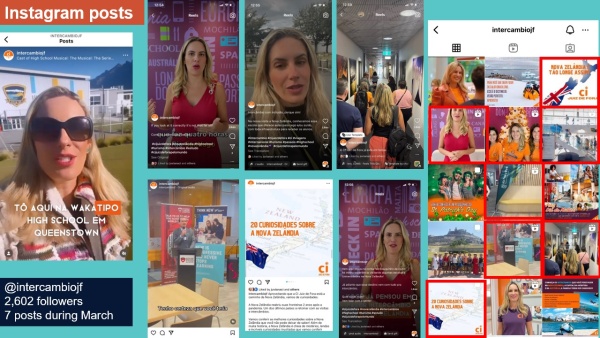
An example of some of the coverage these visits receive. Featured is a compilation of posts that Brazilian agent, Juliana Viana Silveira, owner of CI Intercambio in Juiz de Fora, made on Instagram to her followers during March while in New Zealand. The role of agents in Brazil in international student recruitment is becoming increasingly more important as reported by StudyTravelNetwork here -https://studytravel.network/magazine/news/0/30492
ENZ would like to extend a huge thanks to the education providers and regional representatives for hosting our international visitors and leaving them with a strong sense of New Zealand’s education offerings. The way in which ENZ is able to work collectively with providers and the regional economic development agencies to collaboratively plan the famil is ideal to ensure a good mix of experiences and a balance of activities. This approach helps regions feature strongly in any future famil plans and also helps develop the regional international education ecosystem.
We look forward to hearing about more connections with education representatives at the ICEF ANZA conference in Christchurch.
Check out our image gallery of the famils which shares further details of each of the groups including who attended, where they went and who they met with.
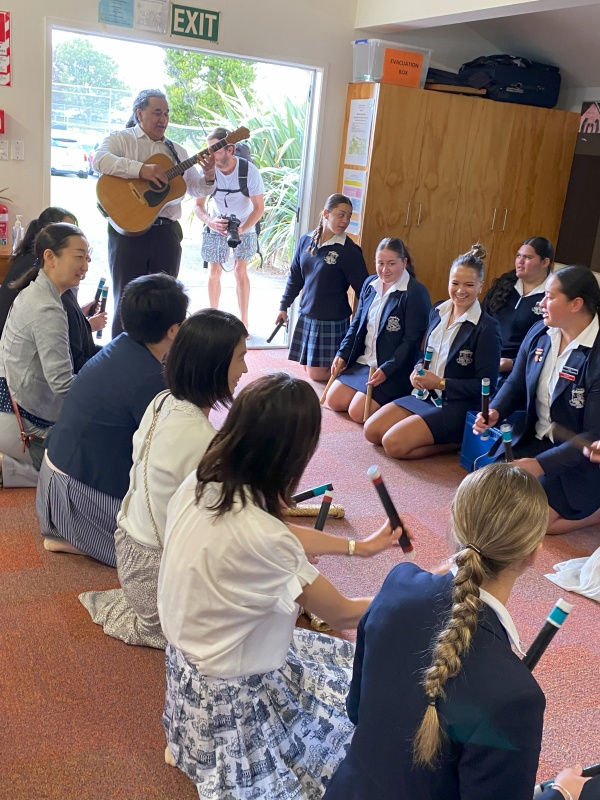
The Japanese All Girls School Teachers participated in a kapa haka class at New Plymouth Girls High School in New Plymouth. Here they are pictured playing the Tītī tōrea Māori Stick game, a traditional New Zealand game which has been played for generations.
-
Important update: passport requirements for temporary visa applicants offshore
Immigration New Zealand has announced a change to passport requirements that affect a number of temporary visa applicants offshore. This change is in effect now.
The change means that people applying from offshore for a student, visitor or work temporary visa only need to send Immigration New Zealand a high-quality scan of their passport, not a physical copy.
An Immigration Officer may still ask for a physical passport if they consider it necessary for the application. This will be on a case-by-case basis.
This is a temporary measure to help with visa processing. People applying for a student visa or group visitor visa through the Immigration Online form will currently receive an automated letter asking for a physical passport to be submitted. This is not required, and Immigration New Zealand is working to update the letter to reflect the change in requirements.
Visit Immigration New Zealand to learn more about passport requirements.