Search
Showing 10 of 1931 results for how to register international groups
-
Prime Minister's Scholarships for study in Asia and Latin America for 2023-24 announced
Prime Minister’s Scholarships for study in Asia and Latin America for 2023-24 announced
114 New Zealanders receive scholarships to Asia and Latin America
New Zealand’s connections with Asia and Latin America are set to receive a boost with the announcement of 114 individual recipients of the Prime Minister’s scholarships for Asia and Latin America over the next year, Acting Chief Executive for Education New Zealand Manapou ki te Ao (ENZ), Linda Sissons announced today.
The latest round will see scholarship recipients heading to destinations including Japan, Korea, Malaysia, China, India, Viet Nam, Mexico, Colombia, Brazil, and Chile for study and internship programmes. The individual scholarships follow the group scholarships awards of earlier this year which saw 14 groups of New Zealanders travelling to study in Asia and Latin America.
Scholarships have been awarded to recipients from a wide range of regions from around New Zealand, including Rotorua, Taupo, Gisborne, Hastings, Feilding, Tauranga, Auckland, Hamilton, Wellington, Palmerston North, Christchurch, Dunedin, Riwaka and Oamaru.
“The Prime Minister’s Scholarships offer a fantastic opportunity for New Zealanders to foster lifelong connections as they learn and grow their understanding of cultures and business practices across Asia and Latin America”, Acting Chief Executive for Education New Zealand, Linda Sissons said.
“The scholarships are awarded to enable recipients to undertake a range of global study opportunities, from language learning and exchange study to internships.
“Over the next year, recipients will embark on semester exchanges, medical electives, language immersion and indigenous integration programmes, internships, and research projects in areas such as architecture and healthcare engineering.
“The scholarships continue to enable a rich exchange of knowledge, ideas and culture for New Zealanders through reciprocal study opportunities and increase global understanding of the strength and quality of our education system”.
A full list of recipients of this individual round can be found here.
Additional information
Read how the Prime Minister’s Scholarships have enabled these past recipients to study abroad and have enriching, life-changing experiences:
About the Prime Minister’s Scholarships for Asia and Latin America
The Prime Minister’s Scholarship programme aims to strengthen New Zealand’s ability to engage with Asian and Latin American trading partners, improve the internationalisation of New Zealand tertiary institutions, showcase the strength and quality of New Zealand's education system and grow inter-cultural awareness and connections between New Zealand and other countries.
The scholarships offer flexible funding to support both short- and long-term programmes, including study abroad or exchange, internships, postgraduate study, and language programmes.
The Prime Minister’s Scholarships are funded by the New Zealand Government and administered by Education New Zealand Manapou ki te Ao.
The Prime Minister’s Scholarships for Asia (PMSA) were launched in 2013 and extended to Latin America (PMSLA) in 2016. To date, 4,155 scholarships have been awarded under the programme.
There are two scholarship rounds each year, and applications for the next scholarship round will be open to group applicants in March 2024. Many scholarship recipients are enrolled in tertiary institutions across New Zealand, but this is not a requirement for the scholarship. Any New Zealand citizen or permanent resident over 18 years old can apply for a scholarship.
For more information on the scholarships and the application process, visit https://scholarships.enz.govt.nz/.
For further information:
Justin Barnett | Director of Communications, Education New Zealand
justin.barnett@enz.govt.nz
+64 21 875 132Eve Abernethy | Communications Advisor, Education New Zealand
eve.abernethy@enz.govt.nz
+64 04 887 5215 -
ENZ unleashes the potential of Prime Minister’s Scholarships alumni
The first-ever event for alumni of the Prime Minister’s Scholarships for Asia and Latin America was hosted by Education New Zealand in November 2021.
The scholarships, administered by ENZ, enable New Zealanders to study, research or intern in Asia or Latin America. Since 2013, more than 2,400 group and individual scholarships have been awarded.
The virtual event – Hono Mai: a call to connect – drew together alumni from all walks of life, based in New Zealand and around the world.
They heard guest speakers from the Asia New Zealand Foundation and the Latin America New Zealand Business Council, held speed networking sessions in small groups on the EventsAir platform, and joined in challenges and trivia questions.
ENZ’s Global Citizens Manager, Carla Rey Vasquez, says the event was designed and driven by alumni, for alumni.
“Our global citizenship work aims to equip New Zealanders with the competencies to engage with the wider world, build connections with people from other countries and cultures, and take action on the things that matter to them.
“Alumni have so many rich, diverse relationships around the world which can be used to support and uplift each other. Hono Mai is about sharing those relationships to help alumni achieve their own goals within their own communities,” she says.
One of the alumni involved in organising the event was Robyn Scrimshaw, who studied Chinese law and language in Shanghai with a Prime Minister’s Scholarship for Asia in 2014.
“Everyone had such a great experience on the trip; the event was about bringing that magic together and connecting everyone’s experiences in one place,” she says.
Now working as an urban planner in Tauranga, Robyn still draws on her experience of “different perceptions of public and private spaces” in the Chinese cities she visited.
Plans are underway for more networking events for Prime Minister’s Scholarships alumni in 2022.
-
Advertising opportunity for Japan’s 2025 New Zealand Study Guidebook
The KBUNSHA New Zealand Study Guidebook is a trusted publication and is the only one of its kind supported by the New Zealand Embassy in Tokyo and Education New Zealand Manapou ki te Ao (ENZ). KBUNSHA distributes 20,000 copies of the study guidebook to Japanese schools, universities and education organisations as well as education fairs and seminars.
ENZ Business Development Manager – Japan, Tomomi Kontani said advertising here is a great opportunity to leverage an increased demand for information on New Zealand’s education offering.
“We are continuing to see significant interest in New Zealand as an education destination from students and their parents, schools, and education agents here in Japan” she said.
“This is a great opportunity to showcase what makes New Zealand unique, especially in the regions. Destination marketing plays a key role in student attraction for a market like Japan with a tourism focus,” Tomomi added.
The guidebook’s last edition was distributed at the annual student fair and stakeholder focus events hosted by ENZ Japan. The events attracted around 1,000 people. The guidebook remains the main information source ENZ refers to and distributes at upcoming events in 2025.
Advertisement rates for individual providers range from approx. $2,560 NZD to $6,120 NZD for guidebook and or website listings. With the ‘Premier Plan’ and ‘Advertorial Plan’, the school logo will be listed on the new scholarship campaign page built by KBUNSHA. Individual providers can download the proposal here. Advertising copy can be provided in English.
For regional groups, download the proposal here for further details on the guidebook and pricing (approx. $2,200 NZD for a two-page colour advertisement and $3,300 NZD for a four-page colour advertisement).
Bookings must be made by 27 June 2025 directly with KBUNSHA. For more information, visit the KBUNSHA website here. The 2024 guidebook can be viewed here.
KBUNSHA contact:
Minori Takahashi (Director)
Tel: +81-3-3234-1744
Email: minori@kbunsha.com
-
Roundtable explores distance education recognition
The roundtable involved senior officials from Chinese education agencies and representatives from the University of Otago, Massey University, New Zealand Qualifications Authority, Universities New Zealand and Education New Zealand.
The recognition of New Zealand distance education programmes has been an item of discussion between New Zealand and Chinese authorities for many years. Currently all foreign qualifications delivered by distance, or with a distance component, are not recognised by Chinese authorities.
“This isn’t a New Zealand-specific issue,” says ENZ's Regional Director Alexandra Grace. “We are very much at first steps, in terms of building understanding of how we assure quality outside of traditional face-to-face qualification delivery. Greater understanding of our processes may also contribute to China’s domestic reform of its local distance qualifications."
The New Zealand-China Free Trade Agreement signed in 2008 included commitments to undertake work on “evaluation of the quality assurance criteria for qualifications which include a distance delivery component.”
Discussions on the recognition of New Zealand distance education qualifications have been ongoing since then.
The roundtable showcased Otago University’s renowned Master in Aviation Medicine qualification which is fully taught by distance and has been offered for over 26 years. Over 100 students are currently studying the programme from the Middle East, North America, Europe, Asia and Australia. Graduates of the programme meet internationally recognised ‘best practice’ standards for aviation medicine practitioners and are frequently employed by airlines including Cathay Pacific, Emirates and Qantas.
The roundtable also featured Massey University’s Master’s degree programmes in Veterinary Medicine (Biosecurity) and Public Health (Biosecurity) which has been completed by nine senior Chinese officials. The qualifications, which require four months to be spent at Massey and the remainder by distance study from China (one year in total), represent collaboration in teaching between Massey’s teaching and research groups, EpiCentre, and the Centre for Public Health Research.
Further work is slated on sharing of information and best practice.
-
Marketing tips for schools
These topics and more were discussed during The Crowdsource Café session, led by ENZ Business Development Managers Mary Camp and Richard Kyle. The session tapped in on the wealth of experience in the audience by pooling together practical ideas for improved marketing of schools.
Working in groups, participants shared key tactics they use to nurture meaningful relationships with students, school staff, agents, the local community and alumni.
“Participants all agreed that our industry is built on relationships. They left the session with the challenge of taking away one thing they could action in the next week. No better time than now to get that action going!” Richard said
“It’s also great to remember that the ENZ Skills Lab is a rich resource that schools can use, with many tools that take you step-by-step through marketing projects (including digital marketing and PR),” he said.
-
Spotlight on the US
At certain times of year, you can stand in a certain apple orchard in the American state of Vermont and hear strands of a Māori waiata.
The East and West Coast Whānau Councils were set up by former students of the Auckland University of Technology’s Noho Marae programme. They were so moved by their experience in Aotearoa that they set up these groups so that they can meet regularly to eat kai, do haka and poi, and keep the whānau spirit alive.
These students are but a handful of the North American students that choose to study in New Zealand every year. In 2018, 3,028 students from the US travelled here for education, a number that has risen steadily – by nearly 23 percent – since 2014.
“More than 300,000 American students study outside the US every year,” ENZ Regional Director – Americas & Europe, Amy Rutherford says. “By educating over one percent of those students year upon year, New Zealand is punching well above its weight.”
Diversity and inclusion
There is a common misperception amongst students in North America that New Zealand is an ‘easy’ destination. Students are drawn here for the tourist opportunities and laidback lifestyle just as much as a quality education.
In an effort to promote New Zealand as a world-leading education destination, ENZ’s team based in North America have focused on diversity and inclusion.
The remit of diversity and inclusion in the US is much broader than it is in Aotearoa. It encompasses not only racial and ethnic minorities, but single parents, first-generation university students, military veterans, and those with disabilities.
Within this space, ENZ has been promoting New Zealand as a welcoming, progressive place to study. As Māori are world leaders in indigenous leadership, New Zealand is particularly well-positioned to support Native American and indigenous students.
New Zealand alumni like Brook Thompson and Hailey Suina have reported that connecting with te ao Māori has strengthened their understanding of their own cultures, boosting their confidence to act as leaders at home.
As part of this work, ENZ recently renewed its commitment to a partnership with the US regarding its Benjamin A. Gilman scholarship, a prestigious prize aimed at students from disadvantaged backgrounds. ENZ has pledged NZ $250,000 over five years for Gilman scholars who choose to come to New Zealand.
Beyond study abroad
The majority of US students come here at university level, often for one semester only as part of the US university and study abroad provider study abroad programmes.
Rather than come here for a complete qualification, US students travel short-term during their third or fourth years of university. Their work here is then cross-credited to their home institution.
Amy says that study abroad is very popular. For those students interested in travel, adventure, and discovering themselves, it is largely self-sustaining. New opportunities in study abroad lie in expanding this base to those students who have been traditionally underrepresented in study abroad, or regions of the country where not much is know about New Zealand.
Amy’s team is now increasingly focused on a new opportunity emerging for New Zealand institutions: attracting tertiary students to study here for their whole qualification.
For American students, committing to leave their home country for at least three years is a big ask. Attending college is a massive social milestone in the US, and one that alumni pin their identities on for the rest of their lives.
However, increasing numbers of students are looking for study opportunities offshore as the cost of studying in the US continues to rise.
US students are drawn to New Zealand’s highly ranked, innovative programmes in niche areas. An example of this is Massey University’s Bachelor of Veterinary Science. This course can be completed in five years (as opposed to eight in the US), costs a fraction of an equivalent US degree, and is approved by the American Veterinary Medical Association (AVMA), allowing graduates to return home and begin working immediately in the field.
Identifying and promoting these academic strengths among New Zealand institutions and explaining how they can propel students towards the career path of their choice is key to positioning a New Zealand education as a desirable alternative to the classic American college life.
Want to find out how your institution can get involved with ENZ’s work in the US?
Contact northamerica@enz.govt.nz.
-
PM announces widened Game On English in Japan
Launched by Prime Ministers Abe and Key in July 2014 and piloted with two groups from Japan last year, the programme has now expanded beyond rugby to include rowing and golf.
Surrounded by past-participants and hopeful future participants of the programme, PM Key noted the importance of building both English language and sporting skills for Japan’s youth in the lead up to the 2019 Rugby World Cup and the 2020 Olympics. Tokyo will be a host city for the RWC and will also host the Olympics and Paralympics.
Ran Aoki, who participated in last year’s pilot programme, and Shunsuke Hoshitani, a hopeful for this year’s programme, greeted Prime Minister Key in English and welcomed him to Japan. They thanked Governor Masuzoe for the opportunity and said that they both aim to represent Japan at the 2019 RWC and 2020 Olympics.
Education New Zealand’s Senior Market Development Manager, Fiona Haiko, commented “At the moment there is a real appetite in Japan for fresh ideas and programmes that not only develop English language skills, but also develop a broader skill set, whether it be in sporting or other areas. Initial feedback and interest in the programme is encouraging.”
Below: PM Key and Tokyo Governor Masuzoe with (L) Shunsuke Hoshitani and (R) Ran Aoki. Back row: Representatives of the Kanto Super League (KSL) teams who participated in the pilot last year and will participate again this year.

-
Government delegation from South Korea visits New Zealand to reconnect with several of our education providers
New Zealand and South Korea have strong education links and one unique partnership is the education cooperation under the Korea-New Zealand Free Trade Agreement (KNZFTA) which has historically included education programmes for Korean school and tertiary students.
The visiting delegation included representatives from the Korea Ministry of Food, Agriculture and Rural Affairs (MAFRA), the Korea Ministry of Oceans and Fisheries (MOF), the Korea Agency of Education, Promotion and Information Service in Food, Agriculture, Forestry and Fisheries (EPIS) and Korea Fisheries Resources Agency (FIRA), the implementing agency for the MOF-funded project.
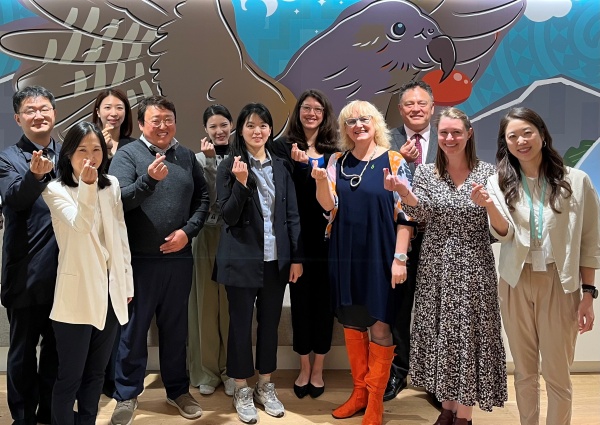
The delegation was welcomed to the ENZ Wellington office with a mihi whakatau on their first day. ENZ, Ministry of Education (MoE) and Ministry of Foreign Affairs and Trade (MFAT) colleagues joined together for waiata and kai with our Korean guests.

Following a welcome and mihi whakatau in Wellington, the group travelled on to Nelson where they visited Te Pūkenga Nelson Marlborough Institute of Technology (NMIT) and Nayland College. The visit to Nayland College was an opportunity for the Korean representatives to gain a better understanding of the pastoral care for school students and the unique offerings such as outdoor education and horticulture programmes.
Kay Lee, ENZ Senior Market Development Manager – Korea, said it was important for the Korean delegation to experience firsthand the welcoming and safe environment of New Zealand schools to regain confidence in the Schools Visits Programme.
“After the COVID-19 pandemic, the Korean Government was concerned about sending students, especially younger students, overseas to study particularly on scholarship programmes because parents wanted assurance their children will be well looked after. In the debrief with the Korean representatives, it was clear they gained confidence from speaking to the New Zealand institution representatives around the procedures and systems in place to support students.”
“We hope that this renewed confidence will mean that we start seeing Korean government scholarship school students studying in New Zealand again in the near future”.
High on the agenda during the delegation’s visit were the School Visits and Tertiary Training Programmes, both of which were affected significantly during the pandemic.
From 2016 –2019, the School Visits Programme provided 150 high school scholarships per year for South Korean students from rural areas to attend New Zealand schools for eight weeks. The Korean Government planned to continue the Schools Visits Programme with its own funding in 2020, however, the programme was cancelled due to travel restrictions during the pandemic.
An alternative programme was run by MAFRA and MOF from December 2022 which involved short-term English Language Training for school students in Korea with three New Zealand teachers travelling to Korea to teach English (Read about their experience here).The Korean organisers have decided to run the English language programme in Korea again with six New Zealand teachers traveling to Korea to teach English in January 2024.
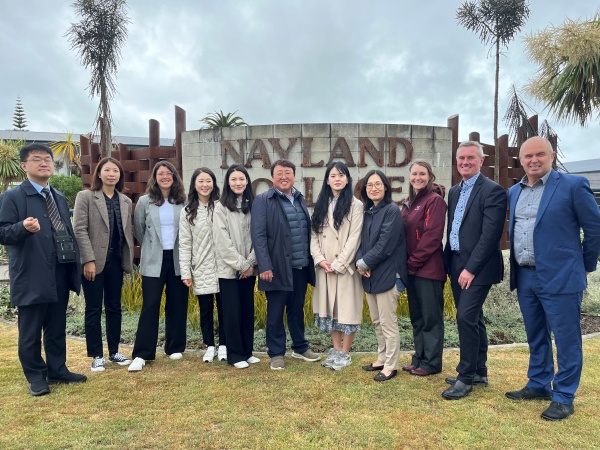
Nayland College demonstrated manaakitanga by welcoming the group to rainy Nelson but provided an Asia Kiwi lunch complete with meat pies and sushi!
Like the Schools Visits Programme, the pandemic interrupted tertiary programmes and the revised programme ran in January 2023 with short term group programmes. The site visits in November to Te Pūkenga NMIT and Lincoln University provided an opportunity to discuss the institutions’ proposals to host Korean tertiary students in January 2024.
Also discussed was the importance of reciprocity and it was noted that Korea is a popular destination for New Zealanders under the Prime Minister’s Scholarship for Asia (PMSA) scheme. Since 2016, the scheme has awarded scholarships to 196 individuals or groups for study, intern or research programmes in Korea. Lincoln University, in particular, has been successful in facilitating group PMSA programmes focused on agriculture to Korea.
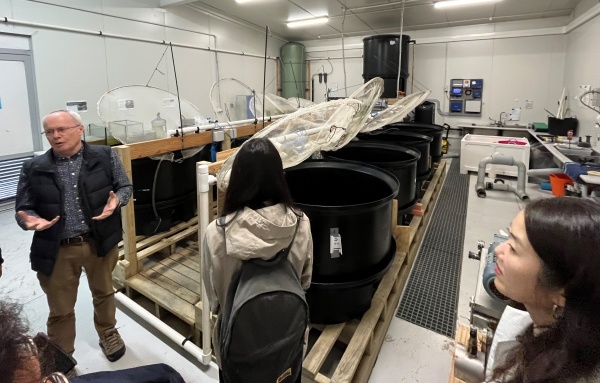
Dr Mark Burdass, Aquaculture Programme Coordinator and Tutor, introduces the hands on learning in the aquaculture programme at Te Pūkenga NMIT.
At the conclusion of their visit, the Korean delegation expressed their gratitude to the institution hosts for making their time in New Zealand memorable and valuable through fruitful discussions. The delegation emphasised the importance of conducting these meetings in person and visiting the campuses to meet with institution staff and academics. The ENZ Manapou ki te Ao team is pleased to continue close cooperation with our Korean education partners to facilitate connections with New Zealand education providers for the education programmes.
If you are interested in finding out more about the education initiatives originally outlined in the KNZFTA, you can read about this in a 2016 E-News article here - New opportunities for New Zealand and Korea.
-
Advertising opportunity in Japan
Click here to view a sample advertisement.
The publication is the only one of its kind supported by the New Zealand Embassy in Tokyo and Education New Zealand. KBUNSHA distributes 20,000 copies to Japanese schools, universities and education organisations as well as education fairs and seminars.
“With the New Zealand border gradually reopening to students from Japan, along with the recent New Zealand Prime Minister’s visit to Japan in April, this is a great opportunity for us to join forces to promote New Zealand education to the Japanese public. Destination marketing plays a key role in student attraction for a market like Japan with a tourism focus and I hope regions can also participate in this special opportunity to introduce their regions and activities,” says ENZ Director of Education – Japan, Misa Kitaoka.
To advertise, bookings must be made by 30 June 2022 directly with KBUNSHA (details for English speaking contact person are included in the NZ Proposal).
Advertisement rates for individual providers range from $NZ1,200 to $NZ6,000 for guidebook and/or website listing. Individual providers can download the proposal here. Advertising copy can be provided in English.
For further details on the guidebook and pricing for regional groups (starting at $NZ2,300 for a 2-page colour advertisement) download the proposal here.
-
ENZ promotes education in Thailand
The counsellors were broken into small groups and rotated between roundtable discussions with Education New Zealand, the US Embassy, British Council, and OCSC.
ENZ’s Marketing and Strategic Relations Manager – Thailand, Chortip Pramoolpol, said this intimate road show format was helpful in sharing key information with the market without overwhelming them.
“It was a great way for school counsellors and students to gain insights into New Zealand’s education system and learn the many benefits of studying there.
“It also means information about New Zealand will be distributed into schools and to students who otherwise wouldn’t have New Zealand on their study abroad radar.”

ENZ and RMUT representatives
The following day, ENZ met with the chairman and presidents of Rajamangala University of Technology (RMUT), a system of nine universities in Thailand. With RMUT’s link to industry and practical teaching styles, it is most similar to New Zealand ITPs.
ENZ’s South, Southeast Asia and Middle East Regional Director, John Laxon gave a crash course on the New Zealand ITP system, welcoming the possibility of future collaborations with RMUT in English language training, double-degree programmes and student exchanges.
To build on this knowledge, ENZ’s Thailand team have begun planning an education road show for all nine RMUT universities starting December.