Search
Showing 10 of 1931 results for how to register international groups
-
Introducing ENZ’s new Board member, Victoria Spackman
Victoria is Chief Executive, Director and co-owner of the screen and visitor experience company, the Gibson Group. You can read Victoria’s bio here but E-News put a few questions her way when she was in the office last week.
How did you come to know about the world of international education?
I worked with Education New Zealand on a Mandarin language TV series called Dragons in a Distant Land, which was all about Chinese students studying in New Zealand. The series was launched by the Prime Minister in Beijing in April 2013 during the celebrations of the 40-year relationship between China and New Zealand, and screened on several TV channels around China.
What interests you about the sector?
I am particularly interested in the fact that there are so many advantages to be had from a well-functioning international education system – advantages to the students visiting NZ, to the NZ students they learn with, to the schools and other providers, and to the wider economies in both NZ and, potentially, in the country that the student is from. The strong personal and professional connections that are made through international education can help fuel lifelong relationships and opportunities.
What excites you most about your appointment to the Board?
I’m looking forward to the opportunity to help the sector grow and help New Zealand take full advantage of its strong international educational reputation.
What challenges do you expect to face?
New Zealand is not the only country competing for international students and we are not the best resourced or the most famous. So we have to differentiate ourselves and help what New Zealand has to offer stand out. My personal challenges will include understanding the complex ecology of the sector as quickly as I can so I can make a full contribution.
What parts of your study/work/life experience do you think is most relevant to your role on the Board?
I started my school life in the UK and, although I don’t think about it much, I expect that it has impacted on the person I am very much. The company I own has pushed into several new export markets in recent years, including China, the US and Denmark. The experience of persisting to reach those goals has taught me a lot about exporting and doing so in challenging markets. I hope that that experience, as well as my broader experience, can help me be of the most assistance to the organisation and the sector.
As well as announcing Victoria’s appointment on 9 July, Tertiary Education, Skills and Employment Minister Steven Joyce also announced the reappointment of Board Chair Charles Finny for an eighteen-month term, and Board members Philip Broughton, Richard Leggat and John Morris for three-year terms.
-
International intern programme helps Kiwi exporters
The International Markets Insights Programme, an intern programme at Victoria University of Wellington, brought together 15 international students from eight countries in Asia, the Middle East and Europe with Wellington businesses looking to export to those countries.
The students provided the exporters with vital information about their home countries to help the Kiwi businesses break into those markets.
Specially designed workshops were an integral part of the programme. Led by international business experts, they covered topics as diverse as digital marketing, intellectual property, export finance, and intercultural communication.
“As well as being useful for skills and information, the workshops were a great networking opportunity for everyone involved, and they were really well attended,” said programme manager Dr Alison Kuiper.
Japanese student Miki Akemitsu joined the Woolyarns New Zealand team, and worked with new contacts in the Japanese textile market.
“There’s a huge advantage in that Miki could contact people directly and speak to them in their language,” said marketing manager Jimad Khan.
Miki also researched Japanese importing legislation and scouted important locations in the Japanese market, which Jimad said helped speed up the process of learning about the new market.
The three-month programme was a partnership between the university and ENZ, and was supported by Wellington Regional Economic Development Agency (WREDA).
“International students are increasingly looking for practical work experience to complement their learning, and lift their future employment prospects,” said Sarah Gauthier, Regional Project Manager at Education New Zealand.
“These internships were highly valued by all the students involved as a stepping stone in their career development, as well as by the companies they worked for.”
-
Sector support needed for the 2024 International Student Expenditure Survey
Education New Zealand Manapou ki te Ao (ENZ) will soon be collecting data for the next International Student Expenditure Survey and is seeking sector support to ensure it gains an accurate picture of international students' expenditure while they study in New Zealand.
This survey is important to the future of New Zealand’s international education sector as it enables us to tell the story of the value to New Zealand, to each sector and to each region. It gathers information on international student travel (including visiting friends and family) and spending from a national survey of student expenditure.
The last survey was undertaken in 2018 and over 5000 responses were received. Since then, that data has since been put to multiple uses, including informing the quarterly Statistics NZ Education Trade Services number as well as a range of other student and regional valuations.
ENZ’s Director of Insights, Marie Clark, ran an information session on the upcoming survey last week. The session covered:
-
Why the survey is important, including other options we have explored
-
An overview of what is being collected.
-
The quality assurance processes
-
Who’s involved with the work
-
An overview of the survey
-
The outputs that are proposed
-
What’s involved for providers and students
If you missed it, you can watch a recording of the session here.
More information will be sent directly to providers soon with details on how the sector can help share the survey amongst students. The more responses we get, the more accurate the results will be and therefore will provide greater insights for education providers, the regions, and the various subsectors.
If you have any questions in the meantime, please reach out to insights@enz.govt.nz.
-
-
Does it matter if New Zealand wasn’t a student’s #1 choice? Join the Insights and Student Experience teams and find out!
In this session, Director of Insights, Marie Clark, Insights Analyst, Dr Tom Vardy, and Student Experience Manager, Ross Crosson, will give an overview of the key findings of the survey and will also exclusively preview our deep dive into the questions on decision making and country choice. Answering the question: Does it matter if New Zealand wasn’t an international student’s first choice?
In the 2024 International Student Experience Survey, students lifted their positive rating of their experience to 86 percent, two percent higher than the previous year. In addition, the number of students who rated their experience as “excellent” lifted eight percent to 41 percent. ENZ’s media release which includes links to the report and data sets can be found on our website - Rise in international students rating New Zealand experience positively.
As many education providers are looking to take advantage of new opportunities, this webinar is an important first chance to identify what additional support for international students may be required for the 2025 academic year.
Click this link to join the session: Student Experience Webinar | Tuesday 24 September 11am to 12pm.
-
From the CE: An amazing adventure
With less than 50 days left in 2023, many of you will be preparing to wrap up this current year. For many it means farewelling some of their international students who have completed their study experiences. For others it is a moment of reflection on how far new learners have come since arriving on our shores at the start of the year. For everyone, while looking forward to a summer of well-deserved rest and relaxation, preparations for the beginning of the new year will also be well underway.
Looking across the whole sector I cannot stress enough how important these preparations are in maintaining the momentum of the past 12 months. With, I’m told, close to 60,000 international student enrolments (up from the low of 40,000 students in 2022), we have collectively made significant progress in a very short time. However, now is not the time to rest on our laurels. As we finish this year, the effort that is made now will certainly lead to further success in 2024.
Here at ENZ, alongside our sector partners, we have been very active in market putting New Zealand in front of agents, parents, and prospective students across the globe. Fairs in Japan, South Korea, Thailand and Viet Nam spring to mind. The new brand campaign is in the market. It is a positive, upbeat, high-energy picture of what you get from a New Zealand education. It builds on the awareness created by I AM NEW while focusing on what makes us different. As international education campaigns go, it is very different, and that is a good thing.
Alongside this work, we are busy preparing for the announcement of the new Minister. This has involved the preparation of briefing papers that will be shared with the new Minister once they take up their office. While we are awaiting instructions which will come in the form of the Minister’s Letter of Expectation and the introductions that will take place in due course, we do know that international education will be a focus of the new government. This is especially in the areas of international connectivity and economic development.
Change and opportunity are ever-present for everyone living and working in international education, it is something we all understand and embrace.
Many of you will be aware that this is my last week at ENZ following my decision to leave after almost 12 years steering this waka. I have been with ENZ since its inception and have seen many major achievements and milestones. While getting stuff done is always important, for me the pleasure and the reward has been the many talented and passionate people I have met and worked with. The collective desire to transform the lives of learners, our communities and at the end of the day Aotearoa New Zealand, sees them doing incredible things day in and day out. This is what saw our industry through the most challenging times our sector has faced during the COVID-19 pandemic. This strength and bravery will see our industry continue to rebuild and thrive; of that I have no doubt.
It has been an amazing adventure championing a New Zealand education. Thank you.
Ngā mihi nui
Grant McPherson
-
India insights snapshot
Country dashboard – India
In the year ended December 2024 New Zealand exported $398.02 million of education related travel to India and imported $3.9 million, representing a trade balance of $394.12 million and a total trade value of $401.92 million.
Broad field and level of study for Indian students in New Zealand - 2023
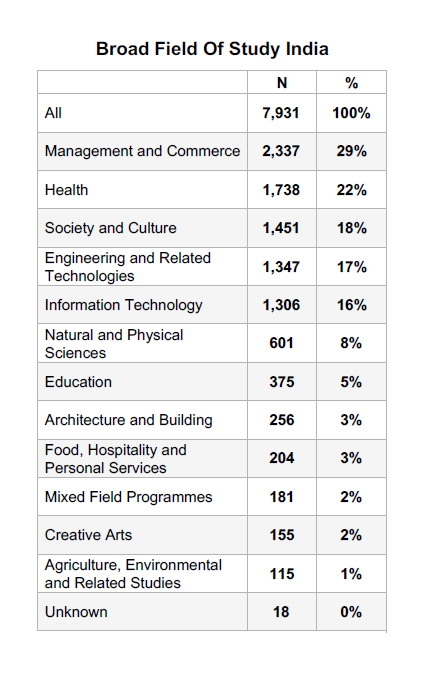
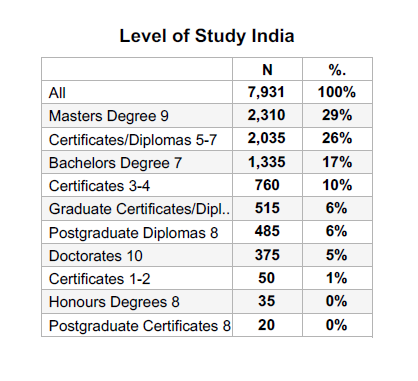
Browse the full country dashboards for India and other markets on this link.
International student enrolments from India
Between January and August 2024, overall international student enrolments from India grew 34% to 10,640 from 7,930 enrolments in the full year period for 2023. Enrolments for universities grew around 64%, private training establishment enrolments grew 36% and Te Pūkenga enrolments from India grew 15% over the same period.
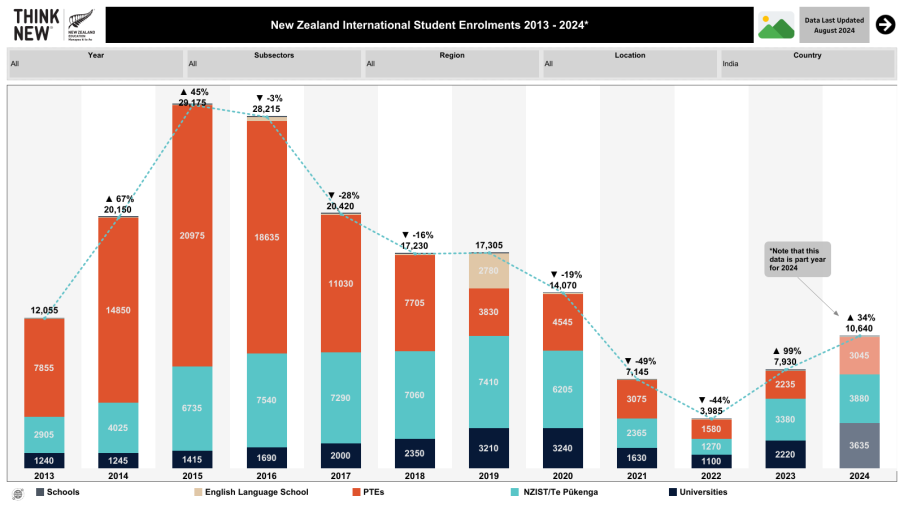
86% of Indian students in New Zealand rate overall experience positively
Indian students are thriving in New Zealand. The New Zealand International Student Experience Survey 2024 reveals that 86% of Indian students rated their overall experience in New Zealand positively.
From high-quality education and a warm, welcoming environment to strong community connections, these insights reflect New Zealand’s continued commitment to delivering a world-class, student-centred experience. -
Talking employment rights with international students
Lesley Brough, International Travel College (ITC)’s International Marketing Manager, welcomed Ms Kaloti to an international student lunch where Ms Kaloti spoke in detail about New Zealand employment rights, including contracts and the minimum wage and what to look out for to avoid exploitation.
“Ms Kaloti’s message reinforced several of our values like inclusivity, fairness, and diversity,” said Lesley.
“While ITC covers these important topics on a regular basis, it was good for international students to hear the same messages from an independent, unaffiliated organisation.
“Now our students know they can also reach out to the Migrant Workers Association if they would like further support or guidance.”
Ms Kaloti encouraged students to discuss these issues with their friends as they could be happening to someone they know.
“It’s really important that our students feel empowered about their rights in New Zealand and are compelled to share this knowledge with their friends and family,” said Lesley.
“The more we can raise awareness about these issues, the less likely it is that exploitation will occur.”
Education providers interested in having Anu Kaloti speak at their institute can email migrantworkersnz@gmail.com.
-
Positive trends signal growth
"While the effects of increasing competition linger, hard work by many across the industry is turning the tide," says ENZ Chief Executive Grant McPherson.
Overall, there were 97,283 international students enrolled at a New Zealand education provider in 2013 – 1.8 per cent less than in 2012.
"This figure is the result of a really hard start to 2013, where from January to April numbers were 5 per cent down on 2012. Growth since then helped offset some of the decline; from May to December student numbers increased by 4 per cent on the same period in 2012."
"There’s no doubt numbers do vary sector by sector and market by market, but I’m confident we’re at a point where they’re heading in the right direction. As an indicator for this year, total student visas approved from January to March 2014 are up 22 per cent on 2013," says Grant.
Highlights from the report include growth in students from China and India, with both countries increasing by 3 per cent on 2012.
"These are countries where ENZ has made a significant investment. This investment is reflected in increasing awareness of New Zealand education – our brand awareness is trending up in China and India and preference for New Zealand as a study destination is level with Australia. We’re starting to get noticed, although we’re still well behind UK and USA.
"In Japan, where enrolments grew 7 per cent between 2012 and 2013, we have also seen our consideration levels increase from 33 to 39 per cent."
In conjunction with the snapshot report, the Government released another report – the Business Growth Agenda Leadership Statement for International Education Progress Update.
The report sets out progress, since 2011, in achieving the goals of the Leadership Statement for International Education. It outlines key actions by government, and ongoing work to support the growth of international education.
"International education is New Zealand’s fifth largest export industry, contributing $2.6 billion to the New Zealand economy annually, and building links of lasting benefit to our communities."
"As an industry, we are working together in many ways to increase that contribution. For example, with more than 1,200 people now subscribed to The Brand Lab we’re telling a unified education story internationally. This can only strengthen our brand as a country, paving the way for providers to promote the distinctive strengths of your region and institution."
-
Around the world in five
Asia
The government of Hong Kong has announced ambitions to become an international hub for post-secondary education with measures including an increased quota for international undergraduates at public universities, more scholarships and work rights for postgraduate students.
North America
Canada is set to introduce a “recognised institution” framework, through which colleges and universities with a positive record of vetting and supporting international students may be eligible for fast-track study permits. This comes after over 100 Indian students faced potential deportation earlier this year after their admission letters to Canadian colleges were found to be fake, which the students were unaware of.
Middle East
A British school in Abu Dhabi that has been rated outstanding by the Emirate's school regulator for promoting the UAE's national identity said it has weaved elements of the country's culture, history, heritage and, Arabic language into its UK curriculum. The British International School Abu Dhabi is home to 2,080 pupils from 96 countries, with one in five pupils at the school being Emirati.
Europe
According to the Irish Higher Education Authority (HEA), In 2022/23, Ireland set a new all-time high for the number of international students studying at Irish universities. 33,480 students were enrolled at Irish universities last year, an increase of nearly 12% compared to 2021/22, according to the report. Furthermore, India’s student population in Ireland has grown by a significant 17.8%, reflecting a surging trend.
Africa
South African business schools are a higher education success story and champions in terms of higher education on the African continent. Though competing for students, they display a strong ethos of collaboration, generated by a sense of shared purpose to upskill a “new” country. These schools show the power of collaboration, common purpose, and internationalisation outlook.
-
The EAIE 2016 builds partnerships
The EAIE conference took place last month in Liverpool, with more than 5000 participants from over 80 countries in attendance. This included ENZ, which coordinated a branded New Zealand pavilion that showcased six universities and four Institutes of Technology and Polytechnics.
ENZ’s Regional Director Americas and Europe, Lisa Futschek, says that partnerships such as NMIT’s confirm how important EAIE is for New Zealand providers wanting to work with overseas institutions.
“Face-to-face relationship building is invaluable in this industry, allowing providers to discuss opportunities in a friendly but focussed environment,” she said.
“Each year EAIE brings together not just European, but global key industry players. It therefore provides a perfect platform for New Zealand industry to establish new and develop existing international partnerships.”
In light of its new partnership, NMIT will begin on-campus promotion of the exchange opportunity to Kiwi students in 2017.
The EAIE is not a student-facing event, similar to its North American counterpart, NAFSA (Association of International Educators) but an important business to business event on the annual international education calendar.

Left: Will Tregidga, International Development Manager from Nelson Marlborough Institute of Technology (NMIT) with Silke Bochow from Cologne Business School.
On the eve of the EAIE conference, ENZ hosted a New Zealand networking function, A Taste of New Zealand in the heart of Liverpool, for New Zealand institutions along with their existing and potential European partners. The New Zealand High Commissioner in London, Sir Lockwood Smith, officially opened the event, delighting guests with his passionate promotion of New Zealand as an international education destination. He shared with the crowd his pride at having introduced the world-leading integrated Qualifications Framework as Education Minister in the late 1980s.
Sir Lockwood brought the evening to a fitting close by leading Ngati Ranana Kapa Haka group in a spontaneous and rousing rendition of “Now is the Hour”.

Sir Lockwood Smith at A Taste of New Zealand in the heart of Liverpool