Search
Showing 10 of 1931 results for how to register international groups
-
Photo story – New Zealand education showcased in China
New Zealand speakers take the stage
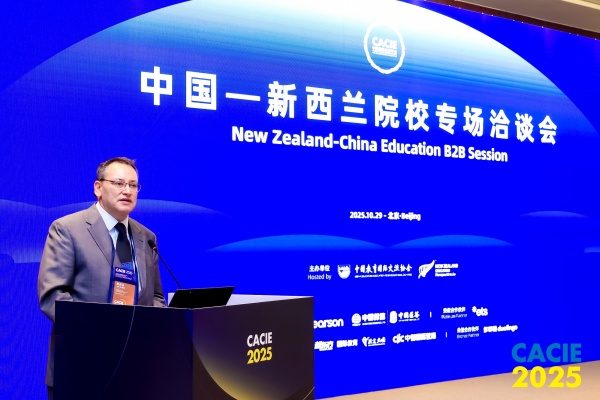
Minister for Universities and Minister of Science, Innovation and Technology, Hon Dr Shane Reti delivering welcome remarks at New Zealand-China Education B2B Session. As part of the China Annual Conference for International Education (CACIE), the B2B Session attracted over 117 visitors to engage in productive dialogues with participating New Zealand tertiary institutions aiming to build collegial partnership.
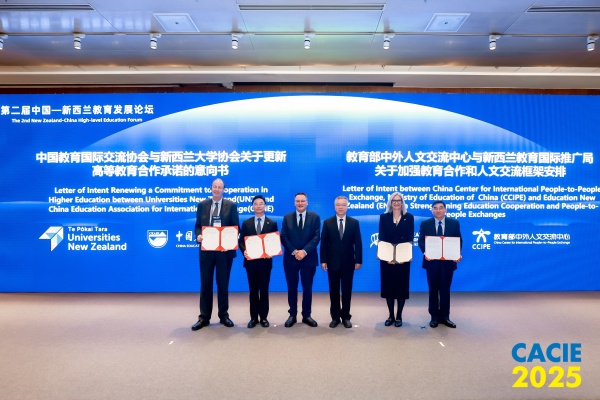
Minister for Universities and Minister of Science, Innovation and Technology, Hon Dr Shane Reti and REN Youqun, Vice Minister of Education of China witnessed the signing of Letter of Intent between Universities New Zealand and China Education Association for International Exchange (CEAIE) and Education New Zealand and China Centre for International People-to-People Exchange (CCIPE) at the 2nd New Zealand High-level Education Forum. The letters of intent between Chinese and New Zealand government agencies places existing collaboration within a more formal framework, allowing both sides to work more effectively together to advance shared education cooperation goals.

Minister for Universities and Minister of Science, Innovation and Technology, Hon Dr Shane Reti delivering remarks at CACIE Night, a key plenary event at the conference. In his remarks, he recognised New Zealand’s role as Country of Honour at CACIE and celebrated the deep and enduring education ties between New Zealand and China.

ENZ Chief Executive Amanda Malu speaking to a packed audience at CACIE Night, highlighting the strengths of New Zealand’s education system, the unique student experience, and the values that underpin our education brand.

Professor Damon Salesa, Vice-Chancellor, Auckland University of Technology (AUT) provided the Academic keynote address at the CACIE Plenary event.
During his address, Damon said: “This year, as New Zealand was recognised as the honour country, we were invited to share our story. It is a story of a small, agile education system that is responding to global challenges with creativity, care and collaboration.”
“It is a story of how we are preparing our learners for a future shaped by advancement in technology, while ensuring that innovation remains human-centred and culturally grounded,” he said.
China Education Expo
The New Zealand pavilion at the China Education Expo was front and centre, attracting many of the 15,000 attendees who attended the Expo in Beijing over two days.

Representatives from New Zealand and China cutting the ribbon to officially open the New Zealand pavilion at CEE.

Te Wehi Haka, the Haka Experience, provided a Māori cultural performance that attracted students, parents, agents and partners to the New Zealand pavilion.
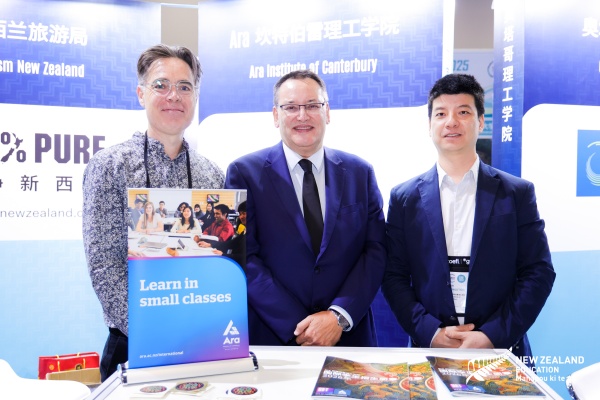
Ara Institute of Canterbury international department staff alongside Minister for Universities and Minister of Science, Technology & Innovation, Hon Dr Shane Reti (pictured centre).
Following the expo, 87% of those surveyed said their knowledge of New Zealand as a country to study in has improved after visiting the New Zealand pavilion
Additionally, 73% of those surveyed said they are more likely to consider New Zealand as a country to study in after visiting the New Zealand pavilion.
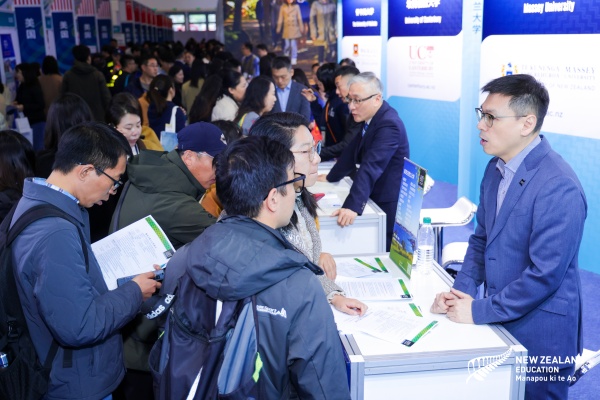
New Zealand education providers talking to crowds of prospective students and their parents at CEE.
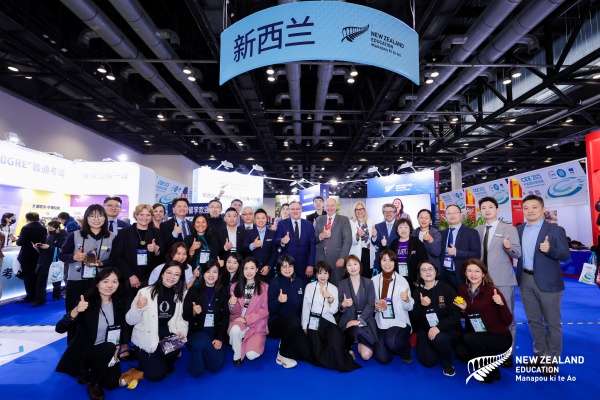
Representatives from the New Zealand government alongside New Zealand education providers at the CEE New Zealand pavillion.
ENZ Agent Seminars in Beijing, Chengdu and Wuhan
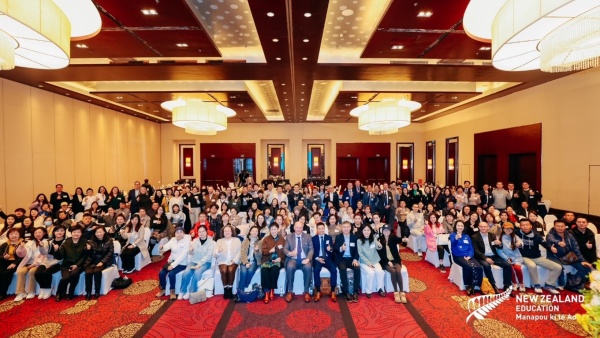
Attendees of the agent seminar in Beijing.
Building on the buzz of CACIE, ENZ hosted three Agent Seminars across Beijing, Chengdu and Wuhan.
The seminars connected over forty New Zealand education providers and around 320 visitors.
The seminars supported New Zealand providers to build connections with Chinese education agents
ENZ Director of Marketing, Adrian Hirst, said the personal connections made were a highlight of the event series.
“Sharing dinner at an agent’s home with parents and future students was a highlight, the informal setting sparked a lively Q&A session, which reinforced the trust families place in the process and the responsibility we all carry in our roles,” Adrian said.
Maximising the Country of Honour opportunity
Being named Country of Honour at CACIE and CEE was a prime opportunity for New Zealand to showcase its world-class education to Chinese audiences. ENZ delivered a strategic, multi-phase approach that built momentum before the events, maximised on-site impact through high-profile media coverage and Ministerial presence, and amplified engagement digitally with campaigns on platforms popular in China.

Minister for Universities and Minister of Science, Innovation and Technology, Hon Dr Shane Reti being interviewed by leading state media outlet, CGTN.

ENZ Chief Executive Amanda Malu speaking to China’s largest state TV network, CCTV at the CEE New Zealand pavilion.

ENZ Regional Director for China, Ron Xavier reporting in from CEE, speaking to Sina Education.
-
Connecting careers in Bay of Plenty and Waikato
This new online resource hub supports international secondary school students to pursue tertiary education and employment opportunities in the regions.
Secondary schools can use the tool to showcase the exciting range of opportunities in the students’ backyard. It encourages them to explore, plan, connect and succeed.
International students staying in the regions bring many benefits, including addressing skill shortages in key industries where skilled workers are in high demand, increased spending and promoting global citizenship and diversity.
Education Tauranga regional relationship manager Melissa Gillingham says providing a comprehensive international student journey plan is becoming increasingly important.
“This allows students and their parents to see the opportunities that exist in the regions, from the school sector, into the tertiary sector and through to employment,” she says.
“Excellent existing relationships across all education sectors within our region allowed us to hit the ground running, creating, delivering and promoting our international student journey plan. We would like to thank all our stakeholders for their support.”
Education Tauranga partnered with Education New Zealand Manapou ki te Ao, Te Waka and Rotorua NZ to help bring Career Connect to life.
-
The first step towards student re-entry
Work is well underway to put in place a new system to allow this cohort of students to enter New Zealand.
For students, there is no rush to apply for these limited spaces. PhD and postgraduate students who hold or held a visa for 2020 will be selected by education providers and offered a place in this first cohort.
The initial student selection process is being finalised by education providers and government agencies, who are also planning the support students will require on their journey to resume their study in New Zealand. Students are expected to start arriving from November, with most arriving after Christmas.
Eligible students will hold or have held a visa to study in 2020 but have been unable to enter New Zealand due to COVID-19, with priority given first to those who must be in New Zealand to complete practical components of their research and study.
Students will need to comply with New Zealand’s COVID-19 regulations, including a 14-day managed isolation period, and payment of the isolation charges. Their arrival remains subject to the availability of these facilities, to avoid preventing New Zealand citizens and residents from returning home, or essential skilled workers from entering the country.
Education New Zealand has been working with the Ministry of Education and other Government agencies and the education sector in building the student re-entry approach.
In announcing this decision on 12 October, Minister Chris Hipkins emphasised the importance of international education to New Zealand’s recovery and rebuild from the pandemic.
“We have been glad to see this initial announcement has been well-received by both the New Zealand public and the education sector,” ENZ General Manager – Stakeholders & Communications, John Goulter, says. “This group of 250 represents only a fraction of our usual international student intake. By keeping this first cohort of international students small, we can all work to make sure students have a great experience – and that they are welcomed and supported by New Zealanders.”
-
Successful agent engagement and student recruitment drive in Malaysia
The events aimed to gauge student interest in studying in New Zealand and deepen collaboration with education agents and schools.
To kick off the series, in early March, ENZ and representatives from New Zealand universities co-hosted a morning tea information session and focus group for Malaysian education agents in Kuala Lumpur.
The session promoted the ENZ resources available to support agents, and representatives from University of Auckland, University of Canterbury, Massey University, University of Otago, and University of Waikato led a discussion exploring key messages that resonate with Malaysian students and parents, understanding the factors influencing destination choice and brainstorming strategies to strengthen New Zealand’s brand visibility.
The event brought together 11 agencies from across Kuala Lumpur.

Co-funded agent activity
ENZ supported three key education agencies from across Malaysia to undertake co-funded student recruitment activity.
In Selangor, AECC Global Malaysia and ENZ hosted a mini-booth fair at HELP International School – giving students the opportunity to interact directly with representatives from Auckland University of Technology, the University of Auckland, the University of Canterbury, University of Otago, and the University of Waikato.
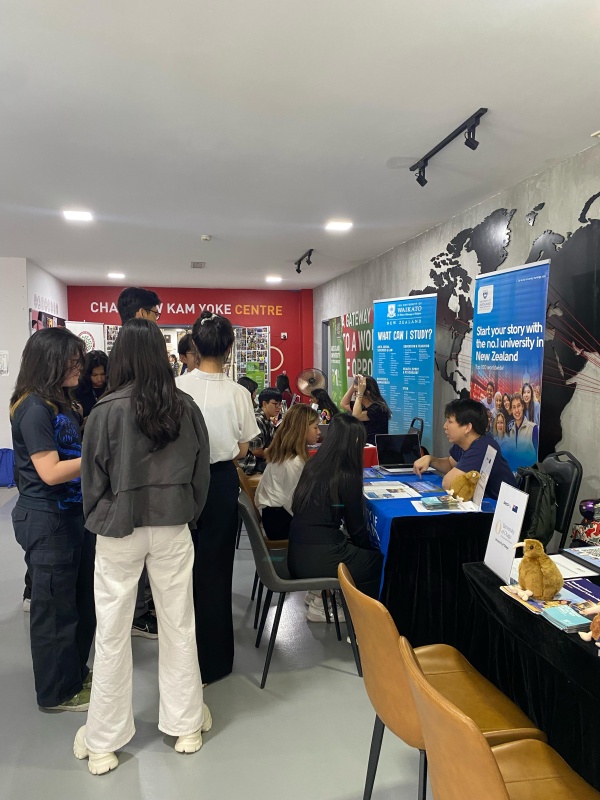
The mini-booth fair at HELP International School.
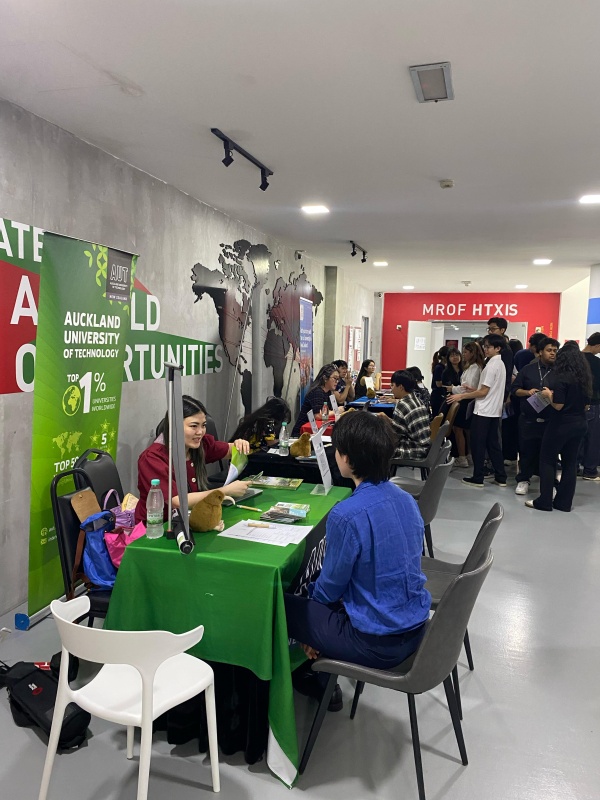
The mini-booth fair at HELP International School.
Over to Shah Alam, SELSET Education partnered with INTEC College to host an information session showcasing eight of New Zealand’s tertiary institutions.
INTEC College students heard from the Auckland University of Technology, the University of Auckland, University of Canterbury, University of Otago, University of Waikato, Southern Institute of Technology, Nelson Marlborough Institute of Technology and pathway provider, University of Canterbury International College.
Around 100 students were in attendance, and the session was followed by an opportunity for students to chat further with the study providers on show.

Students at INTEC College exploring New Zealand tertiary education study options.
To close out the co-funded activity, ENZ made its first official visit to East Malaysia since before the pandemic.
ENZ and JM Education partnered to lead a series of school visits in late April Kota Kinabalu, Sabah.
Around 400 students attended information sessions across three schools. The events were led by the University of Auckland and University of Otago at Kota Kinabalu High School, Sekolah Menengah Sains Sabah, and Maktab Nasional.
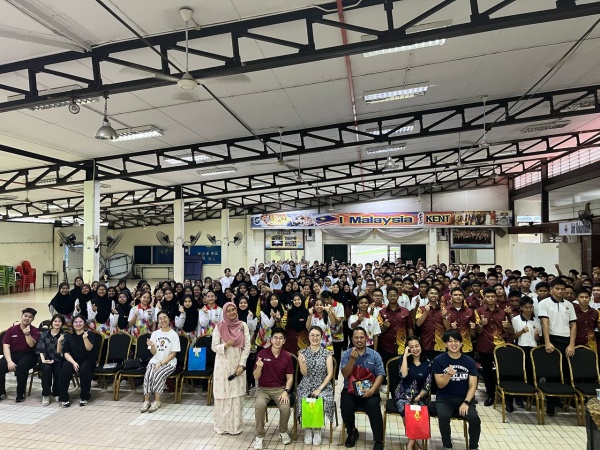
Attendees of one of the information sessions.
ENZ Market Manager for Indonesia and Malaysia, Naluri Bella, said that partnering with agents for co-funding targeted activities helps enhance both agents and students’ awareness and understanding of New Zealand’s unique education offering.
“These collaborations not only build trust and commitment among agents but also positions New Zealand as a competitive and credible choice for Malaysian students,” she said.
-
Catching up with the Canadians – news for the school sector
“Everyone knows that Canada is a key competitor for NZ’s school sector,” Mary says. “I wanted to find out more about their success and learn about the challenges they face”.
“Many of the people I met were surprised to learn that NZ hosts about 16,000 international school students – punching above our weight internationally when compared with Australia’s 18,000 – but still a long way from Canada’s 46,000 enrolments! Nevertheless Canada does see Australia and NZ as its main competitors offshore.”
The theme of the Conference was Collaborating to Educate Tomorrow’s Global Citizens. It was attended by 250 delegates from across Canada. Delegates represent school districts or boards, so each delegate could be working with 10 or 50 schools.
International speakers at the conference noted New Zealand’s recent increased profile and activity level in the school sector, citing government support and the establishment of SIEBA as positive developments.
“We are developing a relationship with CAPS-I, with both sides keen to explore potential collaboration” says Mary.
“During my visit I learnt a lot about Canada’s school international education industry. They draw from many of the same markets we do, but as you might expect NZ is stronger (relatively speaking) in South East Asia while Canada is stronger in Latin America.
“There is very little federal government support for Canadian schools’ international business, because education is a provincial responsibility. Canadian schools are committed to delivering high quality student experiences, but they don’t have a Code of Practice equivalent to regulate high professional standards.”
Mary will be sharing more about her learnings on Canada at a pre-conference workshop at NZIEC 2015.
-
Kapa Haka and lion dancing welcomes students to Christchurch
Christchurch Educated has run the event since 2014, and this year’s welcome was sponsored by Christchurch City Council, Ara Institute of Canterbury, University of Canterbury, Lincoln University and China Southern Airlines. Nearly 250 students – both international and domestic, new and returning – from the Canterbury region attended, with some accompanied by their homestay families.
Izzie Guo, International Student Experience Coordinator at Christchurch Educated said making students feel welcome is a key factor in creating a good student experience.
“Coming to a new country to study and start a new life can be a very challenging journey for international students,” she said.
“We are grateful that they chose our city as their second home, so it’s our responsibility to make sure they are have a positive experience with us and are well-cared for.”
The theme of the event was “Feel at home in Canterbury”. Students received a traditional Mihi followed by a warm welcome from Christchurch Deputy Mayor Andrew Turner.
The welcome event had food trucks, art demonstrations, games, as well as a range of cultural performances, including kapa haka, Indian bhangra, Chinese lion dancing and live music. Students also had a chance to pick up some Kiwi culture with rugby skills training, poi making and flax weaving.
Sigred Yamit, a University of Canterbury student and event MC said such events are a great way to bring the community together.
“My family and I migrated to New Zealand five years ago, so I can relate to the experience of international students. I wasn't aware that such events existed back then but they’re so important,” she said.
“Meeting people from different cultures broadens your perspective in life, and you get the chance to learn something new from them.”


-
International students dig deep
The student volunteers were a mix of high school (Shirley Boys High School, St Bedes College and Riccarton High School) and university students (Ara Institute of Canterbury, Lincoln University and University of Canterbury), said Izzie Guo, Student Experience Coordinator, Canterbury International Education Leadership Accord and Christchurch Educated.
“There was also a great mix of cultures, with students coming from China, India, Japan, Russia, Thailand, Botswana and Zimbabwe, Bolivia, Philippines, Malaysia and New Zealand,” she said.
The students took around two hours to plant 500 native plants, including rushes and sedges.
“The international students learned about native bush, while several locals stopped by to talk to the internationals and learn about the reasons they were in Christchurch, and how they were enjoying studying and living in New Zealand,” Izzie said.
The event was followed by a Kiwi-style BBQ thanks to the Christchurch City Council park ranger involved, Robbie Hewson. It finished with a soccer game, where team China and Japan competed with team Russia and New Zealand.
“After the BBQ, some of the students walked around the Sister City gardens at the quarry – they were very excited to see that the garden was built to signify the relationships between their countries and Christchurch.
”I had a wonderful time!” said Omar Sheta, from Egypt who is studying at Riccarton High School. “I met lovely people from different parts of the world, we volunteered together as one, chatted and played soccer together.
"It was definitely a fun and meaningful experience for all,” said Sigred Yamit, a Filipino who is studying at the University of Canterbury.
“Not only were we able to contribute a bit to the local gardens and community, but we also made new friends. Everyone had a great time and tons of selfies were taken at the end of the day."
This event was supported Christchurch Educated International Student Association and Ara’s student events team.
-
Insights from Europe's biggest international education conference
EAIE is the main annual international education conference in Europe, and September’s event in Helsinki was the largest to date, attracting 6,200 higher education professionals from 95 countries.
ENZ Senior Advisor – Special Projects, Bronwyn Shanks, sees unique opportunities in the Europe market. “New Zealand education offers a contrast to the traditional, theoretically-based learning we often see in European systems,’’ she says. “New Zealand’s natural environment is already a big drawcard, and our practical, hands-on approach also attracts European students to New Zealand’s ITPs and PTEs.’’
European students willing to pay for education like to see a clearly defined return on their investment, she says. This means gaining skills for the future of work, learning to think critically, collaboratively and globally.
In areas of Europe where youth employment is high — it’s over 20 percent in France and above 30 percent in Italy and Spain — the focus is also work preparedness and employability.
ENZ’s focus markets in Europe are Germany, France, the UK and Scandinavia, as well as Italy at secondary school level only. Each market has its own nuances, but all have strong bilateral ties and research links with New Zealand, so it makes sense for ENZ to work with other New Zealand government agencies and institutions to build on those relationships.
Outside the UK, European students are used to a free public university system, which makes this a price-sensitive market. On the other hand, there are policies in place to encourage international student mobility and provide funding, for example through Germany’s Academic Exchange Service (DAAD), generous government funding programmes in Scandinavia, and EU programmes such as Erasmus+.
“To realise the opportunities Europe offers – especially if we’re being realistic about the resources we have – we need to focus on enhancing international engagement. This means partnering with education agents and building both institution-to-institution links and government-to-government relationships to expand our reach.”
-
2016 International Student Experience Survey for PTEs and English language providers
Find out how your institution performs compared to national and international benchmarks in terms of:
• overall satisfaction and recommendation
• the arrival experience – satisfaction with the arrival experience in New Zealand and at their institution
• the learning experience – satisfaction with their course of study, subject choice, learning environment and resources
• the living experience – satisfaction with such things as accommodation, living costs and day-to-day life
• support services – satisfaction with support services.If you participated in the 2012 or 2014 studies, see how your results have changed over time.
Participation in the study is free for institutions. If you would like to take part, please complete the registration form as soon as possible but no later than 7th October 2016.
More information about the 2016 International Student Experience Survey (including reports from the 2014 study) is available in the Frequently Asked Questions document.
Or, please don’t hesitate to contact Kyla Steenhart, Director, i-graduate New Zealand for more details – kyla.steenhart@i-graduate.org or +64 21 857 054.
-
Around the world in five
CHINA
Studying Abroad (magazine affiliated with Guangming Daily)
The August issue of this Mandarin-language magazine shines a spotlight on New Zealand as an education destination. It features interviews with both New Zealand's Ambassador to China and Mongolia, Clare Fearnley and ENZ Director for Greater China, Miranda Herbert.
GLOBAL
‘How to live in a pandemic’: The university class we need during COVID-19?
The COVID-19 pandemic has demonstrated that health is a deeply interdisciplinary issue, demanding expert responses from a cross-section of fields: the arts, public health, social work and K-12 education among them.
AUSTRALIA
Australia visa data raises questions about student swerve
Australia’s latest offshore visa application data which revealed varying declines from important source countries has raised important questions about international student behaviour, and whether or not they are deferring to alternative destinations.
GLOBAL
What we have lost: International education and public diplomacy
Entangling universities with geopolitics can mean a bad student experience has a far broader cost.
GLOBAL
Online testing will become “the norm”
Online secure exams are becoming increasingly popular because of the Covid-19 pandemic, and in the future online testing will become the norm, according to LanguageCert’s chair of the Advisory Council.