Search
Showing 10 of 2262 results for read 2024 FRM Exam Part I - Quantitative Analysis online free
-
New advisory board to support our North American strategy
Established by Education New Zealand Manapou ki te Ao in 2021, this voluntary advisory board includes former Study Abroad scholarship winners to New Zealand, independent education counsellors, and senior leaders in international education in the United States. Members have a shared interest in developing educational ties between the US and NZ and are supporting ENZ’s North America team to implement our strategy for this market.
The 10-member board has established three sub-committees that will develop signature projects to raise awareness of New Zealand’s education brand and promote student flow between the two countries. The sub-committees cover:
- Alumni engagement and student experience: Three board members were former students in New Zealand and discussed ways in which ENZ and institutions could better support international students before, during, and after their study experience in New Zealand.
- State consortia engagement: The United States is vast and decentralised. This sub-committee is advising and assisting with partnership development around State-run education consortia that, in some States, oversee international education initiatives from Kindergarten through PhD-level Colleges and Universities.
- Foundation engagement: In the US, grants, research and special projects are largely funded by foundations set up by companies and individuals. Sub-committee members will use their expertise and networks to help identify foundations whose interests align with ENZ’s and New Zealand’s education and economic goals to set up funded partnerships between the two countries.
The overall aim of this work is to:
- position New Zealand as a destination of choice for students from diverse backgrounds by promoting and changing the understood narrative of New Zealand
- identify and develop strategic, reciprocal partnerships that align with our goals
- evaluate aspects of our programming and outreach related to:
- diversity, equity, and inclusion (DEI)
- student care
- help the ENZ North America team determine how we translate and explain Māori values to North American audiences, how they relate to our work, and how they can contribute to the field of international education
- provide a North American context to international education including but not limited to study abroad, full degree, exchange, and hybrid learning.
DEI is a core part of ENZ’s North American strategy for international education. We hope to move beyond perceptions of New Zealand as a country suitable for adventure seekers, to position New Zealand as a diverse country with a strong bicultural heritage, rich ideals of social justice, and an ideal education destination for students from marginalised backgrounds.
-
SIEBA launches Schools Global Citizenship Pilot Programme
A network of 20 schools will take part, receiving professional advice and support to create, introduce and embed global citizenship strategies and initiatives across their schools.
SIEBA’s recent report on international business recovery for schools highlighted global citizenship education as one of three key areas expected to underpin business recovery and the future of international education, both within New Zealand and globally. The other two areas are sustainability/climate action, and growth in school-to-university pathways.
Global citizenship programmes contribute to a better international student experience, build understanding and support for international education, and enrich the value proposition that schools offer both domestic and international students.
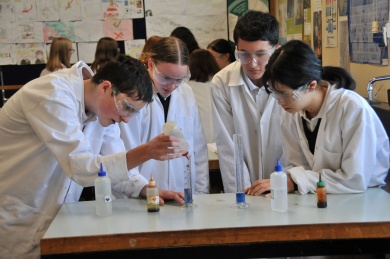
Image above: Japanese and Kiwi students discovering science together at Awatapu College in Palmerston North
“Global citizenship education (GCED) has the potential to bring local and international students together through a focus on global issues, and in development of global competencies. International students and parents are increasingly looking for schools that can demonstrably deliver GCED within the educational experience," the report says.
The pilot programme will be delivered in collaboration with the Centres of Asia-Pacific Excellence. The schools involved will draft Global Citizenship strategies linked to a range of programmes throughout the school, including learning content and teaching approaches, co-curricular programmes, professional learning and development, and student-led initiatives. They will examine how Te Tiriti o Waitangi and Te Ao Māori will underpin their global citizenship strategies. Schools will start local, this will be a multi-year journey, and the result will look different in every school.
Developing global citizens is also one of the overarching goals of the New Zealand International Education Strategy.
-
From the Chief Executive: Stepping up the promotion of international education
We’re about to embark on education-focussed travel that will include three of our important markets for international education – the United States, Chile and Brazil. As part of the trip, the delegation led by Education Minister Chris Hipkins will attend NAFSA, the world’s biggest international education event, held in Denver, Colorado.
This trip will also feature the launch of ENZ’s amazing new global marketing campaign on 31 May 2022 at NAFSA – there’s a sneak preview in this issue of E-News.
I’m also delighted to let you know that planning is well underway for the 29th New Zealand International Education Conference (NZIEC) to be held in August. To ensure we reach the widest possible audience at a critical time for the rebuild of the industry, NZIEC 2022 will be delivered in a virtual format this year, at no cost to attendees.
Following on from the government’s announcements earlier this month on changes to immigration settings and the restart of student visa applications from 31 July 2022, there have been two further announcements that are important for the international education sector. These relate to the outcome of recent consultation on enrolling international fee-paying students under Year 9, and a refresh of the New Zealand International Education Strategy.
International students up to Year 9
The government has decided to make no change to the ability of international students to enrol in New Zealand primary and intermediate schools. This follows earlier consultation on possible options to restrict the enrolment of international students below Year 9, which closed in March 2022.
This announcement has been widely welcomed, and demonstrates the government listened closely to feedback received from the sector and other interested parties. It’s good news that we can resume welcoming young students and groups to New Zealand schools across all age levels as our borders reopen.
New Zealand International Education Strategy (NZIES)
The existing NZIES dates back to 2018, and the impact of Covid-19 and the changed global education environment mean another look at the strategy is timely. Consultation on a refreshed NZIES 2022-2030 is underway, and I encourage you to provide your views and feedback before consultation closes on 24 June 2022.
The draft refreshed NZIES 2022-2030 reflects the government’s continued commitment to international education, and the need for us to focus on building back better from the pandemic. It includes two phases. The first phase is about rebuilding and recovery – promoting New Zealand’s education brand and supporting student recruitment. The second phase aims to build capability and investment in a more diverse and resilient international education sector.
As a package, the recent government decisions including the immigration rebalance mean we now have increased certainty about the operating environment for the international education sector. We look forward to working with you to rebuild our international education sector to be a major contributor to New Zealand. And we look forward to students from all around the world enjoying the benefits of a New Zealand education, and New Zealanders enjoying the benefits these students bring to our communities.
He rā ki tua – better times are coming.
Grant McPherson
-
Education New Zealand marks reopening of borders with new global campaign
Denver Colorado, 31 May 2022: Education New Zealand Manapou ki te Ao at the NAFSA Conference in Denver, Colorado today revealed for the first time a new global marketing campaign emphasising New Zealand’s unique attributes for international students as the country opens for business on 31 July after two years of closed borders.
Central to the campaign are the stories of eight international students from, China, Colombia, Germany, India, Japan, Thailand, USA, and Vietnam. The students share their experience of study and life in New Zealand, and the benefits that result from the weaving together of different cultures in a uniquely New Zealand way.
Education New Zealand invited the eight students to work alongside world-famous Māori fashion designer Kiri Nathan to collaborate on designing a new type of education garment that embodies the cultural values that make a New Zealand education unique: manaakitanga (care of people), kaitiakitanga (care of place), and the pōtiki spirit of youthful energy and finding a better way. The narratives in the campaign are focussed on the students’ experiences and goals, and explore themes such as work and career readiness, sustainability, and innovation through collaboration. It is a campaign authentically rooted in Te Ao Māori values.
“The traditional academic gown worn by students when they graduate is a symbol of achievement, capturing a snapshot in time,” says Ms. Nathan. “Our ‘kākahu’ (garment) symbolises not only this attainment, but most importantly the cultural journey these students have undertaken and will continue throughout their lives. Their experience in New Zealand has changed them, weaving and sharing the values of Te Ao Māori into the unique cultures of their own homeland. The final kākahu designs are a unique collaborative effort, globally-minded and inspiring – just like the students.”
Kiri Nathan is best known for her extensive experience of the modern fashion world infused with her Te Ao Māori roots. She has developed pieces for international figures including Barack Obama, Beyoncé, and the Duchess of Sussex. As a Māori mentor running the Kāhui Collective, she has seen a significant number of NZ Māori fashion designers feature at the NZ Fashion Week, Guangzhou Fashion Week, Hong Kong Fashion Week, and the Fiji fashion week. She also led a delegation to China to meet high level fashion networks and create pathways to market.
More than qualifications
At the core of the campaign is the concept that education with New Zealand is far more than the attainment of academic qualifications.
“What we offer global students is an opportunity to experience something new, different, and ongoing,” says Education New Zealand Chief Executive, Grant McPherson. “It is a new perspective that redefines success in global education beyond degrees and academic achievement and builds greater understanding of the value of continuous learning throughout life.”
“When you study with New Zealand, you’re invited to bring your whole self. You will benefit from New Zealand’s cultural values as well as our high-quality education that embodies innovation, practical learning, and preparing you for the future.”
“But we also know New Zealand benefits too. We want students to bring their stories, their culture, and their perspectives so that we can learn from each other and build a future that is connected, strong and adaptable.”
Across the eight kākahu three sustainable textile options have been used in their manufacture – upcycled commercial linen, sustainable wool from New Zealand mills, and deadstock from fabric wholesalers.
The campaign was launched as part of Education New Zealand’s participation at the NASFA 2022, the world’s largest international education conference and Expo in Denver, Colorado. The campaign will roll out across New Zealand’s key partner countries from June 2, 2022 and runs for 12 weeks initially.
The eight students:
Hanbo Wang (Kevin), from China, studying Viticulture and Wine Science at the Eastern Institute of Technology in Hawke's Bay.
Octavius Jones, from the United States of America, a PhD student in the Te Kawa a Māui department at Victoria University of Wellington. Octavius is studying digital storytelling, African and Māori studies.
Tiara Das, from India, studying Science - Psychology and Neuroscience at the University of Otago in Dunedin.
Bryann Avendaño, from Colombia, studying Civil and Natural Resources Engineering at the University of Canterbury in Christchurch.
Hanna Watanabe, from Japan, is a Year 12 High School student at Rangiora New Life School, in Rangiora, Canterbury.
Khanh Phuong LE, from Vietnam, studying Law at Waikato University, Hamilton.
Atis Suksingha, from Thailand, studying Commerce, majoring in International Business and Marketing at the University of Otago.
Malina Grube, from Germany, studying Law at the University of Auckland, Auckland.
To learn more about our new campaign, visit I AM NEW on Study with New Zealand, and watch our campaign hero video below:
YouTube -
From the CE: Telling the world New Zealand is open for business
Our purpose was to promote New Zealand’s world-class education and share the message that New Zealand is open again for international students. Travelling with the Minister opened many doors for us and led to useful media coverage in all three partner countries.
In Denver, USA, Minister Hipkins spoke at the plenary session to open NAFSA, the world’s largest international education conference. Te Pūkenga used the NAFSA event to launch its international education strategy, and ENZ launched the sector’s I AM NEW global marketing campaign. We met with senior officials to reaffirm New Zealand’s partnership commitment to the Gilman scholarships, which enable students of limited financial means to study abroad. We also met with NZ EdTech companies, including ImmerseMe, which uses virtual reality to teach languages. The company signed a 7-year partnership agreement with schools in the area during our visit.
The next stage of the trip was Brazil. In São Paulo we explored the possibility of English language study in New Zealand for school students with government Ministers; met with the São Paulo Research Foundation to support the growing NZ- São Paulo research engagement; and met with key education stakeholders from three São Paulo Universities: USP, UNESP and UNICAMP.
New Zealand is celebrating 50 years of diplomatic relations with Chile this year, and our visit to Santiago included meeting with Chile’s Minister of Science, Technology, Knowledge, and Innovation, and with Kiwi alumni. We signed two separate Education Cooperation Agreements – with Chile’s Minister of Education, and with the Council of Rectors of Chilean Universities. We also visited Universidad Diego Portales, which has a long history of collaboration with NZ EdTech company, ADInstruments, whose technology has been implemented as part of the university’s educational model.
We were warmly received everywhere, and there was a high level of interest in New Zealand. It was great to reconnect with Kiwis offshore, and with alumni, agents and others who have a genuine interest in building relationships with New Zealand – and to be able to support their efforts in person at a wide range of events.
In other news, the recipients of the recent round of Prime Minister’s Scholarships to Asia and to Latin America are close to being finalised. That round of scholarships, which was solely open for group applications, will soon be followed by the opening of a second round of awards, this time focussed solely on individual applicants. Again, we will be seeking to encourage applicants from a wide range of backgrounds particularly Māori and Pasifika applicants. In anticipation of the next round, we encourage everyone to check out the alumni stories and other useful information on our scholarships website here.
Whāia te mātauranga hei oranga mō koutou – Seek after learning for the sake of your wellbeing.
Grant McPherson
-
Digital masterclass a runaway success
Two New Zealand academics were among the speakers showcasing the latest technological solutions to revolutionise education at this second SEAMEO – New Zealand masterclass.
Professor Richard Green from the Department of Computer Science & Software Engineering at the University of Canterbury, who also co-chairs the NZ AI Researchers Association, presented on “AI is Revolutionising Sustainability, Food and Biosecurity”. Dr Suranga Nanayakkara, Associate Professor at the Auckland Bioengineering Institute, University of Auckland, presented on “Kiwrious: Keeping Kiwi Kids Curious”. The other two keynote speakers were from National Institute of Education, Singapore, and Universiti Malaya, Malaysia.
The event was broadcast on SEAMEO Secretariat YouTube Channel and targeted policy-makers, government officials, educators, teachers, lecturers at TVET institutions and universities in Southeast Asia and beyond.
“The high level of interest in this event reflects the changes that the COVID-19 pandemic has caused in the way we live, work and learn,” said ENZ’s Regional Director, Asia, Ben Burrowes.
“A huge part of the attraction of a New Zealand education has been our world-class teaching and learning environment. We have been focusing on teaching 21st century skills within our national education strategy. This includes soft skills enabling our students to become critical, creative and independent learners. Our use of digital technology in the classrooms is also widely recognised and remains a huge focus in our school and tertiary curriculum.
“This second Master Class gave teachers and educators in the Southeast Asia region an opportunity to learn more about what a New Zealand education can offer, and broaden their viewpoints on the technological disruptions arising from the COVID-19 pandemic.”
Officially admitted as an Associate Member Country in 1973, New Zealand's co-operative relations with SEAMEO include scholarships and provision of experts for SEAMEO Regional Centres. The first SEAMEO-New Zealand masterclass on “Education Technology and Digital Security” was held in September 2021.
The 2022 masterclass can be viewed from the following link on the SEAMEO Secretariat YouTube channel https://link.seameo.org/MasterClass/20220524
-
Building relationships in Brazil and Chile
The visit was an opportunity to highlight that New Zealand is reconnecting with the world, increase the visibility of New Zealand’s education offering, strengthen bilateral and system connections, and boost the visibility of New Zealand as a preferred destination for students from Brazil and Chile.
During the visit, Chris Hipkins highlighted New Zealand’s unique, high-value education offering, met with counterparts to support bilateral relationships, and connected with education agents, alumni, and New Zealanders based offshore. He also made clear that New Zealand valued the depth of the education relationship in each country, and his interest in continuing these relationships.
The New Zealand delegation included Grant McPherson, Chief Executive of Education New Zealand Manapou ki te Ao (ENZ); Lisa Futschek, ENZ’s General Manager International; Freddy Ernst, Senior Policy Manager International Education from the Ministry of Education; and Jacque Bernstein, Senior Private Secretary. In Brazil and Chile, Chris Hipkins was also accompanied by Matthew O’Meagher, Director for the LatAm Centre of Asia-Pacific Excellence and ENZ in-country representatives Amy Rutherford, Javiera Visedo, and Bruna de Natale.
There was a significant media coverage following the visit, including an interview with O Estado de São Paulo, a major nationwide Brazilian media outlet, and a television interview with Pablo Cuellar from Mega Channel, Chile, to promote New Zealand education.
“We would love to see more Brazilians coming to study in New Zealand,” Chris Hipkins said during one of these interviews.
Brazil visit
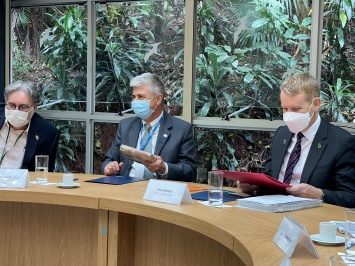
Minister Hipkins with Ronaldo Aloise Pilli – Vice-president / Board of Trustees FAPESP (on his left) and Carlos Américo Pacheco – Executive Board Executive Director FAPESP.
The programme in Brazil included meetings with Patrick Tranjan, São Paulo State Under Secretary of Education, to discuss São Paulo-New Zealand education cooperation and present New Zealand as an education destination for high school students, and with Fundação de Amparo à Pesquisa do Estado de São Paulo (São Paulo Research Foundation, FAPESP) to demonstrate high level New Zealand Government support for growing New Zealand-São Paulo research engagement.
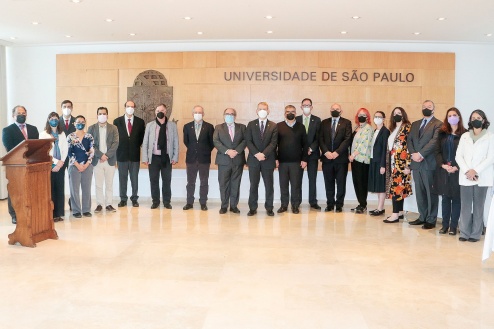
Chris Hipkins and delegation meeting representatives from São Paulo State Universities: USP (Carlos Gilberto Carlotti Junior, Provost), UNICAMP (Marcos Travassos Romano, Pro-Rector of Research) and UNESP (Amadeu Moura Bego, Adviser to the Dean of Undergraduate Studies)
Chris Hipkins also attended an event with New Zealand education agents, alumni, institutions, and business contacts, and visited the University of São Paulo (USP) which included a meeting with key stakeholders from the Council of Deans of São Paulo State Universities.
“It is absolutely brilliant that our Government is demonstrating such strong support to grow research engagement between our two countries, and that our Minister considers agent engagement and alumni as being key to futureproofing our industry,” Ms Futschek says.
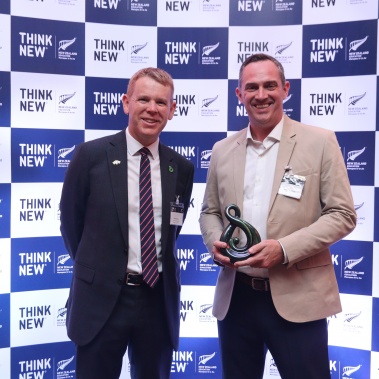
Minister Hipkins and Alexandre Argenta, BELTA President, holding the Piko Iti gifted during the reception in São Paulo for agents and alumni.
The visit to São Paulo was a recognition of the value of international education relationships, and the potential for New Zealand to grow our education partnership with Brazil. Prior to the COVID-19 pandemic, Brazil was New Zealand’s largest source of international students from Latin America. Institution-to-institution relationships are particularly strong, with longstanding partnerships and research collaborations. The Prime Minister’s Scholarships for Latin America are a valuable part of this relationship – of the 400 New Zealanders funded through these scholarships, 109 have been for study in Brazil.
During his visit, Chris Hipkins noted the warmth shown towards New Zealand by Brazilian universities, and the benefits of developing a dual focus. All universities mentioned their growing education engagement with New Zealand institutions, and their wish to further develop this cooperation.
USP’s willingness to consider a “New Zealand Corner” in their International Office demonstrates the success of the investment ENZ has made in its internationalisation focus on Brazil. This work, which began in 2016, has been aimed at developing relationships with highly ranked Brazilian universities.
“New Zealand and Brazil have many issues in common to work on, which they both care about, such as climate change, renewable energy, agriculture, indigenous education. We can gain a lot by exchanging experiences in this regard,” Chris Hipkins said.
Chile visit
The programme in Chile included meetings with new Education Minister Marco Ávila to discuss education cooperation, especially around intercultural education, and to sign a refreshed Education Cooperation Arrangement (ECA); with the new Minister of Science, Technology, Knowledge and Innovation, Flavio Salazar, to discuss potential areas of cooperation, scholarships, and reciprocal education engagement opportunities; and with the Board of the Council of Rectors of Chilean Universities (CRUCH) to witness the signing of an ECA between ENZ and CRUCH that will promote international education and exchange.
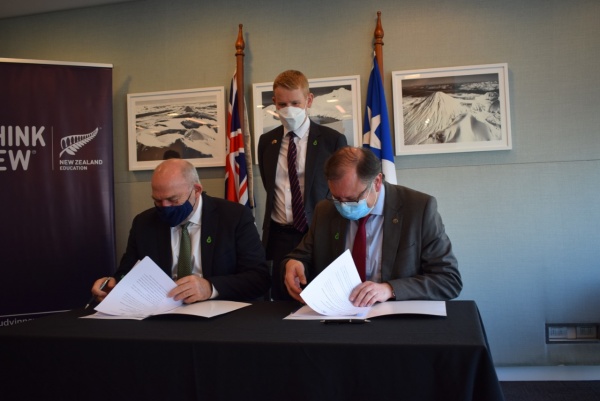
Minister Hipkins witnessing the Education Cooperation Arrangement being signed by Chief Executive Grant McPherson, Education New Zealand Manapou ki te Ao, and Rector Oscar Corrales, Universidad de Valparaíso in Chile.
Chris Hipkins also attended the Chilean Kiwi Alumni Board dinner and an edtech engagement event at the Universidad Diego Portales (UDP). He also hosted the 50th anniversary of the establishment of New Zealand’s first diplomatic post in Latin America (in Santiago), to reinforce the strong bilateral relationship between New Zealand and Chile.
Some key discussions included cooperation, scholarships, student and research mobility, and reciprocal education engagement opportunities. Indigenous exchange and opportunities to support capability and capacity development of young, emerging indigenous leaders were also of very high interest.
“Some of the key takeaways from this visit were the emphasis on diversity, equity, and inclusion, indigenous-led international education engagement, and internationalisation,” says ENZ Regional Director Amy Rutherford. “It is exciting to see the opportunities for collaboration in these areas.”
On his return to New Zealand, the Minister highlighted diversity, equity and inclusion, education agent engagement and alumni engagement as being key to the future of bilateral education relationships in the region.
New Zealand providers are invited to contact Javiera Visedo, ENZ’s Director of Engagement Latin America at latinamerica@enz.govt.nz for further information on the visit, or to discuss plans for engagement in the region.
-
International students welcomed at Waitangi
One such welcome to acknowledge and celebrate students from around the world took place on the Waitangi Treaty Grounds on 10 August 2022.
Study Northland organised a wonderful half day programme to welcome 70 international students currently studying at Whangarei Girls High, NorthTec, Kerikeri High School and Springbank School. This included a pōwhiri, cultural performance, and a ceremony in which each student was presented with Tū Ngātahi pins and welcome certificates. They then had the opportunity to explore the history and relevance of the Treaty Grounds, and the morning ended with fish and chips in the sunshine.
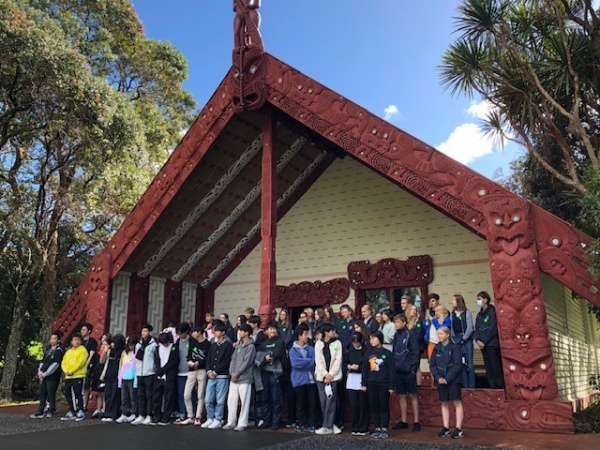
Students outside Te Wharenui at Waitangi
Tū Ngātahi is a te reo Māori phrase calling us to ‘stand together’. Education New Zealand Manapou ki te Ao developed this programme as a demonstration of welcome and support to international students, a celebration of the connection between cultures, and a recognition of the friendship and learning we share. The welcome at the Treaty Grounds was an ideal opportunity for the spirit and concept of Tū Ngātahi to be brought to life.
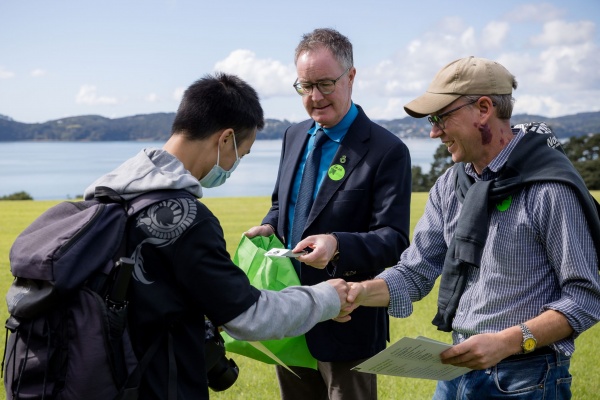
Ross Crossan (centre), ENZ’s Student Experience Manager, presented the students with Tū Ngātahi pins as part of the Waitangi welcome
Students were excited to be in New Zealand, some for the first time and some returning after heading back home during the pandemic.
Several of the recently arrived students at Whangarei Girls shared their first impressions with us. Fish and chips are certainly a hit, as is the chance to play badminton, volleyball, and other sports with friends. A few students mentioned the different school hours here. They also commented that just a little bit more time might be needed to get used to the weather!
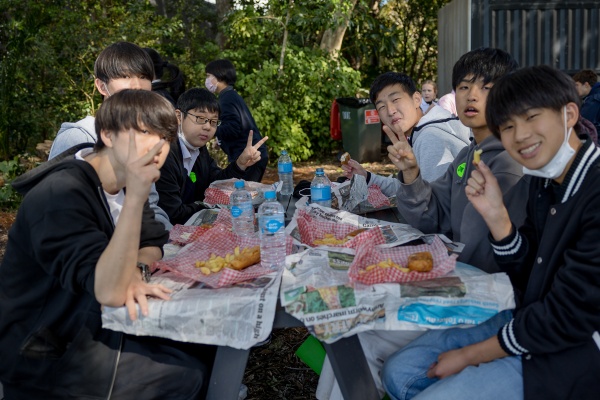
Fish and chips were a highlight at Waitangi
Arisara Pungpho, from Thailand, is attending Springbank School. She has been coming to New Zealand for many years with her family. Arisara is here for six months, and says she most enjoys New Zealand’s environment, and its tranquillity and peacefulness.
“Most places in Thailand compared to New Zealand are very fast, very busy, and very lively,” Arisara says. “I also feel New Zealand is more inclusive of many cultures, which is not what I have experienced in other countries around the world.”
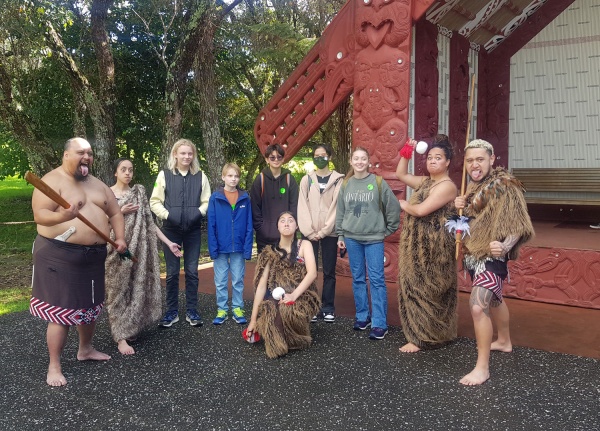
Springbank School students, including Arisara Pungpho (4th from left) and Elisabeth Ringel (3rd from left) enjoyed the cultural demonstration at Waitangi
Elisabeth Ringel particularly appreciated the warm welcome she received when she travelled here from Germany in July for a year.
“When I arrived in Auckland, I was surprised how friendly and welcoming everybody was, and how the brother of the Principal of Springbank School, with his family, drove me to my host family in Kerikeri – because my Auckland to Kerikeri flight was cancelled,” Elisabeth says.
With borders now open again, this is a significant moment for our international education sector, and we all look forward to welcoming more students to our institutions and communities over the coming months.
#TūNgātahi
Recent welcome events around the country
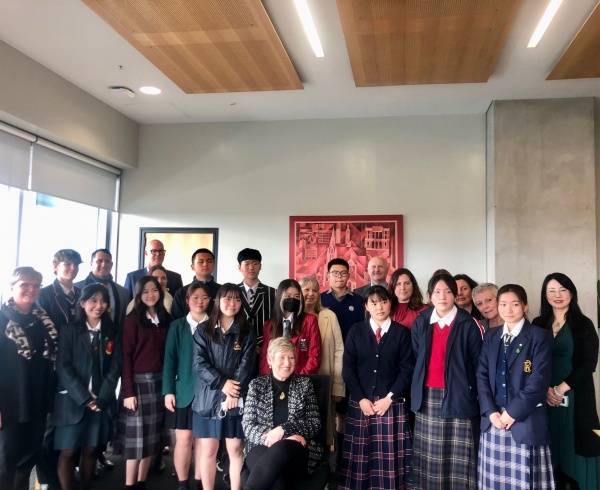
International students met with Christchurch Mayor Lianne Dalziel
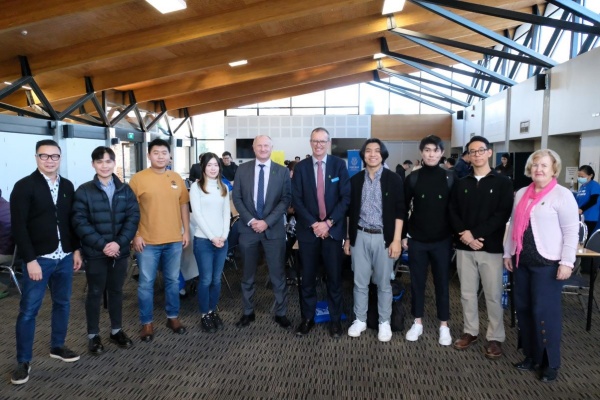
International students being welcomed to Lincoln University
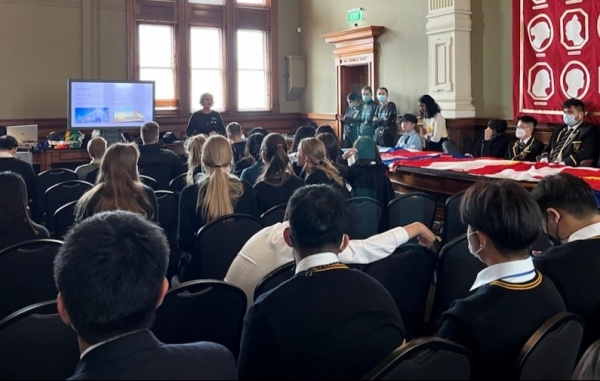
Wellington International Students' Association ran an event for over 140 international students from eight countries over the course of two days
-
Building connnections with career counsellors in India
Seven of New Zealand’s universities took part in the conference, which attracted more than 1,400 delegates, representing 56 nationalities. The university delegates engaged in panel discussions on a range of topics, including ethical counselling and preparing for education abroad, which were well attended. Education New Zealand Manapou ki te Ao (ENZ) led the New Zealand delegation as a gold sponsor of the event.
Launched in 2016, IC3 is the largest platform for connecting high school career counsellors in India with tertiary education institutions. The conference brings together school leaders, teachers, counsellors, universities, education organisations, government bodies, industry leaders and others with an interest in sustainable and inclusive counselling, focused on student success.
Jugnu Roy, ENZ’s Director of Engagement based in India, says participation in the annual conference is valuable for ENZ as well as for the universities involved.
“High school careers and college counsellors are key influencers for students in India when it comes to making choices about tertiary study and future careers. This event has been a great help with building our connections with schools across southern India, so we can develop a pipeline of international students interested in undergraduate study in New Zealand.
“The timing of the conference worked well as an opportunity for branding, visibility, and reconnecting with Indian schools soon after the opening of New Zealand’s borders. This was the first time we had been able to attend in person for two years.
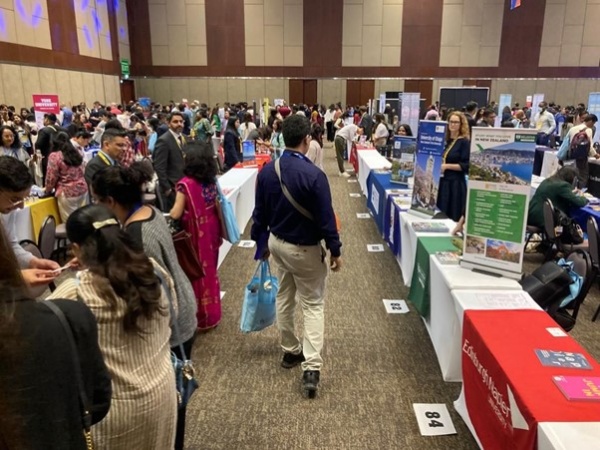
New Zealand universities interacting with schools at the networking session.
“Our participation in the event has already led to increased interest in a New Zealand education among high school counsellors, who are keen to invite New Zealand institutions to their schools for university fairs and to meet with students.
“In a country like India, where many countries are trying hard to attract international students, New Zealand’s presence sends a strong signal that we are committed and here to stay.”
The 2022 IC3 Institute Student Quest Survey Report was published during the conference. More than 10,000 students responded, naming the top three factors affecting their choice of university: programme details, financial aid/scholarship information, and potential job opportunities.
For more information about the conference, see the IC3 Conference website here.
For more information about the recent student survey, see the IC3 Institute website here
-
Study abroad promo in US
Study Abroad Month, led by our Washington DC-based team, targeted the study advisors at United States universities, who support students with their study abroad plans. A series of videos were published each week and sent to key contacts, including a closing video from Education Minister Chris Hipkins.
Lewis Gibson, Field Director North America at Education New Zealand Manapou ki te Ao, says study abroad students are our main source of international students from the US.
“Pre-Covid-19, around 350,000 tertiary students each year spent a semester overseas as part of their degree. We’re looking to increase our share of this group.
“In normal times, US institutions and study abroad advisors rely on the voices of New Zealand alumni, who can share their experiences with other people on campus and build interest in a New Zealand study experience,” he says.
“We needed to do something different this year, because our borders had been closed so there weren’t the alumni students available on campus. We also needed a good way to remind study advisors about New Zealand’s unique education offering.”
Lewis says feedback from institutions in the US has been very positive, and they are looking forward to seeing students travel again to New Zealand. Some of the comments received included the following:
- “Thank you so much for letting us know about this exciting project! I just shared the New Zealand Study Abroad Month YouTube channel with our spring 2023 applicants... We are thrilled to nominate over 15 students to our outstanding partner universities in New Zealand ...for the first time in over two years!”
- “Thank you for sharing this information. I watched Fiona’s video for VUW and I am sharing it with several students who are deciding which NZ institution to attend for Term 1 via TEAN. I’ll be certain to watch future videos and do the same with those.”
- “We are so grateful of the opportunities you provide our students, and our tight partnership together.”
“In case anyone is wondering, we initially intended to run the promotion for four weeks, hence the name, ‘Study Abroad Month’. But with the participation of so many universities, and the inclusion of additional videos reflecting the voices of students, it made more sense to expand the promotion to six weeks.”
Before our borders closed, the US was our sixth largest source of international students, with most students seeking to enrol in university-level study here. Study Abroad Month aimed to attract students to New Zealand from the US spring semester 2023 onwards.
- “Thank you so much for letting us know about this exciting project! I just shared the New Zealand Study Abroad Month YouTube channel with our spring 2023 applicants... We are thrilled to nominate over 15 students to our outstanding partner universities in New Zealand ...for the first time in over two years!”