Search
Showing 10 of 2262 results for read 2024 FRM Exam Part I - Quantitative Analysis online free
-
New Zealand well represented at the 2024 World Digital Education Conference
The 2024 World Digital Education Conference, attended by representatives from over 70 countries and regions as well as international organisations, aims to work with governments, the education sector, and stakeholders to jointly implement the outcomes of the United Nations Transforming Education Summit, promote education recovery post-pandemic, equitable quality education through digital education transformation, and advance the realisation of the Sustainable Development Goals (SDGs).
Chinese Education Minister Huai Jinpeng provided the keynote speech at the opening ceremony. He noted the impact of technology on education and the need to prioritise education reform to keep pace with changes and harness the benefits of digital education. Minister Huai concluded by saying they look forward to the new impetus into promoting international cooperation in digital education through this conference.
New Zealand was represented by Minister of Education, Hon Erica Stanford (through a pre-recorded session); H.E. Grahame Morton, New Zealand Ambassador to People’s Republic of China; Ardi Barnard, New Zealand Consul-General to Shanghai; Dr Grant Klinkum, Chief Executive New Zealand Qualifications Authority and Education New Zealand’s China-based representatives. The strong presence at the conference contributes to New Zealand’s reputation as an education partner with an innovative approach to digital learning. New Zealand Education Minister Hon Erica Stanford gave a video address and shared New Zealand’s efforts to harness digitalisation to improve our education system and support lifelong learning.
“As an education minister with a relentless focus on the progress and achievement of all students, I see that digital tools and the well-designed use of data have enormous potential to help us drive progress and achievement,” said Minister Stanford.

Hon Erica Stanford, New Zealand’s Minister of Education delivered a pre-recorded session, sharing New Zealand’s efforts to harness digitalisation and data in education.
In his address at the Opening Ceremony, Ambassador Morton highlighted the important role of education in the New Zealand-China relationship and gave insights into New Zealand’s innovative EdTech sector.
“Digital education is at the centre of New Zealand’s EdTech sector and its developments. Three-quarters of New Zealand EdTech companies are actively looking to take their offerings to the world,” said Ambassador Morton.
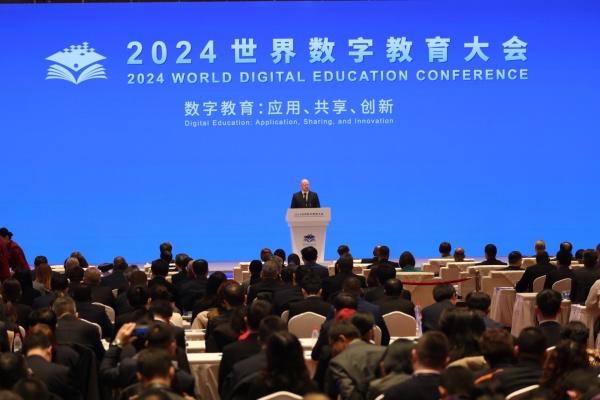
Ambassador Morton addresses the audience during the Opening Ceremony of the conference.
During the Parallel Session on Governance and Digital Transformation, Dr Klinkum shared New Zealand’s experience in quality assurance, qualification recognition and assessment delivery in the digital era.
“We would like to continue working with our international colleagues to ensure that we provide credible education for learners and that life-long learning and global mobility is supported by digital education and reflects the needs of increasingly digital societies,” said Dr Klinkum.
During the conference, organisers held the inaugural launch ceremony of the World Digital Education Alliance (WDEA). Universities New Zealand, on behalf of the University sector, joined the Alliance. The first batch of members is by invitation and as of 30 January 2024, 104 agencies from 41 countries joined the alliance ranging from schools to Technical and Vocational Education and Training (TVET) institutions, training centres, colleges and universities as well as research institutions and enterprises. The initiative aims to fulfil the UN SDG 4, build a mechanism for international cooperation and exchange in digital education, form synergy to promote global educational development, and create a new environment for smart education.
-
Around the world in five
United Kingdom
UK: student visas down as dependent applications plummet
The UK Home Office has published data showing a large decline in student dependent applications since new legislation was introduced at the beginning of this year, as well as a fall in student visa applications.Australia
The Australian government has announced a legislative package with a series of new measures for the country’s international education sector. The measures include a cap on new international student enrolments, a prohibition on education providers holding ownership positions in education agencies, a ban on agent commissions for onshore student transfers, and more stringent oversight of education providers and agents alike.
India
Record immigration is colliding with housing crises across the world
India Times is reporting that countries like Canada and Australia are reevaluating their immigration policies to address the pressures on housing affordability and sustain economic growth.
United States
Agents worried over high US visa rejections for African students
International education actors in Africa are uniting with their US partners and activists to call on the study destination’s government to ‘rethink’ visa policies for African students.
SEA
Malaysia, Singapore & Thailand rise in THE Asia rankings
India has overtaken China as the second-most represented country in the Times Higher Education Asia University rankings 2024, with 91 universities compared with the neighbouring nation’s 86 institutions.
-
Around the world in five
Australia
From 1 July 2024, holders of a Visitor Visa in Australia will not be able to apply for a Student Visa onshore, in new rules announced by the Minister for Home Affairs, the Hon Claire O’Neil MP. Temporary Graduate Visa holders will also no longer be able to apply for Student Visas onshore. According to the Minister, these changes are aimed at restricting visa hopping, “ending the loopholes that allow student and other temporary visa holders to continuously extend their stay in Australia”.
Europe
The European Council, composed of national ministers from each EU country, has accepted a recommendation from the European Commission (which proposes and implements policies for the EU), to increase opportunities for European youth to learn, train, and study in other parts of Europe as well as in non-EU countries.
Japan
The annual survey of The Japan Association of Overseas Studies (JAOS) was released in May, providing a baseline indicator of outbound mobility from Japan based on responses from a sample of 40 JAOS member-agencies. Top line results show that outbound student numbers have now recovered to 83% of pre-Covid levels however destination choices continue to shift for Japanese students, and more are choosing to study within Asia.
Latin America
Latin America has become a region of high interest as colleges and universities worldwide seek to diversify their international student population, steering away from the traditional recruitment markets such as Southeast Asia.
South Africa
After pandemic-induced turbulence in South Africa’s English Language Teaching sector, which saw a decline in memberships, school closures, and more, the country is witnessing a significant market recovery post-Covid.
-
INZ student visa update: July 2024
Visa processing update (as at 10 July 2024).
Since January 2024, Immigration New Zealand (INZ) has received 24,541 student visa applications from international students outside of New Zealand. INZ have completed 20,369 of these applications, with 15,242 approved.
Recent processing times for international student visa applications are published on the INZ website and are updated by month: Visa processing times for international students
Work rights available for more partners of students
In June, the Government expanded the eligibility for work visas for partners of some students studying towards a Green List occupation.
People can now apply for a Partner of Student Work Visa, with open work rights, if their partner is studying a specified level 7 or 8 bachelor’s or bachelor’s (honours) degree that will lead directly to professional registration required for a Green List role.
This relates to Green List roles where occupational registration, rather than qualification requirements, are specified, such as nurses, doctors, and teachers.
For people granted a Partner of Student Work Visa, any school-aged dependents they have will be considered domestic students for tuition fee purposes and can apply for a Dependent Child Student Visa.
End of year student visa peak – Apply early!
The processing of international student visas is a key focus for INZ, particularly as we get closer to the end of the year.
INZ receives the highest volumes of student visa applications between October and March. Applications generally take longer to be decided during this peak period, so it is important that anyone who is wanting to come to New Zealand to study next year applies early. It is recommended students apply three months before their intended travel date to give them the best chance of having their application decided in time.
There are a few things applicants can do to make sure their application is able to be processed as quickly as possible. These include:
-
Check out INZ’s student visa information sheet on the INZ website to make sure a good quality application is submitted that includes all the evidence and supporting documents we need to decide the application. INZ will not be contacting applicants to ask for more information during the peak processing period, so it is important that everything is included from the start.
-
Applicants must demonstrate that they can comfortably afford to study in New Zealand. New Zealand has a thorough funds assessment and INZ looks for genuine sources of funds that are credible and can be verified. If INZ cannot verify funds or is not satisfied that any verification would be genuine, then the application will be declined.
-
INZ is seeing decline rates for international student visas increasing for many markets due to the increase in applications that cannot meet immigration requirements, so make sure the requirements are fully understood before submitting an application.
-
-
NZ Schools Scholarship Programme offers exciting study path for Vietnamese students
The New Zealand Schools Scholarships (NZSS) is a scholarship programme offered exclusively for Vietnamese students in grades 8 – 10. Since it was first launched in 2019, many young Vietnamese students have studied at New Zealand schools across the country thanks to the support of this Programme. Many of these students have gone on to secure scholarships at prestigious universities in New Zealand and other countries, achieving notable success on their academic paths.
Applications for NZSS 2024 were accepted between 22 January to 17 March 2024 and after several screening rounds, 14 NZSS winners were selected. Each scholarship provides a 50% subsidy on the full-year school tuition fees of the first year of study at a New Zealand secondary school.
A standout aspect of this year’s programme was the dual-opportunity scheme in which aspiring candidates who did not receive the NZSS were able to be considered for other scholarships offered by New Zealand schools. This saw an additional four students awarded other school scholarships bringing the total number of school scholarship awardees to 18.

The group of scholarship winners on the stage at the Awards ceremony.
On 9 June, Education New Zealand Manapou ki te Ao (ENZ) organised the Awards Ceremony and Pre-Departure Briefing to recognise the scholarship winners as well as provide information in preparation for their journey ahead. Mr. Scott James, New Zealand Consul General in Viet Nam, attended and delivered a welcome remark, in which he emphasised the mutual respect and understanding that New Zealand and Viet Nam’s relationship is built upon.
Mr James added that “this scholarship programme signals the New Zealand Government’s continuing commitment to growing the relationship between our two countries.”

From left to right, Mr Ben Burrowes. ENZ’s Acting General Manager - International, NZSS Scholarship winner, Ngoc Han, and Mr. Scott James, New Zealand Consul General in Viet Nam.
Mr. Ben Burrowes, ENZ’s Acting General Manager – International, was also present at the event and awarded the winners a scholarship certificate and offered his congratulations. In his speech he reflected that the first eight months of 2023 saw school enrolments of Vietnamese students increase over that of 2022 to a total of 286.
“Given the care that every parent takes when deciding where their children should continue their education, the rebound for school students following the pandemic naturally took a little longer.
“We know that this number will continue to increase as life resumes its normal pattern, especially as parents look to the future, and what is best for their child’s development and education,” said Mr Burrowes.
For the pre-departure briefing, ENZ provided a brief presentation, followed by former NZSS winners, Thuy Truc (2023), Thao Nguyen (2023) and Tuan Minh (2019) sharing their study experiences with the audience. Representatives from the Vietnamese Students Association in New Zealand, Ms. Trang from HHT magazine who joined the New Zealand familiarisation trip in 2023, and Mr. Phu & Ms. Ngoc – parents of students who are currently studying in New Zealand also spoke.
Feedback from parents and students received by ENZ after the event was positive, with many commenting on how welcome and proud they felt as scholarship winners. We look forward to welcoming these students to New Zealand very soon!
-
NZ set to host Brazilian ‘Ganhando o Mundo’ programme scholars in 2025
Brazil is now the 6th largest source of international high school students for New Zealand, moving up from 11th place in 2023 (1). Contributing to this rise in popularity has been the strengthening of educational ties between education partners in Brazil and Education New Zealand Manapou ki te Ao (ENZ).
The ‘Ganhando o Mundo’ programme from Paraná, recently announced new high school student scholarship winners for 2025. Five countries have been chosen to host the students, with New Zealand being announced as one of the five. Approximately 200 scholarship winners are expected to spend two terms in New Zealand schools next year.
‘Ganhando o Mundo’ is an international education programme created by the state of Paraná which allows thousands of students from public high schools to study abroad for six months with all expenses subsidised. The goal is to provide academic training in foreign institutions, as well as cultural and pedagogical experiences that can later be shared in state schools in Paraná.
The announcement was made in Curitiba during a series of engagements that took place in October between a New Zealand delegation and Paraná state institutions, international education agencies and government authorities.

ENZ’s Bruna de Natale meets with ‘Ganhando o Mundo’ programme coordinators at the Paraná State Department of Education, Lucimar Gusmão and Marlon de Campos Mateus in October.
This was followed by a launch event hosted by the Paraná state government on 25 November in which the New Zealand Ambassador to Brazil, Richard Prendergast, attended alongside ENZ’s market development manager for Brazil, Bruna de Natale, state government officials, and hundreds of excited scholarship winners.
Ambassador Prendergast said that it was incredibly gratifying to participate in the Ganhando o Mundo programme launch event.,
New Zealand Ambassador to Brazil, Richard Prendergast, with Ganhando o Mundo scholarship recipients who will be heading to New Zealand in 2025.
“The two hundred students who will be going to New Zealand next year – and the 350 others who went in the two previous editions, in fact, all the Brazilians who studied in New Zealand, our alumni - are ‘informal ambassadors’ of New Zealand in Brazil,” said Ambassador Prendergast.
“They know and understand both countries and tend to work to expand our collaboration, to build bridges. People-to-people relationships are fundamental in our bilateral relationship, he added.”

Following the launch event, the Ambassador and Bruna de Natale, met with the Paraná state Secretary of Science, Technology and Higher Education, Aldo Bona, and the Secretary of Education Roni Miranda. They are pictured here with the Secretary of Education Roni Miranda.
Following the launch event, the Ambassador and Bruna de Natale, met with the Paraná state Secretary of Science, Technology and Higher Education, Aldo Bona, and the Secretary of Education Roni Miranda. They are pictured here with the Secretary of Education Roni Miranda.
ENZ’s Bruna de Natale said that this announcement is testament to the strong educational ties that are continually growing between New Zealand and not just the state of Paraná, but across the rest of Brazil too.
“A similar study abroad programme has also just been announced by the state government of São Paulo. ‘Prontos Pro Mundo’ (Ready for the World) will send approximately 100 Brazilian students to New Zealand high schools during term 1 next year,” said Bruna.
“We look forward to welcoming all of these Brazilian students to high schools and their local communities across the country in 2025 and building on this momentum to host more students in the future,” added Bruna.
1. Source: Ministry of Education interim international student enrolment data (January to August 2024).
-
Government announces International Education Going for Growth Plan
The Plan outlines an objective to double the international education sector’s economic contribution by 2034. This target has been set at $7.2 billion.
In the short term, the Plan will have Education New Zealand (ENZ) focus its promotional efforts on markets with the highest potential for growth while continuing to maintain New Zealand’s strong presence and reputation for high-quality education in other markets.
ENZ Chief Executive Amanda Malu says New Zealand reaps a broad range of economic, social and cultural benefits from having international students in our classrooms and communities.
“A New Zealand education experience transforms lives, creating lifelong connections between students and Aotearoa. International education fuels innovation, boosts our economy, creates business opportunities, and delivers essential cross-cultural skills for a more connected world. The International Education Going for Growth Plan brings to life a vision to grow New Zealand as the destination of choice for international students,” Ms Malu said.
The plan to grow the international student sector has three objectives:
1. raise awareness of New Zealand as a study destination from 40% in 2024, to 42% in 2027 and 44% by 2034.
2. grow student enrolments from 83,400 in 2024 to 105,000 in 2027 and 119,000 by 2034.
3. increase the proportion of prospective students rating NZ among their top three choices of study destination from 18% in 2024 to 20% in 2027 and 22% in 2034.
In November 2025, in-study work rights will increase from 20 to 25 hours per week for eligible student visa holders and in-study work rights will be extended to all tertiary students in approved exchange or Study Abroad programmes, including programmes one-semester long.
The Ministry of Business, Innovation and Employment (MBIE) will progress work on medium-term immigration actions under the Plan - design of a new short duration visa for some sub-degree qualifications not eligible for post-study work rights and ways to make it easier for students to apply for multi-year visas. MBIE will seek input and views from key stakeholders to inform the development of this work.
You can view the International Education Going for Growth Plan document here.
-
Brazilian university professors visit
Last month Education New Zealand and MFAT joined forces with Latino New Zealand to host representatives from top Brazilian universities on a visit to New Zealand. The visit aimed to establish institution to institution links between universities of the two countries, to increase the Brazilian institutions’ understanding of our universities and to raise our profile in the Science Without Borders programme.
Eight Brazilian universities participated in the visit, including State University of Campinas (UNICAMP), Federal University of Rio de Janeiro (UFRJ), Federal University of Minas Gerais (UFMG) and Paulista State University (UNESP), all ranked in the top 500 in world.
The visiting professors met with representatives from all eight of our universities as well as with ENZ, UNZ and the Brazilian Ambassador in New Zealand.
This is the first significant contact between the universities of the two countries and all of the participating universities were very keen to establish long-term research linkages with New Zealand institutions. Most of the Brazilian universities represented are well resourced in various areas of research, particularly in areas such as agriculture and plant and animal sciences.
As a result of the visit, ENZ has received invitations to present to some of the universities and one of the professors also offered to join the New Zealand SWB presentation at his university to share his positive experience in New Zealand. Most of the visiting professors have also uploaded photos of their trip on Facebook and their university pages where they will be widely viewed by their contacts and university communities.
Brazil is New Zealand’s largest source country for international students in Latin America. Traditionally Brazilian students come to New Zealand for short-term language courses, but in recent years we have seen an increase in the number of students from the school sector, mainly due to the Pernambuco state’s Win the World scholarship programme.
Since New Zealand joined the Science without Borders (SWB) scheme in 2013, more than 170 Brazilian students have studied in New Zealand under the undergraduate sandwich programme.
Although the undergraduate sandwich (study abroad) awards take up the majority of the SWB funding, the programme also funds full PhD and sandwich PhD studies. A new Masters programme has also been established and ENZ and UNZ are currently working on New Zealand’s inclusion in this programme.
SWB also provides the following awards:
-
Inbound Fellowships which aim to bring early-career researchers and senior scholars to Brazilian universities and research centres.
-
Young Talent awards fully fund one to three year research stays in Brazil with an attractive package including round-trip tickets, relocation expenses, a tax-free highly competitive lecturer-level monthly allowance, a contribution toward research costs and funding for research assistantship.
-
Special Visiting Researcher Programme for joint projects with research groups in Brazil and work in the country for up to three months every year over two to three years. A generous grant is available to researchers including round-trip tickets for every annual visit, a tax-free highly competitive senior-level monthly allowance, a contribution toward research costs and funding for a sandwich PhD at home and a Post-doctoral Fellowship in Brazil.
-
Offshore Technological and Innovation Development awards that support the participation of Brazilian researchers, specialists and technicians in development and training activities overseas.
-
-
Launch of a visa-free guide for students
To help students prepare to enter New Zealand, Education New Zealand and Immigration New Zealand have launched a guide including the information required to enter New Zealand visa free. The guide is also available in Arabic and is particularly helpful for students travelling from the Gulf-Co-operation Council Countries during the Northern Hemisphere summer. You can check out both versions of the Travelling and Studying in New Zealand guide here.
Further translations will be added in due course.
If you've got students travelling to New Zealand from visa-waiver countries, or you're a student advisor in these countries then you may want to consider familiarising yourself with, and distributing the brochure.
-
Addressing trade barriers
Non-tariff barriers
Trade barriers such as government policies and regulations that favour local suppliers are called non-tariff barriers. Find out how ENZ and other government agencies can help reduce or prevent some of these barriers.
Red tape can push up costs
Non-tariff barriers are rules that make it costly or difficult to export to a particular market. You might experience these as ‘red tape, ‘roadblocks’ or ‘costs of doing business.’
The barriers can arise with any type of export from food to digital goods and education services.
Examples include:
- administrative procedures
- quantity restrictions (such as quotas)
- investment or foreign ownership restrictions
- price controls
- subsidies
- qualifications recognition
- product labelling requirements
- private standards
- technical regulations and standards.
Help available to break the barriers
ENZ and other government agencies can help with trade barriers. We may be able to reduce, resolve or even prevent them from happening. That might be by holding government to government discussions – where officials talk through the issues with overseas agencies. Or it might be through longer-term free trade agreement negotiations.
Some barriers can be cleared up quickly, but others can take years to resolve. It depends on their nature and the willingness of the foreign partner to sort them out. Some may never be resolved for reasons beyond New Zealand’s control.
Sometimes non-tariff barriers exist for good reasons – for example, regulations to protect public health or the environment. In those cases, foreign governments may agree that New Zealand’s regulations provide equivalent protection. Or they may improve their regulations so they meet their purpose without impeding free trade.
Who to contact
Education services
If you export education services, including teaching international students in New Zealand or overseas and face trade barriers such as licencing requirements, investment and foreign ownership restrictions or qualifications recognition contact, Education New Zealand.
Email | tradebarriers@enz.govt.nz
Website | Education New Zealand
Other agencies
Other types of exporters should contact the relevant New Zealand government agencies for help with non-tariff barriers.
Services and investment
If you are a service provider or investor and encounter barriers such as foreign equity caps, data storage requirements or procurement rules that are unfairly preventing you from exporting your services offshore, get in touch with the Ministry of Foreign Affairs and Trade (MFAT) for assistance.
Phone | MFAT Exporter helpline 0800 824 605
Email | exports@mfat.govt.nz
Website | MFAT
Manufacturing
If you’re a manufacturer, and you’re facing regulatory restrictions on your exports such as standards, rules in selling to foreign governments, or other restrictions blocking you from exporting, contact the Ministry of Business, Innovation and Employment.
Email | tradebarriers@mbie.govt.nz
Website | MBIE
Food and primary industries
The Ministry for Primary Industries can help primary industry exporters deal with barriers like arbitrary rules for food safety and standards, or animal welfare.
Phone | 0800 00 83 33 Email | exporterhelp@mpi.govt.nz
Website | MPI: Exporting
Trade barriers clearinghouse
For additional information on barriers to trade; for trade barriers not covered above; or you are unsure where to register your issue, the below site can help. Inquiries registered will be directed to the agency best able to assist.
Website | https://www.tradebarriers.govt.nz
Customs help
Customs can help with advice on a range of export issues including border clearance issues, tariff classification, and rules of origin. Contact New Zealand Customs
Email | export2fta@customs.govt.nz