Search
Showing 10 of 2262 results for read 2024 FRM Exam Part I - Quantitative Analysis online free
-
Education diplomacy strengthens New Zealand’s relationship with the Pacific Alliance
This initiative, funded by Education New Zealand Manapou ki te Ao, is a significant milestone in the relationship between New Zealand the alliance.
At the graduation ceremony, New Zealand Ambassador to Chile, Linda Te Puni, said “this celebration today is, first and foremost, yours but it is also a milestone for New Zealand because it reaffirms our commitment to the Pacific Alliance. We are pleased to continue to build and strengthen this relationship in various areas, including networking, educational and between peoples.”
The Pacific Alliance is a Latin American free trade area and economic integration initiative, established by Chile, Colombia, Mexico, and Peru in 2011. The bloc comprises the world’s eighth-largest economy and is home to over 220 million people. It has been identified by the Ministry of Foreign Affairs and Trade as a priority region for New Zealand, with negotiations for a free trade agreement currently underway.
The objective of the English Network of the Pacific Alliance is to develop a cooperation strategy to improve the language in the bloc, work in which it has had the support of New Zealand as an observer country.
“The promotion of the English language expands our people’s access to educational, scientific, technological and employment opportunities, while contributing to the formation of a more productive workforce, with a view to strengthening our competitiveness in global arenas,” Director of Regional Coordination and Integration Mechanisms of the Ministry of Foreign Affairs of Colombia and National Coordinator of Colombia for the Pacific Alliance, Adela Maestre, said.
The Pacific Alliance version of the NZGCC was led by teachers from Massey University. The first four weeks of the course were dedicated to the certificate, while the last two focused on creating a ‘community of learning’ for support and guidance, where methodologies, teaching practices and resources can be shared well after the course has finished.
The NZGCC was originally designed by AFS. The certificate teaches self-awareness, empathy for other cultures, and ways to build bridges in multicultural settings.
-
Get involved in the next Korea–New Zealand Digital School Exchange Programme
Programme information
-
Number of New Zealand schools selected: Up to 10.
-
Who can apply: Schools with students in Year 7-9.
-
Number of participating students per session: 20-25 (Korean schools typically involve a full class of 20-25 students per exchange session. If a New Zealand school wishes to include more than 25 students, they can form multiple groups of around 20 students each to participate separately.)
-
Exchange period: Four, one-hour Zoom sessions held weekly from Monday 11 May 2026 to Monday 8 June 2026.
-
Exchange times: To accommodate both time zones, exchange sessions will be scheduled between 12:00-3:00pm NZT.
-
Participation fee: Free of charge.
Why join?
-
Promote your school to a South Korean audience for free
-
Showcase New Zealand’s unique education environment and culture
-
Engage your students in a hybrid STEM and cultural exchange
-
No added work to your teaching load - LEL takes care of all the admin and logistics, allowing you to simply show up with your classroom and enjoy the global learning experience
Teachers in previous rounds praised the programme for its smooth delivery and the enthusiasm it sparked in their classrooms.
Check out the story from the previous programme: New Zealand – Korea digital student exchange » Education NZ
How it works
ENZ and Seoul MOE work closely with Learn English Live (LEL), who will:
-
Coordinate all communication with New Zealand schools.
-
Match exchange times with Korean schools and New Zealand schools.
-
Provide pre-training for New Zealand teachers and students.
-
Facilitate sessions using topics tailored for digital exchanges ranging from culture & language sharing, United Nation SDG projects, STEM learning, global citizenship and much more.
In previous programmes, NZ teachers appreciated not having to prepare or run the sessions themselves—LEL takes care of everything.
Is this right for your school?
This programme is a great fit for schools that:
-
Are looking to build long-term sister-school relationships with Korean schools, especially through social studies, cultural/global studies, languages or global citizenship education.
-
See value in soft marketing opportunities, promoting their school in Korea in a meaningful, low-pressure and no cost way, and are interested in attracting potential international students over the long term.
Application timeline
-
Applications close: Friday 12 December 2025 11:59pm
-
Selection process: 15 – 16 December
-
Notification of outcome: Wednesday 17 December
-
Next steps: From April 2026, selected schools will be contacted by LEL with a detailed guide
If you wish to apply for this programme, please fill out the Expression of Interest (EOI) here or scan the QRCode below.
If you have any questions, please contact ENZ (Alana Pellow ) or Learn English Live (William Clarke ).

Background
ENZ has partnered with the Seoul Metropolitan Office of Education (Seoul MOE) to run digital classroom exchanges since 2021 with ENZ education technology partner Learn English Live (LEL) . These exchanges have created meaningful connections between students, teachers, and schools in both countries. NZ students have had the opportunity to connect with their Korean peers, build global friendships, and experience cross-cultural learning—all from their own classrooms.
-
-
We offer flexibility, care and support
At ENZ, we believe that our people are the heart of everything we do. We know that to do great work, you need to feel supported in all areas of your life. That’s why we provide a variety of offerings to help you achieve balance, stay healthy and continue growing personally and professionally.

Employee offerings
- You’ll enjoy five weeks (25 days) paid annual leave that will begin accruing from your very first day.
- 10 days sick leave is added to your balance from the day you start, and a top up of 10 days are added to your balance when you cross over your work anniversary (after 12 months).
- Flu vaccinations will be provided annually.
- As a global organisation working across multiple time zones, flexible work is the way we work at ENZ. We understand that flexibility is valued by our employees, therefore offer different kinds of flexible working around the location, days and times you work while balancing the needs of ENZ, your team and you.
- If you’re based in our Wellington office, you’ll have free access to a nearby gym and (free) personal trainer if you’re interested.
- We provide access to a resourceful Wellbeing Hub through our Employee Assistance Program (EAP), giving you access to confidential support and resources across key areas such as physical health, emotional wellbeing, lifestyle, and workplace support, along with webinars and eLearning modules.
-
PIF Recipient: Mission New Zealand
With support from Education New Zealand Manapou ki te Ao, New Zealand’s government agency for international education, Mission New Zealand showcases courses from a number of New Zealand institutes, and is being developed by The Mind Lab.
Mission New Zealand offers a fully immersive and distinctly New Zealand experience. It focuses on the best of what New Zealand has to offer and the benefits of being part of a global movement for positive change.
From anywhere in the world, learners can choose from a mix of short courses and micro-credentials, grouped around four themes that reflect New Zealand’s progressiveness and values: culture, tech innovation, creativity and sustainability. Courses range from one to 15 weeks in length, with a mix of free and paid options available.
A selection of The Mind Lab’s own micro-credentials is available on Mission New Zealand, along with offerings from Te Pūkenga - New Zealand Institute of Skills and Technology - and some of New Zealand’s most innovative private training establishments.
Visitors to the site will be greeted by the world’s first 360° virtual pōwhiri, starting at the gates of Ngāti Whātua Orākei Marae in Auckland. They will experience being called onto the marae with a karanga and stepping onto the grounds to be welcomed by members of Ngāti Whātua.
Personalised learning, with optional content and stories, insights and other material will help learners experience what makes New Zealand unique.
Through an immersive experience, Mission New Zealand invites learners to take the first step in a lifelong connection with Aotearoa New Zealand.
The new platform is designed to address the increasing global demand for connections with purpose and cause, for online learning options, and for shorter and more flexible courses.
Mission New Zealand is among a range of pilot projects supported by Education New Zealand's Manapou ki te Ao Covid Response and Recovery Fund product and service diversification workstream. This New Zealand Government-funded initiative encourages the development of new products and services in the international education sector.
The Mind Lab was founded in 2013 and has a strong background in innovation, online education delivery that builds impactful futures and building community connections, including relationships with iwi and Māori-led organisations.
More information:
-
From the Chief Executive: Positive steps for international education
Initially focused on Asia, the Prime Minister’s scholarships started in 2013. Since then, more than 2,400 Kiwis have benefited from the experience of living in an Asian or Latin American country, developing personal connections, cultural understanding and global citizenship skills as well as gaining new perspectives in their chosen field of study. These scholarships are a great example of the two-way nature of international education – it’s about the opportunity for us as New Zealanders to learn, as well as for us to contribute.
Over the years the scholarships have evolved and this is set to continue in the future, following two recent wānanga with Māori partners. The first wānanga explored what ‘global citizenship’ means from a Māori world view. The second wānanga discussed the Prime Minister’s Scholarship programme, how to grow Māori participation in it, and how to support rangatahi through creating programme connections with iwi and the Māori economy, so the programme provides greater value for Māori. Alongside participants from a range of iwi and sector interests, representatives from the newly formed Kāhui Kaupapa also attended – Māori alumni of the Prime Minister’s Scholarships for Asia and Latin America. This work is part of ENZ’s long-term programme to build partnerships with iwi, Māori and Māori providers of education services, to transform the understanding of international education and ensure the education system delivers with, and for, Māori in the international context.
We have also made good progress with plans for inbound travel for international education this month. Universities are currently using our new portal system to nominate international students for their 1,450 places as part of the fourth cohort of 5,000 students. Working with the Ministry of Education, we are now assessing applications for places received from schools, PTEs and English language schools and will let them know their individual place allocations next week, so that they can start sending in their nominations, along with Te Pūkenga. Immigration New Zealand is due to begin processing the first formal requests for travel under this border exception by mid-April, in time for a mid-year study start.
In related news, travel from visa waiver countries such as Japan and South Korea has been brought forward two months and will now reopen from 2 May 2022. Students from these countries will be able to come to New Zealand for short courses of up to three months, which is good news for the sector, including English language schools.
While the borders were closed, online education offerings assumed a greater role. This sets us up well to continue to provide a more varied and resilient international education offering in the future. Phase two of a pilot programme to promote New Zealand-branded online education to the world starts in June and interested education providers are invited to a webinar on 31 March 2022 to find out more. This phase of the pilot will continue our partnership with FutureLearn, a well-established online platform with a significant global audience.
COVID-19 has affected our daily lives in many ways, including making virtual meetings the norm. When we held our regular peak body and regional gatherings last week, it was noticeable that a greater degree of formality tends to prevail online, and it’s much harder to get lively discussions underway. We really value and need to hear from our industry partners, and so I would welcome any suggestions for how we can make sure that these meetings enable robust discussion and exchange of ideas.
This month we welcomed Ziena Jalil to her first meeting as an ENZ Board member. Ziena was once an international student and is now an award-winning business and public sector leader, with 20 years’ experience working in New Zealand and Asia. Ziena brings enormous expertise in education, international relations and marketing, which will greatly benefit ENZ and the wider international education sector as we work to rebuild post-COVID.
This month we also published our 2020/21 Annual Report, which had been delayed by a shortage of auditors, related to COVID-19. The report is available on our website here and highlights the impacts of COVID-19 on the sector and our joint efforts to maintain an ongoing commitment to international education during this challenging period.
Okea Ururoatia! – Keep striving forward!
Grant McPherson
-
Whakatipu Scholarships for indigenous students in Malaysia
The Whakatipu Scholarships, funded by Education New Zealand Manapou ki te Ao (ENZ) and UM, aim to empower talented young indigenous students at the Faculty of Arts and Social Sciences (FASS) and encourage knowledge sharing. As part of their scholarship, the three students will have free access to te reo Māori courses via one of our online learning platforms, FutureLearn.
Two of the recipients, Diana Bah Said and Norazah Din, are of Semai ethnicity and are enrolled in East Asian Studies. The third student, Scholastica Philip, is of Kadazan descent and is enrolled in Environmental Studies.
Deputy High Commissioner of New Zealand to Malaysia Sharmila Bernau said the Whakatipu Scholarship was established to recognise the indigenous community, and support diversity and inclusion.
“‘Whakatipu’ in the Māori language means to stimulate or nurture growth. It stems from the Māori word ‘tipu’ which means shoot or new growth, like that from a seed.
“Thus, the scholarship symbolises nourishing its recipients, allowing them to become strong and confident through learning and exchange,” she said at the award ceremony.
FASS dean Prof Datuk Dr Danny Wong Tze Ken said that the scholarship would support the students during their undergraduate degrees while preparing them for lifelong learning.
“It is a thoughtfully structured scholarship, where all of these carefully considered components of the programme will provide structures and networks to nurture, encourage and assist them while they complete their undergraduate degrees, develop life skills, cultivate career ambitions and embark on a lifetime of learning,” he said.
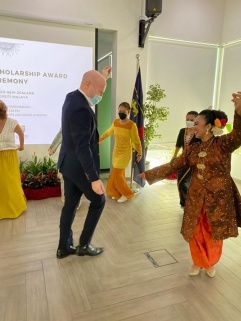
Ben Burrowes (ENZ) was invited to join in a traditional dance as part of the Whakatipu Scholarships award ceremony.
ENZ Regional Director Ben Burrowes said he hoped the scholarships would ease the students’ journeys at university and strengthen indigenous links with New Zealand and te Ao Māori.
The scholarships are part of the Education Cooperation Arrangement signed between Education New Zealand with Universiti Malaya in 2021.
-
Meet the Dream NEW scholarship winners
The initiative was launched in December 2015 by Prime Minister John Key as part of the FTA campaigning in Europe. The scholarship offers EU students one study abroad semester in New Zealand (valued at $12,500 NZD) - sending one student to each of New Zealand’s eight universities.
We received nearly 400 applications from across 21 EU countries, with the majority of students applying from Germany. Candidates were selected based on a combination of their fantastic academic results as well as creative motivational essays or videos.
The winners begin their New Zealand adventure in February 2017, and as official ‘Kiwi Ambassadors’ will keep us updated throughout their time in New Zealand.
Here the eight winners share with us the moment they heard the news, as well as what they are most looking forward to.
 Patrick Rebacz (from Germany, going to Massey University)
“I have never been to New Zealand, so I am very curious about the culture, the landscape, the education system and the food. I am looking forward to meeting new people, getting lots of new ideas, being part of a great educational infrastructure and exploring the amazing landscapes. It will be an inspiring and rewarding experience.”
 Veronika Rudolf (from Germany, going to University of Waikato)
"When I received the call about the Dream NEW Scholarship I couldn't believe it! Even after telling my family and friends, and starting the preparations, it still feels like a dream. I'm looking forward to my papers about Māori culture at the University of Waikato - I can't wait to start my journey and experience a whole new part of the world."
 Lisa Kullander (from Sweden, going to Lincoln University)
“I was so excited when I found out that I won that I wanted to jump and scream with joy. It has given me the opportunity to fulfil my dream to study in New Zealand. There are so many things that I am looking forward to, like exploring the amazing nature. But as a landscape architecture student, what makes me most excited is all the knowledge and inspiration this opportunity will provide me with.”
 Marvin Stüde (from Germany, going to University of Auckland)
“I am most excited to explore the beautiful country and to attend interesting courses about topics which are not taught at my home university. I have no doubt that I will have a great time during my study abroad!”
Read his essay submission here.
 Laura Schnelle (from Germany, going to University of Canterbury)
"I am looking forward to living in Christchurch, exploring the great outdoors and learning new things about health education and motivational psychology!"
Read her essay entry here.
 Simone Grilli (from Italy, going to Auckland University of Technology)
“I am definitely ready for this new adventure and know it will be one of the most important of my life. My mind is focused on the beautiful landscapes of New Zealand, the unique culture and the All Blacks - the best rugby team in the World!”
 Anna Czerwinska (from Poland, going to Victoria University of Wellington)
“I only shared the news with my best friend, my boyfriend and my sister – telling them that it could not be true, it was a dream. During the first week I didn’t tell anyone else about it - I still can't believe that it really happened!”
Watch her video entry here.
 Svenja Niederkrome (from Germany going to University of Otago)
“I can’t put into words how happy I was when I found out that I’m one of the lucky recipients! For me, New Zealand is a little paradise at the other side of the world and I can’t wait to spend a whole term studying in such a unique place!”
Watch her video entry here.
-
Reminder of new data collection requirements
Private Training Establishments who do not receive SAC and/or Youth Guarantee funding from the Tertiary Education Commission, and are also signatories to the Code of Practice for the Pastoral Care of International Students are reminded that they are required to submit new data on their international students from 31 March 2016.
The August 2015 change to the Private Training Establishment (PTE) Registration Rules made it a condition of PTE registration to submit specific data to the Ministry of Education.
Consultation with exempted PTEs
A temporary exemption was granted to PTEs that provide English Language training only. For further information on the exemption please refer to the NZQA website.
An independent facilitator, Pania Gray of Kororā Consulting, is consulting with exempted PTEs on their approach to the new data collection requirements. Pania is consulting with exempted PTEs who are members of English New Zealand, via this representative body. Exempted PTEs who are not members of English New Zealand, and who would like to discuss the issues with Pania, are invited to contact her at: pania@kororaconsulting.co.nz.
Background about the data collection project
The Ministry of Education, Education New Zealand and the New Zealand Qualifications Authority (NZQA) have been working on a project which will gather better information from Unfunded International Education Providers (UIPs) using an automated data collection system.
The aim of the data collection project is to provide better market insights and analysis, and more targeted risk assessments, that will to help inform plans and activities relating to international education.
Good data and in-market intelligence can influence government strategy and policy, and enable informed data-driven decisions to be made. These decisions can work to the benefit of international education providers, international students and the wider international education industry.
More about the data and how to submit it
The UIP Data Collection – SMS Specification document explains which providers are required to submit data and how the data must be submitted.
Further information is available on the Services for Tertiary Organisations (STEO) website.
If you have any questions, or need clarification on who the exemption applies to, please email UIP.Datacollection@education.govt.nz.
The rule change took effect on 1 March 2016 and the new data must be submitted from 31 March 2016. If you require assistance with setting up the data return, please email UIP.Datacollection@education.govt.nz.
-
Latest levy data released
As many expected, the 2012 figures confirm a decline in international student enrolments since 2011. Although enrolment numbers fell by 6 percent (5,665), the report also shows that tuition fees from international education increased by $13.4 million, up 2 percent.
While these are the headline numbers of the report, a more complete picture is revealed by looking at the report in more detail. For instance, while there has been a 5,665 decrease in enrolments, certain sectors have been impacted more than others. Private Training Enterprises (PTEs), mainly non-funded, experienced a drop in enrolments of 5,102. However, Institutes of Technology and Polytechnics (ITPs) saw a 4 percent increase in enrolments, although the numbers, 434, are modest.
Canterbury is suffering reduced student enrolments due to the earthquakes, an important factor in explaining the national numbers. There were 2,979 fewer students – a 31 percent drop – enrolled with Canterbury education providers in 2012.
The ongoing effects of the rising New Zealand dollar are also hurting the industry, and it is important to note that other providers of international education are experiencing similar trends. Australia, for example, has experienced a similar decline in international student enrolments, with their numbers down by 7 percent in 2012.
We need to improve our understanding of what factors drive student choices in our key markets. To this end, much of Education New Zealand’s current work is focused on how students and their families decide on where to undertake their course of study, and the factors that influence their decision.
This research will allow Education New Zealand to provide you, the industry, with detailed information that is current and relevant. We can then work together to develop programmes and initiatives to increase the demand for what New Zealand has to offer.
There is much work to be done. A willingness to take a different approach is essential if we are to grow our industry.
We will provide more analysis of the data in next week’s edition of our e-news, International Education News. Some of the key information from the report is included below.
Kind regards,

Grant McPherson
Chief Executive Education New Zealand
Enrolments: There was a 6% drop (from 98,660 to 92,995 in international student enrolments) in 2012. The main results were:
-
Schools (down 3%), universities (down 2%), funded PTEs (down 6%), non-funded PTEs (down 13%)
-
Canterbury numbers down 31% (a reduction of 2,979)
-
Chinese enrolments up 5% (now 27% of all international students)
-
Japan (number 4 market in 2012) enrolments up 3%
-
Saudi Arabia (number 5 market) down 26%
-
South Korea (number 3 market) down 19%
-
India has overtaken South Korea as our second biggest source of students
-
ITP enrolments up 4%
Tuition fees: There has been an overall $13.4 million (2%) rise in international education tuition fees in 2012, but the results varied according to sector:
-
Universities (up 6%), ITPs (up 5%) and funded PTEs (up 7%)
-
Schools (down 19%) and non-funded PTEs (down 9%)


-
-
More analysis of latest international student enrolment data

The 2012 Export Education Levy data contained mixed news across sectors, and from some of our key international markets. While the number of international student enrolments is down overall, importantly the value of the industry, as measured by international fees earned, has increased by 2 percent and this is a significant result.
Education New Zealand is committed to working with each sector of New Zealand’s international education industry to support institution’s needs and priorities to enable industry-led growth. We have a strong programme of work underway in 2013 to achieve this.Schools

For all schools, international student numbers declined 0.3% to 15,643 students in 2012 compared with 2011
-
Primary and intermediate enrolments were down 3.3%
-
Secondary, composite and special enrolments fell 0.3%.
-
But value has remained more or less static over the past five years
-
South Korea and China make up half the international education market for this sector
South Korea was down 15% for schools in 2012. Why?
-
South Korean Government moves to provide more English language tuition in Korea
-
Foreign providers setting up in Korea
-
Christchurch earthquake
-
Economic factors in markets
-
High NZ dollar.
China shows strong growth
-
In 2012 there was a 20% increase in Chinese school international student numbers
-
Chinese first-time visa applications are up, particularly for contributing, composite and special schools.
Japan is emerging as a growth market
-
Japanese school international student numbers rose 23% in 2012
-
ENZ regards Japan as a market worth further exploration, particularly for school partnerships.
Universities

Universities earned $308.9 million in international fees in 2012, an increase of 5.5%
-
There are fewer international students, but they are higher value.
International university student numbers fell 5.2% - a decline of 980 students
-
Indian international students accounted for more than 40 percent of the decline.
-
There was a small increase in numbers of Chinese international students (universities’ biggest and most valuable market). This suggests that New Zealand’s most important international education market is performing well
-
Japanese international student numbers almost doubled
-
Saudi numbers are falling due to a halt in new intakes for Saudi scholarship students in 2012
-
Universities have seen overall international student numbers fall since 2004 despite ongoing growth in the global market for international students
-
Capacity exists and there is scope for recovering market share in the university sector.
Figures for individual universities are not yet available but we believe about a quarter of this decline can be attributed to a fall in enrolments at Canterbury and Lincoln Universities due to earthquakes
Universities have strong commitment to internationalisation, partnering with institutions in a variety of markets.
Institutes of Technology and Polytechnics (ITPs)
In 2012 ITP fee income was up 4.9% from 2011 - overall revenue for the sector has increased almost 50% since 2007
International student numbers rose 7.1%; EFTS were up a corresponding 3.4%. ITPs was the only sector to see a rise in numbers and EFTS
India and China make a combined 57.6% of all ITP international enrolments:
-
Numbers are up or holding for all major markets
-
There were small declines in South Korea and Saudi Arabia
-
Saudi numbers are falling due to a halt in new intakes for Saudi scholarship students in 2012
-
China remains relatively strong
-
ITPs are encountering strong competition in India from traditional competitors Canada and Australia
-
ITPs want to diversify their exposure to India and China with new market development in the Middle East, Sri Lanka, Nepal, Indonesia and the Philippines.
Private Training Establishments (PTEs)

PTEs (non-SDR)
Enrolments at non-SDR PTEs (mostly English language schools) fell 13% in 2012
-
English language schools down 17%.
-
Tuition fees were down 9 % to $105.1 million
-
The decline in English language schools likely to be linked to the rising value of the NZ dollar. International language travelers are known to be price sensitive; also an area of intense international competition.
This fall, which has been happening for two years, is of concern because ESOL students often move on to further academic study
Why down:
-
Affordability – the high NZ dollar
-
Greater provision of English language tuition in South Korea
-
Saudi Arabia – fewer new Saudi scholarships
-
New immigration policy – changes to work rights for L5 and 6 diplomas introduced in April 2012
-
Competition from other our key global competitors.
PTEs (SDR)
-
Enrolments at SDR PTEs (mainly vocational education training institutions) were down 6% in 2012
-
Tuition fees were up 6.4% to $99 million
-
Internationally, demand is growing for high quality vocational training
-
Some of our competitors (eg. Australia) have tightened up student immigration criteria for vocational training.
-