Search
Showing 10 of 2262 results for read 2024 FRM Exam Part I - Quantitative Analysis online free
-
Exploring indigenous exchange programmes and internships
The students, from University of Auckland and AUT, are part of the British Columbia & New Zealand Indigenous Student Mobility Project,a two-year programme that aims to provide reciprocal, short-term learning abroad and professional development and networking opportunities for indigenous students. The students will be joined by five First Nations students from Victoria University (UVic) in Canada, who are also part of the programme.
Next year the Kiwi students will travel to Vancouver and be hosted by UVic for the 2020 GIC. UVic is a leader in the Canadian Co-Op model, where an internship is a required component of the university degree.
“Increasing access to international learning opportunities for all students, and in particular our Māori and Pasifika students, is an important goal for the University of Auckland,” says Brett Berquist, University of Auckland’s Director International.
“Community and family are key to this strategy, and the chance to share and learn from First Nations students and academics at UVic is a great opportunity for our students.”
The Student Mobility Project aims to engage indigenous students in immersive experiences that help them to establish and maintain relationships with other indigenous students and communities, industry, academics, and higher education professionals. It intends to provide a forum for indigenous students to present their perspectives and experiences, facilitating an exchange of ideas and networks.
At the GIC, the students will share their perspectives and experiences on how international experiences benefit indigenous communities, how to best connect indigenous communities internationally, and how work placements and co-operative education have influenced their lives and careers.
Karima Ramji, UVic’s Manager of International Programmes will also discuss critical success factors in developing indigenous international work-integrated learning exchange programmes.
The GIC will feature further perspectives on global internships via a panel of University of Auckland Māori and Pasifika awardees of the Prime Minister’s Scholarships funded internships in Asia and Latin America.
The 2019 Global Internship Conference will take place on 2-5 July, hosted by the University of Auckland. To register or to find out more, click here.
-
Update from Immigration New Zealand
Planning for the next student visa application peak
Immigration New Zealand (INZ) is now entering the next peak of student visa applications.
INZ say they are in a good space to process the predicted volume of student visa applications. As part of planning, they have validated their predicted numbers of applications with the sector.
"Thanks to the sector peak bodies who circulated the survey on our behalf, we received 99 responses and now have information on the numbers of offers of place already issued to potential students. This has helped us match our resources to the predicted volume for the peak,” INZ National Manager Education and Tourism Jeannie Melville says.
“The queue of student applications from earlier this year has been cleared in Mumbai. Applications are now being allocated to an Immigration Officer for assessment within ten working days.”
Getting applications in early
INZ strongly recommends potential students continue to submit their applications as early as possible – at least eight weeks ahead of a person’s intended travel date.
However, applications can be submitted up to four months ahead of intended travel.
First time visa application checklist
There is now a checklist available to help people submitting a student visa application for the first time. It provides guidance on what they need to do to ensure they are submitting a decision-ready application, which should reduce the likelihood of it missing information.
-
Kiwi scholars to gain international skills
The scholarships, funded by the New Zealand Government and administered by Education New Zealand, support recent graduates or current students to undertake study, research or internships at institutions in Latin America and Asia, including Brazil, Mexico, China, India and Japan.
Awardees in this round (2019-2020 Round Two) are in fields including languages, law, business, health, sustainability and the arts. They will attend for periods ranging from four weeks to one year.
The scholarships enable a wide range of educational experiences, including: a cultural exchange and internship programme for Māori and Pasifika graduates in Vietnam; a group of arts and design students who will attend a course on the economic and cultural significance of modest fashion at the Islamic Fashion Institute in Indonesia; and an internship with an Indian charity supporting the health and education of street children in Jaipur.
‘’A key aspect of international education is sending New Zealand learners out to the world to gain all-important global skills and experience,’’ says ENZ’s Director Student Experience and Global Citizens, Partnerships and Marketing, Sahinde Pala.
“When they return, they bring new perspectives and expertise with them, helping to grow New Zealand’s international networks and inter-cultural awareness.’’
Most awardees undertake programmes that can be credited back to their New Zealand qualification. Similarly, international internships are usually part of their home institution’s work integrated learning programme, Sahinde says.
Background
PMSA and PMSLA support the Government’s International Education Strategy: to build a thriving and globally connected New Zealand through international education.
A total of 2,399 young New Zealanders have taken part since the programme was launched in 2013, initially for Asia (PMSA), and extended to Latin American (PMSLA) in 2016.
The full list of PMSA and PMSLA recipients from this round is on the Education New Zealand website: PMSA recipients and PMSLA recipients. Information on past PMSA and PMSLA recipients can be found here.
How to apply
There are two rounds of PMSA and PMSLA scholarships offered each year, in August and March.
Applications for the next PMSA and PMSLA round (2019-2020 Round Two) open from mid-January 2020 and close on 30 March 2020. More information on the application process can be found on our website. Institutions are encouraged to contact ENZ to discuss potential group applications.
-
Spotlight on the US
At certain times of year, you can stand in a certain apple orchard in the American state of Vermont and hear strands of a Māori waiata.
The East and West Coast Whānau Councils were set up by former students of the Auckland University of Technology’s Noho Marae programme. They were so moved by their experience in Aotearoa that they set up these groups so that they can meet regularly to eat kai, do haka and poi, and keep the whānau spirit alive.
These students are but a handful of the North American students that choose to study in New Zealand every year. In 2018, 3,028 students from the US travelled here for education, a number that has risen steadily – by nearly 23 percent – since 2014.
“More than 300,000 American students study outside the US every year,” ENZ Regional Director – Americas & Europe, Amy Rutherford says. “By educating over one percent of those students year upon year, New Zealand is punching well above its weight.”
Diversity and inclusion
There is a common misperception amongst students in North America that New Zealand is an ‘easy’ destination. Students are drawn here for the tourist opportunities and laidback lifestyle just as much as a quality education.
In an effort to promote New Zealand as a world-leading education destination, ENZ’s team based in North America have focused on diversity and inclusion.
The remit of diversity and inclusion in the US is much broader than it is in Aotearoa. It encompasses not only racial and ethnic minorities, but single parents, first-generation university students, military veterans, and those with disabilities.
Within this space, ENZ has been promoting New Zealand as a welcoming, progressive place to study. As Māori are world leaders in indigenous leadership, New Zealand is particularly well-positioned to support Native American and indigenous students.
New Zealand alumni like Brook Thompson and Hailey Suina have reported that connecting with te ao Māori has strengthened their understanding of their own cultures, boosting their confidence to act as leaders at home.
As part of this work, ENZ recently renewed its commitment to a partnership with the US regarding its Benjamin A. Gilman scholarship, a prestigious prize aimed at students from disadvantaged backgrounds. ENZ has pledged NZ $250,000 over five years for Gilman scholars who choose to come to New Zealand.
Beyond study abroad
The majority of US students come here at university level, often for one semester only as part of the US university and study abroad provider study abroad programmes.
Rather than come here for a complete qualification, US students travel short-term during their third or fourth years of university. Their work here is then cross-credited to their home institution.
Amy says that study abroad is very popular. For those students interested in travel, adventure, and discovering themselves, it is largely self-sustaining. New opportunities in study abroad lie in expanding this base to those students who have been traditionally underrepresented in study abroad, or regions of the country where not much is know about New Zealand.
Amy’s team is now increasingly focused on a new opportunity emerging for New Zealand institutions: attracting tertiary students to study here for their whole qualification.
For American students, committing to leave their home country for at least three years is a big ask. Attending college is a massive social milestone in the US, and one that alumni pin their identities on for the rest of their lives.
However, increasing numbers of students are looking for study opportunities offshore as the cost of studying in the US continues to rise.
US students are drawn to New Zealand’s highly ranked, innovative programmes in niche areas. An example of this is Massey University’s Bachelor of Veterinary Science. This course can be completed in five years (as opposed to eight in the US), costs a fraction of an equivalent US degree, and is approved by the American Veterinary Medical Association (AVMA), allowing graduates to return home and begin working immediately in the field.
Identifying and promoting these academic strengths among New Zealand institutions and explaining how they can propel students towards the career path of their choice is key to positioning a New Zealand education as a desirable alternative to the classic American college life.
Want to find out how your institution can get involved with ENZ’s work in the US?
Contact northamerica@enz.govt.nz.
-
Te oranga me te haumaru ākonga: tertiary student safety and wellbeing – consultation now open
The Ministry of Education (MoE) has today opened consultation on a proposed code of pastoral care for the safety and wellbeing of all tertiary learners, and is asking for your feedback. It proposes a new disputes resolution scheme for domestic tertiary students, and law changes to clarify tertiary organisations’ responsibilities to learners.
Education New Zealand Manapou ki te Ao (ENZ) encourages the broader tertiary sector including our partners, agents and stakeholders both onshore and offshore, to take part in the consultation process and to share their feedback with MoE. Submissions are due by midnight 21 May, with the new code implemented from 1 January 2022.
The proposed Code, led by MoE and administered by NZQA, clarifies the shared responsibilities government, tertiary education providers, whānau and the wider community have for learners’ wellbeing and safety. It draws on the interim Code for domestic tertiary students and the pastoral care code for international students. The proposed changes address inequalities and strengthen support for Māori learners and whānau to achieve their education aspirations.
About the proposed changes
- An on-going code of pastoral care for all tertiary and international students will be developed this year for implementation from 1 January 2022.
- Simplifying the current situation, the proposed code will apply to all domestic and international students in tertiary education, regardless of whether they are full-time, part-time, in apprenticeships or employment, learning on-campus or on-line.
- There are no substantial changes proposed to the requirements for schools enrolling international students.
- A proposed dispute resolution scheme for domestic tertiary learners and providers to settle contractual or financial disputes that are unable to be resolved using provider or sector complaints processes is being developed in parallel with the new code.
- Disputes can have big educational, financial and emotional impacts on learners and their whānau. A stronger dispute resolution scheme will help resolve issues and make the tertiary education system fairer and more accessible for everyone.
- Supporting the proposed changes are a set of proposed law changes that will make sure the new code and dispute resolution scheme are supported by legislation and fit for purpose. They will make sure the code and dispute resolution scheme consistently focus on learner wellbeing and safety, and make it easier for providers to implement the code.
- The new code and dispute resolution scheme will be implemented in 2022.
About the consultation
- Consultation is open 7 April – 21 May.
- Everyone’s views are invited, especially students, whānau, communities, the broader tertiary sector including our partners, agents and stakeholders and those working or volunteering in the tertiary and international education sector.
- MoE is seeking feedback on the proposed code for the wellbeing and safety of all tertiary and international learners, a new dispute resolution scheme for domestic tertiary learners, and proposed legislative changes to clarify and streamline providers’ responsibilities to learners.
- The Education and Training Act 2020 requires the Minister to consult before issuing a code. The Ministry has launched this consultation on behalf of the Minister.
- Learn more about the consultation and have your say on the Kōrero Mātauranga website. Te oranga me te haumaru ākonga | Learner wellbeing and safety.
Interim code changes
- On Wednesday, 31 March 2021, the Minister issued minor and technical changes to the interim code. These include updating the expiry date of the interim code and references to the Education and Training Act 2020, and being clearer about what the Code Administrator must do if it uses powers to enter student accommodation (clause 33).
- Tertiary providers don’t need to do anything differently, and NZQA will ensure that it meets the new requirements. You can view the updated Education (Pastoral Care of Domestic Tertiary Students) Code of Practice
- These changes follow from Parliamentary review of the interim code by the Regulations Review Committee.
-
Education New Zealand to boost global citizenship with expanded NZ Global Competency Certificate
ENZ has once again partnered with Massey University and AFS to help more New Zealanders grow their global cultural competence skills while our borders are closed.
Over the coming months, the course will be delivered to a wide range of learners both here and overseas, including teachers in indigenous communities in the Pacific Alliance; secondary school students in New Zealand regions alongside their counterparts in Asia; and high-achieving secondary school students in Korea, Vietnam and Thailand.
This time around, ENZ is also offering 100 NZ GCC scholarships to school students from lower socio-economic areas (deciles 1-5) in regions around New Zealand. The first cohort of scholarship recipients are from Whangarei, and will start their course alongside students in Japan next month.
The Ministry of Education has previously identified an area for improvement in New Zealand’s global citizenship in the opportunity-to-learn gap between students of socio-economically advantaged and disadvantaged backgrounds.
“In a very short time, the NZ GCC has gone from a small pilot to a very valuable part of ENZ’s global citizenship work,” ENZ Chief Executive, Grant McPherson, says.
“Global citizenship – or, put another way, broadening the horizons and understanding of New Zealanders – is the third pillar of the New Zealand International Education Strategy 2018. We really can’t underestimate the power of global citizenship skills in our rangatahi – it sets us all up for a more tolerant New Zealand and a more meaningfully connected world.”
Whangarei Girls’ High School student Kaye Pemid said the course helped push her out of her comfort zone.
“Thank you for this because I came out of my shell. And I have become more understanding of the emotions and actions of other cultures. I have gained more knowledge of the things about my identity, my culture and the things around me. I will continue to be a good role model to others and carry on the knowledge I have received and gained from this programme.”
If you’re interested in how your school can take part, contact ENZ Business Development Manager Mary Camp (mary.camp@enz.govt.nz).
-
New Zealand – South Korea digital student exchange
From September to December 2021 more than 300 New Zealand students from a range of primary, intermediate and secondary schools joined with more than 700 students from elementary and middle schools in Seoul and Gangwon in digital classroom cultural exchanges.
Education New Zealand Manapou ki te Ao worked in partnership with two education organisations in South Korea, Gangwon International Education Institute and Seoul Metropolitan Office of Education, as well as with NZ-based Learn English Live, to deliver the programme.
The sessions included conversation in English, peer-to-peer teaching and learning, cultural learnings and sharing, and interactive games. Student responses to the programme across both countries highlighted how much they enjoyed meeting people from different cultures and learning to respect different views. Around 70% of New Zealand students said they made a South Korean friend through the digital exchange forums while South Korean students highlighted the improvement in their English language skills, with 70% saying they would like to come to New Zealand.
Parents and teachers also shared heart-warming comments about the how the programme had built their child’s confidence and given them a leadership opportunity. In a survey conducted at the completion of the programme, parents of Lara, a nine-year old New Zealand girl, shared their experience. “It’s been excellent to observe Lara’s leadership ability shine through. I never realised how confident she is and her ability to teach and interact with kids from a different culture… Lara has become more aware of other cultures and appreciates the diversity around her.”
Teachers were also impressed, with one from Manurewa Intermediate commenting, "I want my students to be a part of this programme because it teaches them so many skills."
Following the success of the initial programme, the digital student exchange is set to continue in 2022, expanding to more New Zealand schools and implementing new ideas from students to meet their growing interest in other cultures and languages. New Zealand schools interested in joining the 2022 digital culture exchange can contact William Clarke at Learn English Live: William.h.clarke@hotmail.com
Education cooperation initiatives with ENZ, such as the Global Competence Certificate and this programme of digital culture exchanges are supported by the Arrangement on Education Cooperation that was signed by ENZ and Gangwon International Education Institute in November 2021. A similar agreement was reached with Seoul Metropolitan Office of Education last March.
The digital student exchange programme is in line with ENZ’s goal to develop global citizens as part of the New Zealand International Education Strategy 2018-2030.
-
Appreciating our agents in Viet Nam
The main purpose was to acknowledge the work of Vietnamese agents and thank them for their commitment. This is part of a programme of work to maintain and build our education brand offshore, ahead of the reopening of student visa processing in October 2022.
As well as hearing the latest updates from ENZ and other key education speakers, agents took part in a quiz and brainstorm. This provided some useful market insights into Vietnamese students’ and parents’ demand in a post-Covid world.
We were delighted with the positive feedback from agents about the event, including a renewed commitment to promote New Zealand education. To build on this interest, ENZ is now organising a series of eight workshops themed “The NEW Choices”, to update Vietnamese agents about new programme offerings across sectors.
Other projects underway in this market include a sustainability competition and a scholarship bootcamp, in collaboration with ENZ Recognised Agents based in Viet Nam.
-
Strong start for Cohort 4 international students
Already more than 3,500 international students have been nominated by their education providers and confirmed by education agencies. More than 1,900 of these students have had their Request for Travel approved and have been invited by Immigration New Zealand to apply for their student visas, since the process opened on 13 April 2022.
Places remain available for students with a number of ELS and PTE providers. Only education providers can nominate students for this cohort. Interested international students or their agents should contact ELS or PTEs as soon as possible. Of the 5,000 places in this cohort, 1,000 were allocated to ELS and 850 to PTEs, with the remainder going to universities, Te Pūkenga, and secondary schools.
Once they have been nominated by an education provider and confirmed by education agencies, students have two weeks to make their Request for Travel through the Immigration New Zealand website. Following approval of the Request for Travel, students then have one month to complete and submit a student visa application to Immigration New Zealand, in time for a mid-year start for their studies.
Education providers are due to complete their nominations by 6 May 2022. Any unused places will be transferred to other providers, which means that some providers may get additional places as part of the reallocation process.
This is the fourth cohort of international students to be granted a border exception to enter New Zealand and is part of the progressive reopening of our borders. All visa categories are due to reopen from October 2022 onwards, including visitor and student visas.
For more information on this cohort of international students, see Cohort 4 » Education NZ (enz.govt.nz)
-
Australian fair offers global gateway for Kiwi Edtech
 Although Australia is not a traditional student attraction market for New Zealand, its proximity to us as well as its size, recent digital education reforms in the wake of COVID 19, and its links to the rest of the world, create opportunities for our education technology products and services community.
This was the first time ENZ participated with edtech companies as a group in this two-day conference and expo. With more than 11,000 attendees, 250 speakers, 250 exhibitors and 10 sub conferences (including one on edtech innovation,) EduTECH 2022 is the most comprehensive cross-sector event for education in the southern hemisphere. It brings together ‘educators and solution providers to exchange and explore ideas, techniques, and technology, with the aim of improving teaching, training and learning and raising the education standards in Australia and the world.’
ENZ worked closely with New Zealand Trade and Enterprise (NZTE) to maximise the overall impact for New Zealand Inc from the event, with both organisations supporting edtech companies to take part.

EdPotential General Manager Charlie Tomlinson
Six of NZTE’s focussed edtech customers (Orah, iUgo, Hero, Banqer, StepWeb and EdPotential) were hosted in a NZTE Pavilion at EduTECH. ENZ also supported seven edtech companies keen to explore opportunities in Australia: Learn English Live, Chasing Time English, Language Fuel, ByteEd, Kai's Education, Pacific Kids' Learning and TTRO. Two other New Zealand companies, Education Perfect and MyMahi, also participated independently.
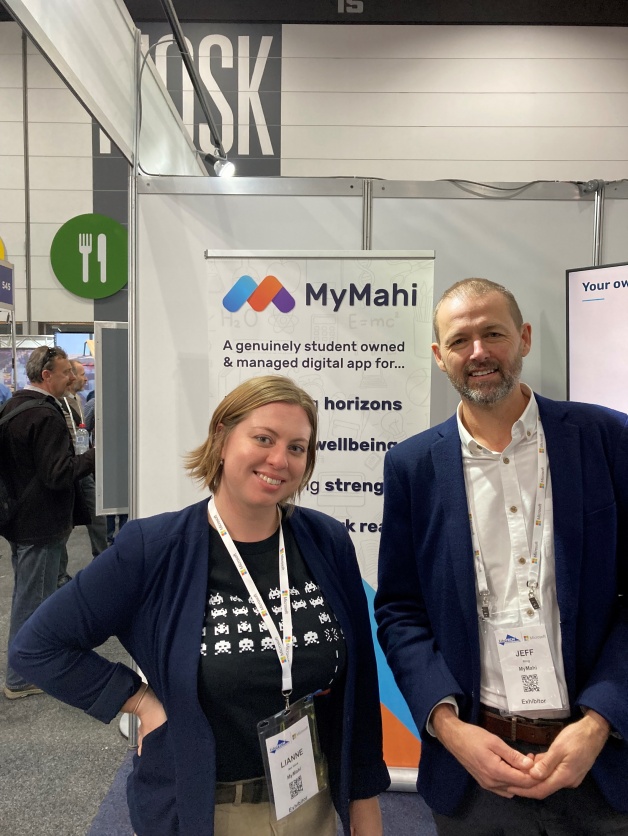
Lianne & Jeff King, Co-founders of MyMahi
In the spirit of collaboration, ENZ hosted an event at the NZTE Pavilion that enabled all 15 companies to connect with a number of Australian education providers as well as with NZTE, to share ideas and insights about edtech opportunities for New Zealand in Australia.
ENZ’s delegation also took part in the local Australian Education Technology Association’s ‘Pasta with Peers’ informal dinner, an opportunity to connect with over 200 Australian edtech founders and CEOs.
“I found the conference really valuable - we actually picked up a series of Indigenous schools to connect in with our Indigenous programme for next year so that was great,” says Will Clarke, Learn English Live co-founder and director.
“EduTech Australia is where it’s happening this week! Lots of information to absorb and great insights on all things edtech! It’s been awesome meeting and spending time with like-minded people who are working hard to build their businesses and brand outside of NZ. With the support of ENZ and the introduction to the NZTE team here, the future looks bright for Pacific Kids Learning,” says Evo Leota-Tupau, founder of Pacific Kids Learning.
Aotearoa’s edtech community is increasingly being recognized for the valuable contribution it makes to international education around the world, says Alana Pellow, Business Development Manager at ENZ.

iUgo Founder and Managing Director Nicola Smith with ENZ's Alana Pellow
“For example, it was great to see two edtech companies being included in the Prime Minister’s recent trade mission to Australia, while several edtech exporters featured in Minister Hipkins’ recent international education engagements in the Americas.”
Following ENZ’s successful participation in EduTECH2022, Ms Pellow is keen to explore further opportunities to bring the collective energy and momentum of the edtech sector together, to support its contribution to international education and the outcomes for learners.
More information:
- Aotearoa EdTech Excellence white paper 2021, developed by EdTechNZ in partnership with ENZ, says that more than 90% of New Zealand edtech businesses export or have ambition to export, with the main markets being the United States (26%) and Australia (24%).
- Education 2030 , a report by HolonIQ, includes predictions about the future growth of the global education market and the role of technology.
- Australia Perception Research 2022 | New Zealand Story Group (nzstory.govt.nz), a webinar by NZStory, suggests Australia is one of the most accessible international markets for New Zealand businesses to enter, and highlights Australia’s growing admiration for the values it perceives New Zealand represents – particularly our leadership and indigenous journey. Our te ao Māori values of manaakitanga and kaitiakitanga resonate deeply with both Australian consumers and businesses.