Search
Showing 10 of 982 results for search for pheen4uuu from wiki 2025
-
Introducing Tohu, the Study in New Zealand chatbot
 Jamie Crump, ENZ’s Director Business Planning, says Tohu was designed to help prospective students on SiNZ, answering their questions in a trusted, fast and friendly way.
“The goal for Tohu is to be a virtual assistant for the New Zealand international education sector by helping answer enquiries from students considering New Zealand 24/7.”
Jamie says currently Tohu can answer more than 300 questions about studying in New Zealand, but this grows with each interaction. While Tohu can only speak English, it is learning other languages, such as Mandarin, in order to service students more comfortable in their native tongue.
“Themore people that chat with it, the more it learns, making its artificial intelligence smarter every day.
“Already we’re seeing trends in commonly asked questions, including how to get a scholarship, how to get a student visa, and how to apply to study, and about New Zealand culture and the cost of study.”
The name Tohu means ‘to advise or provide guidance’ and ‘to be a sign or landmark’ while its appearance is a nod to the word Aotearoa – ‘land of the long white cloud’.
While Tohu currently lives on the SiNZ website, it will soon answer Messenger questions on the SiNZ Facebook page too.
ENZ’s next steps are to connect Tohu with ENZ’s database marketing programme and enable it to answer questions on NauMai NZ.
-
Report concludes international education can recover and grow
In 2019, international education’s direct financial contribution to New Zealand’s GDP was $3.7 billion using the Computable General Equilibrium (CGE) methodology. This contribution was reduced to an estimated $0.8 billion in 2020 by the pandemic. The CGE methodology applied by EY to determine the contribution was supported by MBIE and MoE and is more rigorous than previous analyses.
Having established the direct financial contribution, EY explored the extent of the indirect longer-term contribution to New Zealand’s GDP from the small proportion international students that remain in New Zealand after completion of their studies.
EY found that international students living and working in New Zealand in 2019 and 2022 contributed economic, social, cultural, and international benefits. Using NZ Statistics Department IDI data and CGE modelling, EY found that these students contributed in the order of $6 billion in the form of labour supply and productivity to New Zealand’s GDP in both 2019 and 2022.
Determining this contribution involved estimating the GDP output and wage impacts associated with New Zealand educated international students who remained in New Zealand and transitioned into the domestic workforce in the 10 years leading up to each year.
ENZ Chief Executive, Grant McPherson said, “This report confirms the tough time the sector has had over the past two years, highlights the contribution it made in the past, the contribution it makes beyond economic value, and tells us that it is possible to become a vibrant, sustainable and resilient sector in the future.”
The majority of international students, 62%, return to their country of origin after they have completed their studies. A further 13% leave New Zealand after their post-study work experience meaning that in total 75% have returned home after three years, according to the research.
More broadly, EY concluded there is evidence that international education can enable New Zealand students to develop global competence within a structured teaching environment, and contributes to soft power in diplomacy, trade and perceptions of New Zealand through a range of mechanisms. Broader impacts for Māori are potentially also present across each area of impact from international education. These impacts were not directly quantifiable.
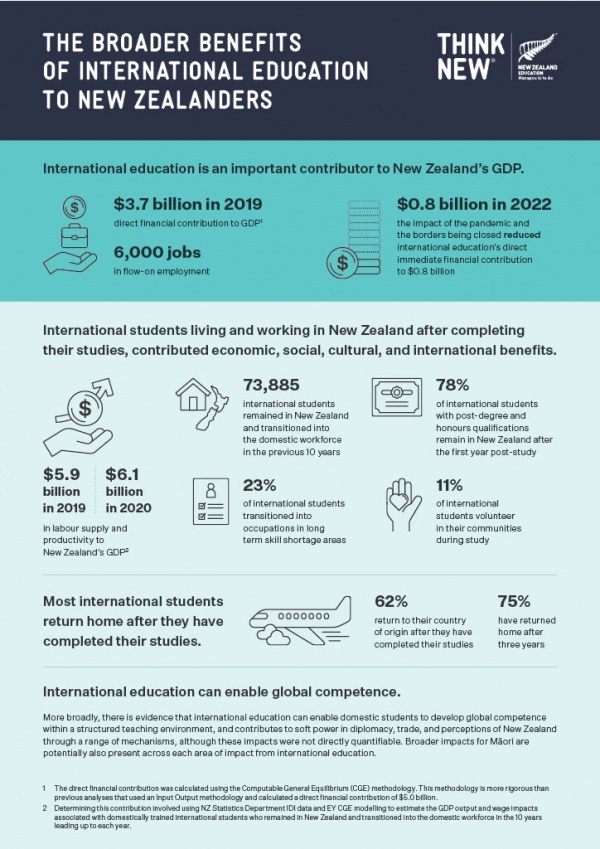
For a full-size image of the infographic, click here. For a full copy of the report, click here.
-
ENZ highlights international students' contributions to New Zealand in comments to immigration settings inquiry
International students coming to New Zealand support the achievement of the Government's broader goals and objectives while contributing to an important export industry. This is one of the key messages from Education New Zealand's submission to the Productivity Commission's inquiry into immigration settings.
In the submission, ENZ says that international students should not be characterised as coming to New Zealand to seek employment, invest or run a business. Rather, international students are motivated by different drivers in deciding whether to come to New Zealand, and are different to other temporary migrants included in the scope of the inquiry.
International students bring foreign exchange to New Zealand to fund their studies and living costs, which contributes to New Zealand's economic development. The submission also discusses the broad benefits international students deliver for New Zealand, including regional development, research output, and strengthened bilateral relationships with other countries.
You can read ENZ's submission to the inquiry here (links to the Productivity Commission's website).
-
Register for ISANA NZ Conference
The conference will be held at Harbourside Function Centre, Wellington from 5-6 September 2019.The theme is ‘Professionalisation of the International Education Sector in New Zealand: Promoting an integrated NZ Inc. approach to student wellbeing.’
Keynote speakers include
- Bariz Shah (New Zealand) – President of the University of Canterbury Muslim Students Association, Bariz became a spokesperson for the Muslim student community following the tragedy of March 15.
- Marcela Lapertosa (Australia) – former Director of Education and Intercultural learning at AFS, Marcela will share insights she gained leading the development of intercultural competence programmes for students, families and staff around the world.
- Lian-Hong Brebner (New Zealand) – Diversity Manager at Auckland University of Technology, Lian-Hong will outline strategies for promoting cultural intelligence within institutions and the wider international education sector.
- Dr Paula Durance (Australia) – Consultant to international education providers, Paula is a respected international education professional. She will be exploring strategies for developing professionalism in international education.
There will also be a range of breakout sessions and workshops from practitioners, policy advisors and educators, including updates on work and study opportunities, tailored mental health practice, strategies for enabling social connections and overcoming communication obstacles and accommodation insights in relation to Code compliance.
Get the early bird rate until 19 July – click here to register.
Education New Zealand and the Ministry of Education International Unit are sponsors.
-
ENZ strengthens role in Indonesia

Desiree Lee
Desiree Lee has been appointed as ENZ Market Manager responsible for Indonesia, in addition to Malaysia and the Philippines.
Naluri Bella Watti has been appointed to the position of ENZ Programme Manager, Indonesia, and will begin with ENZ in the Jakarta office from Monday 17 June. Naluri will be responsible for developing and delivering ENZ’s in-market activities, having formerly worked in a marketing strategy role for British Council Indonesia.

Naluri Bella Watti
ENZ’s Regional Manager East Asia, Ben Burrowes, said these appointments align with ENZ’s strategic direction to bolster in-market representation for ENZ’s priority markets, with at least two representatives now covering the South East Asian markets.
“Indonesia remains an important market for ENZ with a wide range of business opportunities across the country. We’re very pleased to now have additional senior resourcing and with a busy activity calendar ahead, we look forward to working alongside our institution partners to deliver the right results.”
The annual ENZ Fair is the next large event on ENZ’s Indonesia activity calendar and will be held in Jakarta on Sunday 28 July. An agent seminar will also be held the following day on Monday 29 July.
For more information and to register for the events, click here. Please note that the second round of institution registration closes on Monday 13 May.
For any Indonesia enquiries ahead of Naluri’s start date, please contact desiree.lee@enz.govt.nz or ben.burrowes@enz.govt.nz.
-
Around the world in five
VIET NAM
Comparison platform Talk Study launched
Talk Study is a new service allowing prospective international students in Viet Nam to compare study abroad options based on over 20,000 student and alumni reviews on institutions across Australia, UK, US, Canada and New Zealand.
US
Ethical agents should support direct student admissions
According to a survey, only 38.5% of US institutions reported using agents in 2017. This means 61.5% – a solid majority – still didn’t. In addition, nearly 70% of institutions said agents were of limited or no importance to their international recruitment strategy.
FRANCE
France will increase university fees for non-EU students
Foreign students that come to study in France will now have to pay higher fees. Fees for non-European university students will be, at least, ten times higher than for their European counterparts.
JAPAN
English level at Japan's secondary schools falls short of government target
The English-language ability of students at public secondary schools fell short of the government’s target in 2018. A survey shows that final-year students of both junior and senior high schools did not reach the 50 percent goal set for them.
INDIA
Higher education system in India needs more investment, reforms: Govt official
The situation of higher education in India is grim and needs to be reformed, an official has said, while emphasising the need to grow Indian expertise in the fields of science, technology, engineering and mathematics.
- 2024 NZ China Tripartite Fund Proposal Form
-
Applications are open for the Europe and Latin America Engagement Fund
The aim of this funding is to support engagement activities with education agents from Europe, Brazil and Colombia. New Zealand institutions are welcome to submit proposals and apply for up to $3000 per project. We will fund up to 15 projects that focus on engaging with agents from Europe, Brazil and Colombia.
ENZ’s Market Development Manager – Europe, Adina Stoye, said ENZ has a strong and loyal network of agents in Europe, especially Germany and Italy.
“They are keen for support and engagement with New Zealand institutions, and welcome opportunities for events and promotional activities. This initiative is a wonderful opportunity for New Zealand education providers to promote their education offering through building education agent networks.”
Proposed activities should be completed during the second half of 2023 and have firm goals and outcomes in place. Examples of activities are a scholarship campaign, contribution to bringing an agent to New Zealand for a famil, or supporting a trip to attend an event organised by agents.
ENZ’s Director of Engagement – Latin America, Javiera Visedo said education agents in Latin America are keen to learn more about what a New Zealand education has to offer, with students excited at the prospect of studying here. Reconnecting with New Zealand education providers is a top priority for them.”
Applications are open to New Zealand institutions only. This includes New Zealand education providers such as universities, Private Training Establishments (PTEs), English Language Schools (ELS), regional economic development agencies, schools, and peak bodies. Some providers may wish to work together to submit their applications, for example high schools or ELS.
To apply, visit this page. Once applications close, they will be reviewed by a panel of ENZ staff according to the guidelines included on page 5 of the Request for Proposal document.
We will host an information session about the funding and how to apply on Thursday 27 April at 9 am. To register for the session, fill out the form here.
- Applications are open until Friday 12 May at 5pm and applicants will be notified of the outcome on Friday 9 June.
-
ENZ calls for funding proposals for New Zealand-China research partnerships
The New Zealand-China Tripartite Partnership Fund 2023 offers funding of up to NZD 20,000-30,000 for each partnership project, with the call for proposals open until 1 March 2023.
Funding proposals are due by 1 March 2023. Download the New Zealand-China Tripartite Partnership Fund 2023 Guidance and Call for Proposals and the Proposal Form. Send your completed proposal as a PDF, and any questions, to china@enz.govt.nz.
The fund supports new or existing research partnerships between New Zealand and Chinese universities. There are usually three universities involved – two from China and one from New Zealand.
The Tripartite Partnership Fund, administered by ENZ, has a pool of up to NZD 100,000 in 2023 for research partnerships in the arts, humanities, social sciences, sciences and applied sciences. Designed to encourage strategic academic relationships, it supports the creation or development of the partnership rather than funding the research itself.
With the global Covid-19 pandemic restricting some international travel, the fund welcomes innovative ideas. Current investments include digital technology services, communications platforms, translation costs and journal access.
At the recent New Zealand-China 10th Joint Working Group held on 22 November, senior officials at the meeting noted the value of Tripartite research relationships and the impact of having funding from both governments to establish new partnerships or nurture established research collaboration. Li Qing, Deputy Secretary General China Scholarship Council, remarked on the benefits of both student mobility through scholarships and closer research links such as the Tripartite Partnership Programme. The co-chair of the Joint Working Group, Vice Minister Tian Xuejun, stated in his closing remarks that China and New Zealand should continue to strengthen existing cooperation activities, listing the Tripartite Partnership Programme as one of the initiatives.
Lisa Futschek, General Manager International, reinforced ENZ’s commitment to administering the fund.
“We remain committed to the Tripartite Partnership Programme and its valuable contribution toward stronger global connections, research links and partnerships – key goals under the revised New Zealand International Education Strategy, launched by Minister Hipkins in August this year. We look forward to many more partnerships under this programme.”
Established in 2005, the Tripartite Research Partnership is a valued part of the New Zealand – China bilateral education relationship and we welcome proposals from researchers to join the growing list of funding recipients.
Funding proposals are due by 1 March 2023. Download the New Zealand-China Tripartite Partnership Fund 2023 Guidance and Call for Proposals and the Proposal Form. Send your completed proposal as a PDF, and any questions, to china@enz.govt.nz.
-
International Student Hardship Fund
Thank you for all the applications we have received.
The Fund has now been allocated and we are no longer able to accept applications.
The Government has established a $1M hardship fund for international students to address urgent, temporary needs, for example temporary inability to access cash or because of reduced part-time employment.
Criteria
We welcome applications from education providers and organisations to apply for grants of up to $20,000 (GST not to be included) to enable you to provide eligible international students with direct financial relief or other support, including food parcels and support towards living costs.
Organisations can apply for grants up to $20,000.
Applications can be made from 21 May until funding has been allocated.
Which organisations are eligible to apply to ENZ for grants?
- Education providers who are signatories to the Code of Practice
- Community groups
- Peak bodies, or
- Other organisations who currently work with international students and have the mechanisms and experience to support international students with hardship requests.
Individual students and education agents may not apply to ENZ to access the fund.
What grants are available?
- Eligible organisations may apply for grants of up to $20,000 (GST not to be included) per request to the fund.
- Grants are one-off; however, the same organisation may make additional requests after using their initial funding (subject to the availability of funding).
What can grants be used for?
The grants may be used to:
- scale up existing student hardship initiatives
- support eligible students through:
- Direct cash grants
- The purchase of resources on behalf of international students, such as food parcels, where this is appropriate.
- The maximum amount that can be applied for is up to $1,000 per international student your organisation is supporting.
- Funds may not be used for:
- Salaries or staff administration costs
- Funding for flights home
- Tuition fees
- Granting individual students support of more than $1,000 in cash or kind.
Which students are eligible for support?
- Grants can only be used to provide support to eligible students.
- An eligible student is:
- A current fee-paying international student, or enrolled as a fee-paying international student as at 23 March
- Currently in New Zealand
- In genuine, temporary hardship[1]
- Not eligible for other government financial support.
- International PhD students paying domestic fees are eligible for the government’s domestic student hardship fund and should be encouraged to seek help from that scheme in the first instance.
Table: Summary of eligible and ineligible students
Eligible students
Ineligible students
- A current fee-paying international student, or enrolled as an international student as at 23 March.
- In genuine, temporary hardship.
- International PhD students paying domestic fees.
- International students who are not currently enrolled or who were not enrolled as an international student as at 23 March.
- International students who are eligible for other government support.
How do organisations apply?
- To apply for grant funding, organisations must complete and submit an online application form to ENZ.
- Organisations will need to provide the following information:
- Their strategy and approach to identifying students in need, including outreach efforts and ensuring eligibility criteria are met
- Estimated number of international students and basic demographics (e.g. age range, sector, nationalities, region)
- Total amount requested, what it will be used for, and how it has been calculated
- The organisation’s resources to ensure appropriate distribution
- Agreement to meet reporting requirements (including publication) and to repay any underspend within 12 weeks of having been granted the funds
- Invoice and bank details for payment.
- Process – Applications are now closed.
- Assessment of applications will be completed within five working days. Approval will be notified by email, as will confirmation of distribution of funds.
- Any queries about the International Student Hardship Fund can be sent to response@enz.govt.nz or raised with Sahinde Pala, Director of Student Experience & Global Citizens at Education New Zealand.
Reporting requirements:
- Organisations will need to report to ENZ on:
- The number of students assisted, and basic demographics (e.g. age range, sector, nationalities, region of New Zealand)
- The type of assistance provided
- How much was provided.
- To demonstrate programme outcomes, and as part of its commitment to ensuring value for money from expenditure, ENZ will publish reports from participating organisations in whole or part.
Closing date
Applications can be made from 21 May, until funding has been allocated.
Further information
Frequently asked questions are available here.
Any queries or concerns about the International Student Hardship Fund can be sent to response@enz.govt.nz or raised with Sahinde Pala, Director of Student Experience & Global Citizens at Education New Zealand.
Thank you for your assistance in helping to support international students currently studying here during these unprecedented times.
[1] Organisations will have the discretion to determine what constitutes significant, temporary hardship in accordance with their existing policies and practices.