
Search
Showing 10 of 1236 results for Value-priced treatments https://simplemedrx.top
-
We offer flexibility, care and support

At Education New Zealand, you will receive:
- Five weeks (25 days) paid annual leave that will begin accruing from your very first day.
- 10 days sick leave added to your balance from the day you start, and a top up of 10 days to your balance when you cross over your work anniversary (after 12 months).
- Annual flu vaccinations.
- Flexibility. We understand this is valued by our employees, therefore offer different kinds of flexible working around the location, days, and times you work while balancing the needs of ENZ, your team and you.
- Free access to a nearby gym and (free) personal trainer if you’re based in our Wellington office.
- Access to a resourceful Wellbeing Hub through our Employee Assistance Program (EAP), giving you access to confidential support and resources across key areas such as physical health, emotional wellbeing, lifestyle, and workplace support, along with webinars and eLearning modules.
-
Tauranga-based group visits Korea
E-News caught up with one of the organisers of the visit, Education Tauranga’s Anne Young.
What led to the decision to visit Korea as a group of institutions?
Education Tauranga’s 2013-2017 strategy focuses strongly on collaboration between member institutions. We find that we can make more of an impact in a market as a group, and, with a diverse range of institutions participating in activities, we can demonstrate the pathways that exist within our region to cater for all levels of education.
Korean students are enrolled in the full range of education institutions in Tauranga – from primary right through to tertiary. This is one of the reasons Education Tauranga’s Korean student numbers have continued to rise in 2015, while declining in New Zealand overall. We also attribute our success in Korea to the fact that we have committed local agents, strong local government support, highly effective links with the Korean community in the Western Bay of Plenty and institutions that provide excellent education and care to all international students, including those from Korea.
In choosing Korea as our group visit destination, we were able to further capitalise on our already strong position in that market.
What are the advantages of a group visit such as this?
The main advantage of a group visit is that it’s easier to get noticed and to secure meetings than when you’re an individual institution travelling on your own. Promotional costs can be shared, too. In our case, 21 institutions were pitching in, meaning our advertising dollar went a lot further, resulting greater numbers of prospective students at our fairs and good attendance of officials at other events.
Having trip organisers taking care of all the planning, organising and bookings meant it was a much more efficient process for everybody. It also alleviated stress for some first time travellers to Korea who didn’t have to face many of the challenging ‘unknown factors’ that can pop up when organising your own recruitment trip.
What are the downsides?
I don’t think there are any particular disadvantages to marketing as a group offshore. However, there are challenges in the logistics of dealing with such a large group, such as transport arrangements and getting everyone to where they need to be on time, as well as ensuring that planned activities are of benefit to all institutions from a range of sectors.
What were the highlights?
We attracted over 400 prospective students through our fairs which was a great success for one small region of New Zealand. The students who came along were already pretty well informed about Education Tauranga’s education offerings, demonstrating that the effort that we put into advertising prior to the events hit the mark!
Several alumni families also attended the events, and it was wonderful to see them engaging with prospective students and their families and giving their perspective on what studying in our region is like.
The support of big New Zealand brands such as Zespri was also fantastic; their product promotion at our fair went down really well.
Being hosted at the New Zealand Residence by the Deputy Head of Mission to Korea and Education New Zealand was also a highlight as we were able to recognise the contribution they had made to ensuring our activities were a success.
Are there any outcomes on the horizon or promising connections made?
We’re hoping our visit will result in an increase in student numbers from Korea in 2016. The signs are promising so far, with many new students expressing an interest in coming here. Time will tell however!
We have also strengthened relationships with Tauranga’s ‘friendship city’ of Ansan, with a larger study tour group coming in 2016 than came in 2015.
What would you do differently next time?
The visit to Korea was our second regional group visit (we visited China together as a group in March this year) so we already had experience in what did and didn’t work and were able to iron out any issues prior to this trip.
Any hints and tips for together groups thinking of undertaking this sort of group visit?
I think undertaking a visit of this kind is very effective for regions or groups of institutions. My top tips for making your visit a success are as follows:
-
Do your research and have a plan. Know exactly what activities you want to do and why
-
Involve all participating institutions in the planning process
-
Make sure you have support from local councils and your Economic Development Agency
-
Enter the market with a strong brand that all participants believe in
-
Make sure you have translated materials and have translators who know your product/region
-
The work you do prior to arrival is just as important (if not more than) as the work you will do while in country
-
Work with ENZ and local Embassy staff
-
Leverage your alumni
-
Follow up with the people you met with during the visit!
-
-
Announcements to support industry growth
Here’s a round-up of recent news:
$2.7 million for international education in regions and new markets
An additional $2.76 million of funding is being invested through ENZ to strengthen key market relationships, support diversification into new markets and build on our Regional Partnership Programme.
The Regional Partnership Programme will receive $2 million to help grow international education. The investment is focused on growth in the regions, and will enable more regions to join the Programme and further regional development initiatives to be supported. For more information on the Regional Partnership Programme, contact Greg Scott, Business Development Manager.
Efforts to diversify growth across more markets continue, with an additional $700,000 invested in stepping up marketing and promotional activity in Colombia, the USA and Viet Nam, the Philippines and Indonesia.
Here’s a link to the press release.
School ties with China
Twenty-five schools across New Zealand received funding to build their sister school relationships with China. Recipients include Marlborough Girls’ College and Marlborough Boys’ College, which received funding of $5,000 to develop a sister school partnership in Ningxia Hui Autonomous Region, one of China’s leading wine-producing regions. The colleges are also working with the Nelson Marlborough Institute of Technology to encourage Chinese student enrolments into courses relevant to New Zealand’s wine industry.
Here’s a link to the press release.
Read the article in the Marlborough Express here.
Study Abroad growth
A new scholarship for European Union students will target Study Abroad growth at New Zealand universities.
Total funding of NZ$100,000 for scholarships, co-funded between ENZ and universities, will be offered as part of a marketing campaign being prepared to grow the number of Study Abroad student arrivals from Europe to New Zealand. The announcement came during Prime Minister John Key’s visit to Europe to advance the bilateral and trade relationship between EU and New Zealand.
Here’s a link to the press release.
Scholarships bring Korean students to New Zealand
New Zealand’s profile as a study destination was further raised in Korea during Minister Joyce’s recent visit. In Seoul on 19 October the Minister awarded four aspiring Korean golfers scholarships to spend a month in New Zealand receiving intensive English language teaching and top quality golf coaching, under the Game On English - Golf edu-sport programme.
Here’s a link to the press release.
And, for those of you who read Korean, here’s some of the coverage the event received in Korea:
Ilgan Sports ‘Education New Zealand provides golf training opportunity in New Zealand to four aspiring Korean golfers’
Business Korea ‘New Zealand Educates Korean Golfers’
Segye Ilbo ‘New Zealand ‘Game On English-Golf’ providing opportunity to four recipients’
-
Students experience a New Zealand classroom in Thailand
Approximately 600 fair visitors, including students and their parents, were given a glimpse into what life is like for New Zealand students.
The fair was also attended by the New Zealand Ambassador to Thailand, His Excellency Ben King, who presided over the opening ceremony and welcomed all the participants.
A popular exhibit was the New Zealand simulated classroom experience, which showcased New Zealand’s interactive and hands-on learning and teaching methods.
ENZ Marketing and Strategic Relations Manager – Thailand Chortip Pramoolpol, said the simulated classroom experience drew a great response from fair participants and was fully booked for each of the four sessions on offer.
“The simulated classroom experience targeted students aged 11 to 18 years old".
“With Facebook Live in one of the classroom sessions, we were able to reach 43,282 people!"
“The top five locations for people to engage with the Facebook Live stream were Bangkok, Auckland, Wellington, Metro Manila and Ho Chi Minh City.
“We also launched a new registration and lead management system at the fair, which will enable us and education institutions to continue to engage with potential international students,” Chortip said.
-
Winners of KIWI Challenge announced
This year was the first where university students were able to enter a new category alongside the schools' challenge.
The winning teams from Petra Christian University and USG Education headed off strong competition from eight other finalists, drawing praise from the judges for their solutions to support youth-led Small and Medium Enterprises (SMEs).
Finalists presented to a panel of judges from University of Otago – Ōtākou Whakaihu Waka and Education New Zealand Manapou ki te Ao (ENZ), who were cohosting the initiative.
Both winning teams received a voucher valued at 10,000,000 Indonesian Rupiah (approximately 1,000NZD) as well as virtual internships from the University of Otago – Ōtākou Whakaihu Waka commencing in semester one, 2025.
Tech-led solutions
A team from Petra Christian University developed an app ‘Partify’ which connects emerging small businesses and keen part-time workers. Businesses post part-time jobs, and workers swipe to find flexible gigs nearby, with AI matching candidates based on skills, location, and availability.

Partify university winner – ENZ market manager Naluri Bella and University of Otago Regional Market Manager Sarah Ewing present the award for First Place in the University category to team members from Petra Christian University for their app ‘Partify’.
In the high school category, a team from USG Education took the top prize with ‘LAW4MSME’, a platform allowing small businesses to access legal information and advice.
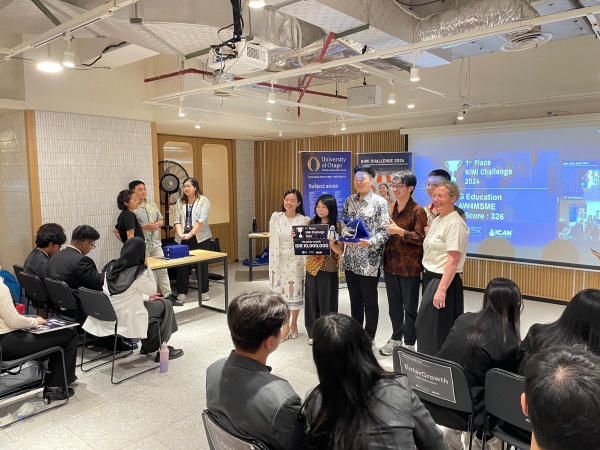
LAW4MSME High school winner - ENZ market manager Naluri Bella and University of Otago Regional Market Manager Sarah Ewing present the award for First Place in the University category to team members from USG Education for their platform “LAW4MSME’.
Explaining the group’s business idea, team leader for LAW4MSME, David Francis said the students found that Indonesian youth-led SMEs lack knowledge of the laws and regulations needed to run their businesses.
“To address this, we developed an AI bot that educates SME owners on these regulations, helping them navigate legal requirements more effectively,” David said.
The KIWI Challenge competition aims to inspire youth across Indonesia to engage in entrepreneurial activities and help resolve societal issues. Over the five years the competition has run, 1000 Indonesian youth have participated. This year, Education New Zealand Manapou ki te Ao (ENZ) partnered with University of Otago to co-host the initiative.
This year’s competition included 49 teams with a total of 221 student participants.
Mentorship key
Mentorship is a key element of the competition. The finalists attended a workshop run by Associate Professor Dr Conor O’Kane, Head of the Bachelor of Entrepreneurship programme at Otago Business School. This assisted entrants to develop their ideas and refine business plans.
ENZ Acting General Manager International Ben Burrowes said he’s delighted to see the continued development of the KIWI Challenge.
“Inviting university students for the first time has given us the opportunity to include a whole new cohort of talented young entrepreneurs, and we have been very impressed with the quality and creativity of their submissions,” Ben said.
“The competition has also benefitted from the enthusiasm and expertise of our colleagues at the University of Otago, and we are grateful for their willingness to partner with us for the KIWI challenge’s fifth year.”
Dr O’Kane said it was inspiring to witness the quality of entrepreneurial thinking among Indonesian students.
“These students have very bright futures. The concepts and programmes the finalists presented were remarkable and captured the impressive ability of the teams to identify tangible business problems and visualise and communicate a solution to these challenges,” Dr O’Kane said.
-
ENZ hosts first agent-led fairs in Viet Nam
The fairs, held in in Ho Chi Minh City and Hanoi, attracted more than 500 prospective students and parents and featured 35 New Zealand providers.
Tam Le, ENZ’s Marketing & Strategic Relations Manager for Viet Nam, said the new agent-led fairs were part of ENZ’s wider efforts to work in close collaboration with one of our top education agents in Viet Nam during key recruitment seasons.
“Agent-led events such as these play a key role in raising the awareness of New Zealand education in during September/October, one of Viet Nam’s key recruitment seasons for international education.
“We are very happy with the quality of students who visited the fairs as well as their genuine enquiries about New Zealand and its education system.”
The fairs were a great opportunity for New Zealand education providers to showcase their internationally-recognised qualifications and to highlight the strong education links between Viet Nam and New Zealand, said Tam.
“It’s fantastic to see New Zealand emerging as a popular education destination for international students from Viet Nam.
“There has been a 62 percent increase in the number of Vietnamese students choosing to study in New Zealand in the first eight months of 2017, compared to the same period last year.”
A growing number of students are also choosing to study at New Zealand’s universities, with an 88 percent increase in the number of Vietnamese students in the first eight months of this year compared to 2016.
-
Otago Chemistry lecturer attracts a crowd at Kuching fair
Jane Goh, ENZ’s Marketing and Strategic Relations Manager, Malaysia, said that around 150 students, parents and teachers in Kuching met with representatives from higher learning institutions, high schools and polytechnics from New Zealand at the fair.
These included Riccarton High School, UC International College (UCIC), University of Canterbury, Lincoln University, The Ara Institute of Canterbury, University of Otago, The University of Auckland, University of Waikato, New Zealand Tertiary College (NZTC) and Academic Colleges Group (ACG).
During the fair, Dr David Warren from the University of Otago gave a lecture on the relevance of chemistry today to teach students how best to study and excel in the subject.

Dr David Warren delivers a lecture on ‘Chemistry and its relevance in today’s life’ during the New Zealand Education Fair 2016 held at Kuching Hilton Hotel.
After the lecture, all participants were given a chemistry quiz contest. Rebecca Chen from Lodge International School won the main prize.

Rebecca Chen from Lodge International School – the top winner of Chemistry Lecture and Quiz.
-
ENZ success at the NZ Direct Marketing Awards
It is the first time in the Awards’ history that one organisation has taken out all of the top honours. ENZ was also awarded a further seven golds, three silvers and one bronze across a variety of categories.
The awards, which celebrate excellence in digital, database and direct marketing, recognised ENZ's database marketing strategy over the past 18 months, including its Study in NZ database marketing programme, MyStudyNZ member website and Future Proof Yourself campaign.
Each was delivered with the support of SpeakData, ENZ’s data partner, and OMD, ENZ’s media partner.
ENZ Chief Executive Grant McPherson was delighted with the agency’s success.
“We’ve made a fundamental shift from promotions, events and limited fact-to-face interactions to a sophisticated digital marketing approach that is truly global that is an asset for New Zealand education providers involved in international education.
“We want to attract students who choose New Zealand for the value of our education offering and contribute to New Zealand and our society by helping us grow our understanding and connections with the world.”
Paul Irwin, ENZ’s General Manager Student Marketing, said ENZ’s digital approach matched the key audience that New Zealand needed to connect with – students.
“The current generation of students live and breathe in a digital world. Today’s students expect to be able to find what they need on-line and this is playing a key role in their decision making,” said Paul
“Our digital approach connects students to education offerings that are optimally suited to their interests and ambitions. This helps them have the best possible experience living and studying in New Zealand and boosts employment outcomes.”
The NZDM Awards are one of two key annual New Zealand marketing award events and are run by the New Zealand Marketing Association.
This was the first time ENZ entered the awards, competing against many of New Zealand’s biggest corporates, including Spark, Westpac, ANZ, Vodafone and Air New Zealand.
-
ACG expands its New Zealand vocational group
ACG Group Chief Executive, John Williamson, said that acquisitions are part of ACG’s plan to broaden its portfolio of high-quality educational services.
“With ongoing demand for recognised, quality educational qualifications, we are well positioned to grow, either through developing new offerings ourselves or acquiring providers whose philosophies and standards match ours,” said Williamson.
ACG’s vocational diplomas, degrees and courses are offered in a range of creative industries such as IT, tourism and hospitality, trades and services, health, and early childhood. The acquisitions will now see ACG delivering education to over 12,000 students through its 35 campuses across three countries.
ACG’s other institutions include Yoobee School of Design, New Zealand Management Academies, New Zealand School of Tourism and New Zealand Career College.
Animation College is New Zealand's leading character animation college, delivering both traditional and 3D animation courses. AMES is one of New Zealand’s top IT education providers, while South Seas Film & Television School is a leading film, television, screen acting, animation and photography training institution.
-
Tauranga education delegation travels to Korea and Japan
Two successful education fairs were held in Korea, with more than 100 Korean students committing to study in Tauranga from Term 1, 2023 onwards. 400 people attended the events overall.
Relationship-building was also a key focus of the trip, making many new connections and strengthening long-term ones in both countries.
Korea
The trip to Korea was coordinated by Education Tauranga and TKT agency. The two organisations held education fairs together in Korea for 12 years prior to COVID-19. This trip was especially important as 2022 marks 60 years of diplomatic relationships between New Zealand and Korea.
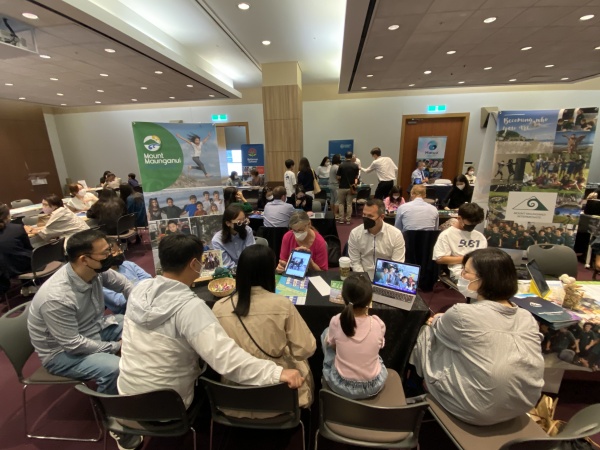
Regional marketing at the Seoul education fair
“It was exciting to travel offshore again to promote the Tauranga region. Korean families contribute so much to our city and our community - socially, culturally, and economically,” says Education Tauranga Regional Manager Melissa Gillingham.
The trip provided an insight into Korean culture and helped school representatives understand the support families need as they settle into life and school in Tauranga.
On average, Korean families stay in Tauranga for two to three years and contribute about $20 million per year to the local economy. A single family will spend about $100,000 per year on various costs related to establishing a home and participating in tourism activities.
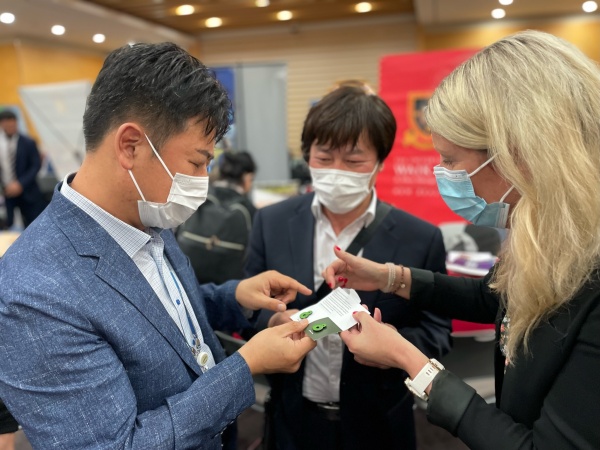
Anne Young from The University of Waikato explains the Tu Ngatahi pin to a prospective parent at the Seoul education fair
Because the group was the largest New Zealand delegation to visit South Korea since the end of 2019, Education Tauranga organised a special Alumni Event with support from Education New Zealand. Hosted by New Zealand’s Ambassador to South Korea, Philip Turner, the event attracted 70 alumni Korean families.
The families were eager to reconnect and relive the positive experiences they had living and studying in Tauranga.
“It was fantastic to have the opportunity to connect with them again face-to-face and see what they've been up to since returning to Korea,” says Anne Young, International Manager of the University of Waikato Tauranga Campus.
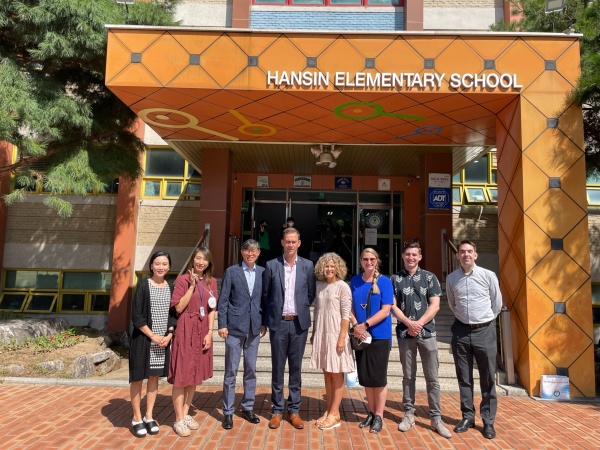
Greenpark Primary School reconnecting with the sister-school they have had reciprocal exchanges with for 18 years, Hansin Elementary
Visits to sister schools were next, with representatives from the delegation calling on Sanui Primary School and Hansin Elementary. They were treated to full school tours and discussed next steps in strengthening their relationships and the potential for restarting international exchanges once again.
In addition to the education fairs, this was an opportunity to reconnect with Tauranga’s ‘friendship city’ in Korea; Ansan. Situated on the outskirts of Seoul, Ansan is a planned city that grew from a population of 120,000 to over 750,000 in the past 35 years. With a wide scope of primary and secondary industries, and a strong focus on sustainable growth, there are similarities connecting Tauranga and Ansan city.
Japan
After the success of the events in Korea, Tauranga city representatives Dean Prendergast and Melissa Gillingham travelled on to Japan to continue reconnecting with their international contacts.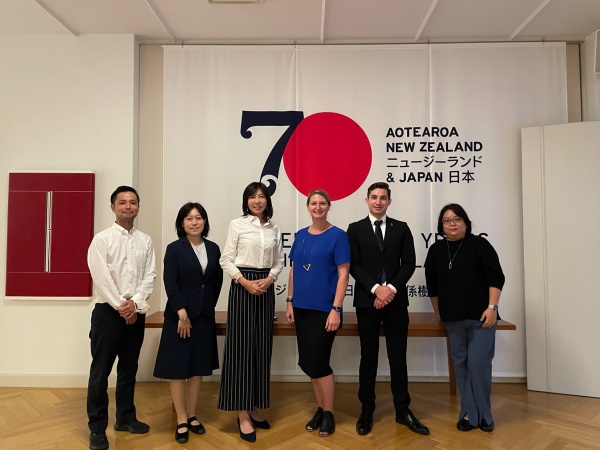
Meeting with Waseda University and Japanese Women’s University at the New Zealand Embassy, hosted by ENZ representative, Misa Kitaoka
This year marks 70 years of diplomatic relations between New Zealand and Japan. Mr Prendergast and Ms Gillingham visited the New Zealand Embassy to celebrate this milestone. There they met with representatives from top Japanese universities, Waseda University and Japan Woman’s University, to discuss studying abroad and online exchange activities.
High interest in the United Nations’ 17 Sustainable Development Goals is shared between the two schools.
“It’s important to discuss ways for youth to connect over common goals that will continue to unite our two countries for future generations,” Ms Gillingham says.
The final stop on the trip was Tauranga’s sister-city, Hitachi, in the Ibaraki prefecture. Next year the two cities will be celebrating the 35-year anniversary of the sister-city relationship, a significant and long-term connection that has seen many exchanges on an educational, economic, and personal level.
The representatives had an opportunity to meet with Hitachi Mayor, Haruki Ogawa and exchange stories. Mr Ogawa was delighted to meet with the delegates and is waiting eagerly for the next mayoral delegation to visit Hitachi.
