Search
Showing 10 of 1236 results for Value-priced treatments https://simplemedrx.top
-
Recovery plan for the international education sector

The Minister of Education has announced a long-term recovery plan for the international education sector.
It includes a $51.6 million investment from the COVID-19 recovery and response fund to help reset New Zealand’s international education sector.
The Plan consists of three concurrent workstreams that focus on stabilising the international education sector, strengthening the system, and accelerating the transformation of the sector as signalled in the 2018 International Education Strategy.
It includes:
- $20 million in support for state and state-integrated schools to continue to employ the specialist international workforce to provide teaching and pastoral care to international students in New Zealand this year.
- $10 million targeted and immediate funding to private training providers of strategic importance (including English language schools) to preserve the foundations of the sector. MOE is developing eligibility criteria which will be implemented by TEC; providers can apply to TEC from mid-August.
- $1.5 million for English Language Schools to deliver English language training to migrants to help them to succeed in our schools and communities.
- $6.6 million to continue pastoral care and other activities normally funded by the Export Education Levy.
- $500k for NZQA to ensure the quality of New Zealand education being delivered offshore, and continue strengthening ongoing quality assurance processes.
ENZ will administer:
- $3 million for marketing and brand protection activities to keep New Zealand’s education brand visible in key markets and to ensure we capitalise on the strong international reputation New Zealand has gained through its handling of the COVID-19 crisis.
- $10 million to develop new future-focused products and services to drive growth in our system onshore and offshore, to ensure a more resilient sector. This will include:
- An offshore pathways initiative to enable learners to begin their New Zealand education journey from their home country and to study programmes that pathway directly into bachelors and masters degrees in New Zealand, providing greater flexibility for learners and resilience to shocks.
- A New Zealand digital platform to provide a single strong New Zealand brand and presence to enable New Zealand providers to deliver their education products and study programmes to more people offshore, and to meet changing learner needs.
Education New Zealand will also support and drive the Recovery Plan through its annual activity. This will include brand positioning, maintaining engagement with students, partners and agents offshore, student retention and transitions, building the international reputation of New Zealand education, and working with the sector and regions on innovation and new modes of delivery.
The Ministry of Education has developed criteria for the allocation of funding for Private Training Establishments (PTEs) and English language schools, to be implemented by the Tertiary Education Commission (TEC).
Fund for PTEs in financial difficulty due to COVID-19
The Private Training Establishment (PTE) Targeted Assistance Fund (TAF) closed on 11 September 2020.
PTE ESOL Provision Fund
The PTE ESOL Provision Fund closed on 28 August 2020.
Further information
- Download the Recovery Plan outline here
- Read the Minister of Education's release
- Cabinet Paper - A Strategic Recovery Plan for the International Education Sector
-
Around the world in five
New Zealand
NZ public positive on overseas student benefits and return
The report was commissioned by Education New Zealand to gauge public opinion in the context of the Covid-19 pandemic, and was conducted by research company TRA, based on a survey of 560 people as well as qualitative co-creation sessions.
United States
US begins processing student visas for Chinese students
Visa processing for Chinese students would resume this month, with plans to handle 2,000 applications a day by mid-May.
Canada
International grad stream reaches 40,000 limit in one day
Canada’s new pathway to residency for international graduates has reached its 40,000 application limit, just over one day after going live.
Global
Survey confirms that vaccination rollouts are influencing student choice
New QS global research indicates that the introduction of COVID vaccines is strengthening prospective international students’ resolve to study abroad, and that many students now want to begin their studies sooner than they had planned because of vaccine availability.
Latin America
If you are from a university, join the virtual THE Latin America Universities Summit 2021 free of charge to examine how the higher education sector across the region can develop strategies to build capacity, adapt to digitisation, increase strategic impact and improve public appreciation of universities’ role in progressing society as we look towards a new era post-pandemic.
Hosted in partnership with the University of São Paulo, this online summit will bring together leaders from across the region and their institutional partners around the world to set the agenda for the future of higher education in Latin America.
-
New video series: Discover the inspiring journeys of New Zealand alumni
The series showcases the journeys of New Zealand alumni from across the world, highlighting the diverse paths they have taken since graduation.
Three videos have been released so far, with the remaining set to be released through the rest of this year.
Each video offers a glimpse into the personal and professional achievements of former students who have made their mark across various industries and communities.
Alumni from all levels of New Zealand’s education offering will be featured – ranging from schools to universities and vocational education providers.
These stories are designed to inspire prospective students and their families to consider New Zealand as their study destination of choice.
You can view and download the alumni videos and photos on The ENZ BrandLab. Search ‘Alumni’ to see the latest stories.
In addition, the series is supported by a new alumni blog story each month on the Study with New Zealand website and a dedicated page for Alumni stories.
Check out the series so far
Meet Yao – classical musician and cultural bridgebuilderOur first story features Chen Xiyao, a Chinese-born guzheng player and classical musician now based in Beijing. Although he earned a degree in Business Administration, it was in New Zealand where his love of music truly flourished—thanks to the support of an inspiring high school teacher. He went on to earn a Master of Arts (with Distinction) from Wintec.
From playing in a metal band to performing with Māori musicians and even entertaining former Prime Minister John Key, Yao's journey reflects the unique opportunities and cultural exchange that a New Zealand education can offer.
Today, he teaches music for Wintec in China, continuing to share his passion and talent with others.
From New Zealand to New Delhi: Suvan’s Inspirational Culinary JourneySuvan Kitchlue began his Bachelor of Culinary Arts at Le Cordon Bleu Wellington in 2015, graduating in 2018.
Inspired by MasterChef Australia in India, he chose the school for its rare offering of a culinary arts degree at that time. He thrived in the programme, calling it the “Harvard of culinary education.”
After graduating, Suvan opened a European café in New Delhi, aiming to bring refined technique and quality baked goods to a market he felt was underserved. Inspired by Wellington’s coffee culture, he also focused on elevating his café’s coffee offerings to New Delhi.
He plans to open two more café locations, and a fine-dining restaurant.
Devika Hartono: Alumni storyDevika was born in Indonesia and moved to New Zealand in 2016 on a scholarship to study Biotechnology at The University of Waikato.
Passionate about biology since high school, she sought scholarships to expand her opportunities beyond medical school or teaching. A photo of New Zealand’s stunning landscapes sparked her interest, and she was thrilled to receive both the University of Waikato International Excellence Scholarship and the High Achievement Scholarship for International Students.
After graduating, she launched Keyoura, a skincare brand inspired by the Māori greeting "Kia ora."
-
Our role
Education New Zealand Manapou ki te Ao (ENZ) is a Crown Agent under Schedule 1 of the Crown Entities Act. ENZ has a dedicated focus on international education and brings the New Zealand Government’s goals for international education to life, bringing benefits to New Zealanders and international learners.
We promote New Zealand as a study destination and support the delivery of education services offshore. We also administer scholarships to support New Zealanders studying overseas, particularly in Asia and Latin America.
Specifically, ENZ...
- leads the future thinking of New Zealand’s international education industry, and drives forward future activities for growth of the industry
- facilitates education industry capability so providers can effectively recruit and support international students
- helps the education industry to identify new opportunities for growth
- leverages the offshore promotional activities of other NZ Inc agencies - such as the Ministry of Foreign Affairs and Trade, Immigration New Zealand, Tourism New Zealand and New Zealand Trade and Enterprise - to raise the profile of New Zealand education
- works closely with other New Zealand agencies to create an environment in which international education can grow and international students can flourish
- provides information to prospective international students and their families about studying with New Zealand
- works with other agencies and the education industry to ensure international students continue to receive a high quality experience while living and studying in New Zealand
- spreads the word about the social, cultural and economic benefits of international education within New Zealand.
Our vision
Transforming lives through international education experiences.
Our work to support Māori Crown relationships
ENZ is committed to giving practical effect to the Crown's Te Tiriti o Waitangi (Te Tiriti) responsibilities in our work and giving effect to Te Tiriti obligations in the Education and Training Act 2020. We take a wide and deliberate view of Te Tiriti to build understanding of what it means and how it can contribute to international education in practice.
ENZ is implementing He Rautaki Māori, our Māori Strategy, by weaving the following Ngā Whainga (key objectives) into our activities:
- Facilitating strategic partnerships and connections with indigenous iwi/hapu and Māori providers to deliver international education with, and for, indigenous and Māori communities.
- Embedding the principles of ENZ's Te Tiriti o Waitangi framework into all facets of operation to present the education system as valuing a Māori world view.
- Supporting public sector objectives in Māori-Crown relationships
- Continuing to weave te reo me ōna tikanga into ENZ's purpose, which is to spread the word about the social, cultural, and economic benefits of international education within New Zealand.
Who we work with
ENZ works with New Zealand’s diverse international education industry, organisations and companies that cover seven sectors:
-
Student visas moving to enhanced Immigration Online
From 18 August 2025, all international student visa applications will move to Immigration New Zealand’s enhanced Immigration Online system. For education agents submitting applications on behalf of international students around this timeframe, here are important updates on how applications will be managed during this transition –
-
All applications submitted on or before 17 August will be processed under the old system
-
Draft applications that have not been submitted by 17 August have until 17 September to be completed and submitted.
-
International students should still aim to apply 3 months ahead of their intended travel date regardless of the change in Immigration New Zealand’s application forms. This will help to avoid delays that may impact students’ ability to begin study.
To help you prepare, Immigration New Zealand has developed this video explaining the new process: Guidance on the new Student Visa application form.
If you have questions, please submit using this form: https://forms.office.com/r/DkHAk36fiw by 1 August, Friday 6pm NZDT.
Responses will be uploaded onto https://agentlab.enz.govt.nz/inz-faq-topics/ on 18 August.
Important to note: Immigration New Zealand will do its best to answer submitted questions but may not be able to respond to all of them. Questions that will be resolved by viewing/using the new Student Visa application form on 18 August will not be answered.
-
-
Around the world in five
China
China’s Ministry of Education has approved a slew of new transnational educational partnerships, as the country aims to grow its TNE enrolments from 800,000 to eight million.
Global
Students around the world are more confident about career prospects but are increasingly concerned about a range of other issues, including student diversity and their quality of life, according to the latest Global Student Satisfaction (GSS) Report 2025.
United Kingdom
According to a new report from the All-Party Parliamentary Group (APPG) for International Students, International students contribute more than £41.9 billion annually to the UK economy, with their impact felt in local communities.
Australia
The Australian Centre for Student Equity and Success (ACSES) has released a new report calling for a complete shift in how Australia’s higher education system addresses equity and access issues.
United States of America
An estimated 30% to 40% fewer international students are expected on American college campuses in the fall of 2025, compared with trends in the 2024-2025 academic year, according to NAFSA: Association of International Educators.
-
Consultations
Open
There are no open consultations at this time.
Closed
New Zealand Qualifications Authority (NZQA) Rules
The New Zealand Qualifications Authority (NZQA) is reviewing the NZQA Rules to reflect amendments to the Education and Training Act 2020 which came into effect on 1 August 2022, and to ensure the rules remain up-to-date and fit for purpose.
Consultation closed on 21 October 2022. Go to https://www.nzqa.govt.nz/providers-partners/rules-consultation/
New Zealand International Education Strategy 2022-2030
The Minister of Education is refreshing the New Zealand International Education Strategy. The Ministry of Education has developed a draft Strategy and was seeking your views on the proposed changes.
Consultation closed on 28 June 2022. Go to https://consultation.education.govt.nz/te-puna-kaupapahere-policy/new-zealand-international-education-strategy-2022/
Enrolling international fee-paying students under Year 9
The Ministry of Education was seeking your views on the future of enrolling international fee-paying students under Year 9 (primary and intermediate level).
Submissions closed on 11 March 2022. Go to consultation.education.govt.nz/international-education/intlenrolunderyear9
Immigration policy settings
The New Zealand Government has asked the Productivity Commission to undertake an inquiry into what immigration policy settings would best facilitate New Zealand’s long-term economic growth and promote the wellbeing of New Zealanders.
Submissions closed on 24 December 2021. Go to www.productivity.govt.nz/inquiries/immigration-settings
ENZ made its own submission to the inquiry, which you can read here (links to Productivity Commission website).
Draft policy statement: high value for international education
The Ministry of Education was seeking your views to help it define what ‘high-value’ means for international education.
Submissions closed on 24 September 2021. Go to consultation.education.govt.nz/international-education/highvalue/
-
ENZ launches new tool to help students with visa application process
Developed as a resource for both students and education agents, the video guides students through the steps of applying for a visa to study in Aotearoa, New Zealand. The video, now available in English, Chinese, Korean, Japanese and Thai, offers students helpful tips to increase their chances of a successful visa application outcome.
As we near the October and March period when Immigration New Zealand (INZ) receives its highest volume of visa applications it is important that students not only apply early for their visa but also complete their application properly to ensure it is processed as quickly as possible. INZ recommends that students apply at least three months before their intended travel date to give them the best chance of having their application decided in time.
The visa videos are free to download from Brand Lab and can be used across the marketing channels of individual education providers. The English language version of the video is also publicly available on YouTube and on the Study with New Zealand website.
-
EdTech famil programme provides eyes on New Zealand for innovation
The programme included visits to Singapore, Viet Nam and Indonesia by a New Zealand delegation that included nine companies. The nine companies had a diverse range of education expertise, products and services from cutting edge Neuroscience for early childhood education to delivering TV-style drama series for English language education young adults. Six core companies participated across the three counties - Language fuel, Neurofrog, Chasing time English, StepsWeb, Jix Reality, and PipiLearning, while three additional companies already in the regions Writers' toolbox,Komodo wellbeing and Kami, joined the Singapore programme for specific elements.
The programme included meetings with the Ministries of Education of all three countries, specifically to understand the digital adoption and education roadmaps of each. Singapore shared their Transformation of education technology masterplan 2030 as a capability multiplier for educators and learners, and Viet Nam shared their focus on and investment in technology and management systems and using education technology to build the human potential of their citizens. Indonesia shared their Super App which allows for their 646.2 thousand schools, 4.2 million teachers and lecturers and 71 million students to all benefit from the large-scale acceleration of an economy moving at pace with a firm policy that ‘no one is left behind’.
Alana Pellow, ENZ’s Business Development Manager, led the delegation and said that the programme was carefully put together to ensure the visit was as much about showcasing New Zealand’s expertise and innovation in EdTech as it was to learn about what other countries and leaders in this space are doing.
“Across the three countries, the EdTech companies had the opportunity to meet and visit education providers from schoolteachers and leaders, vocational education providers and universities to education enrichment centers. They also heard from New Zealand business leaders and government agencies in each region, as well as had briefings and networking with local EdTech owners to gain a deep understanding of the economic and EdTech landscapes in each country.
“The public, private and enrichment education landscapes, which offer significant opportunity for EdTech’s, was a great eye opener particularly in Early Childhood Education (ECE), English language, literacy and English language teacher’s space.
“For example, in Viet Nam it is not uncommon for parents to spend 30% of their income on education – including after school enrichment education such is the ambition of parents for their children,” said Alana.
The private school market across all three markets is viewed as particularly significant for New Zealand. During the visit, it was noted by a number of diverse education related professionals how the New Zealand EdTech group were subject matter experts with education specific capabilities and expertise across many areas from linguistics, literacy, English language, teaching, academic R&D and collaboration with recognised and respected global experts such as – Oxford University Press, Oxford University, Royal Melbourne Institute of Technology, National University of Singapore, Institute of Technolgy Education and the University of Auckland.
Interest in New Zealand’s Education Technology was picked up by the local press in Indonesia and Viet Nam, with Viet Nam in particular seeing 17 stories feature across its various media channels. This has provided valuable visibility of New Zealand’s innovation and expertise in digital education across a wide education subsector value base from ECE and K-14 to R&D at tertiary level. Positive leads have followed and the founder and CEO of SIS and Inspirasi schools, which has schools across Indonesia, South Korea, Myanmar, and India, has already been in touch with two of the NZ EdTech companies to explore future collaboration.
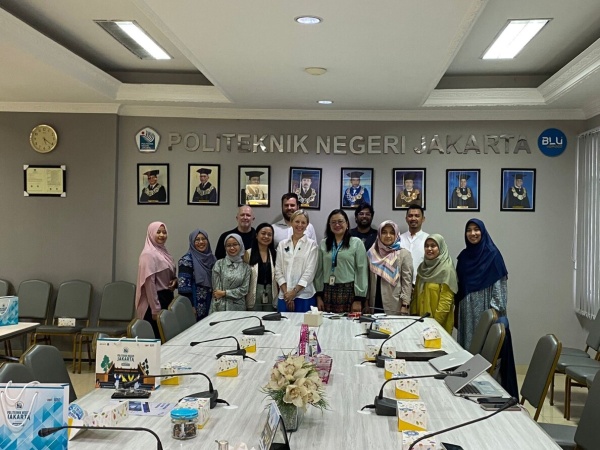
Meeting with Politeknik Negeri Jakarta (VET) Indonesia.
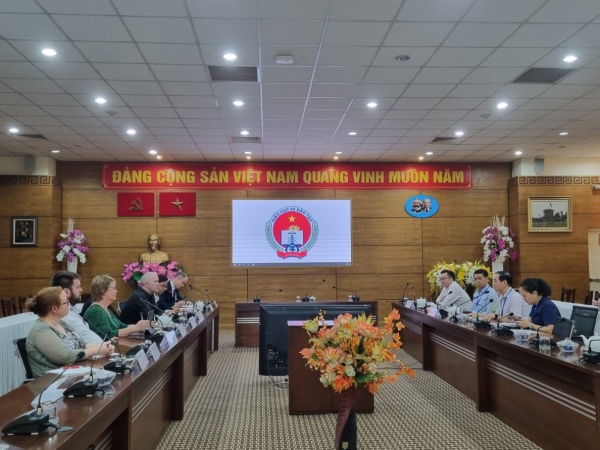
ENZ’s EdTech delegation meeting with Mr. Nguyen Bao Quoc, Deputy Director (Digital Transformation), and colleagues at the HCMC Department of Education & Training, Ho Chi Mihn City, Viet Nam.
The delegation also attended the EDUtech Asia Policy Summit in Singapore where education, education policy makers and education technology solution providers came together from across Southeast Asia. Highlights included:
- The pace and scale at which many SEA countries are upskilling and shifting their policy and philosophy to equip their educators, citizens and systems to be meaningfully productive.
- That digital literacy training is not just the domain of learners. Educators also need high quality digital training, materials and resources.
- Artificial Intelligence is forcing a rethink on everything and in assessments, what do we care about assessing? Knowledge attainment or the deep skills for being human?
- Partnership is hard but offers competitive advantage and ‘’success’’ when human skills are done well, and many global universities are doing partnership well and reaping the rewards.
Any New Zealand EdTech and Education publisher companies interested in finding out more about the SEA market can contact Alana Pellow - alana.pellow@enz.govt.nz

ENZ’s EdTech delegation meeting with Mr. Nguyen Bao Quoc, Deputy Director (Digital Transformation), and colleagues at the HCMC Department of Education & Training, Ho Chi Mihn City, Viet Nam.
-
Around the world in five
NEW ZEALAND
Radio New Zealand: Deal promises pathway for eventual return of foreign students
The arrangement organised by Education New Zealand and the country's eight universities would see the universities recognise pre-university courses offered by the company NCUK, which was owned by British universities and had study centres in more than 30 countries.
Read more
UNITED KINGDOMThe PIE News: International students in UK will be able to access vaccine
International students in the UK will be able to access the Pfizer/BioNTech vaccine as it is rolled out across the country, The PIE News has learnt.
UNITED STATES
Study International: Here’s what Biden’s cabinet picks studied in uni
President-elect Joe Biden has announced key nominations for the US Democratic cabinet. It is his first order of business as the incoming US president, and the world is watching closely. “It’s a team that reflects the fact that America is back. Ready to lead the world, not retreat from it,” Biden said.
GLOBAL
University World News: Universities ‘essential’ to climate action, says UN chief
The United Nations secretary general, António Guterres, has called on the world to take urgent action to combat climate change and has praised the work of universities as “essential to our success”.
GLOBAL
ICEF Monitor: Students relying more on education agents for assistance with study abroad decisions
QS data shows that education agents represent an increasingly important marketing channel in the pandemic as international travel is not possible and face-to-face student fairs aren’t happening