Search
Showing 10 of 1236 results for Value-priced treatments https://simplemedrx.top
-
Advertising opportunity for Japan’s 2025 New Zealand Study Guidebook
The KBUNSHA New Zealand Study Guidebook is a trusted publication and is the only one of its kind supported by the New Zealand Embassy in Tokyo and Education New Zealand Manapou ki te Ao (ENZ). KBUNSHA distributes 20,000 copies of the study guidebook to Japanese schools, universities and education organisations as well as education fairs and seminars.
ENZ Business Development Manager – Japan, Tomomi Kontani said advertising here is a great opportunity to leverage an increased demand for information on New Zealand’s education offering.
“We are continuing to see significant interest in New Zealand as an education destination from students and their parents, schools, and education agents here in Japan” she said.
“This is a great opportunity to showcase what makes New Zealand unique, especially in the regions. Destination marketing plays a key role in student attraction for a market like Japan with a tourism focus,” Tomomi added.
The guidebook’s last edition was distributed at the annual student fair and stakeholder focus events hosted by ENZ Japan. The events attracted around 1,000 people. The guidebook remains the main information source ENZ refers to and distributes at upcoming events in 2025.
Advertisement rates for individual providers range from approx. $2,560 NZD to $6,120 NZD for guidebook and or website listings. With the ‘Premier Plan’ and ‘Advertorial Plan’, the school logo will be listed on the new scholarship campaign page built by KBUNSHA. Individual providers can download the proposal here. Advertising copy can be provided in English.
For regional groups, download the proposal here for further details on the guidebook and pricing (approx. $2,200 NZD for a two-page colour advertisement and $3,300 NZD for a four-page colour advertisement).
Bookings must be made by 27 June 2025 directly with KBUNSHA. For more information, visit the KBUNSHA website here. The 2024 guidebook can be viewed here.
KBUNSHA contact:
Minori Takahashi (Director)
Tel: +81-3-3234-1744
Email: minori@kbunsha.com
-
Felix Loh: kūwaha a symbol of enduring ties to New Zealand
Now chief executive of the stunning and expansive botanical attraction that is Singapore’s Gardens by the Bay, Felix is delighted that it was selected as the site for a Māori kūwaha, or carved doorway, which feels personally symbolic to him.
Recently unveiled by Prime Minister Jacinda Ardern, the kūwaha celebrates the long-standing friendship between Aotearoa New Zealand and Singapore. “New Zealand has a special place in my heart, and I am honoured to host this precious Māori artefact. I hope the kūwaha will be a symbol of our friendship for many years to come.”
New Zealand now feels like a second home to Felix, but he shocked his parents and perplexed the scholarship selection committee back in 1988 when he told them he wanted to study horticulture at Massey University.
“I knew that Massey was well-known as an agricultural centre of excellence, and that horticulture was a very popular course,” he says. “But they were puzzled and asked me why I wanted to be a farmer in an urban city state like Singapore.
“My Dad did not speak to me for a few years, because Asians all want their kids to be lawyers, engineers, and doctors, and I chose to be a plant doctor instead. But I never regretted that decision.”
Felix says he felt welcome from the moment he arrived in New Zealand and enjoyed his four years as an international student so much he would have stayed on if he could. But the terms of his scholarship meant he needed to return to Singapore.
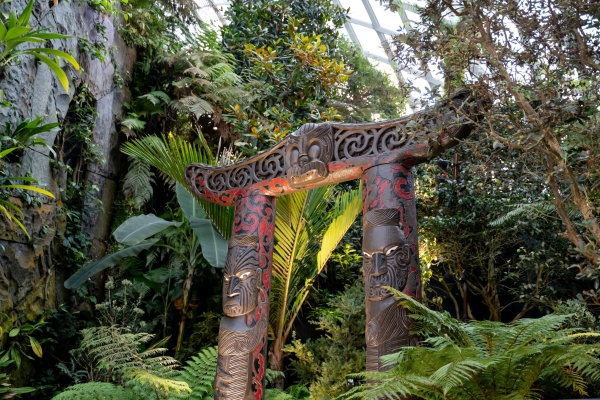
The Māori kūwaha recently unveiled at Gardens by the Bay.
No such thing as a stupid question
A less formal approach to education, with an emphasis on inquiry and collaborative learning, proved an initial challenge for Felix but ended up being one of the reasons he rates his New Zealand education experience so highly.
“At my first class we were told that we were expected to ask questions. This was the first time that I heard the phrase ‘there’s no such thing as a stupid question’,” he says. “That shook me, because in Singapore in those days nobody answered a question in class unless they were sure they had the right answer. For the first time, someone was willing to explore an alternative point of view.”
He turned up to English classes thinking it would simply be language tuition but discovered it was all about writing for your audience, with essays to be critiqued by classmates. “I initially questioned why fellow students would judge my work, but I quickly understood the value in taking on board a diversity of views to refine an idea or get a better product.”
And group project work certainly provided a life lesson for Felix, who had been conditioned to individual success based on exam results. “Not only did we have to work in groups, but we couldn’t choose our project partners,” he says.
“I’ll never forget the lecturer telling us that when we get to the workplace, we cannot choose our boss or even our colleagues, so we need to be able to work with different people. I learned that New Zealanders place people at the centre of what they do, and that we need to learn to appreciate the input of others.”
“I learned that New Zealanders place people at the centre of what they do”
Felix says his New Zealand education set him up for life-long learning which has helped to drive his career success. “You’ve got to learn and unlearn throughout your whole lifetime. It’s not so much about the content, but about being curious and knowing where to go for the answers.”
Friendships lead to enduring ties
It is through the people he met that he has forged an enduring relationship with New Zealand. Fellow churchgoers and schoolmates became life-long friends and “a moral and emotional support base” over the years. He has returned to New Zealand many times and stays in touch with former lecturers and teaching staff, some of whom are now plant suppliers for him in his role at Gardens by the Bay.
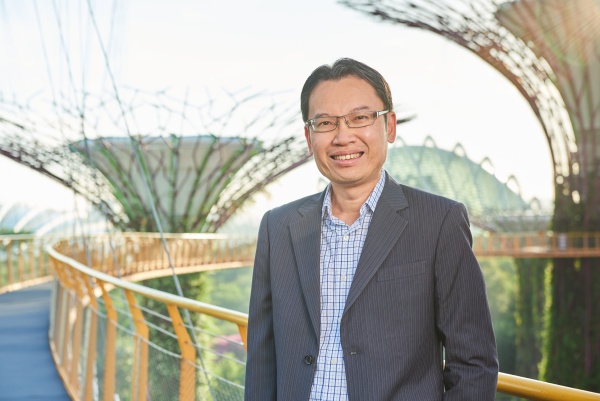
Felix at Gardens by the Bay.
“When I took on this job, one of my first trips was to go back to New Zealand to source new plants for our temperate Flower Dome. I visited a number of nurseries, just knocking on their doors, and I was made to feel so welcome. It just felt like I was at home.”
The world is a very different place from what it was in the 1990s, but Felix says the value of international education remains as important as ever.
“International education helps us to understand other perspectives better and demystify misconceptions we have about each other.
“In today’s uncertain world it is always good to have friends in other places. You discover that we have more things in common than set us apart.”
-
Fermented flour a food waste breakthrough
Ninna Granucci, a former University of Auckland international student, is part of a new generation of thinkers contributing solutions with out-of-the-box thinking.
Ninna grew up in Brazil and saw for herself the amount of food waste primary producers there generated. Learning about the scale of the problem globally, she resolved to apply her skills to help bring about change.
“I wanted to use science in an area which fascinates me –microbiology and specifically, fermentation – to try and find a solution to this huge problem.”
University of Auckland a great place for new ideas
Ninna chose to study for her PhD in Biological Sciences under Dr Silas Villas-Boas at the University of Auckland in 2014. “The university environment was a great place for new ideas, to promote the spark to find solutions to problems, with the scientific approach to support it.”
It clearly worked. After only 18 months, she had a breakthrough in the lab which she knew could make a real difference. She refined a fermentation process to successfully convert waste pulp and peel from selected fruit and vegetables into a nutritious flour. Widening the range of ingredients in her trial, she proved she was on to something.
Data from the UN’s Food and Agriculture Organisation (FAO)shows that almost 32 percent of plant-based product is wasted annually. Ninna’s technology has the potential to make substantial progress on this.
It turned out that the ingredients also tick all the boxes for health and sustainability-conscious consumers: high protein, high fibre, low calorie, gluten free, rich in vitamins, minerals and natural antioxidants. And the bonus is that they also have lowest CO2 footprint compared with other ingredients in the market today.
Entering her prototype into the University’s Velocity 100K Business Idea Challenge sparked media interest and a flurry of inquiries from supermarkets and other businesses wanting to buy the product. “That was when we realised it was not only an academic project but also something which could be much bigger and could help to address the problem of food waste,” Ninna says.
Green Spot Technologies has global plans
With support from Velocity, she and Silas co-founded sustainable food innovation company Green Spot Technologies, which has ambitious plans to go global. Ninna is now CEO and based in Toulouse, France, where the business is established in a start-up accelerator environment and employs 15 people.
But back in the early days, it was pretty nerve-wracking. “My plan was to complete my PhD first and then set up a company based around the project. But after the success in the Velocity Challenge, we decided the time was right to forge ahead with the start-up. It was quite challenging. My background is all scientific, I didn’t have any experience in business, and I had a lot to learn.”
She is grateful for the support she got at the University of Auckland and believes that her career path would never have progressed as quickly if she hadn’t chosen New Zealand as a study destination.
“I give a lot of credit to New Zealand for how things worked out”
“New Zealand was the catalyst,” she says. “I managed to secure a scholarship through Callaghan Innovation available to students looking to add value to waste streams. It allowed me to focus on the work and find opportunity. I give a lot of credit to New Zealand for how things worked out.”
Ninna worked in Auckland with other international students from around the world and says that, too, helped contribute to her success. “When you are in the same situation you can support each other and that was super important during my PhD.”
New Zealand education the right decision
Ninna remains passionate about sustainability and reducing food waste. It is at the heart of her business and is important to her personally. The mission of Green Spot Technologies is “challenging the food waste paradigm to feed the future”. The company has won multiple awards, both in New Zealand and in Europe, highlighting the unique nature of its technology and products.
With food insecurity spreading to hundreds of millions of people around the world, the UN has set a Sustainable Development Goal (SDG) to halve food waste by 2030. It is an ambitious target and needs innovative thinkers like Ninna to make it achievable.
“I think it is incredible that we waste so much food, knowing that we need more food in the world. It doesn’t make any sense, but it motivates me to work on solutions,” she says.
The decision to study in New Zealand was a critical part of Ninna’s journey from international student to international businesswoman and innovator. “I could not have imagined that it would lead to such huge changes in my life in such a short time,” she says.
“A New Zealand education provides a truly enriching experience. I really think I made the right decision.”
-
Following his own path – International student builds life, family, and community in New Zealand
Luke Qin has never been afraid of a challenge. Born in Sichuan, China, his childhood was a rich mix of classical Chinese literature, table tennis, badminton, basketball, football, and music.
Early intensive schooling means he can read, write, speak, think and dream in Chinese and draw on traditional Chinese virtues, but a desire to follow his own path, experience something new and explore education options overseas, led him to New Zealand as a high school student.
Selecting New Zealand was a relatively easy choice at the time – English-speaking, safe, ‘clean and green’ and affordable – it ticked all the necessary boxes. But his desire to test himself drew him to Christchurch because “fewer Chinese students there” meant he would have no choice but to fully immerse himself in the new environment.
And what an immersion it was. Luke credits his first years at Linwood High School as the perfect place to experience “an excellent introduction to the New Zealand way of life” and in his first year in New Zealand, he was playing on the wing for Linwood High School’s First XV rugby team!

“With a little help from All Black stars!” Luke tapped his rugby passion to enlist support for the Dragonboat Festival in Wellington from All Blacks Ardie Savea (left) and Dane Coles.
“I wasn’t very big and didn’t know the rules of the game when I arrived, but I had some wheels back then.” Luke explains. If it looked like trouble was coming my way, I’d just try to outrun it!” But he also knew he had to prove himself to his teammates. Once, while tackling his opposite wing, a strapping Samoan teammate joined in and sent them all to the ground. “I felt something hot dripping down my forehead but charged straight back into the ruck, only to be dragged off the field and sent to the hospital.” Three stitches later, he knew he had earned the respect of his teammates and become ‘one of the boys’.
Luke credits his school experience with developing his self-belief and preparing him for what was to come, through his university years and beyond.
After graduating with a Bachelor of Commerce from the University of Canterbury, he relocated to Wellington to join the banking industry, and completed a Master in Applied Finance from Victoria University of Wellington. He then continued on with his quest for lifelong learning and experience by achieving qualifications in Sustainable Finance, Te Reo Māori, Medical Co-Response, Citizen diplomacy and Urban Fire and Rescue, and volunteering for a number of causes.
His banking experience broadened, and several promotions later he joined Kiwibank in Auckland, leading the development of its International Strategy and Trade Finance offering, and working closely with NZ Inc partners to help New Zealand exporters and importers with risk mitigation and working capital funding.
Nowhere has his quest for a challenge been more evident than in his decision to become a volunteer firefighter 10 years ago.
“My younger self had been watching ‘Spiderman’ and saw Peter Parker leap into a burning building to save the day. At the time I thought, ‘I wonder if I could do that?’ Then I heard a call for volunteers from the NZ Fire Service on the radio while driving to work so decided to contact my local fire brigade in Seaview, Lower Hutt.”
“I thought I might be the first Asian volunteer in the station, but I was beaten to it by a Chinese lady.”
“The Fire Service is where you find the real New Zealand,” says Luke.
“Teachers, accountants, plumbers, builders, people from all walks of life - all bonded by the same commitment to serve their community. The camaraderie and environment was addictive.”
There, with the support of Fire and Emergency New Zealand, he completed the Sky Tower Stair Challenge with fellow firefighters from across the country to raise funds for Leukaemia and Blood Cancer New Zealand.
Scaling 1103 steps and 51 flights of stairs in full fire-fighting gear with a steel cylinder on his back was one of the most physical tests he has put himself through.

1,103 steps and 51 flights of stairs behind him, Luke was happy to complete the Sky Tower Stair Challenge - “Man of Steel” with other firefighters dressed in full gear with steel cylinders on their backs to raise funds for leukaemia and blood cancer in New Zealand.
“I have benefitted so much from all the opportunities and adventures since coming to New Zealand, especially from my volunteer roles. It’s a small way I could repay my second home for its kindness.”
“I hope I can encourage more international students and members of our diverse ethnic communities in New Zealand to become volunteers and join activities that benefit the community. There is so much we have to offer, and the reward in terms of friendships and life skills is amazing.”

From Sichuan to Wellington waterfront, leading the Dragon Dance during Chinese New Year Parade.
Luke Qin’s journey as an international student began with a desire to immerse himself in a new environment. Grateful to his family, friends, colleagues, and mentors for the opportunities and adventures New Zealand has given him, he takes pride in being able to go home whichever way he travels between his ‘little shire’ in Sichuan and ‘Middle Earth’ New Zealand.
-
Prime Minister unveils 2025 Tripartite Fund recipients at Fudan University
During his remarks at Fudan University, Prime Minister Christopher Luxon announced the 2025 New Zealand–China Tripartite Partnership Fund recipients, as well as plans for a second high-level Education Forum to be held during China Annual Conference and Expo for International Education (CACIE) 2025.
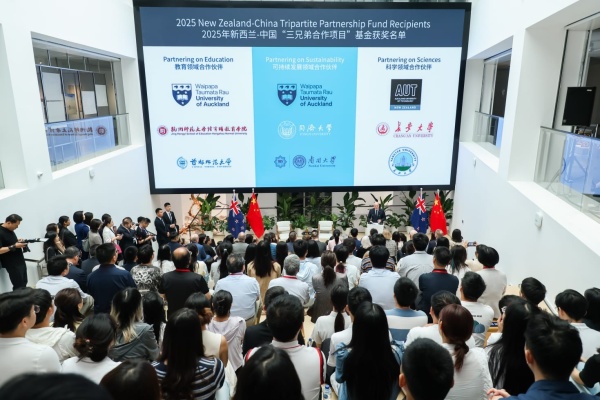
2025 marks 20 years of the New Zealand – China Tripartite Partnership Programme. Photo credit: New Zealand Trade & Enterprise.
ENZ congratulates the following researchers whose projects exemplify the high-quality research collaboration between our two countries:
-
Dr Fiona Ell (University of Auckland): Working with Hangzhou Normal University and Capital Normal University to enhance mathematics and science teacher education through comparative studies and exchanges.
-
Dr Sihong Wu (University of Auckland): Partnering with Tongji and Nankai Universities on sustainable production and carbon neutrality in manufacturing joint ventures.
-
Dr Yiming Ma (Auckland University of Technology): Collaborating with Chang’an and Yangtze Universities to explore mechanisms behind silent earthquakes.
Dr Fiona Ell said she is looking forward to working with her Chinese research partners to enhance mathematics and science teacher preparation, an important focus for education systems in both New Zealand and China.
“Our study brings together teacher educators from two Chinese universities, and teacher educators at the University of Auckland to exchange ideas and techniques for mathematics and science teacher preparation. The Tripartite grant allows us to visit each other, see teacher education practices in each country and compare policy directions in teacher education,” she said.
This will enhance the understanding and skills of all participants and help us find ways to improve mathematics and science teacher education in both countries,” Dr Ell added.
The Tripartite Fund, managed by ENZ in collaboration with several government agencies, supports strategic research partnerships between one New Zealand and two Chinese universities. The programme celebrates its 20th anniversary in 2025.
Learn more about the Tripartite Partnership Fund here.

Professor Nic Smith, Vice-Chancellor Te Herenga Waka – Victoria University of Wellington exchanges a Memorandum of Understanding with Fudan University President, Li JIN. Photo credit: New Zealand Trade & Enterprise.
Another key part of the event was Victoria University of Wellington renewed an agreement with Fudan University to revitalise the relationship, achieve resumption of student flows, and pursue research cooperation in the areas of public health, bio-tech and climate science.
-
-
PM mission advances New Zealand and China education relationship
The New Zealand Education Connect event on 20 June at the New Zealand Embassy in Beijing brought together leading Chinese government representatives, institutional partners, education agents, and alumni to strengthen people-to-people links and celebrate collaboration.
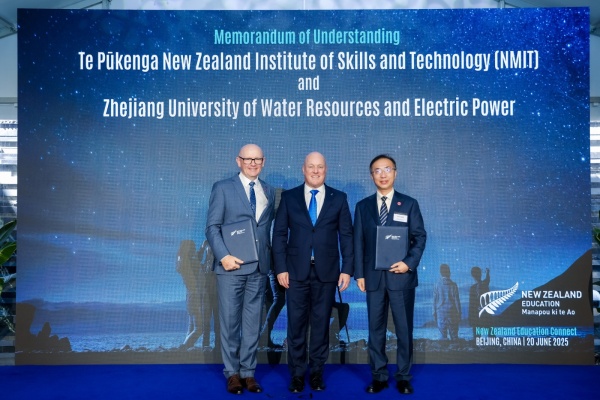
The event programme was packed, with nine Memorandums of Understanding (MoUs) signed between New Zealand and Chinese counterparts, and another MoU signed between Victoria University of Wellington and Fudan University on 19 June.
Providers from across the tertiary education sector signed the MoUs – with Victoria University of Wellington, Unitec, NMIT and UP Education’s University of Auckland International College and New Zealand Tertiary College formalising partnerships.
These agreements cover a mix of in-market delivery, joint programmes, and initiatives to grow student mobility between New Zealand and China.
This builds on the now over 60 approved joint education programmes and institutes recognised by the China Ministry of Education between New Zealand and Chinese institutions, and other education partnerships across early childhood education, vocational training, higher education, and research areas.
The New Zealand Education Connect event had senior leaders officially launching New Zealand’s Country of Honour campaign for the upcoming China Annual Conference and Expo for International Education (CACIE), China's largest platform for international education, due to take place in October this year.
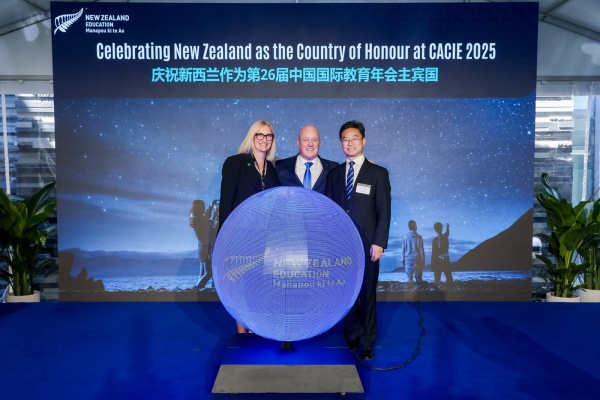
ENZ’s Chief Executive, Amanda Malu, launches the Country of Honour campaign for New Zealand at CACIE alongside Prime Minister Luxon and CEAIE’s Secretary General Jun Yang.
ENZ Chief Executive, Amanda Malu, said it’s exciting to see advancement of the partnerships New Zealand providers have built with their Chinese counterparts.
“We’re eager to see the outcomes of the new agreements formalised at New Zealand Education Connect and look forward to deepening our bilateral ties by leading a delegation to CACIE later this year,” she said.
Information on the registration process for New Zealand education providers to join the New Zealand Country of Honour events in October will be shared next month on ENZ’s event page.
The Country of Honour promotional video is available with Chinese subtitles on The Brand Lab.
-
Winds of Change students team up to tackle shared climate challenges
While world leaders continue to discuss how to best tackle global warming, an inspiring group of students is stepping up collaboration between New Zealand and Chile to better understand the problems both countries face, share knowledge, and identify solutions.
The Winds of Change programme, funded by the Latin America Centre of Asia-Pacific Excellence (LatAm CAPE) and hosted by Otago University, is taking a broad approach by drawing in post-graduate students from a range of backgrounds including natural, physical or social science, business, finance, science communication, and humanities.
They are motivated to tackle climate change by developing sustainable strategies in land management, business, and policy-making. Supporting them is a team of talented academics from both countries whose insight and expertise are helping to create impact.
“The Winds of Change participants are extraordinary leaders from diverse backgrounds with a passion for making a difference,” says lead Otago academic Associate Professor Chris Moy.
“Their collaborative work will help inspire communities and drive change.”
Joining forces to reach common goals
Project manager Hélène Eunson says the multi-disciplinary approach is vital. “It is one of the key features and strengths of the programme. We need people who bring a range of perspectives in addressing climate change issues,” she says.
“We have come to realise that the scientists want to learn more about business and policy-making, and the policy-makers want to learn more about the science. We are trying to join forces to reach our common goals.”
Now in its second year, Ms Eunson says there has been huge interest in the six-month programme, which seeks to attract 30 students in each cohort - 10 New Zealanders based in New Zealand, 10 Chilean students based in New Zealand (“Chiwis”), and 10 Chileans based in Chile.
“These young leaders have a real drive to make a change. They volunteer their time and do not earn credits towards their degrees.”
The participants work in small groups on projects based on common interest, to investigate an aspect of climate change, its impact on the environment and communities, and to identify solutions. Their findings are presented at an annual symposium attended by key industry players, researchers, embassy representatives, and past participants.
The Winds of Change programme includes a series of workshops hosted by a range of expert speakers from both countries including business owners, industry experts, and academics studying climate change.
Pacific partners help shape future solutions
By studying the common climate change impacts that New Zealand and Chile are facing, the students are not only helping to shape future solutions, but also to build relationships with a key Pacific partner and enhance economic and social wellbeing in both countries.
Projects undertaken by the participants have tackled wide-ranging issues including wetland restoration, wildfires, water scarcity, rising sea levels, diversity in agriculture, and renewable energies.
Ms Eunson says the concept of global citizenship is a strong theme which runs through the programme. “The participants share experiences from their own countries and help to create bonds with each other by bringing their different perspectives to the table.”
Being involved in the programme has been a profound experience for many of the participants.
“Often, if you think as an individual about environmental issues, you don’t feel as though you can achieve much, but when you see all these people together with the same objective, you feel really powerful to make change,” says Julia Harvey, who grew up in Invercargill.
“Meeting people from different backgrounds with a common interest has provided a unique opportunity to learn about sustainability in both countries,” says Javiera Otero, originally from Villa Alemana, Chile, but currently living in Napier.
“This experience has given me hope for the future, as there are people out there who want to make changes to live a more compatible life with the planet.”
Winds of Change programme builds credibility and impact
Winds of Change is quickly building its network and outreach. “As we build the credibility of the programme, we will start to see long-term impacts,” Ms Eunson predicts.
This new generation of leaders is already anticipating a future of global collaboration. In last year’s first post-programme survey, participants identified the most important benefits as “building networks, connections, and relationships”, and “having confidence to work in a transnational team”.
LatAm CAPE Director Matthew O’Meagher says he looks forward to the ongoing expansion of the programme to include other partners, and ideally other nations in Latin America. “In this way we can continue to provide the best opportunities for our talented young New Zealanders to engage internationally on innovative scientific, sustainable business, and policy-focused, solutions to climate change.”
Dr Moy agrees. “Our future depends on culturally-aware young leaders that can think globally and work collaboratively to tackle climate change impacts.”
Learn more about the Winds of Change programme on the LatAm CAPE website.
-
Upcoming webinar: New Zealand International Education Enrolments 2024
Webinar details
- Wednesday 30th July, 11:00am-12:00pm (UTC+12)
- Register here: New Zealand International Education Enrolments 2024
Following the recent launch of the International Education Going for Growth Plan, join this webinar with Marie Clark, Director Insights, Education New Zealand Manapou ki te Ao, to hear more about the 2024 international student enrolments.
The full-year 2024 international student enrolments saw New Zealand reach 72 percent of pre-pandemic levels seen in 2019, with most sub-sectors contributing to this growth. Primary and intermediate schools have experienced the strongest growth, and New Zealand universities and government-funded PTEs are now very close to meeting or exceeding their 2019 enrolment numbers.
During this session, Marie will take participants through the data, including total enrolment numbers by subsector, highlight emerging trends and will offer advice on how this information can be used in your organisational planning.
If you have something you would like us to specifically highlight or a question please email insights@enz.govt.nz by 5pm Monday 28 July.
-
From the CE: Growth on the go
Kia ora koutou,
This month, the Government announced the International Education Going for Growth Plan – this is an exciting, positive step forward for international education as we chase a big growth target to double the value of New Zealand international education by 2034.
It’s an ambitious target. However, with the strong and steady growth we have seen in international student numbers in 2024, the Growth Plan will help us boost that growth track to make New Zealand the destination of choice for international students.
At its heart, the Growth Plan is about striking the right balance between achieving sustainable growth for the sector, while providing our international students with an excellent experience in New Zealand and enabling our communities to understand the broad benefits that international education brings.
I am pleased with the work that is underway to progress the plan’s implementation. Over July and early August, ENZ is holding a series of market focused, cross-sector sessions to share market plans for 2025-26. The sessions will provide sector representatives with a topline update on market plans, growth targets, the approach for subsectors, and market activity.
I believe these sessions will prove useful in clarifying how ENZ intends to engage with the sector to activate and deliver the plan.
And with the way our latest 2024 enrolment numbers have continued their upward surge, we are on the right track to advance towards our growth goals. Our enrolments are now at 72 percent of pre-pandemic levels seen in 2019, with most sub-sectors contributing to this growth.
We are also seeing interesting trends in these enrolment numbers across subsectors, level of study and source markets and we look forward to sharing these insights with the sector. So make sure you sign up for ENZ’s webinar on 2024 international student enrolments to learn more about emerging trends with students, and how you can use this information in your organisational planning.
Last week, we said farewell to two of ENZ’s long-serving Board members, Linda Sissons and Lyn Provost, who completed their terms, and welcomed new members Sara Brownlie and Prabha Ravi with a mihi whakatau.
Finally, this week, I will be attending The PIE Live Asia Pacific event, where I will be speaking at a ‘New Zealand: Country update and trends’ panel session alongside University of Canterbury Vice-Chancellor Cheryl de la Rey and Deputy Editor of The PIE News UK, Kimberley Martin.
The session will discuss how New Zealand is poised for sustainable growth in international education and will cover the New Zealand International Education Going for Growth Plan and its ambitious target to double the value of international education by 2034.
For those of you attending the event, I look forward to seeing you there.
Waiho i te toipoto, kaua i te toiroa
Let there be closeness, not distance
Ngā mihi nui,
Amanda Malu
Chief Executive
-
Apply early and get ahead of the student visa peak
Immigration New Zealand (INZ) is approaching a peak period for student visa processing, which typically occurs between October and March as international students who are overseas prepare for the first half of the 2026 academic year.
Get your application in early
During peak periods, applications may take longer to process. To ensure timely visa decisions, prospective international students who are overseas are encouraged to submit their applications around 3 months before the intended travel date, as this provides the best chance of receiving a decision in time to begin study in New Zealand.
Late submissions risk missing the start of study and may result in declined applications if key documents are missing.
Students who are offshore and apply very early (for example, 6 months or more), may receive an approval in principle, allowing them to provide confirmation of study, funds transfers and tuition fee payment closer to their study commencement.
Check the recent processing times for student visa applications.
Changes to student visa work rights
Visas granted on or after 3 November 2025 will include a condition allowing up to 25 hours of work a week during term time, including those approved after that date from earlier applications.
If your visa is granted before 3 November 2025, the current 20-hour a week work limit will still apply. If you would like to work more hours after that date, you will need to apply for a variation of conditions to update your visa.
Upcoming changes to student visa work rights
To support a smoother and more transparent application process, INZ has moved international student visas to a new enhanced Immigration Online system.
The new form is tailored to each applicant’s situation. It asks only relevant questions and provides clear guidance throughout. It also provides real-time status updates and email notifications, giving students and their advisers greater visibility of application progress and clarity around any required actions.
While the new form may take slightly longer to complete, the additional information collected upfront is expected to reduce overall processing time.
Applying on enhanced Immigration Online
Students applying for the following visa types will be automatically directed to a redesigned, dynamic application form:
- English Language Student Visa
- Exchange Student Visa
- Fee Paying Student Visa
- Pathway Student Visa
- NZ Government Scholarship Student Visa
- Foreign Government Supported Student Visa
Applications submitted on or before 17 August 2025 will continue to be processed, and students will retain access to upload documents and respond to Immigration New Zealand requests until a decision is made.
Draft applications not submitted by 17 August 2025 can still be completed and submitted until 17 September 2025.
After 17 September 2025, all remaining drafts will be deleted, and a new application using the enhanced form will be required. The new student visa application forms on enhanced Immigration Online include built-in guidance to support applicants. It helps ensure they understand what is being asked and provides easy access to information to help them answer questions accurately.
Help us process your application faster
To avoid delays, students should ensure their application includes all required documentation. INZ may not contact applicants if key documents are missing, and incomplete applications may be declined.
INZ understands that some students may face delays in obtaining final academic documentation required for their application.
We recommend you apply as soon as you have the required documentation or contact your education provider to see if a conditional Offer of Place is available, so you can submit your student visa application and get the process underway.
If you do apply late, your application may not be processed in time for your study in New Zealand.