Search
Showing 10 of 538 results for group registration
-
Japanese teachers experience New Zealand’s regional schools
“Waseda University and its affiliated schools are longstanding and valued partners for us,” says Misa Kitaoka, Director of Education in Japan for Education New Zealand Manapou ki te Ao (ENZ).
“It’s exciting to see the strong regional focus they have chosen for their students’ study in New Zealand in 2023 and hear about the planned growth of the programme.”
Waseda University schools will be sending up to 60 students on a group programme to schools in Manawatū and Hawke’s Bay for two weeks in March 2023. The two regions were selected to receive students after taking part in an Expression of Interest process. Close to 80 students have already applied to take part, and Waseda plans to increase the number of participants to 100 from 2024, and to increase the length of their visit in future years.
ENZ hosted the familiarisation tour (famil) to Manawatū and Hawke’s Bay from 21- 25 November 2022. Four Tokyo schools took part alongside Waseda University: Waseda University Senior High School, Waseda University Honjo Senior High School, Waseda Jitsugyo High School and Waseda Saga Junior and Senior High School. The famil was co-funded by ENZ and Air New Zealand, and Palmerston North City Council and Learning Hawkes Bay played a major role in helping to organise visits to 14 different education providers.
“Through the five-day famil, our regional and institutional partners demonstrated their strengths and uniqueness,” says ENZ’s Director Marketing and Strategies, Patrick Holden, who travelled with the delegation.
“Delegates commented on how welcome they felt and how impressed they were to see indigenous Māori language and customs being incorporated into the school curriculum. The manaakitanga shown by the different institutions was well received, especially the pōwhiri.”
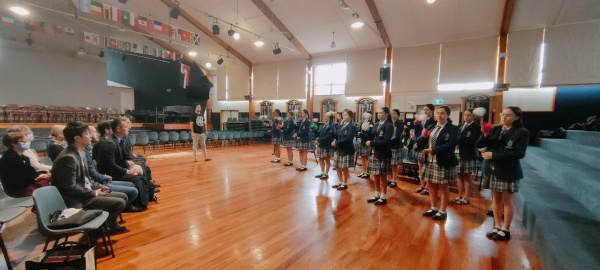
The delegation is welcomed with a powhiri at Napier Girls High School
Misa Kitaoka stressed the importance of destination marketing with support from regional partners.
“While decision-making tends to be institution-led in the tertiary sector, decisions for the school sector are often led by the region or city. This famil was a great opportunity for us to showcase the regions first, followed by the education offerings available in the regions.
“Japanese school students, parents and educators are also interested in cultural experiences in New Zealand beyond education, including the opportunities to interact with local students and host families, and to embrace New Zealand’s cultural values of diversity and inclusion.
“While video-calling offers many benefits and has been vital across the pandemic, bringing famils back into the country means our offshore stakeholders can experience first-hand what New Zealand has to offer. Regional involvement will play a key role in building long-term reciprocal relationships for Aotearoa.”
For more on ENZ’s education partnership with Waseda University and its affiliated schools, please click here.
For more on the value of short-term programmes for international students in New Zealand and the potential benefits to New Zealand and the educator sector, check out this recent Spinoff article: How educational exchange fosters more than just learning | The Spinoff
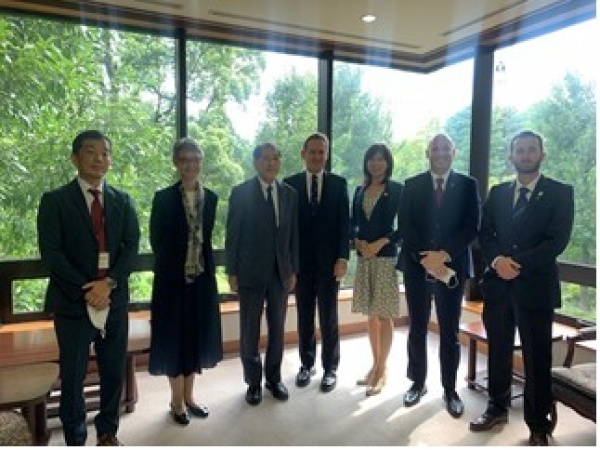
Hamish Cooper, NZ Ambassador to Japan, and ENZ staff Misa Kitaoka, Patrick Holden and Ben Burrowes called on the President of Waseda University, Dr Aiji Tanaka and Prof. Kate Elwood, Dean of Centre for International Education recently to congratulate Dr Tanaka on his reelection as the 18th President of Waseda University
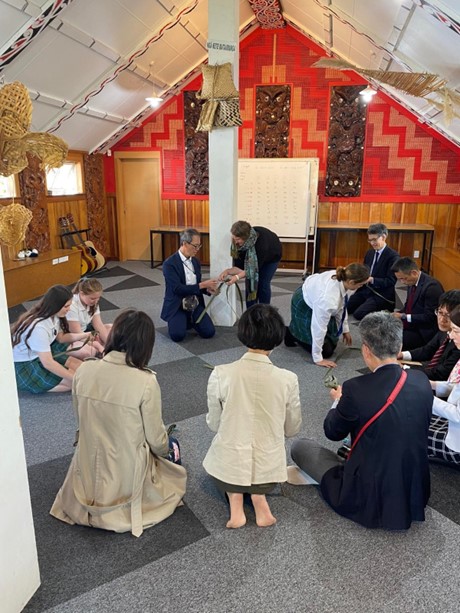
The delegation was welcomed on to the Central Hawkes Bay College Marae where they were given background about the history of the marae and given a quick fire class in flax weaving
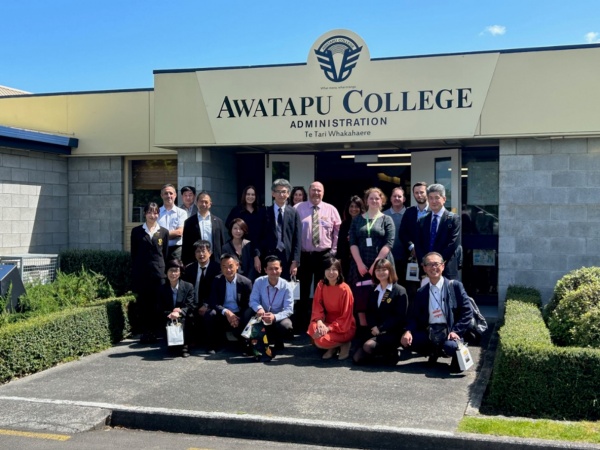
Waseda delegation outside Awatapu College
-
Teaching English in Korea
The temperature drop of over 30 degrees, didn’t deter Christine Black, teacher from James Hargest School in Invercargill from enjoying a unique opportunity to teach a week-long English programme sponsored by the South Korean government.
Black and two other teachers from New Zealand, Elizabeth Henry from Kowhai Intermediate School, in Auckland and Patsy Richardson, from Te Puke School, in the Bay of Plenty were selected to teach the English programme in South Korea.
The teachers were selected through an application process facilitated by ENZ to teach 15 students from throughout South Korea about New Zealand culture and history at the JEI education centre in Cheonan from 19-23 December 2022.
Through the English Language programme funded by the Korean government, New Zealand teachers were invited to Korea to support Korean school students from rural agricultural backgrounds to extend their conversational and speaking skills. The students also engaged in hands-on classroom activities that included mini science experiments.
The one-off 2022 Korea-New Zealand English Language Training Program was sponsored by EPIS, an agency tasked by the Korean government to support English language training for Korean students and facilitated by Korea FAO Association.
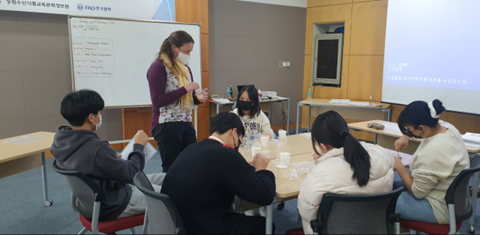
Teacher Christine Black leads the students in an experiment making slime. Photo credit: Korea FAO Association
Yoon Cho, Senior Manager of Korea FAO Association, said it was an experience the students will never forget.
“Well before the teachers arrived, they could feel their passion and enthusiasm for meeting students from rural areas in Korea. I would like to thank the New Zealand teachers who took time to visit Korea at the end of December, especially Christmas week, and made meaningful memories for middle and high school students in Korean rural areas,” Cho said.
School teacher Christine Black was excited for how her first visit to South Korea broadened her understanding of Korean culture.
“It was exciting to travel there to broaden my understanding of this culture as my high school has international students from South Korea. This definitely was a win-win situation to be able to travel somewhere new to me and also share our New Zealand culture.”
As part of the programme, each teacher was responsible for a couple of aspects of New Zealand. Black was responsible for sharing the life of a New Zealand high school student and introduce the different regions of New Zealand and their unique characteristics.
For Patsy Richardson, a teacher at Te Puke School, it was her first time in South Korea, and she introduced waiata to her homeroom group.
“I chose to teach the waiata ‘Tutira mai ngā iwi,’ with actions. We had three 30-minute slots in which to learn it and they had it perfected. Now whether that is because they are willing and diligent students, or I am such a fantastic teacher, is to be debated. The students also performed the waiata at the closing ceremony [for the programme] and it was a great display of cross-cultural connections,” Richardson said.
Despite the short time spent together, it was a great opportunity for the students and teachers to build relationships and cultural understanding between the two countries. The students in Korea were enthusiastic about speaking in English and enjoyed learning some Kiwi slang.
An intermediate school student, Kyungdon Joo, said he studied English and made new friends during the training which gave him a new perspective. “Now I have another goal: To go to New Zealand and learn more about New Zealand.”
For Elizabeth Henry, a teacher from the Auckland region, the English teaching programme was more than the opportunity to enhance language skills. Henry recognised the importance of being a cultural ambassador as she was one of the first New Zealanders the students had ever met.
“I was prepared to bring my best teaching practice to this opportunity prior to the trip not realising that once in Korea, the picture of my purpose there was so much bigger than I had anticipated. Not only did I bring my very best teaching practice to all the students I taught, my mindset changed, thinking one day these children will share this experience with their family and friends.”
Final reflections
Black reflected on the opportunity it provided for the New Zealand teachers as well as students.
“I think it is really important for teachers to grab opportunities like this, especially as there is more and more diversity in our classrooms, and it is important to get first-hand experience of other cultures.”
Henry summed up the English language teaching experience well. She hopes that whenever the students think of New Zealand “a happy memory pops into their mind from this experience.”
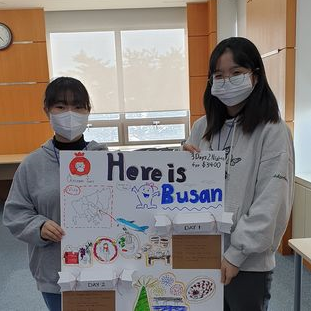
Students present their destination marketing posters Photo credit: Patsy Richardson
Education New Zealand Manapou ki te Ao would like to thank North Asia CAPE and regional education bodies for sharing the opportunity with contacts. This was a one-off overseas short-term teaching programme organised by the South Korean government. ENZ will continue to share these opportunities as they arise with education cooperation partners through the CAPE and regional education channels.
-
From the CE: 2023 is off to a flying start
Following the appointment of Chris Hipkins to Prime Minister, last week we welcomed our new Minister of Education, Jan Tinetti. Minister Tinetti knows education well. She has over 20 years as a primary school principal, in four schools across Southland and Tauranga. She also holds a Diploma in Teaching (Primary), a Bachelor of Education and Master’s in Education with First Class Honours, from the University of Canterbury.
Both appointments are good news for international education. We have both a Prime Minister with rich knowledge and appreciation for the many benefits that international education brings working alongside a Minister of Education who has significant education experience.
The first month of the year saw significant announcements in China, an important partner country. The first was the change to the Zero-COVID policy, followed shortly after with the decision by the Chinese qualification recognition agency to revert to pre-COVID settings for online qualifications. Chinese students were already returning to study in New Zealand and these announcements will encourage this further.
In response to these changes in China our team collaborated with Tourism New Zealand to drive awareness of New Zealand as a short-term study destination. Late last year we put the New Zealand education brand back on the map in Colombia with an important event in Bogota. I am also excited to see the relaunch of the New Zealand Schools Scholarships – our flagship initiative for Viet Nam.
The first month of the year also saw our first iwi-led Prime Minister’s Scholarship for Asia recipients (Te Piriru Marae, Ngāti Maniapoto) travelling to Hokkaido for six weeks, forging connections with the indigenous Ainu people of Japan. There will be more on this in next month’s ENews.
While I’m on the subject of the Prime Minister’s Scholarships the most recent round of applications saw a significant and very pleasing increase in Māori participation to 22 percent up from five percent from 2016 to 2019. We are eager to continue this increase and will be partnering with iwi to raise it further in the March group application round.
After the challenges of the past couple of years, a flying start was exactly what we needed and I am very pleased that is what we have.
Waiho i te toipoto, kaua i te toiroa
Let us keep close together, not wide apart.
Ngā mihi nui,
Grant McPherson
-
Winners of KIWI Challenge announced
This year was the first where university students were able to enter a new category alongside the schools' challenge.
The winning teams from Petra Christian University and USG Education headed off strong competition from eight other finalists, drawing praise from the judges for their solutions to support youth-led Small and Medium Enterprises (SMEs).
Finalists presented to a panel of judges from University of Otago – Ōtākou Whakaihu Waka and Education New Zealand Manapou ki te Ao (ENZ), who were cohosting the initiative.
Both winning teams received a voucher valued at 10,000,000 Indonesian Rupiah (approximately 1,000NZD) as well as virtual internships from the University of Otago – Ōtākou Whakaihu Waka commencing in semester one, 2025.
Tech-led solutions
A team from Petra Christian University developed an app ‘Partify’ which connects emerging small businesses and keen part-time workers. Businesses post part-time jobs, and workers swipe to find flexible gigs nearby, with AI matching candidates based on skills, location, and availability.

Partify university winner – ENZ market manager Naluri Bella and University of Otago Regional Market Manager Sarah Ewing present the award for First Place in the University category to team members from Petra Christian University for their app ‘Partify’.
In the high school category, a team from USG Education took the top prize with ‘LAW4MSME’, a platform allowing small businesses to access legal information and advice.
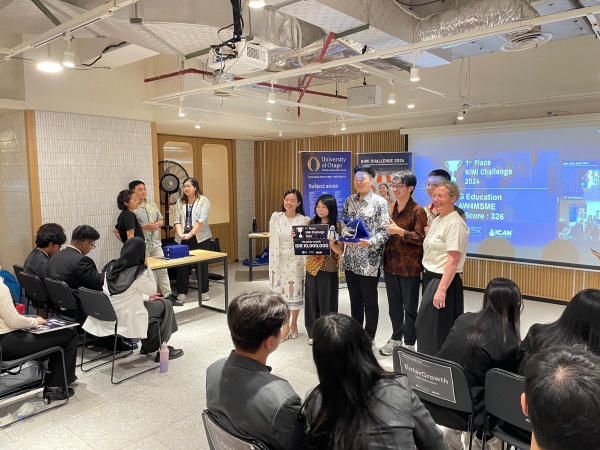
LAW4MSME High school winner - ENZ market manager Naluri Bella and University of Otago Regional Market Manager Sarah Ewing present the award for First Place in the University category to team members from USG Education for their platform “LAW4MSME’.
Explaining the group’s business idea, team leader for LAW4MSME, David Francis said the students found that Indonesian youth-led SMEs lack knowledge of the laws and regulations needed to run their businesses.
“To address this, we developed an AI bot that educates SME owners on these regulations, helping them navigate legal requirements more effectively,” David said.
The KIWI Challenge competition aims to inspire youth across Indonesia to engage in entrepreneurial activities and help resolve societal issues. Over the five years the competition has run, 1000 Indonesian youth have participated. This year, Education New Zealand Manapou ki te Ao (ENZ) partnered with University of Otago to co-host the initiative.
This year’s competition included 49 teams with a total of 221 student participants.
Mentorship key
Mentorship is a key element of the competition. The finalists attended a workshop run by Associate Professor Dr Conor O’Kane, Head of the Bachelor of Entrepreneurship programme at Otago Business School. This assisted entrants to develop their ideas and refine business plans.
ENZ Acting General Manager International Ben Burrowes said he’s delighted to see the continued development of the KIWI Challenge.
“Inviting university students for the first time has given us the opportunity to include a whole new cohort of talented young entrepreneurs, and we have been very impressed with the quality and creativity of their submissions,” Ben said.
“The competition has also benefitted from the enthusiasm and expertise of our colleagues at the University of Otago, and we are grateful for their willingness to partner with us for the KIWI challenge’s fifth year.”
Dr O’Kane said it was inspiring to witness the quality of entrepreneurial thinking among Indonesian students.
“These students have very bright futures. The concepts and programmes the finalists presented were remarkable and captured the impressive ability of the teams to identify tangible business problems and visualise and communicate a solution to these challenges,” Dr O’Kane said.
-
International students welcomed across New Zealand

In February, hundreds of international students gathered at a University of Auckland orientation event. ENZ’s Student Experience Manager, Ross Crosson, says, “The wait, for many, has been long but there was a very positive vibe in the air.”
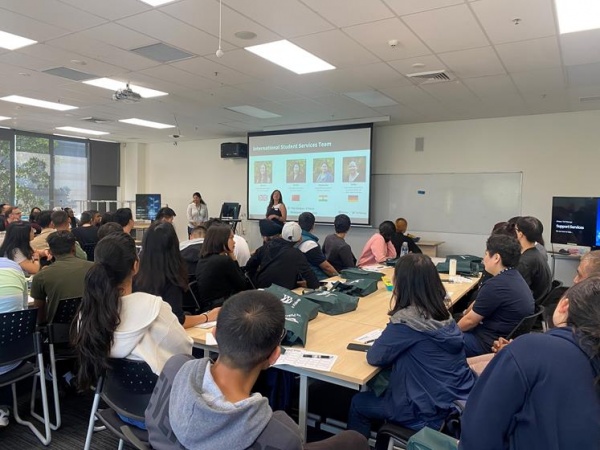
In Hamilton, the Wintec | Te Pūkenga International student services team held an interactive event to welcome students on campus. They used a range of activities to create connections amongst the students and to familiarise them with student support services available.

Over in Wellington, Victoria University of Wellington Vice Chancellor Nic Smith took the opportunity to connect with students face-to-face as they were settling into halls of residence.
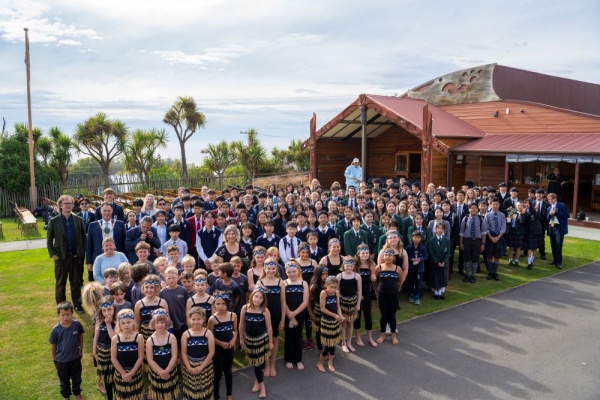
More than 150 international students from 11 local secondary schools were welcomed into Dunedin at Puketeraki Marae on 8 March. In the event organised by Enterprise Dunedin and Kāti Huirapa Rūnaka ki Puketeraki, the guests spent the morning at the pōwhiri, which was accompanied by pupils from Waitati School kapa haka group, and then enjoyed a kōrero and some kai.
-
Prime Minister's Scholarships for Asia help students from New Zealand and India to showcase a unique cross-cultural collaboration
The students travelled to India and for five weeks, worked with local students from Indian fashion powerhouse Pearl Academy and artisans from Kala Raksha, an NGO in Kutch, Western India. Collectively they produced a collection of garments, which reflected a philosophy from the past to everyday life. The work helped students and artisans to develop an understanding of different cultural values and ability to think creatively and collaboratively.
“We are thrilled to have 15 Prime Minister’s Scholarship recipients from Whitecliffe College visit India and take this opportunity to collaborate with Pearl Academy students in fashion and sustainability.” said David Pine, New Zealand High Commissioner to India.
“New Zealand and India hold strong education ties and the Prime Minister’s Scholarship for Asia symbolises the New Zealand government’s commitment to further strengthen bilateral ties between both countries.”
Administered by Education New Zealand | Manapou ki te Ao, the Prime Minister's Scholarships for Asia is a unique scholarship programme that enables the rich exchange of language, culture, skills and opportunities. It not only highlights New Zealand government’s commitment to help grow strong connections between young New Zealanders and Indians but fosters global citizens by inspiring students to take action on pressing issues affecting the world.
Since 2013, the Prime Minister’s Scholarship for Asia and Latin America have enabled more than 2,400 New Zealanders to broaden their horizons through life-changing learning experiences in Asia and Latin America. Applications are open until 23 April for the 2023 group scholarship round. To find out more about the Prime Minister's Scholarships for Asia and Latin America, visit our website here.
-
NZ EdTech’s taking a diversified and leading message to the Australian digital education market
ENZ had a stand at NZTE’s pavilion with six of the eight EdTech who had expressed an interest in attending EduTech as part of an ENZ delegaton, showcasing their products alongside NZTE’s five customers. The companies in the ENZ delegation included Pacific Kids' Learning, Nutriblocks, PipiLearning, Jix Reality, PolyMath and Code Avengers and the Student Volunteer Army were also part of the wider ENZ delegation. This diverse group of technology providers from K-12 to Vocational Training and Education (VET) and Higher Education (HE) provide a range of digital education solutions including numeracy, literacy, financial literacy, STEM, programmes for neuro diverse learners, Pacific based and culturally responsive digital tools, immersive digital education experiences and health and wellbeing educational games.
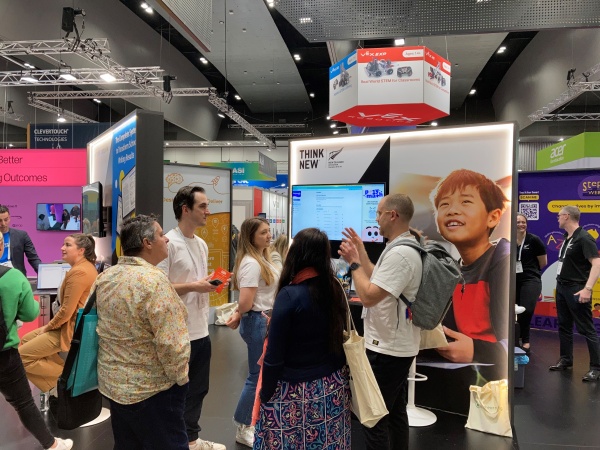
PolyMath Co-Founders Sophie and Christian Silver (second and third from left) talking with attendees at their EduTech Melbourne 2023 stand.
ENZ’s participation supports Focus Area Two of the New Zealand International Education Strategy which is to ‘Build a new international education future’. In taking NZ EdTech offshore, ENZ’s goal is to show how Aotearoa New Zealand is leading in education innovation while also helping NZ EdTech companies explore and understand the export opportunity in Australia in a low-risk and low-cost way.
ENZ’s Business Development Manager | Kaiwhakawhanake Pakihi, Alana Pellow, said that having a stand on NZTE’s pavilion gave ENZ’s delegation profile and extra visibility during the Expo. This included the opportunity to promote their products, a presentation slot to pitch their products, visibility of their collateral and the opportunity to engage with expo attendees over the two days of the event.
“All six EdTechs on our stand generated a total of 80 prospective customer and partner leads, with one company signing a contract with a local university while there.
“All met with decisions makers and government education officials, explored opportunities to partner with other NZ EdTechs and refined their thinking and business planning on the opportunities presented by the Australian market. They all referenced the significant value of being ‘in market.’”
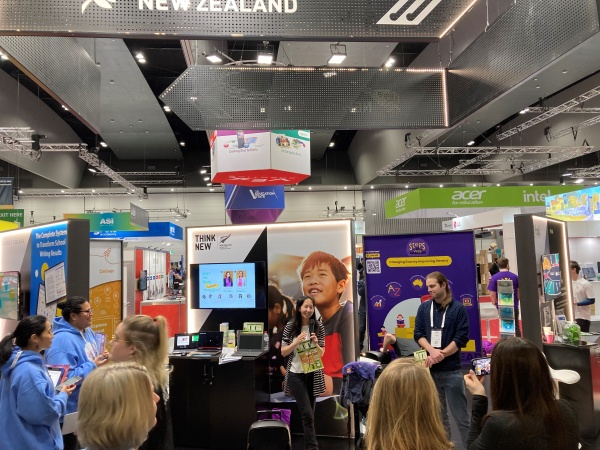
Nutriblocks Co-Founder Dr Claudia Leong and Tech Programme Developer Tim Kern presenting at EduTech Melbourne 2023.
ENZ also sponsored the NZTE networking dinner for the combined 13 EdTech businesses. Invited guests included representatives from the Victorian Department of Education and Training, Victorian Association of State Secondary Principals, Matterworks/Board Director and the NSW Department of Education. Both Education Departments set the scene for the education technology landscape in NSW and Victoria and the journey both states are on in digital adapting and adopting specifically in K-12.
ENZ also supported giving broader visibility of Aotearoa New Zealand’s expertise in digital education and secured two speaker sessions for the EduTech VET conference stream. Norie Ape, Digital Product Manager for Te Pūkenga, presented on ‘Collaborative Innovation: Transforming Vocational Education through Technology and Work Based Learning’ while Elizabeth Asbury, Director of Pipi Learning also spoke on ‘Cultural responsive and designed for neurodiversity in the Vocational Education and Training sector’. Both sessions were well attended and Norie and Elizabeth have been approached for further discussions involving contracting their EdTech services.
Norie said it was a huge privilege to spend time together connecting on our shared passion for better outcomes for our learners, employers, and our colleagues.
“We had two incredible days of meeting, learning, and collaborating in person with awesome humans using Tech 4 Good in Melbourne. Time now to recover and setup all those post conference connections to further the new relationships forged and consider how to embed new ways of collaboration in and beyond.’’

Norie Ape, Digital Product Manager for Te Pūkenga (second from left) with Code Avengers Founder, Hamish Day (far right) and Bradley Hansen (left) plus Karl de Borst (second from right) of Amazon Web Services.
At the conclusion of EduTech Melbourne 2023, Alana shared here top three takeaways from the conference.
“Firstly, nothing beats being on the ground in market, to understand the needs of educators and the opportunity that exists.
“Secondly, there is power in the collective ‘we’ when Aotearoa New Zealand turns up en masse, in market. Collaborating and having deep relationships with other NZ Inc agencies adds greater support to the sector and provides one door to our government, truly putting the customer at the centre.
“My last takeaway is how the Australian education ecosystem is embracing all that technology offers without throwing learners or indeed educators to the kerb. We could learn more from our Australian education colleagues and how they are using digital to create competitive advantage that supports their international education success alongside building their domestic market citizens ‘fit for future’ capability”, said Alana.
Next stop for NZ EdTech companies with ENZ is EduTech Asia in Singapore this November. Any NZ EdTech and Education publisher companies or education providers looking to be involved in education technology related Conferences and Expos can contact Alana Pellow on alana.pellow@enz.govt.nz
-
Around the world in five
United Kingdom
British Council examines future of English language learning
English will remain the world’s most widely spoken language over the next decade driven by employment and higher education trends, and teachers will continue to be at the heart of learning despite the rise of AI and automation, according to a new publication by the British Council.
United States
New forecast warns that US is falling behind in the global race for talent
A new HolonIQ analysis focused on the US and its competitive position relative to other leading study abroad destinations finds that within the total global international education market, the US is losing share of foreign students to Australia, Canada, and the UK.
Canada
Dalhousie University - New study abroad course takes 14 Indigenous students to Aotearoa-New Zealand
A group of Indigenous students from Dalhousie have embarked on a two-week study tour of New Zealand that will transport them deep into the country's rich Māori history and culture.
India
Dishonest players in India are 'damaging' industry reputation
Education counsellors across India say duplicitous players in the international education market are having a seriously negative impact on the sector, with one senior counsellor describing the situation as “supremely unethical”.
Netherlands
Netherlands outlines plans to control international student flows
The Dutch education minister has written to universities to outline plans for controlling international student numbers, including a central management system, tools for ministerial intervention, strengthening of the Dutch language and targeted instruments on programmes to control flows.
-
Continuing the discussion on the impact of AI on education
Since ChatGPT’s (Chat Generative Pretrained Transformer) launch in November last year, the Artificial Intelligence (AI) tool has featured heavily in headlines around the world, sparking conversations from boardrooms, to classrooms, and around the dining room table. Discussions on the significant impact this tool and future AI technology is having on how we teach, assess, and support our students here in New Zealand’s education system are happening in all areas of our sector, including here at Education New Zealand Manapou ki te Ao (ENZ),
A particular discussion during a recent EdTechNZ panel webinar on Artificial Intelligence and the impact on Education, looked at where educators may want to focus their valuable time now that generative AI platforms are available. For example, do educators want to spend their time researching topics, analysing data, and producing unique activities of work, or spend it on building meaningful relationships and place-based experiences with and for learners; gaining insights into learners’ interests, engaging in critical thinking activities and deepening learners experience of and outcomes in education?
Following EdTechNZ’s interesting and successful March webinar which can be viewed here; Artificial Intelligence and the impact on education, ENZ hosted an in-person seminar at our Tāmaki Makaurau offices in late April. This seminar's purpose was to look deeper at how this emerging technology is changing the way we learn, teach, and innovate.
Professor Ian Watson, recent past professor at the University of Auckland, spoke to a group from across the education spectrum including secondary schools, Private Training Establishments, EdTech founders, Education Publishers, Google, about AI and its impact on education.
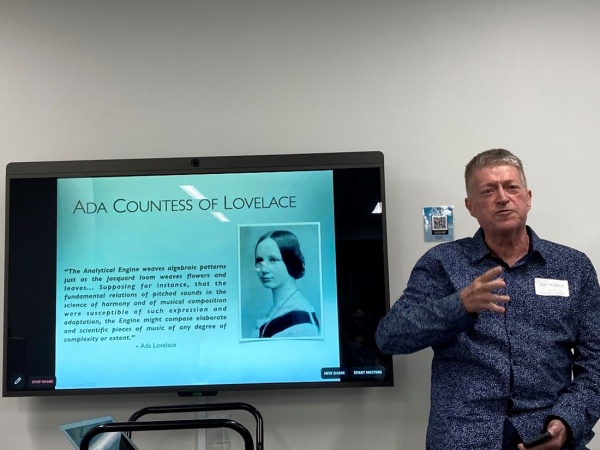
Professor Watson is considered an AI pioneer with 30+ years in the AI machine learning environment and reflected on the history of AI, including that it is not a new or sudden phenomenon, and its progress over time.
“AI imitates intelligence and is great at the specific but not so much the general. For example, aircraft use AI to be able to perform extremely specific flight tasks, but it will never be able to suggest a recipe and cook it!”, Professor Watson said.
“Within education, AI will certainly provide value in routine, mundane and repetitive tasks such as grading, lesson planning, report writing but in the hard and difficult tasks such as developing a universal design for learning and differentiated or targeted learning, it has its flaws. It is not always factually correct and still needs a human to educate it”.
Professor Watson also talked about how important it is, critical even, to teach learners how to use these tools, so they are empowered. Such tools include the likes of AI4K12 for K-12 learners.
Anyone looking for more insights and conversations about AI should check out the TechWeek23 programme with over 400 in person and online events to be hosted from 13 – 20 May.
Techweek AI focussed online events of note include:
- AI and education with AUT Monday 15 May
- AI is here to stay: Its impact on online, flexible, and distance learn with FLANZ (Flexible Learning Association) and EdTechNZ Thursday 18 May at 11:00am – 12:00pm.
-
Survey shows that New Zealand is among top destinations for Brazilians who study abroad
Belta’s annual survey, sponsored by Education New Zealand Manapou ki te Ao (ENZ), was conducted between December 2022 and April 2023 with 763 students and 317 international education agents from all regions of Brazil surveyed to assess their perceptions of international education. The survey results were shared at a recent event in Sao Paolo with dozens of agents and media attending, in person and virtually, to hear about the survey’s latest findings.
ENZ’s Market Development Manager in Brazil, Bruna de Natale, delivered a short speech ahead of the results release. She said it was positive to see so much interest in the release of the survey results, especially when the results revealed that New Zealand continues to rank strongly as an international education destination amongst Brazilian students.
“In this most recent survey, New Zealand moved to seventh position on the list of top education destinations sought by Brazilians who studied abroad, compared to before the Covid-19 pandemic when it was in eighth place. The main reason driving country choice for the students surveyed is the quality of life – New Zealand ranks very well for the quality of life, education, and the protection of civil rights.
“The quality of teaching is another reason given by those surveyed when choosing New Zealand and 60% of participants rated the quality of our English schools and language programmes as good or excellent. It is fantastic to see that New Zealand continues to attract attention as a quality international education destination and it is certainly on the radar as a desired destination for future exchange students,” said Bruna.
Of the international education agents who were surveyed, 52.9% reported that the demand for students interested in New Zealand has remained stable since the borders reopened, while 20.6% recorded growth in interest. This group projects that the numbers of Brazilian students travelling to New Zealand will return to pre-pandemic levels in 2023 and 2024, with the highest flows expected for the first (35.3%) and second quarters of 2024 (32.4%), with demand increasing gradually from the first quarter of 2023.
For a copy of the full survey in English, please email belta@belta.org.br.
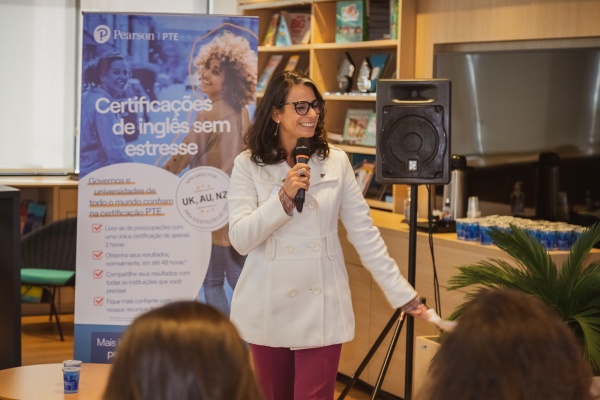
Bruna delivering an introductory speech at an event which released the results from Belta’s survey on international education.