Search
Showing 10 of 2262 results for read 2024 FRM Exam Part I - Quantitative Analysis online free
-
New Zealand top of the world in university sustainability stewardship
New Zealand universities have come out on top of the world for sustainability stewardship in the Times Higher Education Impact Rankings 2024.
New Zealand universities’ approach to sustainability and equality has been announced as world-leading by Times Higher Education (THE) in its most recent Impact Rankings (2024). The stewardship rankings saw New Zealand score an average of 85.3 to come out ahead of Australia (84.4) and Hong Kong (81.9). All eight New Zealand universities participated in the rankings.
Now in its sixth year, the Impact Rankings is the only ranking system in the world that measures universities’ contributions to the United Nations’ Sustainability Goals (UN SDG’s). The Rankings assess the commitment made by universities to sustainability across four broad areas: research, stewardship, outreach, and teaching.
In topping the table for sustainability stewardship, New Zealand’s universities have scored well against indicators such as tracking food waste and having sustainable food choices on campus (SDG 2), the proportion of senior female academics (SDG 5), having water reuse policies and measurements (SDG 6), ensuring energy efficiency with renovations of buildings (SDG 7), and guaranteeing a living wage (SDG 8).
New Zealand universities also came second equal in the world against sustainability outreach, meaning high scores were achieved for contributing to policies addressing poverty (SDG 1), collaborating with health institutions (SDG 3), providing programmes for the local community to learn about energy efficiency (SDG 7), participating in cooperative planning for climate change disasters (SDG 13), and providing expert advice to government (SDG 16).
ENZ’s Acting Chief Executive Dr Linda Sissons welcomed the results and said the global recognition for New Zealand’s universities working hard to make a positive impact in the face of pressing environmental and social challenges world-wide was significant.
“New Zealand’s education system is guided by Kaitiakitanga (the Māori concept of guardianship). This principle instils a deep sense of connection to our land and a commitment to ensuring its health and vitality for future generations.
"Kaitiakitanga informs the approach taken by our universities to resource management, conservation, and sustainable development that all contribute to the UN’s SDGs particularly in the areas of food security, bioenergy, sustainable urban development, and climate change,” said Dr Sissons.
Dr Sissons added “It is incredibly positive to have our approach to sustainability stewardship and outreach recognised as world leading. This is particularly important to us as we know that students around the globe are increasingly prioritising environmental and social responsibility and choosing to study at institutions that align with their personal values.”
In this year's Impact Rankings, a record 2,152 universities from 125 countries/regions were assessed. Progress is measured for each of the individual 17 SDGs, and across the goals as a whole. View the full Impact Rankings 2024 results here.
Top countries/regions for sustainability stewardship in THE’s Impact Rankings 2024
Country/region
Number of ranked universities
Average stewardship score
New Zealand
8
85.3
Australia
21
84.4
Hong Kong
5
81.9
Ireland
8
81.4
Canada
24
80.5
United Kingdom
68
79.7
United States
46
69.1
South Korea
24
67.9
Belgium
5
65.2
Netherlands
6
64.5
Note: Table only includes nations with five or more ranked universities. Credit: Times Higer Education Rankings 2024
Top countries/regions for sustainability outreach in THE’s Impact Rankings 2024
Country/region
Number of ranked universities
Average stewardship score
Hong Kong
5
81.4
New Zealand
8
80.4
Canada
24
80.4
Australia
21
80
Ireland
8
76.4
United Kingdom
68
75.6
Belgium
5
71.9
Germany
8
68.1
South Korea
24
67.9
Netherlands
6
66.2
Note: Table only includes nations with five or more ranked universities. Credit: Times Higer Education Rankings 2024
For further information
Stephanie Morison, Senior Communications Advisor,
Education New Zealand Manapou ki te Ao
Stephanie.Morison@enz.govt.nz | +64223020104
Notes to Editors:
About Education New Zealand (ENZ) https://www.enz.govt.nz/
Education New Zealand Manapou ki te Ao (ENZ) is the government agency dedicated to helping Aotearoa New Zealand realise the social, cultural, and economic benefits of international education. Our role is to promote New Zealand as a high-quality education destination offering excellent education and students experiences and to encourage New Zealand students to study overseas.
With approximately 110 staff in 16 locations around the world, ENZ works closely with New Zealand’s diverse education sector which includes schools, English language providers, Private Training Establishments, Institutes of Technology and Polytechnics (Te Pūkenga), and universities. Internationally, we work with a range of education stakeholders, including government agencies and education providers to identify and encourage sustainable growth opportunities for New Zealand’s education sector.
-
India insights snapshot
Country dashboard – India
In the year ended December 2024 New Zealand exported $398.02 million of education related travel to India and imported $3.9 million, representing a trade balance of $394.12 million and a total trade value of $401.92 million.
Broad field and level of study for Indian students in New Zealand - 2023
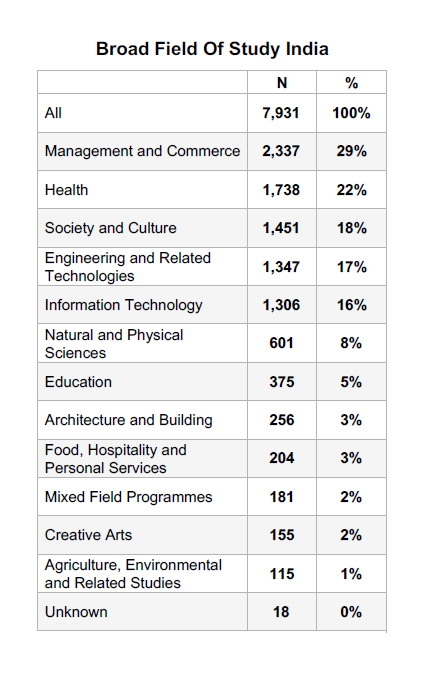
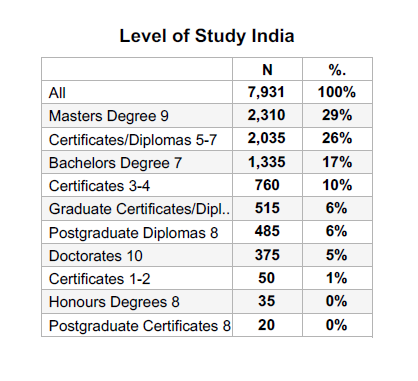
Browse the full country dashboards for India and other markets on this link.
International student enrolments from India
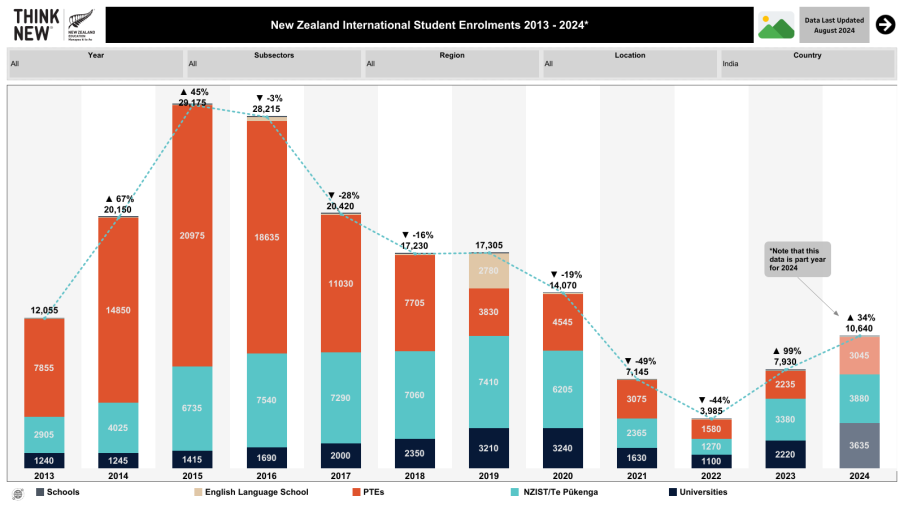
Between January and August 2024, overall international student enrolments from India grew 34% to 10,640 from 7,930 enrolments in the full year period for 2023. Enrolments for universities grew around 64%, private training establishment enrolments grew 36% and Te Pūkenga enrolments from India grew 15% over the same period.
86% of Indian students in New Zealand rate overall experience positively
Indian students are thriving in New Zealand. The New Zealand International Student Experience Survey 2024 reveals that 86% of Indian students rated their overall experience in New Zealand positively.
From high-quality education and a warm, welcoming environment to strong community connections, these insights reflect New Zealand’s continued commitment to delivering a world-class, student-centred experience. -
Online education pilot with FutureLearn enters second phase
A webinar for interested providers on 31 March will be followed by an international campaign from 30 June to end of September 2022.
Education New Zealand Manapou ki te Ao will again partner with FutureLearn, a London-based platform with a global learner base of 17+ million people. The successful first phase saw 22 online courses from New Zealand providers attract more than 80,000 enrolments from learners in over 200 countries, highlighting the potential of online study platforms to reach new global audiences.
The focus of this second phase will be on how to convert an online audience into a sustainable commercial proposition for New Zealand-based providers.
We are interested in hearing from providers who have online content ready to go, or who are confident they can develop online content quickly. We are looking primarily to include short, taster courses (6-20 hours of learning). There is also scope for short credit-bearing courses, including micro-credentials.
This opportunity is open to both registered and non-registered education providers, EdTech companies, regional economic bodies and others. If you have education content and you’re interested in participating, please register for our information webinar on 31 March 2022 to find out more.
Participants have told us that the benefits of this initiative included being able to explore online distribution models and understand more about who the online audience is, and how they behave in a learning environment. It also presents an opportunity for providers to test and learn at low cost and with low risk, as well as profiling their brand to a global audience.
Online education is part of a programme of work to diversify international education products and services, in line with the New Zealand International Education Strategy 2018-2030.
Phase 1 pilot with FutureLearn
Through the first pilot we confirmed there is demand for online courses from New Zealand providers, willingness by many in the sector to pilot online learning, and that New Zealand courses can attract learners in full-time employment.
View the New Zealand Collection on FutureLearn here.
You can explore the data and key insights we gathered from the first phase in our report here:
Download our report about FutureLearn Phase 1
Key dates:
31 March 2022 – Pilot #2 Information webinar
30 June to end of September – Campaign goes live
-
Sharing the international student experience
In August, ENZ and the Ministry of Foreign Affairs and Trade brought together 30 international tertiary students representing all ten ASEAN countries, and ten New Zealand students who had participated in the Prime Minister’s Scholarships for Asia Understanding South East Asia programme. The purpose? To celebrate 40 years of diplomatic relations between New Zealand and ASEAN by strengthening connections among students, and to provide the students with a platform for sharing their views on the international student experience in New Zealand.
Over 100 nominations were received from a range of New Zealand’s universities, institutes of technology and polytechnics, and private training establishments for students from ASEAN countries to participate. Each nominating institution had at least one representative at the two-day programme in Wellington. Participating students were enrolled in a range of programmes from Level 4 certificates through to doctoral level.
Many of the nominating institutions created online media content around Student Voice and the students themselves set up a Facebook page especially for the event which attracted media attention both in New Zealand and overseas.
The students heard from industry experts on the importance of alumni networks, the value of a New Zealand education, and the importance of ASEAN-New Zealand links in business.
Lester Khoo from AUT University engaged the students on how a New Zealand education can launch careers in ASEAN, with one student responding:
“The launch pad was really useful and changed my perspective of being an ASEAN student. I used to think very selfishly about my own career not about the development of my country and other ASEAN countries. The launch pad makes me realize there might be something that I can do to improve my country and the relationship between New Zealand and ASEAN countries.”
In the key download session of Student Voice 2015, the students employed “Design Thinking” methodology to share their international student experiences and to think creatively together to reframe any challenges as opportunities.
There was lots of discussion around the quirkiness of New Zealand life which the students rated as very appealing. This included getting to understand and use Kiwi slang, and the relaxed and welcoming way everyone treats each other. Life in New Zealand is “sweet as”.
Integration in New Zealand was a topic that was very important to the students. They collaborated to develop a range of solutions to improve the integration process for international students in New Zealand. These included initiatives for New Zealand institutions but also advice for international students themselves. Some of the ideas for initiatives focused on campus events, and social media activity, to encourage an appreciation of cultures, and for international students to actively look for opportunities to engage with their New Zealand peers.
ENZ will be sharing further detail directly with the New Zealand institutions who engaged in Student Voice.
One student commented on the integration process by saying, “independence especially in a foreign country is a challenge, making it more difficult when homesickness strikes and adaptation is hard. But I think it’s all part of the process, because in a brighter perspective, New Zealand offers a wide opportunity to search for new paths in expressing yourself and adopting to different cultures and people.”
The students also listed some of their “top fives” on a range of topics.
Reasons for picking NZ as your study destination

-
Overseas graduates are inspirational and exceptional
-
Experience new things and independence
-
Higher quality of education
-
Financial support i.e. scholarships
-
To fulfil my fly fishing obsession
Things I hope my NZ education will provide for me

-
Change
-
Professional development
-
Friendship network
-
World class education
-
Personal development
Things that influenced my decision to study abroad

-
Safe, clean and student friendly environment
-
More job opportunities and linkages
-
Multicultural environment
-
State of the art technology and top notch quality of education system
Things that surprised me about NZ

-
You can take a banana to the exam room
-
Slang is the new English
-
You can banter with professors – no more ‘yes sir’
-
Four seasons in one day
-
Ethics approval is required for animal studies – even for mussels!
Things I would tell my friends about studying in NZ

-
Surprising kindness – a kiwi high school teacher decided to pay for my studies overnight
-
To see people go to school bare footed
-
NZ institutions offer a world class standard of education and you will definitely change as individuals to become a well-rounded person
-
Explore – do outdoor activities
-
The freedom of expression
Things I would say to recommend NZ to potential students

-
Come to one country and see the whole world
-
Number 1 place to experience study and witness the best of nature
-
The best place for study and family life
-
It is really safe here – 2nd safest county in the world. Low crime rate, Low accident rate.
-
Mixed religion – freedom to practice our beliefs
-
-
Around the world in five
GLOBAL
Institutional websites remain a key element of online recruiting
As many as 9 in 10 prospective students don’t have a particular school in mind when they begin their search process, making institution websites an essential source of information for prospective students. Social media plays an important part too, particularly for gathering recommendations for institutions or schools and as a window into student life.
GLOBAL
Teacher demand international schools’ biggest challenge
Parents’ desire to equip their children with English language skills and prepare them for university overseas have contributed to a worldwide boom. The number of international students worldwide is forecasted to reach 6.3 million by 2021. Schools will therefore face the challenge of finding enough skilled teachers to deliver a high quality education to all of these students – some 150,000 qualified teachers are expected to be needed by 2021.
USA/MEXICO
Building bridges not walls will bring greater innovation
Over 60 university leaders from the Americas, Europe, Asia, Middle East and Africa met earlier this month along the USA-Mexico border to discuss the challenges and opportunities pertaining to innovation in higher education. They discussed innovation through effective partnerships – internationally, and between business connections and between disciplines.
AUSTRALIA
The growth of the higher education sector as an industry: what can we learn from Australia?
Australia is an attractive destination for students, but the country doesn’t rest on its laurels. Australia’s universities and schools take a proactive approach to recruitment. Many Australian institutions have implemented student diversification policies and have begun direct recruitment to specific demographics or regions.
UK
Mobility = Employability
In 2015, 64% of employers said that graduates with international experience are more employable – up from 33% in 2006. Globally, mobility is on the rise yet the UK fares poorly. In 2013/14, just over 10,000 of all higher education students in UK were outwardly mobile, compared to 50,000 each from Germany and Spain. The dominant barriers to mobility include lack of confidence with language skills (36%) and perceived difficulties adapting to a different culture (19%). So what are we doing to respond to these barriers?
-
Around the world in five
CHINA
HSBC launches international education payment service
HSBC has launched a mobile payment system on mobile app and WeChat for Chinese international students. The service offers tuition payment with currency conversion and transfer to major global universities.
SOUTH EAST ASIA
ASEAN higher education more open to international engagement
Higher education systems in the ASEAN region, particularly Malaysia, Viet Nam, The Philippines, Indonesia and Thailand, are becoming more open for international engagement, according to a new British Council report.
US
The continuing expansion of online learning in the US
Distance education enrolments continue to increase in the US, with total enrolments of 6.36 million, which equate to nearly 31.6% of all higher education enrolments in the country.
CANADA
Ontario’s new international strategy for post-secondary education
The Canadian region has released a new strategy, Educating Global Citizens, in a bid to create study abroad opportunities for students, enrich the learning environment at Ontario’s public colleges, and build a stronger workforce by attracting more students to the region.
GLOBAL
Google invests in app to prep students for TOEFL
Google has announced its investment in an app that helps students prepare for standardised English language tests such as TOEFL. This is part of the company's investment in start-ups offering developing technologies that will broaden features offered by Google’s virtual assistant.
-
Update from Immigration New Zealand
Update for international students: In-study work hours increasing from 3 November
From 3 November 2025, eligible international students will be able to work up to 25 hours per week during the semester - an increase from the current 20-hour limit. This change applies to all new student visas granted from that date, even if the application was submitted earlier.
If international students hold a student visa with a 20-hour work limit and want to take advantage of the new 25-hour allowance, they will need to apply for a variation of conditions (VOC) or a new student visa and pay the relevant fee
They can choose to apply now for the extra five hours or if their visa allows full-time work during summer vacation then they do not require the extra five hours and may choose to wait until later to apply for a variation. Some students will choose not to apply for a variation of conditions at all, and wait until their next student visa application
The process for applying for a variation of conditions depends on which system a visa was submitted through i.e. the old system or through enhanced Immigration Online.
For more information, visit Upcoming changes to student visa work rights: Immigration New Zealand
If they’re unsure which system their visa was issued in or which form to use, they can contact us for support before applying: Contact us: Immigration New Zealand
Update for international students: Changing your education provider or lowering your level of study from 3 November 2025
If a student visa holder is planning to change education provider or lower their level of study (for example, from a degree to a diploma), they’ll need to apply for a new student visa - not just a variation of conditions.
Upcoming changes to student visa work rights: Immigration New Zealand
This requirement ensures their visa accurately reflects the new study situation and complies with immigration requirements.
Before making any changes, students or their representatives should check the INZ website for guidance on how to apply for a new student visa on enhanced Immigration Online and ensure they apply in advance to avoid any disruption to their studies.
For more information, visit Study visas: Immigration New Zealand
Update for international students: Keep your visa photo filter free
We all like to look our best, but to avoid delays or declines, visa application photos must be a true, unedited likeness. That means students must abandon those filters and submit an accurate photo in order to avoid processing delays or declines.
Immigration New Zealand uses facial recognition, so filters, AI edits, or beauty enhancements interfere with identity checks. Photos must meet international biometric standards - natural skin tones, clear lighting, and no digital alterations.
Edited images including smoothing skin, changing eye size, reshaping facial features, or cropping your head onto a plain background will cause delays in processing and may lead to declined applications.
Key tips:
- Don’t use selfies - get someone to take your photo or use a professional.
- Tell photographers not to apply digital enhancements, like beauty filters or AI adjustments.
- Some photo apps or online tools may not be suitable for visa applications.
More information and examples of acceptable photos can be found on our website: Acceptable photos for a visa or NZeTA : Immigration New Zealand
Guardian visitor visa applications moving online from 3 November
From 3 November 2025, all Guardian Visitor Visa applications should be submitted on Immigration New Zealand’s enhanced Immigration Online system. This update is part of INZ’s broader digital transformation, aimed at improving the visa experience for families supporting international students.
While the information required remains the same, the application form may look a little different.
The enhanced system offers better application tracking and a more streamlined experience for applicants. Updated guidance and support materials are built into the form.
If you have an application in draft or submitted under the old application form, you will still be able to access or submit this application after 3 November 2025. We will notify you when the old application form is due to close.
For current visa holders, if your child is applying for a new student visa and you intend to apply for another Guardian Visitor Visa, both applications should be submitted through the enhanced system.
This change is particularly relevant for education providers, agents, and advisers supporting families of international students. Please share this update with your networks and encourage early preparation ahead of the transition.
Guardian Visitor Visa applications moving to enhanced Immigration Online: Immigration New Zealand
-
Around the world in five
CHINA
Studying Abroad (magazine affiliated with Guangming Daily)
The August issue of this Mandarin-language magazine shines a spotlight on New Zealand as an education destination. It features interviews with both New Zealand's Ambassador to China and Mongolia, Clare Fearnley and ENZ Director for Greater China, Miranda Herbert.
GLOBAL
‘How to live in a pandemic’: The university class we need during COVID-19?
The COVID-19 pandemic has demonstrated that health is a deeply interdisciplinary issue, demanding expert responses from a cross-section of fields: the arts, public health, social work and K-12 education among them.
AUSTRALIA
Australia visa data raises questions about student swerve
Australia’s latest offshore visa application data which revealed varying declines from important source countries has raised important questions about international student behaviour, and whether or not they are deferring to alternative destinations.
GLOBAL
What we have lost: International education and public diplomacy
Entangling universities with geopolitics can mean a bad student experience has a far broader cost.
GLOBAL
Online testing will become “the norm”
Online secure exams are becoming increasingly popular because of the Covid-19 pandemic, and in the future online testing will become the norm, according to LanguageCert’s chair of the Advisory Council.
-
Spotlight on Japan
When young Japanese student and talented rugby player Megumi came to New Zealand for six weeks to learn English in 2018, she loved it so much she decided to stay.
Her welcoming host family and peers were a large part of why she chose to make the move – on top of the chance to play rugby four times a week and learn at a high-quality secondary school.
Megumi is just one of the over 9,000 Japanese who come to New Zealand annually to study.
In fact, Japan is the third largest source country for New Zealand’s international education sector.
“New Zealand really values its education relationship with Japan, which stretches back over 60 years,” ENZ General Manager International, Lisa Futschek, says. “It’s economically important, but it also helps to enrich our young people’s lives and maintain strong cultural and people-to-people ties.”
The number of Japanese students coming here to study has grown steadily since 2013, and looks likely to increase as a number of Japanese government policies centred on internationalisation take effect.
ENZ Senior Market Development Manager for Japan, Misa Kitaoka, says 688 people visited the 2019 ENZ Fair, held in September; an all-time high and up from 500 visitors in 2018.
“I noticed significantly more parents with young children were present at the fair and this is likely driven by the fact that English will become a compulsory subject for primary-schoolers in Japan next year from 2020,” she says.

While the market demand has traditionally been focused on short-term programmes (less than three months), Misa also saw increasing interest in the long-term studies among the visitors. Given the Japanese government’s internationalisation agenda, Japanese universities are increasingly adopting the Admission Office (AO) method of assessing applicants. This means there is less emphasis on Japan’s university entrance exam held once a year, allowing those students who return from New Zealand with NCEA certification to more easily apply to Japanese universities.
Scholarships are also playing a part in generating interest in New Zealand. The Japanese government also support a series of scholarships. The Japan Student Services Organisation (JASSO), for example, offers monetary awards for both inbound and outbound students studying at tertiary level. The TOBITATE (“leap for tomorrow” in Japanese) Study Abroad initiative administered by the Ministry of Education, Culture, Sports, Science and Technology (MEXT) also provides scholarships for both school and tertiary students to study overseas.
What do Japanese students love about New Zealand?
Most Japanese students travel to New Zealand to study at secondary school level.
The opportunity to learn English in a safe and supportive environment is attractive to many Japanese learners, as is the chance to visit a country that is almost as rugby-mad as Japan. Programmes such as Game On English leverage both interests, bringing students here to both learn English and play sport at the same time.
New Zealand’s unique style of teaching is also a major attraction for prospective Japanese students and their parents. From primary school on, Kiwi students are encouraged to work collaboratively with digital devices, which develops the “21st century skills” promoted by the Japanese government and outlined in a report published by the World Economic Forum. Additionally, Japanese students coming to New Zealand will experience this learning environment in an inclusive and diverse environment with many different cultures.
Many Japanese alumni report that the Māori culture made a big impact on their time in New Zealand. Research released by the Asia New Zealand Foundation in September this year, New Zealand and Japan: To Our Future, identified Japan as the Asian country that held the most culturally similar views and values to Māori culture.
“The importance Japanese people place on reciprocity and hospitality resonates with values like manaakitanga and kaitiakitanga. Both cultures emphasise respect for elders, take a long-term perspective and stress personal relationships underpinning business dealings.”
2019 Rugby World Cup
Education New Zealand, alongside other NZ Inc agencies, have concentrated efforts on raising New Zealand’s profile in Japan during the Rugby World Cup 2019.
New Zealand and Japan: To Our Future found that many Japanese have a limited view of New Zealand. New Zealand was seen as being safe, clean and green, but also a little unsophisticated and not as technologically advanced as Japan.
Tourism New Zealand led the hosting of a pop-up event with support from ENZ last month.
Prime Minister Jacinda Ardern attended and posed for pictures with former All Blacks captain Richie McCaw and international alumni.
ENZ’s Misa Kitaoka says cross-agency collaboration like this is one of the most effective ways to increase awareness of New Zealand among the Japanese public.
“As destination marketing plays a key role for us, I hope to leverage high-profile NZ Inc activities and ministerial visits.”
-
Around the world in five
GLOBAL
Instagram’s profound effect on travel destination choice
One of the biggest subject niches on Instagram is travel, and new research is showing that travel posts are dramatically affecting millennials’ decision-making about the experiences they choose to have.
UNITED KINGDOM
UK government launches fast-track visa route in research shake-up
The UK government has announced a new fast-track visa scheme for researchers, with no cap on the maximum that can apply, which will launch next month.
GLOBAL
From 9/11 to Christchurch earthquakes: how unis have supported students after a crisis
Tragedies and disasters can have an emotional and cognitive impact on learning. So, how can universities support students and staff during times of collective crisis?
NORTH AMERICA
US overtakes UK as “best in world” for education
The US is perceived as the top country in the world for education, having overtaken last year’s top spot holder the UK, according to a survey by U.S. News & World Report.
GLOBAL
Slower growth in new MOOC degrees but online learning is alive and well
Roughly 10 million more learners were enrolled in MOOCs in 2019 than in 2018, leading to an estimated global enrolment of 110 million and 10% year-over-growth in student numbers.