Search
Showing 10 of 1236 results for Value-priced treatments https://simplemedrx.top
-
Around the world in five
Asia
While financially strained institutions in the U.S and UK reassess their models, Asia’s universities are reshaping global higher education, leveraging innovation and collaboration to address economic challenges. The shifting dynamics carry profound implications for how knowledge is produced, shared, and valued, raising the question of how it will ultimately redefine higher education worldwide.
Australia
The Department of Education in Australia has released six new guides and an overall framework to support innovative practice in international student engagement, covering areas such as mental wellbeing, community engagement, developing innovative programmes and supporting with accommodation.
Mexico
Study travel agents in Mexico are expecting a diversification of outbound trends in the year, while it is hoped that business to the traditional top destination of Canada will settle after a challenging year of policy changes and visa issues, according to delegates at the recent ST Alphe Secondary Focus Mexico City event.
New Zealand
News Editor of StudyTravel Network, Matthew Knott, shares comments from Executive Directors of English New Zealand and SIEBA, Kim Renner and John van der Zwan, along with Keri Ramirez, Managing Direcotr of Studymove on New Zealand’s international education recovery. A recent industry seminar on industry data claimed full recovery could come in 2025.
Sri Lanka
Perth-based Curtin University has officially launched a new branch campus in the Sri Lankan capital of Colombo. After establishing similar facilities in Singapore, Malaysia, the UAE, and Mauritius, Curtin University Colombo is the institution’s fifth global campus.
-
NZIEC 2018 showcases global citizenship
Two Ministers attended: Minister of Immigration, Hon Iain Lees-Galloway, spoke about the Government’s changes to post-study work rights for international students, and Education Minister, Hon Chris Hipkins announced the International Education Strategy 2018-2030. Both Ministers spoke of the Government’s confidence in the bright future of New Zealand’s international education future.
Master of ceremonies, award-winning journalist Miriama Kamo, kept conference moving with humour and poise. She interviewed three international students on their experiences living and studying in New Zealand.

Yuki Sugito from Japan came to New Zealand after being interested in the All Blacks at the 2015 World Cup. Ada Wang from Nanchang, China, who is studying a Master’s degree at Victoria University, told us about the case she took to the Tenancy Tribunal and won. Angelique Viola talked about leaving behind a business and career in her native Philippines to study accounting at WelTec. All three are enjoying their lives and studies in New Zealand – and Kiwi food featured strongly, most especially their love for fish’n’chips.


We learned from Shanton Chang about the digital journeys of international students. And we became one of New Zealand’s top trending topics on Twitter.
Delegates enjoyed a taste of Brazil at the NZIEC Carnival on Thursday night.

NZIEC Country of Honour host, Brazilian Ambassador HE Paulo Camargo, spoke movingly of the connections between Brazil and New Zealand.

Surprise poet Karlo Mila delighted guests by pulling together two days of intense discussions in a poem specially commissioned for NZIEC 2018.
The largest number of industry presenters inspired, debated and informed delegates across six breakout streams providing new insights for improving the student experience, making a mark online, collaborating to win – and more.
And delegates took up the plentiful networking opportunities with gusto – many a korero was observed in the conference environs!
ENZ gratefully acknowledges all our conference partners and exhibitors, including Lead Partner BPO Intelligence, Premium Partners Vodafone New Zealand and OKNZ and Southern Cross Travel Insurance, Partners IDP IELTS Australia, QS and Western Union, Media Partner The PIE News, Programme Partner AFS New Zealand, Espresso Partner StuMagz and Country of Honour host, the Embassy of Brazil in New Zealand. Thank you one and all.
If you missed the opportunity to connect with our partners or exhibitors at conference, you can do so through the NZIEC website.
Conference delegates can provide feedback on conference through the conference app. If you have any suggestions for next year, please don’t hesitate to email nziec@verve.co.nz.
NZIEC 2019 will be held at the SkyCity Convention Centre on 7-8 August 2019. The theme will be ‘Navigating Our Changing World’.
We look forward to seeing you in Auckland for NZIEC 2019!
-
Noteworthy education programme featured during Prime Minister’s Trade Mission to Japan
Hot on the heels of the Prime Minister’s Trade Mission to Southeast Asia in April, relationships with our partner countries in the region continued to be strengthened for the benefit of the education sector during New Zealand’s most recent trade mission to Japan. This mission supported export sectors, including education, to engage with the Japan market and leverage emerging opportunities while advancing the New Zealand brand. The inclusion of education in the high-level visit acknowledges its contribution to the government’s ambition to lift the value of exports.
The strong people-to-people links between New Zealand and Japan are noteworthy with high student mobility in both directions. Japan is the third largest source of international students for New Zealand according to 2023 international student enrolment data with the school sector making up the largest proportion of enrolments. Japan is also a top destination for New Zealand scholars with many joining the Japan Exchange and Teaching (JET) programme and in the most recent Prime Minister’s Scholarship for Asia group announcement, three groups were awarded scholarships for programmes in Japan.
The international education sector was represented by two delegates nominated by ENZ to participate in the full business delegation. Cheryl de la Rey, Vice-Chancellor University of Canterbury, attended as Chair of the Vice-Chancellor’s Committee on behalf of the wider university sector and John van der Zwan, Executive Director, Schools International Education Business Association (SIEBA). Unfortunately, John had to withdraw due to illness.
The education programme elements woven into the high-level visit included a Memorandum of Understanding (MoU) signing, a visit by Mrs Amanda Luxon to a local Japanese school, and scholarship students participating in the New Zealand Sports and Business Leadership luncheon.
MoU between Massey University and a group of all-girls secondary schools
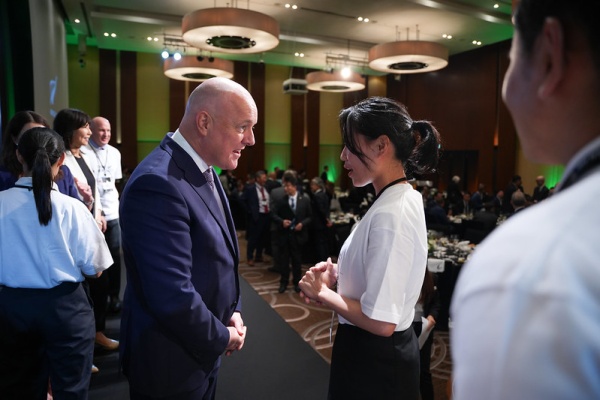
The Prime Minister promoted awareness of New Zealand’s world-leading universities among high schools in Japan through witnessing the signing of an MoU between Massey University and six all-girls secondary schools in Japan.

Prime Minister Christopher Luxon witnessed the signing of the MoU between Massey University and six all-girls secondary schools in Japan.
The memorandum signing ceremony was held at the New Zealand Embassy in Japan on 18 June. The MoU will develop a special admission system, enabling Massey University’s foundation or bachelor’s programmes to accept outstanding students recommended by the principals of the Japanese high schools. Through this agreement, students who meet Massey University's English and academic requirements and receive a recommendation from their schools will be able to enrol in Massey University's bachelor's programmes. Students can graduate with a degree in three years from the time they start their studies.
Shelly Turner, Deputy Vice Chancellor represented Massey University in Tokyo at the MoU signing and said at the signing “Te Kunenga ki Pūrehuroa Massey University has a long-standing relationship with Japan, reflecting our commitment to fostering international education and cultural exchange, and more recently we have seen a growing interest in our full degree programmes.
“We are dedicated to providing comprehensive support to ensure our Japanese students thrive academically and personally. We recognise the crucial role of women and girls in tertiary education and are committed to empowering them to achieve their full potential during their studies, and transition to successful careers,” said Shelly.
The Japanese school Principals, including Japan Women’s University Senior High School Principal, Yumi Susuki also welcomed the new partnership.
“For the past 30 years, our school has deepened its understanding of New Zealand culture and society through language training programs in New Zealand. With the 2022 agreement between Education New Zealand and our school, and now the new special admission system with Massey University, we hope to build even richer relationships and empower our students to shape their future,” said Yumi.
The Japanese schools that signed the agreement participated in the 'New Zealand Education Familiarisation Tour,' co-hosted by ENZ and Air New Zealand in March 2024. During the tour, they found a high level of compatibility with Massey’s educational philosophy, wide range of academic options, future-oriented learning environment, and extensive support for international students.
Homei Elementary School

Mrs Luxon with teachers and students at Homei Elementary School.
International education opportunities were also highlighted in a well-received visit Mrs Luxon made to Homei Elementary School on 19 June (affiliated to Japan Women’s University). It was Mrs Luxon's first trip to Japan and her school visit enhanced New Zealand's presence and reputation among all-girls' schools and universities in Japan.
In 2022, an Education Cooperation Arrangement between ENZ and Japan Women's University (JWU) and its affiliated schools including the Homei Elementary School was concluded to promote student and teacher exchange as well as gender equality and women’s empowerment.
From 2025, Homei Elementary School will send its first cohort of six graders (11-12 years old) to St. Margaret’s College for a short-term study and homestay experience.
Sports and Business Leadership Luncheon
The Sports and Business Leadership Luncheon held earlier in the programme on 17 June celebrated people-to-people connections and promoted New Zealand as an attractive study destination, including through the “Tobitate” scholarship programme.
The Tobitate programme, managed by Japan’s Ministry of Education, Culture, Sports, Science and Technology (MEXT), sends students abroad and New Zealand has welcomed many students as part of this initiative. Ten Tobitate Alumni were invited by ENZ to attend the lunch in support of the New Zealand – Japan sporting ties and to promote education opportunities in New Zealand to the Japanese audience.
The Prime Minister’s remarks during the event celebrated ten years of the Game on English programme (which combines rugby and study in New Zealand for Japanese high school students), highlighted Fonterra’s contribution to its success, and announced Air New Zealand as a new sponsor.
Upcoming Events in Japan for NZ education providers
ENZ’s Acting General Manager International and Regional Director Asia (excluding China), Ben Burrowes accompanied the delegation and said he is looking forward to the upcoming ENZ events in Japan.
“The team is preparing to welcome providers to Japan later this year for the New Zealand Fair and Agent Seminars from 6 to 8 October.
“The timing of Prime Minister Christopher Luxon’s recent visit to Japan couldn’t have been better. We will look to further leverage this focus by continuing our work with the sector to promote New Zealand’s education offerings with prospective students, families and education stakeholders in Japan.”
-
Around the world in five
JAPAN
International students fall behind in job hunt
Despite efforts to encourage Japanese companies to globalise, language issues and mismatches between students and employers mean few job offers are made to international students.
TAIWAN
Government to boost post-study work rights
The Taiwan government is looking to lower restrictions for international students to remain after graduation and access work rights in a move to bolster the country’s professional workforce.
GLOBAL
For international students, shifting choices of where to study
What do falling or stagnating international student enrolments in the US and UK mean for international student mobility around the world?
AMERICAS
Crossing borders: How 10 universities are forging new ties in the Americas
Institutional collaborations are enabling 10 universities across the Americas to work together on common issues such as lack of technological innovation, climate change and public health issues.
GERMANY
Germany seeks solutions for lack of teachers in schools
An "education emergency" looms in Germany as schools struggle with a shortage of nearly 40,000 teachers due to a population increase and hurdles to get into teacher training programmes.
-
Around the world in five
GLOBAL
Gulf study interest falls 30% as conflict reshapes student demand
Global student demand for universities in the Gulf is falling fast, with a recent report showing a steep drop in March 2026 compared to growth seen since late 2025, as the conflict reshapes perceptions of stability and choice.
SOUTH AMERICA
There is significant demand in Mexico for study abroad, and Mexicans are considering a wider range of destinations than in the past
CHINA
US no longer a top-three destination for China’s students
The United States continues to lose its long-held appeal among Chinese prospective international students, a new report by a major study abroad consultancy has found.
UK
The Home Office has circulated draft guidance with additional detail on more stringent sponsor compliance requirements for UK universities.
GLOBAL
What the Iran-Israel war could mean for students who depend on ChatGPT, Gemini, and Claude
The Iran-Israel war may seem far away, but its effects are increasingly felt close to home. A way that we – and especially students — might be feeling the impacts of warfare, though, is with AI.
-
Around the world in five
Australia
An IDP survey finds that reactions are varied across key student sending markets to Australia’s tighter immigration rules and higher financial requirements and visa fees. The findings suggest, however, that increased financial requirements and application fees could influence the study plans of half (or more) of prospective students
India
In its first full budget since coming to power for the third term, the Modi government has focused on some major funding allocations for different areas in India’s education sector.
Malta
International students are turning to Malta for study opportunities – in part due to a scheme that allows them to earn back the majority of their tuition fees once they start working.
Nepal
Study visa issuance to Nepalese citizens has grown in three of the top four English-speaking destinations.
United States
The Biden-Harris administration in the US has announced actions to speed up visa processing for college graduates who hold job offers, sending a positive signal for prospective international students.
-
Around the world in five
Asia
A shift towards non-recruitment based engagement with Indian schools could be key to better managing student expectations, stakeholders have suggested. Those who have done it well – particularly schools in the US – have created engagement through faculty, immersion trips, experiential learning opportunities, curriculum engagement and alumni, The PIE learned.
North America
British Columbia is Canada's westernmost province, and a leading destination for international students within Canada. On 1 March, the BC Ministry of Post-Secondary Education and Future Skills released details of how the international student cap will be applied within the province's education system.
Europe
A new paper from a group of experts, including three former universities ministers, challenges suggestions that the United Kingdom has too many international students and warns that the government is using out-of-date data to predict the number of overseas students expected to come to the UK for their higher education.
Africa
International educators need to prepare for ‘The Africa Decade’, where enrolment growth rates of African students globally are expected to hit their fastest rates over the next 10 years. Modelling suggested African students will account for one in eight international students by 2050, but visa rejections are seriously hampering efforts to enrol students from across the continent.
Oceania
International students are more open to switching destinations following recent government policy changes in three of the top destinations – Australia, Canada and the UK, with the UK most affected and the USA looking set to benefit, according to a student survey conducted by global higher education-focused agency group IDP Education.
-
Around the world in five
Asia
China urged to “go global” as NAFSA cohort returns
Chinese higher education institutions are encouraged to increase their global presence, as a significant number of Chinese universities attended the NAFSA conference in 2023. Despite geopolitical tensions, some American and European universities remain open to collaboration with Chinese institutions. Chinese HEIs are urged to diversify their portfolio and actively engage in international exchanges and cooperation.
North America
U.S. denied more than a third of student visa applications in FY2022
The USA denied 35% of student visa applications in 2022, resulting in an estimated $26.4 billion economic loss. Factors contributing to the increase include high demand, lack of non-immigrant intent, and a shift in source markets, with India surpassing China as the top source country.
South America
Brazil: Affordability will be key to unleashing demand for study abroad
The Brazilian economy is recovering, and there is a strong demand for study abroad among Brazilians. However, students and their families are facing financial challenges, making affordability a key factor in attracting Brazilian students. Scholarships, agent support, and work opportunities will be crucial in attracting Brazilian students in the coming years.
Europe
UK: operational shift in diversify drive mapped
90% of UK universities are diversifying international student recruitment, with changes in application processes, multiple rounds of applications, and the introduction of scholarships to adapt to the global market. Pre-CAS interviews, deposit requirements, and agent quality frameworks are proposed to maintain high recruitment standards and mitigate risks.Africa
Collaboration aims to help make Africa’s youth an asset
African universities unite under the Education Collaborative to transform higher education, focusing on shared curricula, student exchanges, and joint research. The goal is to make Africa's youth an asset, benefiting at least one million students by 2030. The initiative promotes leadership collaboration, incentivizing staff innovation, and embraces a dynamic approach to sustainability for transformative change.
-
Around the world in five
Asia
‘Islands of internationalisation’ risk as central Asian hubs grow
Central Asia has emerged as a new hub for international universities in recent years but countries in the region are being urged to ensure domestic universities and research systems benefit from branch campus push.
Global
The questions families are actually asking
Inside the student advising conversation in 2026.
Europe
Manifest Global acquires EduGo Abroad to expand Europe offering
Singapore-headquartered Manifest Global has acquired India-based international education consultancy EduGo Abroad, in a move that will strengthen the group’s presence in the European higher education market.
Australia
What 44+ nationalities of international students taught me
Nick Shrestha, founder of Career Panacea, a graduate employability and workforce development platform, shares insights on international students and graduates navigating work pathways.
Viet Nam
15% decline in Indian students seeking undergraduate courses in US: Report
The report recorded a 15 percent decrease in applicants from India, the top source for international students in the US.
-
Around the world in five
Global
Findings from the latest Global Enrolment Benchmark Survey reinforce the profound impact of current policy settings in Australia, Canada, the UK, and US on international enrolments. Universities in those countries reported significant declines in new enrolments at both undergraduate and postgraduate levels.
France
Number of students in higher education more than doubled in 20 years, but inequalities remain
UNESCO’s first Higher Education Global Trends Report shows that the number of students enrolled in higher education worldwide has more than doubled over the past two decades, reaching 269 million in 2024. International mobility has tripled over the same period, with nearly 7.3 million students studying abroad, half of them hosted in European and North American countries.
United Kingdom
Climate-ready countries attracting more international students, major study finds
Countries that are better prepared for climate change are becoming more attractive to international students while more vulnerable nations are losing their appeal, according to a major new global study involving researchers from The University of Manchester.
South Korea
South Korea in post-study visa push amid shift towards quality
After surpassing its ‘Study Korea 300K’ target ahead of schedule, South Korea says it now wants to shift focus towards ‘strategic quality management’, post-graduation opportunities and long-term talent retention.
Germany
India’s smaller cities fuel Germany’s popularity as students rethink study abroad
According to a recent TerraTern survey of more than 2,800 students and early-career professionals across smaller Indian cities, Germany emerged as the most preferred destination, with 75 percent selecting it as their top choice, followed by the US (68 percent), UK (62 percent), Australia (55 percent) and Canada (50 percent).