Search
Showing 10 of 2262 results for read 2024 FRM Exam Part I - Quantitative Analysis online free
-
New ECA signed with US institution
Increased opportunities for students and researchers from diverse backgrounds to study and carry out research in New Zealand, and more international opportunities for Māori will result from the new agreement between the Louis Stokes Alliance for Minority Participation-National Science Foundation International Center of Excellence (LSAMP-NICE) and Education New Zealand Manapou ki te Ao (ENZ).
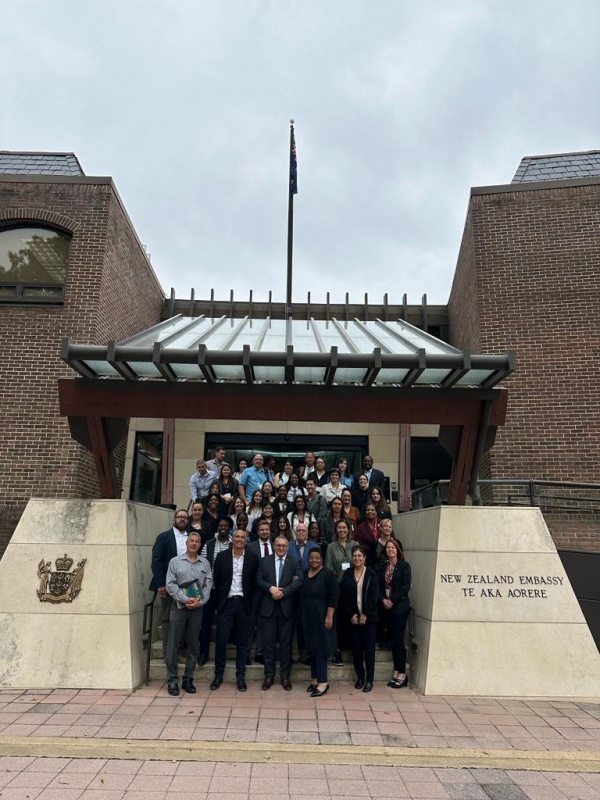
Attendees outside the Embassy of New Zealand in Washington DC, where the meeting was held
The Embassy of New Zealand in Washington DC was the venue for the annual general meeting and conference of LSAMP-NICE on 29-30 September 2022. Representatives of 60 LSAMP institutions across the US attended, as well as international partners including the University of Toulouse, the French Embassy, a Te Kāhui Amokura delegation, and ENZ. The role of Te Kāhui Amokura is to advance and promote the collective interests of New Zealand’s universities to improve outcomes for Māori, and the delegation comprised:
- Rawinia Higgins, Deputy Vice-Chancellor, Māori, at Victoria University of Wellington (VUW)
- Meegan Hall, Assistant Vice-Chancellor Mātauranga Māori, VUW
- Fiona Johnson-Bell, Senior Manager, Education and Māori, Universities New Zealand
- Tim Manukau, Mātauranga Co-Director, University of Waikato Environmental Research Institute
- Megan Ranapia, PhD student, University of Waikato
- Kirita-Rose Escott, PhD student, VUW.
ENZ Manukura Chief Advisor Māori, Ed Tuari, welcomed attendees with a mihi whakatau, and Lance Fisher (Northern Cheyenne) responded with a traditional Northern Cheyenne song. The meeting ended with the signing of the new agreement by Steve Dupuis, LSAMP-NICE Project Principal Investigator, Salish Kootenai College, and Ed Tuari on behalf of ENZ.
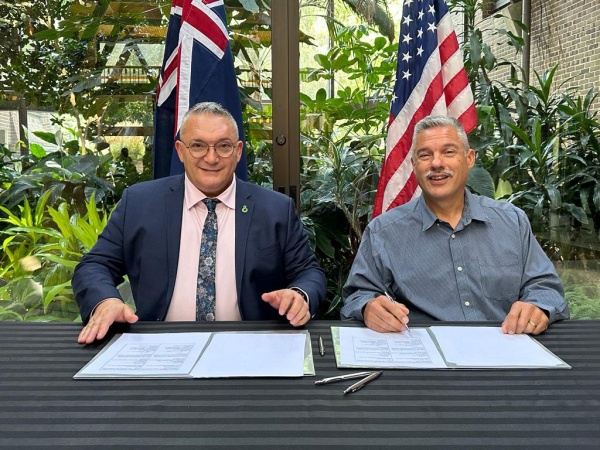
Ed Tuari and Steve Dupuis signed the education cooperation arrangement
“We are working to build people’s understanding of New Zealand as a country with a unique bicultural heritage and strong social justice values,” DuBois Jennings, ENZ’s Director of Engagement, North America said.
“The new agreement reflects that New Zealand is an ideal education destination for students from historically marginalised backgrounds, and it opens up exchange possibilities for Māori and Pasifika students from New Zealand to experience education on US campuses.
“We have been developing these relationships over several years, including at NAFSA earlier this year. Future possibilities include agreements between LSAMP-NICE and individual New Zealand providers.”
In late 2021 the National Science Foundation, Te Kāhui Amokura and ENZ worked together on a series of virtual information exchange sessions, which covered indigenous language research, indigenous data sovereignty, and the impacts of climate change on indigenous communities. More than 150 experts took part, including Native American, Alaskan Native, Native Hawaiian, and Māori scholars.
LSAMP-NICE is funded by the Louis Stokes Alliances for Minority Participation (LSAMP) programme, an alliance-based programme which aims to diversify the science, technology, engineering and maths (STEM) workforce in the US by increasing the number of STEM degrees awarded to historically underrepresented populations, specifically African Americans, Hispanic Americans, American Indians, Alaska Natives, Native Hawaiians, and Native Pacific Islanders. Salish Kootenai College, a Tribal College based in Montana serving the Confederated Salish and Kootenai Tribes, is LSAMP’s lead institution.
-
Wide-ranging masterclasses in Vietnam
“We were very pleased at the interest shown by the Vietnamese students,” says Van Banh, Market Manager at Education New Zealand Manapou ki te Ao (ENZ).
“Some of the students had previously taken part in other events with us, which shows the level of interest they have in New Zealand.
“Each session included a Q&A session with the lecturers about undergraduate programmes at their institution, and an opportunity for us to highlight the upcoming New Zealand education fairs at the end of October.”
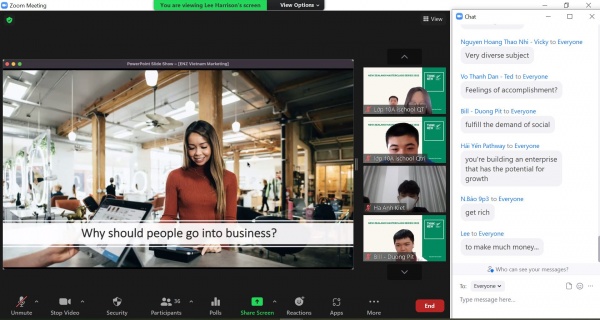
Artificial intelligence, chemical engineering, and sheep milk cheese were among the many and diverse topics covered by 19 academics across the 21 masterclasses, which were offered to students from nine different school chains across Vietnam.

-
High level of interest in vocational education forum
Organised by Skills Consulting Group and Education New Zealand Manapou ki te Ao (ENZ), together with Te Pūkenga, the forum provided an opportunity to share knowledge and insights on best practice in technical and vocational education and training, in an accessible format.
A key theme was the importance of close relationships with industry, particularly in terms of apprenticeships. For some participants, a longstanding perception that higher education is more important than vocational education remains a challenge. Student panel participants also talked about the confidence and support that their parents provided when they were making decisions about whether to enter vocational education programmes, and having no regrets about the career paths followed.
Topics covered included solving skills shortages, apprenticeships, youth employment, lifelong learning, digital transformation, sustainability, and promoting diversity. Senior government officials, major companies, international organisations, sector leaders and students from around the world spoke at the forum, which was opened with a speech from Education Minister Chris Hipkins.
Text-based chat and discussion tools in the virtual environment were multilingual, providing instant translation to enable communication and networking across 28 different languages.
The China – New Zealand Higher Vocational Education Summit was also part of the APAC TVET Forum and featured a dedicated virtual room for Chinese presenters and audience members. The Summit provided a platform to:
- discuss New Zealand’s recent experience of vocational education reform
- further develop cooperation in vocational education between New Zealand and China, building on the existing joint programmes between Te Pūkenga subsidiaries and vocational institutions in China.
Keynote speakers from China included Chen Dali, Deputy Director, General Department of International Cooperation and Exchanges from the China Ministry of Education, and presenters from industry including Wang Jinsheng from Qingdao Technical College.
ENZ Business Development Manager Richard Kyle says APAC TVET is the only forum of its type in the region.
“It was particularly encouraging to see double the number of registrations this year, building on the success of the first forum in 2021. There’s clearly a high level of interest in this event, and it’s a great opportunity to showcase New Zealand’s strengths in vocational and technical education.”
Positive comments were received from many attendees.
“Brilliant tech. Excellent management…and good content.”
“Amazing numbers... Very informative sessions and I’ve got people more interested in our upcoming activities.”
“It was well organised from the invitation to the closure of the forum – well done job!”
-
Education delegation to Asia
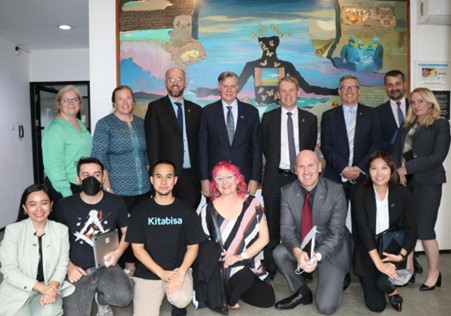
One of the real highlights of the trip for the Minister was meeting New Zealand alumni, compelling ambassadors for a New Zealand education. Vikra Ijas is a former University of Auckland student and co-founder of Kitabisa, a crowd-funding platform in Indonesia. His story of schooling and tertiary study in New Zealand leading to the establishment of his fundraising platform for social good in Indonesia was truly inspiring.
South Korea
The programme in South Korea included the Minister’s speech to the Korean International Education and Career Fair. This is the largest international education fair in South Korea, with an estimated 25,000 attendees. More than 40 New Zealand providers were present, many exhibiting on the Education New Zealand country pavilion.
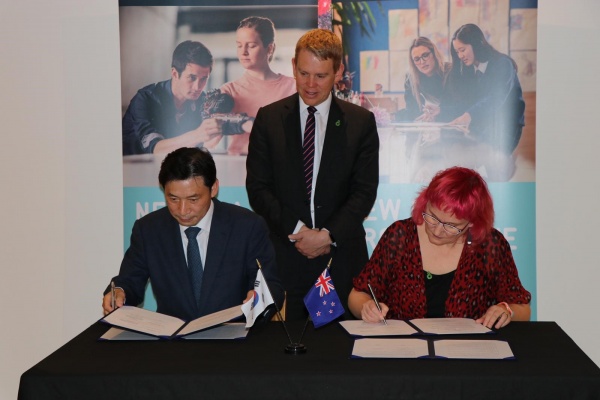
The Minister also witnessed the signing of the Education New Zealand-Incheon Education Cooperation Arrangement (ECA). The formal partnership, based on the ECA, has been designed to establish and strengthen communication ties between ENZ and the Incheon East Asia Global Education Institute, to identify creative areas of potential collaboration and to open up more learning possibilities for our institutions and students.
Minister Hipkins also attended an event with New Zealand education agents, alumni and institutions to celebrate the 60th diplomatic anniversary between South Korea and New Zealand.
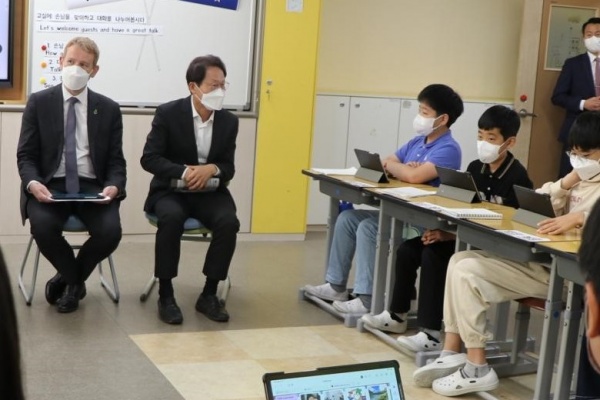
One of the highlights of the Minister’s visit to South Korea was on 24 October 2022, when the education delegation visited Kyodong Elementary School, the oldest school in South Korea (established in 1894). The delegation toured the school and interacted with the students who are participating with Raumati Beach School in the New Zealand - Korea digital cultural exchange programme supported by Education New Zealand and facilitated by Learn English Live.
Indonesia
The programme in Indonesia included bilateral meetings with the Secretary General of the Ministry of Education and Culture, the Coordinating Minister for Human Development and Culture, the Minister for National Development Planning and the ASEAN Secretary-General. The Minister also met with the President Director of Lembaga Pengelola Dana Pendidikan (LPDP), the key Indonesian government scholarship agency, to discuss opportunities to promote New Zealand as a destination for the awardees while further expanding the number of New Zealand institutions eligible to receive the scholarship students.
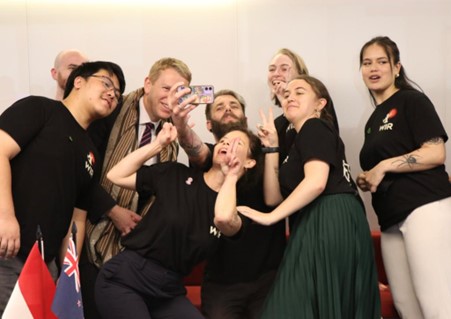
As well as the visit to Kitabisa, the Minister also had the opportunity to meet a group of Kiwi students interning at WIR Group (Metaverse) in Jakarta under the Prime Ministers Scholarship for Asia. The students were thriving on the unique opportunity and wringing every bit of experience from their internship at WIR. He also launched KIWI Challenge 2022, the annual entrepreneurship competition for Indonesian high school students organised by Education New Zealand.
As with South Korea there was a reception in Jakarta with agents, alumni, PMSA students and key stakeholders.
Singapore Visit
The focus of the Singapore leg of the visit was signing the refreshed Education Cooperation Arrangement with the Minister of Education from Singapore. The arrangement, first signed in 2018, confirms New Zealand’s commitment to engaging with Singapore on education cooperation initiatives in key policy areas including early childhood education, digital classrooms/blended learning, vocational and lifelong learning, sports and physical education, STEM uptake, and the development of mental health support programmes for the sector.
The Minister also made several institutional visits. The first was to the Institute of Technical Education Central College to understand where Institutes of Technical Education fit within Singapore’s education ecosystem; and the second was the Public Service Sector and Civil Service College. The purpose of this visit was to understand the role that the Civil Service plays in designing, developing and delivering programmes for the Public Service.
The final visit of the trip was to the Centre for Strategic Focus. The Centre is part of the Strategy Group in the Prime Minister’s Office which was set up to focus on whole of government strategic planning and prioritisation.
“The messages around the strong commitment of the New Zealand government to international education were very well received by our partners,” says ENZ Regional Director Ben Burrowes. “Whether via student mobility, international education partnerships or systems level dialogue, it’s exciting to see the interest generated through New Zealand stepping up its international engagement once again.”
-
Hands-on environmental studies for US students
EcoQuest Education Foundation is a charitable trust and PTE based in Whakatīwai, with strong connections to Ngāti Paoa and Ngāti Whanaunga.
“We had a wonderful day on the Wharekawa Coast,” says Ria Brejaart, EcoQuest’s Academic Director.
“Led by mana whenua, our students welcomed special guests US Consul General Sarah Nelson, Director of USA Study Abroad Heidi Manley, and Senior Education Advisor US Consulate General, Katie Sleeman. EcoQuest’s Board of Trustees and academic associates also attended the event, along with other key supporters.
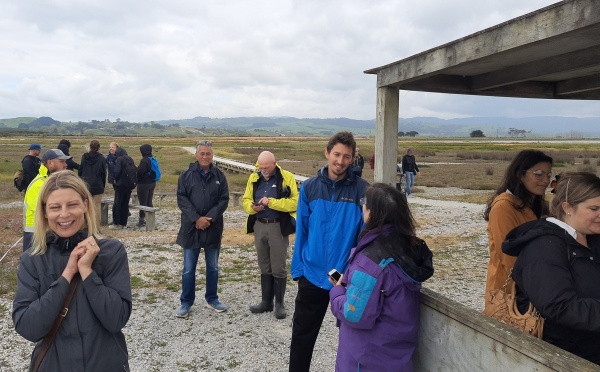
EcoQuest team and manuhiri at the bird hide.
“It was a great way to celebrate both the return of our US students after a long Covid-19 hiatus, and our enduring relationships with our collaborators and supporters. It felt particularly apt to be on the shores of Tikapa Moana, where the kuaka (bar-tailed godwits) return each year from Alaska.
“The morning of observing birds on the shell-banks was followed by a visit to Pūkorokoro Miranda Shorebird Centre, for a talk by Keith Woodley, Centre Manager. We then returned to EcoQuest where we marked the occasion by presenting Tū Ngātahi pins to all our students, on behalf of Education New Zealand Manapou ki te Ao.”
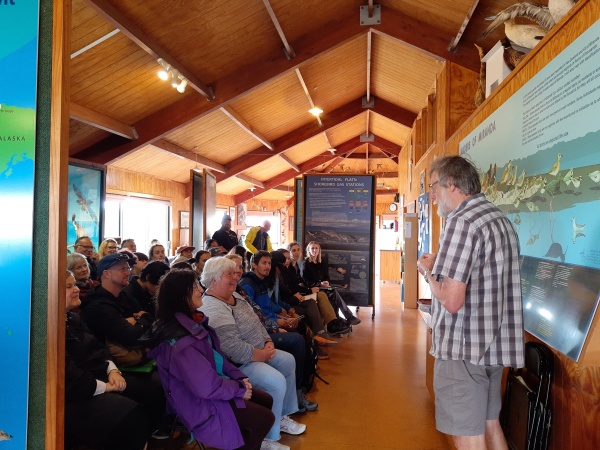
A presentation from Keith Woodley (Pūkorokoro Miranda Shorebird Centre Manager). Front row left, Beth Coleman (EcoQuest Board Chair) and Sarah Nelson (US Consul General).
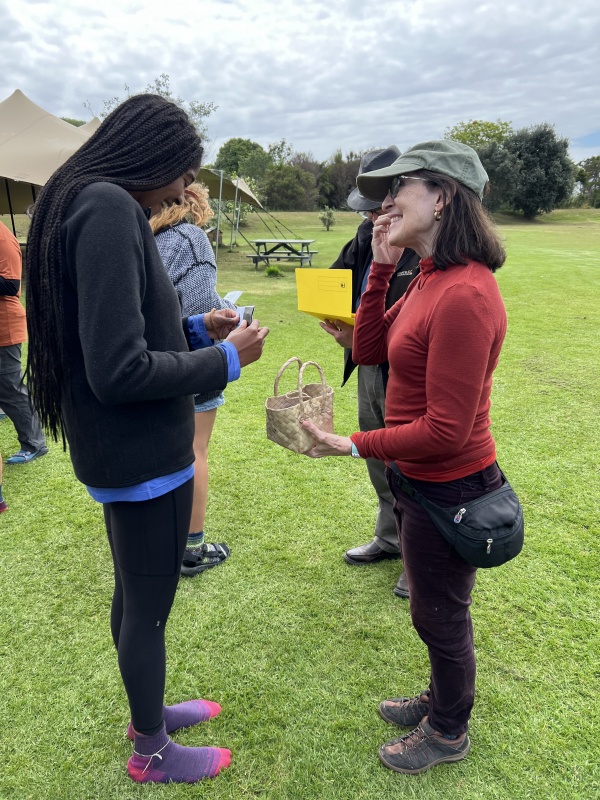
Beth Coleman (EcoQuest Board Chair) and Jono Clark (Director) presented Tū Ngātahi pins to the students.
The eighteen students are from the University of New Hampshire (UNH), Cornell University, University of Michigan, and Colorado State University. They are participating in a fifteen-week residential semester programme with EcoQuest, which offers undergraduate programmes in partnership with UNH. Students gain credits for their undergraduate degrees back home.
“Within the international education sector, EcoQuest contributes high-quality, niche programmes,” says Alana Pellow, Business Development Manager at ENZ.
“These international student programmes align well with New Zealand’s areas of excellence in ecology, restoration ecology, environmental policy, and sustainability. EcoQuest students undertake real-time research for many different collaborators including iwi, NGOs and trusts, councils, private land owners and the Department of Conservation. Academic and scientific rigour are the basis for these unique hands-on learning opportunities.”
“EcoQuest also contributes to international thinking around indigenous approaches to sustainability, through inclusion of elements of Te Ao Māori and mātauranga in its education and research activities.”
The current students are part of Cohort 4, the final cohort of international students to be given entry to New Zealand through a border exception earlier this year. Cohort 4, which was jointly led by ENZ and the Ministry of Education, saw 5,000 international students from 109 different countries nominated for student visas, before New Zealand’s borders fully reopened in August.
-
Prime Minister’s Scholarships to study in Asia and Latin America announced
Education New Zealand Manapou ki te Ao (ENZ) Chief Executive Grant McPherson, today announced the names of 111 New Zealanders who will travel to destinations in Latin America and Asia for an international education experience on a Prime Minister’s Scholarship for Asia (PMSA) or Latin America (PMSLA).
Funds awarded for individuals in this scholarship round total $1.5 million.
The individual recipients are the second round of scholarships to be announced this year. The earlier round of scholarships was awarded to groups.The recipients will undertake study, research and internship programmes in fields such as business, language, indigenous rights, sustainable development and architecture for a minimum period of four weeks (Latin America) and six weeks (Asia) up to two years. The top Latin America study destinations for this round are Chile and Colombia, with Japan and the Republic of Korea most popular destinations in Asia among scholars.
“The merit of our scholarship applicants continues to be impressive – we are proud to offer this opportunity for people to develop their inter-cultural skills, build networks and enjoy experiences abroad,” said McPherson. “We know they will make us proud to have them representing New Zealand in this important time of rebuilding and reconnecting with overseas partners.”
“Interest for this programme continues to grow, building collective skills and understanding of different cultures helps our country show leadership in matters of significance for Asia and Latin America regions.”
Māori Participation lifts significantly
A group of Māori Prime Minister’s Scholarship alumni, Te Kāhui Kaupapa, have been working to raise access and participation for Māori. Participation in this round increased to 22% for PMSA and 17% of PMSLA recipients, compared to an average of 5% for PMSA and 8% for PMSLA rounds in 2016 to 2019. This is part of a wider programme of work to ensure the scholarship programme is more accessible to all New Zealanders over the age of 18, and that it delivers on our Te Tiriti obligations.
The Prime Minister’s Scholarship programme aims to strengthen New Zealand’s ability to engage with key Asian and Latin American trading partners, improving the internationalisation of indigenous communities, New Zealand tertiary institutions, showcasing the strength and quality of New Zealand's education system and enhancing inter-cultural awareness and connections between New Zealand and other countries. The scholarship offers flexible funding to support both short and long-term programmes including study abroad / exchange, internships, postgraduate study, and language programmes.
The scholarships programme is funded by the New Zealand Government and administered by ENZ.
The PMSA was launched in 2013 and extended to Latin America in 2016. To date, there have been 2,879 PMSA and PMSLA scholarships awarded.
There are two scholarship rounds each year, and applications for the next individual round will be held in August 2023. Many of the awardees are enrolled in universities across New Zealand, but this is not a requirement for the scholarship. Any New Zealand citizen or permanent resident over 18 can apply for a PMSA or PMSLA.
More information on the application process can be found here.
A full list of this round of scholars can be found here.
-
ENZ calls for funding proposals for New Zealand-China research partnerships
The New Zealand-China Tripartite Partnership Fund 2023 offers funding of up to NZD 20,000-30,000 for each partnership project, with the call for proposals open until 1 March 2023.
Funding proposals are due by 1 March 2023. Download the New Zealand-China Tripartite Partnership Fund 2023 Guidance and Call for Proposals and the Proposal Form. Send your completed proposal as a PDF, and any questions, to china@enz.govt.nz.
The fund supports new or existing research partnerships between New Zealand and Chinese universities. There are usually three universities involved – two from China and one from New Zealand.
The Tripartite Partnership Fund, administered by ENZ, has a pool of up to NZD 100,000 in 2023 for research partnerships in the arts, humanities, social sciences, sciences and applied sciences. Designed to encourage strategic academic relationships, it supports the creation or development of the partnership rather than funding the research itself.
With the global Covid-19 pandemic restricting some international travel, the fund welcomes innovative ideas. Current investments include digital technology services, communications platforms, translation costs and journal access.
At the recent New Zealand-China 10th Joint Working Group held on 22 November, senior officials at the meeting noted the value of Tripartite research relationships and the impact of having funding from both governments to establish new partnerships or nurture established research collaboration. Li Qing, Deputy Secretary General China Scholarship Council, remarked on the benefits of both student mobility through scholarships and closer research links such as the Tripartite Partnership Programme. The co-chair of the Joint Working Group, Vice Minister Tian Xuejun, stated in his closing remarks that China and New Zealand should continue to strengthen existing cooperation activities, listing the Tripartite Partnership Programme as one of the initiatives.
Lisa Futschek, General Manager International, reinforced ENZ’s commitment to administering the fund.
“We remain committed to the Tripartite Partnership Programme and its valuable contribution toward stronger global connections, research links and partnerships – key goals under the revised New Zealand International Education Strategy, launched by Minister Hipkins in August this year. We look forward to many more partnerships under this programme.”
Established in 2005, the Tripartite Research Partnership is a valued part of the New Zealand – China bilateral education relationship and we welcome proposals from researchers to join the growing list of funding recipients.
Funding proposals are due by 1 March 2023. Download the New Zealand-China Tripartite Partnership Fund 2023 Guidance and Call for Proposals and the Proposal Form. Send your completed proposal as a PDF, and any questions, to china@enz.govt.nz.
-
Teaching English in Korea
The temperature drop of over 30 degrees, didn’t deter Christine Black, teacher from James Hargest School in Invercargill from enjoying a unique opportunity to teach a week-long English programme sponsored by the South Korean government.
Black and two other teachers from New Zealand, Elizabeth Henry from Kowhai Intermediate School, in Auckland and Patsy Richardson, from Te Puke School, in the Bay of Plenty were selected to teach the English programme in South Korea.
The teachers were selected through an application process facilitated by ENZ to teach 15 students from throughout South Korea about New Zealand culture and history at the JEI education centre in Cheonan from 19-23 December 2022.
Through the English Language programme funded by the Korean government, New Zealand teachers were invited to Korea to support Korean school students from rural agricultural backgrounds to extend their conversational and speaking skills. The students also engaged in hands-on classroom activities that included mini science experiments.
The one-off 2022 Korea-New Zealand English Language Training Program was sponsored by EPIS, an agency tasked by the Korean government to support English language training for Korean students and facilitated by Korea FAO Association.
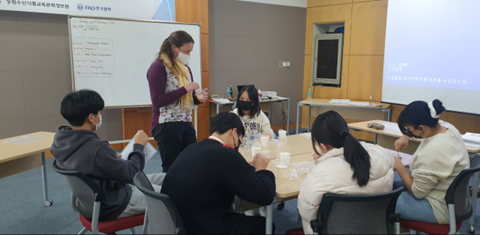
Teacher Christine Black leads the students in an experiment making slime. Photo credit: Korea FAO Association
Yoon Cho, Senior Manager of Korea FAO Association, said it was an experience the students will never forget.
“Well before the teachers arrived, they could feel their passion and enthusiasm for meeting students from rural areas in Korea. I would like to thank the New Zealand teachers who took time to visit Korea at the end of December, especially Christmas week, and made meaningful memories for middle and high school students in Korean rural areas,” Cho said.
School teacher Christine Black was excited for how her first visit to South Korea broadened her understanding of Korean culture.
“It was exciting to travel there to broaden my understanding of this culture as my high school has international students from South Korea. This definitely was a win-win situation to be able to travel somewhere new to me and also share our New Zealand culture.”
As part of the programme, each teacher was responsible for a couple of aspects of New Zealand. Black was responsible for sharing the life of a New Zealand high school student and introduce the different regions of New Zealand and their unique characteristics.
For Patsy Richardson, a teacher at Te Puke School, it was her first time in South Korea, and she introduced waiata to her homeroom group.
“I chose to teach the waiata ‘Tutira mai ngā iwi,’ with actions. We had three 30-minute slots in which to learn it and they had it perfected. Now whether that is because they are willing and diligent students, or I am such a fantastic teacher, is to be debated. The students also performed the waiata at the closing ceremony [for the programme] and it was a great display of cross-cultural connections,” Richardson said.
Despite the short time spent together, it was a great opportunity for the students and teachers to build relationships and cultural understanding between the two countries. The students in Korea were enthusiastic about speaking in English and enjoyed learning some Kiwi slang.
An intermediate school student, Kyungdon Joo, said he studied English and made new friends during the training which gave him a new perspective. “Now I have another goal: To go to New Zealand and learn more about New Zealand.”
For Elizabeth Henry, a teacher from the Auckland region, the English teaching programme was more than the opportunity to enhance language skills. Henry recognised the importance of being a cultural ambassador as she was one of the first New Zealanders the students had ever met.
“I was prepared to bring my best teaching practice to this opportunity prior to the trip not realising that once in Korea, the picture of my purpose there was so much bigger than I had anticipated. Not only did I bring my very best teaching practice to all the students I taught, my mindset changed, thinking one day these children will share this experience with their family and friends.”
Final reflections
Black reflected on the opportunity it provided for the New Zealand teachers as well as students.
“I think it is really important for teachers to grab opportunities like this, especially as there is more and more diversity in our classrooms, and it is important to get first-hand experience of other cultures.”
Henry summed up the English language teaching experience well. She hopes that whenever the students think of New Zealand “a happy memory pops into their mind from this experience.”
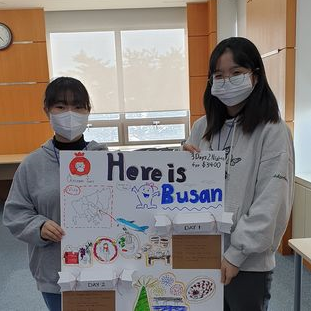
Students present their destination marketing posters Photo credit: Patsy Richardson
Education New Zealand Manapou ki te Ao would like to thank North Asia CAPE and regional education bodies for sharing the opportunity with contacts. This was a one-off overseas short-term teaching programme organised by the South Korean government. ENZ will continue to share these opportunities as they arise with education cooperation partners through the CAPE and regional education channels.
-
Welcoming students and tourists to New Zealand as China re-opens borders
The successful local engagement – which was held both in person and via live stream – had nearly 60 school principals and educators attending in person and attracted more than 21,000 views (you can watch the presentation in Chinese language here).
The study tour forum was a part of the 2022 Redefine Asian International Schools and Education Conference (RAISE) in Guangzhou (postponed from December 2022 due to COVID outbreak). The RAISE Conference attracted 500 senior school leaders and teachers from more than 200 bilingual and international schools to discuss together the future of the international education in China.
The forum saw ENZ’s Senior Market Development Manager – Greater China, Felix Ye present an overview of New Zealand education for attendees. While Tourism New Zealand’s Strategic Relationship Manager, Alfred Li, and South China Trade Manager, Sandy He, shared an update focused on tourism in New Zealand.
Three Auckland-based operators from the education and tourism industry participated virtually and shared their knowledge. Gordon Chang, Founder, Southern Cross Ecotourism & Education Ltd spoke about the New Zealand ecotourism experience they offer their students. Fan Zhou, Director of Go New Zealand International Ltd spoke about how their study tour and short-term study programmes that are designed and developed for New Zealand schools, deliver both fun and education. Lisa Li, General Manager of China Travel Service (NZ) Ltd talked about their offering with over 20 years of award-winning tour services to Chinese customers.
ENZ’s Regional Director Greater China, Michael Zhang said marking the first day of China’s borders re-opening with a forum to promote Aotearoa as a study and travel destination was both timely and symbolic.
“The removal of quarantine for international arrivals in China has been eagerly anticipated by the education and tourism sectors. This was another example of excellent NZ Inc collaboration – thanks again to the Tourism New Zealand team!
“We can now build on the work that NZ Inc and New Zealand providers have done while travel was restricted and step up our engagement with local partners in 2023. Chinese students and travellers are keen to get back out into the world, and we look forward to seeing New Zealand providers back in-market soon”.
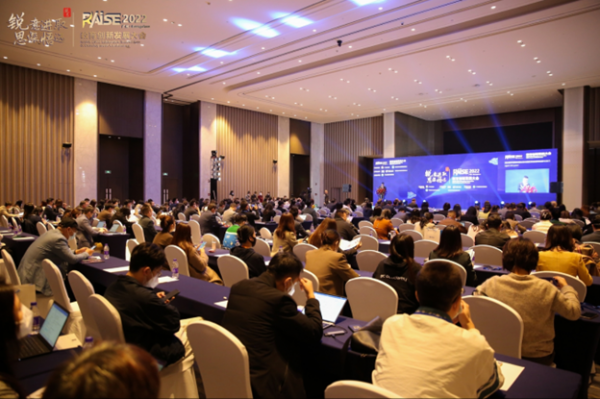
Redefine Asian International Schools and Education Conference, Guangzhou
-
March update from Immigration New Zealand
Update on Student visa processing*
Since New Zealand’s international borders reopened in August 2022, Immigration New Zealand (INZ) has received 29,228 student visa applications from international students outside of New Zealand. We have completed 24,549 of these applications.
Our recent processing times for international student visa applications are published on our website. These are updated each month: Visa processing times for international students | Immigration New Zealand
*Figures current as at 10pm on 6 March 2023.
Impact of Cyclone Gabrielle on international students
We are aware that some education providers' campuses have been damaged by Cyclone Gabrielle and have been forced to close temporarily.
This affects students’ immigration status because their current student visa requires them to attend the place of study specified on the visa which may not be currently possible. We understand that this is a difficult time, and we would like to help. An information sheet has been developed for affected international students and can be found here.
Approval in Principle timeframe
We have shortened the standard length of time we allow most offshore students to provide a tuition fee receipt (or other financial evidence) from ten to five working days to encourage students to complete the final steps of their student visa application quickly. We understand that some students may not be able to provide evidence in the timeframe they are given due to their individual circumstances. Extensions to this timeframe are available – the student or agent just needs to upload a brief letter explaining how much longer they will require and why.
Tuition fees
We would like to remind you that changes to the requirements for tuition fee payment evidence for students were introduced last year as part of the Immigration Rebalance.
Students need to pay tuition fees for the first year, or first programme of study (whichever is the shorter), and they will have to prove personal/maintenance funds for the same period. We do not accept payment of tuition fees by instalment; the only exception is for some aviation students.
Agent declaration
If you are providing advice or assistance with a student visa application - DECLARE yourself in the application. Education agents outside New Zealand are permitted to give immigration advice on student visas but must declare themselves in the application. We are seeing increasing numbers of agents not declaring themselves and these applications may take longer to process as a result.
INZ is intending to resume reporting on agent visa approval rates later this year, probably in September/October. If you are not declaring your involvement in an application, this will have an impact on your publicly available performance information. Education providers in New Zealand will be encouraged to check the agent performance report.