Search
Showing 10 of 2262 results for read 2024 FRM Exam Part I - Quantitative Analysis online free
-
NZ admissions staff key to sustainable industry
There are relatively small numbers of people working in the area of international qualifications in New Zealand, so training and the sharing of knowledge is vital.
To support this need for professional development, AUT and ENZ jointly hosted UK NARIC to run training sessions on 17 and 18 September for New Zealand admissions staff. The workshop also provided a valuable opportunity for admissions staff from around the country to share their knowledge and expertise.
UK NARIC is the designated United Kingdom national agency responsible for providing information, advice and expert opinion on vocational, academic and professional skills and qualifications from over 180 countries worldwide.
The sessions were well attended and well received. Here’s some of the feedback, grouped under each of the four training session topics.
Evaluating International Qualifications.
This session provided some guidance in the all-important area of qualification evaluation.
-
This session helped me to understand different models of education and evaluation process of international qualifications. Among the four traditional education models of: Anglo- Scottish, American, Humboldt and Napoleonic. The first two models are quite straight forward, unlike the last two!
-
Exercises in identifying which model to apply where, gave us better understanding of the entry requirements, duration, progression route and qualification comparison the various qualifications.
-
I now have a greater understanding on what to request and look for while checking and accepting documents.
Degrees of Deception.
This session looked at the worldwide problem of applicants presenting fraudulent documents to ensure a place in a learning institute.
-
The overview, general and brief as it was, gave me a starting point as to the kinds of alterations to look for when presented with a document for assessing.
-
A major part of an admissions staffer’s daily workload includes deciphering international documents and recognising the difference between acceptable and fraudulent qualifications. The NARIC training course has made me think twice and question things I may have otherwise not thought about.
Education in China.
This session gave an overview of the structure of the education systems in China.
-
As well as gaining a general understanding of the Chinese education system in different provinces, I found the session on numbers and dates in Chinese characters particularly helpful, as it helped me get a precise understanding of the course duration, start date and completion date in order to verify authenticity of the translation. Also, the exercise we did identifying Chinese characters to confirm the school and entry to higher education will help me to understand Chinese certificates more easily.
-
The other interesting exercise was identifying the authenticity of the certificate by looking at its serial number. After this session I am clear about how to read the transcript and the completion certificate.
Education in North America.
This session gave an overview of the structure of the education systems in North America.
My top three takeaways from this session were:
-
There is no national qualifications framework in Canada, thus there is a lot of variation in education between the provinces.
-
There is also no national accrediting body in Canada to evaluate the quality of all degree programmes, although a number of regulatory authorities perform this function for programmes in professional subjects at both the undergraduate and graduate levels.
-
Many countries in the Caribbean have very few nationally accredited higher education institutions, so links with international universities to offer recognised qualifications are common
Ways in which the training will change or improve the way I work:
-
More knowledge of the education systems in North America will make it easier and more efficient to assess applicants from this area, as less time will be spent looking up information.
A particular challenge in my job that is now made easier since having the training:
-
The training provided specific information on the difference between vocational and academic Associate Degrees from the United States. This was useful as we only accept Academic Associate Degrees for University Entrance and it was previously not always easy to identify if the qualification was academic or vocational.
-
-
Generation Study Abroad and Travel Award winners announced
ENZ has awarded five students US$2000 travel stipends: Cooper Frantz Geddes, Raquel Goutierez, Emma Hardy, William Pahutski and Phoebe Stark.
A further nine students received US$500 from New Zealand universities towards their study costs.
An example of a ‘Kiwi ambassador’ - US student Jake Voss shares his New Zealand adventures on the SiNZ Instagram.
To apply, students had to submit an essay explaining why they wanted to study in New Zealand and serve as ‘Kiwi ambassadors’ on social media.
ENZ’s Director of Education, North America, Amy Rutherford said this support is part of ENZ’s commitment to helping US students experience New Zealand universities.
"These programmes open up new opportunities for US students seeking to study in New Zealand.”
Launched in 2014 by the Institute of International Education, GSA is an initiative to double the number of American students who study abroad by the end of the decade.
ENZ has provided more than 24 scholarships to US students since the programme’s inception, selecting recipients on the basis of academic excellence, leadership skills and ambassadorial qualities.
In addition to the GSA Awards, ENZ and the US Department of State recently announced a new $100,000 partnership in support of the Benjamin A. Gilman International Scholarship Program, which enables students of limited financial means to study or intern abroad.
To read about the winners’ Kiwi adventures, visit their blogs:
Cooper Frantz Geddes http://coopertakeschristchurch.blogspot.com/ Raquel Goutierez http://raquelalexis.weebly.com Emma Hardy https://emkathardy.wordpress.com/ William Pahutski http://billsnewzealandadventure.weebly.com/ Phoebe Stark https://therockytopkiwi.wordpress.com/ Maya Calderwood https://studynz17.wordpress.com/2017/04/27/why-new-zealand/ Sadie Dix https://mynewzealandchronicles.wordpress.com/ Eliza Fallick https://efallicknz2017.wordpress.com Carli Fawcett http://newzealandadventures.webs.com/ Michael McGaw https://michaeltakesonnewzealand.wordpress.com/ Daniel Patel http://danpinnz.blogspot.com/2017/04/im-off-to-new-zealand.html Ellie Peoples https://passportpagesweb.wordpress.com/ Kelsey Woody https://kelseywoody22.wixsite.com/website/blog Josie Davis https://medium.com/@davis.josie01 -
Journey to transformational student experience
To tackle this challenge, ENZ and Study Auckland recently undertook an International Student Experience design project.
The goal of the design project was to provide detailed international student experience insights that can help education institutions lift their student satisfaction and referral rates, says ENZ Director of Student Experience, Hayley Shields.
Four areas of opportunity were prioritised: information provision, employability, social connectivity and shared values. From these, guiding principles were developed for how international students’ needs can be addressed to create unique value to the student experience in these areas.
Hayley says the New Zealand industry needs to focus beyond the on-campus experience.
“International students come to New Zealand to experience life beyond their studies and to grow as individuals.
“In true manaakitanga spirit, if we want to host, care for and respect our international students, we need to design programmes that are student centred.”
As part of the report, more than 80 face-to-face conversations were undertaken with students, business people and local community representatives. The students interviewed came from 16 countries in Asia, Latin America and North America.
The findings of the report were also informed by a wide range of international research projects which featured insights from leading global surveys on international student, parental and employer expectations.
The full report can now be accessed in IntelliLab here.

An example of an off-campus student experience was Study Auckland’s Rugby Have-a-Go Day for international students in July, where All Blacks players taught basic rugby skills. Through this, international students had a taste of Kiwi culture, and learned how rugby’s values can help form bonds and leadership skills. You can read more about the experience here.
-
Minister Hipkins welcomes new Board members
During the meeting, Minister Hipkins shared his views on the importance of the new International Education Strategy, ENZ’s role and how international education fits within the Government’s plans for a modern and prosperous New Zealand.
John Goulter, ENZ General Manager, Stakeholders and Communications, said the meeting was a good opportunity for the new Board members to hear directly from the Minister what the Government’s priorities are for the sector.
“Each Board member brings a great deal of experience to the Board and fresh perspectives to ENZ’s work yet it’s equally important for them to understand the Government’s position and what Minister Hipkins sees as their role.”
There was general agreement at the meeting that launch of the new Strategy reflected international education’s importance as an export sector for New Zealand, with ample opportunity for providers to grow the value of the sector around the world, he said.
Also discussed was the interface between international education and immigration, the future of the global international education market and the importance of showing how international education contributes to New Zealanders’ wellbeing.
International education’s importance to New Zealand’s bilateral relationships and the desire to see more New Zealanders studying overseas as part of their studies was also covered.
Read more about the ENZ Board members here.
-
Mortal Engines offers ENZ opportunity to showcase education strengths in creative arts to prospective students
The New Zealand premiere of Mortal Engines took place in Auckland last night and the film is released to New Zealand audiences from today.
ENZ and the New Zealand Film Commission (NZFC) have partnered with Universal Pictures, MRC and Hungry City Limited on the film as part of the New Zealand Screen Production Grant 5% uplift.
ENZ Chief Executive Grant McPherson says this partnership is a great opportunity to build awareness of New Zealand’s world-leading education system – particularly in the creative industries.
“Mortal Engines marks a real shift in the New Zealand story we want to tell the world,” Mr McPherson says.
“This film was made in New Zealand not because of the beauty of our landscapes but because of the depth of talent and level of technical sophistication available here.
“The partnership allows us to showcase New Zealand’s education strengths in the creative arts. It supports our brand positioning of New Zealand as a modern, dynamic and innovative country with a lot to offer in the highly competitive international education market.”
The last few years have already seen growing numbers of international students studying creative arts in New Zealand – 5,139 in 2017, up 24% on 2012.
Principal photography took place in Wellington in early 2017, and involved more than 1000 New Zealanders including crew, cast and craftspeople. The film was shot at Stone Street and Avalon Studios and at a few small local exterior locations. Post production was completed by Park Road Post Production with visual effects work realised by Academy-Award winning company Weta Digital.
Crew members included recent graduates (including several former international students): an assistant props designer who studied Industrial Design at Victoria University of Wellington, an apprentice editor who studied at South Seas Film School in Auckland, a film editor with a Bachelor of Digital Design from Auckland University of Technology, and a visual special effects capture booth photographer who studied animation at Yoobee School.
Grant says the partnership has provided an opportunity for ENZ to tell graduates’ stories to other prospective international students through an integrated promotional campaign, including PR, digital marketing and social media activity across our channels which have more than one million followers.
The campaign will begin in January 2019. There will be a Mortal Engines page on the Study in New Zealand website which will encourage prospective students to sign up to ENZ’s database. A series of emails will follow to this qualified audience providing information about a variety of design disciplines and courses related to filmmaking.
“Our goal is to generate awareness of New Zealand’s specialised courses and hands-on learning style in the creative industries through sharing videos and profiles celebrating our graduates who worked on the film,” says Grant.
“We look forward to getting the marketing campaign underway next month, and attracting more high-quality, creative international students to study in our institutions.”
You can read the full media release here.
-
New Zealand tops English-speaking countries in Educating for the Future ranking again
New Zealand retained its ranking from 2018, with an overall score of 79.9, close behind Sweden (84.3) and Finland (84.8), which topped the rankings.
New Zealand achieved a top score in the index’s socio-economic environment category, which measures how education systems expose their students to global values such as gender equality, civic freedom, and diversity and tolerance.
The index’s socio-economic environment category compares freedom of religion and the press, gender equality, attitudes toward immigrants, and protecting the environment.
“High-income economies have the most open societies and are therefore conducive to learning future-oriented skills,” the EIU 2019 report said.
New Zealand also ranked among the top five countries in the education policy environment category, which tracked economies focusing on critical thinking, digital skills and soft skills as part of the secondary school curriculum.
“It’s a fantastic result for New Zealand to have retained our top global ranking in the English-speaking world as well as the Asia-Pacific region,” ENZ Chief Executive Grant McPherson said.
“It’s great to see New Zealand do so well in the index’s socio-economic environment category that measures exposure to global values such as diversity and tolerance.
“Future skills are vital to advancing these global values.”
The index assesses the effectiveness of education systems in preparing students for the demands of work and life in a rapidly changing landscape.
It focuses on young people aged 15-24 in 50 economies, and measures three pillars of education systems – policy approaches, teaching conditions and broader gauges of societal freedom and openness – as a means of readying young people to meet the challenges of work and society in future.
Read the full report at this link.
The top 10 country rankings (2019 Educating for the Future Index) were:
Rank
Economy
Score
1
Finland
84.8
2
Sweden
84.3
3
New Zealand
79.9
4
Singapore
79.7
5
Netherlands
79.2
6
Canada
79.1
7
Switzerland
78.5
8
Australia
77.8
9
Germany
74.9
10
Japan
74.2
-
Updated timeframe for the re-opening of New Zealand's borders
Note: The information in this story was correct at the time of publication, however, some steps in New Zealand's border reopening plan have now been brought forward. Click here to check the current border reopening steps.
“To slow the rapid spread we have seen overseas, we are pushing out the start of non-MIQ travel until the end of February 2022”, COVID-19 Response Minister Chris Hipkins said.
You can read the full announcement from the Government here.
The Government has not yet announced the date from which any specific group of foreign nationals, such as international students, will be able to travel to New Zealand or apply for visas to do so.
Until then, New Zealand’s current border settings will remain in place. Most people outside New Zealand cannot apply for a visa unless they have a border exception. There are limited border exceptions for international students.
New Zealand suspended most offshore visa applications from August 2020 and that suspension currently extends to August 2022. The Government may decide to lift the suspension, in whole or in part, before August 2022 – in line with its decisions on the stages of the border re-opening.
It is Education New Zealand’s view that it is better for international students, education providers and agents to wait for certainty on border entry conditions before making new plans or commitments to students.
At this stage, in most cases, if international students who are now in New Zealand leave, they will not be able to return to the country for the start of the 2022 academic year. They will need to wait to apply for visas and to travel to New Zealand until the dates the Government sets for them to do so.
At Education New Zealand we understand how much international students and education providers have been through during the COVID-19 pandemic. We will keep students and providers up to date with the Government’s decisions as they are announced.
We are looking forward to welcoming international students back to New Zealand.
More information
Find out more about visas from Immigration New Zealand if:
- You want to enter New Zealand
- You want to study in New Zealand
- You are a student visa holder already in New Zealand.
Find out more about New Zealand’s response to COVID-19:
- Official government Covid-19 website
- International travel and transit
- Information for international students on NauMai NZ
-
From the CE: Memorable trip highlights value of international education
This was the first mission led by the Prime Minister since our borders closed in 2020, and it combined education, tourism, New Zealand businesses and government agencies. It sent a clear message that New Zealand is open for business and ready to reconnect with the world.
A couple of excellent things happened in Singapore from an education perspective, the first at Gardens by the Bay, which is a nature park of more than 100 hectares, visited by around 14 million people every year.
At a ceremony to mark the unveiling of a bespoke Māori carving, the Chief Executive of Gardens by the Bay, Felix Loh, spoke about his education experience in New Zealand 30 years ago. He said that studying for a Bachelor of Horticulture at Massey University had a huge impact on his life and career, not only because of what he learnt from his studies, but also because of the care and support he received here. It was a great endorsement of the best that an education in New Zealand can offer and highlighted to everyone who heard him that international education brings long-term value.
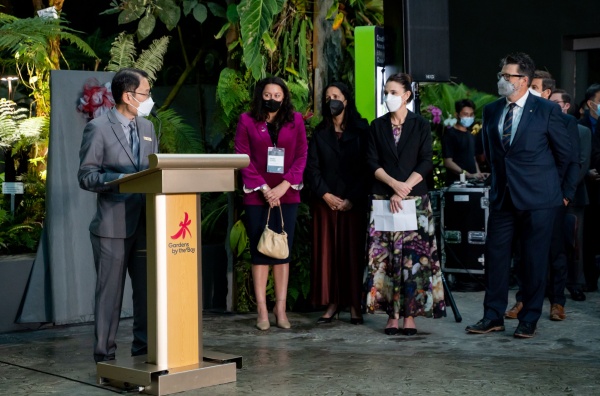
Image: Felix Loh, Chief Executive of Gardens by the Bay, speaks at the ceremony to mark the unveiling of a bespoke Māori carving. Photographer – Karan Gurnani, 35mm.
We had a similar experience the following day, at the signing of an MOU between the Singapore Institute of Technology (SIT) and FoodBowl, a New Zealand food innovation network based in Auckland. The senior signing official for SIT was their President, Professor Chua Kee Chaing, who was a student in New Zealand 40 years ago. Again, we saw the warmth and long-term relationships that are generated by international education.
The Japan part of our trip featured several events with a specific focus on international education, including signing an agreement with Japan Women’s University, relaunching Game on English for female rugby players, and an event at the Cookie Time store in Tokyo with an opportunity to meet previous participants in the working holiday scheme, including former students. You can read more about these events in a separate article in this issue of E-News.
It was great to meet people who feel such a strong connection to New Zealand, even after many years have passed. We often refer to the social, cultural and economic benefits of international education – what we experienced on this trip brought those words to life and marked another significant step on our path to rebuild New Zealand’s international education sector.
He aha te mea nui o tea ao? He tangata, he tangata, he tangata
What is the most important thing in the world? It is people, it is people, it is people.
Grant McPherson
-
Prime Minister welcomes international students
One of many welcome events around the country since our borders reopened at the end of July, the ceremony was attended by more than 70 students, as well as representatives of UoA and Education New Zealand Manapou ki te Ao (ENZ). It was an emotional moment for some of the students, who had been waiting a long time for the opportunity to study here.
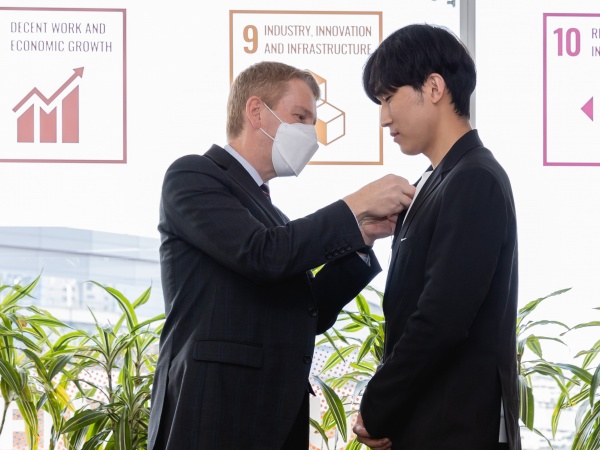
Minister Hipkins presenting a Tū Ngātahi pin to international student Kyeongmin Kang from English Language Academy
Tū Ngātahi pins were presented to international students Petchpiangpor Sueasuwan from Western Springs College; Kyeongmin Kang from English Language Academy; and Ankeeta Karmakar from UoA by the Prime Minister, Minister Hipkins and UoA Vice-Chancellor, Professor Dawn Freshwater respectively.
ENZ Chief Executive Grant McPherson explained the significance of the Tū Ngātahi pins, which you can read more about here.
The formal welcome was followed by morning tea, with further exchanges of Tū Ngātahi pins and opportunities for photographs.

Professor Dawn Freshwater, Vice-Chancellor at University of Auckland, with university student Ankeeta Karmakar.

International student Malina Grube from the University of Auckland spoke about her experiences here, and her involvement in the kākahu project.
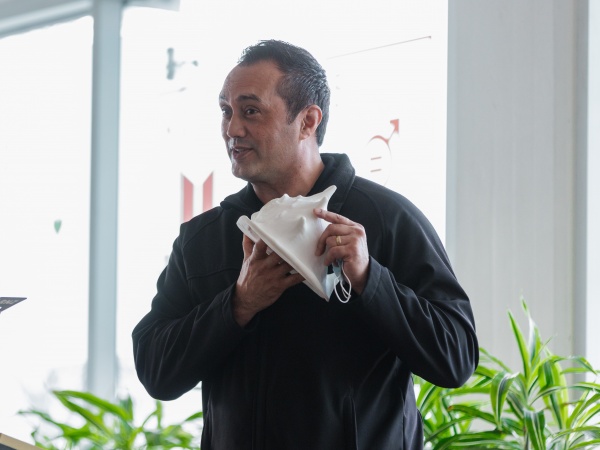
Michael Steedman, Kaiarataki at the University of Auckland, demonstrated a 3D-printed conch shell as part of his welcome to guests – a metaphor for new arrivals and new opportunities.
-
NZ’s updated Code of Practice – caring for international students
The following article is based on a presentation by Julia Moore from the New Zealand Qualifications Authority (NZQA) at NZIEC KI TUA 2022 in August. NZQA is responsible for administering the Education (Pastoral Care of Tertiary and International Learners) Code of Practice 2021 (the Code), which came into effect in January this year.
All domestic and international tertiary students, and international students in schools, are now covered by the Code. Offshore learners are also covered, with updated guidance from NZQA explaining what is expected, and what pastoral care might be provided for people studying offshore.
Wellbeing is closely connected with success in education, and this is recognised in the updated Code. The Code signals a new way of thinking about success for learners which includes wellbeing and acknowledges that being heard and responded to is part of wellbeing.
“International learners should be able to have their voices heard and heeded,” Julia said.
The Code sets a framework for the relationship between providers and students. It acknowledges solutions are best found locally, so the Code requires providers to work out what is appropriate in their own setting, and for meeting the needs of diverse learners. Learners and their communities need to be included in the design, review, and improvement of practice. Taking care of international learners has become an organisation-wide responsibility for the education provider, rather than the sole responsibility of pastoral support teams or the international office.
“We aim to support providers’ continuous improvement in taking a whole-of-organisation approach to pastoral care, honouring Te Tiriti o Waitangi, and responding appropriately to the diverse voices and wellbeing needs of their learners,” Julia said.
You can listen to NZQA’s full presentation at the link below.
NZQA holds regular workshops on the Code, and you can find out more here
Links to further information:
Read the Education (Pastoral Care of Tertiary and International Learners) Code of Practice 2021
Code resources for tertiary providers
Code resources for school signatories
If you have any questions, please email the code team at NZQA: Code.Enquiries@nzqa.govt.nz