Search
Showing 10 of 2262 results for read 2024 FRM Exam Part I - Quantitative Analysis online free
-
Why country preference matters for international student experience
The 2025 International Student Experience Survey has recently closed. Many thanks to all providers who encouraged participation from their current or recent students.
As we grow our timeseries we aim to look below the topline findings for additional nuggets of information. For example, in our analysis of the 2024 International Student Experience Survey we looked at how a first-choice preference of study destination may impact eventual student experience.
Summary of findings
- 78% of international students currently or recently studying with a New Zealand provider reported that New Zealand was their number one choice of study destination.
- Of the 22% of respondents for whom New Zealand was not their first choice, Australia was most preferred (32%), followed by the USA (17%), Canada (15%), and the UK (14%).
- The most common reasons people gave for selecting a country other than New Zealand as their first choice of study destination was that their preferred country has ‘a good standard of living/is a developed country’ (26%), good institutions/education providers (24%), ‘a high quality of education’ (23%), and ‘good employment opportunities’ (23%).
- Country preference matters for student experience: Overall, experience scores were higher for those who reported that New Zealand was their first-choice destination for international education (median score 8 out of 10) compared to those for whom New Zealand was not their first choice (median score 7 out of 10). This effect persisted controlling for age, gender, subsector, and home country.
ENZ’s Director of Insights, Marie Clark, says that her team will be looking to focus on more of these sorts of insights for the coming year.
“With global policy changes impacting student decision making around country preference, it is important to understand how this might flow on to influence student experience and, even more importantly, actions providers can take to improve the experience of students for whom New Zealand may not have been the first choice for a study destination,” Marie says.
Recommendations for education providers to ensure a positive student experience
Irrespective of whether New Zealand is a prospective or current international student’s preferred study destination, education providers can take the following actions before and during the student application phase and after enrolment to ensure a positive overall student experience.
Prospective decision-making phase
1. Clearly articulate the benefits of studying in New Zealand, followed by benefits offered by specific locations and education providers to ensure that students have a broad idea of the New Zealand way of life.
2. Identify the key drivers of choice for your target students and if those drivers focus around country, course or provider choice.
3. Ensure that those supporting student decision-making are equipped with the same knowledge as well as how New Zealand compares to the alternative destinations that the prospective student may be considering.
Application and enrolment phase
4. Invest in pre-arrival communications, take the time to reinforce the choice of destination with both the international students and their influencers.
5. Ensure pre-arrival communications address common challenges or challenges regularly highlighted by international students of a similar demographic.
6. Consider how international students can begin to build their networks and local connections to ensure a smooth transition.
During study
7. Identify if there are a group of students at your institution, who may have been actively considering an alternative destination.
8. Look at which aspects of student experience have the most impact on overall experience and invest your resources there. For example, enhancements to living experience scores are likely to have the most impact on overall student experience.
-
NZ firm a finalist in global EdTech 2017 Awards
"We're delighted," said Lift Education Publishing Manager Matt Comeskey. Lift Education is a division of South Pacific Press Limited.
Matt described CSIPrivate Eye as "an online series of solve-as-you-read mysterious, interactive adventures".

Lift Education Publishing Manager Matt Comeskey
"It is aimed at engaging students in years 4–9 in reading and writing, while boosting their literacy and critical thinking skills. Students travel back and forward in time, and use fun digital tools to navigate their way through each adventure," said Matt.
Mysterious topics include a 'forgotten' moon landing, a disappearing pharaoh, an ancient terracotta army, a remarkable castaway tale and a New Zealand mystery – The Ship that Time Forgot. Each online experience contains science, history, geography, maths, and more.
"In addition to learning about fascinating topics, students use their close-reading skills and strategies, vocabulary acquisition, and reading fluency to engage with the texts. They also write and record their observations and predictions online as they gather evidence."
CSI Private Eye was made available to schools in early 2016. To date, about 25,000 student accounts have been allocated across seven countries, with approximately 400 schools/700 classes signed up to either a trial or a paid subscription.
So far, six interactive adventures have been developed, along with comprehensive writing lessons, teacher support, adventure walkthrough documents, and curriculum correlations for New Zealand, Australia, the US, UK and Hong Kong.
Matt said feedback had been overwhelmingly positive, with one principal saying his students' engagement was "off the scale" particularly for boys.
He put this down to several factors including the tool's story-telling approach, interactivity, high quality visual content, and the fact it was browser-based (no software downloads required).
CSI Private Eye development was enabled with a $50,000 match funding grant from Education New Zealand via the IEGF fund. This allowed for the illustration and technical development of each adventure.
Matt said his company planned many more adventures in the CSI Private Eye series.
"We want to build a large library of stories from around the world, accessible in several languages and at various difficulty levels."
Winners of the EdTech Digest Awards will be announced before end of March 2017.
Video: https://tinyurl.com/zm8y2yr
Demo and free trial (NZ) www.csi-literacy.nz/demo
Demo and free trial (US) www.csi-privateeye.com
-
Around the world in five
CHINA
International students from China need extra support, say experts
US student agency WholeRen says Chinese students need extra support to succeed at universities, due to ‘only-child’ syndrome – Chinese students are typically a single child and come from a different education system, language and culture.
INDIA
Demand for education technology in India is huge – the challenge is language
There has recently been a sharp rise in India in the use of technology in education. Nick Cain, Project Manager (Education) at Google.org, talks about technology’s potential in providing quality education.
JAPAN
Most international students opt to stay in Japan after graduation
A survey conducted by the Japan Student Services Organization found that nearly three-quarters of international students in Japan at universities and other educational institutions remained in Japan to pursue employment or a higher degree.
MALAYSIA
Malaysia’s education is outdated says new education minister Mahathir
Malaysia’s new Prime Minister says the country’s teaching is “outdated” and wants to introduce online teaching so that Malaysians will be more computer-savvy.
UK
Slow uptake in study abroad, but student profile increasingly diverse
In 2017, UUKi launched a campaign to double the number of outbound international students by 2020. While the number in the latest report was near identical to the previous cohort, the findings revealed a more diverse range of undergraduates are choosing to study abroad.
-
Around the world in five
CANADA
Faster student visa processing for four Asian countries
Canada has launched a Student Direct Stream to make visa processing times faster for eligible students from China, India, Vietnam and the Philippines.
GLOBAL
Let them talk: The power of student reviews
Candid student reviews of study destinations and institutions have a profound impact on prospect engagement, search optimisation, and the overall effectiveness of the recruitment marketing effort.
US
Soft power declines as number of international students shrinks
The decline in international students studying in the US may mean a decline in the US’s soft power, according to two researchers at the University of Pittsburgh.
SOUTH EAST ASIA
Ed-tech start-up raises $8.5 million from Malaysian investors
An education technology start-up has raised $8.5 million as it aims to keep building its platform for hosting massive open online courses. The business has seven Australian universities and 30 Malaysian universities as customers.
UK
UK relaxes visa rules for students from 11 ‘low-risk’ countries
The UK Home Office has announced a revised immigration policy, no longer requiring student applicants from 11 countries to show proof for educational, financial and English requirements. The revised list does not include India, which The National Indian Students and Alumni Union UK has called unfair.
-
Around the world in five
JAPAN
Japanese-language schools expand offerings overseas
Japanese education companies are expanding their language offerings overseas to meet the growing demand for Japanese-speaking foreign manpower as the nation opens its doors to workers from overseas.
THAILAND
Thailand eyes lifelong learning push
To address concerns that Thailand’s “outdated” education system can no longer offer "future-proof" degrees for students, there are calls to develop a lifelong learning approach comprised of online learning, in-line learning, beeline learning and frontline learning.
US
US Department of State endorses education agencies
In a historic move, the US Department of State has officially endorsed the usage of education agents, with a State Department representative expressing a desire to “work together to promote the United States as the destination choice for international students.”
INDIA
India needs better strategies to promote 'Study in India'
Earlier this year, the Indian Government launched a ‘Study in India’ website to help foreign students find Indian universities, but more needs to be done. There were only 46,144 foreign students in India in 2017, but higher numbers could significantly boost India’s soft power and university rankings.
FRANCE
French university fees for non-EU students set to rocket
University fees for students outside of the EU, which will include Brits after Brexit, are set to shoot up by as much as 16 times the current cost, the French prime minister has announced.
-
eVisas and VisaView coming soon
From 7 December, eVisas (passport-free applications and label-less visas) will be available for many students who apply online, joining the one thousand applicants who are applying for visas electronically every week through Immigration ONLINE.
At the same time, New Zealand education providers will become able to use Immigration New Zealand’s VisaView service to check whether a non-New Zealand student can study with them.
eVisas
INZ will extend eVisas to the following online applicants:
-
People applying in New Zealand to renew their Work, Visitor and Student visas (except Chinese nationals)*
-
People from visa-waiver countries applying outside New Zealand for a Work, Visitor or Student visa (citizens of visa-waiver countries do not need a visa to travel to New Zealand as a tourist for less than three months).
These applicants will not have to send in their passports to INZ when they submit their applications online. The visa holder will receive their visa approval notification through their Immigration ONLINE account, and may print their visa record from their account. This notification contains visa details, including travel and other visa conditions.
Visa holders are advised to carry their visa approval notification when they travel. Online systems allow airlines to confirm that a person can travel to New Zealand, but the visa approval notification can be used as an additional confirmation if requested.
Further information about eVisas is available at www.immigration.govt.nz/eVisas
Visa transfer to new passports
Because visa details are linked to passports, people who obtain a new passport after being granted their visa need to transfer their visa details to their new passport. There is potentially a greater risk with eVisas that visa holders may neglect to transfer visa details to their new passports. For explanation of how to transfer visa details, see here.
VisaView
VisaView is an online visa enquiry system that is being extended to education providers from 7 December 2015. It will enable providers to check whether a non-New Zealand citizen can study with them.
VisaView is currently used by employers to check migrants’ eligibility to work in New Zealand.
What happens next?
We will email education providers when VisaView is launched, with a link inviting them to register for a VisaView account. A detailed user guide will be available.
There will be some opportunities for education providers to attend face to face training sessions in a few centres during December and early February.
* INZ is liaising with Chinese authorities and plans to implement eVisas for Chinese nationals during 2016.
-
-
Great ideas from schools
The ENZ Schools’ Reference Group was set up last year as a way to collect school feedback and ideas about how the sector can best develop.
ENZ Business Development Manager Mary Camp says the latest meeting on 25 February generated a swag of suggestions for the professional development workshops held in the lead-up to the New Zealand International Education Conference (NZIEC). More are welcome…
“This reference group is really benefitting our work to support the industry,” Mary says.
“Given there are so many schools, spread from one end of the country to the other, and with so much variety of character and programme, it can be hard for us to be sure we’re hearing what we need to hear from schools.”
“It’s great now to have an official channel open for that conversation, as well as the other connections we have through regional clusters and the like. We’ve been able to design services and products to suit schools’ current needs, and schools’ feedback on other parts of Education New Zealand’s work has been hugely valuable.”
Mary says the pre-conference workshops in 2013 (on business planning, social media and working with agents) were well attended and rated highly by participants. The aim is to keep relevance high for this year’s NZIEC – held in Wellington on 21-22 August 2014.
Additions to this ‘working topic list’ from the Schools’ Reference Group meeting are welcome:
-
Collaboration – looking at different collaborative business models, eg regional, niche
-
Homestay systems/ processes, building your homestay community, sharing ideas
-
Alumni – using them effectively
-
Agent perspectives – what are they looking for? (panel)
-
Market analysis – including hard stats, competitor analysis, and recommended key markets for schools.
To make a suggestion for workshop topics please contact one of ENZ’s Business Development Managers for the school sector, Richard.Kyle@enz.govt.nz or Mary.Camp@enz.govt.nz. -
-
Around the world in five
UK
Students reveal intent to build community links
A student roundtable session saw 20 international students from across the UK give feedback on their experience. More targeted orientation and help finding part-time work were among their top recommendations. The ability to work part-time was seen as very important, not only for financial reasons but because of the opportunity to access a wider network, build self-confidence, and to immerse themselves in city life.
INDONESIA
Researchers still not getting published
The head of Gadjah Mada University's (UGM) Graduate School of Medicine says inadequate writing skills means Indonesian researchers struggle to produce scientific papers for international journals. A recent study shows over a defined period, Indonesia published only 39,719 scientific documents, compared to Singapore’s 215,553 publications and Malaysia’s 181,251 publications.
UNITED STATES
Are micro-campuses a new model for international HE?
With an estimated 400 million people in developing countries lacking access to higher education, the University of Arizona (UA) has developed a ‘micro-campus’, using technology to deliver education to students anywhere in the world. Students watch lectures outside of class, and use class time on a local campus to work practically with other students.
SOUTH EAST ASIA
The demand for international schools in Asia continues
Recent data shows that the demand for international schools in South East Asia is exceeding supply. Furthermore, student enrolment is no longer dominated by expatriates, but by local families who want an English-medium education with globally recognised qualifications for their children. Across the region, the number of students attending international schools increased by 10 percent from September 2015 to September 2016.
EUROPE
Europeans back funding vocational training over higher education
A recent survey of nearly 9,000 citizens in eight European countries reveals that, when forced to prioritise one area of education, 17 per cent chose higher education, compared with 30 per cent who want more vocational education and training (VET). Support for higher education was highest in Spain (30 per cent) and Italy (23 per cent), and lowest in Sweden (6 per cent), Germany and Denmark (both 9 per cent).
-
From the CE: Coming together to offer a New Zealand Education online
Through this initiative, we’re bringing a New Zealand education to those who can’t be onshore due to COVID-19 restrictions. We’re also tapping into a wider audience of learners looking for online options, and developing a pipeline of learners seeking a pathway to study in New Zealand.
This initiative supports the Government’s Recovery Plan for our international education sector. Part 3 of the Plan led by Education New Zealand, Transforming to a more sustainable future state, has accelerated the diversification of products and services, one of three goals set out in the New Zealand International Education Strategy.
ENZ is supporting the international education sector through this initiative by facilitating engagement with a global audience online. Our partnership with FutureLearn lets us explore the value of promoting New Zealand content under a national online banner, as well as the benefits of partnering with third parties who have existing online audiences.
Some quick day-one statistics that I would like to share with you. We had close to 1,000 enrolments in a New Zealand-based course within the first 24 hours of launching. I expect to see very strong enrolment numbers once the promotional campaign funded by ENZ begins today (9 June).
FutureLearn host quality online courses that help learners build skills and upskill in areas of interest or need, from home – with potential to continue study in country (when border restrictions ease sufficiently) or continue online where available. The New Zealand collection collated for this initiative includes short courses from universities, English language and TESOL educators, vocational/institutes of technology and edtech educators including virtual reality developers and game designers. ENZ has funded the initial eight-week promotional campaign to celebrate the FutureLearn initiative’s launch.
We understand sustainability is becoming an increasingly important factor in a student’s study choices. Research commissioned by ENZ in May 2021 indicated that 79 percent of responders showed interest in studying sustainability and climate change as a subject.
Moreover, the QS Environmental Concerns Survey in 2019 found 79 percent of prospective international students were “somewhat more likely” or “much more likely” to choose a degree if the content helped them to learn about reducing their environmental impact.
A survey undertaken by Times Higher Education in April 2021 on students, sustainability and study choices showed that 80 percent believe in living their lives as sustainable citizens.
To cater for this, more than half of the courses included in this initiative are themed around sustainability. Courses like teaching and learning for sustainable education, English language for sustainability, and growing a sustainable workforce. It’s a great demonstration to the world that we take our cultural value of kaitiakitanga seriously.
Let me take this opportunity to also thank the providers who took the leap and joined ENZ on this new and exciting journey.
If you’re worried about missing this opportunity, it’s not too late to be part of the action. Get in touch with Project Manager Tim Brown [tim.brown@enz.govt.nz] for more information on how you can be part of this 12-month initiative, and any future initiatives that spring from this.
And if you’re keen to make the most of the New Zealand education offerings on FutureLearn, visit the following link: futurelearn.com/courses/collections/study-new-zealand
Ngā mihi,
Grant McPherson
Chief Executive Education New Zealand Manapou ki te Ao -
Government delegation from South Korea visits New Zealand to reconnect with several of our education providers
New Zealand and South Korea have strong education links and one unique partnership is the education cooperation under the Korea-New Zealand Free Trade Agreement (KNZFTA) which has historically included education programmes for Korean school and tertiary students.
The visiting delegation included representatives from the Korea Ministry of Food, Agriculture and Rural Affairs (MAFRA), the Korea Ministry of Oceans and Fisheries (MOF), the Korea Agency of Education, Promotion and Information Service in Food, Agriculture, Forestry and Fisheries (EPIS) and Korea Fisheries Resources Agency (FIRA), the implementing agency for the MOF-funded project.
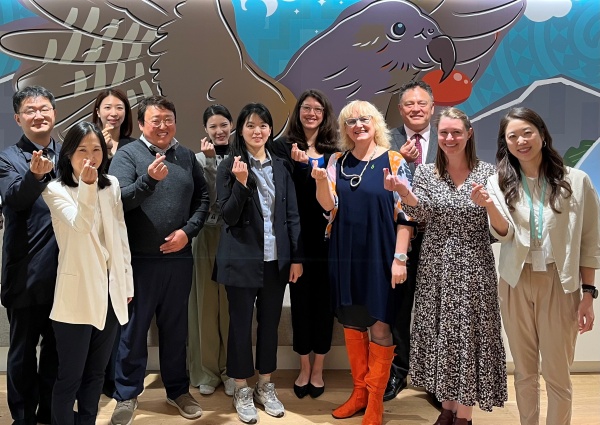
The delegation was welcomed to the ENZ Wellington office with a mihi whakatau on their first day. ENZ, Ministry of Education (MoE) and Ministry of Foreign Affairs and Trade (MFAT) colleagues joined together for waiata and kai with our Korean guests.

Following a welcome and mihi whakatau in Wellington, the group travelled on to Nelson where they visited Te Pūkenga Nelson Marlborough Institute of Technology (NMIT) and Nayland College. The visit to Nayland College was an opportunity for the Korean representatives to gain a better understanding of the pastoral care for school students and the unique offerings such as outdoor education and horticulture programmes.
Kay Lee, ENZ Senior Market Development Manager – Korea, said it was important for the Korean delegation to experience firsthand the welcoming and safe environment of New Zealand schools to regain confidence in the Schools Visits Programme.
“After the COVID-19 pandemic, the Korean Government was concerned about sending students, especially younger students, overseas to study particularly on scholarship programmes because parents wanted assurance their children will be well looked after. In the debrief with the Korean representatives, it was clear they gained confidence from speaking to the New Zealand institution representatives around the procedures and systems in place to support students.”
“We hope that this renewed confidence will mean that we start seeing Korean government scholarship school students studying in New Zealand again in the near future”.
High on the agenda during the delegation’s visit were the School Visits and Tertiary Training Programmes, both of which were affected significantly during the pandemic.
From 2016 –2019, the School Visits Programme provided 150 high school scholarships per year for South Korean students from rural areas to attend New Zealand schools for eight weeks. The Korean Government planned to continue the Schools Visits Programme with its own funding in 2020, however, the programme was cancelled due to travel restrictions during the pandemic.
An alternative programme was run by MAFRA and MOF from December 2022 which involved short-term English Language Training for school students in Korea with three New Zealand teachers travelling to Korea to teach English (Read about their experience here).The Korean organisers have decided to run the English language programme in Korea again with six New Zealand teachers traveling to Korea to teach English in January 2024.
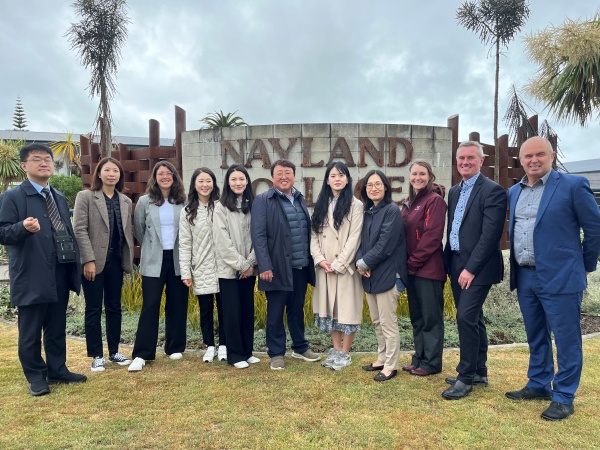
Nayland College demonstrated manaakitanga by welcoming the group to rainy Nelson but provided an Asia Kiwi lunch complete with meat pies and sushi!
Like the Schools Visits Programme, the pandemic interrupted tertiary programmes and the revised programme ran in January 2023 with short term group programmes. The site visits in November to Te Pūkenga NMIT and Lincoln University provided an opportunity to discuss the institutions’ proposals to host Korean tertiary students in January 2024.
Also discussed was the importance of reciprocity and it was noted that Korea is a popular destination for New Zealanders under the Prime Minister’s Scholarship for Asia (PMSA) scheme. Since 2016, the scheme has awarded scholarships to 196 individuals or groups for study, intern or research programmes in Korea. Lincoln University, in particular, has been successful in facilitating group PMSA programmes focused on agriculture to Korea.
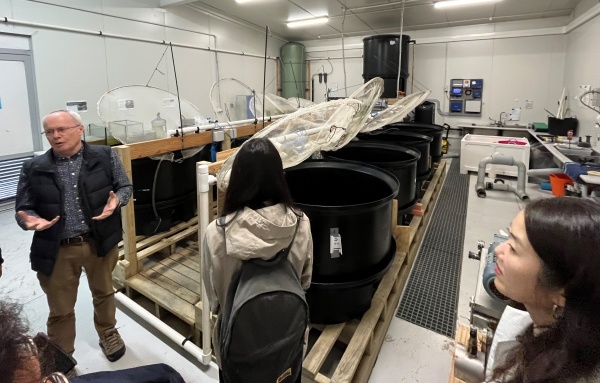
Dr Mark Burdass, Aquaculture Programme Coordinator and Tutor, introduces the hands on learning in the aquaculture programme at Te Pūkenga NMIT.
At the conclusion of their visit, the Korean delegation expressed their gratitude to the institution hosts for making their time in New Zealand memorable and valuable through fruitful discussions. The delegation emphasised the importance of conducting these meetings in person and visiting the campuses to meet with institution staff and academics. The ENZ Manapou ki te Ao team is pleased to continue close cooperation with our Korean education partners to facilitate connections with New Zealand education providers for the education programmes.
If you are interested in finding out more about the education initiatives originally outlined in the KNZFTA, you can read about this in a 2016 E-News article here - New opportunities for New Zealand and Korea.