Search
Showing 10 of 7241 results
-
Around the world in five
Asia
The government of Hong Kong has announced ambitions to become an international hub for post-secondary education with measures including an increased quota for international undergraduates at public universities, more scholarships and work rights for postgraduate students.
North America
Canada is set to introduce a “recognised institution” framework, through which colleges and universities with a positive record of vetting and supporting international students may be eligible for fast-track study permits. This comes after over 100 Indian students faced potential deportation earlier this year after their admission letters to Canadian colleges were found to be fake, which the students were unaware of.
Middle East
A British school in Abu Dhabi that has been rated outstanding by the Emirate's school regulator for promoting the UAE's national identity said it has weaved elements of the country's culture, history, heritage and, Arabic language into its UK curriculum. The British International School Abu Dhabi is home to 2,080 pupils from 96 countries, with one in five pupils at the school being Emirati.
Europe
According to the Irish Higher Education Authority (HEA), In 2022/23, Ireland set a new all-time high for the number of international students studying at Irish universities. 33,480 students were enrolled at Irish universities last year, an increase of nearly 12% compared to 2021/22, according to the report. Furthermore, India’s student population in Ireland has grown by a significant 17.8%, reflecting a surging trend.
Africa
South African business schools are a higher education success story and champions in terms of higher education on the African continent. Though competing for students, they display a strong ethos of collaboration, generated by a sense of shared purpose to upskill a “new” country. These schools show the power of collaboration, common purpose, and internationalisation outlook.
-
Japanese teachers experience New Zealand’s regional schools
“Waseda University and its affiliated schools are longstanding and valued partners for us,” says Misa Kitaoka, Director of Education in Japan for Education New Zealand Manapou ki te Ao (ENZ).
“It’s exciting to see the strong regional focus they have chosen for their students’ study in New Zealand in 2023 and hear about the planned growth of the programme.”
Waseda University schools will be sending up to 60 students on a group programme to schools in Manawatū and Hawke’s Bay for two weeks in March 2023. The two regions were selected to receive students after taking part in an Expression of Interest process. Close to 80 students have already applied to take part, and Waseda plans to increase the number of participants to 100 from 2024, and to increase the length of their visit in future years.
ENZ hosted the familiarisation tour (famil) to Manawatū and Hawke’s Bay from 21- 25 November 2022. Four Tokyo schools took part alongside Waseda University: Waseda University Senior High School, Waseda University Honjo Senior High School, Waseda Jitsugyo High School and Waseda Saga Junior and Senior High School. The famil was co-funded by ENZ and Air New Zealand, and Palmerston North City Council and Learning Hawkes Bay played a major role in helping to organise visits to 14 different education providers.
“Through the five-day famil, our regional and institutional partners demonstrated their strengths and uniqueness,” says ENZ’s Director Marketing and Strategies, Patrick Holden, who travelled with the delegation.
“Delegates commented on how welcome they felt and how impressed they were to see indigenous Māori language and customs being incorporated into the school curriculum. The manaakitanga shown by the different institutions was well received, especially the pōwhiri.”
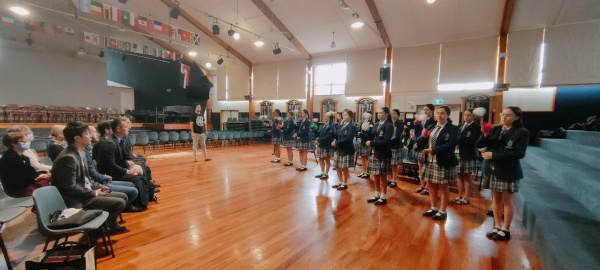
The delegation is welcomed with a powhiri at Napier Girls High School
Misa Kitaoka stressed the importance of destination marketing with support from regional partners.
“While decision-making tends to be institution-led in the tertiary sector, decisions for the school sector are often led by the region or city. This famil was a great opportunity for us to showcase the regions first, followed by the education offerings available in the regions.
“Japanese school students, parents and educators are also interested in cultural experiences in New Zealand beyond education, including the opportunities to interact with local students and host families, and to embrace New Zealand’s cultural values of diversity and inclusion.
“While video-calling offers many benefits and has been vital across the pandemic, bringing famils back into the country means our offshore stakeholders can experience first-hand what New Zealand has to offer. Regional involvement will play a key role in building long-term reciprocal relationships for Aotearoa.”
For more on ENZ’s education partnership with Waseda University and its affiliated schools, please click here.
For more on the value of short-term programmes for international students in New Zealand and the potential benefits to New Zealand and the educator sector, check out this recent Spinoff article: How educational exchange fosters more than just learning | The Spinoff
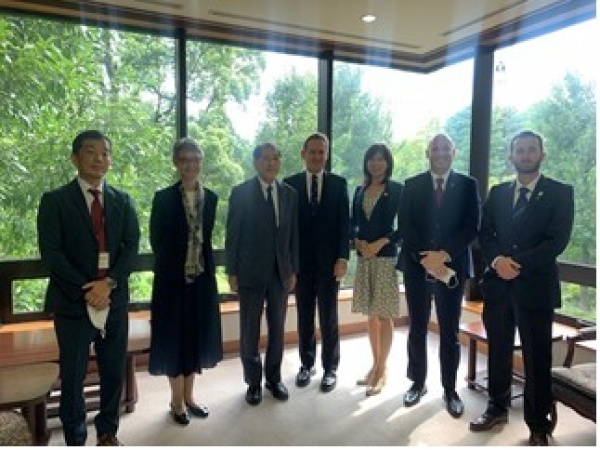
Hamish Cooper, NZ Ambassador to Japan, and ENZ staff Misa Kitaoka, Patrick Holden and Ben Burrowes called on the President of Waseda University, Dr Aiji Tanaka and Prof. Kate Elwood, Dean of Centre for International Education recently to congratulate Dr Tanaka on his reelection as the 18th President of Waseda University
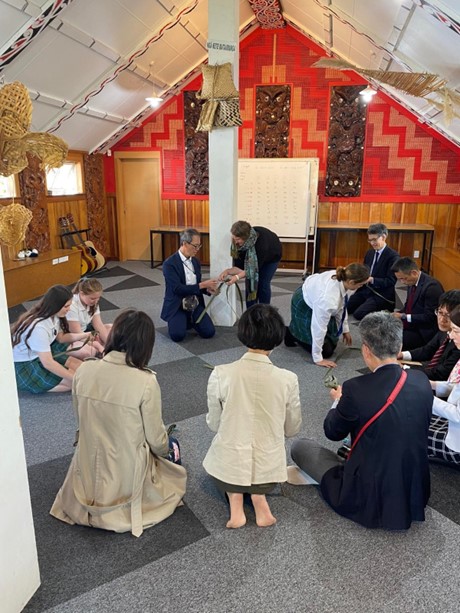
The delegation was welcomed on to the Central Hawkes Bay College Marae where they were given background about the history of the marae and given a quick fire class in flax weaving
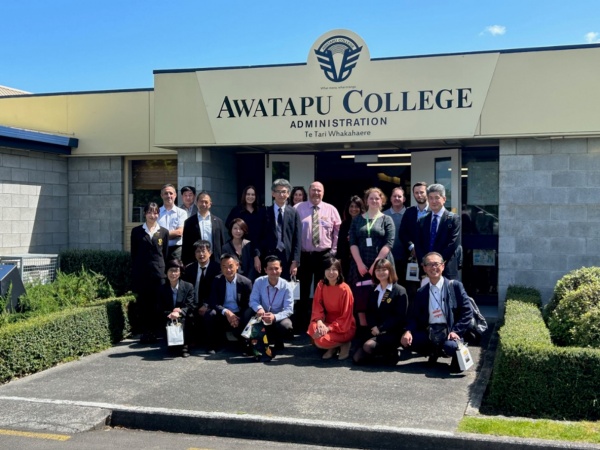
Waseda delegation outside Awatapu College
-
International recognition for New Zealand educational robot KaiBot before official launch
The AI-enabled robot, KaiBot, which has won the award two months before its official launch date, is designed to support 5 to 15-year-old children to develop coding skills.
The Smart Toys competition is coordinated by the Dubai Future Foundation in collaboration with the World Economic Forum to highlight the best-emerging AI toys in education. The competition attracts innovators, entrepreneurs, toy developers, and start-ups from 20 countries globally.
Education New Zealand Manapou ki te Ao (ENZ) has been offering wraparound support to Kai’s Education over the last year, including supporting them to participate at EduTech Australia in August, profiling them with a spotlight feature with EdTechNZ, and offering support and insights as they venture into the UAE region.
ENZ’s Business Development Manager Alana Pellow, who has been working with Kai’s Education, said this was a fantastic outcome for New Zealand’s edtech community.
“KaiBot is a great example of how innovative and fun technology can positively impact education outcomes for young learners. It’s wonderful to see the Kai’s Education team achieve international recognition for the transformative impact their edtech has on learners.”
Read more about EdTech company Kai’s Education and KaiBot on this link.
- 2022 ICEF ANZA Thursday 22
- enz 22
- NZIEC2024322of128 1
- Ninna Granucci Green Spot Technologies.jpg resize
- DSC 3438.jpg resize
-
Government delegation from South Korea visits New Zealand to reconnect with several of our education providers
New Zealand and South Korea have strong education links and one unique partnership is the education cooperation under the Korea-New Zealand Free Trade Agreement (KNZFTA) which has historically included education programmes for Korean school and tertiary students.
The visiting delegation included representatives from the Korea Ministry of Food, Agriculture and Rural Affairs (MAFRA), the Korea Ministry of Oceans and Fisheries (MOF), the Korea Agency of Education, Promotion and Information Service in Food, Agriculture, Forestry and Fisheries (EPIS) and Korea Fisheries Resources Agency (FIRA), the implementing agency for the MOF-funded project.
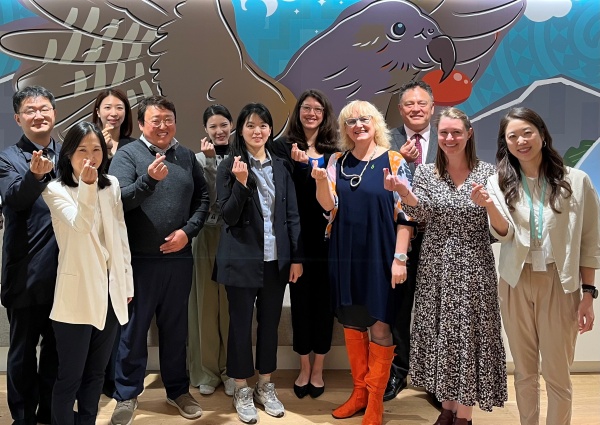
The delegation was welcomed to the ENZ Wellington office with a mihi whakatau on their first day. ENZ, Ministry of Education (MoE) and Ministry of Foreign Affairs and Trade (MFAT) colleagues joined together for waiata and kai with our Korean guests.

Following a welcome and mihi whakatau in Wellington, the group travelled on to Nelson where they visited Te Pūkenga Nelson Marlborough Institute of Technology (NMIT) and Nayland College. The visit to Nayland College was an opportunity for the Korean representatives to gain a better understanding of the pastoral care for school students and the unique offerings such as outdoor education and horticulture programmes.
Kay Lee, ENZ Senior Market Development Manager – Korea, said it was important for the Korean delegation to experience firsthand the welcoming and safe environment of New Zealand schools to regain confidence in the Schools Visits Programme.
“After the COVID-19 pandemic, the Korean Government was concerned about sending students, especially younger students, overseas to study particularly on scholarship programmes because parents wanted assurance their children will be well looked after. In the debrief with the Korean representatives, it was clear they gained confidence from speaking to the New Zealand institution representatives around the procedures and systems in place to support students.”
“We hope that this renewed confidence will mean that we start seeing Korean government scholarship school students studying in New Zealand again in the near future”.
High on the agenda during the delegation’s visit were the School Visits and Tertiary Training Programmes, both of which were affected significantly during the pandemic.
From 2016 –2019, the School Visits Programme provided 150 high school scholarships per year for South Korean students from rural areas to attend New Zealand schools for eight weeks. The Korean Government planned to continue the Schools Visits Programme with its own funding in 2020, however, the programme was cancelled due to travel restrictions during the pandemic.
An alternative programme was run by MAFRA and MOF from December 2022 which involved short-term English Language Training for school students in Korea with three New Zealand teachers travelling to Korea to teach English (Read about their experience here).The Korean organisers have decided to run the English language programme in Korea again with six New Zealand teachers traveling to Korea to teach English in January 2024.
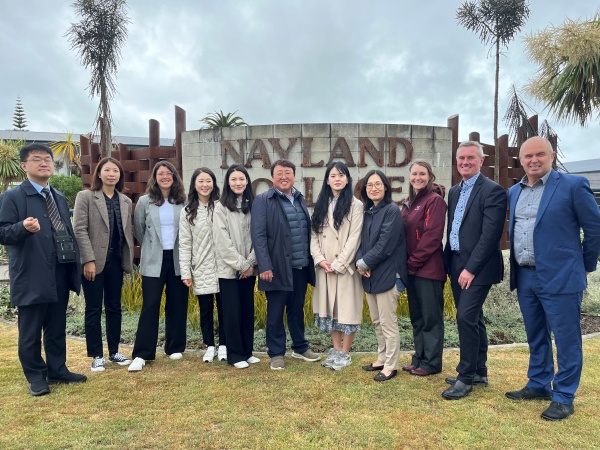
Nayland College demonstrated manaakitanga by welcoming the group to rainy Nelson but provided an Asia Kiwi lunch complete with meat pies and sushi!
Like the Schools Visits Programme, the pandemic interrupted tertiary programmes and the revised programme ran in January 2023 with short term group programmes. The site visits in November to Te Pūkenga NMIT and Lincoln University provided an opportunity to discuss the institutions’ proposals to host Korean tertiary students in January 2024.
Also discussed was the importance of reciprocity and it was noted that Korea is a popular destination for New Zealanders under the Prime Minister’s Scholarship for Asia (PMSA) scheme. Since 2016, the scheme has awarded scholarships to 196 individuals or groups for study, intern or research programmes in Korea. Lincoln University, in particular, has been successful in facilitating group PMSA programmes focused on agriculture to Korea.
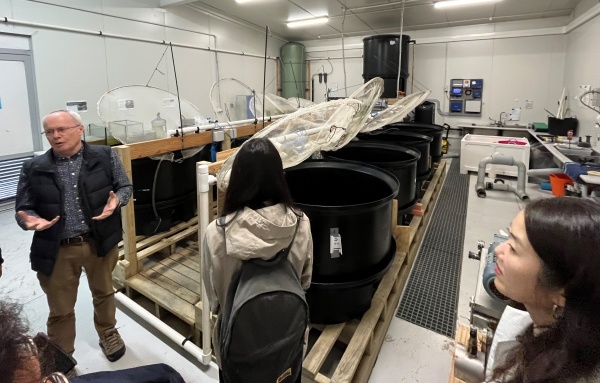
Dr Mark Burdass, Aquaculture Programme Coordinator and Tutor, introduces the hands on learning in the aquaculture programme at Te Pūkenga NMIT.
At the conclusion of their visit, the Korean delegation expressed their gratitude to the institution hosts for making their time in New Zealand memorable and valuable through fruitful discussions. The delegation emphasised the importance of conducting these meetings in person and visiting the campuses to meet with institution staff and academics. The ENZ Manapou ki te Ao team is pleased to continue close cooperation with our Korean education partners to facilitate connections with New Zealand education providers for the education programmes.
If you are interested in finding out more about the education initiatives originally outlined in the KNZFTA, you can read about this in a 2016 E-News article here - New opportunities for New Zealand and Korea.
-
Huge education potential with Viet Nam
“It was a great privilege to be part of this visit. We were warmly welcomed everywhere, and there was a lot of interest in New Zealand education,” says Grant McPherson, Chief Executive at Education New Zealand Manapou ki te Ao (ENZ).
“An education forum in Ha Noi was a late addition to the programme, in response to a request from Viet Nam’s Ministry of Education and Training - this shows the high level of enthusiasm and energy for this relationship.”
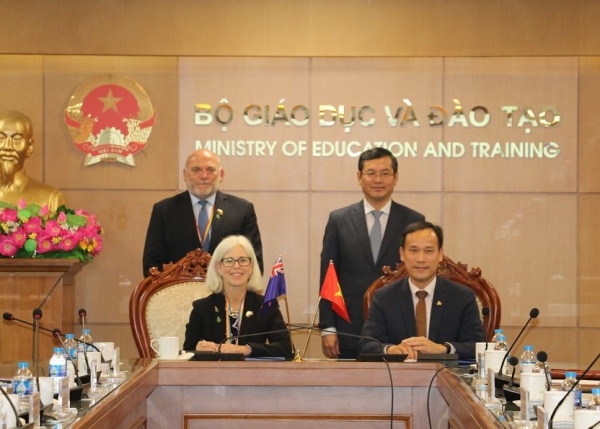
Eleven representatives formed the New Zealand delegation for the education forum. Key officials and education sector representatives from Viet Nam joined the event, which was hosted by Vice Minister Nguyen Van Phuc. Institutional autonomy, scholarships, and foreign investment in education were the three main topics on the agenda, generating animated questions and discussion.
Three education arrangements were signed during the Prime Minister’s visit. The Education Cooperation Arrangement between the Ministries of Education in both countries was renewed, with the signing witnessed by the two Prime Ministers.
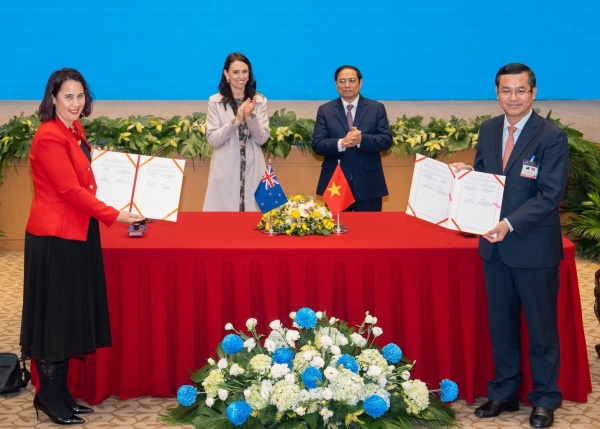
University of Auckland Vice Chancellor Dawn Freshwater also signed two arrangements with Ho Chi Minh City University of Technology (HCM-UT), relating to qualifications in computer and data science.
The visit also included an opportunity for the Prime Minister and the delegation to meet with around 70 Vietnamese alumni.

“Over the years, many Vietnamese students have studied in New Zealand, and they have become part of a network of influential alumni. These relationships span every sector of Viet Nam business and government,” Mr McPherson said.
“Five alumni showcased their businesses and social projects at the event and had the opportunity to discuss their work with Prime Minister Ardern Dave Quach, Hoa Pham, Nhien Le, Van Nguyen, and Ngan Le. Their work spanned sustainable textile manufacturing; a kindergarten that applies values of New Zealand’s early childhood education curriculum, Te Whāriki; mindfulness photography for social development; a tech-enabled platform that supports young people to pursue their study abroad dream; and an innovative agribusiness model for women of ethnic minorities in northern Vietnam.”
In recognition of the achievements of alumni and to support them as a community, Prime Minister Ardern launched a digital badge for Vietnamese alumni, I AM NEW, at the event.
Education was on the agenda at a business dialogue on 15 November and a business breakfast on 17 November provided a valuable opportunity to catch up with local institutional partners and agents.
The Prime Minister’s visit generated significant media and social media coverage in Viet Nam, and built on an earlier series of targeted events to promote New Zealand education in Viet Nam:
- Viet Nam Agent Seminars that enabled numerous New Zealand institutions to connect with education agents in Ha Noi and Ho Chi Minh City on 28 and 31 October, and where agents heard directly from Immigration New Zealand about student visa requirements
- ENZ’s Viet Nam Education Fairs on 29 and 30 October in Ha Noi and Ho Chi Minh City, enabling New Zealand providers to connect directly with prospective students and their families. These fairs generated similar levels of interest to events pre-Covid, and again included an opportunity for students to hear directly from Immigration New Zealand about student visa requirements
- Viet Nam School Leaders and Counsellors Meet-ups on 28 and 31 October in Ha Noi and Ho Chi Minh City, which enabled New Zealand tertiary providers to connect with representatives from international and private schools
- Launch of Te Pūkenga at an event that was well attended by education agents in Ho Chi Minh City on 31 October
- Education Workshop on Micro-Credentials in Future-focused Education on 1 November, in association with The MindLab and NZQA.
The sector has recognised the opportunities in education with Vietnam. Sector and government agencies’ work so far is helping to raise the profile of New Zealand and the quality of an education delivered by New Zealand.
- Viet Nam Agent Seminars that enabled numerous New Zealand institutions to connect with education agents in Ha Noi and Ho Chi Minh City on 28 and 31 October, and where agents heard directly from Immigration New Zealand about student visa requirements