Search
Showing 10 of 2262 results for read 2024 FRM Exam Part I - Quantitative Analysis online free
-
Issues of race, heritage and identity connect students across the seas
There was a total of 87 participants, made up of members of UMD’s College Success Scholars’ Programme, a cohort of 100 Black and Latino men, and students of Jason King’s Māori Leadership course at AUT.
ENZ Director of Engagement – North America, DuBois Jennings, described the event as profoundly moving.
“It was incredible seeing the two cohorts of students sharing both their similar and unique experiences,” he said.
“This is exactly the kind of engagement Education New Zealand is looking for in terms of our goal of creating global citizens in New Zealand and developing mutual understanding between underrepresented students in both countries. We're excited to see what else can be done in the future and hopeful that this is the beginning of a long and meaningful relationship between UMD and AUT.”
UMD have expressed some interest in developing a programme based on this event that looks to develop inter-cultural competency and a better understanding of racial issues.
The success of this programme aligns well with ENZ’s goals in the United States of repositioning New Zealand as a recognised leader in diversity, equity and inclusion.
“It also aligns nicely with the internationalisation stream of the New Zealand Government’s Recovery Plan,” DuBois said. “While borders remain closed, we are committed to building on our connections within the US, as we continue to find new opportunities for students and educators from the US and New Zealand to meaningfully engage.”
-
Introducing the AgentLab WeChat mini programme
As AgentLab is a web-based platform with English content, it needed a separate programme for Chinese audiences. The new mini programme not only uses Chinese language, but it also offers a localised user experience more suitable for this group.
“Education agents continue to have a crucial role in ensuring that international students and their parents have accurate information about what New Zealand, as a study destination can offer. Especially in China, agents are the main interface between education providers, students, and students’ parents,” ENZ Director – Greater China, Miranda Herbert says.
The agent landscape in China is extensive. The biggest agencies have around 50 branches in the mainland, with different agencies having particular regional strengths. Because agents run their own events – both B2B and with students – ENZ supports their activities rather than running our own ENZ Recognised Agency fairs.
AgentLab is ENZ’s dedicated communications portal for education agents, providing them with the training and resources they need to best promote New Zealand as an international study destination.
It has proven to be a very effective way to support agents during these uncertain, fast-changing times. There are now close to 5,000 users on the platform, which is a 60 percent increase since March 2020. This year alone ENZ conducted almost 50 webinars (some region-specific) through AgentLab, and shared regular updates via news feeds, direct messages, and the COVID-19 FAQs page.
Access 新西兰留学顾问计划 on WeChat, or use the QR code below:

-
Applications open for the NZ-China Tripartite Fund
Revised as at 2 March 2021
ENZ is committed to supporting New Zealand institutions to progress and grow their research opportunities in China. In view of the current global situation and based on interim reports from the 2020/21 Tripartite Funding recipients, ENZ has made the following changes:
- The application deadline has been extended to Monday 8 March 2021 COP.
- The following section in the application has been revised:
- Funding is available for costs associated with mobility, meetings and small scale operational costs. Due to the current global situation, applications that include costs relating to research or overhead costs will be considered for this round.
Any questions please contact china@enz.govt.nz.
---
University researchers are invited to submit proposals for the latest round, with up to $20,000 available per application to support quality, high-level research and collaboration. The fund seeks to initiate new tripartite partnerships and enable the further development of existing partnerships between a New Zealand university and two Chinese partner universities.
Eligible Tripartite Fund subjects can be drawn from the arts; humanities; social sciences; sciences and applied sciences; including agriculture; food safety; conservation; forestry; advanced materials engineering and environmental science.
The fund was established in 2005 when the New Zealand and Chinese Ministries of Education agreed to formally support and promote tripartite relationships between Kiwi and Chinese institutions, in which a New Zealand university became the ‘third brother’ to an existing ‘two brothers’ agreement.
This agreement was a first for the education relationship between New Zealand and China, and since then many other countries have followed New Zealand’s lead.
To account for the impact of COVID-19 on mobility of research partners, the 2020/21 Tripartite Partnership Funding Round awarded five successful recipients of up to $20,000NZD in comparison to previous years where there were three recipients of $30,000NZD each. The selection panel will take into consideration the current context when deciding on the funding structure for the 2021/22 award round.
“The Tripartite programme highlights our commitment to the strategic education partnership between China and New Zealand,” ENZ Director – Greater China, Miranda Herbert, says. “We are pleased to see university representatives innovating and adapting their research and communication methods to the virtual environment in order to maintain strong links with Chinese partner institutions and progress research projects despite the challenging environment.”
The deadline for applications is 1 March 2021, with a project start date of 1 May 2021 through until 30 April 2022.
Below is the criteria for successful applicants:
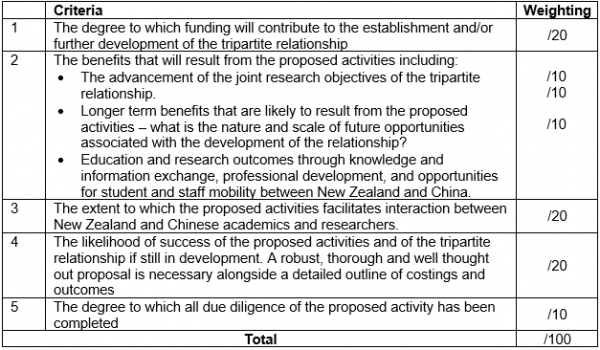
Download the application form and submit it to china@enz.govt.nz. Any queries can also be sent to this address.
-
A word from the Minister
It has been, and continues to be, an extremely challenging time for many of New Zealand’s universities, schools, polytechnics and institutes of technology, as well as private providers and English language schools with our border closed.
But I think we are starting to see the light at the end of the tunnel. I anticipate we will have a further 12-18 months of disruption before we see a future where much of that will start to fade. The recent news of promising vaccines against COVID-19 is very encouraging. It’s difficult to share an exact timeline with you all as we need to consider vaccination around the rest of the world and international supply chains.
Over the next 12 months, I expect to see a series of progressive changes. That could look like a risk tolerance map of the world for countries that we have safe travel zones with, or for countries we have lower isolation requirements for when they arrive, for example.
While we are looking to move as quickly as possible on the border, it is very unlikely that there will be one magic day where we cut a ribbon at the airport and all travellers will be welcomed in.
We have made a start and granted an exemption for a cohort of 250 postgraduate (largely PhD) students to enter New Zealand from early next year to continue their study. And we’ll consider further cohorts in the future, based on capacity.
This government will continue to support the sector through our Recovery Plan for international education.
The recent New Zealand Global Pathways initiative that New Zealand universities, ENZ and NCUK have entered into is a very welcome development. It’s the first time that ENZ and all the universities have been involved in such a partnership. It’s encouraging and it’s the sort of innovation that we are looking for during this period of difficulty.
International education has been good for New Zealand – not just economically, but culturally and socially too. I look forward to waving the flag for New Zealand internationally and at home too. New Zealand has such an incredible, high-value education to offer to the rest of the world.
Meri Kirihimete,
Chris Hipkins
Minister of Education
-
New Zealand and Vietnam celebrate 45 years of bilateral ties
The alumni were: Le Thi My Hanh, Country Representative at Global Green Growth Institute (GGGI); Nguyen Bao Tram – Vice President, User Growth Strategy and Planning at Lazada Vietnam; Trinh Thi Thuy Lien – PhD Candidate in Education and Higher Education, College of Education and Higher Education Development Center at the University of Otago; Le Ba An Binh – Managing Director at Adtima, a division of VNG; Nguyen Minh Dung (Daniel Nguyen) – Executive Chef at Mia Saigon Luxury Boutique Hotel; Founder of Coco Consulting Limited in Auckland; and Nguyen Quang Dat – Captain (Airbus A320), Pacific Airlines.
ENZ Regional Manager – East Asia, Ben Burrowes said, “We are extremely proud to recognise each individual awardee today and to celebrate the role that a New Zealand education has played in both their personal and professional lives. It is inspiring to learn what they’ve achieved since graduating in New Zealand and to hear real-life examples of New Zealand’s unique approach to learning.”
New Zealand Ambassador to Vietnam, Wendy Matthews, also spoke at the awards ceremony.
“The quality of New Zealand education can be seen in the quality of our graduates, and these alumni are examples of the globally engaged students New Zealand aims to produce,” she said.
“New Zealand is committed to helping build the future leaders of Vietnam. We are proud of our alumni and the New Zealand alumni community, who have come to be affectionately known as the ‘Kiwi mafia’. Alumni play an integral role in the New Zealand-Vietnam bilateral relationship, which celebrated its 45th anniversary this year.”
Vietnam and New Zealand first established diplomatic ties in 1975. The countries’ education relationship stretches back even further to the 1960s, with Vietnamese students having come to New Zealand since the first days of the Colombo Plan.
Today, Vietnam remains an important market for New Zealand’s international education sector. Vietnamese students make up the seventh biggest cohort from a single country. In 2019, 3,040 Vietnamese students studied at New Zealand institutions, up 10 percent from the year before. Of the 3,040 students, 35 percent studied in the universities, followed by schools (28 percent). The number of Vietnamese students studied in schools and universities increased 29 percent and 9 percent respectively from 2018 to 2019.
-
Immigration New Zealand email error
Due to an administrative error, some partners and dependents of international students with work rights may have received an email from INZ on 23 December 2020 that incorrectly stated their visas may have been eligible for a six month extension. Student visas have not been extended.
Those who received the email incorrectly will need to apply for a further visa or arrange to depart New Zealand before their current visa expires. Further information on applying for visas is available on the Immigration New Zealand website or an immigration professional can help.
We acknowledge this is a stressful process for students and their families.
-
Government announcement allows longer stays for visitor visa holders in NZ
What does this announcement mean for international students currently in New Zealand?
- This announcement is unlikely to have any impact on international students currently in New Zealand, as most students are likely holding student visas.
- Visitor visa holders who have not yet studied, may wish to consider undertaking a short course at an approved education provider.
- Visitor visa holders can study short course/s (or a term at school) of up to three months per 12 month period. The extension of visitor visas does not extend how long visitor visa holders may study for.
- Family members of students currently studying in New Zealand may benefit from the visitor visa extension if they remain in New Zealand due to COVID-19 restrictions, or otherwise choose to stay longer. Under the announcement they will also be able to apply for further visitor visas as the limit of time spent in New Zealand as a visitor has been temporarily suspended.
Immigration New Zealand will email affected visa holders to confirm the visa extension by 5 March 2021.
Where to go for more information:
- If you would like to know more, visit Immigration New Zealand for Information on visa extensions, new visa expiry dates, and changes to visa conditions
- Or see Minister Faafoi’s full press release
- This announcement is unlikely to have any impact on international students currently in New Zealand, as most students are likely holding student visas.
-
No NZIEC in 2021
Although it may be disappointing, this decision provides clarity for our conference partners, exhibitors and delegates and enables us to focus our resources on supporting the industry’s recovery.
While NZIEC will not go ahead this year, we are planning a range of engagements across the sector. This includes our regular meetings with peak bodies and regional partners as well as specific hui to progress the International Education Recovery Plan.
We’re also exploring other ways in which we can bring the sector together to discuss shared priorities and challenges without the costs involved with NZIEC. We are in the initial stages of planning and will be able to advise further details later in the year. Stay tuned to E-News for the latest information – you can sign up for it here.
-
Kōrerorero is back for 2021
Aimed at audiences in the Americas and Europe, the session will be moderated by Deputy Vice-Chancellor Māori at the University of Waikato, Dr Sarah-Jane Tiakiwai.
Learn more and register here.
Kōrerorero in 2020
Kōrerorero is a virtual series of webinars, or conversations that matter, between education leaders in New Zealand and Latin America.
The series aims to promote New Zealand’s academic excellence in Latin America, and draw connections between us on key issues like Indigenous education, tourism, the creative industries and agritech.
A total of 1121 people registered for the five 2020 sessions, hailing from over 20 different countries.
ENZ would like to thank all our panelists so far:
- Representatives from AUT, University of Otago, Lincoln University, Massey University, and the University of Waikato.
- Government representatives from Tourism New Zealand, Innpulsa (Colombia), the Ministry of Agriculture in Brazil and the NZ Special Agriculture Trade Envoy (SATE).
- AD Instruments, Pik Pok Gaming, EduSystems, Livestock Improvement Corp., Miramar Creative.
Missed an episode of Kōrerorero?
-
ENZ invites proposals to establish New Zealand Education Centres globally
The centres will deliver education programmes for students progressing onto further study with New Zealand education providers, and act as pathways for greater education, cultural and diplomatic engagement between New Zealand and partner countries.
The centres will receive support from New Zealand universities, ENZ design and marketing packages, and have opportunities to host events, promotions and student mobility activities.
“In developing New Zealand Education Centres we are extending our support for international students offshore, and providing flexibility in how and where they experience a high-quality New Zealand education” ENZ Chief Executive Grant McPherson said.
“The establishment of New Zealand Education Centres will support both the Government’s International Education Recovery Plan and the goals of the New Zealand International Education Strategy aiming for a more globally connected New Zealand.”
Interested organisations can contact John Laxon, Director Global Education Partnerships (nzcentres@enz.govt.nz) to receive further information on the establishment process.
Download the NZ Centre Proposal Summary Information 2021 here.
Proposals are due by Wednesday 25 May, with centres being established and open for initial student intakes by 2022.