Search
Showing 10 of 7217 results
- Ak Uni 5
- Around the world in correct size
- Image20240604161451
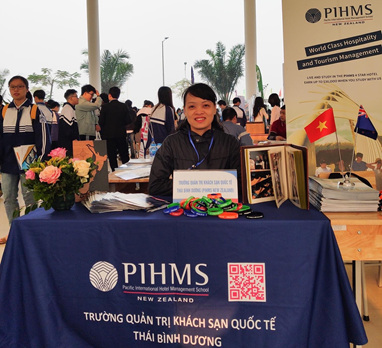
- vietnamfeb21
- Group Applications Assessment Criteria TT
- Education New Zealand quarterly report for 1 January to 31 March 2018
-
Graduate’s Kiwi know-how helps reduce water use in UAE desert
Rather than travelling to New Zealand and undertaking theoretical research with limited relevance back home, Wafa was able to carry out hands-on work addressing critical water management issues in her arid home country, while being supervised by New Zealand-based experts.
It was a personalised and practical kind of international education experience which Wafa is grateful for. “It allowed me to continue working, while at the same time learning and finding solutions to the water management issues facing the UAE.”
The education partnership grew out of a New Zealand G2G (Government to Government) relationship with the UAE which dates back to 2014. “The aim is to build the capacity of local people and find solutions to real problems through scholarships for study,” she says.
Already qualified with a Bachelor’s degree in ecology and environmental science and Master’s degree in water and environmental engineering, Wafa was working as an environmental scientist for Environment Agency - Abu Dhabi (EAD) when asked to be involved in the programme.
The region needs to find ways to manage the growing demand for groundwater in a hyper-arid, saline environment. Abu Dhabi, the capital of the UAE, has about 19 million planted trees in desert “forests”, a precious legacy of founding father Sheikh Zayed Al Nayhan. They provide a range of ecological benefits but are heavily dependent on groundwater irrigation.
With EAD given a government mandate in 2016 to protect groundwater reserves, water meters were introduced and areas of wastage identified. Wafa’s research was required to determine the exact water needs of the plants through the implementation of New Zealand technology, and experimentation with the use of treated sewage effluent, or “grey water”.
Distance learning partnership with Massey University
She worked with a team at New Zealand’s Plant & Food Research and her project was supervised by Principal Scientist Brent Clothier. The programme was managed by Lesley Kennedy of Wellington-based consultancy firm OnlyFromNZ.
“I travelled to New Zealand once or twice a year to meet Massey University requirements such as attending exams, presentations, or conferences. Likewise, Brent would come to the UAE with his team and help oversee the research.”
“It’s fit-for-purpose academic knowledge with real practical utility,” Dr Clothier says.
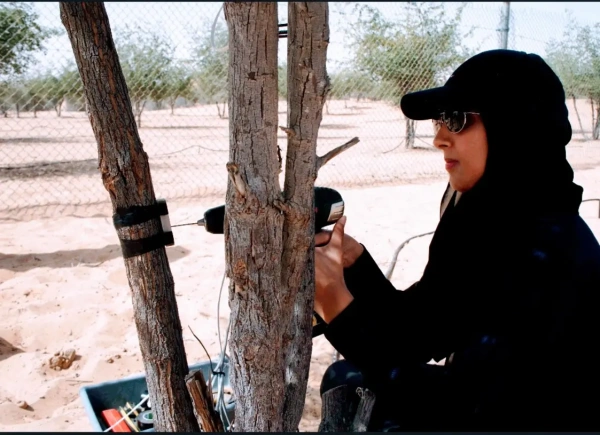
Wafa used Plant & Food Research’s heat pulse technology, which has been employed successfully in New Zealand and other parts of the world, but never in a region where temperatures can reach close to 50degC in summer. Once up and running, the technology provided readings every 30 minutes which allowed Wafa to calculate precisely the amount of water being absorbed by the plant.
“The data provided new and exciting information for us. We found that many of the trees had already adapted to the summer heat and did not take up as much water as we were providing through irrigation,” she says.
“By the end of the study we determined that we could save 35 - 70 percent of the water we have been supplying through irrigation.”
The technology was extended to other crops, and farmers are now provided with crop calculator software which provides guidance on the specific water needs of a tree, according to the month of the year, location, and soil type. “It’s a very important tool for growers in the UAE.”
“It’s good for countries to work together and find solutions to our challenges.”
Enduring relationship with New Zealand
Wafa is proud of the fact that her research is helping to solve a critical environmental issue in her country and knows that the collaboration with Massey through the NZ G2G partnership has been an integral part of her success. It has also paved the way for two other Emirati students to follow in her footsteps.
“I met other international students from the Middle East while at Massey and they were envious of me. They said I was very lucky because I was doing something for my country.”
She believes international education plays a key role in the exchange of information with other countries. “It’s good for countries to work together and find solutions to our challenges. If we are talking about the environment, we are all living in one world so it’s important that we work together to solve issues.”
But this academic partnership has not just produced practical results. It’s also seen a special bond develop between the New Zealand scientists and their Emirati students.
“I have built a long-lasting relationship with New Zealand,” Wafa says. “I know that I can always call my contacts in New Zealand to discuss an issue and they will be there for me.
“The relationship is much bigger than the life of the project and this is very important for me as a scientist and a researcher.”
-
Japan-New Zealand education ties strengthen with growing collaboration
Signed on 28 June, ENZ’s memorandum of understanding with Waseda University and its affiliate schools will be influential in developing international education exchanges that benefit institutions in Japan and New Zealand at school and tertiary level.
Under the MOU, the first cohort of 12 students from Waseda Jitsugyo School will visit New Zealand schools in mid-July. This will be followed by an ENZ and Air New Zealand-led familiarisation visit to New Zealand schools involving 10 schoolteachers from Japan, including a Waseda University staff member in charge of overseas programmes for its affiliate schools.
ENZ’s Senior Market Development Manager – Japan, Misa Kitaoka, said the MOU is a significant one as it helps develop a strong relationship between a prestigious Japanese university, its affiliate schools and New Zealand schools.
“By partnering with one of the top universities in the world, the MOU will not only promote student mobility from Japan but also boost New Zealand’s reputation and credibility in Japan,” Misa said.
“We are keen to replicate this strategic partnership with universities and affiliate schools in Japan’s regions.”
It was also fitting to see this MOU achieved in the lead up to NZIEC 2019 where Japan will feature as Country of Honour, Misa said.
“With the Rugby World Cup about to be held in Asia for the first time in the tournament’s history, it is fantastic to see Japan feature as the Country of Honour at NZIEC.”
The Country of Honour designation celebrates and showcases New Zealand’s international education connections with partner countries. Japan is New Zealand’s third-largest source country with more than 10,000 Japanese students enrolled here every year.
“We look forward to sharing the latest Japan market updates and opportunities with NZIEC delegates in three sessions involving guest speakers from Japan, whose unique insights will present new opportunities for partnerships and collaboration.”
Attendees will learn more about doing business with Japan, what the protocols are and the expectations of Japanese agents, education providers and government agencies. These insights will provide delegates with an overview of Japan’s internationalisation agenda and how it could be relevant to their international relations and marketing.
The conference dinner will celebrate Japan’s fascinating culture. Japanese Ambassador, His Excellency Hiroyasu Kobayashi, will be guest of honour.
Find out more in the NZIEC 2019 programme.
- PM Scholarship
- IMG 0026