Search
Showing 10 of 7245 results
-
ENZ discontinues recognised agency programme
The decision followed a global review that included input from NZ education providers, education agents globally and NZ government agencies. It also considered practice across other jurisdictions and the global education agent landscape in a post-pandemic environment. The decision becomes effective immediately. The review was foreshadowed in the refresh of the New Zealand International Education Strategy in 2022.
“There are many positive aspects of our engagement with agents,” said General Manager of Sector Services, Sahinde Pala.
“Our global staff network and trusted relationships with agents are important factors in assisting students who wish to further their studies in New Zealand. ENZ’s AgentLab platform has also been a rich resource and information hub for education agents, particularly during the pandemic. We will continue to offer these services going forward.”
“But there were also issues. Our review showed that many successful agents did not see the value in joining the programme. The programme was also not accessible to emerging education consultants and organisations, and it did not meet the needs of New Zealand education providers.”
“After careful consideration of the feedback from many agencies and New Zealand education providers, it became clear that the existing programme was not fit for the emerging environment and the decision was taken to discontinue.”
“Looking forward, we want to ensure a more even-handed and efficient approach and feel the best way of achieving this is to open up the power of our international network, along with our information and training capability to all agents, regardless of their size, expertise or capability.”
While the ENZRA programme will cease, the new AgentLab platform will be launched in August and will include a wide range of updates relevant to education agents, including a calendar of events, details of upcoming webinars, resources, and latest news and updates from across the New Zealand education landscape.
Education agents will be able to access the same level of information and resources via the AgentLab platform. The discontinuation of the ENZRA programme will not affect this.
Any agent seeking more information or support should email: agent.help@enz.govt.nz
For further information:
Sai Raje | Senior Advisor Communications, Education New Zealand
+64 21 479 649
Notes to Editors:
About Education New Zealand (ENZ) https://www.enz.govt.nz/
Education New Zealand Manapou ki te Ao (ENZ) is the government agency responsible for taking New Zealand’s education experiences to the world. ENZ promotes a New Zealand education as one that teaches students to be critical thinkers, problem solvers and lifelong learners, which will help them succeed in their future careers and create a positive impact on the world.
With approximately 100 staff in 18 locations around the world, ENZ works closely with New Zealand’s diverse education sector including schools, English language providers, Private Training Establishments, Te Pūkenga (Institutes of Technology and Polytechnics), universities; and internationally with NZ Inc agencies, Government agencies and education providers to encourage sustainable growth and identify opportunities.
- NauMai QR code crop
- DSC 5899
- shruthi
- BK Fair 1
- METEOR Famil 4
-
Reflections from English Teachers in South Korea
In January 2024, six New Zealand teachers were selected to spend part of their summer season teaching English in South Korea as part of the New Zealand Korea FTA Partnership English Language Training Programme.
This programme is supported by Education New Zealand Manapou ki te Ao (ENZ) who assists with the teacher recruitment process. This was one of the key KNZFTA programmes recently discussed during the South Korea Government delegation visit to New Zealand late last year.

The group of six New Zealand teachers selected to teach English in South Korea in January. From left, Jane Bassett, Food Technology Teacher from Havelock North Intermediate School, Sharon Powell, English Teacher from Long Bay College in Auckland, Kara Shortland, Acting Team Leader (Bilingual) from Whangārei Intermediate School Te Tai Tokerau. Glenn Cheyne, Head of Learning Area Social Sciences from Nayland College in Nelson, Gordon Sim, Social Science teacher from Hillcrest High School in Hamilton, and Dan Greer, Social Studies/Drama teacher from Logan Park High School in Dunedin.
Kay Lee, ENZ Senior Market Development Manager – Korea, said that it was an absolute pleasure to see New Zealand teachers continue to travel to South Korea to teach English during their summer break.
“There are so many positive outcomes from the running of this cross-cultural programme for both the Korean students and the New Zealand teachers participating.
"On one hand, the students get the opportunity to hone their English language skills while experiencing the New Zealand teaching style, learning more about New Zealand, including its culture and education system. Meanwhile, while teaching English and serving as ambassadors of a New Zealand education, the teachers can immerse themselves in Korean life for a few weeks, seeing new sights, trying new food and making new friends.

Gordon, Jane, and Dan, sampling Korean cuisine at the end of the teaching day.
"Our Korean government partner for educational programmes, EPIS, has acknowledged ENZ for its significant contribution to the programme’s success through effective teacher recruitment. These positive outcomes are testament to the strength of our NZ-Korea Government-to-Government partnership,” added Kay.
Upon their return to New Zealand, two of the teachers who are trained in teaching English as a Second Language (ESL), shared their experiences with ENZ. Read on to hear about the reflections from their two weeks abroad....
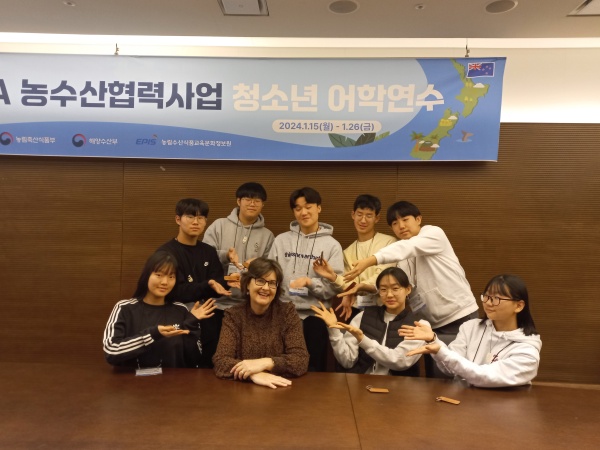
Jane Bassett (지안 (Jian) from Havelock North Intermediate School with her students.
Jane Bassett is a Food Technology teacher at Havelock North Intermediate School and said that the experience of exchanging cultures whilst teaching in an overseas classroom environment was an absolute privilege.
“Our students were aged 14 – 17 years old and came from all over South Korea with family backgrounds in the Agricultural and Fisheries industries. Each student had been awarded a scholarship from the Korean government to attend the two-week intensive English programme organised by the Hyundai Research Institute.
"The Institute went above and beyond in their efforts to ensure an incredible experience for both the students and our group of teachers.
“The teaching programme included a wide range of modules and as well as English grammar, we covered lessons on New Zealand culture, history, tourism, agriculture, sports, famous New Zealanders, and school life. My class was also exposed to the New Zealand Technology curriculum and was tasked with developing a new snack product. As part of the project, I introduced them to several New Zealand snacks and Kiwi classics such as WeetBix, Marmite and Watties Baked Beans, to varying degrees of enjoyment!”
Students were encouraged to speak in English throughout the day via fun-games, readings, conversations and plays so that the teachers could fine-tune their English to help them become more fluent with more natural English phrasing.
"We also explained aspects of Māori culture and the significance of pepeha (way of introduction). The students, who were from agricultural and fisheries backgrounds, were quickly able to identify their own awa (river) and maunga (mountain), showing their own personal connection to their land.”
Jane said that a personal highlight was being able to spend her birthday in Seoul learning about Korean cuisine through a cooking class on kimchi making and tea ceremony in a traditional house. She admitted that this was an appropriate birthday experience for a New Zealand Food Technology teacher!
She summed up the experience by saying that the group of teachers gained a greater understanding of cultural diversity and appreciation of the challenges learning English poses for new learners, learnings which they will take home with them.
“We really hope that our students will remember their experience as fondly as we will and that they will look to study and visit New Zealand in the future.”
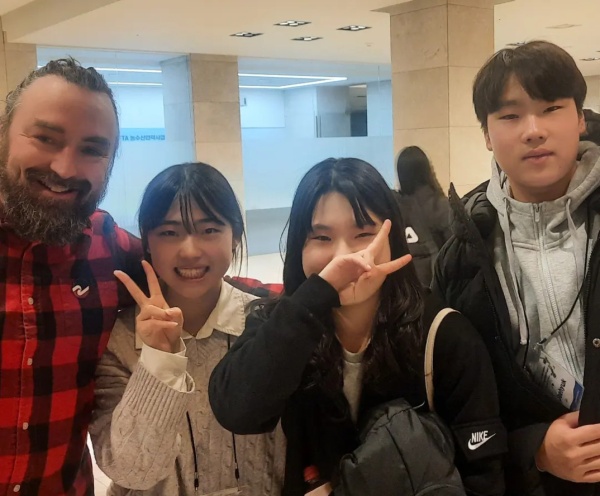
Drama and Social Studies teacher, Dan Greer, of Logan Park High School with three of his students.
Dan Greer, is a drama and social studies secondary school teacher from Logan Park School in Dunedin. He joined Jane as one of the six teachers selected to travel to South Korea, his second experience as an English language teacher in South Korea, having taught in Ulsan 12 years ago.
“I had such an amazing time participating in the Hyundai Research Institute’s programme. It was great to have other quality teachers on this experience with me and we were able to work together, mixing up the style of teaching and activities. I had the more beginner level class, and as a drama teacher we added games to my traditional English teaching. The students really enjoyed it, and it gave them more confidence to give things a go”.
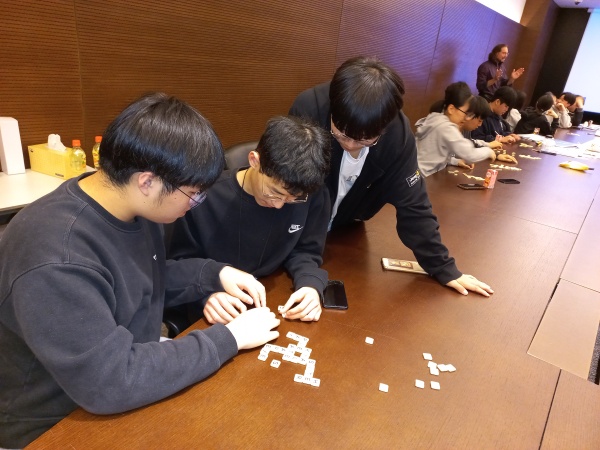
Dan reflected on the fact that there was one practice of teaching English in Korea that he had often thought was a little unfair, that being the naming of Korean students with English names.
“As an English teacher in Korea, you are often asked to name Korean students with English names. Sometimes this is because they want them, sometimes it is because they ’have’ to, and for many it is because westerners find Korean names hard to pronounce. I have named nine children in my life, one being my daughter and the other eight have been my Korean students”.
Dan used this practice as a topic of discussion in class one day and shared his opinion that it had not always felt right to him as he felt that if Korean students were taking the time to learn the English language, that teachers should make an effort in return.
He then asked his students whether English teachers should have Korean names. This prompted them to ask many questions about Dan including who he is when he is not “Dan the teacher”, his whakapapa, and the meaning of his name in English.
Dan said “You can imagine my surprise when my students were all waiting for me when I arrived the next day. One wonderful student then stood up and using perfect English gifted me a Korean name. I was no longer just “Dan the Teacher,” but also now 도혁 (Dohyuk), which meant I was ‘leading them to a bright path’.
“This was such a humbling experience that I will cherish forever. For me, this is what makes teaching and life so special,” added 도혁 (Dan).
If the Korean organisers decide to run the NZ-Korea FTA Partnership English Language Training Programme in the future, ENZ will continue to share the applications with NZ school teachers through the Asia NZ Foundation and Schools International Education Business Association (SIEBA).
-
Around the world in five
Asia
India’s path to internationalised higher education
India's higher education system is expanding internationalisation efforts to retain students and enhance global competitiveness. The National Education Policy (NEP) 2020 focuses on cross-cultural understanding and fostering global perspectives. The government encourages collaborations with foreign universities and has established foreign campuses in India to offer world-class education opportunities at home.
North America
US sector applauds gov’t export strategy
The US government's National Export Strategy includes international education for the first time, recognising its importance for the country's global competitiveness. While stakeholders celebrate this move, they urge the government to take further action to protect and strengthen the US's position as the leading destination for international students.
South America
In 2022, Brazilian agencies experienced significant growth in business volumes, with language plus work programmes being highly requested by students. The total number of students placed by surveyed agencies was 7,802, and overall business growth reached 57%. The preferred destinations remained the UK, United States, Canada, South Africa, and Australia, with more students planning to study abroad for higher education.
Europe
Record number of international students for Spain's universities
Spain's international student population surged by 13.6% in the 2021/22 academic year, reaching a record 170,222 students, led by significant growth from Latin American countries like Colombia and Ecuador. The top ten markets all exceeded pre-pandemic levels, with efforts underway to improve work opportunities for non-EU international students.
Africa
Nigerian students rush to secure UK places before dependants ban
International students are applying to UK universities for September 2023 to avoid a forthcoming ban on bringing family members from 2024. Nigerian applications have surged, while some Indian students explore alternative study destinations like such as Canada and Australia.
- International photo round-up
- E-News-November