Search
Showing 10 of 7308 results
- 5079 Wanaka scenic 0294
- Svenja Niederkrome
-
International education delivers for New Zealand communities and visiting students
These are the key findings of two ENZ research projects to measure the student experience and the views New Zealanders hold towards international education.
Student experience in New Zealand
In the 2023 International Student Experience survey of 4,755 international students from more than 70 nationalities, 84 percent rated their overall experience positively, while another 83 percent said they would recommend New Zealand as a study destination.
Students were most positive about their personal development and outcomes, with 87 percent saying the experience helped encourage their curiosity and develop new ideas. Students were also very positive (88 percent) about the people and connections they made in New Zealand.
New Zealand was the first choice of study destination of 78 percent of respondents and 64 percent said their New Zealand experience had met or exceeded their expectations, which is consistent with previous research.
Commenting on the results, ENZ Student Experience Manager, Ross Crosson, said the results showed that New Zealand’s ability to deliver a quality education to international students had remained strong through the recent pandemic, and boded well for further recovery of the sector.
“The strong preference of students for New Zealand as a place where they can obtain a high-quality education while enjoying unique personal development really shone through in the student experience survey. It was heartening to hear about students growing their confidence because of their study experience in the country.
“We now want to make sure we’re using insights from the survey to inform our work – to ensure New Zealand continues to be the open, inclusive, and welcoming study destination it is known to be.”
ENZ’s Director Insights, Marie Clark, says the survey is a significant undertaking for ENZ and is an important resource for the international education sector.
"For one, it’s the only national survey of international students or indeed even students. We now have the beginnings of a valuable timeseries of data going back to 2019.
"It's important to be able to surface international student insights based on all sorts of variables, including country, sector or gender or a combination of these. We hope people working in the sector will find the sub-sector deep dives and Tableau dashboards particularly insightful resources,” she says.
The International Student Experience Survey 2023 Report is available here on IntelliLab.
Local benefits
In an ENZ survey of 1,100 New Zealanders conducted in December last year, 75 percent of respondents believe that international students benefit New Zealand.
The Ipsos Fast Facts survey, which drew responses from all regions of the country, saw 80 percent of respondents highlighting economic benefits, particularly in local communities, as a key reason for their positive view. Local and cultural contributions were also noted with 81 percent saying international students help local students learn about other cultures and ways of living, and contribute to New Zealand’s cultural diversity.
The results of the 2023 survey highlighted the continuing growth in support for international students and their positive impact on New Zealand since 2016 when only 57 percent believed international students helped the New Zealand economy and economic growth.
The proportion of New Zealanders who feel that international students make it harder for New Zealanders to get jobs also decreased from 34 percent in 2018 to 24 percent in 2023.
However, some respondents expressed concern that some international students use the New Zealand education system as a means to residency, while 32 percent felt New Zealand’s infrastructure in housing, transport and medical services is not well equipped to allow for international students.
Marie said the positive result from the domestic survey was also good news.
“International students have always been a significant contributor to regional economies. It is particularly pleasing that there is strong awareness and support of the cultural exchanges that happen when international students learn alongside New Zealand students and participate in our communities. While the research identified some challenges, the definite trend in awareness of the benefits international students bring to New Zealand is very positive for the future.”
-
Government delegation from South Korea visits New Zealand to reconnect with several of our education providers
New Zealand and South Korea have strong education links and one unique partnership is the education cooperation under the Korea-New Zealand Free Trade Agreement (KNZFTA) which has historically included education programmes for Korean school and tertiary students.
The visiting delegation included representatives from the Korea Ministry of Food, Agriculture and Rural Affairs (MAFRA), the Korea Ministry of Oceans and Fisheries (MOF), the Korea Agency of Education, Promotion and Information Service in Food, Agriculture, Forestry and Fisheries (EPIS) and Korea Fisheries Resources Agency (FIRA), the implementing agency for the MOF-funded project.

The delegation was welcomed to the ENZ Wellington office with a mihi whakatau on their first day. ENZ, Ministry of Education (MoE) and Ministry of Foreign Affairs and Trade (MFAT) colleagues joined together for waiata and kai with our Korean guests.

Following a welcome and mihi whakatau in Wellington, the group travelled on to Nelson where they visited Te Pūkenga Nelson Marlborough Institute of Technology (NMIT) and Nayland College. The visit to Nayland College was an opportunity for the Korean representatives to gain a better understanding of the pastoral care for school students and the unique offerings such as outdoor education and horticulture programmes.
Kay Lee, ENZ Senior Market Development Manager – Korea, said it was important for the Korean delegation to experience firsthand the welcoming and safe environment of New Zealand schools to regain confidence in the Schools Visits Programme.
“After the COVID-19 pandemic, the Korean Government was concerned about sending students, especially younger students, overseas to study particularly on scholarship programmes because parents wanted assurance their children will be well looked after. In the debrief with the Korean representatives, it was clear they gained confidence from speaking to the New Zealand institution representatives around the procedures and systems in place to support students.”
“We hope that this renewed confidence will mean that we start seeing Korean government scholarship school students studying in New Zealand again in the near future”.
High on the agenda during the delegation’s visit were the School Visits and Tertiary Training Programmes, both of which were affected significantly during the pandemic.
From 2016 –2019, the School Visits Programme provided 150 high school scholarships per year for South Korean students from rural areas to attend New Zealand schools for eight weeks. The Korean Government planned to continue the Schools Visits Programme with its own funding in 2020, however, the programme was cancelled due to travel restrictions during the pandemic.
An alternative programme was run by MAFRA and MOF from December 2022 which involved short-term English Language Training for school students in Korea with three New Zealand teachers travelling to Korea to teach English (Read about their experience here).The Korean organisers have decided to run the English language programme in Korea again with six New Zealand teachers traveling to Korea to teach English in January 2024.
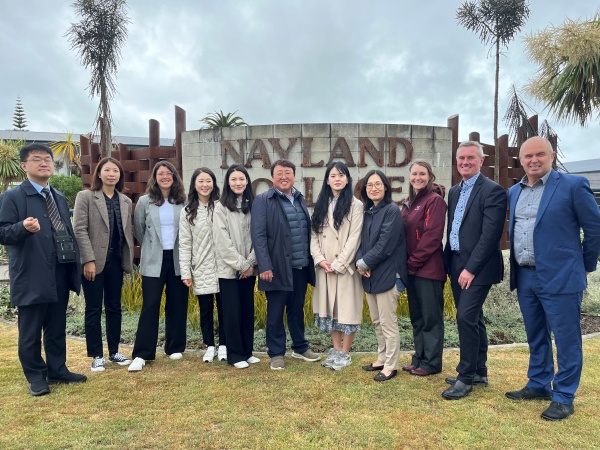
Nayland College demonstrated manaakitanga by welcoming the group to rainy Nelson but provided an Asia Kiwi lunch complete with meat pies and sushi!
Like the Schools Visits Programme, the pandemic interrupted tertiary programmes and the revised programme ran in January 2023 with short term group programmes. The site visits in November to Te Pūkenga NMIT and Lincoln University provided an opportunity to discuss the institutions’ proposals to host Korean tertiary students in January 2024.
Also discussed was the importance of reciprocity and it was noted that Korea is a popular destination for New Zealanders under the Prime Minister’s Scholarship for Asia (PMSA) scheme. Since 2016, the scheme has awarded scholarships to 196 individuals or groups for study, intern or research programmes in Korea. Lincoln University, in particular, has been successful in facilitating group PMSA programmes focused on agriculture to Korea.
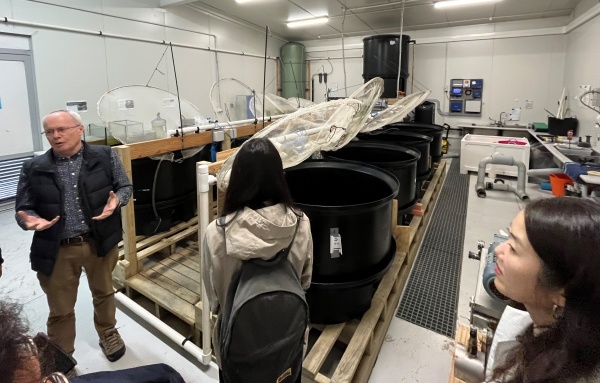
Dr Mark Burdass, Aquaculture Programme Coordinator and Tutor, introduces the hands on learning in the aquaculture programme at Te Pūkenga NMIT.
At the conclusion of their visit, the Korean delegation expressed their gratitude to the institution hosts for making their time in New Zealand memorable and valuable through fruitful discussions. The delegation emphasised the importance of conducting these meetings in person and visiting the campuses to meet with institution staff and academics. The ENZ Manapou ki te Ao team is pleased to continue close cooperation with our Korean education partners to facilitate connections with New Zealand education providers for the education programmes.
If you are interested in finding out more about the education initiatives originally outlined in the KNZFTA, you can read about this in a 2016 E-News article here - New opportunities for New Zealand and Korea.
-
Around the world in five
Asia
The government of Hong Kong has announced ambitions to become an international hub for post-secondary education with measures including an increased quota for international undergraduates at public universities, more scholarships and work rights for postgraduate students.
North America
Canada is set to introduce a “recognised institution” framework, through which colleges and universities with a positive record of vetting and supporting international students may be eligible for fast-track study permits. This comes after over 100 Indian students faced potential deportation earlier this year after their admission letters to Canadian colleges were found to be fake, which the students were unaware of.
Middle East
A British school in Abu Dhabi that has been rated outstanding by the Emirate's school regulator for promoting the UAE's national identity said it has weaved elements of the country's culture, history, heritage and, Arabic language into its UK curriculum. The British International School Abu Dhabi is home to 2,080 pupils from 96 countries, with one in five pupils at the school being Emirati.
Europe
According to the Irish Higher Education Authority (HEA), In 2022/23, Ireland set a new all-time high for the number of international students studying at Irish universities. 33,480 students were enrolled at Irish universities last year, an increase of nearly 12% compared to 2021/22, according to the report. Furthermore, India’s student population in Ireland has grown by a significant 17.8%, reflecting a surging trend.
Africa
South African business schools are a higher education success story and champions in terms of higher education on the African continent. Though competing for students, they display a strong ethos of collaboration, generated by a sense of shared purpose to upskill a “new” country. These schools show the power of collaboration, common purpose, and internationalisation outlook.
- ENZ Year of Rabbit Homepage banner
- Around the world in 10
- IMG 2703
- Whanganui
- 2G2A8513